Tales of modern day data breaches - a web
security guide for developers
Jaap Karan Singh
jaap@scw.io
Co-Founder & Chief Singh, Secure Code Warrior
> Today’s challenges with software security
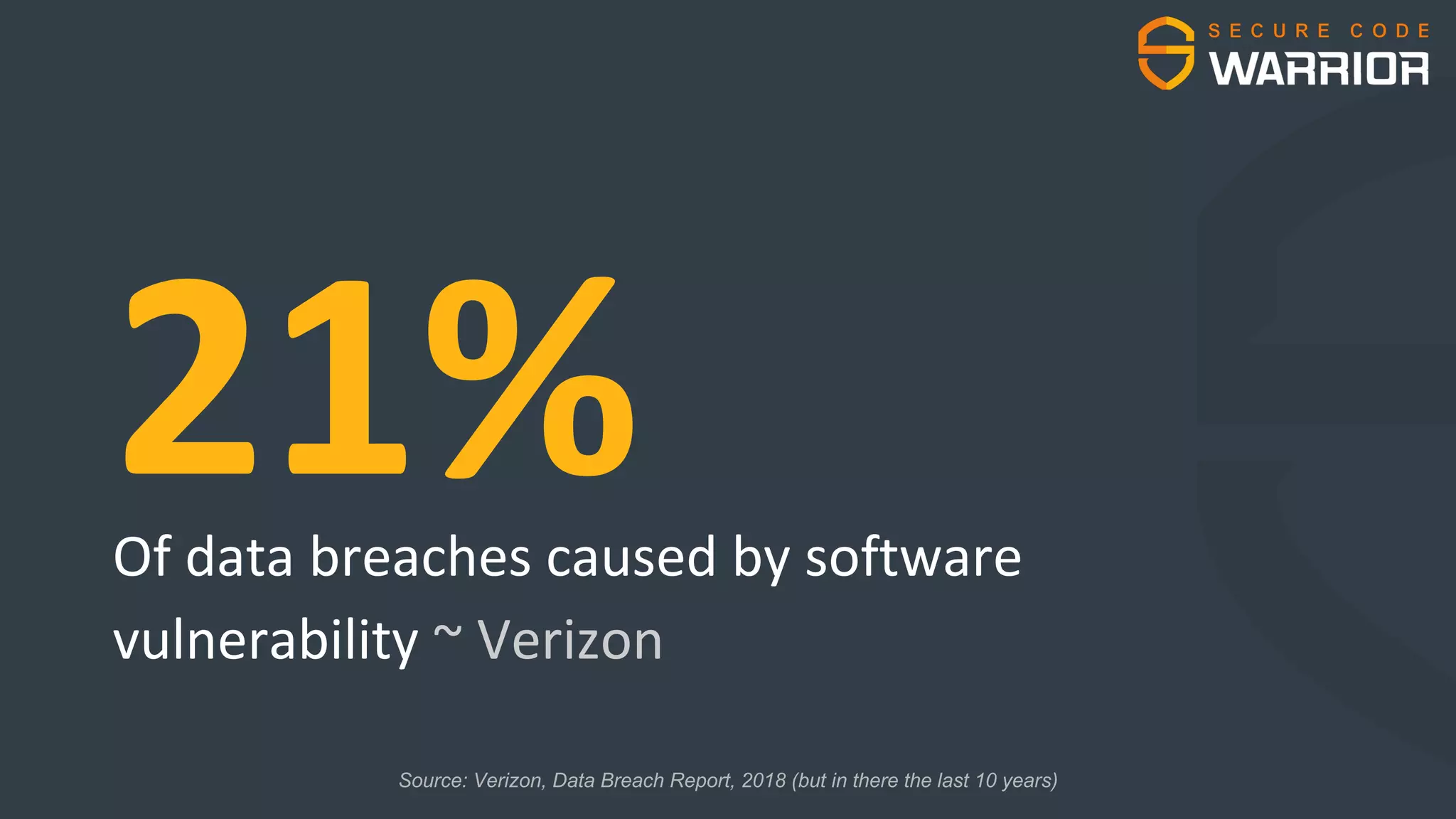
Of data breaches caused by software
vulnerability ~ Verizon
21%
Source: Verizon, Data Breach Report, 2018 (but in there the last 10 years)
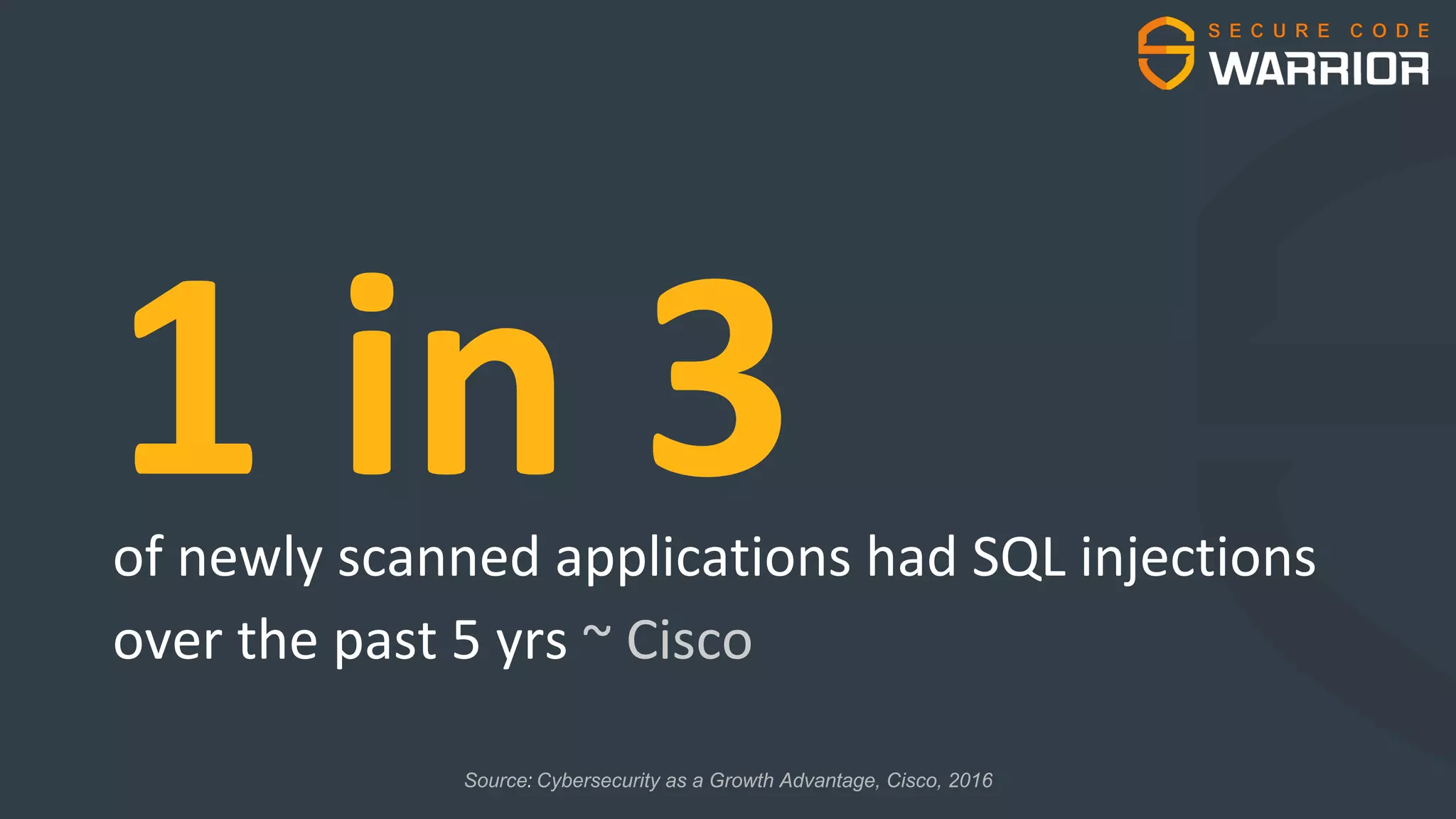
of newly scanned applications had SQL injections
over the past 5 yrs ~ Cisco
1 in 3
Source: Cybersecurity as a Growth Advantage, Cisco, 2016
> Data Breach #1: US Election Board Systems
Personal data of voters stolen by a teenager
SQL Injection
Understanding the data breach
Was it an Anonymous hacker lurking
in the shadows?
Script kiddie ALERT!
Freely available tools and scripts used for the attack
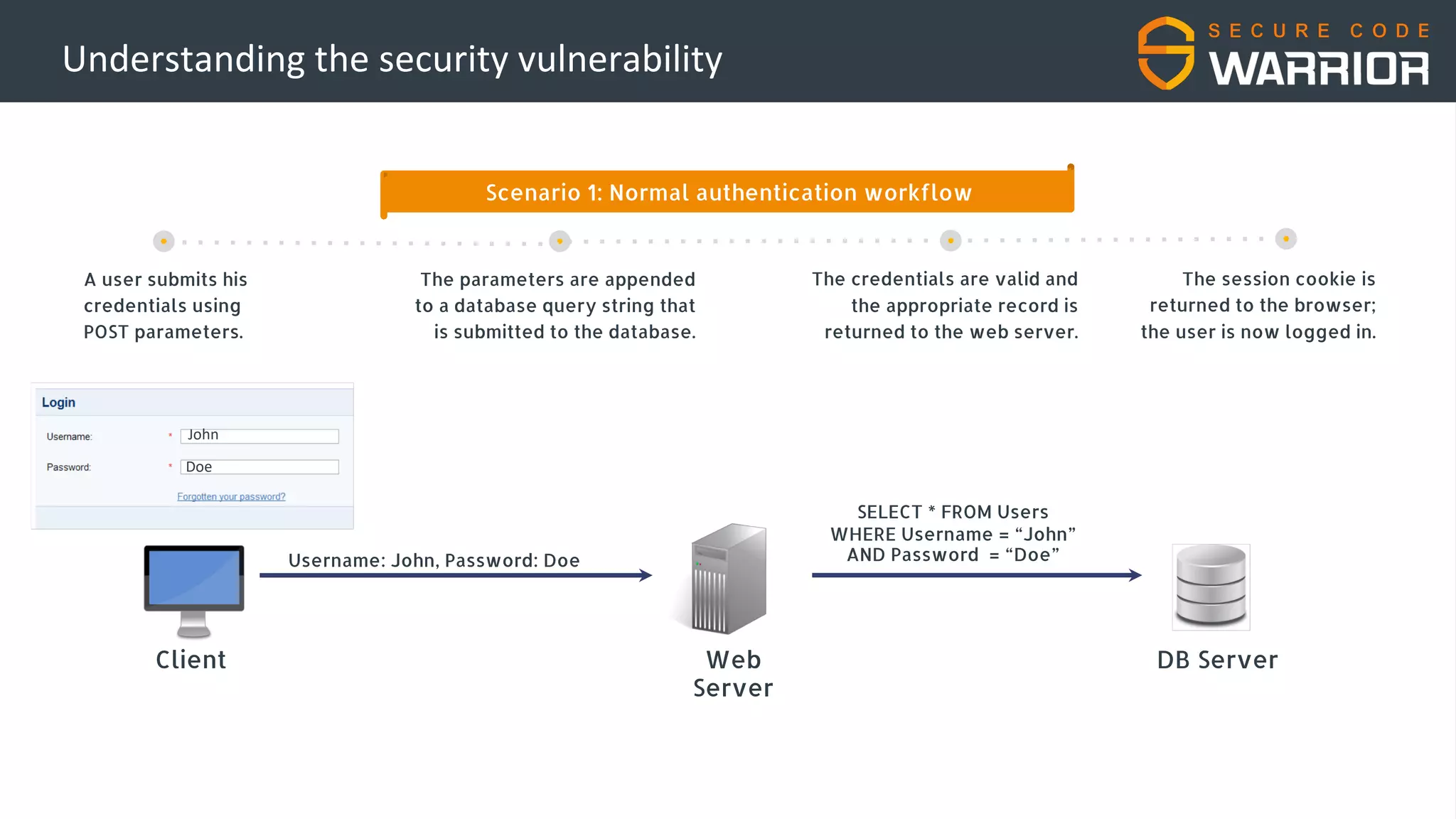
A user submits his
credentials using
POST parameters.
The parameters are appended
to a database query string that
is submitted to the database.
The session cookie is
returned to the browser;
the user is now logged in.
Client Web
Server
DB Server
John
Doe
Username: John, Password: Doe
SELECT * FROM Users
WHERE Username = “John”
AND Password = “Doe”
Scenario 1: Normal authentication workflow
The credentials are valid and
the appropriate record is
returned to the web server.
Understanding the security vulnerability
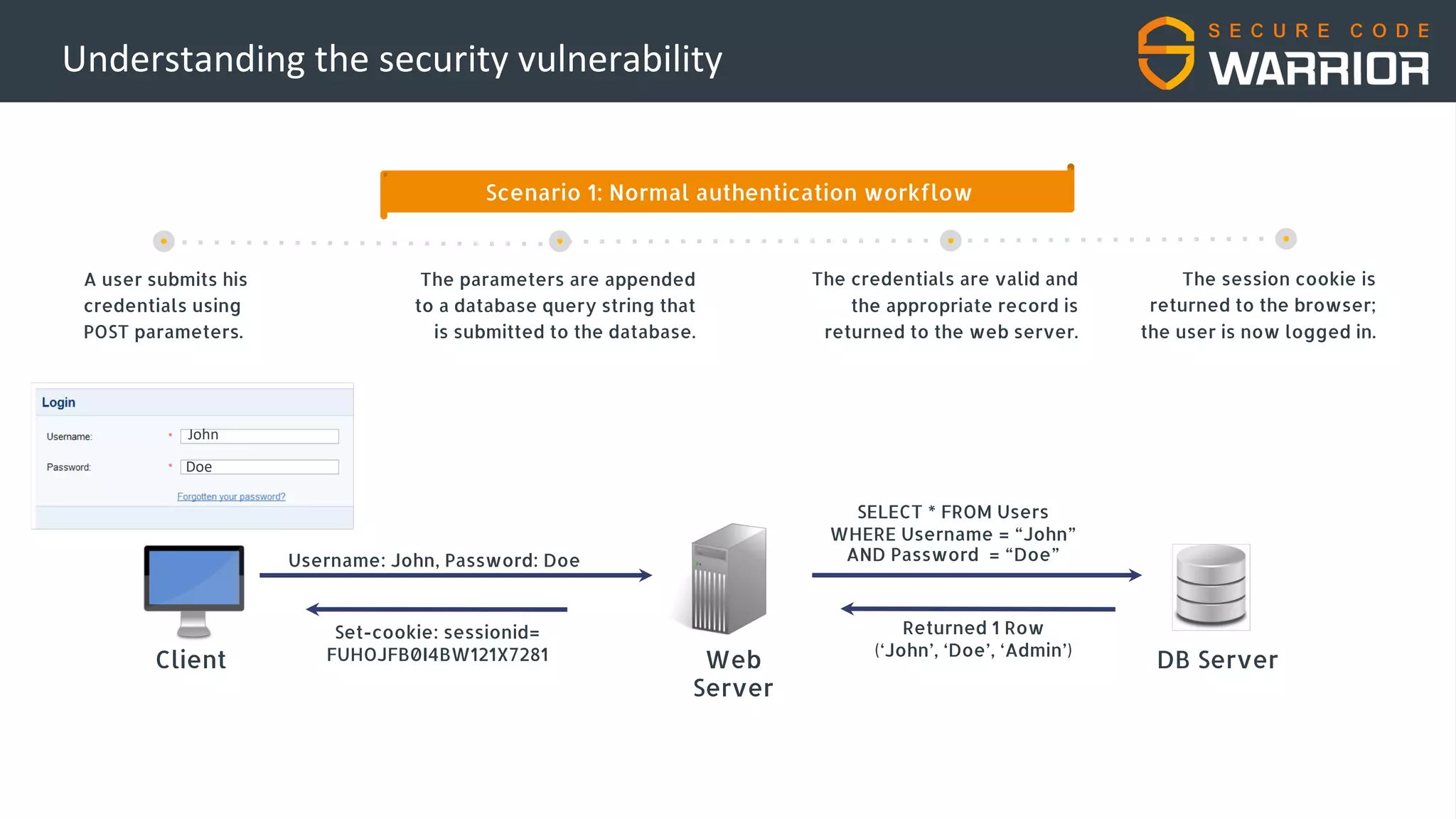
A user submits his
credentials using
POST parameters.
The parameters are appended
to a database query string that
is submitted to the database.
The session cookie is
returned to the browser;
the user is now logged in.
Client Web
Server
DB Server
John
Doe
Username: John, Password: Doe
SELECT * FROM Users
WHERE Username = “John”
AND Password = “Doe”
Returned 1 Row
(‘John’, ‘Doe’, ‘Admin’)
Set-cookie: sessionid=
FUHOJFB0I4BW121X7281
Scenario 1: Normal authentication workflow
The credentials are valid and
the appropriate record is
returned to the web server.
Understanding the security vulnerability
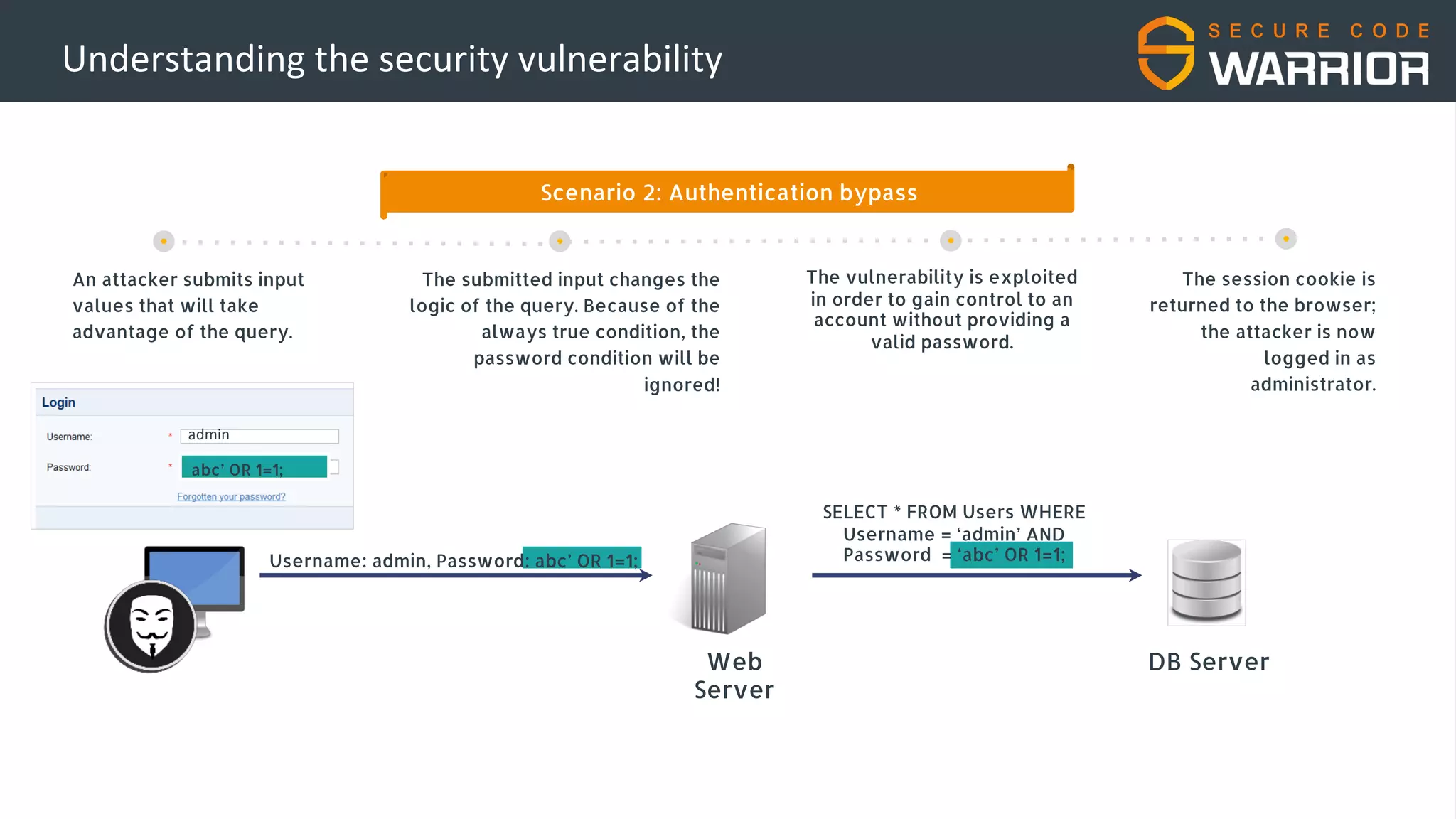
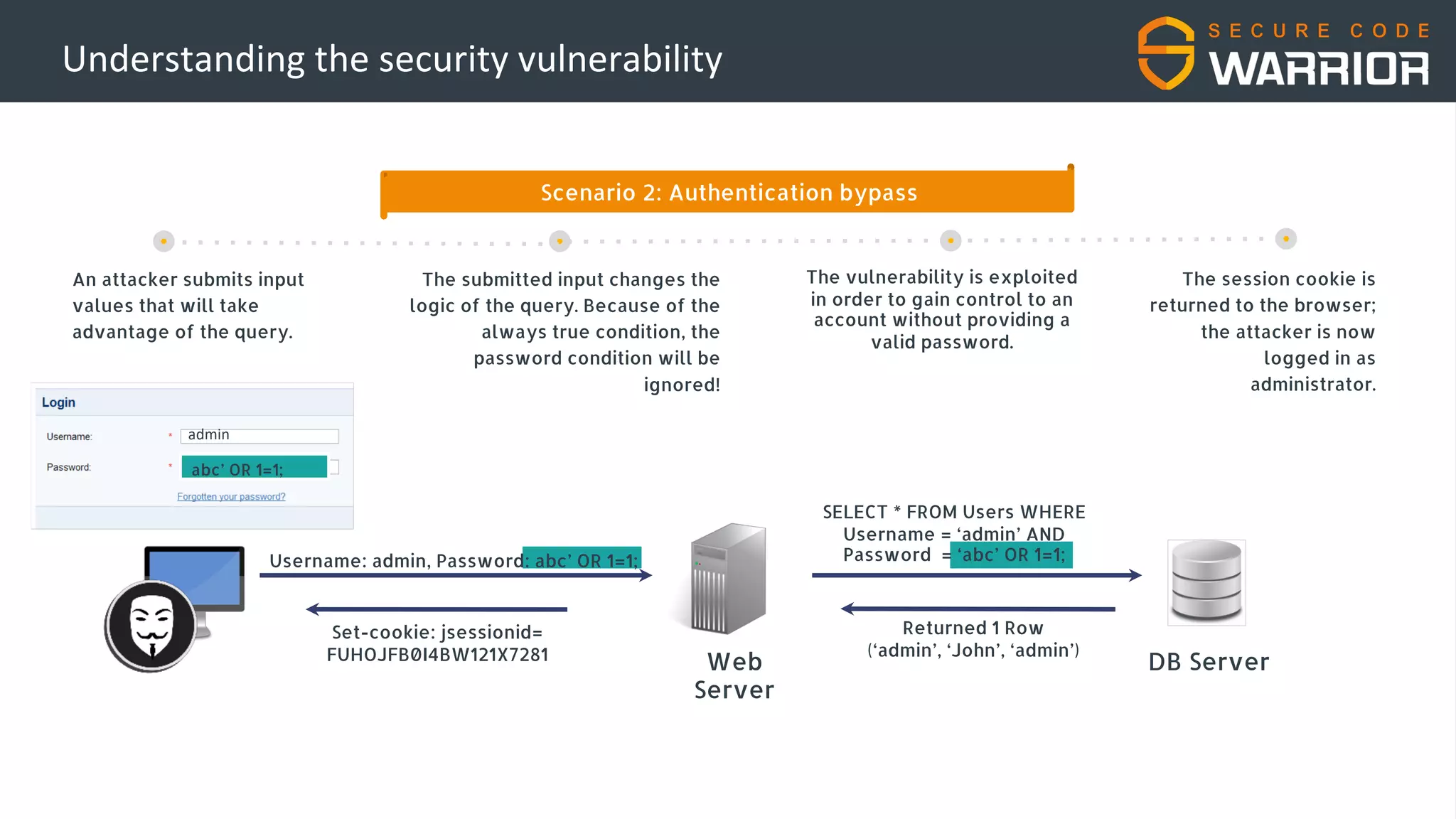
SELECT * FROM Users WHERE
Username = ‘admin’ AND
Password = ‘abc’ OR 1=1;Username: admin, Password: abc’ OR 1=1;
Web
Server
DB Server
admin
abc’ OR 1=1;
Scenario 2: Authentication bypass
The submitted input changes the
logic of the query. Because of the
always true condition, the
password condition will be
ignored!
The session cookie is
returned to the browser;
the attacker is now
logged in as
administrator.
The vulnerability is exploited
in order to gain control to an
account without providing a
valid password.
An attacker submits input
values that will take
advantage of the query.
Understanding the security vulnerability
SELECT * FROM Users WHERE
Username = ‘admin’ AND
Password = ‘abc’ OR 1=1;Username: admin, Password: abc’ OR 1=1;
Web
Server
DB Server
admin
Returned 1 Row
(‘admin’, ‘John’, ‘admin’)
Set-cookie: jsessionid=
FUHOJFB0I4BW121X7281
abc’ OR 1=1;
Scenario 2: Authentication bypass
The submitted input changes the
logic of the query. Because of the
always true condition, the
password condition will be
ignored!
The session cookie is
returned to the browser;
the attacker is now
logged in as
administrator.
The vulnerability is exploited
in order to gain control to an
account without providing a
valid password.
An attacker submits input
values that will take
advantage of the query.
Realising the impact
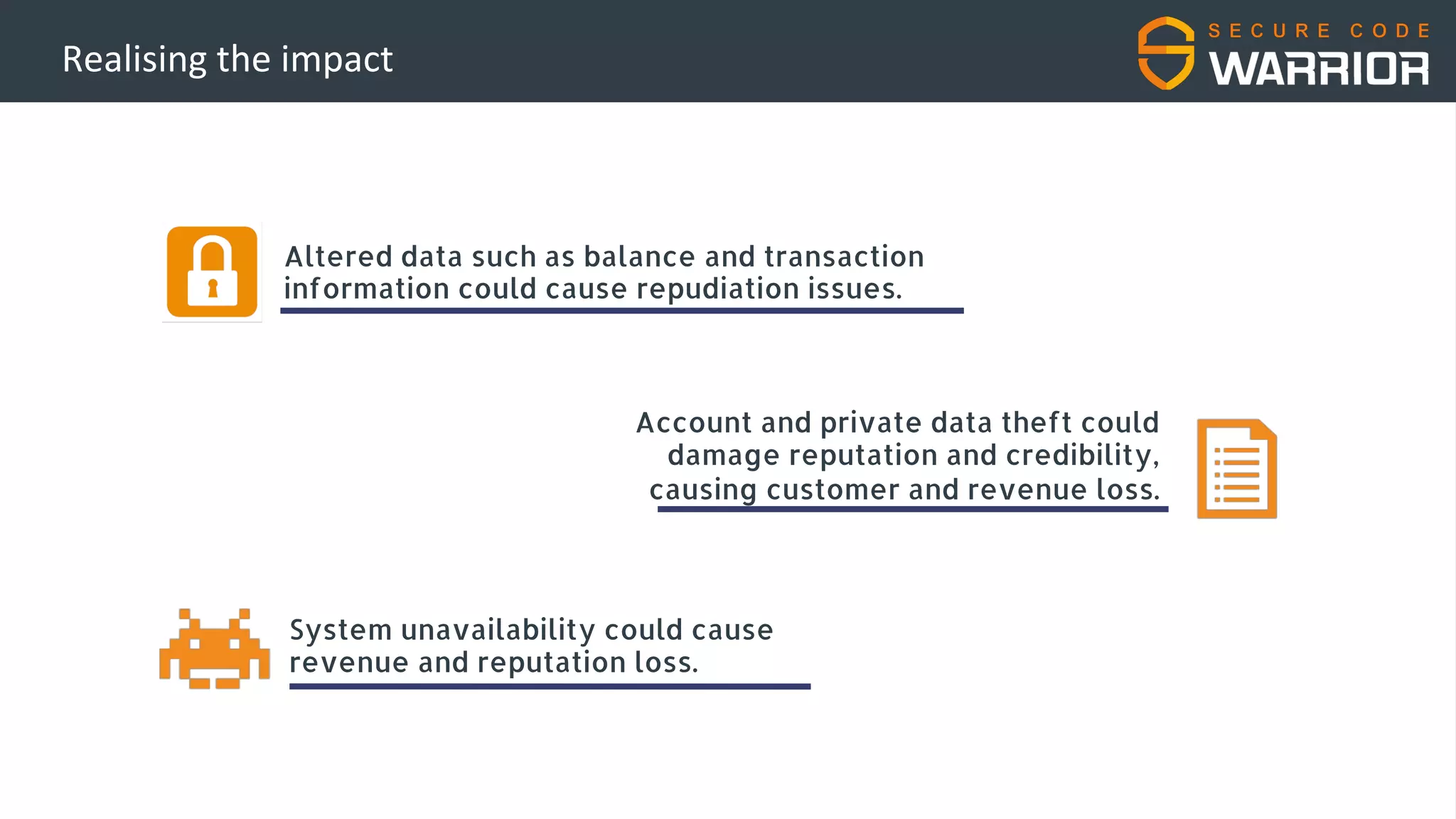
Altered data such as balance and transaction
information could cause repudiation issues.
System unavailability could cause
revenue and reputation loss.
Account and private data theft could
damage reputation and credibility,
causing customer and revenue loss.
Preventing the mistake
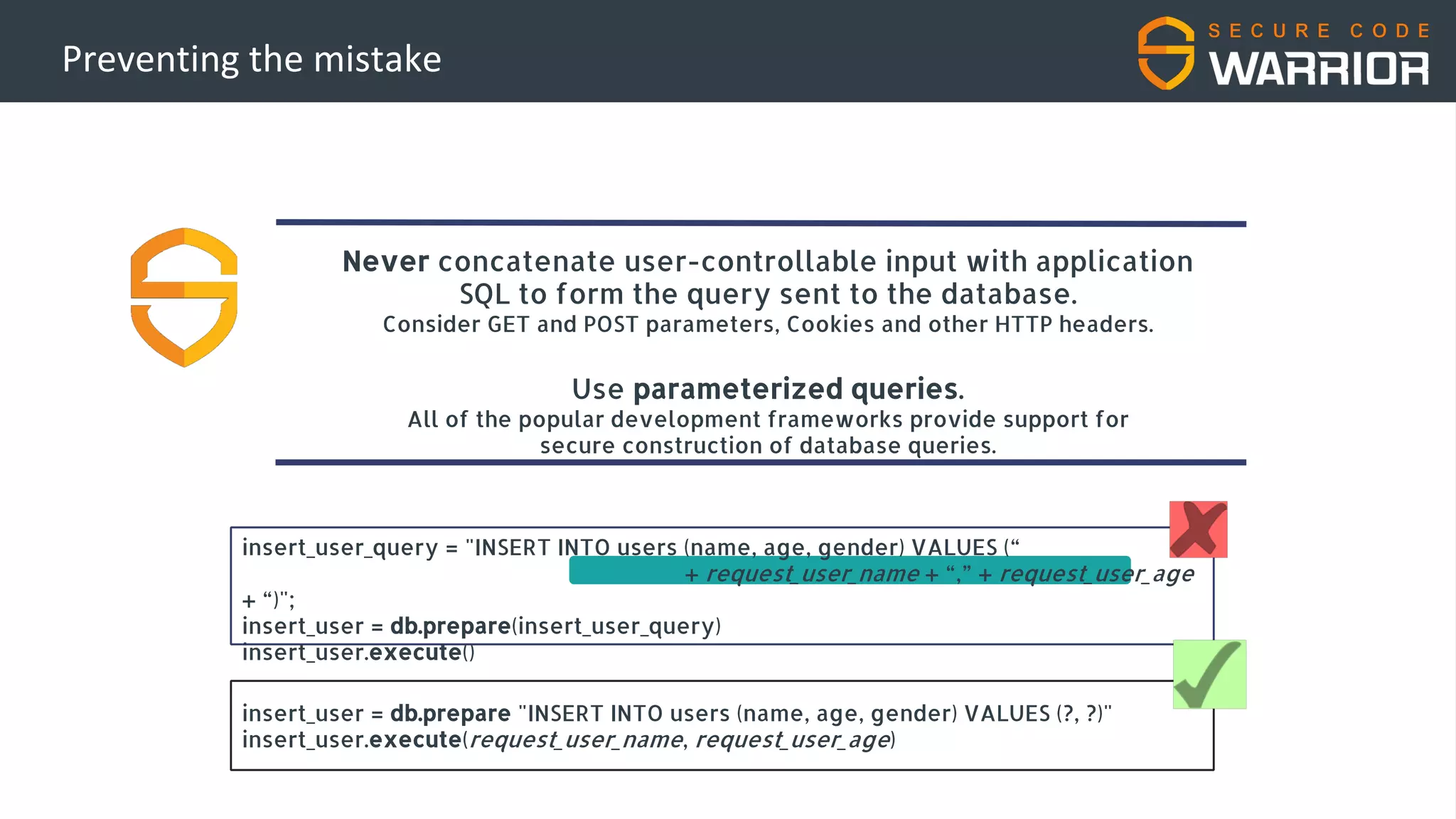
Never concatenate user-controllable input with application
SQL to form the query sent to the database.
Consider GET and POST parameters, Cookies and other HTTP headers.
Use parameterized queries.
All of the popular development frameworks provide support for
secure construction of database queries.
insert_user_query = "INSERT INTO users (name, age, gender) VALUES (“
+ request_user_name + “,” + request_user_age
+ “)";
insert_user = db.prepare(insert_user_query)
insert_user.execute()
insert_user = db.prepare "INSERT INTO users (name, age, gender) VALUES (?, ?)"
insert_user.execute(request_user_name, request_user_age)
Preventing the mistake
In addition, apply white-list validation on all user input.
Consider GET and POST parameters, Cookies and other HTTP headers.
Apply the least privilege principle on the database users.
How easy is it to exploit SQL injection?
Follow along on your computer and find out!
> Data Breach #2: Facebook Access Tokens
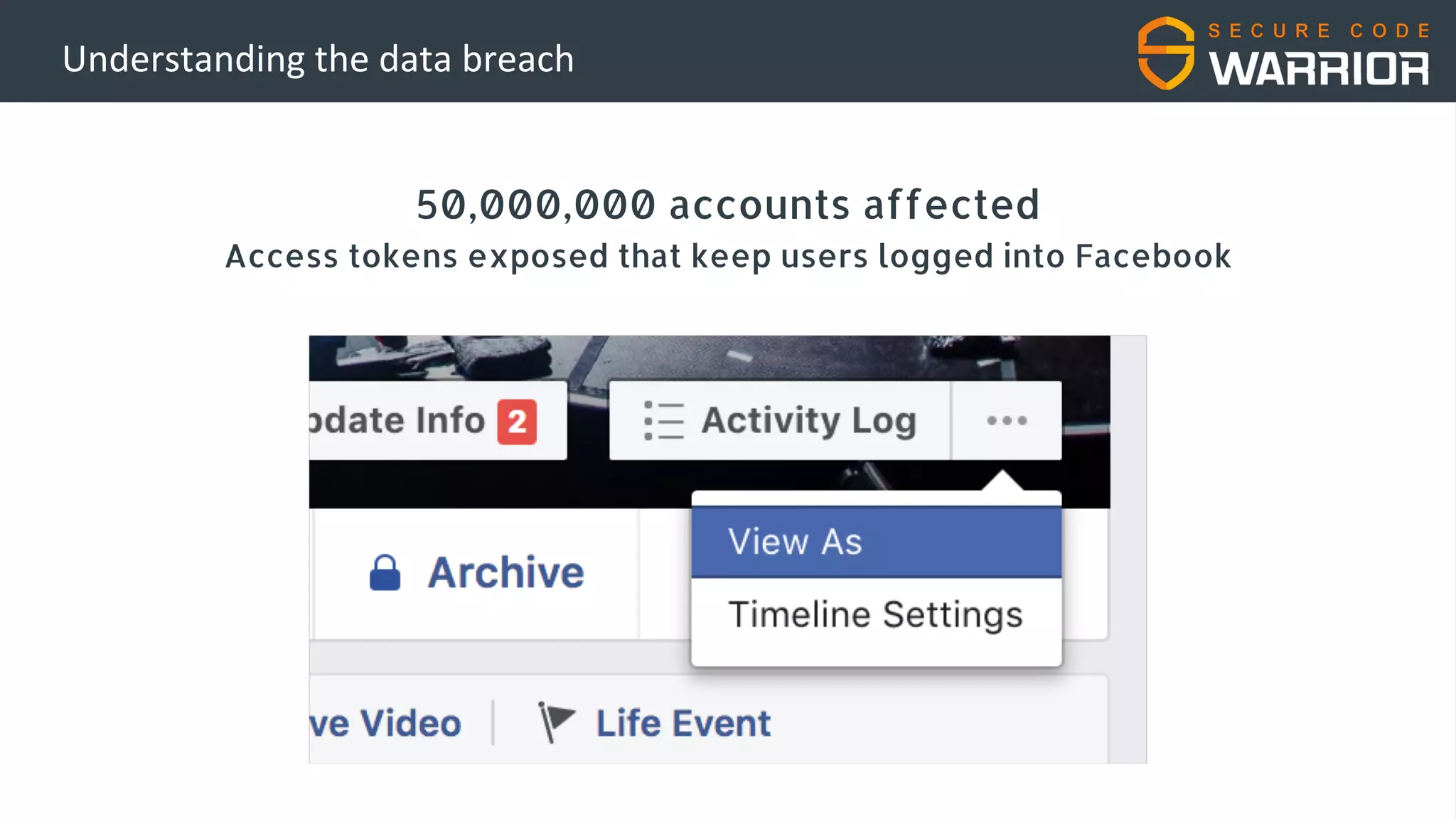
50,000,000 accounts affected
Access tokens exposed that keep users logged into Facebook
Understanding the data breach
Do you have a login system in your applications?
cookies && sessions
Insecure Session Management
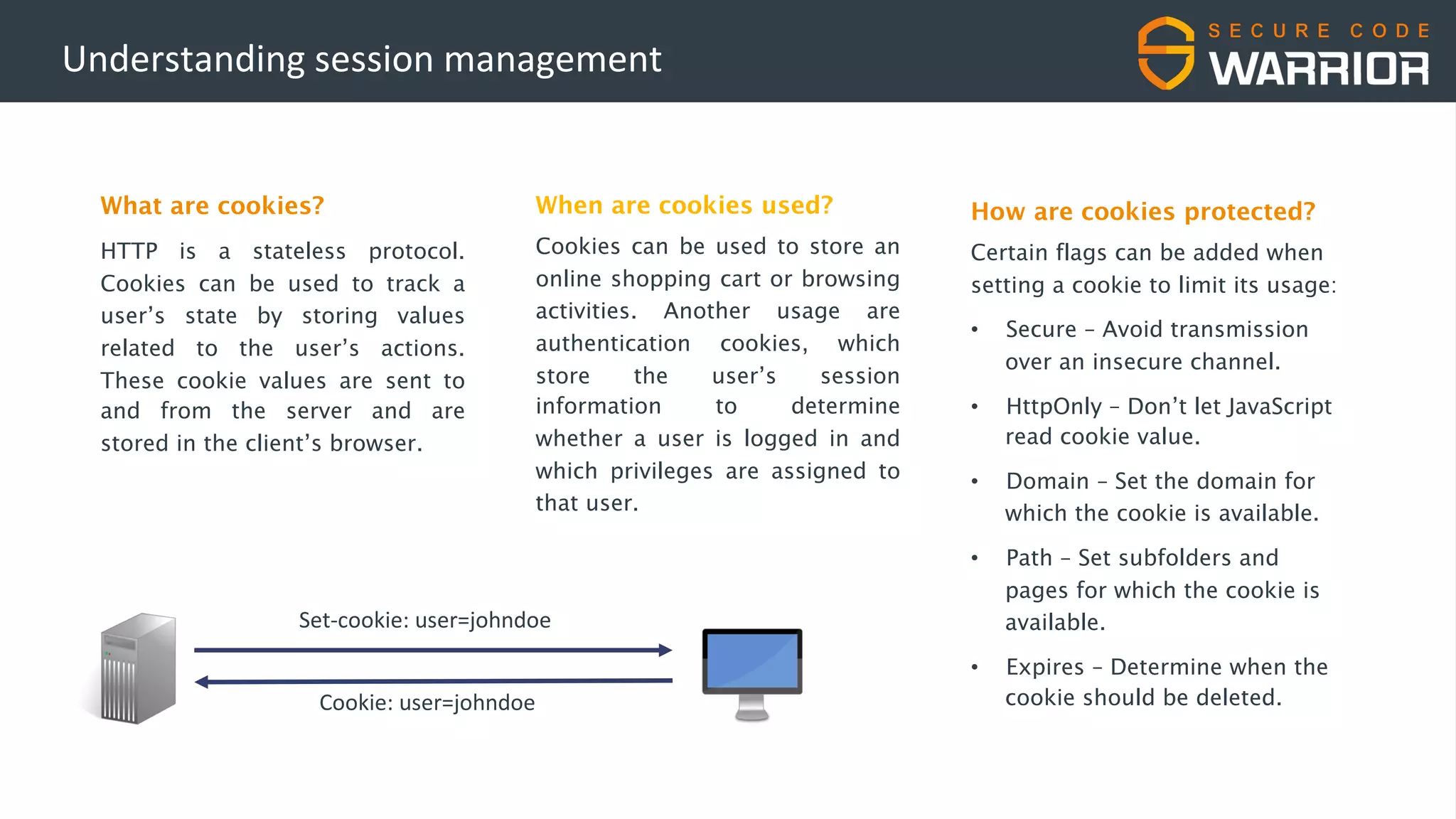
Understanding session management
What are cookies?
HTTP is a stateless protocol.
Cookies can be used to track a
user’s state by storing values
related to the user’s actions.
These cookie values are sent to
and from the server and are
stored in the client’s browser.
When are cookies used?
Cookies can be used to store an
online shopping cart or browsing
activities. Another usage are
authentication cookies, which
store the user’s session
information to determine
whether a user is logged in and
which privileges are assigned to
that user.
Set-cookie: user=johndoe
Cookie: user=johndoe
How are cookies protected?
Certain flags can be added when
setting a cookie to limit its usage:
• Secure – Avoid transmission
over an insecure channel.
• HttpOnly – Don’t let JavaScript
read cookie value.
• Domain – Set the domain for
which the cookie is available.
• Path – Set subfolders and
pages for which the cookie is
available.
• Expires – Determine when the
cookie should be deleted.
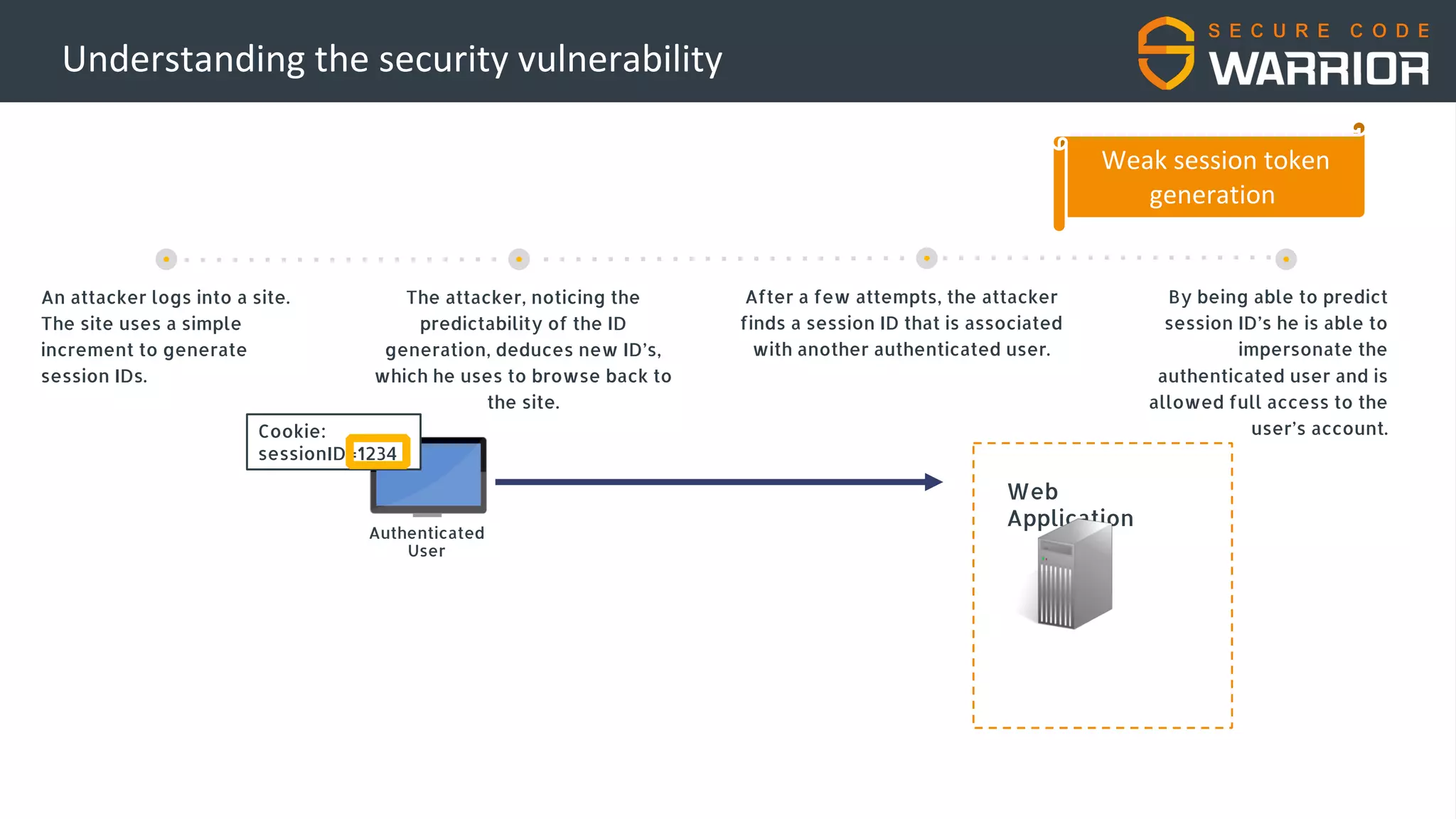
Understanding the security vulnerability
An attacker logs into a site.
The site uses a simple
increment to generate
session IDs.
The attacker, noticing the
predictability of the ID
generation, deduces new ID’s,
which he uses to browse back to
the site.
By being able to predict
session ID’s he is able to
impersonate the
authenticated user and is
allowed full access to the
user’s account.
After a few attempts, the attacker
finds a session ID that is associated
with another authenticated user.
Web
Application
Cookie:
sessionID=1234
Weak session token
generation
Authenticated
User
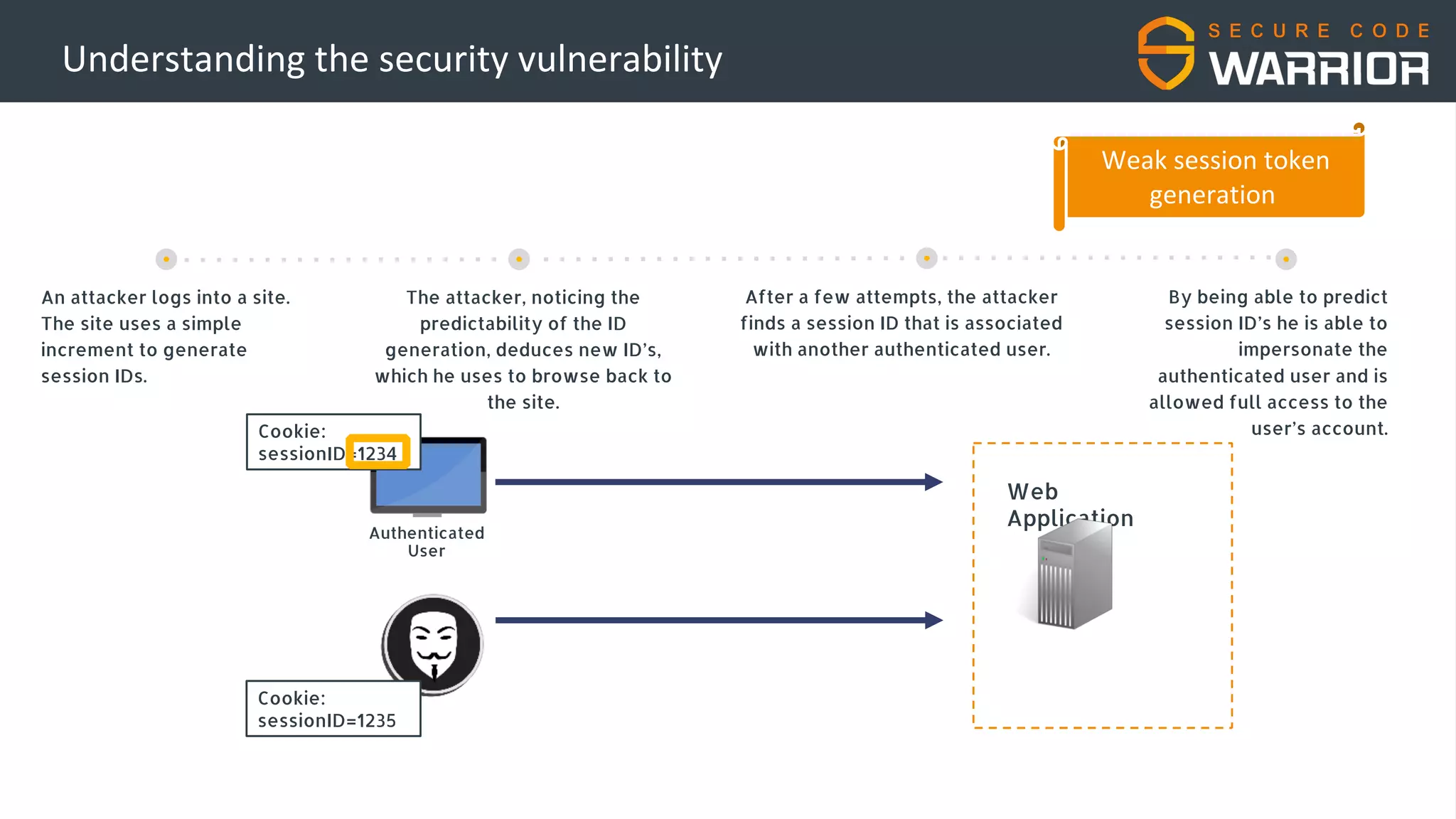
Understanding the security vulnerability
An attacker logs into a site.
The site uses a simple
increment to generate
session IDs.
The attacker, noticing the
predictability of the ID
generation, deduces new ID’s,
which he uses to browse back to
the site.
By being able to predict
session ID’s he is able to
impersonate the
authenticated user and is
allowed full access to the
user’s account.
After a few attempts, the attacker
finds a session ID that is associated
with another authenticated user.
Web
Application
Cookie:
sessionID=1235
Cookie:
sessionID=1234
Weak session token
generation
Authenticated
User
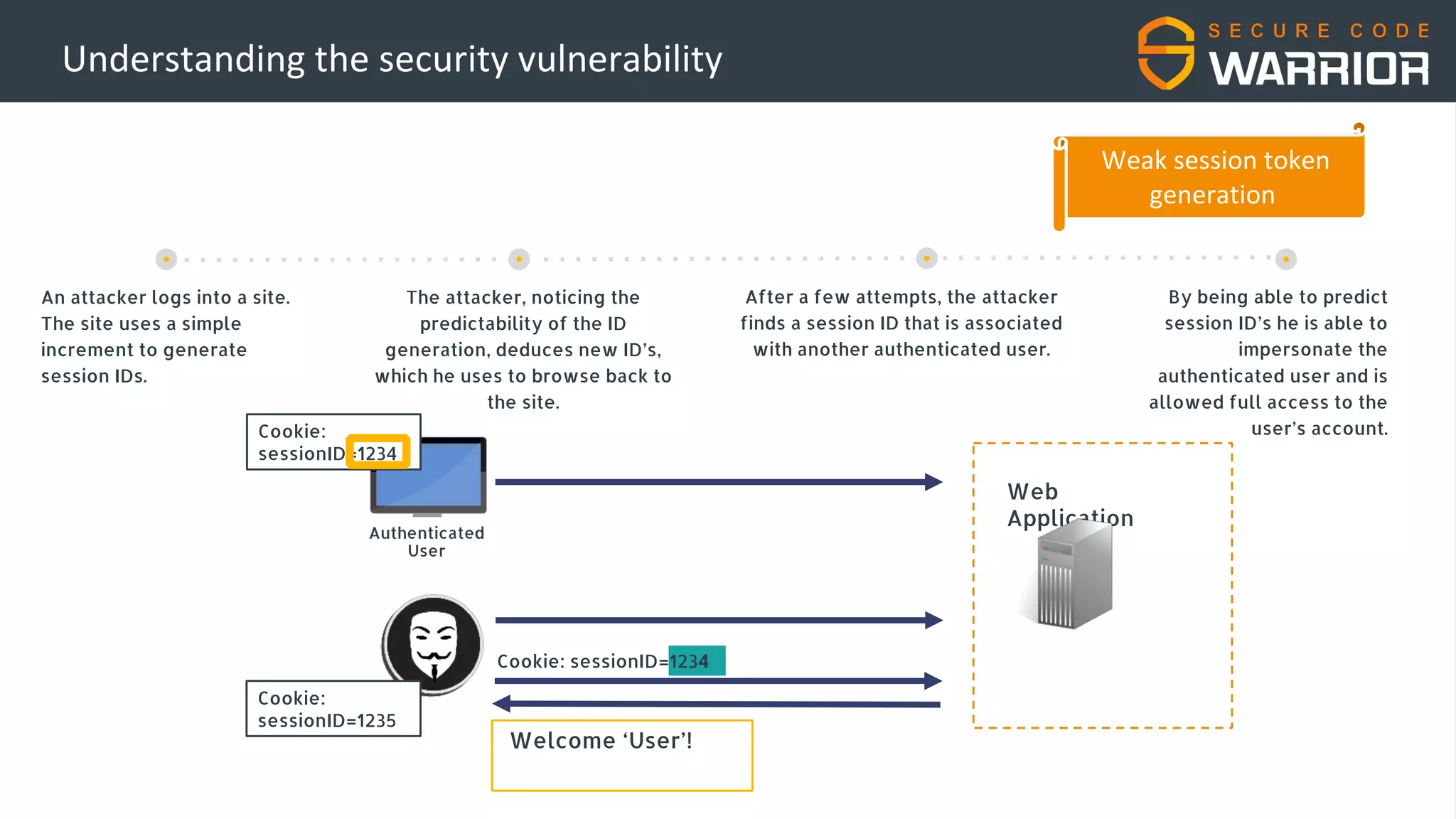
Understanding the security vulnerability
An attacker logs into a site.
The site uses a simple
increment to generate
session IDs.
The attacker, noticing the
predictability of the ID
generation, deduces new ID’s,
which he uses to browse back to
the site.
By being able to predict
session ID’s he is able to
impersonate the
authenticated user and is
allowed full access to the
user’s account.
After a few attempts, the attacker
finds a session ID that is associated
with another authenticated user.
Web
Application
Cookie:
sessionID=1235
Cookie:
sessionID=1234
Weak session token
generation
Cookie: sessionID=1234
Authenticated
User
Welcome ‘User’!
Understanding the security vulnerability
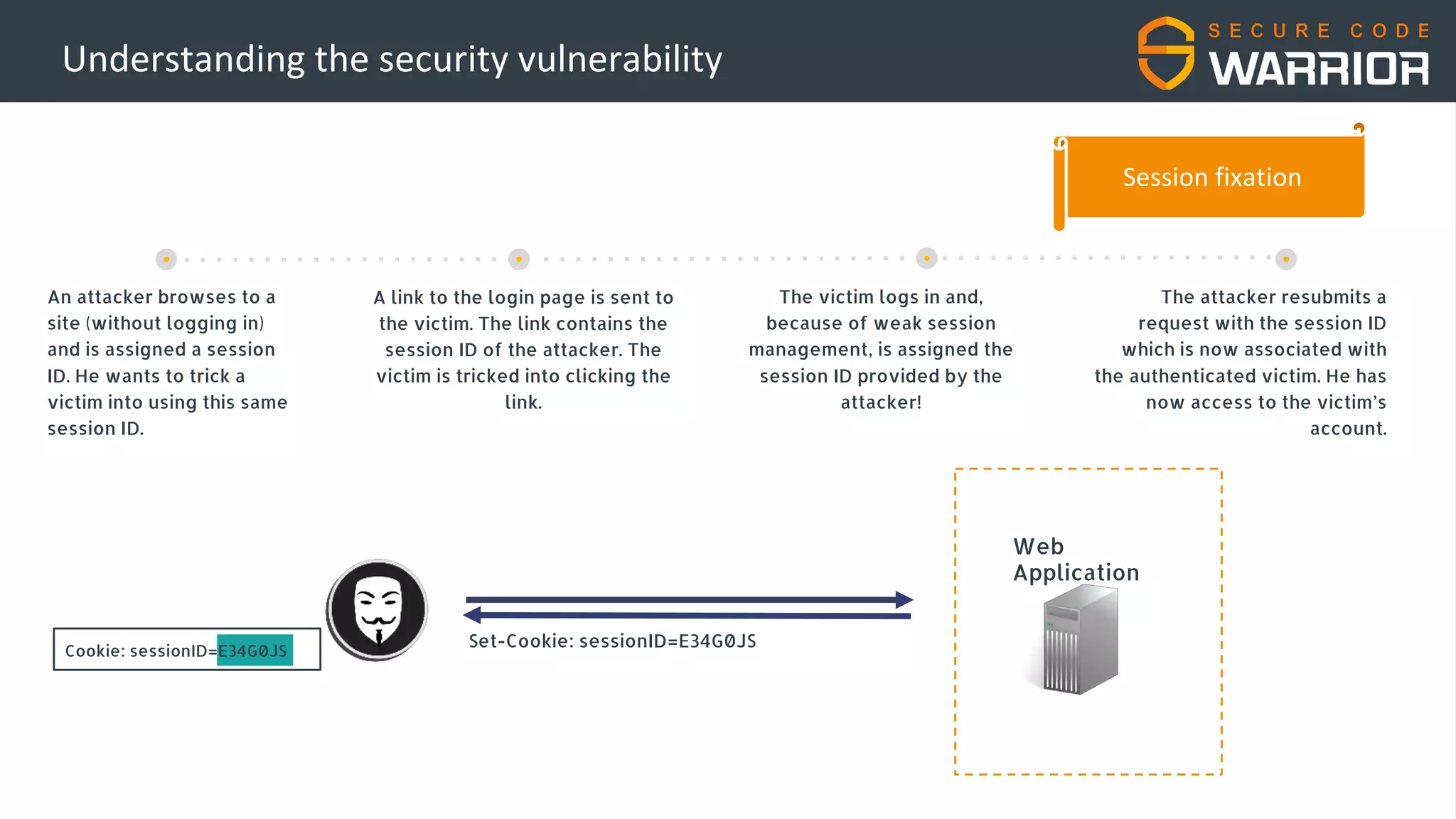
An attacker browses to a
site (without logging in)
and is assigned a session
ID. He wants to trick a
victim into using this same
session ID.
A link to the login page is sent to
the victim. The link contains the
session ID of the attacker. The
victim is tricked into clicking the
link.
The attacker resubmits a
request with the session ID
which is now associated with
the authenticated victim. He has
now access to the victim’s
account.
The victim logs in and,
because of weak session
management, is assigned the
session ID provided by the
attacker!
Web
Application
Session fixation
Set-Cookie: sessionID=E34G0JS
Cookie: sessionID=E34G0JS
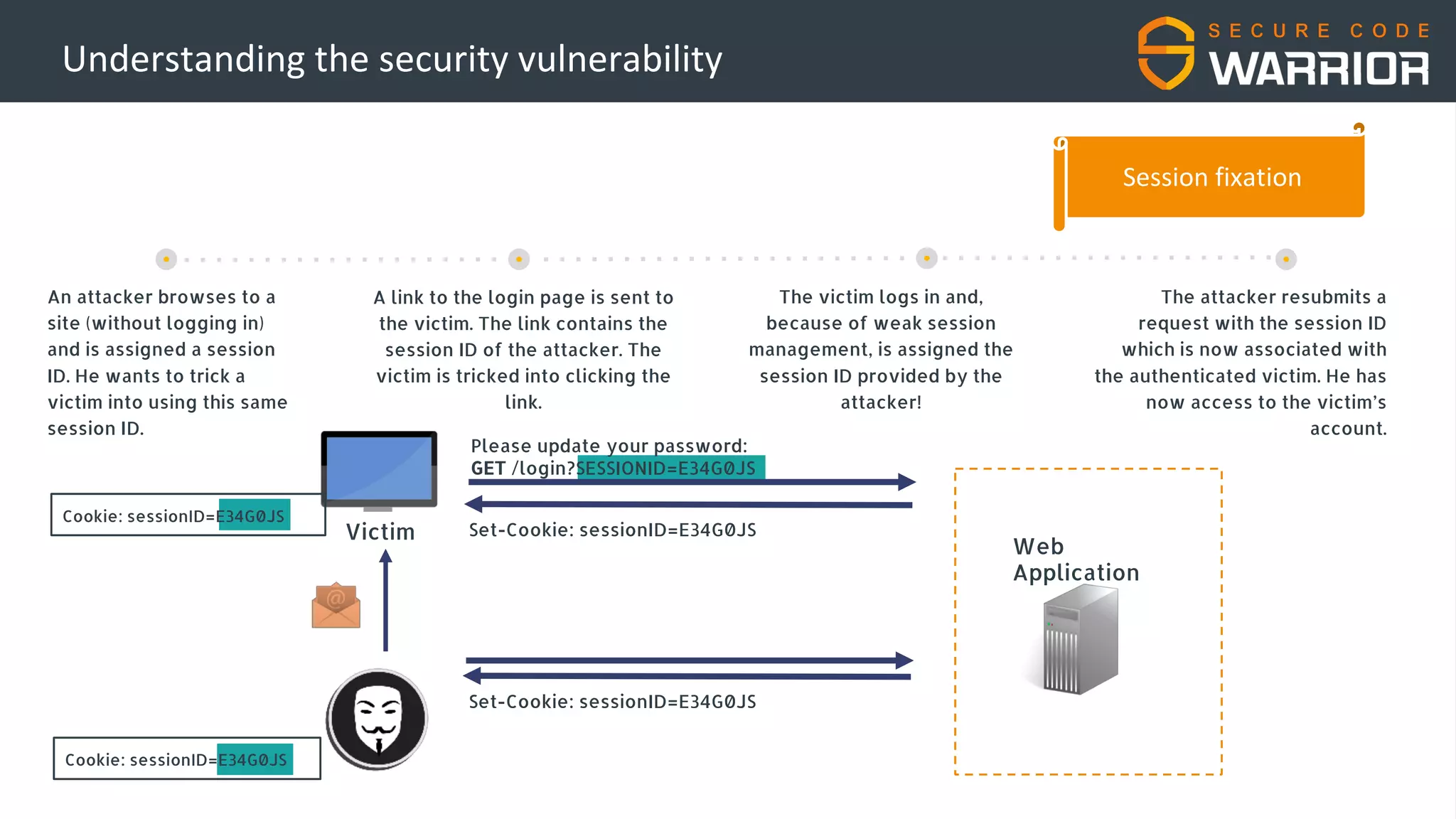
Understanding the security vulnerability
Please update your password:
GET /login?SESSIONID=E34G0JS
An attacker browses to a
site (without logging in)
and is assigned a session
ID. He wants to trick a
victim into using this same
session ID.
A link to the login page is sent to
the victim. The link contains the
session ID of the attacker. The
victim is tricked into clicking the
link.
The attacker resubmits a
request with the session ID
which is now associated with
the authenticated victim. He has
now access to the victim’s
account.
The victim logs in and,
because of weak session
management, is assigned the
session ID provided by the
attacker!
Web
Application
Session fixation
Victim
Set-Cookie: sessionID=E34G0JS
Cookie: sessionID=E34G0JS
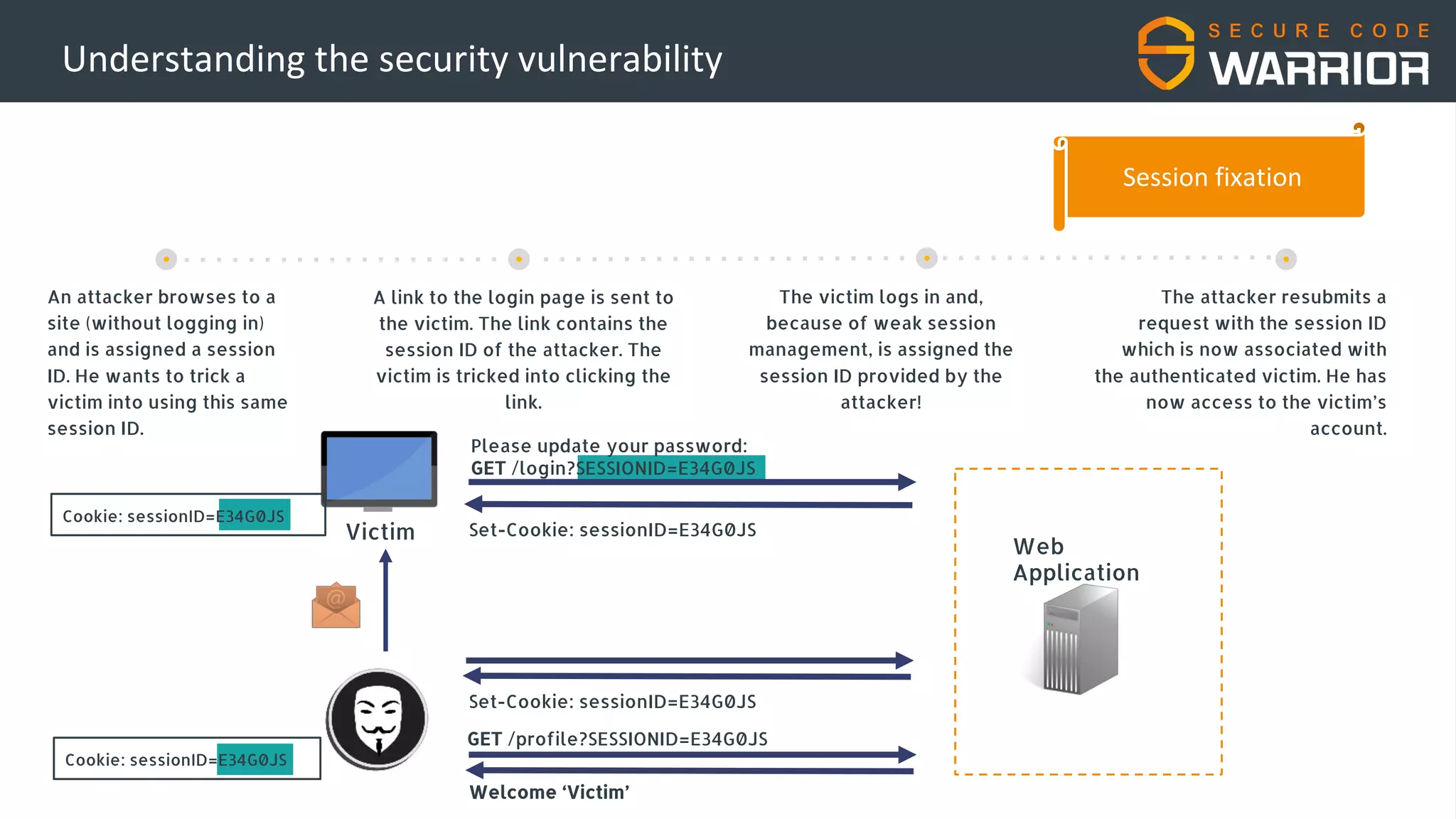
Understanding the security vulnerability
Please update your password:
GET /login?SESSIONID=E34G0JS
An attacker browses to a
site (without logging in)
and is assigned a session
ID. He wants to trick a
victim into using this same
session ID.
A link to the login page is sent to
the victim. The link contains the
session ID of the attacker. The
victim is tricked into clicking the
link.
The attacker resubmits a
request with the session ID
which is now associated with
the authenticated victim. He has
now access to the victim’s
account.
The victim logs in and,
because of weak session
management, is assigned the
session ID provided by the
attacker!
Web
Application
Session fixation
Victim
Set-Cookie: sessionID=E34G0JS
Cookie: sessionID=E34G0JS
GET /profile?SESSIONID=E34G0JS
Welcome ‘Victim’
Cookie: sessionID=E34G0JS
Realizing the impact
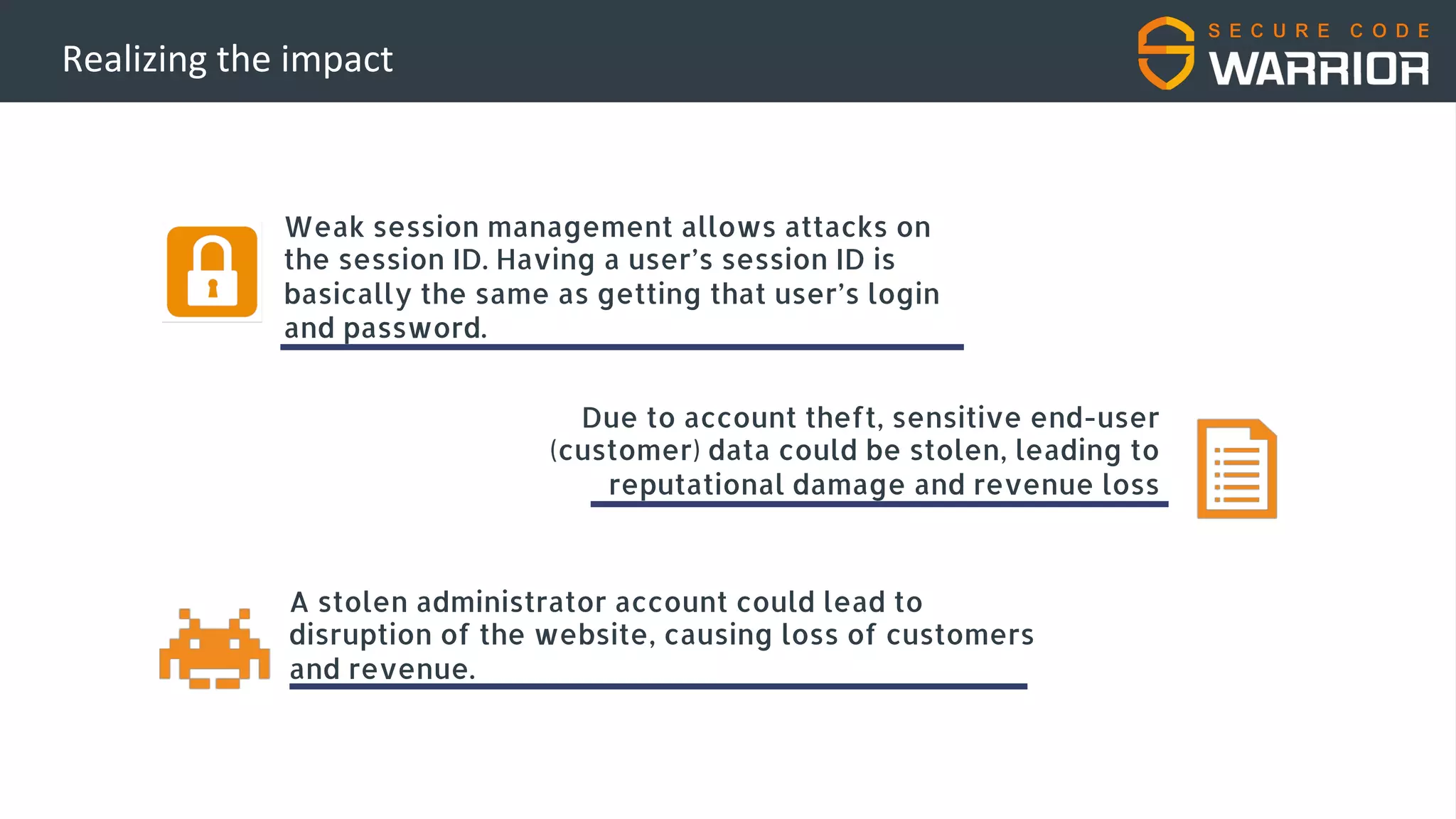
Weak session management allows attacks on
the session ID. Having a user’s session ID is
basically the same as getting that user’s login
and password.
A stolen administrator account could lead to
disruption of the website, causing loss of customers
and revenue.
Due to account theft, sensitive end-user
(customer) data could be stolen, leading to
reputational damage and revenue loss
Preventing the mistake
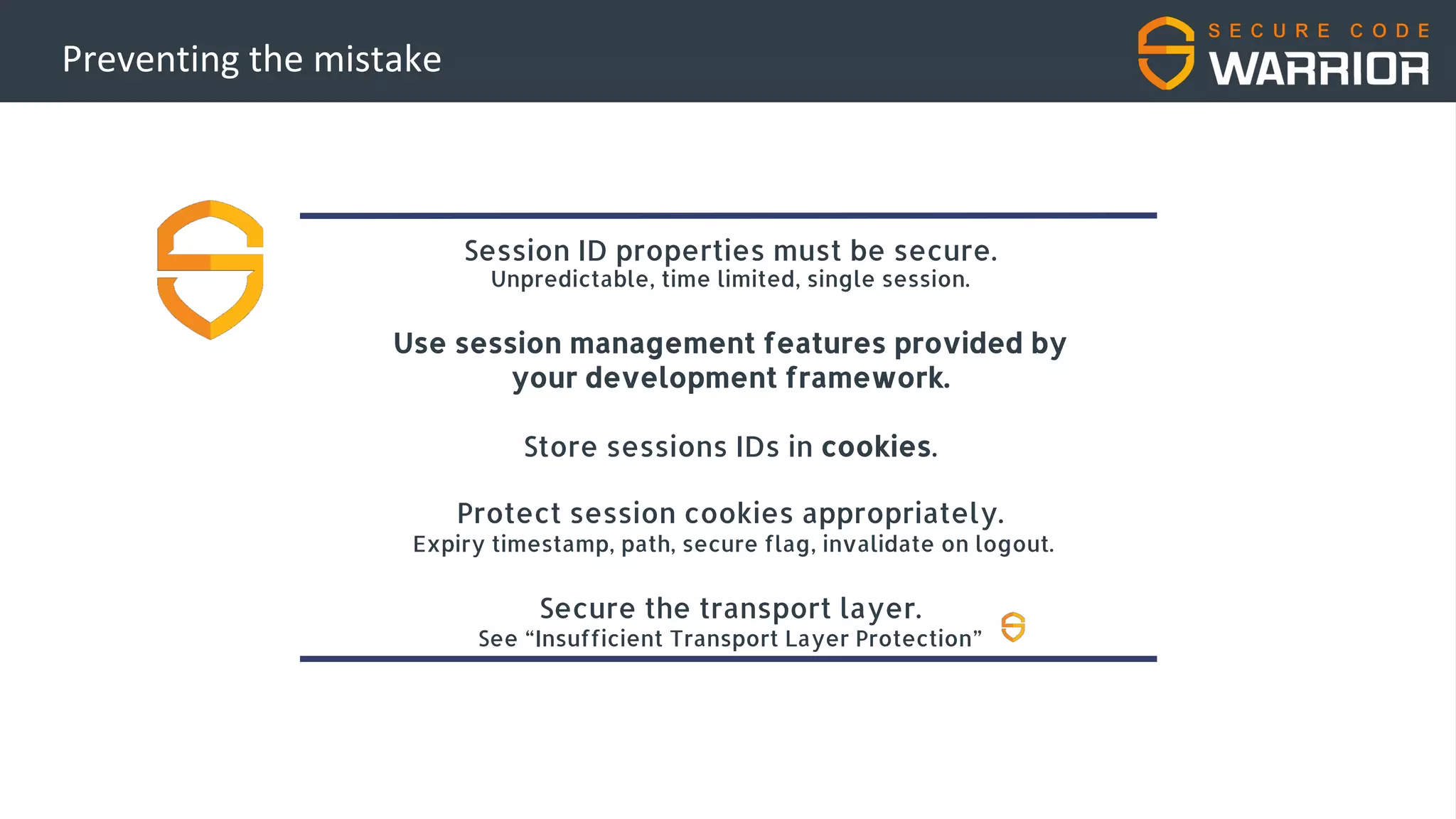
Session ID properties must be secure.
Unpredictable, time limited, single session.
Use session management features provided by
your development framework.
Store sessions IDs in cookies.
Protect session cookies appropriately.
Expiry timestamp, path, secure flag, invalidate on logout.
Secure the transport layer.
See “Insufficient Transport Layer Protection”
How easy is it to exploit session
management vulnerabilities?
Follow along on your computer and find out!
> Lessons learnt
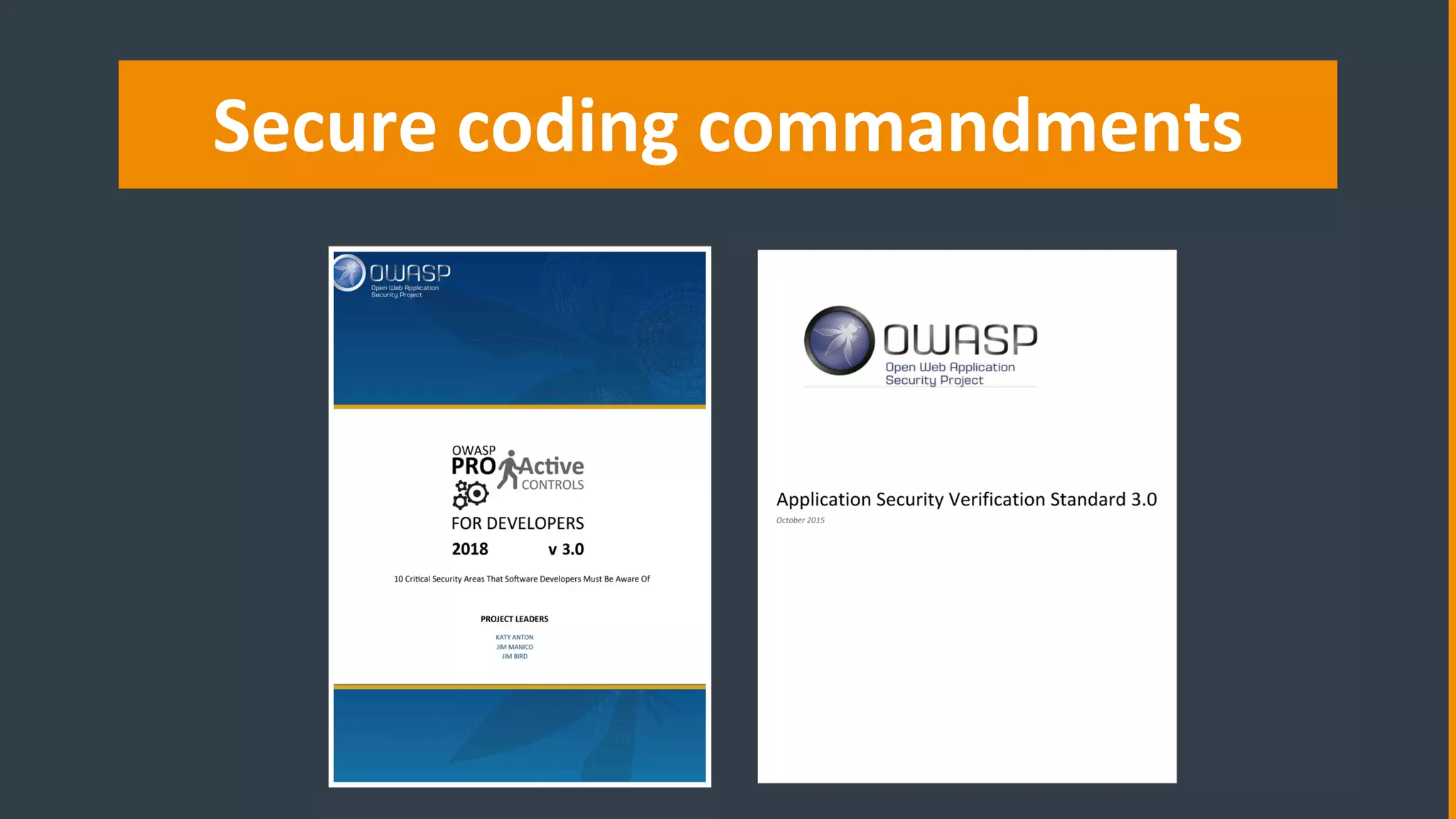
Secure coding commandments
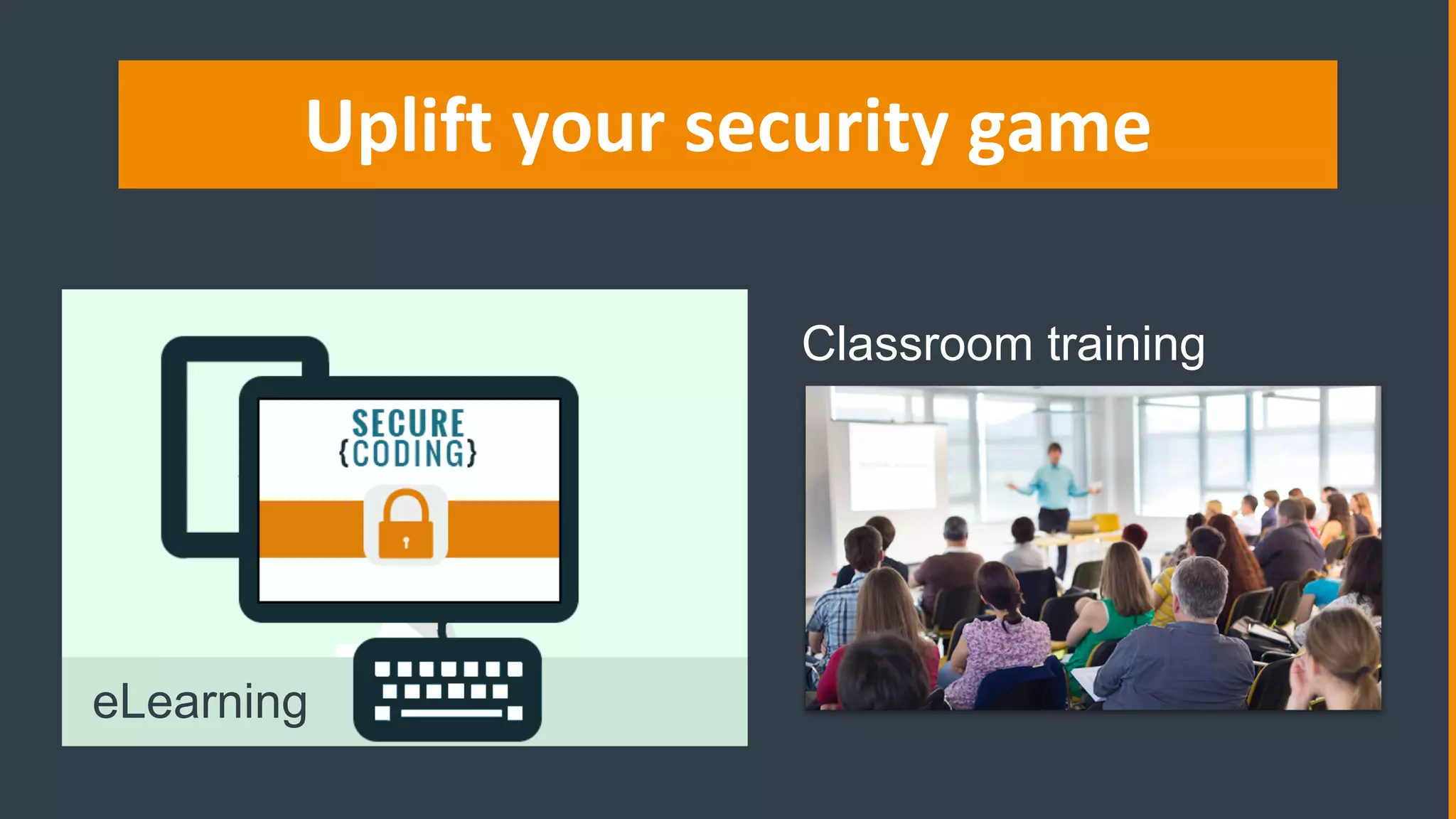
Uplift your security game
Classroom training
eLearning
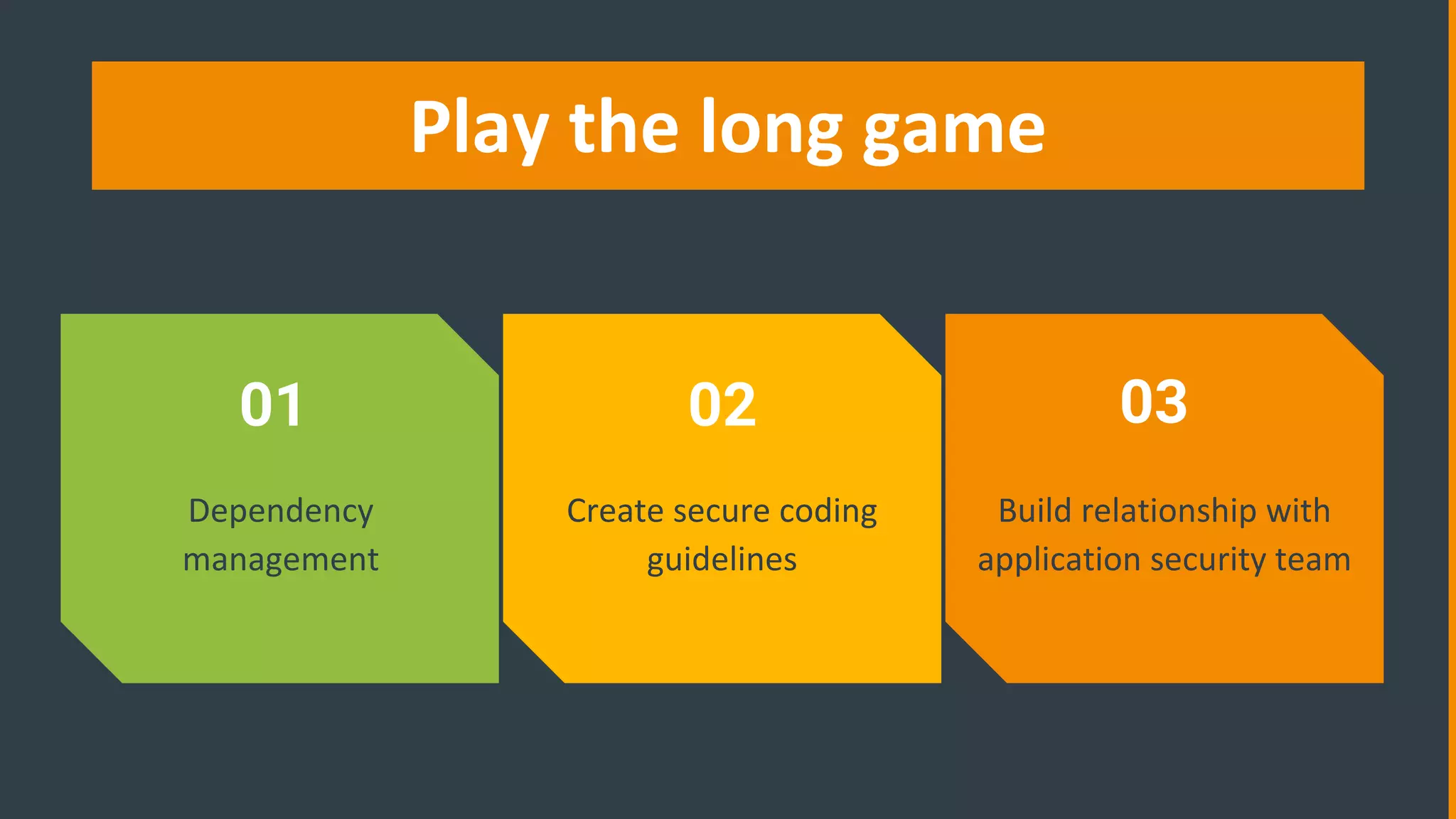
Play the long game
Dependency
management
Create secure coding
guidelines
Build relationship with
application security team
01 02 03
Are you ready to be a superhero?

Tales of modern day data breaches - a web security guide for developers

  • 1.
    Tales of modernday data breaches - a web security guide for developers Jaap Karan Singh jaap@scw.io Co-Founder & Chief Singh, Secure Code Warrior
  • 2.
    > Today’s challengeswith software security
  • 3.
    Of data breachescaused by software vulnerability ~ Verizon 21% Source: Verizon, Data Breach Report, 2018 (but in there the last 10 years)
  • 4.
    of newly scannedapplications had SQL injections over the past 5 yrs ~ Cisco 1 in 3 Source: Cybersecurity as a Growth Advantage, Cisco, 2016
  • 5.
    > Data Breach#1: US Election Board Systems
  • 6.
    Personal data ofvoters stolen by a teenager SQL Injection Understanding the data breach
  • 7.
    Was it anAnonymous hacker lurking in the shadows? Script kiddie ALERT! Freely available tools and scripts used for the attack
  • 8.
    A user submitshis credentials using POST parameters. The parameters are appended to a database query string that is submitted to the database. The session cookie is returned to the browser; the user is now logged in. Client Web Server DB Server John Doe Username: John, Password: Doe SELECT * FROM Users WHERE Username = “John” AND Password = “Doe” Scenario 1: Normal authentication workflow The credentials are valid and the appropriate record is returned to the web server. Understanding the security vulnerability
  • 9.
    A user submitshis credentials using POST parameters. The parameters are appended to a database query string that is submitted to the database. The session cookie is returned to the browser; the user is now logged in. Client Web Server DB Server John Doe Username: John, Password: Doe SELECT * FROM Users WHERE Username = “John” AND Password = “Doe” Returned 1 Row (‘John’, ‘Doe’, ‘Admin’) Set-cookie: sessionid= FUHOJFB0I4BW121X7281 Scenario 1: Normal authentication workflow The credentials are valid and the appropriate record is returned to the web server. Understanding the security vulnerability
  • 10.
    Understanding the securityvulnerability SELECT * FROM Users WHERE Username = ‘admin’ AND Password = ‘abc’ OR 1=1;Username: admin, Password: abc’ OR 1=1; Web Server DB Server admin abc’ OR 1=1; Scenario 2: Authentication bypass The submitted input changes the logic of the query. Because of the always true condition, the password condition will be ignored! The session cookie is returned to the browser; the attacker is now logged in as administrator. The vulnerability is exploited in order to gain control to an account without providing a valid password. An attacker submits input values that will take advantage of the query.
  • 11.
    Understanding the securityvulnerability SELECT * FROM Users WHERE Username = ‘admin’ AND Password = ‘abc’ OR 1=1;Username: admin, Password: abc’ OR 1=1; Web Server DB Server admin Returned 1 Row (‘admin’, ‘John’, ‘admin’) Set-cookie: jsessionid= FUHOJFB0I4BW121X7281 abc’ OR 1=1; Scenario 2: Authentication bypass The submitted input changes the logic of the query. Because of the always true condition, the password condition will be ignored! The session cookie is returned to the browser; the attacker is now logged in as administrator. The vulnerability is exploited in order to gain control to an account without providing a valid password. An attacker submits input values that will take advantage of the query.
  • 12.
    Realising the impact Altereddata such as balance and transaction information could cause repudiation issues. System unavailability could cause revenue and reputation loss. Account and private data theft could damage reputation and credibility, causing customer and revenue loss.
  • 13.
    Preventing the mistake Neverconcatenate user-controllable input with application SQL to form the query sent to the database. Consider GET and POST parameters, Cookies and other HTTP headers. Use parameterized queries. All of the popular development frameworks provide support for secure construction of database queries. insert_user_query = "INSERT INTO users (name, age, gender) VALUES (“ + request_user_name + “,” + request_user_age + “)"; insert_user = db.prepare(insert_user_query) insert_user.execute() insert_user = db.prepare "INSERT INTO users (name, age, gender) VALUES (?, ?)" insert_user.execute(request_user_name, request_user_age)
  • 14.
    Preventing the mistake Inaddition, apply white-list validation on all user input. Consider GET and POST parameters, Cookies and other HTTP headers. Apply the least privilege principle on the database users.
  • 15.
    How easy isit to exploit SQL injection? Follow along on your computer and find out!
  • 16.
    > Data Breach#2: Facebook Access Tokens
  • 17.
    50,000,000 accounts affected Accesstokens exposed that keep users logged into Facebook Understanding the data breach
  • 18.
    Do you havea login system in your applications? cookies && sessions Insecure Session Management
  • 19.
    Understanding session management Whatare cookies? HTTP is a stateless protocol. Cookies can be used to track a user’s state by storing values related to the user’s actions. These cookie values are sent to and from the server and are stored in the client’s browser. When are cookies used? Cookies can be used to store an online shopping cart or browsing activities. Another usage are authentication cookies, which store the user’s session information to determine whether a user is logged in and which privileges are assigned to that user. Set-cookie: user=johndoe Cookie: user=johndoe How are cookies protected? Certain flags can be added when setting a cookie to limit its usage: • Secure – Avoid transmission over an insecure channel. • HttpOnly – Don’t let JavaScript read cookie value. • Domain – Set the domain for which the cookie is available. • Path – Set subfolders and pages for which the cookie is available. • Expires – Determine when the cookie should be deleted.
  • 20.
    Understanding the securityvulnerability An attacker logs into a site. The site uses a simple increment to generate session IDs. The attacker, noticing the predictability of the ID generation, deduces new ID’s, which he uses to browse back to the site. By being able to predict session ID’s he is able to impersonate the authenticated user and is allowed full access to the user’s account. After a few attempts, the attacker finds a session ID that is associated with another authenticated user. Web Application Cookie: sessionID=1234 Weak session token generation Authenticated User
  • 21.
    Understanding the securityvulnerability An attacker logs into a site. The site uses a simple increment to generate session IDs. The attacker, noticing the predictability of the ID generation, deduces new ID’s, which he uses to browse back to the site. By being able to predict session ID’s he is able to impersonate the authenticated user and is allowed full access to the user’s account. After a few attempts, the attacker finds a session ID that is associated with another authenticated user. Web Application Cookie: sessionID=1235 Cookie: sessionID=1234 Weak session token generation Authenticated User
  • 22.
    Understanding the securityvulnerability An attacker logs into a site. The site uses a simple increment to generate session IDs. The attacker, noticing the predictability of the ID generation, deduces new ID’s, which he uses to browse back to the site. By being able to predict session ID’s he is able to impersonate the authenticated user and is allowed full access to the user’s account. After a few attempts, the attacker finds a session ID that is associated with another authenticated user. Web Application Cookie: sessionID=1235 Cookie: sessionID=1234 Weak session token generation Cookie: sessionID=1234 Authenticated User Welcome ‘User’!
  • 23.
    Understanding the securityvulnerability An attacker browses to a site (without logging in) and is assigned a session ID. He wants to trick a victim into using this same session ID. A link to the login page is sent to the victim. The link contains the session ID of the attacker. The victim is tricked into clicking the link. The attacker resubmits a request with the session ID which is now associated with the authenticated victim. He has now access to the victim’s account. The victim logs in and, because of weak session management, is assigned the session ID provided by the attacker! Web Application Session fixation Set-Cookie: sessionID=E34G0JS Cookie: sessionID=E34G0JS
  • 24.
    Understanding the securityvulnerability Please update your password: GET /login?SESSIONID=E34G0JS An attacker browses to a site (without logging in) and is assigned a session ID. He wants to trick a victim into using this same session ID. A link to the login page is sent to the victim. The link contains the session ID of the attacker. The victim is tricked into clicking the link. The attacker resubmits a request with the session ID which is now associated with the authenticated victim. He has now access to the victim’s account. The victim logs in and, because of weak session management, is assigned the session ID provided by the attacker! Web Application Session fixation Victim Set-Cookie: sessionID=E34G0JS Set-Cookie: sessionID=E34G0JS Cookie: sessionID=E34G0JS Cookie: sessionID=E34G0JS
  • 25.
    Understanding the securityvulnerability Please update your password: GET /login?SESSIONID=E34G0JS An attacker browses to a site (without logging in) and is assigned a session ID. He wants to trick a victim into using this same session ID. A link to the login page is sent to the victim. The link contains the session ID of the attacker. The victim is tricked into clicking the link. The attacker resubmits a request with the session ID which is now associated with the authenticated victim. He has now access to the victim’s account. The victim logs in and, because of weak session management, is assigned the session ID provided by the attacker! Web Application Session fixation Victim Set-Cookie: sessionID=E34G0JS Set-Cookie: sessionID=E34G0JS Cookie: sessionID=E34G0JS GET /profile?SESSIONID=E34G0JS Welcome ‘Victim’ Cookie: sessionID=E34G0JS
  • 26.
    Realizing the impact Weaksession management allows attacks on the session ID. Having a user’s session ID is basically the same as getting that user’s login and password. A stolen administrator account could lead to disruption of the website, causing loss of customers and revenue. Due to account theft, sensitive end-user (customer) data could be stolen, leading to reputational damage and revenue loss
  • 27.
    Preventing the mistake SessionID properties must be secure. Unpredictable, time limited, single session. Use session management features provided by your development framework. Store sessions IDs in cookies. Protect session cookies appropriately. Expiry timestamp, path, secure flag, invalidate on logout. Secure the transport layer. See “Insufficient Transport Layer Protection”
  • 28.
    How easy isit to exploit session management vulnerabilities? Follow along on your computer and find out!
  • 29.
  • 30.
  • 31.
    Uplift your securitygame Classroom training eLearning
  • 32.
    Play the longgame Dependency management Create secure coding guidelines Build relationship with application security team 01 02 03
  • 33.
    Are you readyto be a superhero?