
HUMAN RESOURCE
                PLANNING
             “Throughout history it is the quality of the
           country’s manpower that has distinguished or
               disgraced it in the comity of nations.”
                                   Anonymous


09/21/12                                                    1
Definitions
• HRP is the process by which an org ensures that it has
  the right number and kind of people, at the right place, at
  the right time, capable of effectively and efficiently
  completing those tasks that will help the org achieve its
  overall obj.
• HRP translates the org’s objectives and plans of workers
  needed to meet those objectives. Without a clear-cut
  planning, estimation of an org’s human resource need is
  reduced to mere guess work.


09/21/12                                                    2
AIM OF HRP
• Attract and retain people with appropriate
  skills, expertise and competencies
• Anticipate the problems of potential
  surpluses and deficits of people
• Develop a well trained and flexible work
  force
• Have an appropriate retention policy

09/21/12                                       3
Potential benefits
• Upper management better aware of the
  HR current configuration.
• Personnel cost is controlled.
• More time provided to locate talent.
• Affirmative Action Plan implemented
• Time to develop employees


09/21/12                                 4
Sequencing-Human resource
             planning
• Planning Process related to Strategy
• Resourcing strategy as employer of
  choice.
• Scenario planning-Trends
• Demand/ Supply forecasting-Techniques.
  Advertisement
• Recruiting
  Documentation
09/21/12                                   5
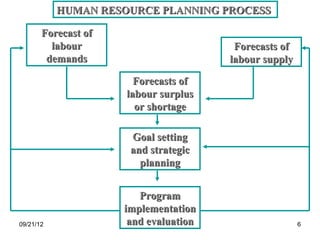
HUMAN RESOURCE PLANNING PROCESS

       Forecast of
         labour                         Forecasts of
        demands                        labour supply

                       Forecasts of
                     labour surplus
                       or shortage

                      Goal setting
                      and strategic
                        planning


                        Program
                     implementation
09/21/12              and evaluation                   6
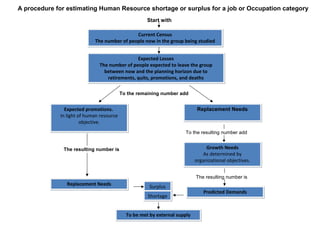
A procedure for estimating Human Resource shortage or surplus for a job or Occupation category
                                                     Start with

                                             Current Census
                            The number of people now in the group being studied


                                              Expected Losses
                              The number of people expected to leave the group
                                between now and the planning horizon due to
                                 retirements, quits, promotions, and deaths

                                          To the remaining number add


               Expected promotions.                                         Replacement Needs
             In light of human resource
                       objective.
                                                                     To the resulting number add


              The resulting number is                                           Growth Needs
                                                                               As determined by
                                                                           organizational objectives.


                                                                           The resulting number is
               Replacement Needs                      Surplus
                                                                               Predicted Demands
                                                     Shortage


                                            To be met by external supply
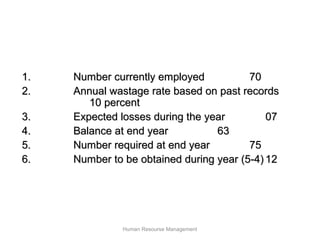
1.   Number currently employed           70
2.   Annual wastage rate based on past records
        10 percent
3.   Expected losses during the year         07
4.   Balance at end year          63
5.   Number required at end year         75
6.   Number to be obtained during year (5-4) 12


               Human Resourse Management
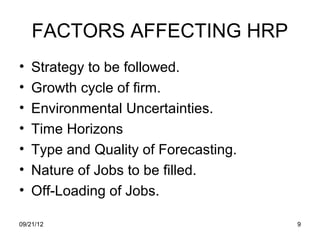
FACTORS AFFECTING HRP
•   Strategy to be followed.
•   Growth cycle of firm.
•   Environmental Uncertainties.
•   Time Horizons
•   Type and Quality of Forecasting.
•   Nature of Jobs to be filled.
•   Off-Loading of Jobs.

09/21/12                               9
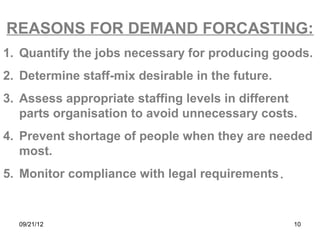
REASONS FOR DEMAND FORCASTING:
1. Quantify the jobs necessary for producing goods.
2. Determine staff-mix desirable in the future.
3. Assess appropriate staffing levels in different
   parts organisation to avoid unnecessary costs.
4. Prevent shortage of people when they are needed
   most.
5. Monitor compliance with legal requirements.


  09/21/12                                        10
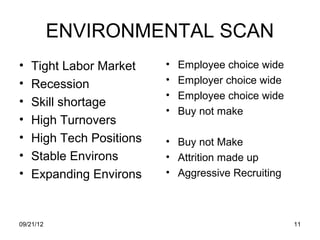
ENVIRONMENTAL SCAN
•   Tight Labor Market    •   Employee choice wide
•   Recession             •   Employer choice wide
                          •   Employee choice wide
•   Skill shortage
                          •   Buy not make
•   High Turnovers
•   High Tech Positions   • Buy not Make
•   Stable Environs       • Attrition made up
•   Expanding Environs    • Aggressive Recruiting


09/21/12                                             11
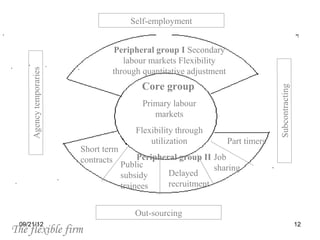
Self-employment


                                  Peripheral group I Secondary
                                     labour markets Flexibility
                                  through quantitative adjustment
     Agency temporaries


                                            Core group


                                                                                  Subcontracting
                                            Primary labour
                                               markets
                                           Flexibility through
                                               utilization          Part timers
                          Short term
                          contracts         Peripheral group II Job
                                       Public                   sharing
                                       subsidy      Delayed
                                       trainees     recruitment


                                          Out-sourcing
 09/21/12                                                                                          12
The flexible firm
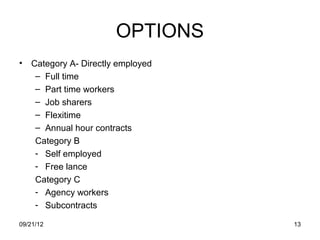
OPTIONS
•   Category A- Directly employed
     – Full time
     – Part time workers
     – Job sharers
     – Flexitime
     – Annual hour contracts
     Category B
     - Self employed
     - Free lance
     Category C
     - Agency workers
     - Subcontracts

09/21/12                            13
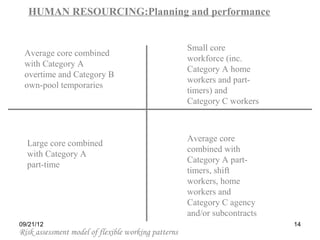
HUMAN RESOURCING:Planning and performance
                           Fluctuations in demand
                                     High
                                                     Small core
 Average core combined
                                                     workforce (inc.
 with Category A
                                                     Category A home
 overtime and Category B
                                                     workers and part-
 own-pool temporaries
                                                     timers) and
Low                                                  Category C workers    High
Labour
costs
                                                     Average core
  Large core combined
                                                     combined with
  with Category A
                                                     Category A part-
  part-time
                                                     timers, shift
                                                     workers, home
                                                     workers and
                                                     Category C agency
                                                     and/or subcontracts
                                  Low
09/21/12                                                                     14
Risk assessment model of flexible working patterns
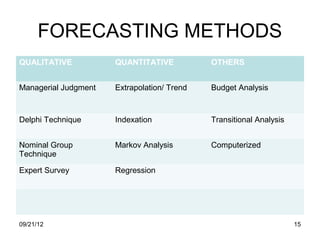
FORECASTING METHODS
QUALITATIVE           QUANTITATIVE           OTHERS


Managerial Judgment   Extrapolation/ Trend   Budget Analysis


Delphi Technique      Indexation             Transitional Analysis


Nominal Group         Markov Analysis        Computerized
Technique

Expert Survey         Regression


09/21/12                                                             15
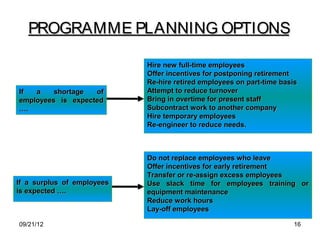
PROGRAMME PLANNING OPTIONS

                            Hire new full-time employees
                            Offer incentives for postponing retirement
                            Re-hire retired employees on part-time basis
If  a    shortage  of       Attempt to reduce turnover
employees is expected       Bring in overtime for present staff
….                          Subcontract work to another company
                            Hire temporary employees
                            Re-engineer to reduce needs.


                            Do not replace employees who leave
                            Offer incentives for early retirement
                            Transfer or re-assign excess employees
If a surplus of employees   Use slack time for employees training or
is expected ….              equipment maintenance
                            Reduce work hours
                            Lay-off employees

09/21/12                                                               16
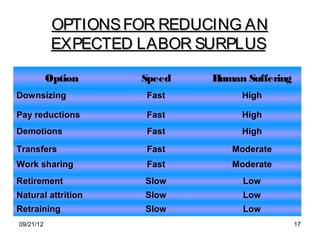
OPTIONS FOR REDUCING AN
            EXPECTED LABOR SURPLUS

           Option    Speed   Human Suffering
Downsizing            Fast        High

Pay reductions        Fast        High
Demotions             Fast        High

Transfers             Fast      Moderate
Work sharing          Fast      Moderate
Retirement           Slow         Low
Natural attrition    Slow         Low
Retraining           Slow         Low
09/21/12                                       17
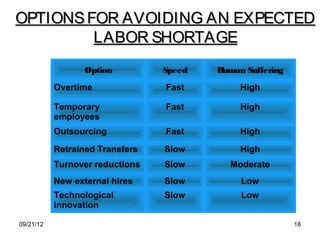
OPTIONS FOR AVOIDING AN EXPECTED
         LABOR SHORTAGE
                  Option         Speed   Human Suffering
           Overtime              Fast         High

           Temporary             Fast         High
           employees
           Outsourcing           Fast         High

           Retrained Transfers   Slow         High
           Turnover reductions   Slow       Moderate
           New external hires    Slow         Low
           Technological         Slow         Low
           innovation

09/21/12                                                   18
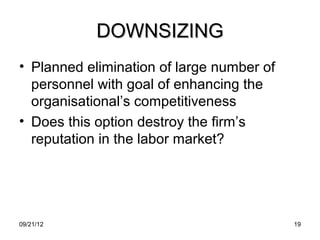
DOWNSIZING
• Planned elimination of large number of
  personnel with goal of enhancing the
  organisational’s competitiveness
• Does this option destroy the firm’s
  reputation in the labor market?


09/21/12                                   19
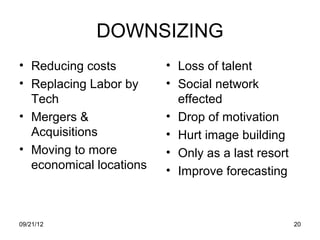
DOWNSIZING
• Reducing costs         • Loss of talent
• Replacing Labor by     • Social network
  Tech                     effected
• Mergers &              • Drop of motivation
  Acquisitions           • Hurt image building
• Moving to more         • Only as a last resort
  economical locations   • Improve forecasting


09/21/12                                           20
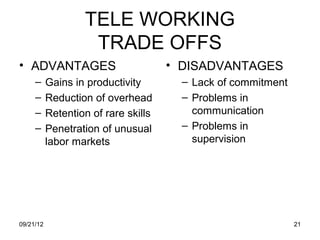
TELE WORKING
                    TRADE OFFS
• ADVANTAGES                          • DISADVANTAGES
     –     Gains in productivity        – Lack of commitment
     –     Reduction of overhead        – Problems in
     –     Retention of rare skills       communication
     –     Penetration of unusual       – Problems in
           labor markets                  supervision


09/21/12                                                       21
RETENTION PLANS
•   Compensation plans made attractive.
•   Fair Appraisal management
•   Advancement opportunities
•   Congenial working climate.
•   Compatibility job and person
•   HR Audit.


09/21/12                                  22
BARRIERS TO HRP
• Principle of “Employment at Will”
• HR taking a back seat on “Strat partner” role.
• Financial forecasting takes precedence.
• Conflict between short and long term goals.
• Conflict between Qualitative and Quantitative
  methods of forecasting.
• Mis-coord between operations and HR


09/21/12-                                          23
Cost of Labor Turnover
• Leaving cost
• Direct costs: Ad, Selection cost/time,
  Orientation/training costs


09/21/12                                   24
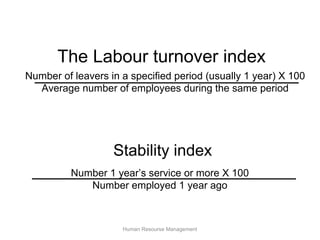
The Labour turnover index
Number of leavers in a specified period (usually 1 year) X 100
  Average number of employees during the same period


                   Stability index
          Number 1 year’s service or more X 100
             Number employed 1 year ago


                     Human Resourse Management
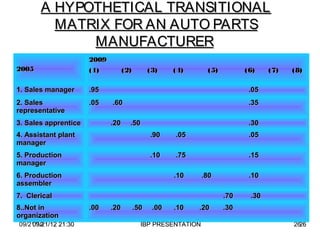
A HYPOTHETICAL TRANSITIONAL
         MATRIX FOR AN AUTO PARTS
             MANUFACTURER
                      2009
2005                  (1)          (2)         (3)    (4)      (5)         (6)    (7)   (8)

1. Sales manager      .95                                                   .05
2. Sales              .05    .60                                            .35
representative
3. Sales apprentice          .20     .50                                    .30
4. Assistant plant                             .90    .05                   .05
manager
5. Production                                  .10    .75                   .15
manager
6. Production                                         .10     .80           .10
assembler
7. Clerical                                                          .70    .30
8..Not in             .00    .20         .50    .00   .10   .20      .30
organization
09/21/12
    09/21/12 21:30                         IBP PRESENTATION                             2626
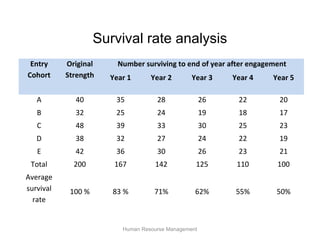
Survival rate analysis
 Entry     Original     Number surviving to end of year after engagement
Cohort     Strength   Year 1      Year 2        Year 3    Year 4    Year 5

   A         40        35           28               26    22         20
   B         32        25           24               19    18         17
   C         48        39           33               30    25         23
   D         38        32           27               24    22         19
   E         42        36           30               26    23         21
 Total       200       167         142           125       110       100
Average
survival    100 %      83 %        71%           62%       55%       50%
  rate


                         Human Resourse Management
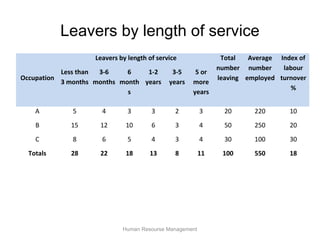
Leavers by length of service
                    Leavers by length of service               Total   Average Index of
                                                              number number     labour
           Less than 3-6     6    1-2         3-5     5 or
Occupation                                                    leaving employed turnover
           3 months months month years       years   more
                                                                                  %
                             s                       years

    A         5       4        3       3       2         3      20      220       10
    B        15      12       10       6       3         4      50      250       20
    C         8       6        5       4       3         4      30      100       30
  Totals     28      22       18      13       8         11    100      550       18


                             Human Resourse Management

Rect sel human resource planning spr 2012

  • 1.
    HUMAN RESOURCE PLANNING “Throughout history it is the quality of the country’s manpower that has distinguished or disgraced it in the comity of nations.” Anonymous 09/21/12 1
  • 2.
    Definitions • HRP isthe process by which an org ensures that it has the right number and kind of people, at the right place, at the right time, capable of effectively and efficiently completing those tasks that will help the org achieve its overall obj. • HRP translates the org’s objectives and plans of workers needed to meet those objectives. Without a clear-cut planning, estimation of an org’s human resource need is reduced to mere guess work. 09/21/12 2
  • 3.
    AIM OF HRP •Attract and retain people with appropriate skills, expertise and competencies • Anticipate the problems of potential surpluses and deficits of people • Develop a well trained and flexible work force • Have an appropriate retention policy 09/21/12 3
  • 4.
    Potential benefits • Uppermanagement better aware of the HR current configuration. • Personnel cost is controlled. • More time provided to locate talent. • Affirmative Action Plan implemented • Time to develop employees 09/21/12 4
  • 5.
    Sequencing-Human resource planning • Planning Process related to Strategy • Resourcing strategy as employer of choice. • Scenario planning-Trends • Demand/ Supply forecasting-Techniques. Advertisement • Recruiting Documentation 09/21/12 5
  • 6.
    HUMAN RESOURCE PLANNINGPROCESS Forecast of labour Forecasts of demands labour supply Forecasts of labour surplus or shortage Goal setting and strategic planning Program implementation 09/21/12 and evaluation 6
  • 7.
    A procedure forestimating Human Resource shortage or surplus for a job or Occupation category Start with Current Census The number of people now in the group being studied Expected Losses The number of people expected to leave the group between now and the planning horizon due to retirements, quits, promotions, and deaths To the remaining number add Expected promotions. Replacement Needs In light of human resource objective. To the resulting number add The resulting number is Growth Needs As determined by organizational objectives. The resulting number is Replacement Needs Surplus Predicted Demands Shortage To be met by external supply
  • 8.
    1. Number currently employed 70 2. Annual wastage rate based on past records 10 percent 3. Expected losses during the year 07 4. Balance at end year 63 5. Number required at end year 75 6. Number to be obtained during year (5-4) 12 Human Resourse Management
  • 9.
    FACTORS AFFECTING HRP • Strategy to be followed. • Growth cycle of firm. • Environmental Uncertainties. • Time Horizons • Type and Quality of Forecasting. • Nature of Jobs to be filled. • Off-Loading of Jobs. 09/21/12 9
  • 10.
    REASONS FOR DEMANDFORCASTING: 1. Quantify the jobs necessary for producing goods. 2. Determine staff-mix desirable in the future. 3. Assess appropriate staffing levels in different parts organisation to avoid unnecessary costs. 4. Prevent shortage of people when they are needed most. 5. Monitor compliance with legal requirements. 09/21/12 10
  • 11.
    ENVIRONMENTAL SCAN • Tight Labor Market • Employee choice wide • Recession • Employer choice wide • Employee choice wide • Skill shortage • Buy not make • High Turnovers • High Tech Positions • Buy not Make • Stable Environs • Attrition made up • Expanding Environs • Aggressive Recruiting 09/21/12 11
  • 12.
    Self-employment Peripheral group I Secondary labour markets Flexibility through quantitative adjustment Agency temporaries Core group Subcontracting Primary labour markets Flexibility through utilization Part timers Short term contracts Peripheral group II Job Public sharing subsidy Delayed trainees recruitment Out-sourcing 09/21/12 12 The flexible firm
  • 13.
    OPTIONS • Category A- Directly employed – Full time – Part time workers – Job sharers – Flexitime – Annual hour contracts Category B - Self employed - Free lance Category C - Agency workers - Subcontracts 09/21/12 13
  • 14.
    HUMAN RESOURCING:Planning andperformance Fluctuations in demand High Small core Average core combined workforce (inc. with Category A Category A home overtime and Category B workers and part- own-pool temporaries timers) and Low Category C workers High Labour costs Average core Large core combined combined with with Category A Category A part- part-time timers, shift workers, home workers and Category C agency and/or subcontracts Low 09/21/12 14 Risk assessment model of flexible working patterns
  • 15.
    FORECASTING METHODS QUALITATIVE QUANTITATIVE OTHERS Managerial Judgment Extrapolation/ Trend Budget Analysis Delphi Technique Indexation Transitional Analysis Nominal Group Markov Analysis Computerized Technique Expert Survey Regression 09/21/12 15
  • 16.
    PROGRAMME PLANNING OPTIONS Hire new full-time employees Offer incentives for postponing retirement Re-hire retired employees on part-time basis If a shortage of Attempt to reduce turnover employees is expected Bring in overtime for present staff …. Subcontract work to another company Hire temporary employees Re-engineer to reduce needs. Do not replace employees who leave Offer incentives for early retirement Transfer or re-assign excess employees If a surplus of employees Use slack time for employees training or is expected …. equipment maintenance Reduce work hours Lay-off employees 09/21/12 16
  • 17.
    OPTIONS FOR REDUCINGAN EXPECTED LABOR SURPLUS Option Speed Human Suffering Downsizing Fast High Pay reductions Fast High Demotions Fast High Transfers Fast Moderate Work sharing Fast Moderate Retirement Slow Low Natural attrition Slow Low Retraining Slow Low 09/21/12 17
  • 18.
    OPTIONS FOR AVOIDINGAN EXPECTED LABOR SHORTAGE Option Speed Human Suffering Overtime Fast High Temporary Fast High employees Outsourcing Fast High Retrained Transfers Slow High Turnover reductions Slow Moderate New external hires Slow Low Technological Slow Low innovation 09/21/12 18
  • 19.
    DOWNSIZING • Planned eliminationof large number of personnel with goal of enhancing the organisational’s competitiveness • Does this option destroy the firm’s reputation in the labor market? 09/21/12 19
  • 20.
    DOWNSIZING • Reducing costs • Loss of talent • Replacing Labor by • Social network Tech effected • Mergers & • Drop of motivation Acquisitions • Hurt image building • Moving to more • Only as a last resort economical locations • Improve forecasting 09/21/12 20
  • 21.
    TELE WORKING TRADE OFFS • ADVANTAGES • DISADVANTAGES – Gains in productivity – Lack of commitment – Reduction of overhead – Problems in – Retention of rare skills communication – Penetration of unusual – Problems in labor markets supervision 09/21/12 21
  • 22.
    RETENTION PLANS • Compensation plans made attractive. • Fair Appraisal management • Advancement opportunities • Congenial working climate. • Compatibility job and person • HR Audit. 09/21/12 22
  • 23.
    BARRIERS TO HRP •Principle of “Employment at Will” • HR taking a back seat on “Strat partner” role. • Financial forecasting takes precedence. • Conflict between short and long term goals. • Conflict between Qualitative and Quantitative methods of forecasting. • Mis-coord between operations and HR 09/21/12- 23
  • 24.
    Cost of LaborTurnover • Leaving cost • Direct costs: Ad, Selection cost/time, Orientation/training costs 09/21/12 24
  • 25.
    The Labour turnoverindex Number of leavers in a specified period (usually 1 year) X 100 Average number of employees during the same period Stability index Number 1 year’s service or more X 100 Number employed 1 year ago Human Resourse Management
  • 26.
    A HYPOTHETICAL TRANSITIONAL MATRIX FOR AN AUTO PARTS MANUFACTURER 2009 2005 (1) (2) (3) (4) (5) (6) (7) (8) 1. Sales manager .95 .05 2. Sales .05 .60 .35 representative 3. Sales apprentice .20 .50 .30 4. Assistant plant .90 .05 .05 manager 5. Production .10 .75 .15 manager 6. Production .10 .80 .10 assembler 7. Clerical .70 .30 8..Not in .00 .20 .50 .00 .10 .20 .30 organization 09/21/12 09/21/12 21:30 IBP PRESENTATION 2626
  • 27.
    Survival rate analysis Entry Original Number surviving to end of year after engagement Cohort Strength Year 1 Year 2 Year 3 Year 4 Year 5 A 40 35 28 26 22 20 B 32 25 24 19 18 17 C 48 39 33 30 25 23 D 38 32 27 24 22 19 E 42 36 30 26 23 21 Total 200 167 142 125 110 100 Average survival 100 % 83 % 71% 62% 55% 50% rate Human Resourse Management
  • 28.
    Leavers by lengthof service Leavers by length of service Total Average Index of number number labour Less than 3-6 6 1-2 3-5 5 or Occupation leaving employed turnover 3 months months month years years more % s years A 5 4 3 3 2 3 20 220 10 B 15 12 10 6 3 4 50 250 20 C 8 6 5 4 3 4 30 100 30 Totals 28 22 18 13 8 11 100 550 18 Human Resourse Management

Editor's Notes

  • #7 Tight labor market Recession