Talal Javed Qadri
Duke Class of 2015
   Worked with The Duke Imaging and
    Spectroscopy Program (DISP)
   Dr. David J Brady- Head of the program
   Computational optical sensors research
    program
   Affiliated with the Department of Electrical
    and Computer Engineering, the Fitzpatrick
    Institute for Photonics, and the Pratt School of
    Engineering at Duke University
   Various Projects
   DISP developed a two gigapixel camera
   Used new techniques like multi-scale design
    using mononcentric optical designs and using
    microcameras as a general optical processing
    unit
   Started with initial design of 1 gigapixel and
    plan to eventually develop a 40 gigapixel
    camera
   Currently working on a 10 gigapixel design
   Traditional monolithic lens designs, must
    increase focus and lens complexity
   Reduce field of view as image scale increases.
   Traditional electronic architectures are not
    designed for highly parallel streaming and
    analysis of large scale images.
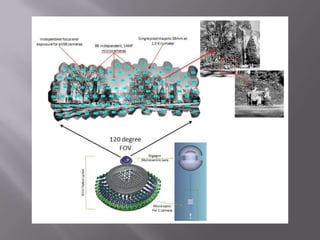
   The AWARE design addresses these challenges
    using multiscale designs that combine a
    monocentric objective lens with arrays of
    secondary microcameras.
   Composed of 98 smaller cameras that shoot at 14
    megapixels
   These micro cameras rest in a football-sized sphere
   Pictures from the multiple cameras are then
    combined together in a computer connected to the
    sphere
   This „stitching‟ of images is achieved by using
    Gigapan software, as well as Python and Matlab
    programs specifically written for this purpose
   The final result is one highly detailed image
   Billion pixel shots generate photos with five times as
    much detail as what a person with 20/20 vision can
    see, and produce images 30 times better than the best
    SLR camera available on the market
   Department of Defense funded the research of this
    device in hopes of using this technology in both aerial
    and land surveillance
   Other gigapixel cameras developed but none boast a
    field of view 120 degrees wide and 50 degrees tall like
    the Aware-2
   Currently weighs a 100 pounds and shoots only in
    black-and-white
   The next 10 gigapixel camera will shoot color images
    and will also be lighter
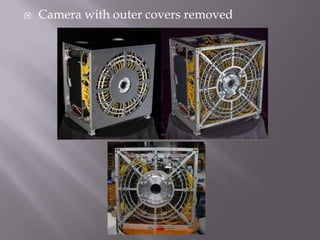
   Camera with outer covers removed
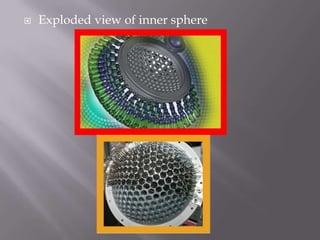
   Exploded view of inner sphere
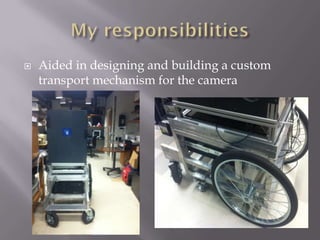
   Aided in designing and building a custom
    transport mechanism for the camera
   Took pictures with the camera in different
    locations for example in the Duke gardens
   Created a method for recording the exact
    coordinates of each picture on the Linux
    system of the camera‟s computer. Achieved
    this using a Garmin GPS receiver along with a
    software called “gpsd”

Talal's Poster Presentation

  • 1.
  • 2.
    Worked with The Duke Imaging and Spectroscopy Program (DISP)  Dr. David J Brady- Head of the program  Computational optical sensors research program  Affiliated with the Department of Electrical and Computer Engineering, the Fitzpatrick Institute for Photonics, and the Pratt School of Engineering at Duke University  Various Projects
  • 3.
    DISP developed a two gigapixel camera  Used new techniques like multi-scale design using mononcentric optical designs and using microcameras as a general optical processing unit  Started with initial design of 1 gigapixel and plan to eventually develop a 40 gigapixel camera  Currently working on a 10 gigapixel design
  • 4.
    Traditional monolithic lens designs, must increase focus and lens complexity  Reduce field of view as image scale increases.  Traditional electronic architectures are not designed for highly parallel streaming and analysis of large scale images.  The AWARE design addresses these challenges using multiscale designs that combine a monocentric objective lens with arrays of secondary microcameras.
  • 5.
    Composed of 98 smaller cameras that shoot at 14 megapixels  These micro cameras rest in a football-sized sphere  Pictures from the multiple cameras are then combined together in a computer connected to the sphere  This „stitching‟ of images is achieved by using Gigapan software, as well as Python and Matlab programs specifically written for this purpose  The final result is one highly detailed image
  • 6.
    Billion pixel shots generate photos with five times as much detail as what a person with 20/20 vision can see, and produce images 30 times better than the best SLR camera available on the market  Department of Defense funded the research of this device in hopes of using this technology in both aerial and land surveillance  Other gigapixel cameras developed but none boast a field of view 120 degrees wide and 50 degrees tall like the Aware-2  Currently weighs a 100 pounds and shoots only in black-and-white  The next 10 gigapixel camera will shoot color images and will also be lighter
  • 7.
    Camera with outer covers removed
  • 8.
    Exploded view of inner sphere
  • 10.
    Aided in designing and building a custom transport mechanism for the camera
  • 11.
    Took pictures with the camera in different locations for example in the Duke gardens  Created a method for recording the exact coordinates of each picture on the Linux system of the camera‟s computer. Achieved this using a Garmin GPS receiver along with a software called “gpsd”