PAGE
Industry Partner
Taking your code to production
Deployment and 12 factor
PAGE
Industry Partner
Speaker: Muayyad Alsadi
Free software contributor and
advocate. One of the Tech
leads at OpenSooq.com.
https://muayyad-alsadi.github.io/
PAGE
Industry Partner
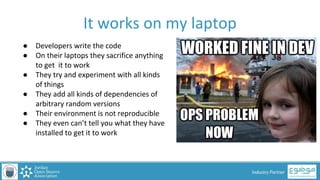
It works on my laptop
● Developers write the code
● On their laptops they sacrifice anything
to get it to work
● They try and experiment with all kinds
of things
● They add all kinds of dependencies of
arbitrary random versions
● Their environment is not reproducible
● They even can’t tell you what they have
installed to get it to work
PAGE
Industry Partner
It works on my laptop
• The develop is not aware that he is using bleeding edge non-production
branch of library that only adds a shiny logo and millions of bugs
• The develop is too lazy, instead of using standard things he uses all kinds
of third party helpers
• The developer tries to avoid writing two lines of code by using thousands of
random code on the internet that he/she does not understand.
• The developer is trying to avoid reading the docs by re-inventing the wheel
• Re-inventing the square wheel indeed.
• The developer hacks the framework core so it no longer do what it’s
expected to do. And there is no documentation of the new behavior
• Too much magic behind the scenes.
PAGE
Industry Partner
PAGE
Industry Partner
PAGE
Industry Partner
PAGE
Industry Partner
It works on my laptop
• The data needed to reproduce the bug is not in the outdated or small dev
database.
• The bug is only seen at thousands of requests per seconds
• The bug is only seen when your first request lands on a server on one
region and then next requests on another requests
• The scenario needed to reproduce the bug involves new sign up with a new
real facebook account, sms verification with a real phone number in
another country, doing a payment ..etc.
• The bug is not even reproducible
• Heisenbug/schrödinbug is a bug that changes its behavior when you study
it (in the presence of tools to debug it)
PAGE
Industry Partner
Software Defined Everything
• Software can add more value (ex. a smartphone software can use
gyroscope sensor to do image stabilization)
• Software define the value
• Software defined does not mean fake or virtual but it means
– Controlled
– Scriptable and Automated
– Reproduced
• Software as a service
– “Everything as a service”
• Ironic is a bare-metal as a service
PAGE
Industry Partner
Microservice Architecture
• Infrastructure as code
• Microservice is Similar to Unix
Philosophy
– Do one thing and do it right
– Everything is a file (here
everything is a service)
– Every file is a text file (every
service is a load-balanced port)
PAGE
Industry Partner
Decouple
PAGE
Industry Partner
Pets vs. Cattle
PAGE
Industry Partner
Cattle vs. Ants
● Thousands of containers
○ docker
● Fast startup time
● Continue to work even if you kill many
of them
● Dev-Ops
PAGE
Industry Partner
Cattle vs. Burger
● Serverless
○ Lambda
○ Kubeless.io
● No-ops
PAGE
Industry Partner
On-premises vs. pay as you go
PAGE
Industry Partner
Introducing 12 Factor App
• https://12factor.net/
• By Heroku co-founder Adam Wiggins
• #1 code in a VCS (like git), one app, one code, many deployments.
– Dev1, dev2, staging, production, all same code, same repo
– No many apps sharing code (split common into libraries)
• #2 Explicitly declare and isolate dependencies
– No system-wide dependencies
• One app uses django 1.11 while other needs 1.9
– Scoped dependencies
• Python’s virtualenv
• Ruby’s bundler
• Php’s composer into vendor directory ..etc.
PAGE
Industry Partner
Introducing 12 Factor App
• #3 Strict separation of config from code
– Accept config from environment variable or service discovery
– No config hardcoded in the code
– “confd” can be used to template environment variable into config files
• #4 Treat backing services as attached resources
– Like MySQL or MongoDB or S3
– Resources can be attached and detached to deploys at will. For
example, if the app’s database is misbehaving due to a hardware
issue, the app’s administrator might spin up a new database server
restored from a recent backup. The current production database could
be detached, and the new database attached – all without any code
changes.
PAGE
Industry Partner
Introducing 12 Factor App
• #5 Strictly separate build and run stages
• #6 Execute the app as one or more stateless processes
– Stateful parts are via attached backing services
– Sticky sessions are a violation of twelve-factor and should never be
used or relied upon
• #7 Export services via port
• #8 Scale out via the process model
• #9 Disposability: Maximize robustness with fast startup and graceful
shutdown
– app’s processes are disposable, meaning they can be started or
stopped at a moment’s notice
• #10 Keep development, staging, and production as similar as possible
PAGE
Industry Partner
Introducing 12 Factor App
• #11 just output logs to standard output
– A twelve-factor app never concerns itself with routing or storage of its
output stream.
• #12 Run admin/management tasks as one-off processes
– One-off admin processes should be run in an identical environment as
the regular long-running processes of the app. They run against a
release, using the same codebase and config as any process run
against that release. Admin code must ship with application code to
avoid synchronization issues.
PAGE
Industry Partner
Similar Manifesto
• http://www.reactivemanifesto.org/
• Resilient: expect the failure as part of the
process
• Elastic:
– Scale-out (not scale up) to handle high loads
– Scale-in to save cost
• Message driven
PAGE
Industry Partner
Gitflow workflow
• An always stable production/release
branch
– Known to be working
• Each feature is a branch
– Developers work in
• A merge (staging) branch
– To be production branch
• Hotfix fast lane
• Tag for each past release
• Branch for past releases if you are
going to support them with backports
PAGE
Industry Partner
Code Quality
• Fail early
• Auto checks before you commit
– Pre-commit hook on developer machine
– “php -l” that checks syntax
– “python -m compileall MyApp”
• Lint your code for a common style and best practices
– Pylint for python, eslint for javascript/nodejs
PAGE
Industry Partner
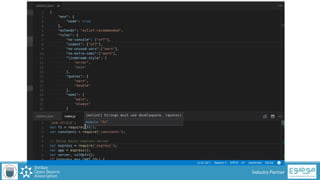
Left: pylintrc showing how I disabled some warnings, and allowed some names
Right: Pylint telling you that you should put spaces around assignment “=”
PAGE
Industry Partner
PAGE
Industry Partner
CI/CD
• Continuous integration / continuous delivery
• The What?
– Each/some commits or tags or pushes triggers build
servers, integration and automated tests
• The Why? Reproducible builds, guaranteed quality
• The How
– Jenkins (I hate it, but it’s the most common)
– Gitlab ci
– Good old git hooks (server side), scripts, ansible ..etc.
PAGE
Industry Partner
Some types of testings
• Unit tests: test every function
– Positive assertions
– Negative assertions
– Coverage: did your test cases cover all code (cases for if
part, other cases for else part)
• Stress testing:
– siege/ab
– A way to skip cache (Always miss cache component)
– Replay network capture from live on test
PAGE
Industry Partner
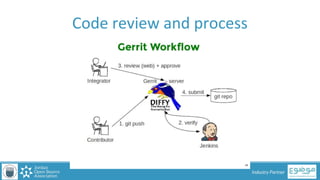
Code review and process
PAGE
Industry Partner
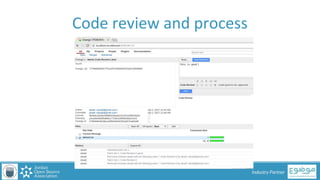
Code review and process
PAGE
Industry Partner
Deployments
• Local
– developer code on developer machine
– In-office toy machine
• Test (developer code on non-developer environment)
• Staging
– Merge / Integration
– Many features and branches
– Avoid conflicting or competing changes
• Pre-Production
– Candidate code on production database
PAGE
Industry Partner
Canary testing
• Pass small fraction of production traffic to new candidate
code
• Deliver the new version of the app (ex. Via Google play) to
small fraction of users
• Enable the new feature to small fraction of user base (using
configuration service)
PAGE
Industry Partner
Blue-green deployment
• Roll the new release using a fan out, instead of all servers at
once
• Let’s denote current production version as green and new
release as blue
• Make 10% of servers blue, 90% green
• Increase the percent blue, while watching logs
• End with all blue servers.
PAGE
Industry Partner
Immutable servers
• You don’t just “git pull” code on existing servers
• You launch new servers running new code
• When done, you terminate old ones.
• Servers are not pets, they get launched and killed all
the time
• Deliver code as docker images
• Orchestrate containers using kubernetes
PAGE
Industry Partner
Questions?
PAGE
Industry Partner
Thank you

Taking your code to production

  • 1.
    PAGE Industry Partner Taking yourcode to production Deployment and 12 factor
  • 2.
    PAGE Industry Partner Speaker: MuayyadAlsadi Free software contributor and advocate. One of the Tech leads at OpenSooq.com. https://muayyad-alsadi.github.io/
  • 3.
    PAGE Industry Partner It workson my laptop ● Developers write the code ● On their laptops they sacrifice anything to get it to work ● They try and experiment with all kinds of things ● They add all kinds of dependencies of arbitrary random versions ● Their environment is not reproducible ● They even can’t tell you what they have installed to get it to work
  • 4.
    PAGE Industry Partner It workson my laptop • The develop is not aware that he is using bleeding edge non-production branch of library that only adds a shiny logo and millions of bugs • The develop is too lazy, instead of using standard things he uses all kinds of third party helpers • The developer tries to avoid writing two lines of code by using thousands of random code on the internet that he/she does not understand. • The developer is trying to avoid reading the docs by re-inventing the wheel • Re-inventing the square wheel indeed. • The developer hacks the framework core so it no longer do what it’s expected to do. And there is no documentation of the new behavior • Too much magic behind the scenes.
  • 5.
  • 6.
  • 7.
  • 8.
    PAGE Industry Partner It workson my laptop • The data needed to reproduce the bug is not in the outdated or small dev database. • The bug is only seen at thousands of requests per seconds • The bug is only seen when your first request lands on a server on one region and then next requests on another requests • The scenario needed to reproduce the bug involves new sign up with a new real facebook account, sms verification with a real phone number in another country, doing a payment ..etc. • The bug is not even reproducible • Heisenbug/schrödinbug is a bug that changes its behavior when you study it (in the presence of tools to debug it)
  • 9.
    PAGE Industry Partner Software DefinedEverything • Software can add more value (ex. a smartphone software can use gyroscope sensor to do image stabilization) • Software define the value • Software defined does not mean fake or virtual but it means – Controlled – Scriptable and Automated – Reproduced • Software as a service – “Everything as a service” • Ironic is a bare-metal as a service
  • 10.
    PAGE Industry Partner Microservice Architecture •Infrastructure as code • Microservice is Similar to Unix Philosophy – Do one thing and do it right – Everything is a file (here everything is a service) – Every file is a text file (every service is a load-balanced port)
  • 11.
  • 12.
  • 13.
    PAGE Industry Partner Cattle vs.Ants ● Thousands of containers ○ docker ● Fast startup time ● Continue to work even if you kill many of them ● Dev-Ops
  • 14.
    PAGE Industry Partner Cattle vs.Burger ● Serverless ○ Lambda ○ Kubeless.io ● No-ops
  • 15.
  • 16.
    PAGE Industry Partner Introducing 12Factor App • https://12factor.net/ • By Heroku co-founder Adam Wiggins • #1 code in a VCS (like git), one app, one code, many deployments. – Dev1, dev2, staging, production, all same code, same repo – No many apps sharing code (split common into libraries) • #2 Explicitly declare and isolate dependencies – No system-wide dependencies • One app uses django 1.11 while other needs 1.9 – Scoped dependencies • Python’s virtualenv • Ruby’s bundler • Php’s composer into vendor directory ..etc.
  • 17.
    PAGE Industry Partner Introducing 12Factor App • #3 Strict separation of config from code – Accept config from environment variable or service discovery – No config hardcoded in the code – “confd” can be used to template environment variable into config files • #4 Treat backing services as attached resources – Like MySQL or MongoDB or S3 – Resources can be attached and detached to deploys at will. For example, if the app’s database is misbehaving due to a hardware issue, the app’s administrator might spin up a new database server restored from a recent backup. The current production database could be detached, and the new database attached – all without any code changes.
  • 18.
    PAGE Industry Partner Introducing 12Factor App • #5 Strictly separate build and run stages • #6 Execute the app as one or more stateless processes – Stateful parts are via attached backing services – Sticky sessions are a violation of twelve-factor and should never be used or relied upon • #7 Export services via port • #8 Scale out via the process model • #9 Disposability: Maximize robustness with fast startup and graceful shutdown – app’s processes are disposable, meaning they can be started or stopped at a moment’s notice • #10 Keep development, staging, and production as similar as possible
  • 19.
    PAGE Industry Partner Introducing 12Factor App • #11 just output logs to standard output – A twelve-factor app never concerns itself with routing or storage of its output stream. • #12 Run admin/management tasks as one-off processes – One-off admin processes should be run in an identical environment as the regular long-running processes of the app. They run against a release, using the same codebase and config as any process run against that release. Admin code must ship with application code to avoid synchronization issues.
  • 20.
    PAGE Industry Partner Similar Manifesto •http://www.reactivemanifesto.org/ • Resilient: expect the failure as part of the process • Elastic: – Scale-out (not scale up) to handle high loads – Scale-in to save cost • Message driven
  • 21.
    PAGE Industry Partner Gitflow workflow •An always stable production/release branch – Known to be working • Each feature is a branch – Developers work in • A merge (staging) branch – To be production branch • Hotfix fast lane • Tag for each past release • Branch for past releases if you are going to support them with backports
  • 22.
    PAGE Industry Partner Code Quality •Fail early • Auto checks before you commit – Pre-commit hook on developer machine – “php -l” that checks syntax – “python -m compileall MyApp” • Lint your code for a common style and best practices – Pylint for python, eslint for javascript/nodejs
  • 23.
    PAGE Industry Partner Left: pylintrcshowing how I disabled some warnings, and allowed some names Right: Pylint telling you that you should put spaces around assignment “=”
  • 24.
  • 25.
    PAGE Industry Partner CI/CD • Continuousintegration / continuous delivery • The What? – Each/some commits or tags or pushes triggers build servers, integration and automated tests • The Why? Reproducible builds, guaranteed quality • The How – Jenkins (I hate it, but it’s the most common) – Gitlab ci – Good old git hooks (server side), scripts, ansible ..etc.
  • 26.
    PAGE Industry Partner Some typesof testings • Unit tests: test every function – Positive assertions – Negative assertions – Coverage: did your test cases cover all code (cases for if part, other cases for else part) • Stress testing: – siege/ab – A way to skip cache (Always miss cache component) – Replay network capture from live on test
  • 27.
  • 28.
  • 29.
    PAGE Industry Partner Deployments • Local –developer code on developer machine – In-office toy machine • Test (developer code on non-developer environment) • Staging – Merge / Integration – Many features and branches – Avoid conflicting or competing changes • Pre-Production – Candidate code on production database
  • 30.
    PAGE Industry Partner Canary testing •Pass small fraction of production traffic to new candidate code • Deliver the new version of the app (ex. Via Google play) to small fraction of users • Enable the new feature to small fraction of user base (using configuration service)
  • 31.
    PAGE Industry Partner Blue-green deployment •Roll the new release using a fan out, instead of all servers at once • Let’s denote current production version as green and new release as blue • Make 10% of servers blue, 90% green • Increase the percent blue, while watching logs • End with all blue servers.
  • 32.
    PAGE Industry Partner Immutable servers •You don’t just “git pull” code on existing servers • You launch new servers running new code • When done, you terminate old ones. • Servers are not pets, they get launched and killed all the time • Deliver code as docker images • Orchestrate containers using kubernetes
  • 33.
  • 34.