NECESSARY SKILLS IN TAKING TABLE RESERVATIONS
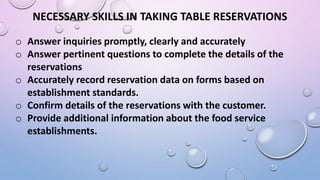
o Answer inquiries promptly, clearly and accurately
o Answer pertinent questions to complete the details of the
reservations
o Accurately record reservation data on forms based on
establishment standards.
o Confirm details of the reservations with the customer.
o Provide additional information about the food service
establishments.
1. CONVENTIONAL- it is the most common of all the systems in food
service. In this kind of system, ingredients are assembled and
food dish is produced on site.
2. CENTRALIZED (Commissary) Foodservice- known as central
kitchen or food factory. Food is prepared in one place then
transported to satellite kitchens.
3. READY- PREPARED – food is produced on site, it is produced on
site and it is usually chilled or froze, ex. Hospital
4. Assembly Serve
- Foods is purchased then stored either chilled or frozen for later use.
Usually used by in- flight caterers.
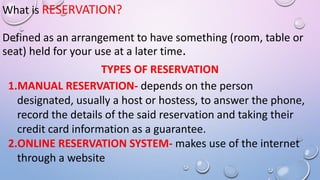
What is RESERVATION?
Defined as an arrangement to have something (room, table or
seat) held for your use at a later time.
TYPES OF RESERVATION
1.MANUAL RESERVATION- depends on the person
designated, usually a host or hostess, to answer the phone,
record the details of the said reservation and taking their
credit card information as a guarantee.
2.ONLINE RESERVATION SYSTEM- makes use of the internet
through a website
3. CALL AHEAD SEATING- the guest calls when they are on their
way and sets a specific time when they will arrive. Usually
restaurants will hold a table for 20-30 minutes.
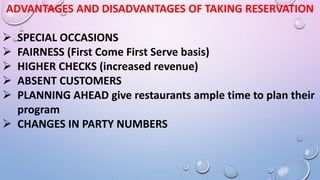
ADVANTAGES AND DISADVANTAGES OF TAKING RESERVATION
 SPECIAL OCCASIONS
 FAIRNESS (First Come First Serve basis)
 HIGHER CHECKS (increased revenue)
 ABSENT CUSTOMERS
 PLANNING AHEAD give restaurants ample time to plan their
program
 CHANGES IN PARTY NUMBERS
ALTERNATIVES TO RESERVATIONS
In the case of some restaurants who do not accept reservations of for
those who cannot accommodate a large number of guests, the
following options can be considered:
o The waiting list
Guest give their names, stay inside the restaurant and wait for their
wait for their names to be called.
o The call- ahead list
Guests call ahead to place their names on the waiting list and inquire
and inquire how long will it take to wait.
o Pagers
Many restaurants employ electronic pagers in lieu of calling out
calling out customers names when table are ready.
PERFORMANCE:
PERFORM A TELEPHONE
RESERVATION

FBS ppt..pptx

  • 1.
    NECESSARY SKILLS INTAKING TABLE RESERVATIONS o Answer inquiries promptly, clearly and accurately o Answer pertinent questions to complete the details of the reservations o Accurately record reservation data on forms based on establishment standards. o Confirm details of the reservations with the customer. o Provide additional information about the food service establishments.
  • 2.
    1. CONVENTIONAL- itis the most common of all the systems in food service. In this kind of system, ingredients are assembled and food dish is produced on site. 2. CENTRALIZED (Commissary) Foodservice- known as central kitchen or food factory. Food is prepared in one place then transported to satellite kitchens. 3. READY- PREPARED – food is produced on site, it is produced on site and it is usually chilled or froze, ex. Hospital 4. Assembly Serve - Foods is purchased then stored either chilled or frozen for later use. Usually used by in- flight caterers.
  • 3.
    What is RESERVATION? Definedas an arrangement to have something (room, table or seat) held for your use at a later time. TYPES OF RESERVATION 1.MANUAL RESERVATION- depends on the person designated, usually a host or hostess, to answer the phone, record the details of the said reservation and taking their credit card information as a guarantee. 2.ONLINE RESERVATION SYSTEM- makes use of the internet through a website
  • 4.
    3. CALL AHEADSEATING- the guest calls when they are on their way and sets a specific time when they will arrive. Usually restaurants will hold a table for 20-30 minutes.
  • 5.
    ADVANTAGES AND DISADVANTAGESOF TAKING RESERVATION  SPECIAL OCCASIONS  FAIRNESS (First Come First Serve basis)  HIGHER CHECKS (increased revenue)  ABSENT CUSTOMERS  PLANNING AHEAD give restaurants ample time to plan their program  CHANGES IN PARTY NUMBERS
  • 6.
    ALTERNATIVES TO RESERVATIONS Inthe case of some restaurants who do not accept reservations of for those who cannot accommodate a large number of guests, the following options can be considered: o The waiting list Guest give their names, stay inside the restaurant and wait for their wait for their names to be called. o The call- ahead list Guests call ahead to place their names on the waiting list and inquire and inquire how long will it take to wait. o Pagers Many restaurants employ electronic pagers in lieu of calling out calling out customers names when table are ready.
  • 7.