Applying REST to Network Management;
An Implementor’s View
Carl Moberg, VP Technology
calle@tail-f.com
   @cmoberg


Confidential Information | December 18, 2012
Agenda

•    Background and Overview of REST
•    REST in a Network Management Context
•    Introducing Data Models
•    Putting it all Together
•    A Short Demo


Confidential Information | December 18, 2012   1
A Brief History of REST

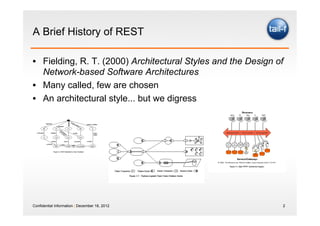
•  Fielding, R. T. (2000) Architectural Styles and the Design of
   Network-based Software Architectures
•  Many called, few are chosen
•  An architectural style... but we digress


Confidential Information | December 18, 2012                   2
Which Way to Slice This?

•  The REST Architectural Style describes six constraints:
       –  Uniform interface, Stateless, Cacheable, Client-server, Layered
          System, Code on demand (optional)
•  Guiding principles for of a REST interface (the Uniform
   Interface constraints):
       –    Resources have unique identifiers (e.g. URIs)
       –    Manipulations of resources through representations
       –    Self-descriptive Messages
       –    Hypermedia as the engines of application state (HATEOAS)


Confidential Information | December 18, 2012                                3
Resources Have Unique Identifiers (e.g. URIs)


GET /api/running/interfaces/interface/eth0/ipv4 HTTP/1.1!
!
<ipv4 y:self="/api/running/interfaces/interface/eth0/ip:ipv4”>!
  <address y:self=”[...]">!
     <ip>192.168.0.1</ip>!
...!
!

•  Individual resources are identified in requests using URIs
•  Resources are conceptually separate from the
   representations
•  Resource representations depend on query and server
   support (e.g. XML and JSON)


Confidential Information | December 18, 2012                      4
Manipulation of Representations


  < Content-Type: application/vnd.yang.data+xml!
  !
  <ipv4 y:self="/api/running/interfaces/interface/eth0/ip:ipv4”>!
    <address y:self=”[...]">!
      <ip>192.168.0.1</ip>!
    </address>!
  </ipv4>!

•  Representations (including metadata) contain enough
   information to be modified or deleted
•  Provided that the client has permission to do so


Confidential Information | December 18, 2012                        5
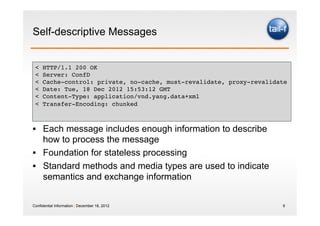
Self-descriptive Messages


 <   HTTP/1.1 200 OK!
 <   Server: ConfD!
 <   Cache-control: private, no-cache, must-revalidate, proxy-revalidate
                                                                       !
 <   Date: Tue, 18 Dec 2012 15:53:12 GMT!
 <   Content-Type: application/vnd.yang.data+xml!
 <   Transfer-Encoding: chunked!


•  Each message includes enough information to describe
   how to process the message
•  Foundation for stateless processing
•  Standard methods and media types are used to indicate
   semantics and exchange information


Confidential Information | December 18, 2012                          6
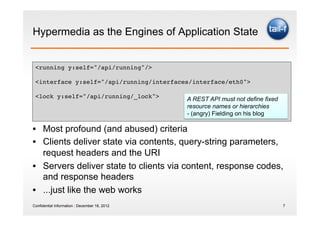
Hypermedia as the Engines of Application State


 <running y:self="/api/running"/>!
 !
 <interface y:self="/api/running/interfaces/interface/eth0">!
 !
 <lock y:self="/api/running/_lock">!       A REST API must not define fixed
 !                                         resource names or hierarchies
                                               - (angry) Fielding on his blog

•  Most profound (and abused) criteria
•  Clients deliver state via contents, query-string parameters,
   request headers and the URI
•  Servers deliver state to clients via content, response codes,
   and response headers
•  ...just like the web works
Confidential Information | December 18, 2012                                    7
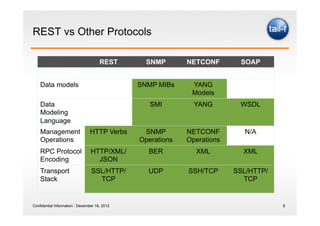
REST vs Other Protocols

                                      REST       SNMP       NETCONF       SOAP


    Data models                                SNMP MIBs     YANG
                                                             Models
    Data                                          SMI         YANG        WSDL
    Modeling
    Language
    Management                  HTTP Verbs      SNMP        NETCONF         N/A
    Operations                                 Operations   Operations
    RPC Protocol                 HTTP/XML/       BER          XML          XML
    Encoding                       JSON
    Transport                    SSL/HTTP/       UDP        SSH/TCP      SSL/HTTP/
    Stack                          TCP                                     TCP


Confidential Information | December 18, 2012                                         8
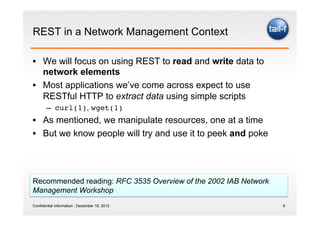
REST in a Network Management Context

•  We will focus on using REST to read and write data to
   network elements
•  Most applications we’ve come across expect to use
   RESTful HTTP to extract data using simple scripts
       –  curl(1), wget(1)
•  As mentioned, we manipulate resources, one at a time
•  But we know people will try and use it to peek and poke


Recommended reading: RFC 3535 Overview of the 2002 IAB Network
Management Workshop
Confidential Information | December 18, 2012                     9
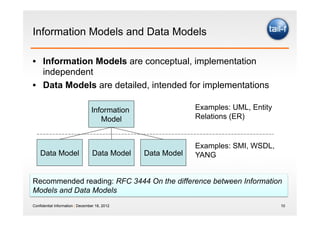
Information Models and Data Models

•  Information Models are conceptual, implementation
   independent
•  Data Models are detailed, intended for implementations

                                 Information                Examples: UML, Entity
                                    Model                   Relations (ER)


                                                            Examples: SMI, WSDL,
    Data Model                    Data Model   Data Model   YANG


Recommended reading: RFC 3444 On the difference between Information
Models and Data Models
Confidential Information | December 18, 2012                                        10
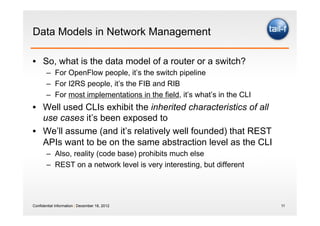
Data Models in Network Management

•  So, what is the data model of a router or a switch?
       –  For OpenFlow people, it’s the switch pipeline
       –  For I2RS people, it’s the FIB and RIB
       –  For most implementations in the field, it’s what’s in the CLI
•  Well used CLIs exhibit the inherited characteristics of all
   use cases it’s been exposed to
•  We’ll assume (and it’s relatively well founded) that REST
   APIs want to be on the same abstraction level as the CLI
       –  Also, reality (code base) prohibits much else
       –  REST on a network level is very interesting, but different


Confidential Information | December 18, 2012                              11
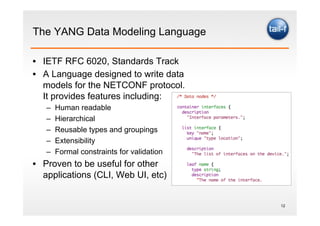
The YANG Data Modeling Language

•  IETF RFC 6020, Standards Track
•  A Language designed to write data
   models for the NETCONF protocol.
   It provides features including:
   –    Human readable
   –    Hierarchical
   –    Reusable types and groupings
   –    Extensibility
   –    Formal constraints for validation
•  Proven to be useful for other
   applications (CLI, Web UI, etc)


                                            12
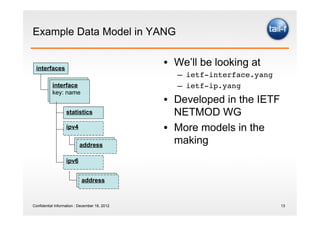
Example Data Model in YANG


  interfaces
                                               •  We’ll be looking at
                                                  –  ietf-interface.yang!
           interface                              –  ietf-ip.yang!
           key: name
                                               •  Developed in the IETF
                   statistics                     NETMOD WG
                   ipv4                        •  More models in the
                         address
                          address
                                                  making
                   ipv6

                          address
                           address


Confidential Information | December 18, 2012                                13
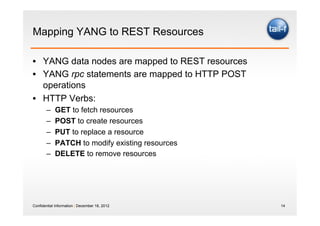
Mapping YANG to REST Resources

•  YANG data nodes are mapped to REST resources
•  YANG rpc statements are mapped to HTTP POST
   operations
•  HTTP Verbs:
       –    GET to fetch resources
       –    POST to create resources
       –    PUT to replace a resource
       –    PATCH to modify existing resources
       –    DELETE to remove resources


Confidential Information | December 18, 2012      14
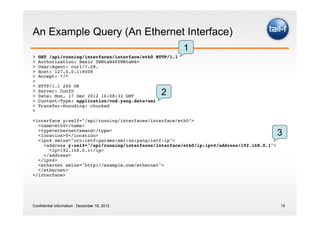
An Example Query (An Ethernet Interface)
                                                       1
> GET /api/running/interfaces/interface/eth0 HTTP/1.1!
> Authorization: Basic YWRtaW46YWRtaW4=!
> User-Agent: curl/7.28.!
> Host: 127.0.0.1:8008!
> Accept: */*!
> !
< HTTP/1.1 200 OK!
< Server: ConfD!
< Date: Mon, 17 Dec 2012 16:08:33 GMT!
                                               2
< Content-Type: application/vnd.yang.data+xml!
< Transfer-Encoding: chunked!
< !
!
<interface y:self="/api/running/interfaces/interface/eth0”>!
  <name>eth0</name>!
  <type>ethernetCsmacd</type>!
  <location>0</location>!                                                                3
  <ipv4 xmlns="urn:ietf:params:xml:ns:yang:ietf-ip">!
    <address y:self="/api/running/interfaces/interface/eth0/ip:ipv4/address/192.168.0.1">!
      <ip>192.168.0.1</ip>!
    </address>!
  </ipv4>!
  <ethernet xmlns="http://example.com/ethernet">!
  </ethernet>!
</interface>!
!


Confidential Information | December 18, 2012                                                 15
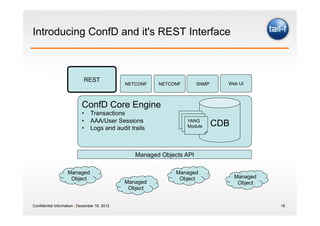
Introducing ConfD and it's REST Interface


                             REST
                                               NETCONF   NETCONF        SNMP     Web UI


                            ConfD Core Engine
                            •  Transactions
                            •  AAA/User Sessions
                            •  Logs and audit trails
                                                                   YANG
                                                                   Module      CDB


                                                  Managed Objects API

                    Managed                                    Managed
                     Object                                     Object               Managed
                                               Managed                                Object
                                                Object


Confidential Information | December 18, 2012                                                   16
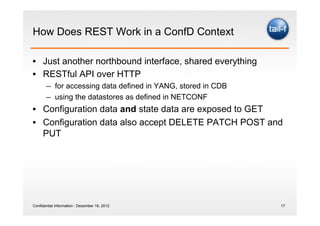
How Does REST Work in a ConfD Context

•  Just another northbound interface, shared everything
•  RESTful API over HTTP
       –  for accessing data defined in YANG, stored in CDB
       –  using the datastores as defined in NETCONF
•  Configuration data and state data are exposed to GET
•  Configuration data also accept DELETE PATCH POST and
   PUT


Confidential Information | December 18, 2012                  17
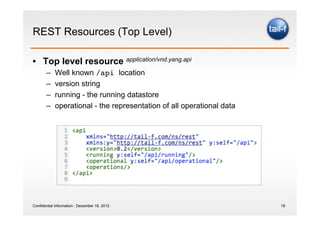
REST Resources (Top Level)

•  Top level resource application/vnd.yang.api
       –    Well known /api location
       –    version string
       –    running - the running datastore
       –    operational - the representation of all operational data


Confidential Information | December 18, 2012                           18
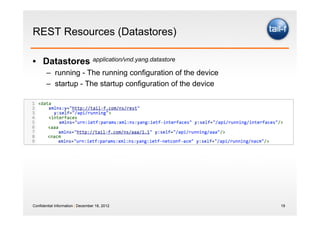
REST Resources (Datastores)

•  Datastores application/vnd.yang.datastore
       –  running - The running configuration of the device
       –  startup - The startup configuration of the device


Confidential Information | December 18, 2012                  19
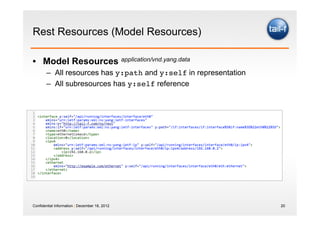
Rest Resources (Model Resources)

•  Model Resources application/vnd.yang.data
       –  All resources has y:path and y:self in representation
       –  All subresources has y:self reference


Confidential Information | December 18, 2012                      20
(Finally) Time for Demo

•  Queries
       –  Top-level
       –  Datastores
       –  Operations
•  Interface configuration
       –  Look at interfaces
       –  Change IP address


Confidential Information | December 18, 2012   21
Conclusions and Things to Ponder

•  REST allows for easy scripting with existing tools
       –  Many command line tools available and default on Linux and Mac
       –  Many, many language bindings
•  REST does not provide sessions:
       –  Impact on error management
       –  How about transactions
•  Rest allows for changing a single resource at a time:
       –  How does this scale in multi-parameter, complex environment


Confidential Information | December 18, 2012                               22
Wrap up and Questions

•  Suggested reading list:
       –    Fielding Dissertation
       –    RFC 3535
       –    RFC 3444
       –    YANG-API Protocol Draft (draft-bierman-netconf-yang-api-01)


•  Discuss!
       –  @cmoberg
       –  calle@tail-f.com


Confidential Information | December 18, 2012                              23

Webinar: Applying REST to Network Management – An Implementor’s View

  • 1.
    Applying REST toNetwork Management; An Implementor’s View Carl Moberg, VP Technology calle@tail-f.com @cmoberg Confidential Information | December 18, 2012
  • 2.
    Agenda •  Background and Overview of REST •  REST in a Network Management Context •  Introducing Data Models •  Putting it all Together •  A Short Demo Confidential Information | December 18, 2012 1
  • 3.
    A Brief Historyof REST •  Fielding, R. T. (2000) Architectural Styles and the Design of Network-based Software Architectures •  Many called, few are chosen •  An architectural style... but we digress Confidential Information | December 18, 2012 2
  • 4.
    Which Way toSlice This? •  The REST Architectural Style describes six constraints: –  Uniform interface, Stateless, Cacheable, Client-server, Layered System, Code on demand (optional) •  Guiding principles for of a REST interface (the Uniform Interface constraints): –  Resources have unique identifiers (e.g. URIs) –  Manipulations of resources through representations –  Self-descriptive Messages –  Hypermedia as the engines of application state (HATEOAS) Confidential Information | December 18, 2012 3
  • 5.
    Resources Have UniqueIdentifiers (e.g. URIs) GET /api/running/interfaces/interface/eth0/ipv4 HTTP/1.1! ! <ipv4 y:self="/api/running/interfaces/interface/eth0/ip:ipv4”>! <address y:self=”[...]">! <ip>192.168.0.1</ip>! ...! ! •  Individual resources are identified in requests using URIs •  Resources are conceptually separate from the representations •  Resource representations depend on query and server support (e.g. XML and JSON) Confidential Information | December 18, 2012 4
  • 6.
    Manipulation of Representations < Content-Type: application/vnd.yang.data+xml! ! <ipv4 y:self="/api/running/interfaces/interface/eth0/ip:ipv4”>! <address y:self=”[...]">! <ip>192.168.0.1</ip>! </address>! </ipv4>! •  Representations (including metadata) contain enough information to be modified or deleted •  Provided that the client has permission to do so Confidential Information | December 18, 2012 5
  • 7.
    Self-descriptive Messages < HTTP/1.1 200 OK! < Server: ConfD! < Cache-control: private, no-cache, must-revalidate, proxy-revalidate ! < Date: Tue, 18 Dec 2012 15:53:12 GMT! < Content-Type: application/vnd.yang.data+xml! < Transfer-Encoding: chunked! •  Each message includes enough information to describe how to process the message •  Foundation for stateless processing •  Standard methods and media types are used to indicate semantics and exchange information Confidential Information | December 18, 2012 6
  • 8.
    Hypermedia as theEngines of Application State <running y:self="/api/running"/>! ! <interface y:self="/api/running/interfaces/interface/eth0">! ! <lock y:self="/api/running/_lock">! A REST API must not define fixed ! resource names or hierarchies - (angry) Fielding on his blog •  Most profound (and abused) criteria •  Clients deliver state via contents, query-string parameters, request headers and the URI •  Servers deliver state to clients via content, response codes, and response headers •  ...just like the web works Confidential Information | December 18, 2012 7
  • 9.
    REST vs OtherProtocols REST SNMP NETCONF SOAP Data models SNMP MIBs YANG Models Data SMI YANG WSDL Modeling Language Management HTTP Verbs SNMP NETCONF N/A Operations Operations Operations RPC Protocol HTTP/XML/ BER XML XML Encoding JSON Transport SSL/HTTP/ UDP SSH/TCP SSL/HTTP/ Stack TCP TCP Confidential Information | December 18, 2012 8
  • 10.
    REST in aNetwork Management Context •  We will focus on using REST to read and write data to network elements •  Most applications we’ve come across expect to use RESTful HTTP to extract data using simple scripts –  curl(1), wget(1) •  As mentioned, we manipulate resources, one at a time •  But we know people will try and use it to peek and poke Recommended reading: RFC 3535 Overview of the 2002 IAB Network Management Workshop Confidential Information | December 18, 2012 9
  • 11.
    Information Models andData Models •  Information Models are conceptual, implementation independent •  Data Models are detailed, intended for implementations Information Examples: UML, Entity Model Relations (ER) Examples: SMI, WSDL, Data Model Data Model Data Model YANG Recommended reading: RFC 3444 On the difference between Information Models and Data Models Confidential Information | December 18, 2012 10
  • 12.
    Data Models inNetwork Management •  So, what is the data model of a router or a switch? –  For OpenFlow people, it’s the switch pipeline –  For I2RS people, it’s the FIB and RIB –  For most implementations in the field, it’s what’s in the CLI •  Well used CLIs exhibit the inherited characteristics of all use cases it’s been exposed to •  We’ll assume (and it’s relatively well founded) that REST APIs want to be on the same abstraction level as the CLI –  Also, reality (code base) prohibits much else –  REST on a network level is very interesting, but different Confidential Information | December 18, 2012 11
  • 13.
    The YANG DataModeling Language •  IETF RFC 6020, Standards Track •  A Language designed to write data models for the NETCONF protocol. It provides features including: –  Human readable –  Hierarchical –  Reusable types and groupings –  Extensibility –  Formal constraints for validation •  Proven to be useful for other applications (CLI, Web UI, etc) 12
  • 14.
    Example Data Modelin YANG interfaces •  We’ll be looking at –  ietf-interface.yang! interface –  ietf-ip.yang! key: name •  Developed in the IETF statistics NETMOD WG ipv4 •  More models in the address address making ipv6 address address Confidential Information | December 18, 2012 13
  • 15.
    Mapping YANG toREST Resources •  YANG data nodes are mapped to REST resources •  YANG rpc statements are mapped to HTTP POST operations •  HTTP Verbs: –  GET to fetch resources –  POST to create resources –  PUT to replace a resource –  PATCH to modify existing resources –  DELETE to remove resources Confidential Information | December 18, 2012 14
  • 16.
    An Example Query(An Ethernet Interface) 1 > GET /api/running/interfaces/interface/eth0 HTTP/1.1! > Authorization: Basic YWRtaW46YWRtaW4=! > User-Agent: curl/7.28.! > Host: 127.0.0.1:8008! > Accept: */*! > ! < HTTP/1.1 200 OK! < Server: ConfD! < Date: Mon, 17 Dec 2012 16:08:33 GMT! 2 < Content-Type: application/vnd.yang.data+xml! < Transfer-Encoding: chunked! < ! ! <interface y:self="/api/running/interfaces/interface/eth0”>! <name>eth0</name>! <type>ethernetCsmacd</type>! <location>0</location>! 3 <ipv4 xmlns="urn:ietf:params:xml:ns:yang:ietf-ip">! <address y:self="/api/running/interfaces/interface/eth0/ip:ipv4/address/192.168.0.1">! <ip>192.168.0.1</ip>! </address>! </ipv4>! <ethernet xmlns="http://example.com/ethernet">! </ethernet>! </interface>! ! Confidential Information | December 18, 2012 15
  • 17.
    Introducing ConfD andit's REST Interface REST NETCONF NETCONF SNMP Web UI ConfD Core Engine •  Transactions •  AAA/User Sessions •  Logs and audit trails YANG Module CDB Managed Objects API Managed Managed Object Object Managed Managed Object Object Confidential Information | December 18, 2012 16
  • 18.
    How Does RESTWork in a ConfD Context •  Just another northbound interface, shared everything •  RESTful API over HTTP –  for accessing data defined in YANG, stored in CDB –  using the datastores as defined in NETCONF •  Configuration data and state data are exposed to GET •  Configuration data also accept DELETE PATCH POST and PUT Confidential Information | December 18, 2012 17
  • 19.
    REST Resources (TopLevel) •  Top level resource application/vnd.yang.api –  Well known /api location –  version string –  running - the running datastore –  operational - the representation of all operational data Confidential Information | December 18, 2012 18
  • 20.
    REST Resources (Datastores) • Datastores application/vnd.yang.datastore –  running - The running configuration of the device –  startup - The startup configuration of the device Confidential Information | December 18, 2012 19
  • 21.
    Rest Resources (ModelResources) •  Model Resources application/vnd.yang.data –  All resources has y:path and y:self in representation –  All subresources has y:self reference Confidential Information | December 18, 2012 20
  • 22.
    (Finally) Time forDemo •  Queries –  Top-level –  Datastores –  Operations •  Interface configuration –  Look at interfaces –  Change IP address Confidential Information | December 18, 2012 21
  • 23.
    Conclusions and Thingsto Ponder •  REST allows for easy scripting with existing tools –  Many command line tools available and default on Linux and Mac –  Many, many language bindings •  REST does not provide sessions: –  Impact on error management –  How about transactions •  Rest allows for changing a single resource at a time: –  How does this scale in multi-parameter, complex environment Confidential Information | December 18, 2012 22
  • 24.
    Wrap up andQuestions •  Suggested reading list: –  Fielding Dissertation –  RFC 3535 –  RFC 3444 –  YANG-API Protocol Draft (draft-bierman-netconf-yang-api-01) •  Discuss! –  @cmoberg –  calle@tail-f.com Confidential Information | December 18, 2012 23