Java Network Programming Fourth Edition Elliotte Rusty Harold
1.
Java Network ProgrammingFourth Edition Elliotte
Rusty Harold install download
https://ebookname.com/product/java-network-programming-fourth-
edition-elliotte-rusty-harold/
Get the full ebook with Bonus Features for a Better Reading Experience on ebookname.com
2.
Instant digital products(PDF, ePub, MOBI) available
Download now and explore formats that suit you...
XML in a nutshell 3rd ed Edition Elliotte Rusty Harold
https://ebookname.com/product/xml-in-a-nutshell-3rd-ed-edition-
elliotte-rusty-harold/
Linear programming and network flows Fourth Edition M.
S. Bazaraa
https://ebookname.com/product/linear-programming-and-network-
flows-fourth-edition-m-s-bazaraa/
Java Programming 5th Edition Joyce Farrell
https://ebookname.com/product/java-programming-5th-edition-joyce-
farrell/
Scott 2007 Standard Postage Stamp Catalogue Vol 6
Countries of the World So Z 163rd Edition James E.
Kloetzel
https://ebookname.com/product/scott-2007-standard-postage-stamp-
catalogue-vol-6-countries-of-the-world-so-z-163rd-edition-james-
e-kloetzel/
3.
601 great scrapbookideas 1st ed Edition Memory Makers
Books
https://ebookname.com/product/601-great-scrapbook-ideas-1st-ed-
edition-memory-makers-books/
On Percs Facebooking While Intoxicated 1st Edition Mike
Rainey
https://ebookname.com/product/on-percs-facebooking-while-
intoxicated-1st-edition-mike-rainey/
If Not Now When Writings in Defense of Europe 1st
Edition Mathijs Koenraadt
https://ebookname.com/product/if-not-now-when-writings-in-
defense-of-europe-1st-edition-mathijs-koenraadt/
Research for Development A Practical Guide 1st Edition
Sophie Laws
https://ebookname.com/product/research-for-development-a-
practical-guide-1st-edition-sophie-laws/
A Slice of Organic Life 1st Edition Sheherazade
Goldsmith
https://ebookname.com/product/a-slice-of-organic-life-1st-
edition-sheherazade-goldsmith/
4.
Handbook of Diabetes4th Edition Rudy Bilous
https://ebookname.com/product/handbook-of-diabetes-4th-edition-
rudy-bilous/
Preface
Java’s growth overthe past 20 years has been nothing short of phenomenal. Given Java’s
rapid rise to prominence and the even more spectacular growth of the Internet, it’s a
little surprising that network programming in Java remains so mysterious to so many.
It doesn’t have to be. In fact, writing network programs in Java is quite simple, as this
book will show. Readers with previous experience in network programming in a Unix,
Windows, or Macintosh environment will be pleasantly surprised at how much easier
it is to write equivalent programs in Java. The Java core API includes well-designed
interfaces to most network features. Indeed, there is very little application layer network
software you can write in C or C++ that you can’t write more easily in Java. Java Network
Programming, Fourth Edition, endeavors to show you how to take advantage of Java’s
network class library to quickly and easily write programs that accomplish many com‐
mon networking tasks. Some of these include:
• Browsing the Web with HTTP
• Writing multithreaded servers
• Encrypting communications for confidentiality, authentication, and guaranteed
message integrity
• Designing GUI clients for network services
• Posting data to server-side programs
• Looking up hosts using DNS
• Downloading files with anonymous FTP
• Connecting sockets for low-level network communication
• Multicasting to all hosts on the network
Java is the first (though no longer the only) language to provide such a powerful cross-
platform network library for handling all these diverse tasks. Java Network Program‐
ming exposes the power and sophistication of this library. This book’s goal is to enable
xiii
20.
you to startusing Java as a platform for serious network programming. To do so, this
book provides a general background in network fundamentals, as well as detailed dis‐
cussions of Java’s facilities for writing network programs. You’ll learn how to write Java
programs that share data across the Internet for games, collaboration, software updates,
file transfer, and more. You’ll also get a behind-the-scenes look at HTTP, SMTP,
TCP/IP, and the other protocols that support the Internet and the Web. When you finish
this book, you’ll have the knowledge and the tools to create the next generation of
software that takes full advantage of the Internet.
About the Fourth Edition
In 1996, in the first edition of this book’s opening chapter, I wrote extensively about the
sort of dynamic, distributed network applications I thought Java would make possible.
One of the most exciting parts of writing subsequent editions has been seeing virtually
all of the applications I foretold come to pass. Programmers are using Java to query
database servers, monitor web pages, control telescopes, manage multiplayer games,
and more, all by using Java’s native ability to access the Internet. Java in general and
network programming in Java in particular has moved well beyond the hype stage and
into the realm of real, working applications.
This book has come a long way, too. The fourth edition focuses even more heavily on
HTTP and REST. HTTP has gone from being one of many network protocols to almost
the network protocol. As you’ll see, it is often the protocol on which other protocols are
built, forming its own layer in the network stack.
There have been lots of other small changes and updates throughout the java.net and
supporting packages in Java 6, 7, and 8, and these are covered here as well. New classes
addressed in this edition include CookieManager, CookiePolicy, CookieStore,
HttpCookie, SwingWorker, Executor, ExecutorService, AsynchronousSocketChan
nel, AsynchronousServerSocketChannel, and more. Many other methods have been
added to existing classes in the last three releases of Java, and these are discussed in the
relevant chapters. I’ve also rewritten large parts of the book to reflect the ever-changing
fashions in Java programming in general and network programming in particular. I
hope you’ll find this fourth edition an even stronger, longer-lived, more accurate, and
more enjoyable tutorial and reference to network programming in Java than the pre‐
vious one.
Organization of the Book
Chapter1,Basic Network Concepts,explainsindetailwhataprogrammerneedstoknow
about how the networks and the Internet work. It covers the protocols that underlie the
Internet, such as TCP/IP and UDP/IP.
xiv | Preface
21.
The next twochapters throw some light on two parts of Java programming that are
critical to almost all network programs but are often misunderstood and misused: I/O
and threading. Chapter 2, Streams, explores Java’s classic I/O which—despite the new
I/O APIs—isn’t going away any time soon and is still the preferred means of handling
input and output in most client applications. Understanding how Java handles I/O in
the general case is a prerequisite for understanding the special case of how Java handles
network I/O. Chapter 3, Threads, explores multithreading and synchronization, with a
special emphasis on how they can be used for asynchronous I/O and network servers.
ExperiencedJavaprogrammersmaybeabletoskimorskipthesetwochapters.However,
Chapter 4, Internet Addresses, is essential reading for everyone. It shows how Java pro‐
grams interact with the Domain Name System through the InetAddress class, the one
class that’s needed by essentially all network programs. Once you’ve finished this chap‐
ter, it’s possible to jump around in the book as your interests and needs dictate.
Chapter 5, URLs and URIs, explores Java’s URL class, a powerful abstraction for down‐
loadinginformationandfilesfromnetworkserversofmanykinds.TheURLclassenables
you to connect to and download files and documents from a network server without
concerning yourself with the details of the protocol the server speaks. It lets you connect
to an FTP server using the same code you use to talk to an HTTP server or to read a file
on the local hard disk. You’ll also learn about the newer URI class, a more standards-
conformant alternative for identifying but not retrieving resources.
Chapter 6, HTTP, delves deeper into the HTTP protocol specifically. Topics covered
include REST, HTTP headers, and cookies. Chapter 7, URLConnections, shows you how
to use the URLConnection and HttpURLConnection classes not just to download data
from web servers, but to upload documents and configure connections.
Chapter 8 through Chapter 10 discuss Java’s low-level socket classes for network access.
Chapter 8, Sockets for Clients, introduces the Java sockets API and the Socket class in
particular. It shows you how to write network clients that interact with TCP servers of
all kinds including whois, dict, and HTTP. Chapter 9, Sockets for Servers, shows you
how to use the ServerSocket class to write servers for these and other protocols. Finally,
Chapter 10, Secure Sockets, shows you how to protect your client-server communica‐
tions using the Secure Sockets Layer (SSL) and the Java Secure Sockets Extension (JSSE).
Chapter 11, Nonblocking I/O, introduces the new I/O APIs specifically designed for
network servers. These APIs enable a program to figure out whether a connection is
ready before it tries to read from or write to the socket. This allows a single thread to
manage many different connections simultaneously, thereby placing much less load on
the virtual machine. The new I/O APIs don’t help much for small servers or clients that
don’t open many simultaneous connections, but they may provide performance boosts
for high-volume servers that want to transmit as much data as the network can handle
as fast as the network can deliver it.
Preface | xv
22.
Chapter 12, UDP,introduces the User Datagram Protocol (UDP) and the associated
DatagramPacket and DatagramSocket classes that provide fast, unreliable communi‐
cation. Finally, Chapter 13, IP Multicast, shows you how to use UDP to communicate
with multiple hosts at the same time.
Who You Are
This book assumes you are comfortable with the Java language and programming en‐
vironment, in addition to object-oriented programming in general. This book does not
attempt to be a basic language tutorial. You should be thoroughly familiar with the
syntaxofJava.Youshouldhavewrittensimpleapplications.Italsowouldn’thurtifyou’re
familiar with basic Swing programming, though that’s not required aside from a few
examples. When you encounter a topic that requires a deeper understanding for net‐
work programming than is customary—for instance, threads and streams—I’ll cover
that topic as well, at least briefly.
However, this book doesn’t assume that you have prior experience with network pro‐
gramming. You should find it a complete introduction to networking concepts and
network application development. I don’t assume that you have a few thousand net‐
working acronyms (TCP, UDP, SMTP, etc.) at the tip of your tongue. You’ll learn what
you need to know about these here.
Java Versions
Java’s network classes have changed a lot more slowly since Java 1.0 than other parts of
the core API. In comparison to the AWT or I/O, there have been almost no changes and
only a few additions. Of course, all network programs make extensive use of the I/O
classes and some make heavy use of GUIs. This book is written with the assumption
that you are coding with at least Java 5.0. In general, I use Java 5 features like generics
and the enhanced for loop freely without further explanation.
For network programming purposes, the distinction between Java 5 and Java 6 is not
large. Most examples look identical in the two versions. When a particular method or
class is new in Java 6, 7, or 8, it is noted by a comment following its declaration like this:
public void setFixedLengthStreamingMode(long contentLength) // Java 7
Java 7 is a bit more of a stretch. I have not shied away from using features introduced
in Java 7 where they seemed especially useful or convenient—for instance, try-with-
resources and multicatch are both very helpful when trying to fit examples into the
limited space available in a printed book—but I have been careful to point out my use
of such features.
Overall, though, Java’s networking API has been relatively stable since Java 1.0. Very
little of the post-1.0 networking API has ever been deprecated, and additions have been
xvi | Preface
23.
relatively minor. Youshouldn’t have any trouble using this book after Java 8 is released.
New APIs, however, have been somewhat more frequent in the supporting classes, par‐
ticularly I/O, which has undergone three major revisions since Java 1.0.
About the Examples
Most methods and classes described in this book are illustrated with at least one com‐
plete working program, simple though it may be. In my experience, a complete working
program is essential to showing the proper use of a method. Without a program, it is
too easy to drop into jargon or to gloss over points about which the author may be
unclear in his own mind. The Java API documentation itself often suffers from exces‐
sively terse descriptions of the method calls. In this book, I have tried to err on the side
of providing too much explication rather than too little. If a point is obvious to you, feel
free to skip over it. You do not need to type in and run every example in this book; but
if a particular method does give you trouble, you should have at least one working
example.
Each chapter includes at least one (and often several) more complex programs that
demonstrate the classes and methods of that chapter in a more realistic setting. These
often rely on Java features not discussed in this book. Indeed, in many of the programs,
the networking components are only a small fraction of the source code and often the
least difficult parts. Nonetheless, none of these programs could be written as easily in
languages that didn’t give networking the central position it occupies in Java. The ap‐
parent simplicity of the networked sections of the code reflects the extent to which
networking has been made a core feature of Java, and not any triviality of the program
itself. All example programs presented in this book are available online, often with
corrections and additions. You can download the source code from http://www.cafeau
lait.org/books/jnp4/.
I have tested all the examples on Linux and many on Windows and Mac OS X. Most of
the examples given here should work on other platforms and with other compilers and
virtual machines that support Java 5 or later. The most common reasons an example
may not compile with Java 5 or 6 are try-with-resources and multicatch. These examples
can easily be rewritten to support earlier Java versions at the cost of increased verbosity.
I do feel a little guilty about a couple of compromises necessitated by the needs of space
in a printed book. First, I rarely check preconditions. Most methods assume they are
passed good data, and dispense with null checks and similar principles of good code
hygiene. Furthermore, I have reduced the indentation to two characters per block and
four characters per continuation line, as opposed to the Java standard of four and eight,
respectively. I hope these flaws will not be too distracting. On the positive side, these
compromises have aided me in making this edition considerably shorter (by several
hundred pages) than the previous edition.
Preface | xvii
24.
Conventions Used inThis Book
Body text is Minion Pro, normal, like you’re reading now.
A monospaced typewriter font is used for:
• Code examples and fragments
• Anything that might appear in a Java program, including keywords, operators, data
types, method names, variable names, class names, and interface names
• Program output
• Tags that might appear in an HTML document
A bold monospaced font is used for:
• Command lines and options that should be typed verbatim on the screen
An italicized font is used for:
• New terms where they are defined
• Pathnames, filenames, and program names (however, if the program name is also
the name of a Java class, it is given in a monospaced font, like other class names)
• Host and domain names (www.hpmor.com)
• URLs (http://www.cafeaulait.org/slides/)
• Titles of other books (Java I/O)
Indicates a tip, suggestion, or general note.
Indicates a warning or caution.
Significant code fragments and complete programs are generally placed into a separate
paragraph, like this:
Socket s = new Socket("java.oreilly.com", 80);
if (!s.getTcpNoDelay()) s.setTcpNoDelay(true);
xviii | Preface
25.
When code ispresented as fragments rather than complete programs, the existence of
the appropriate import statements should be inferred. For example, in the preceding
code fragment you may assume that java.net.Socket was imported.
Some examples intermix user input with program output. In these cases, the user input
will be displayed in bold, as in this example from Chapter 9:
% telnet rama.poly.edu 7
Trying 128.238.10.212...
Connected to rama.poly.edu.
Escape character is '^]'.
This is a test
This is a test
This is another test
This is another test
9876543210
9876543210
^]
telnet> close
Connection closed.
Finally, although many of the examples used here are toy examples unlikely to be reused,
a few of the classes I develop have real value. Please feel free to reuse them or any parts
of them in your own code. No special permission is required. They are in the public
domain (although the same is most definitely not true of the explanatory text!).
Request for Comments
I enjoy hearing from readers, whether with general comments about this book, specific
corrections, other topics they would like to see covered, or just war stories about their
own network programming travails. You can reach me by sending an email to
elharo@ibiblio.org.Pleaserealize,however,thatIreceiveseveralhundredpiecesofemail
a day and cannot personally respond to each one. For the best chance of getting a per‐
sonal response, please identify yourself as a reader of this book. If you have a question
about a particular program that isn’t working as you expect, try to reduce it to the
simplest case that reproduces the bug, preferably a single class, and paste the text of the
entire program into the body of your email. Unsolicited attachments will be deleted
unopened. And please, please send the message from the account you want me to reply
to and make sure that your Reply-to address is properly set! There’s nothing quite so
frustrating as spending an hour or more carefully researching the answer to an inter‐
esting question and composing a detailed response, only to have it bounce because my
correspondentsentherfeedbackfromapublicterminalandneglectedtosetthebrowser
preferences to include her actual email address.
I also adhere to the old saying “If you like this book, tell your friends. If you don’t like
it, tell me.” I’m especially interested in hearing about mistakes. This is the fourth edition.
I’ve yet to make it perfect, but I keep trying. As hard as I and the editors at O’Reilly
Preface | xix
26.
workedonthisbook,I’msuretherearemistakesandtypographicalerrorsthatwemissed
here somewhere. AndI’m sure that at least one of them is a really embarrassing whopper
of a problem. If you find a mistake or a typo, please let me know so I can correct it. I’ll
post it on the O’Reilly website at http://oreil.ly/java_np_errata. Before reporting errors,
please check one of those pages to see if I already know about it and have posted a fix.
Any errors that are reported will be fixed in future printings.
Using Code Examples
This book is here to help you get your job done. In general, if this book includes code
examples, you may use the code in this book in your programs and documentation. You
do not need to contact us for permission unless you’re reproducing a significant portion
of the code. For example, writing a program that uses several chunks of code from this
book does not require permission. Selling or distributing a CD-ROM of examples from
O’Reilly books does require permission. Answering a question by citing this book and
quoting example code does not require permission. Incorporating a significant amount
of example code from this book into your product’s documentation does require per‐
mission.
We appreciate, but do not require, attribution. An attribution usually includes the title,
author,publisher,andISBN.Forexample:“JavaNetworkProgramming,FourthEdition,
by Elliotte Rusty Harold (O’Reilly). Copyright 2014 Elliotte Rusty Harold,
978-1-449-35767-2.”
If you feel your use of code examples falls outside fair use or the permission given here,
feel free to contact us at permissions@oreilly.com.
Safari® Books Online
Safari Books Online is an on-demand digital library that delivers
expert content in both book and video form from the world’s lead‐
ing authors in technology and business.
Technology professionals, software developers, web designers, and business and crea‐
tive professionals use Safari Books Online as their primary resource for research, prob‐
lem solving, learning, and certification training.
Safari Books Online offers a range of product mixes and pricing programs for organi‐
zations, government agencies, and individuals. Subscribers have access to thousands of
books, training videos, and prepublication manuscripts in one fully searchable database
from publishers like O’Reilly Media, Prentice Hall Professional, Addison-Wesley Pro‐
fessional, Microsoft Press, Sams, Que, Peachpit Press, Focal Press, Cisco Press, John
Wiley & Sons, Syngress, Morgan Kaufmann, IBM Redbooks, Packt, Adobe Press, FT
Press, Apress, Manning, New Riders, McGraw-Hill, Jones & Bartlett, Course Technol‐
xx | Preface
27.
ogy, and dozensmore. For more information about Safari Books Online, please visit us
online.
How to Contact Us
Please address comments and questions concerning this book to the publisher:
O’Reilly Media, Inc.
1005 Gravenstein Highway North
Sebastopol, CA 95472
800-998-9938 (in the United States or Canada)
707-829-0515 (international or local)
707-829-0104 (fax)
We have a web page for this book, where we list errata, examples, and any additional
information. You can access this page at http://oreil.ly/java-network-prgamming.
To comment or ask technical questions about this book, send email to bookques
tions@oreilly.com.
For more information about our books, courses, conferences, and news, see our website
at http://www.oreilly.com.
Find us on Facebook: http://facebook.com/oreilly
Follow us on Twitter: http://twitter.com/oreillymedia
Watch us on YouTube: http://www.youtube.com/oreillymedia
Acknowledgments
Many people were involved in the production of this book. My editor, Mike Loukides,
gotthingsrolling,andprovidedmanyhelpfulcommentsalongthewaythatsubstantially
improved the book. Dr. Peter “Peppar” Parnes helped out immensely with Chapter 13.
The technical editors all provided invaluable assistance in hunting down errors and
omissions. Simon St. Laurent provided crucial advice on which topics deserved more
coverage. Scott Oaks lent his thread expertise to Chapter 3, proving once again by the
many subtle bugs he hunted down that multithreading still requires the attention of an
expert. Ron Hitchens shone light into many of the darker areas of the new I/O APIs.
Marc Loy and Jim Elliott reviewed some of the most bleeding edge material in the book.
Timothy F. Rohaly was unswerving in his commitment to making sure I closed all my
socketsandcaughtallpossibleexceptions,andingeneralwrotethecleanest,safest,most
exemplary code I could write. John Zukowski found numerous errors of omission, all
nowfilledthankstohim.Andtheeagle-eyedAvnerGelbdisplayedanastonishingability
to spot mistakes that had somehow managed to go unnoticed by myself, all the other
Preface | xxi
28.
editors, and thetens of thousands of readers of the first edition. Alex Stangl and Ryan
Cuprak provided further assistance with spotting both new and lingering mistakes in
this latest edition.
It isn’t customary to thank the publisher, but the publisher does set the tone for the rest
of the company, authors, editors, and production staff alike; and I think Tim O’Reilly
deserves special credit for making O’Reilly Media absolutely one of the best houses an
author can write for. If there’s one person without whom this book would never have
been written, it’s him. If you, the reader, find O’Reilly books to be consistently better
than most of the dreck on the market, the reason really can be traced straight back to
Tim.
My agent, David Rogelberg, convinced me it was possible to make a living writing books
like this rather than working in an office. The entire crew at ibiblio.org over the last
several years has really helped me to communicate better with my readers in a variety
of ways. Every reader who sent in bouquets and brickbats for previous editions has been
instrumental in helping me write this much-improved edition. All these people deserve
much thanks and credit. Finally, as always, I’d like to offer my largest thanks to my wife,
Beth, without whose love and support this book would never have happened.
—Elliotte Rusty Harold
elharo@ibiblio.org
July 5, 2013
xxii | Preface
29.
CHAPTER 1
Basic NetworkConcepts
Network programming is no longer the province of a few specialists. It has become a
core part of every developer’s toolbox. Today, more programs are network aware than
aren’t. Besides classic applications like email, web browsers, and remote login, most
major applications have some level of networking built in. For example:
• Text editors like BBEdit save and open files directly from FTP servers.
• IDEs like Eclipse and IntelliJ IDEA communicate with source code repositories like
GitHub and Sourceforge.
• Word processors like Microsoft Word open files from URLs.
• Antivirus programs like Norton AntiVirus check for new virus definitions by con‐
necting to the vendor’s website every time the computer is started.
• Music players like Winamp and iTunes upload CD track lengths to CDDB and
download the corresponding track titles.
• Gamers playing multiplayer first-person shooters like Halo gleefully frag each other
in real time.
• Supermarket cash registers running IBM SurePOS ACE communicate with their
store’s server in real time with each transaction. The server uploads its daily receipts
to the chain’s central computers each night.
• Schedule applications like Microsoft Outlook automatically synchronize calendars
among employees in a company.
Java was the first programming language designed from the ground up for network
applications. Java was originally aimed at proprietary cable television networks rather
than the Internet, but it’s always had the network foremost in mind. One of the first two
real Java applications was a web browser. As the Internet continues to grow, Java is
uniquely suited to build the next generation of network applications.
1
30.
One of thebiggest secrets about Java is that it makes writing network programs easy. In
fact, it is far easier to write network programs in Java than in almost any other language.
This book shows you dozens of complete programs that take advantage of the Internet.
Some are simple textbook examples, while others are completely functional applica‐
tions. One thing you’ll notice in the fully functional applications is just how little code
is devoted to networking. Even in network-intensive programs like web servers and
clients, almost all the code handles data manipulation or the user interface. The part of
the program that deals with the network is almost always the shortest and simplest. In
brief, it is easy for Java applications to send and receive data across the Internet.
This chapter covers the background networking concepts you need to understand be‐
fore writing networked programs in Java (or, for that matter, in any language). Moving
from the most general to the most specific, it explains what you need to know about
networks in general, IP and TCP/IP-based networks in particular, and the Internet. This
chapter doesn’t try to teach you how to wire a network or configure a router, but you
will learn what you need to know to write applications that communicate across the
Internet.Topicscoveredinthischapterincludethenatureofnetworks;theTCP/IPlayer
model; the IP, TCP, and UDP protocols; firewalls and proxy servers; the Internet; and
the Internet standardization process. Experienced network gurus may safely skip this
chapter, and move on to the next chapter where you begin developing the tools needed
to write your own network programs in Java.
Networks
A network is a collection of computers and other devices that can send data to and
receive data from one another, more or less in real time. A network is often connected
by wires, and the bits of data are turned into electromagnetic waves that move through
the wires. However, wireless networks transmit data using radio waves; and most long-
distance transmissions are now carried over fiber-optic cables that send light waves
through glass filaments. There’s nothing sacred about any particular physical medium
for the transmission of data. Theoretically, data could be transmitted by coal-powered
computers that send smoke signals to one another. The response time (and environ‐
mental impact) of such a network would be rather poor.
Each machine on a network is called a node. Most nodes are computers, but printers,
routers, bridges, gateways, dumb terminals, and Coca-Cola™ machines can also be no‐
des. You might use Java to interface with a Coke machine, but otherwise you’ll mostly
talk to other computers. Nodes that are fully functional computers are also called
hosts. I will use the word node to refer to any device on the network, and the word host
to refer to a node that is a general-purpose computer.
Every network node has an address, a sequence of bytes that uniquely identifies it. You
can think of this group of bytes as a number, but in general the number of bytes in an
address or the ordering of those bytes (big endian or little endian) is not guaranteed to
2 | Chapter 1: Basic Network Concepts
31.
match any primitivenumeric data type in Java. The more bytes there are in each address,
the more addresses there are available and the more devices that can be connected to
the network simultaneously.
Addresses are assigned differently on different kinds of networks. Ethernet addresses
are attached to the physical Ethernet hardware. Manufacturers of Ethernet hardware
use preassigned manufacturer codes to make sure there are no conflicts between the
addresses in their hardware and the addresses of other manufacturers’ hardware. Each
manufacturer is responsible for making sure it doesn’t ship two Ethernet cards with the
same address. Internet addresses are normally assigned to a computer by the organi‐
zation that is responsible for it. However, the addresses that an organization is allowed
to choose for its computers are assigned by the organization’s Internet service provider
(ISP). ISPs get their IP addresses from one of four regional Internet registries (the reg‐
istry for North America is ARIN, the American Registry for Internet Numbers), which
are in turn assigned IP addresses by the Internet Corporation for Assigned Names and
Numbers (ICANN).
On some kinds of networks, nodes also have text names that help human beings identify
them such as “www.elharo.com” or “Beth Harold’s Computer.” At a set moment in time,
aparticularnamenormallyreferstoexactlyoneaddress.However,namesarenotlocked
to addresses. Names can change while addresses stay the same; likewise, addresses can
change while the names stay the same. One address can have several names and one
name can refer to several different addresses.
All modern computer networks are packet-switched networks: data traveling on the
network is broken into chunks called packets and each packet is handled separately.
Each packet contains information about who sent it and where it’s going. The most
importantadvantageofbreakingdataintoindividuallyaddressedpacketsisthatpackets
from many ongoing exchanges can travel on one wire, which makes it much cheaper to
build a network: many computers can share the same wire without interfering. (In
contrast,whenyoumakealocaltelephonecallwithinthesameexchangeonatraditional
phone line, you have essentially reserved a wire from your phone to the phone of the
person you’re calling. When all the wires are in use, as sometimes happens during a
major emergency or holiday, not everyone who picks up a phone will get a dial tone. If
you stay on the line, you’ll eventually get a dial tone when a line becomes free. In some
countries with worse phone service than the United States, it’s not uncommon to have
to wait half an hour or more for a dial tone.) Another advantage of packets is that
checksums can be used to detect whether a packet was damaged in transit.
We’re still missing one important piece: some notion of what computers need to say to
pass data back and forth. A protocol is a precise set of rules defining how computers
communicate: the format of addresses, how data is split into packets, and so on. There
are many different protocols defining different aspects of network communication. For
example, the Hypertext Transfer Protocol (HTTP) defines how web browsers and
Networks | 3
32.
servers communicate; atthe other end of the spectrum, the IEEE 802.3 standard defines
a protocol for how bits are encoded as electrical signals on a particular type of wire.
Open, published protocol standards allow software and equipment from different ven‐
dors to communicate with one another. A web server doesn’t care whether the client is
a Unix workstation, an Android phone, or an iPad, because all clients speak the same
HTTP protocol regardless of platform.
The Layers of a Network
Sending data across a network is a complex operation that must be carefully tuned to
the physical characteristics of the network as well as the logical character of the data
being sent. Software that sends data across a network must understand how to avoid
collisions between packets, convert digital data to analog signals, detect and correct
errors, route packets from one host to another, and more. The process is further com‐
plicated when the requirement to support multiple operating systems and heterogene‐
ous network cabling is added.
To hide most of this complexity from the application developer and end user, the dif‐
ferent aspects of network communication are separated into multiple layers. Each layer
represents a different level of abstraction between the physical hardware (i.e., the wires
and electricity) and the information being transmitted. In theory, each layer only talks
to the layers immediately above and immediately below it. Separating the network into
layers lets you modify or even replace the software in one layer without affecting the
others, as long as the interfaces between the layers stay the same.
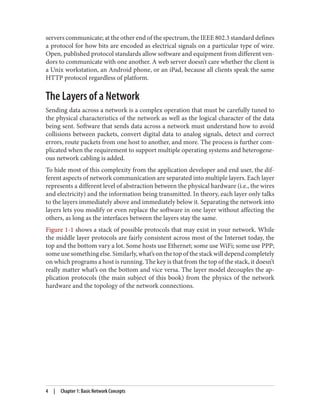
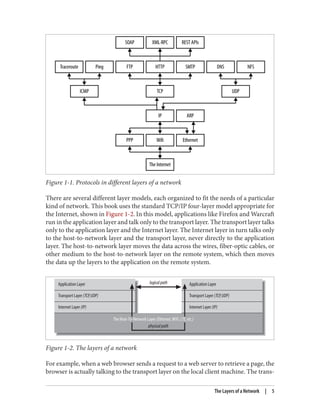
Figure 1-1 shows a stack of possible protocols that may exist in your network. While
the middle layer protocols are fairly consistent across most of the Internet today, the
top and the bottom vary a lot. Some hosts use Ethernet; some use WiFi; some use PPP;
some use something else. Similarly, what’s on the top of the stack will depend completely
on which programs a host is running. The key is that from the top of the stack, it doesn’t
really matter what’s on the bottom and vice versa. The layer model decouples the ap‐
plication protocols (the main subject of this book) from the physics of the network
hardware and the topology of the network connections.
4 | Chapter 1: Basic Network Concepts
33.
Figure 1-1. Protocolsin different layers of a network
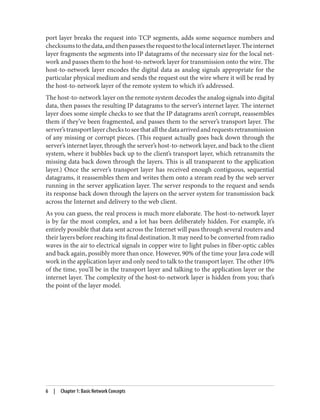
There are several different layer models, each organized to fit the needs of a particular
kind of network. This book uses the standard TCP/IP four-layer model appropriate for
the Internet, shown in Figure 1-2. In this model, applications like Firefox and Warcraft
run in the application layer and talk only to the transport layer. The transport layer talks
only to the application layer and the Internet layer. The Internet layer in turn talks only
to the host-to-network layer and the transport layer, never directly to the application
layer. The host-to-network layer moves the data across the wires, fiber-optic cables, or
other medium to the host-to-network layer on the remote system, which then moves
the data up the layers to the application on the remote system.
Figure 1-2. The layers of a network
For example, when a web browser sends a request to a web server to retrieve a page, the
browser is actually talking to the transport layer on the local client machine. The trans‐
The Layers of a Network | 5
34.
port layer breaksthe request into TCP segments, adds some sequence numbers and
checksumstothedata,andthenpassestherequesttothelocalinternetlayer.Theinternet
layer fragments the segments into IP datagrams of the necessary size for the local net‐
work and passes them to the host-to-network layer for transmission onto the wire. The
host-to-network layer encodes the digital data as analog signals appropriate for the
particular physical medium and sends the request out the wire where it will be read by
the host-to-network layer of the remote system to which it’s addressed.
The host-to-network layer on the remote system decodes the analog signals into digital
data, then passes the resulting IP datagrams to the server’s internet layer. The internet
layer does some simple checks to see that the IP datagrams aren’t corrupt, reassembles
them if they’ve been fragmented, and passes them to the server’s transport layer. The
server’stransportlayercheckstoseethatallthedataarrivedandrequestsretransmission
of any missing or corrupt pieces. (This request actually goes back down through the
server’s internet layer, through the server’s host-to-network layer, and back to the client
system, where it bubbles back up to the client’s transport layer, which retransmits the
missing data back down through the layers. This is all transparent to the application
layer.) Once the server’s transport layer has received enough contiguous, sequential
datagrams, it reassembles them and writes them onto a stream read by the web server
running in the server application layer. The server responds to the request and sends
its response back down through the layers on the server system for transmission back
across the Internet and delivery to the web client.
As you can guess, the real process is much more elaborate. The host-to-network layer
is by far the most complex, and a lot has been deliberately hidden. For example, it’s
entirely possible that data sent across the Internet will pass through several routers and
their layers before reaching its final destination. It may need to be converted from radio
waves in the air to electrical signals in copper wire to light pulses in fiber-optic cables
and back again, possibly more than once. However, 90% of the time your Java code will
work in the application layer and only need to talk to the transport layer. The other 10%
of the time, you’ll be in the transport layer and talking to the application layer or the
internet layer. The complexity of the host-to-network layer is hidden from you; that’s
the point of the layer model.
6 | Chapter 1: Basic Network Concepts
FAITH i ssman has taken from me the form of his being
and the manner of his speech. What to thee is evil, to another is
good, to thee it is poison, to another it is sweet honey. To me words
are nothing. I look into the heart of man." VII The Persian poet,
Mohammed Roumi, who lived in the thirteenth century, is the author
of the celebrated poem " Masnava." It contains some remarkable
verses on prayer which are worthy of a trusting soul : — " A certain
man cried out in the silence of the night, • Oh, Allah ! ' But Satan
answered, ' Be silent, thou fool, thou hast babbled enough already !
Thou wilt never hear an answer from the height of the throne,
however much thou mayst cry " Allah ! " and look disheartened.' "
The man's heart was troubled, and he hung his head. Then
appeared to him the prophet Kisr, and asked : ' Why hast thou
ceased to call on God, and repented of thy prayers ? ' The man
answered, ' I got no answer from Allah ; I heard no voice saying, " I
am here," and I fear that the gates of salvation are shut against me.'
Kisr answered, ' Thus has Allah commanded me, " Go thou to him
and say, ' Oh, man, tried by much, have I not commanded thee to
serve me ; have I not commanded thee to call on me. And my reply,
" Here am I " is the same as thine " Oh, Allah ! " Thy suffering, thy
ardour, and thy zeal, all these are my messengers to thee : when
37.
156 REFLECTIONS OFA RUSSIAN STATESMAN thou
strugglest with thyself and cryest for help, by this struggle and cry I
draw thee to myself, and answer thy prayer. Thy fear and thy love
are the signs of my forgiveness, and in thy words, "O Allah ! " is a
multitude of answers, " I am with thee." ' "
38.
THE IDEALS OFUNBELIEF The ancient words, " The fool
hath said in his heart, there is no God," apply with especial force to-
day. Their truth is plainer than the sun, although now all "
progressive minds " are possessed by a passionate desire to live
without God, to conceal Him, to deny His presence. Even men at
heart benevolent and honourable ask themselves how they may
realise benevolence, honour, and conscience without God. The
Government of France, in the last stage of political disintegration,
has organised its national schools without God. Among us,
unhappily, certain representatives of intelligence have rivalled the
Moscow princess, who said, " Ah, France, no better country in the
world ! " — for not long ago a celebrated schoolmaster pointed out
the French scholastic system as a model worthy of imitation. Among
the latest books officially prescribed for study in the female schools
of France is one entitled, " Instruction Morale et Civique des Jeunes
Filles." This is in the nature of a secular catechism of morals,
appointed to replace the study of the Word of God. This book is
worthy of notice. It is divided into three sections, each bearing a
different title. The first is composed of certain moral precepts on
duty, honesty, conscience, and so forth. The second part iS7
39.
158 REFLECTIONS OFA RUSSIAN STATESMAN contains a
short description of the State and of the national institutions. The
third part treats of woman, her mission, faculties, and virtues. The
matter in the book is concise, simple, and clear, written as a
textbook ought to be with a multitude of clear examples and
illustrations. No exception can be taken to the manner of this book ;
it preaches order, good morals, purity of thought and intention, kind
deeds ; it approves with emphasis the sentiment and recognition of
duty, and carefully sets forth a woman's duties in social and
domestic life. One thing alone is notable. On no single page is
mentioned the name of God, nor is there the slightest reference to
the religious feeling. The author, after explaining the great
importance of the part played in man by conscience, defines it thus :
" Conscience is our conception of the opinion which others ..have
about us and our actions" {consideration de Vopinion des antres).
On this treacherous and mutable base, the opinion of others, is
affirmed the moral foundation of our lives. How excellently this
illustrates the ancient proverb, " Who thinks himself too wise
becomes a fool." Unhappily, to this stream of idiotcy flooding France
to-day are drawn even from our poor Russia little rills of native
intelligence ; and in our newspapers and gazettes, in our leading
articles and feuilletons are repeated in chorus the words of the
Moscow princess. To the same chorus too often are drawn those
well-meaning, but simple and inexperienced men, who fancy
newspapers must bring to them some " new word " of civilisation.
Nothing is more deplorable than the reasoning on
40.
THE IDEALS OFUNBELIEF 159 the subject of education of
our journalist critics, who tell us that while religion and religious
training are indispensable, churches and ministers must be
abolished. Sometimes they speak more plainly. " We do not reject
religious teaching, we even demand it ; we cannot understand
education without it ; but we object to Clericalism." By this term we
must understand the Church and everything appertaining thereto.
This Jesuitical casuistry, which the apostles of popular education
have made peculiarly their own, misleads many readers who cannot
appreciate subtlety in writing. These good men do not know that the
word religion, as many other words, has changed its signification,
and is made by many to imply something from which, if they but
understood it, believers in God would recoil with abhorrence. They
do not know that in our time religion may exist without God, and
that the very word God, in its application by so-called men of
science, has a double meaning. In 1882 appeared a remarkable
book which awakened general interest. Therein the negation of God,
by the enemies of all religion, was expressed with ferocity, with
reckless and malicious irony, with a demand for the exclusive
consideration of matter in the universe. The first part of the work
expressed, in a tranquil tone, with dignity, with an ideal outlook on
life, the whole teaching of the religion without God. This book was
entitled "Natural Religion" (London, 1882). Its author, Professor
Seeley of Oxford, was he whose former "Ecce Homo," which
appeared ten years before, had attracted the attention, not only of
men of
41.
160 REFLECTIONS OFA RUSSIAN STATESMAN science, but
of religious idealists who sought in it some new word on Christ and
the Christian faith. A Russian translation of this latter work has been
published by an admirer. But to the adherents of the Church Mr
Seeley's work seemed strange and questionable. Few could look on
it without distrust. This book contained an artistic analysis of the
earthly life and character of Jesus Christ, treating exclusively of his
human nature. It was written in a spirit of deep piety, in the
language of philosophy, with occasional recourse to the terminology
of theologians. The object of the "work seemed to be to hold up the
image of Christ to pious imitation. The author, it seemed, was a
Christian, full of religious feeling. But many religious readers took
alarm, as if their views and sentiments of Christianity were not in
accord with the views and sentiments of the author. The picture of
Christ was a picture of supreme holiness, purity, and goodness, but
not that picture which we have been taught to venerate from
childhood — not the Christ honoured by the Christian Church.
Something discordant appeared throughout the book, as if the
author had either lost all faith, or was on the point of losing it.
Nevertheless, the writer plainly affirmed his faith in the existence of
a personal God ; in the immortality of the human soul ; in the
Messianic significance of the appearance of Christ ; and even,
although with some hesitation, in the reality of His miracles. Ten
years passed ; again Mr Seeley appeared as the inspired prophet of
religion, this time a new religion, and not the religion of Christ. The
ancient
42.
THE IDEALS OFUNBELIEF 161 revelation, he said, had
done its work ; instead, a new revelation had come ; the naturalists,
historians, and philologists of the age had borne us a revelation of
which the ancient prophets had never dreamed. The Biblical criticism
of German scholars was greater and more perfect than the Bible
itself. With uncommon simplicity, turning to the believers and
members of the Church, he asks : " Why should we quarrel, why
should there be strife between us? We may unite in a single faith.
We, men of science, also trust in God. Our God is Nature, which in
one sense is a revelation too. Therefore we are not -atheists," he
repeats, " and the battle between us, men of science, and you, men
of faith, is merely a battle of words. Is it not the same ? For us God
is Nature, and the scientific theory of the universe is a theory of
theism also. Nature is a force existing outside of us ; its law for us is
absolute : there is the divinity which we adore." Is it not strange that
the author, while rejecting the personal existence of God, at the
same time protests with energy against the accusation of atheism,
which he rejects and condemns? What is atheism, then? This
question Mr Seeley answers with a tortuous subtlety which to a
simple mind must seem insanity. "There is an atheism which is a
mere speculative crotchet, and there is an atheism which is a great
moral disease. . . . The purest form of such real atheism might be
called by the general name of wilfulness. All human activity is a
transaction with Nature. It is the arrangement of a compromise
between what we want on the one hand, and what Nature has
decreed on the other. Not to recognise anything but your own will, to
fancy anything within your reach if you only will strongly L
43.
162 REFLECTIONS OFA RUSSIAN STATESMAN enough, to
acknowledge no superior power outside yourself which must be
considered, and in some way propitiated, if you would succeed in
any undertaking : this is complete wilfulness, or, in other words,
pure atheism." — Seeley, " Natural Religion," p. 27. To illustrate this
obscure and disorderly argument, our author takes as example a
country in its fate a symbol of pure atheism, and points to Poland. "
Sedet aternumque sedebit" says he, " that unhappy Poland, not
indeed extinguished, but partitioned, and every thirty years
decimated anew, expiates the crime of atheistic wilfulness, the fatal
pleasure of unbounded individual liberty, which rose up against the
very nature of things." — Ibid. p. 29. Having disclosed this theory of
religion, he describes in detail how the religious feeling is born from
science, and, passing through the prism of imagination, is refracted
in the moral nature of man into a religious trinity : the religion of
Nature, the religion of Humanity, and the religion of Beauty. In this
book, written with talent and spirit, is a doctrine by no means new,
although for the first time expressed with such completeness. The
reader finds there the well-known features of the Positivism so
fashionable in our time — features familiar through the writings of
Kant, George Eliot, and Herbert Spencer — the well-beloved of
Russian translators. Not one of these writers exposes so clearly the
internal weakness of this fashionable theory as the author of "
Natural Religion." To what idiotcy must the mind have sunken when,
drawn by the pride of self-adoration, it rejects the supernatural in life
and nature, and strives to build a theory of life in relation to the
universe. This theory is condemned to turn in an
44.
THE IDEALS OFUNBELIEF 163 enchanted circle, and to
contradict itself for ever. Denying a personal God, in vain it would
sustain religion and establish an object of religious feeling; for,
except the living God, there can be no object of religion. Rejecting
the invisible world, the immortality of the soul, and the future life, it
proclaims that the end of life is happiness, and would confine
humanity within the limits of matter and of its earthly nature.
Condemning revelation as invention or fantasy, and every dogma as
falsehood, it seeks to support itself by a new dogma, proclaiming as
an indisputable axiom the constant and endless progress of
humanity. This theory, in a flash, reflects that wilfulness and that
obduracy of thought which our author combines in his conception of
atheism. It shows no sign of that clear and simple confidence which
serves as a symptom of the truth and durability of doctrines. In their
sermons on the happiness of humanity, its prophets all stumble on
an actuality which they cannot deny. This actuality is the inevitable
presence of evil and of evil works, of violence and of injustice in
human life — the argument of pessimism. This argument cannot be
lived down, although some of the apostles of Positivism strive to
stifle its voice or hypocritically to ignore it, while others, more
conscientious, stand by it with grief and questioning. To the number
of the last belongs our author. While extolling the new religion of
Nature, Humanity, and Beauty, and proving the strength and
actuality of the cult it preaches, at the same time he admits that
hardly have we found satisfaction in these ideas when pessimism
raises its head
45.
164 REFLECTIONS OFA RUSSIAN STATESMAN and brings
us to despair. If it were not for pessimism, he declares, nothing
would destroy our religious beliefs. And at the end of the book,
when crowning his edifice, he makes these remarks : "The more our
thoughts widen and deepen, as the universe grows upon us and we
become accustomed to boundless space and time, the more
petrifying is the contrast of our own insignificance, the more
contemptible become the pettiness, shortness, fragility of the
individual life. A moral paralysis creeps upon us. For a while we
comfort ourselves with the notion of self-sacrifice ; we say, What
matter if I pass, let me think of others ! But the other has become
contemptible no less than the self; all human griefs alike seem little
worth assuaging, human happiness too paltry at the best to be
worth increasing. The whole moral world is reduced to a point ; the
spiritual city, 'the goal of all the saints/ dwindles to the 'least of little
stars'; good and evil, right and wrong, become infinitesimal,
ephemeral matters, while eternity and infinity remain attributes of
that only which is outside the realm of morality. Life becomes more
intolerable the more we know and discover, so long as everything
widens and deepens, except our own duration, and that remains as
pitiful as ever. The affections die away in a world where everything
great and enduring is cold ; they die of their own conscious
feebleness and bloodlessness. "Supernatural Religion met this want
by connecting Love and Righteousness with eternity. If it is shaken,
how shall its place be supplied ? And what would Natural Religion
avail then ? " Ibid. p. 261. Who would believe that these words were
written by the ardent prophet of Natural Religion? Thus may a
serious mind be entangled in the intellectual network it weaves. The
essence of this work, with all its moderation of tone, with all the
sincerity of its author, is a joyless paradox. That the various systems
of cosmology, the scientific, the artistic, and the humanist, contain
elements of religious feeling cannot be denied.
46.
THE IDEALS OFUNBELIEF 165 But they do not embody the
elements of a new faith, of a new church ; they are separate limbs
— disjecta membra — of the Christian philosophy of life. Religion is
impossible without the recognition of axiomatic truths unattainable
by the path of induction. To such truths belong the existence of a
personal God, and the immaterial nature of the human soul, whence
springs supernaturalism, without which religion is inconceivable.
With the exception of mathematics, scientific truths are by their
nature hypothetical : they exist consciously only for scholars, and
only by deception may be imparted to the mass in dogmatic form.
This deception obtains among us and progresses — of this we find
fresh evidence every day. II Intolerance of strange beliefs and
strange opinions has never been so sharply expressed as it is
nowadays by the apostles of radical and negative beliefs, among
whom such intolerance is merciless and bitter, and joined with
animosity and contempt. When we consider the relations of these
teachers to the new doctrines they proclaim, their intolerance is
more abhorrent than the old religious intolerance which expressed
itself in sanguinary persecution. Then persecution was based on
unqualified faith in a truth which absolutely existed. When men
believe that they possess an absolute truth, sprung from the
ultimate principle of life and involving happiness for all, as the
Moslem believes in the Koran, it is conceivable that they may
consider it a duty r
47.
166 REFLECTIONS OFA RUSSIAN STATESMAN not only
openly to preach their doctrine, but, if need be, by violence to
enforce it upon others. But when it is merely an opinion, although it
may be that nothing is more probable for him who formed it, how
can we understand fanaticism so great that its advocate does not
admit not only contradiction but even compromise, although
conditional and temporary, with adverse opinion? Yet such
passionate attachment to their own convictions or to the doctrines of
their schools is an attribute to all the prophets of negation.
Rejecting, as if it were not, the whole former history of the spiritual
development of humanity, ignoring all ancient faiths and the spiritual
conditions of peoples, denying all rights of independent existence,
repelled not by the sanctity of personal faith, they claim admittance
to every soul, and everywhere strive to establish their new religion.
This they call the truth of their convictions. One of the
representatives of the doctrine of Comte and the Positivists (John
Morley "On Compromise") maintains that the first duty of every man
to himself and to humanity is to solve in his heart the question, Does
he or does he not believe in the existence of God ? Should he reach
the conviction that faith in God is no better than a blind and
unhealthy superstition, it is his sacred duty to break in with this
conviction on every soul, to take advantage of every occasion to
convert, firstly,his kinsmen and neighbours, and then, if possible, the
people ; to proclaim it everywhere, and in private and public life
wholly to renounce all forms and ceremonies which, directly or
indirectly, express a faith opposed to his conviction. What is this but
a terrible violence against the conscience of
48.
THE IDEALS OFUNBELIEF 167 others — and in the name
of what? In the name of a personal opinion. In this hell of vanity we
can find neither love nor faith. But without love and without faith
there can be no truth. How different to listen to the voice of the old
true teacher ! What faith and love, what knowledge of the human
soul is there in those words in which the Apostle to the Corinthians
enjoins respect for human conscience. He knows the truth, but with
his deep spiritual knowledge how cautiously would he approach the
human soul ! His purpose is that the soul shall accept and embrace
the new belief in the spirit of sincerity and truth by faith alone,
without disunion, without discord with itself. All that comes not from
faith is sin. And the Apostle teaches the strong and learned that they
must spare the consciences of their weaker brethren even in
superstition, when the soul is not ripe to accept the truth with entire
faith. The Apostle, the herald of Christian freedom, acting from
conviction, sacrifices freedom itself to the sanctity of conscience,
knowing that conscience is dearer than all. You know, says he, that
meat commendeth us not to God ; for neither if we eat are we the
better ; neither if we eat not are we the worse. You know that the
idol is nothing, that the false God does not exist, therefore with quiet
conscience buy meat and eat it, which was brought as sacrifice to
the idol. Ill Nothing is more surprising than the fatuity of clever men
who have grown up in estrangement from
49.
168 REFLECTIONS OFA RUSSIAN STATESMAN actual life,
and who are blinded by confidence in the infallibility of logic. By
adoration of reason they are seduced from religion, and at last
incited to hatred of every faith in the only living God. But those who
at the same time are men of conscience, find that they cannot rid
themselves of the aspiration to faith innate in humanity ; those
whose hearts are unhardened by the severity of logic admit the
lawfulness of religious feeling in man, and strive to satisfy it by some
religion devised by themselves. We may wonder at the fancifulness
of plans contrived by minds apparently striving to drive away
everything like fancy out of their reasoning and deliberations.
Strauss, in his work on "The Old and the New Faith," while rejecting
Christianity, speaks with enthusiasm of the religious sentiment, but
as its object and centre replaces the living God with the idea of the
World, the so-called Universum. After the death of Mill, his
occasional thoughts on religion appeared in London under the title, "
Three Essays on Religion : Nature, the Utility of Religion, and
Theism." The utility of religion he admits without reserve, and, while
rejecting Christianity, he speaks of the individual Christ with the
greatest enthusiasm. "The value of religion to the individual, both in
the past and present, as a source of personal satisfaction and of
elevated feelings, is not to be disputed. But it has still to be
considered whether, in order to obtain this good, it is necessary to
travel beyond the boundaries of the world which we inhabit j or
whether the idealisation of our earthly life, the cultivation of a high
conception of what it may be made, is not capable of supplying a
poetry, and, in the best sense of the word, a religion, equally fitted
to exalt the feelings, and (with the same aid from education) still
better calcu
50.
THE IDEALS OFUNBELIEF 169 lated to ennoble the
conduct, than any belief respecting the unseen powers." "Three
Essays on Religion" (Utility of Religion), pp. 104-5. London, 1874.
The question is worthy of Mill as we know him by the history of his
education. It is interesting to note how in his decision of this
question, Mill could not, with Strauss, accept as decisive the idea of
the Universe, for Mill, strange to say, did not trust in Nature. In the
beginning of the same book, true as ever to his estrangement from
reality, he speaks of " Enquiry into the truth of the doctrines which
make Nature a test of right and wrong, good and evil, or which in
any mode or degree attach merit or approval to following, imitating,
or obeying Nature." — Ibid. (Nature), p. 13. These doctrines Mill
rejects, for in Nature he sees blind force and nothing more. Nature
inspires desires which it does not satisfy ; it builds great edifices,
powers, and actions, in a moment to overthrow them ; it destroys
blindly and indiscriminately all that it has created. For this reason Mill
declines to construct on Nature any system of morals or of religion.
What, then, does he think ? These are his own words : "When we
consider how ardent a sentiment, in favourable circumstances of
education, the love of country has become, we cannot judge it
impossible that the love of that larger country, the world, may be
nursed into similar strength, both as a source of elevated emotion
and as a principle of duty. He who needs any other lesson on this
subject than the whole course of ancient history affords, let him read
Cicero De Officiis. It cannot be said that the standard of morals laid
down in that celebrated treatise is a high standard. To our notions, it
is on many points unduly lax, and admits capitu
51.
170 REFLECTIONS OFA RUSSIAN STATESMAN lations of
conscience. But on the subject of duty to our country there is no
compromise. That any man, with the smallest pretensions to virtue,
could hesitate to sacrifice life, reputation, family, everything valuable
to him, to the love of country, is a supposition which this eminent
interpreter of Greek and Roman morality cannot entertain for a
moment. If, then, persons could be trained, as we see they were,
not only to believe in theory that the good of their country was an
object to which all others ought to yield, but to feel this practically
as the grand duty of life, so also may they be made to feel the same
absolute obligation towards the universal good. A morality grounded
on large and wise views of the whole, neither sacrificing the
individual to the aggregate nor the aggregate to the individual, but
giving to duty, on the one hand, and to freedom and spontaneity, on
the other, their proper province, would derive its power in the
superior natures from sympathy and benevolence and the passion
for ideal excellence ; in the inferior, from the same feelings cultivated
up to the measure of their capacity, with the superadded force of
shame. This exalted morality would not depend for its ascendency
on any hope of reward ; but the reward which might be looked for,
and the thought of which would be a consolation in suffering, and a
support in moments of weakness, would not be a problematical
future existence, but the approbation in this of those whom we
respect, and ideally of all those, dead or living, whom we admire or
venerate. For, the thought that our dead parents or friends would
have approved our conduct is a scarcely less powerful motive than
the knowledge that our living ones do approve it ; and the idea that
Socrates, or Howard or Washington, or Antoninus, or Christ, would
have sympathised with us, or that we are attempting to do our part
in the spirit in which they did theirs, has operated on the very best
minds as a strong incentive to act up to their highest feelings and
convictions. "To call these sentiments by the name of morality,
exclusively of any other title, is claiming too little for them. They are
a real religion 5 of which, as of other religions, outward good works
(the utmost meaning usually suggested by the word morality) are
52.
only a part,and are indeed rather the fruits of the religion than the
religion itself. The essence of religion is the strong and earnest
direction of the emotions and desires towards an ideal object,
recognised as of the highest excellence, and as rightfully paramount
53.
THE IDEALS OFUNBELIEF 171 over all selfish objects of
desire. This condition is fulfilled by the Religion of Humanity in an
eminent degree, and in as high a sense, as by the supernatural
religions even in their best manifestations, and far more so than in
any of their others." Ibid. (Utility of Religion), pp. 107-9. The
foregoing words explain themselves. They show the narrowness, we
should say rather the idiotcy, of human wisdom when it seeks an
abstract conception of life and of humanity, while ignoring life itself,
and rejecting the human soul. Such a religion may indeed be
sufficient for thinkers like Mill, secluded from the world in abstract
speculation, but how shall the people accept and understand it ? —
the people, a living organism held in communion only by living
sentiment and conscience, and repelled by abstractions and
generalities. In the people, such a religion, if it bore fruit at all,
would bear fruit in reversion to paganism. The people — which we
cannot conceive detached from Nature — if it forgot the faith of its
fathers, would again personify the idea, either of the universe,
resolving it into separate forces, or of that humanity which stands as
a binding spiritual principle, resolving it also into its representative
spiritual forces ; and there would result so many false gods instead
of one true God. It cannot be that we are condemned to suffer this?
54.
THE NEW RELIGIONAND THE NEW MARRIAGE We are told
that our religion is drawing to its end, that a new faith will replace it,
the dawn of which is on the point of appearing. God grant that this
maybe delayed, and that, if it must come, it may not be for long !
For it will not be a time of enlightenment, but of darkness. The
ancient faith contains all that human nature has of sincerity — the
sincerity of direct sensations and conscience, the sincerity which,
from the depths of our spiritual nature, corresponds to the words of
divine revelation. This is a living truth, and its roots are sunken in
the souls of all. Of it was it said : " Every one that is of the truth
heareth my voice." The ancient faith was founded on the
consciousness of every man of a living soul which is immortal and
one, a living soul he confounds neither with Nature nor with
humanity. By this ' he knows himself before God and before his
fellow-men, by this he wishes to live eternally. By this he enters into
the free alliance of love with others, and, as he lives in his soul, so
he answers for it himself. Through this the existence of his Creator is
revealed as simply as his own life, and by this simple feeling,
independently of reason, he maintains his faith. The prophets of a
new religion appear. Some laugh at the ancient faith, and would
destroy it, 172
55.
THE NEW RELIGIONAND THE NEW MARRIAGE 173
without the will to create anew. Others appear more serious ; they
seek supreme wisdom, and strive to impose on us a wisdom of their
own. Each offers us his own conception of truth, his favourite system
of religion, for all apprehend the necessity of religion, and each
would create one himself. How pitiable are these creations I They
lack the power to draw the living soul and inspire it with a living
idea, for not one of them sets the living spirit of God in the centre of
his faith. In recent times many various systems have appeared from
the pens of philosophers, each at will attempting to construct for
humanity a faith without God. Each would constitute his system on
the basis of reason, by its nature an absurdity. For human reason in
a straight path, ignoring and rejecting no facts of Nature or of the
human soul, can never eliminate the idea of God. The true source of
atheism is not in the mind but in the heart, for, as the prophet said,
"The fool hath said in his heart, there is no God." In the heart, that
is, in the will, is the source of all error, however reason may seek to
explain it. Error is born by the desire of the heart for full freedom, by
rebellion against the commandments, and against Him who is the
beginning and the end of all commandments. To free oneself of the
commandments, there is no other path than to reject their supreme
authority, and to replace it by the authority of self. The oldest of
human histories is repeated from generation to generation, " Ye shall
be as gods, knowing good and evil." This has been the source of
atheism from immemorial time. It is wonderful, indeed, how reason
deceives itself.
56.
174 REFLECTIONS OFA RUSSIAN STATESMAN Without God
it seems that there can be no religion, yet such a religion is
proclaimed by atheists. They say, " In the place of these outworn
tales of God let us put the truth. God is nowhere visible, while
Nature and humanity are actual facts. Humanity is not only a fact, it
is a force able, by the paths of reason and experience, to attain in
the course of centuries unimaginable perfection. This idea of
progression contains such internal force and profundity that it is
enough to compensate man for religious sentiment, and to bind the
race in the universal religion of humanity." Is this not the Biblical, "
Ye shall be as gods " ? Such are the doctrines of modern Positivist
science, and of the so-called Utilitarianism. From another side
appears the celebrated apostle of the Tubingen school, the pillar of
Biblical criticism, who lived to an old age in denial of the historic
foundation of Christianity. This is Dr Strauss, the author of the " Life
of Jesus " ; the author of " The Old and the New Religion," in which
he himself says he has made his confession, and given to the world
the result of all his learned labours and philosophical speculations on
God, on Nature, and on humanity. In youth, in the " Life of Jesus,"
he undertook, with some respect and caution, the analysis of those
facts consecrated by the traditional belief of man, touching with
tenderness the fundamental ideas of faith. In this work is seen a
remnant of respect for God. But later we find a furious irritation
against the Godhead, as a false and pernicious fable which has
corrupted the minds of mankind. But while rejecting God, by a
strange incon
57.
THE NEW RELIGIONAND THE NEW MARRIAGE 175
sistency of thought, he does not abandon the religious feeling. In
himself he feels the necessity, and affirms the existence, of religious
devotion. What is the object of this devotion, which at the same
time has power to possess and inspire the soul ? Not a personal
divinity which exists not, but the world {Uftiversum) which
constitutes the source of all good and power — which exists by the
law of pure reason. We demand, he says, for this Universe the same
devout feeling as a good man of the ancient faith cherished towards
God. What is this Universe, and what its spiritual element?
Answering that question, Strauss reveals himself as a disciple of the
Positivist philosophy, and of the new materialism. The doctrine of
Kant and of Laplace on the exclusive activity of mechanical forces in
the planetary system, he applies absolutely to all the phenomena of
animal and spiritual life ; he regards the soul of man as nothing
better than the result of the complex interaction of mechanical
forces. The soul as a spiritual essence Strauss rejects. As might be
expected, he accepts triumphantly the theories of Darwin on the
Origin of Species, limiting not their application to the phenomena of
the external world, but extending them capriciously to all the
manifestations of life. The imperfection and inconsistency of
Darwin's reasonings do not alarm him in the least. All doubt is
eliminated by his new religion, by faith in his own hypothesis,
incompatible, he tells us, with the existence of God. It matters not
that such abstract hypotheses as spontaneous generation remain
unproven. He cannot say how or when, but without doubt some day
they
58.
REFLEC70NS OF ARUSSIAN STATESMAN will be prove. In
considering the origin of man, he does not rouble to explain and
reconcile the origin of his intellectual powers, his moral ideas, and
his aesthcic conceptions. All is explained by the magic wois, "Natural
Selection." Surely, if this capricious inituation with theory constitutes
the new religion, hat religion is nothing better than a new
superstitm. The doctrie of Darwin could not have appeal at a time
mre opport new religion. It enlighu it gave ther. the keystc crown the
valt of their his teaching with eagerne that the anent faith wa
annihilated. From every apply his pnciples to all life, deducin
conclusions Darwin neve dreamed, pupils out-cstanced the ma near
when tey will condemn Meantime, te doctrines of application ■> the
facts from hardly justif those apprehensio the faith wich they
awakened herents. Th system of Galile Newton, all ew discoveries in
ge their day aakei more agitati the faith ofl in no will it be " these
are nt re and the firsfcnthusic to wane. Tey are ac the prophets of
with a new 1 they sougl They seized then proc :rthrohast lena it /
61.
Welcome to ourwebsite – the ideal destination for book lovers and
knowledge seekers. With a mission to inspire endlessly, we offer a
vast collection of books, ranging from classic literary works to
specialized publications, self-development books, and children's
literature. Each book is a new journey of discovery, expanding
knowledge and enriching the soul of the reade
Our website is not just a platform for buying books, but a bridge
connecting readers to the timeless values of culture and wisdom. With
an elegant, user-friendly interface and an intelligent search system,
we are committed to providing a quick and convenient shopping
experience. Additionally, our special promotions and home delivery
services ensure that you save time and fully enjoy the joy of reading.
Let us accompany you on the journey of exploring knowledge and
personal growth!
ebookname.com
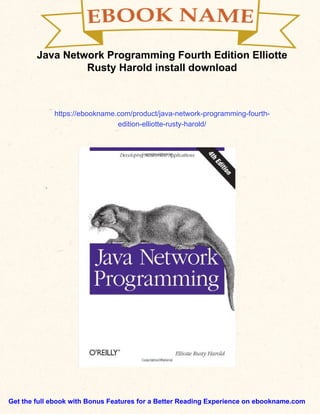
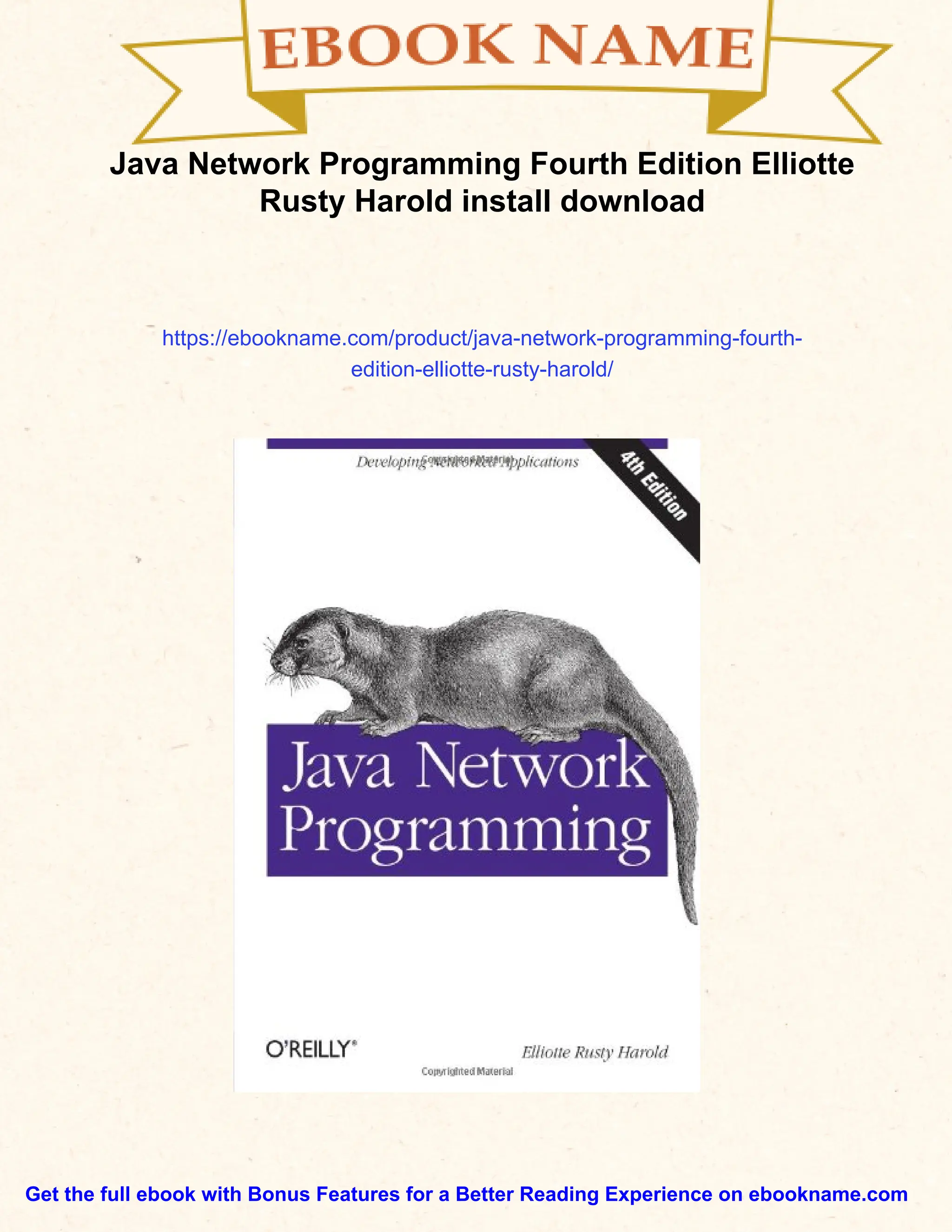


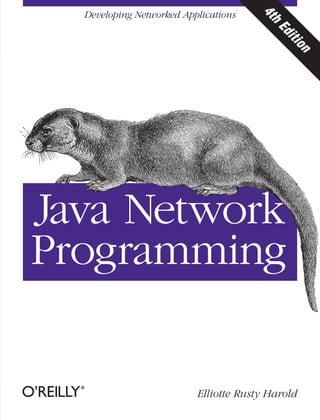
![Java Network Programming, Fourth Edition
by Elliotte Rusty Harold
Copyright © 2014 Elliotte Rusty Harold. All rights reserved.
Printed in the United States of America.
Published by O’Reilly Media, Inc., 1005 Gravenstein Highway North, Sebastopol, CA 95472.
O’Reilly books may be purchased for educational, business, or sales promotional use. Online editions are
alsoavailableformosttitles(http://my.safaribooksonline.com).Formoreinformation,contactourcorporate/
institutional sales department: 800-998-9938 or corporate@oreilly.com.
Editor: Meghan Blanchette
Production Editor: Nicole Shelby
Copyeditor: Kim Cofer
Proofreader: Jasmine Kwityn
Indexer: Judy McConville
Cover Designer: Randy Comer
Interior Designer: David Futato
Illustrator: Rebecca Demarest
October 2013: Fourth Edition
Revision History for the Fourth Edition:
2013-09-23: First release
See http://oreilly.com/catalog/errata.csp?isbn=9781449357672 for release details.
Nutshell Handbook, the Nutshell Handbook logo, and the O’Reilly logo are registered trademarks of O’Reilly
Media, Inc. Java Network Programming, the image of a North American river otter, and related trade dress
are trademarks of O’Reilly Media, Inc.
Many of the designations used by manufacturers and sellers to distinguish their products are claimed as
trademarks. Where those designations appear in this book, and O’Reilly Media, Inc., was aware of a trade‐
mark claim, the designations have been printed in caps or initial caps.
While every precaution has been taken in the preparation of this book, the publisher and author assume no
responsibility for errors or omissions, or for damages resulting from the use of the information contained
herein.
ISBN: 978-1-449-35767-2
[LSI]](https://image.slidesharecdn.com/69220-250721122359-8b368991/85/Java-Network-Programming-Fourth-Edition-Elliotte-Rusty-Harold-8-320.jpg)


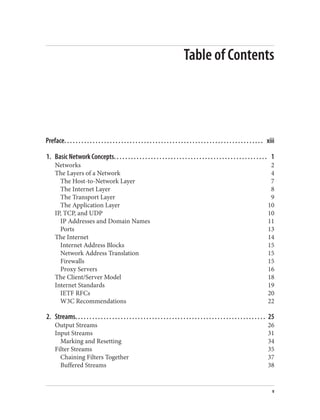



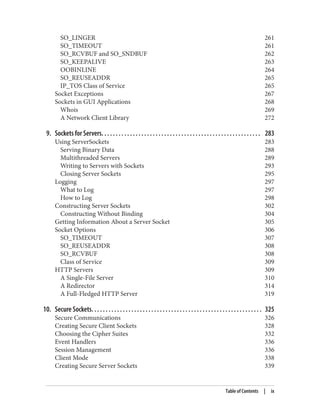



![When code is presented as fragments rather than complete programs, the existence of
the appropriate import statements should be inferred. For example, in the preceding
code fragment you may assume that java.net.Socket was imported.
Some examples intermix user input with program output. In these cases, the user input
will be displayed in bold, as in this example from Chapter 9:
% telnet rama.poly.edu 7
Trying 128.238.10.212...
Connected to rama.poly.edu.
Escape character is '^]'.
This is a test
This is a test
This is another test
This is another test
9876543210
9876543210
^]
telnet> close
Connection closed.
Finally, although many of the examples used here are toy examples unlikely to be reused,
a few of the classes I develop have real value. Please feel free to reuse them or any parts
of them in your own code. No special permission is required. They are in the public
domain (although the same is most definitely not true of the explanatory text!).
Request for Comments
I enjoy hearing from readers, whether with general comments about this book, specific
corrections, other topics they would like to see covered, or just war stories about their
own network programming travails. You can reach me by sending an email to
elharo@ibiblio.org.Pleaserealize,however,thatIreceiveseveralhundredpiecesofemail
a day and cannot personally respond to each one. For the best chance of getting a per‐
sonal response, please identify yourself as a reader of this book. If you have a question
about a particular program that isn’t working as you expect, try to reduce it to the
simplest case that reproduces the bug, preferably a single class, and paste the text of the
entire program into the body of your email. Unsolicited attachments will be deleted
unopened. And please, please send the message from the account you want me to reply
to and make sure that your Reply-to address is properly set! There’s nothing quite so
frustrating as spending an hour or more carefully researching the answer to an inter‐
esting question and composing a detailed response, only to have it bounce because my
correspondentsentherfeedbackfromapublicterminalandneglectedtosetthebrowser
preferences to include her actual email address.
I also adhere to the old saying “If you like this book, tell your friends. If you don’t like
it, tell me.” I’m especially interested in hearing about mistakes. This is the fourth edition.
I’ve yet to make it perfect, but I keep trying. As hard as I and the editors at O’Reilly
Preface | xix](https://image.slidesharecdn.com/69220-250721122359-8b368991/85/Java-Network-Programming-Fourth-Edition-Elliotte-Rusty-Harold-25-320.jpg)