Fundamental Concepts


   OWASP Hyderabad
    Oct 10th, 2009

  Marc-André Laverdière
Agenda
●   Network Basics
●   IP, TCP, UDP, DNS
●   Internet Architecture
●   Static Web architecture
●   HTTP features
●   REST-based architecture


    (P.S. All images courtesy of Wikipedia)
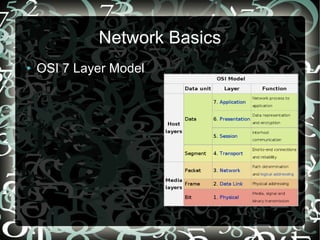
Network Basics
●   OSI 7 Layer Model
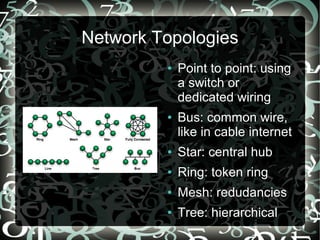
Network Topologies
         ●   Point to point: using
             a switch or
             dedicated wiring
         ●   Bus: common wire,
             like in cable internet
         ●   Star: central hub
         ●   Ring: token ring
         ●   Mesh: redudancies
         ●   Tree: hierarchical
Network Terms
●   Client: computer that requests a service
●   Server: computer that fulfills the request
●   Gateway: point of contact to another network
●   Proxy: intermediary for making requests to servers.
    Often caches resources
●   Router: forwards information
●   Hub: connects many network segments
●   Switch: more efficient hub
●   Link: connection between two points
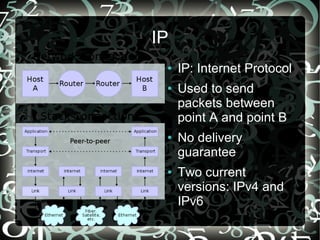
IP
 ●   IP: Internet Protocol
 ●   Used to send
     packets between
     point A and point B
 ●   No delivery
     guarantee
 ●   Two current
     versions: IPv4 and
     IPv6
IPv4 vs IPv6
●   IPv6 adds many features to IPv4:
       –   Greater address space
       –   Supports autoconfiguration
       –   Multicast
       –   Mandatory IPSec (encryption, authentication,
            tunelling)
       –   Removed rare fields, redundant checksum
       –   Larger max packet size (4GB)
       –   Support for mobile devices
NAT
●   Network Address Translation, used with IP
    masquerading
●   Used to make one IP address as front-end
    for many. E.g. Wireless hub+router
●   Gateway rewrites the packets so that they
    look like they all originate from the gateway
●   Breaks some applications, like SIP and some
    peer-to-peer clients
TCP
●   Transmission Control Protocol
●   Allows reliable transmissions
●   Error detection
●   Flow/congestion control
●   Add concept of port
●   Connection-based
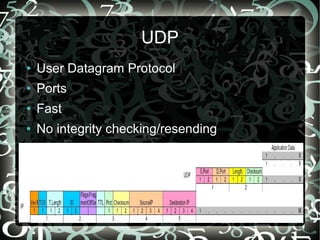
UDP
●   User Datagram Protocol
●   Ports
●   Fast
●   No integrity checking/resending
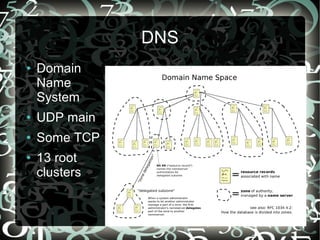
DNS
●   Domain
    Name
    System
●   UDP main
●   Some TCP
●   13 root
    clusters
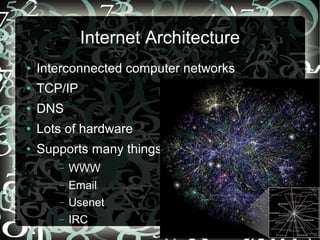
Internet Architecture
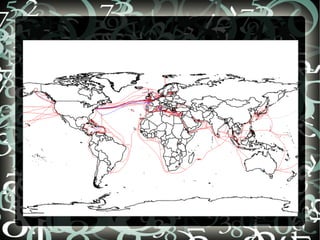
●   Interconnected computer networks
●   TCP/IP
●   DNS
●   Lots of hardware
●   Supports many things
       –   WWW
       –   Email
       –   Usenet
       –   IRC
Static Web Architecture
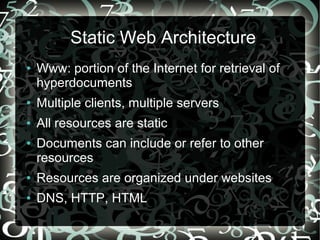
●   Www: portion of the Internet for retrieval of
    hyperdocuments
●   Multiple clients, multiple servers
●   All resources are static
●   Documents can include or refer to other
    resources
●   Resources are organized under websites
●   DNS, HTTP, HTML
HTTP
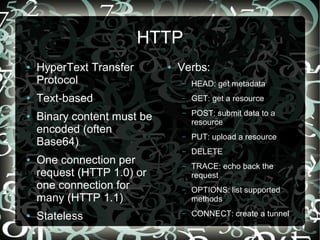
●   HyperText Transfer       ●   Verbs:
    Protocol                     –   HEAD: get metadata
●   Text-based                   –   GET: get a resource
                                     POST: submit data to a
●   Binary content must be       –
                                     resource
    encoded (often
                                 –   PUT: upload a resource
    Base64)
                                 –   DELETE
●   One connection per           –   TRACE: echo back the
    request (HTTP 1.0) or            request
    one connection for           –   OPTIONS: list supported
    many (HTTP 1.1)                  methods
●   Stateless                    –   CONNECT: create a tunnel
HTTP Request
●   User-Agent Opera/9.64 (X11; Linux i686; U; en)
    Presto/2.1.1
●   Host   www.wired.com
●   Accept   text/html, application/xml;q=0.9,
    application/xhtml+xml, image/png, image/jpeg,
    image/gif, image/x-xbitmap, */*;q=0.1
●   Accept-Language    en-IN,en;q=0.9
●   Accept-Charset iso-8859-1, utf-8, utf-16, *;q=0.1
●   Accept-Encoding    deflate, gzip, x-gzip, identity,
    *;q=0
●   Cookie    [cut]
●   Cookie2   $Version=1
●   Proxy-Connection   Keep-Alive
HTTP Response Header
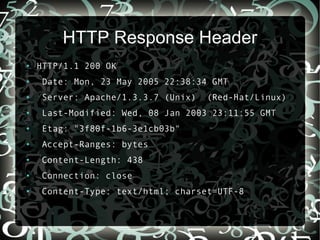
●   HTTP/1.1 200 OK
●    Date: Mon, 23 May 2005 22:38:34 GMT
●    Server: Apache/1.3.3.7 (Unix)   (Red-Hat/Linux)
●    Last-Modified: Wed, 08 Jan 2003 23:11:55 GMT
●    Etag: "3f80f-1b6-3e1cb03b"
●    Accept-Ranges: bytes
●    Content-Length: 438
●    Connection: close
●    Content-Type: text/html; charset=UTF-8
Cookies
●   Cookies are values determined by the server
    that are stored by the client
●   The client automatically sends the cookie
    value on every request to the server
REST-Based Architecture
●   Problem: what I described is static. We need
    to execute code to have Web Applications
●   Principles:
        –   Everything goes through the resources.
             Resources are different than the
             representation given to the clients
        –   Resources can be manipulated through the
             representation
        –   Each message is self-descriptive
        –   Hypermedia contains the application state
Essentially
●   Applications react to queries from the clients
    only. Nothing happens without a query.
●   Resource access is free to trigger any
    processing

Network concepts

  • 1.
    Fundamental Concepts OWASP Hyderabad Oct 10th, 2009 Marc-André Laverdière
  • 2.
    Agenda ● Network Basics ● IP, TCP, UDP, DNS ● Internet Architecture ● Static Web architecture ● HTTP features ● REST-based architecture (P.S. All images courtesy of Wikipedia)
  • 3.
    Network Basics ● OSI 7 Layer Model
  • 4.
    Network Topologies ● Point to point: using a switch or dedicated wiring ● Bus: common wire, like in cable internet ● Star: central hub ● Ring: token ring ● Mesh: redudancies ● Tree: hierarchical
  • 5.
    Network Terms ● Client: computer that requests a service ● Server: computer that fulfills the request ● Gateway: point of contact to another network ● Proxy: intermediary for making requests to servers. Often caches resources ● Router: forwards information ● Hub: connects many network segments ● Switch: more efficient hub ● Link: connection between two points
  • 6.
    IP ● IP: Internet Protocol ● Used to send packets between point A and point B ● No delivery guarantee ● Two current versions: IPv4 and IPv6
  • 7.
    IPv4 vs IPv6 ● IPv6 adds many features to IPv4: – Greater address space – Supports autoconfiguration – Multicast – Mandatory IPSec (encryption, authentication, tunelling) – Removed rare fields, redundant checksum – Larger max packet size (4GB) – Support for mobile devices
  • 8.
    NAT ● Network Address Translation, used with IP masquerading ● Used to make one IP address as front-end for many. E.g. Wireless hub+router ● Gateway rewrites the packets so that they look like they all originate from the gateway ● Breaks some applications, like SIP and some peer-to-peer clients
  • 9.
    TCP ● Transmission Control Protocol ● Allows reliable transmissions ● Error detection ● Flow/congestion control ● Add concept of port ● Connection-based
  • 10.
    UDP ● User Datagram Protocol ● Ports ● Fast ● No integrity checking/resending
  • 11.
    DNS ● Domain Name System ● UDP main ● Some TCP ● 13 root clusters
  • 12.
    Internet Architecture ● Interconnected computer networks ● TCP/IP ● DNS ● Lots of hardware ● Supports many things – WWW – Email – Usenet – IRC
  • 14.
    Static Web Architecture ● Www: portion of the Internet for retrieval of hyperdocuments ● Multiple clients, multiple servers ● All resources are static ● Documents can include or refer to other resources ● Resources are organized under websites ● DNS, HTTP, HTML
  • 15.
    HTTP ● HyperText Transfer ● Verbs: Protocol – HEAD: get metadata ● Text-based – GET: get a resource POST: submit data to a ● Binary content must be – resource encoded (often – PUT: upload a resource Base64) – DELETE ● One connection per – TRACE: echo back the request (HTTP 1.0) or request one connection for – OPTIONS: list supported many (HTTP 1.1) methods ● Stateless – CONNECT: create a tunnel
  • 16.
    HTTP Request ● User-Agent Opera/9.64 (X11; Linux i686; U; en) Presto/2.1.1 ● Host www.wired.com ● Accept text/html, application/xml;q=0.9, application/xhtml+xml, image/png, image/jpeg, image/gif, image/x-xbitmap, */*;q=0.1 ● Accept-Language en-IN,en;q=0.9 ● Accept-Charset iso-8859-1, utf-8, utf-16, *;q=0.1 ● Accept-Encoding deflate, gzip, x-gzip, identity, *;q=0 ● Cookie [cut] ● Cookie2 $Version=1 ● Proxy-Connection Keep-Alive
  • 17.
    HTTP Response Header ● HTTP/1.1 200 OK ● Date: Mon, 23 May 2005 22:38:34 GMT ● Server: Apache/1.3.3.7 (Unix) (Red-Hat/Linux) ● Last-Modified: Wed, 08 Jan 2003 23:11:55 GMT ● Etag: "3f80f-1b6-3e1cb03b" ● Accept-Ranges: bytes ● Content-Length: 438 ● Connection: close ● Content-Type: text/html; charset=UTF-8
  • 18.
    Cookies ● Cookies are values determined by the server that are stored by the client ● The client automatically sends the cookie value on every request to the server
  • 19.
    REST-Based Architecture ● Problem: what I described is static. We need to execute code to have Web Applications ● Principles: – Everything goes through the resources. Resources are different than the representation given to the clients – Resources can be manipulated through the representation – Each message is self-descriptive – Hypermedia contains the application state
  • 20.
    Essentially ● Applications react to queries from the clients only. Nothing happens without a query. ● Resource access is free to trigger any processing