

Introduction to Data Models
and Cisco's NextGen
Device-Level APIs
Einar Nilsen-Nygaard
Principal Engineer, Cisco
• Why network programmability matters
• Why data models?
• Industry & Cisco approach
• Tooling
• Conclusion
Agenda
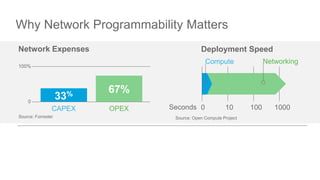
Why Network Programmability Matters
0
100%
67%
Source: Forrester
CAPEX OPEX
33%
0 10 100 1000
Compute Networking
Seconds
Source: Open Compute Project
Network Expenses Deployment Speed
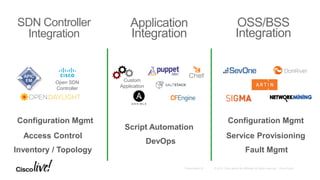
SDN Controller
Integration
Open SDN
Controller
Inventory / Topology
Configuration Mgmt
Access Control
Script Automation
DevOps
Custom
Application
Service Provisioning
Fault Mgmt
Configuration Mgmt
Application
Integration
OSS/BSS
Integration
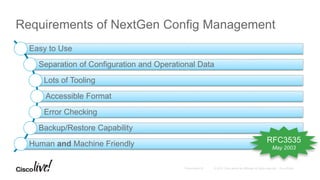
Requirements of NextGen Config Management
Easy to Use
Separation of Configuration and Operational Data
Lots of Tooling
Accessible Format
Error Checking
Backup/Restore Capability
Human and Machine Friendly RFC3535
May 2003
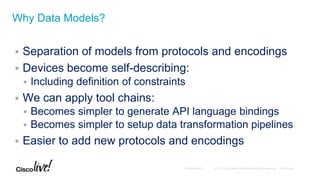
 Separation of models from protocols and encodings
 Devices become self-describing:
 Including definition of constraints
 We can apply tool chains:
 Becomes simpler to generate API language bindings
 Becomes simpler to setup data transformation pipelines
 Easier to add new protocols and encodings
Why Data Models?
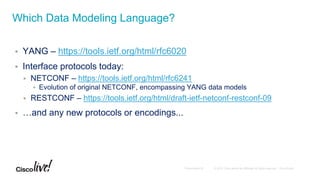
 YANG – https://tools.ietf.org/html/rfc6020
 Interface protocols today:
 NETCONF – https://tools.ietf.org/html/rfc6241
 Evolution of original NETCONF, encompassing YANG data models
 RESTCONF – https://tools.ietf.org/html/draft-ietf-netconf-restconf-09
 …and any new protocols or encodings...
Which Data Modeling Language?
Cisco’s Approach
9
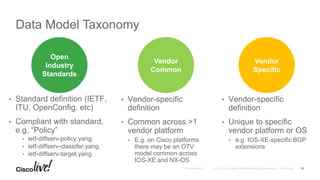
Data Model Taxonomy
10
• Standard definition (IETF,
ITU, OpenConfig, etc)
• Compliant with standard,
e.g. “Policy”
• ietf-diffserv-policy.yang,
• ietf-diffserv-classifer.yang,
• ietf-diffserv-target.yang
Open
Industry
Standards
• Vendor-specific
definition
• Common across >1
vendor platform
• E.g. on Cisco platforms
there may be an OTV
model common across
IOS-XE and NX-OS
Vendor
Common
• Vendor-specific
definition
• Unique to specific
vendor platform or OS
• e.g. IOS-XE-specific BGP
extensions
Vendor
Specific
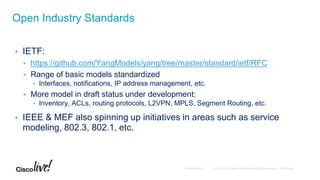
 IETF:
 https://github.com/YangModels/yang/tree/master/standard/ietf/RFC
 Range of basic models standardized
 Interfaces, notifications, IP address management, etc.
 More model in draft status under development:
 Inventory, ACLs, routing protocols, L2VPN, MPLS, Segment Routing, etc.
 IEEE & MEF also spinning up initiatives in areas such as service
modeling, 802.3, 802.1, etc.
Open Industry Standards
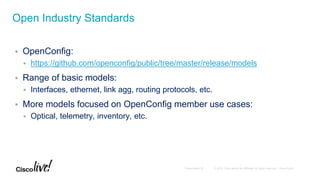
 OpenConfig:
 https://github.com/openconfig/public/tree/master/release/models
 Range of basic models:
 Interfaces, ethernet, link agg, routing protocols, etc.
 More models focused on OpenConfig member use cases:
 Optical, telemetry, inventory, etc.
Open Industry Standards
 Vendors such as Brocade, Cisco, YumaWorks:
 https://github.com/YangModels/yang/tree/master/vendor
Vendor-Specific
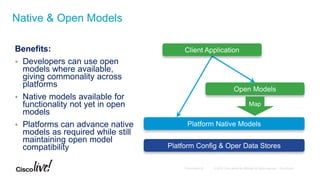
Benefits:
 Developers can use open
models where available,
giving commonality across
platforms
 Native models available for
functionality not yet in open
models
 Platforms can advance native
models as required while still
maintaining open model
compatibility
Native & Open Models
Open Models
Platform Native Models
Platform Config & Oper Data Stores
Map
Client Application
Tooling
15
 pyang (open source)
 pip install pyang
 https://github.com/mbj4668/pyang
 goyang (open source)
 https://github.com/openconfig/goyang
 YANG Design Studio (open source, AT&T)
 https://github.com/openconfig/yang-design-studio
YANG Schema Tools
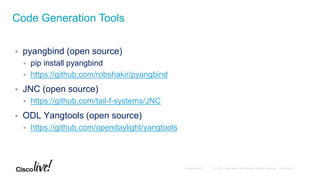
 pyangbind (open source)
 pip install pyangbind
 https://github.com/robshakir/pyangbind
 JNC (open source)
 https://github.com/tail-f-systems/JNC
 ODL Yangtools (open source)
 https://github.com/opendaylight/yangtools
Code Generation Tools
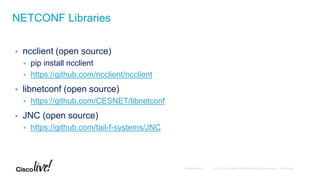
 ncclient (open source)
 pip install ncclient
 https://github.com/ncclient/ncclient
 libnetconf (open source)
 https://github.com/CESNET/libnetconf
 JNC (open source)
 https://github.com/tail-f-systems/JNC
NETCONF Libraries
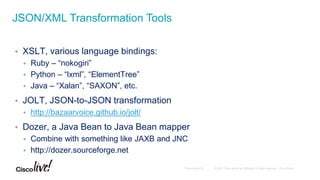
 XSLT, various language bindings:
 Ruby – “nokogiri”
 Python – “lxml”, “ElementTree”
 Java – “Xalan”, “SAXON”, etc.
 JOLT, JSON-to-JSON transformation
 http://bazaarvoice.github.io/jolt/
 Dozer, a Java Bean to Java Bean mapper
 Combine with something like JAXB and JNC
 http://dozer.sourceforge.net
JSON/XML Transformation Tools
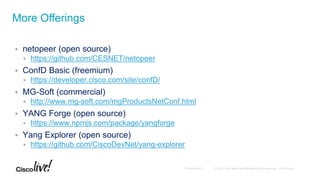
 netopeer (open source)
 https://github.com/CESNET/netopeer
 ConfD Basic (freemium)
 https://developer.cisco.com/site/confD/
 MG-Soft (commercial)
 http://www.mg-soft.com/mgProductsNetConf.html
 YANG Forge (open source)
 https://www.npmjs.com/package/yangforge
 Yang Explorer (open source)
 https://github.com/CiscoDevNet/yang-explorer
More Offerings
 Momentum building behind data models for device and network
layers
 Vendors and operators unifying behind open YANG models
 Broad availability of YANG data models at device layer a reality
 Community investing in tooling built around YANG models
 Easy for users to transition to models
Conclusion
Thank you
Introduction to Data Models & Cisco's NextGen Device Level APIs: an overview

Introduction to Data Models & Cisco's NextGen Device Level APIs: an overview

  • 2.
    Introduction to DataModels and Cisco's NextGen Device-Level APIs Einar Nilsen-Nygaard Principal Engineer, Cisco
  • 3.
    • Why networkprogrammability matters • Why data models? • Industry & Cisco approach • Tooling • Conclusion Agenda
  • 4.
    Why Network ProgrammabilityMatters 0 100% 67% Source: Forrester CAPEX OPEX 33% 0 10 100 1000 Compute Networking Seconds Source: Open Compute Project Network Expenses Deployment Speed
  • 5.
    SDN Controller Integration Open SDN Controller Inventory/ Topology Configuration Mgmt Access Control Script Automation DevOps Custom Application Service Provisioning Fault Mgmt Configuration Mgmt Application Integration OSS/BSS Integration
  • 6.
    Requirements of NextGenConfig Management Easy to Use Separation of Configuration and Operational Data Lots of Tooling Accessible Format Error Checking Backup/Restore Capability Human and Machine Friendly RFC3535 May 2003
  • 7.
     Separation ofmodels from protocols and encodings  Devices become self-describing:  Including definition of constraints  We can apply tool chains:  Becomes simpler to generate API language bindings  Becomes simpler to setup data transformation pipelines  Easier to add new protocols and encodings Why Data Models?
  • 8.
     YANG –https://tools.ietf.org/html/rfc6020  Interface protocols today:  NETCONF – https://tools.ietf.org/html/rfc6241  Evolution of original NETCONF, encompassing YANG data models  RESTCONF – https://tools.ietf.org/html/draft-ietf-netconf-restconf-09  …and any new protocols or encodings... Which Data Modeling Language?
  • 9.
  • 10.
    Data Model Taxonomy 10 •Standard definition (IETF, ITU, OpenConfig, etc) • Compliant with standard, e.g. “Policy” • ietf-diffserv-policy.yang, • ietf-diffserv-classifer.yang, • ietf-diffserv-target.yang Open Industry Standards • Vendor-specific definition • Common across >1 vendor platform • E.g. on Cisco platforms there may be an OTV model common across IOS-XE and NX-OS Vendor Common • Vendor-specific definition • Unique to specific vendor platform or OS • e.g. IOS-XE-specific BGP extensions Vendor Specific
  • 11.
     IETF:  https://github.com/YangModels/yang/tree/master/standard/ietf/RFC Range of basic models standardized  Interfaces, notifications, IP address management, etc.  More model in draft status under development:  Inventory, ACLs, routing protocols, L2VPN, MPLS, Segment Routing, etc.  IEEE & MEF also spinning up initiatives in areas such as service modeling, 802.3, 802.1, etc. Open Industry Standards
  • 12.
     OpenConfig:  https://github.com/openconfig/public/tree/master/release/models Range of basic models:  Interfaces, ethernet, link agg, routing protocols, etc.  More models focused on OpenConfig member use cases:  Optical, telemetry, inventory, etc. Open Industry Standards
  • 13.
     Vendors suchas Brocade, Cisco, YumaWorks:  https://github.com/YangModels/yang/tree/master/vendor Vendor-Specific
  • 14.
    Benefits:  Developers canuse open models where available, giving commonality across platforms  Native models available for functionality not yet in open models  Platforms can advance native models as required while still maintaining open model compatibility Native & Open Models Open Models Platform Native Models Platform Config & Oper Data Stores Map Client Application
  • 15.
  • 16.
     pyang (opensource)  pip install pyang  https://github.com/mbj4668/pyang  goyang (open source)  https://github.com/openconfig/goyang  YANG Design Studio (open source, AT&T)  https://github.com/openconfig/yang-design-studio YANG Schema Tools
  • 17.
     pyangbind (opensource)  pip install pyangbind  https://github.com/robshakir/pyangbind  JNC (open source)  https://github.com/tail-f-systems/JNC  ODL Yangtools (open source)  https://github.com/opendaylight/yangtools Code Generation Tools
  • 18.
     ncclient (opensource)  pip install ncclient  https://github.com/ncclient/ncclient  libnetconf (open source)  https://github.com/CESNET/libnetconf  JNC (open source)  https://github.com/tail-f-systems/JNC NETCONF Libraries
  • 19.
     XSLT, variouslanguage bindings:  Ruby – “nokogiri”  Python – “lxml”, “ElementTree”  Java – “Xalan”, “SAXON”, etc.  JOLT, JSON-to-JSON transformation  http://bazaarvoice.github.io/jolt/  Dozer, a Java Bean to Java Bean mapper  Combine with something like JAXB and JNC  http://dozer.sourceforge.net JSON/XML Transformation Tools
  • 20.
     netopeer (opensource)  https://github.com/CESNET/netopeer  ConfD Basic (freemium)  https://developer.cisco.com/site/confD/  MG-Soft (commercial)  http://www.mg-soft.com/mgProductsNetConf.html  YANG Forge (open source)  https://www.npmjs.com/package/yangforge  Yang Explorer (open source)  https://github.com/CiscoDevNet/yang-explorer More Offerings
  • 21.
     Momentum buildingbehind data models for device and network layers  Vendors and operators unifying behind open YANG models  Broad availability of YANG data models at device layer a reality  Community investing in tooling built around YANG models  Easy for users to transition to models Conclusion
  • 22.