MODULE-III
TAIL DESIGN
Horizontal Tail and Vertical
Tail
LECTURE BY
Dr S Kishore Kumar
Department of Aerospace Engineering
Introduction-Tail Design
• Define Design Requirements
• Select Tail Configuration
• Determine Tail Sizing
• Aerodynamic Considerations
• Structural Design
• Control Surface Design
• Stability Analysis
• Iterative Refinement
• Integration with Other Systems
• Compliance with Regulations
• Final Design and Documentation
Tail in conventional aircraft
• The tail in a conventional aircraft often has two components:
horizontal tail and vertical tail carries two primary functions:
1. Trim (longitudinal and directional).
2. Stability (longitudinal and directional).
Since two conventional control surfaces (i.e., elevator and rudder)
are indeed parts of the tail to implement control, it is proper to add the
following item as the third function of a tail:
3. Control (longitudinal and directional).
Three functions are described in brief
here: Tail Design
• The first and primary function of a horizontal tail is longitudinal trim, also referred to as
equilibrium or balance.
• The second function of the tails is to provide stability. The horizontal tail is responsible
for maintaining longitudinal stability, while the vertical tail is responsible for maintaining
directional stability.
• The third primary function of the tails is control. The elevator as part of the horizontal tail
is designed to provide longitudinal control, while the rudder as part of the vertical tail is
responsible for providing directional control.
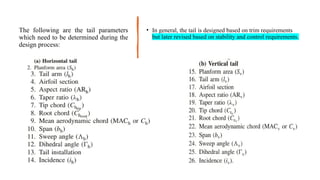
The following are the tail parameters
which need to be determined during the
design process:
• In general, the tail is designed based on trim requirements
but later revised based on stability and control requirements.
• There are a few other intermediate parameters, such as
downwash angle,
sidewash angle, and
effective angle of attack
• The above parameters are used to calculate some tail
parameters.
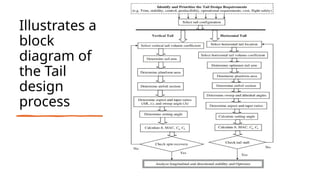
Illustrates a
block
diagram of
the Tail
design
process
Tail volume
coefficients
of several
aircraft [5]
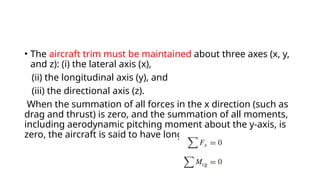
• The aircraft trim must be maintained about three axes (x, y,
and z): (i) the lateral axis (x),
(ii) the longitudinal axis (y), and
(iii) the directional axis (z).
When the summation of all forces in the x direction (such as
drag and thrust) is zero, and the summation of all moments,
including aerodynamic pitching moment about the y-axis, is
zero, the aircraft is said to have longitudinal trim:
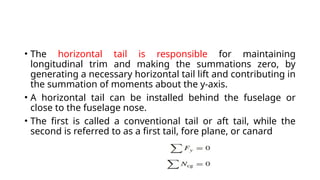
• The horizontal tail is responsible for maintaining
longitudinal trim and making the summations zero, by
generating a necessary horizontal tail lift and contributing in
the summation of moments about the y-axis.
• A horizontal tail can be installed behind the fuselage or
close to the fuselage nose.
• The first is called a conventional tail or aft tail, while the
second is referred to as a first tail, fore plane, or canard
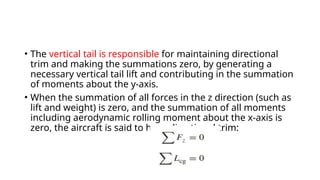
• The vertical tail is responsible for maintaining directional
trim and making the summations zero, by generating a
necessary vertical tail lift and contributing in the summation
of moments about the y-axis.
• When the summation of all forces in the z direction (such as
lift and weight) is zero, and the summation of all moments
including aerodynamic rolling moment about the x-axis is
zero, the aircraft is said to have directional trim:
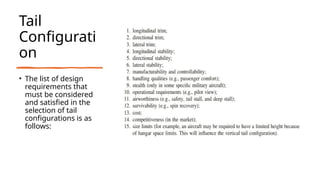
Tail
Configurati
on
• The list of design
requirements that
must be considered
and satisfied in the
selection of tail
configurations is as
follows:
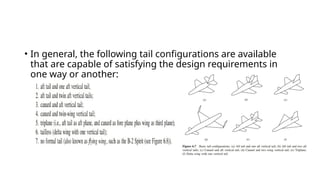
• In general, the following tail configurations are available
that are capable of satisfying the design requirements in
one way or another:
Based on the statistics
• The majority of aircraft designers (about 85%) select the aft
tail configuration.
• About 10% of current aircraft have a canard.
• About 5% of today’s aircraft have other configurations that
could be called unconventional tail configurations.
Aft Tail Configuration
• An Aft Tail Configuration is a traditional aircraft design
where the tail section, also known as the empennage, is
positioned at the rear of the aircraft.
• The tail typically consists of a horizontal stabilizer and a
vertical stabilizer, providing pitch and yaw stability and
control, respectively.
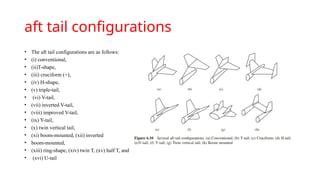
aft tail configurations
• The aft tail configurations are as follows:
• (i) conventional,
• (ii)T-shape,
• (iii) cruciform (+),
• (iv) H-shape,
• (v) triple-tail,
• (vi) V-tail,
• (vii) inverted V-tail,
• (viii) improved V-tail,
• (ix) Y-tail,
• (x) twin vertical tail,
• (xi) boom-mounted, (xii) inverted
• boom-mounted,
• (xiii) ring-shape, (xiv) twin T, (xv) half T, and
• (xvi) U-tail
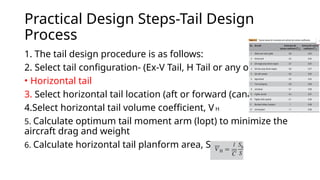
Practical Design Steps-Tail Design
Process
1. The tail design procedure is as follows:
2. Select tail configuration- (Ex-V Tail, H Tail or any other)
• Horizontal tail
3. Select horizontal tail location (aft or forward (canard);
4.Select horizontal tail volume coefficient, V H
5. Calculate optimum tail moment arm (lopt) to minimize the
aircraft drag and weight
6. Calculate horizontal tail planform area, Sh
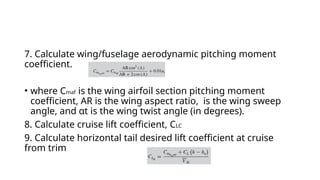
7. Calculate wing/fuselage aerodynamic pitching moment
coefficient.
• where Cmaf is the wing airfoil section pitching moment
coefficient, AR is the wing aspect ratio, is the wing sweep
angle, and αt is the wing twist angle (in degrees).
8. Calculate cruise lift coefficient, CLC
9. Calculate horizontal tail desired lift coefficient at cruise
from trim
10. Select horizontal tail airfoil section
11.Select horizontal tail sweep angle and dihedral.
12. Select horizontal tail aspect ratio and taper ratio.
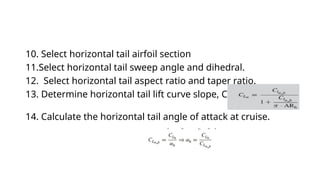
13. Determine horizontal tail lift curve slope, CLα_h
14. Calculate the horizontal tail angle of attack at cruise.
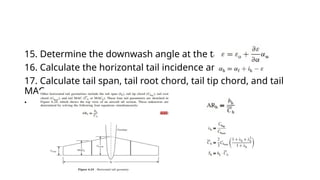
15. Determine the downwash angle at the tail
16. Calculate the horizontal tail incidence angle; it
17. Calculate tail span, tail root chord, tail tip chord, and tail
MAC
•
18. Calculate the horizontal tail-generated lift coefficient at cruise.
19. If the horizontal tail generated lift coefficient (step 17) is not
equal to the horizontal tail required lift coefficient (step 8), adjust
the tail incidence.
20.Check the horizontal tail stall.
21.Calculate the horizontal tail contribution to the static
longitudinal stability derivative (Cmα). The value for the Cmα
derivative must be negative to insure a stabilizing
contribution. If the design requirements are not satisfied,
redesign the tail.
21. Analyze the dynamic longitudinal stability. If the design
requirements are not satisfied, redesign the tail.
22. Optimize the horizontal tail.
Reminder: Tail design is an iterative process.
When the other aircraft components (such as fuselage and wing) are
designed, the aircraft dynamic longitudinal-directional stability needs to
be analyzed, and based on that, the tail design may need some
adjustments.
TAIL DESIGN AND ITS CONFIGURATION   TYPES

TAIL DESIGN AND ITS CONFIGURATION TYPES

  • 1.
    MODULE-III TAIL DESIGN Horizontal Tailand Vertical Tail LECTURE BY Dr S Kishore Kumar Department of Aerospace Engineering
  • 2.
    Introduction-Tail Design • DefineDesign Requirements • Select Tail Configuration • Determine Tail Sizing • Aerodynamic Considerations • Structural Design • Control Surface Design • Stability Analysis • Iterative Refinement • Integration with Other Systems • Compliance with Regulations • Final Design and Documentation
  • 3.
    Tail in conventionalaircraft • The tail in a conventional aircraft often has two components: horizontal tail and vertical tail carries two primary functions: 1. Trim (longitudinal and directional). 2. Stability (longitudinal and directional). Since two conventional control surfaces (i.e., elevator and rudder) are indeed parts of the tail to implement control, it is proper to add the following item as the third function of a tail: 3. Control (longitudinal and directional).
  • 4.
    Three functions aredescribed in brief here: Tail Design • The first and primary function of a horizontal tail is longitudinal trim, also referred to as equilibrium or balance. • The second function of the tails is to provide stability. The horizontal tail is responsible for maintaining longitudinal stability, while the vertical tail is responsible for maintaining directional stability. • The third primary function of the tails is control. The elevator as part of the horizontal tail is designed to provide longitudinal control, while the rudder as part of the vertical tail is responsible for providing directional control.
  • 5.
    The following arethe tail parameters which need to be determined during the design process: • In general, the tail is designed based on trim requirements but later revised based on stability and control requirements.
  • 6.
    • There area few other intermediate parameters, such as downwash angle, sidewash angle, and effective angle of attack • The above parameters are used to calculate some tail parameters.
  • 7.
  • 8.
  • 9.
    • The aircrafttrim must be maintained about three axes (x, y, and z): (i) the lateral axis (x), (ii) the longitudinal axis (y), and (iii) the directional axis (z). When the summation of all forces in the x direction (such as drag and thrust) is zero, and the summation of all moments, including aerodynamic pitching moment about the y-axis, is zero, the aircraft is said to have longitudinal trim:
  • 10.
    • The horizontaltail is responsible for maintaining longitudinal trim and making the summations zero, by generating a necessary horizontal tail lift and contributing in the summation of moments about the y-axis. • A horizontal tail can be installed behind the fuselage or close to the fuselage nose. • The first is called a conventional tail or aft tail, while the second is referred to as a first tail, fore plane, or canard
  • 11.
    • The verticaltail is responsible for maintaining directional trim and making the summations zero, by generating a necessary vertical tail lift and contributing in the summation of moments about the y-axis. • When the summation of all forces in the z direction (such as lift and weight) is zero, and the summation of all moments including aerodynamic rolling moment about the x-axis is zero, the aircraft is said to have directional trim:
  • 12.
    Tail Configurati on • The listof design requirements that must be considered and satisfied in the selection of tail configurations is as follows:
  • 13.
    • In general,the following tail configurations are available that are capable of satisfying the design requirements in one way or another:
  • 14.
    Based on thestatistics • The majority of aircraft designers (about 85%) select the aft tail configuration. • About 10% of current aircraft have a canard. • About 5% of today’s aircraft have other configurations that could be called unconventional tail configurations.
  • 15.
    Aft Tail Configuration •An Aft Tail Configuration is a traditional aircraft design where the tail section, also known as the empennage, is positioned at the rear of the aircraft. • The tail typically consists of a horizontal stabilizer and a vertical stabilizer, providing pitch and yaw stability and control, respectively.
  • 16.
    aft tail configurations •The aft tail configurations are as follows: • (i) conventional, • (ii)T-shape, • (iii) cruciform (+), • (iv) H-shape, • (v) triple-tail, • (vi) V-tail, • (vii) inverted V-tail, • (viii) improved V-tail, • (ix) Y-tail, • (x) twin vertical tail, • (xi) boom-mounted, (xii) inverted • boom-mounted, • (xiii) ring-shape, (xiv) twin T, (xv) half T, and • (xvi) U-tail
  • 17.
    Practical Design Steps-TailDesign Process 1. The tail design procedure is as follows: 2. Select tail configuration- (Ex-V Tail, H Tail or any other) • Horizontal tail 3. Select horizontal tail location (aft or forward (canard); 4.Select horizontal tail volume coefficient, V H 5. Calculate optimum tail moment arm (lopt) to minimize the aircraft drag and weight 6. Calculate horizontal tail planform area, Sh
  • 18.
    7. Calculate wing/fuselageaerodynamic pitching moment coefficient. • where Cmaf is the wing airfoil section pitching moment coefficient, AR is the wing aspect ratio, is the wing sweep angle, and αt is the wing twist angle (in degrees). 8. Calculate cruise lift coefficient, CLC 9. Calculate horizontal tail desired lift coefficient at cruise from trim
  • 19.
    10. Select horizontaltail airfoil section 11.Select horizontal tail sweep angle and dihedral. 12. Select horizontal tail aspect ratio and taper ratio. 13. Determine horizontal tail lift curve slope, CLα_h 14. Calculate the horizontal tail angle of attack at cruise.
  • 20.
    15. Determine thedownwash angle at the tail 16. Calculate the horizontal tail incidence angle; it 17. Calculate tail span, tail root chord, tail tip chord, and tail MAC •
  • 21.
    18. Calculate thehorizontal tail-generated lift coefficient at cruise. 19. If the horizontal tail generated lift coefficient (step 17) is not equal to the horizontal tail required lift coefficient (step 8), adjust the tail incidence. 20.Check the horizontal tail stall. 21.Calculate the horizontal tail contribution to the static longitudinal stability derivative (Cmα). The value for the Cmα derivative must be negative to insure a stabilizing contribution. If the design requirements are not satisfied, redesign the tail.
  • 22.
    21. Analyze thedynamic longitudinal stability. If the design requirements are not satisfied, redesign the tail. 22. Optimize the horizontal tail. Reminder: Tail design is an iterative process. When the other aircraft components (such as fuselage and wing) are designed, the aircraft dynamic longitudinal-directional stability needs to be analyzed, and based on that, the tail design may need some adjustments.