Fundamental of
Aeronautical Engineering
29-07-2020
Fundamentals of Aeronautical Engineering
KIT-Kalaignarkarunanidhi Insititute of Technology
Prepared By
Ms.K.Niranjana
Assistant Professor
Department of Aeronautical Engineering
KIT-Kalaignarkarunanidhi Institute of Technology
UNIT- I
HISTORY OF FLIGHT
Balloon flight – ornithopers - Early Airplanes by Wright
Brothers, biplanes and monoplanes, Developments in
aerodynamics, materials, structures and propulsion over
the years.
29-07-2020
Fundamentals of Aeronautical Engineering
KIT-Kalaignarkarunanidhi Insititute of Technology
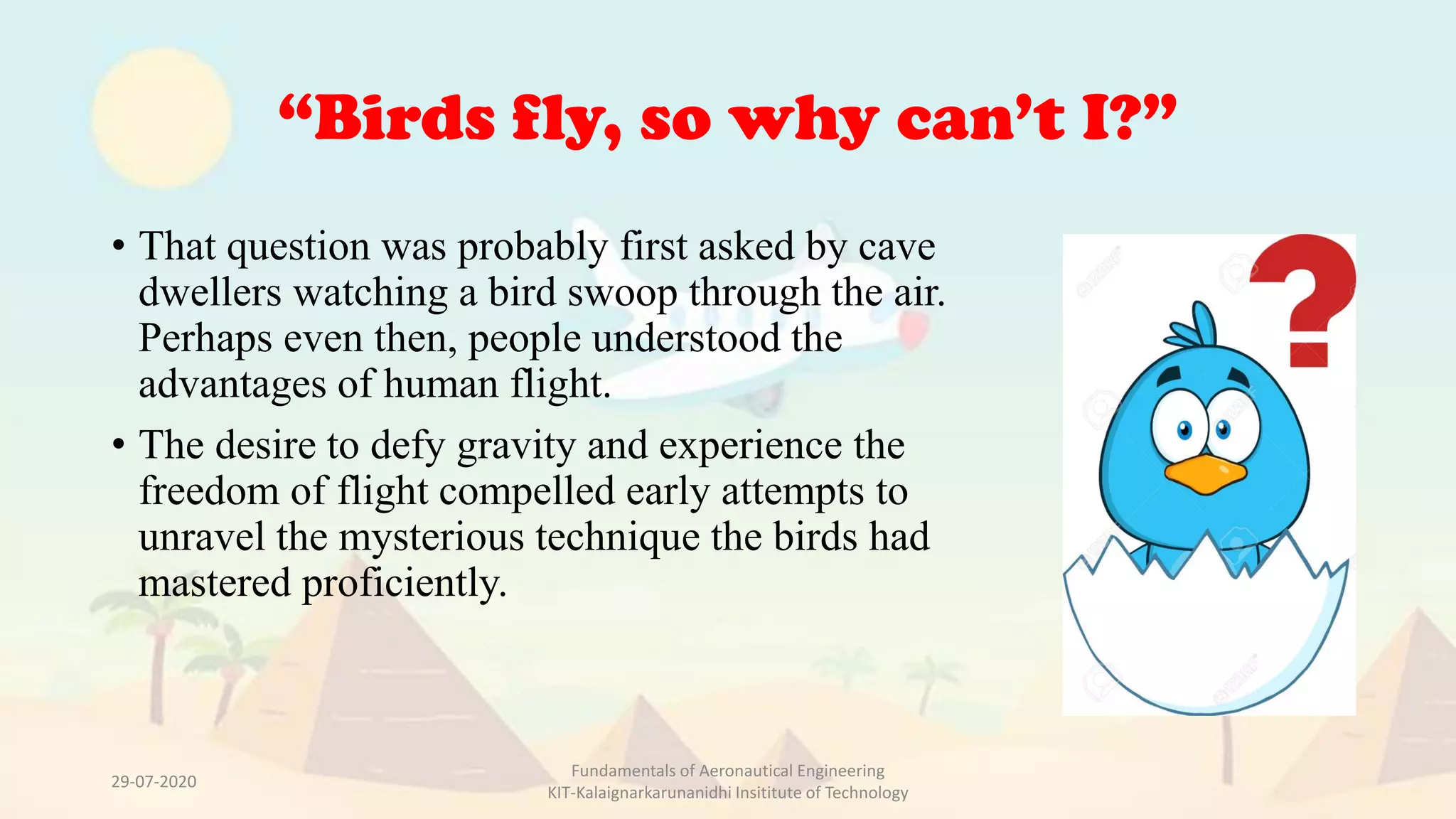
“Birds fly, so why can’t I?”
• That question was probably first asked by cave
dwellers watching a bird swoop through the air.
Perhaps even then, people understood the
advantages of human flight.
• The desire to defy gravity and experience the
freedom of flight compelled early attempts to
unravel the mysterious technique the birds had
mastered proficiently.
29-07-2020
Fundamentals of Aeronautical Engineering
KIT-Kalaignarkarunanidhi Insititute of Technology
Myths Flight of Fantasy
Greek Myth Daedalus and Icarus
Wings Fastened with Wax
29-07-2020
Fundamentals of Aeronautical Engineering
KIT-Kalaignarkarunanidhi Insititute of Technology
29-07-2020
Fundamentals of Aeronautical Engineering
KIT-Kalaignarkarunanidhi Insititute of Technology
Early dreams of powered flight...???
Eighteenth century BC
The flying chariot of
Ki-Kung-Shi
29-07-2020
Fundamentals of Aeronautical Engineering
KIT-Kalaignarkarunanidhi Insititute of Technology
Aerial Steam Carriage
• Henson's 1842 design based on
the ideas of Sir George Cayley
• The patent drawings, and
imaginative sketches derived
from them, received world-wide
publicity.
• The plane never left the drawing
board, but still inspired
widespread research and
experimentation.
29-07-2020
Fundamentals of Aeronautical Engineering
KIT-Kalaignarkarunanidhi Insititute of Technology
Eole’s Flight
• Clement Ader's Eole was the
first piloted aeroplane to take off
under its own power, for a brief
uncontrolled hop in 1890.
• The Eole had a light but
powerful 20HP steam engine
and bat like wings.
Unfortunately it had little flight
control and no forward vision
for the pilot.
29-07-2020
Fundamentals of Aeronautical Engineering
KIT-Kalaignarkarunanidhi Insititute of Technology
…..came
closer to
reality
Flyer
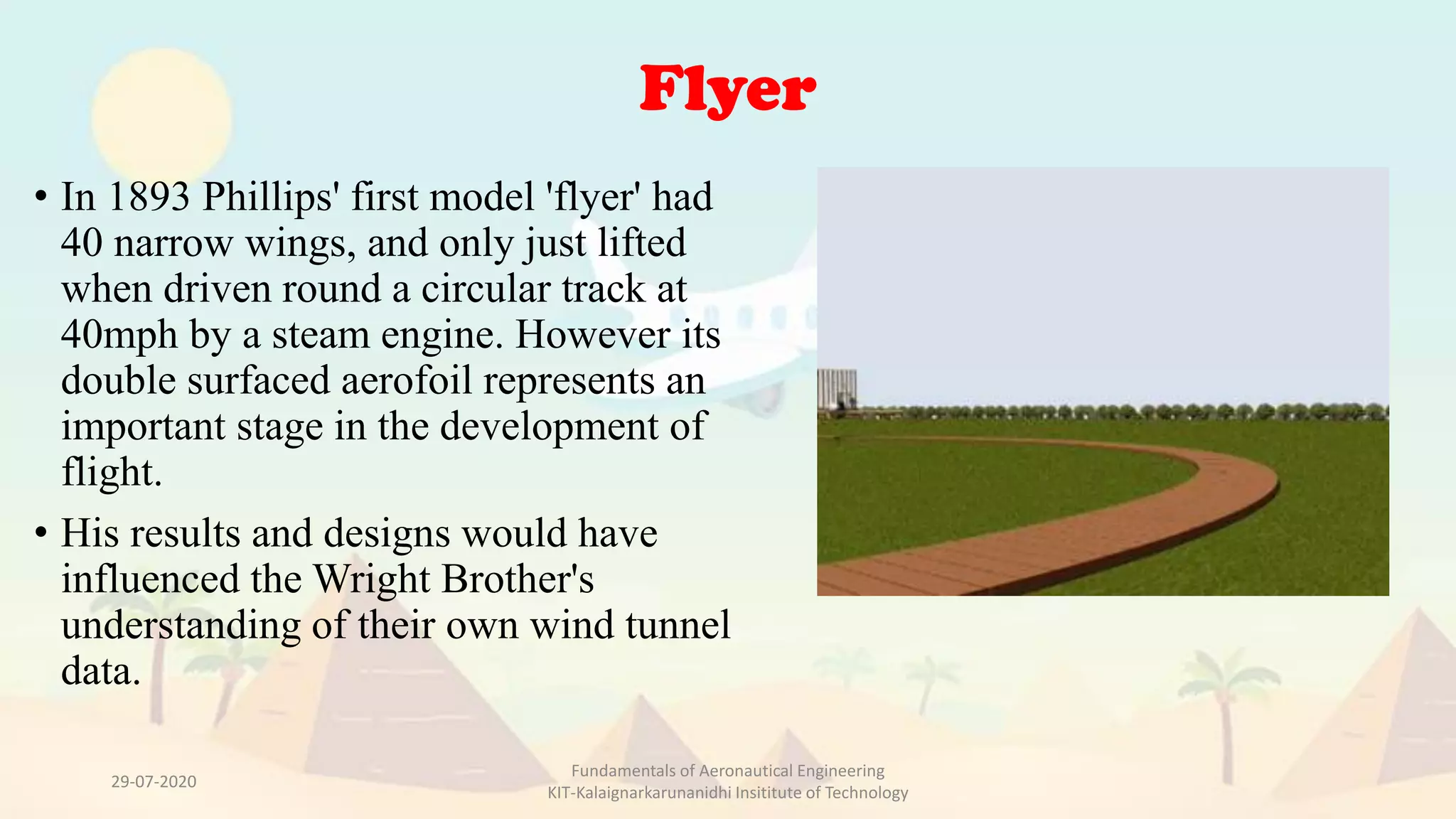
• In 1893 Phillips' first model 'flyer' had
40 narrow wings, and only just lifted
when driven round a circular track at
40mph by a steam engine. However its
double surfaced aerofoil represents an
important stage in the development of
flight.
• His results and designs would have
influenced the Wright Brother's
understanding of their own wind tunnel
data.
29-07-2020
Fundamentals of Aeronautical Engineering
KIT-Kalaignarkarunanidhi Insititute of Technology
To the exciting world of aeronautics!!!!
•The term aeronautics originated in
France
•Derived from Greek words for “air”
and “to sail.”
•It is the study of flight and the
operation of aircraft.
29-07-2020
Fundamentals of Aeronautical Engineering
KIT-Kalaignarkarunanidhi Insititute of Technology
29-07-2020
Fundamentals of Aeronautical Engineering
KIT-Kalaignarkarunanidhi Insititute of Technology
400 B.C. The first kites were invented by
the Chinese.
Timeline for Key Event History of Flight
1485 Leonardo da Vinci designed the ornithopter
(a wing flapping aircraft).
29-07-2020
Fundamentals of Aeronautical Engineering
KIT-Kalaignarkarunanidhi Insititute of Technology
1849 Sir George Cayley, “The Father of Aerial
Navigation,” designed the first three wing glider
that lifted a person off the ground.
1783 Joseph and Etienne Montgolfier
launched the first passengers a duck, a
sheep, and a rooster—in a hot air balloon.
29-07-2020
Fundamentals of Aeronautical Engineering
KIT-Kalaignarkarunanidhi Insititute of Technology
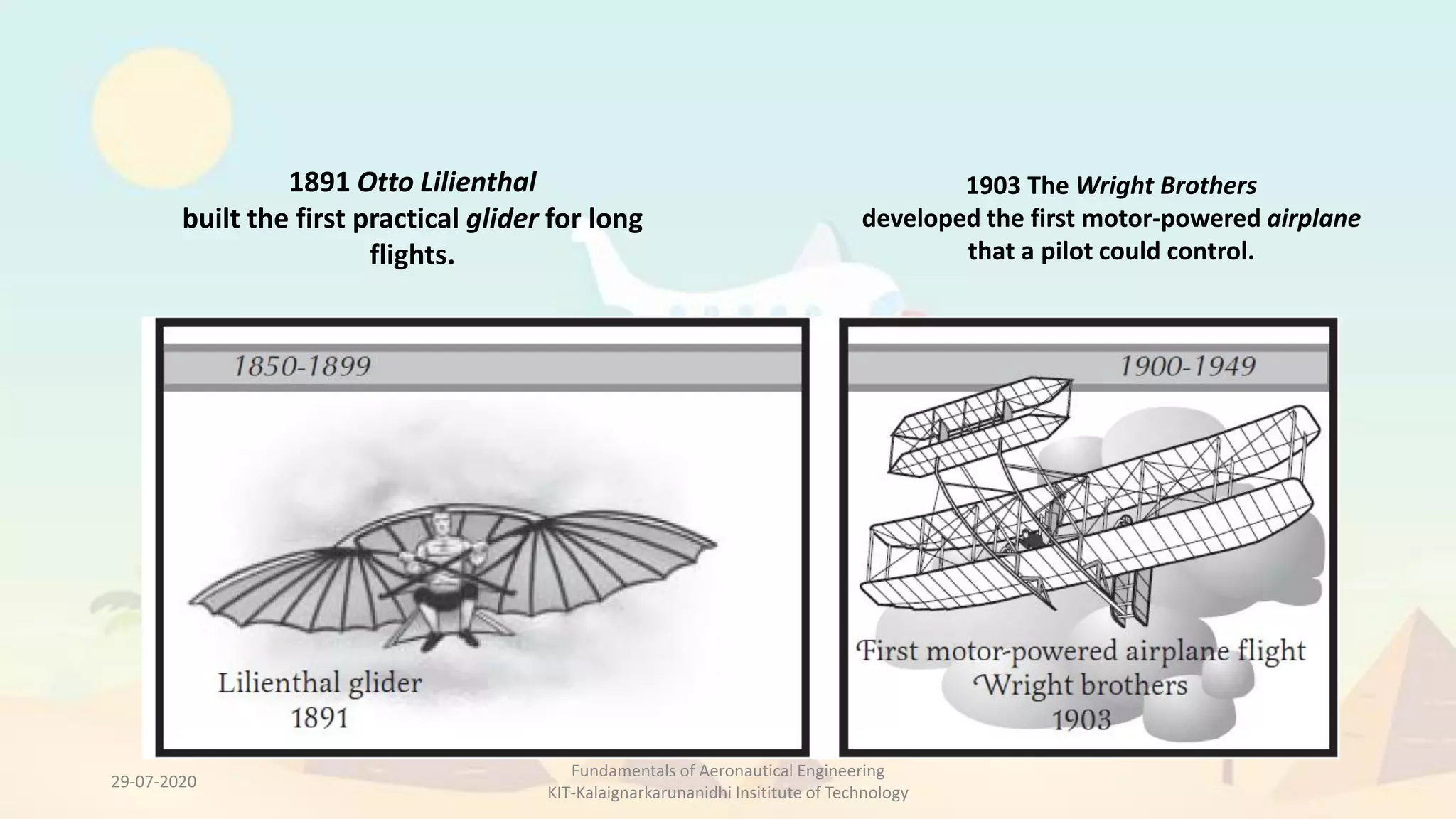
1891 Otto Lilienthal
built the first practical glider for long
flights.
1903 The Wright Brothers
developed the first motor-powered airplane
that a pilot could control.
29-07-2020
Fundamentals of Aeronautical Engineering
KIT-Kalaignarkarunanidhi Insititute of Technology
1907 Paul Cornu built the first free flying
helicopter.
1919 Lieutenant-Commander A.C. Reed
and his crew were the first to fly across
the Atlantic Ocean, making several stops,
in the Curtiss Flying Boat.
29-07-2020
Fundamentals of Aeronautical Engineering
KIT-Kalaignarkarunanidhi Insititute of Technology
1927 Charles Lindbergh was the first
person to fly across the Atlantic Ocean
nonstop.
1935 Amelia Earhart was the first
person to fly solo across the Pacific
Ocean from Hawaii to California
29-07-2020
Fundamentals of Aeronautical Engineering
KIT-Kalaignarkarunanidhi Insititute of Technology
1947 Chuck Yeager
became the first pilot to
break the sound barrier.
1979 The Gossamer Albatross was
the first craft powered by a human
(Bryan Allen) to fly across the
English Channel.
29-07-2020
Fundamentals of Aeronautical Engineering
KIT-Kalaignarkarunanidhi Insititute of Technology
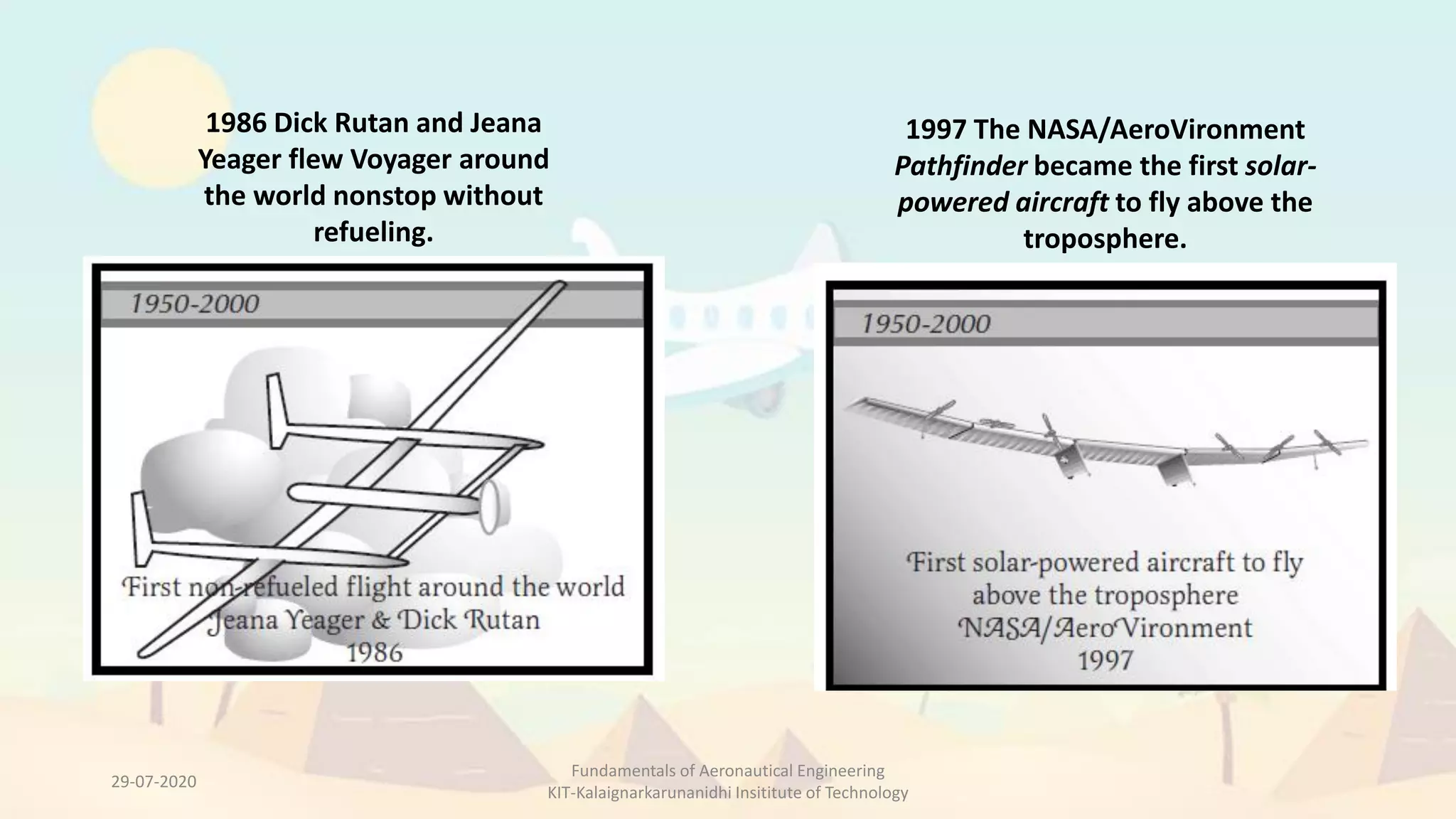
1997 The NASA/AeroVironment
Pathfinder became the first solar-
powered aircraft to fly above the
troposphere.
1986 Dick Rutan and Jeana
Yeager flew Voyager around
the world nonstop without
refueling.
29-07-2020
Fundamentals of Aeronautical Engineering
KIT-Kalaignarkarunanidhi Insititute of Technology
400 B.C. The first kites were invented by the Chinese.
1485 Leonardo da Vinci designed the ornithopter (a wing flapping aircraft).
1783 Joseph and Etienne Montgolfier launched the first passengers—a duck, a sheep, and a rooster in a
hot air balloon.
1849 Sir George Cayley, “The Father of Aerial Navigation,” designed the first three wing glider that lifted
a person off the ground.
1891 Otto Lilienthal built the first practical glider for long flights.
1903 The Wright Brothers developed the first motor-powered airplane that a pilot could control.
1907 Paul Cornu built the first free flying helicopter.
1919 Lieutenant-Commander A.C. Reed and his crew were the first to fly across the Atlantic Ocean,
making several stops, in the Curtiss Flying Boat.
1927 Charles Lindbergh was the first person to fly across the Atlantic Ocean nonstop.
1935 Amelia Earhart was the first person to fly solo across the Pacific Ocean from Hawaii to California.
1947 Chuck Yeager became the first pilot to break the sound barrier.
1979 The Gossamer Albatross was the first craft powered by a human (Bryan Allen) to fly across the
English Channel.
1986 Dick Rutan and Jeana Yeager flew Voyager around the world nonstop without refueling.
1997 The NASA/AeroVironment Pathfinder became the first solar-powered aircraft to fly above the
troposphere.
HOT AIR BALLOONS
• Oldest successful aeronautic
design.
• The first unmanned balloons
were the Kongming lanterns and
the Nazca Lines balloons.
29-07-2020
First manned balloon
• The first manned balloon was the
Montgolfier balloon created by Joseph
Michel Montgolfier.
• It's first tethered flight, a flight with people
aboard, was on October 15, 1783. It was
then used in the French military as an
observation post at the Battle of Fleurus
(1794).
• Tested with first passengers are a duck, a
sheep, and a rooster
29-07-2020
Fundamentals of Aeronautical Engineering
KIT-Kalaignarkarunanidhi Insititute of Technology
• Joseph Michel Montgolfier filled a silk
bag with air in his house, and it rose up
to his ceiling. This proved that flight
with hot air balloons was possible.
29-07-2020
Fundamentals of Aeronautical Engineering
KIT-Kalaignarkarunanidhi Insititute of Technology
Working Principle of Hot Air Balloon
29-07-2020
Fundamentals of Aeronautical Engineering
KIT-Kalaignarkarunanidhi Insititute of Technology
Hot air balloons are based on a very basic
scientific principle:
• Warmer air rises in cooler air.
• Hot air is lighter than cool air, because it has less mass per unit of
volume.
• A cubic foot of air weighs roughly 28 grams (about an ounce). If you
heat that air by 100 degrees F, it weighs about 7 grams less.
• Therefore, each cubic foot of air contained in a hot air balloon can lift
about 7 grams. That's not much, and this is why hot air balloons are so
huge -- to lift 1,000 pounds, you need about 65,000 cubic feet of hot
air.
29-07-2020
Fundamentals of Aeronautical Engineering
KIT-Kalaignarkarunanidhi Insititute of Technology
Buoyancy Effect
29-07-2020
Fundamentals of Aeronautical Engineering
KIT-Kalaignarkarunanidhi Insititute of Technology
Three essential parts:
• Burner, which heats the air
• The balloon envelope, which holds the
air
• The basket, which carries the
passengers.
Other Parts of the Hot air balloon
• Coating
• Fuel Tanks
• Parachute Valve
• Instrumentation
29-07-2020
Fundamentals of Aeronautical Engineering
KIT-Kalaignarkarunanidhi Insititute of Technology
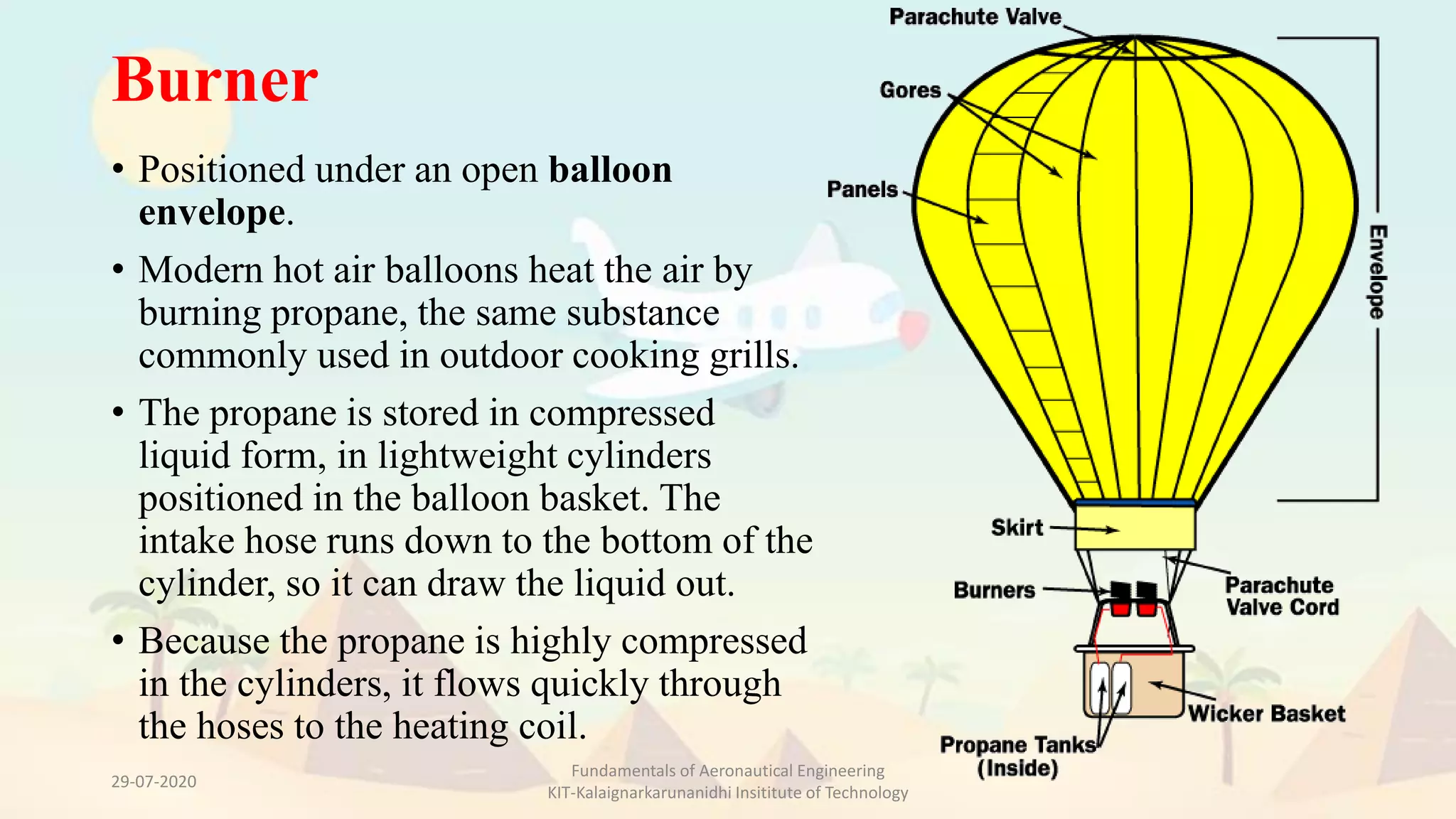
Burner
• Positioned under an open balloon
envelope.
• Modern hot air balloons heat the air by
burning propane, the same substance
commonly used in outdoor cooking grills.
• The propane is stored in compressed
liquid form, in lightweight cylinders
positioned in the balloon basket. The
intake hose runs down to the bottom of the
cylinder, so it can draw the liquid out.
• Because the propane is highly compressed
in the cylinders, it flows quickly through
the hoses to the heating coil.
29-07-2020
Fundamentals of Aeronautical Engineering
KIT-Kalaignarkarunanidhi Insititute of Technology
Burner
29-07-2020
Fundamentals of Aeronautical Engineering
KIT-Kalaignarkarunanidhi Insititute of Technology
• The heating coil is simply a length of steel tubing arranged in a coil
around the burner.
• When the balloonist starts up the burner, the propane flows out in
liquid form and is ignited by a pilot light.
• As the flame burns, it heats up the metal in the surrounding tubing.
When the tubing becomes hot, it heats the propane flowing through it.
This changes the propane from a liquid to a gas, before it is ignited.
This gas makes for a more powerful flame and more efficient fuel
consumption.
29-07-2020
Fundamentals of Aeronautical Engineering
KIT-Kalaignarkarunanidhi Insititute of Technology
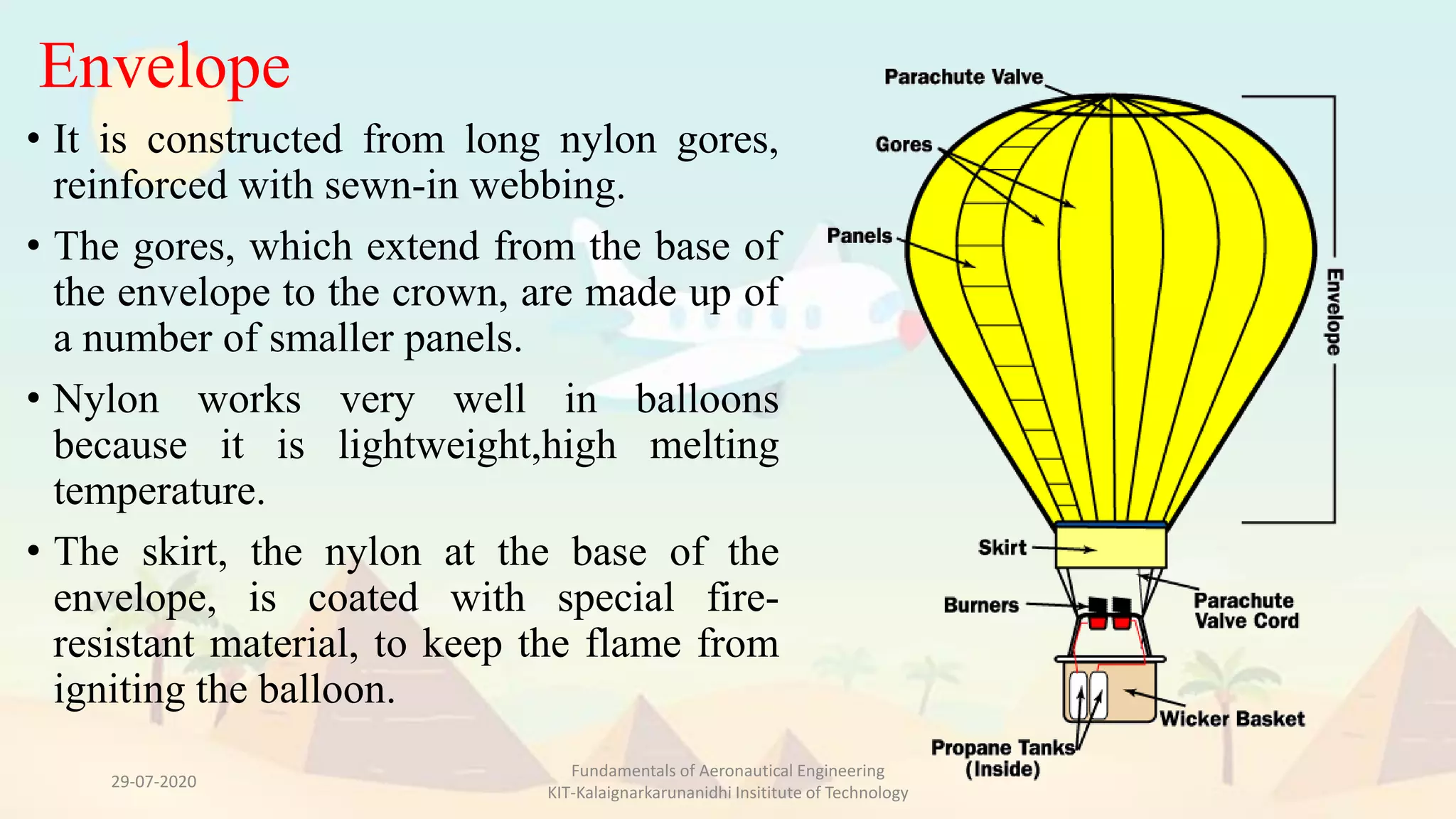
Envelope
• It is constructed from long nylon gores,
reinforced with sewn-in webbing.
• The gores, which extend from the base of
the envelope to the crown, are made up of
a number of smaller panels.
• Nylon works very well in balloons
because it is lightweight,high melting
temperature.
• The skirt, the nylon at the base of the
envelope, is coated with special fire-
resistant material, to keep the flame from
igniting the balloon.
29-07-2020
Fundamentals of Aeronautical Engineering
KIT-Kalaignarkarunanidhi Insititute of Technology
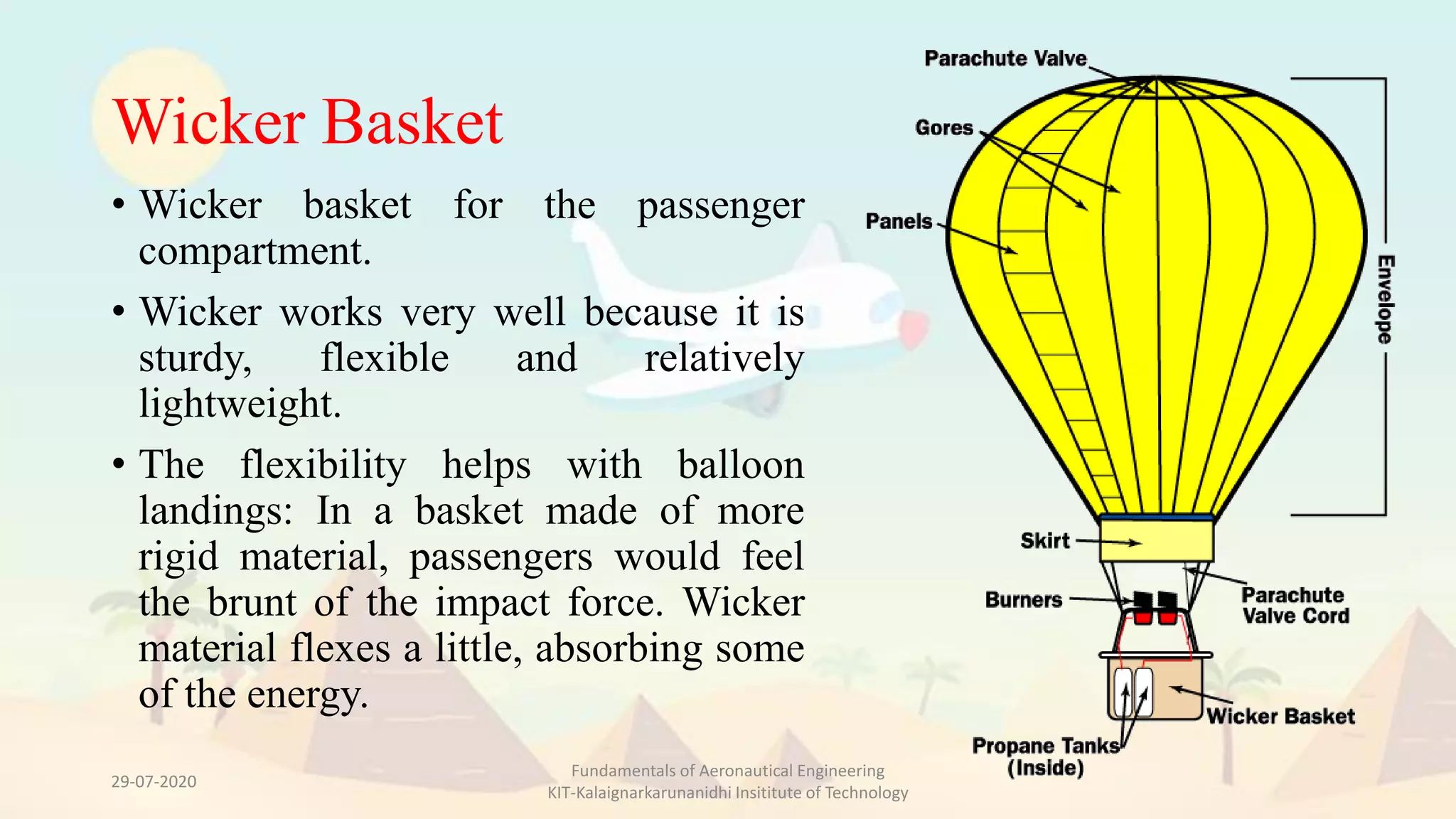
Wicker Basket
• Wicker basket for the passenger
compartment.
• Wicker works very well because it is
sturdy, flexible and relatively
lightweight.
• The flexibility helps with balloon
landings: In a basket made of more
rigid material, passengers would feel
the brunt of the impact force. Wicker
material flexes a little, absorbing some
of the energy.
29-07-2020
Fundamentals of Aeronautical Engineering
KIT-Kalaignarkarunanidhi Insititute of Technology
Piloting a Balloon
• Essentially, these are the only controls -- heat to make the balloon rise
and venting to make it sink.
• This raises an interesting question: If pilots can only move hot air
balloons up and down, how do they get the balloon from place to
place?
• As it turns out, pilots can maneuver horizontally by changing their
vertical position, because wind blows in different directions at
different altitudes. To move in a particular direction, a pilot ascends
and descends to the appropriate level, and rides with the wind. Since
wind speed generally increases as you get higher in the atmosphere,
pilots can also control horizontal speed by changing altitude.
29-07-2020
Fundamentals of Aeronautical Engineering
KIT-Kalaignarkarunanidhi Insititute of Technology
Launching and Landing
29-07-2020
Fundamentals of Aeronautical Engineering
KIT-Kalaignarkarunanidhi Insititute of Technology
Once the balloon envelope is down
on the ground, the crew begins
pushing the air out. When the
balloon is flattened, the crew packs
it into a stuff sack. This whole
process is a lot like packing up a
giant sleeping bag.
ORNITHOPTER
• The word "ornithopter" means "bird wing".
• An ornithopter doesn't need to have feathers,
though.
• What makes it birdlike is the flapping
motion.
• Airplanes and helicopters use rotating
propellers.
• Instead of rotation, the ornithopter imitates
the reciprocating motion of a bird's wing.
29-07-2020
Fundamentals of Aeronautical Engineering
KIT-Kalaignarkarunanidhi Insititute of Technology
Timeline of Ornithopter
• Until the nineteenth century,
Leonardo da Vinci was generally
known only as a painter.
• Among the many subjects
Leonardo studied, the possibility of
human mechanical flight held
particular fascination.
29-07-2020
Fundamentals of Aeronautical Engineering
KIT-Kalaignarkarunanidhi Insititute of Technology
• He produced more than 35,000 words and 500 sketches dealing with flying
machines, the nature of air, and bird flight.
• These investigations of flight are scattered throughout the many da Vinci
codices and manuscript collections
• Produce one short codex almost entirely on the subject in 1505-1506,
the Codice sul volo degli uccelli (Codex on the Flight of Birds) which is a
handwritten manuscript mirror image
• Work Manuscript is been stored in ????
29-07-2020
Fundamentals of Aeronautical Engineering
KIT-Kalaignarkarunanidhi Insititute of Technology
British Library in London
In Indian Epic ?????
• The Sanskrit epic Ramayana
describes an ornithopter, the
Pushpaka Vimana.
• The first writings on trying to use
the idea of flapping flight date all
the way back, but there were not
any recorded designs made from
the descriptions in the writing.
29-07-2020
Fundamentals of Aeronautical Engineering
KIT-Kalaignarkarunanidhi Insititute of Technology
Da Vinci sketches of the ornithopter
• It has used a system of pulleys and
gears powered by the arms and legs
that would make the wings move in
the fashion that a bird’s wing does.
• Da Vinci’s design was not based on an
idea of having a wing attached to each
arm of a human and having that
person flapping their arms up and
down because he discovered that
humans were not strong enough to
generate the power needed to fly.
29-07-2020
Fundamentals of Aeronautical Engineering
KIT-Kalaignarkarunanidhi Insititute of Technology
• The amount of lift needed to put a human in the air was physically
impossible to achieve so the lift to drag ratio compared to that of a bird
was much too small due to the lack of lift generated.
• The only way to overcome that factor was to add the system of pulleys
that would multiply the force exerted by the human’s arms and legs
and transfer that power to the wings to make them flap fast enough to
generate the lift needed to fly.
• Da Vinci did not make a full scale model of his design, but many other
future innovators in flight would try to perfect da Vinci’s design and
build a machine that would allow humans to fly through the
phenomenon of flapping flight.
29-07-2020
Fundamentals of Aeronautical Engineering
KIT-Kalaignarkarunanidhi Insititute of Technology
NASA's Mars Curiosity Rover and Leonardo da
Vinci's Codex
• July 24, 2012
• An etched version of Leonardo da Vinci's self-portrait on the
Microchip to be placed aboard NASA's Mars Curiosity Rover.
• Leonardo da Vinci's Codex on Bird Flight, a document from about
1505 was reproduced on a microscopic scale and fastened to the chip
on Curiosity. Leonardo's self-portrait is also on the rover, along with
some essays, drawings, and other submissions from finalists and semi-
finalists who participated in the "Send Your Name to Mars" rover
naming contest opportunity.
29-07-2020
Fundamentals of Aeronautical Engineering
KIT-Kalaignarkarunanidhi Insititute of Technology
29-07-2020
Fundamentals of Aeronautical Engineering
KIT-Kalaignarkarunanidhi Insititute of Technology
Purpose of Ornithopter
• Carry cameras and other payloads.
• Save lives by chasing birds away from airport runways.
• Building ornithopter is an excellent hands on experience for students,
as well as great enjoyment for hobbyists
29-07-2020
Fundamentals of Aeronautical Engineering
KIT-Kalaignarkarunanidhi Insititute of Technology
Other Uses
• Forestry monitoring
• Security reason
• Bird eye view
• Maps
• Location tracing
• As a spy
29-07-2020
Fundamentals of Aeronautical Engineering
KIT-Kalaignarkarunanidhi Insititute of Technology
Major Types of Ornithopter
• Free Flight Ornithopters
• Radio Controlled Ornithopters
• Manned Ornithopters
29-07-2020
Fundamentals of Aeronautical Engineering
KIT-Kalaignarkarunanidhi Insititute of Technology
Free Flight Ornithopters
• Simplest and least expensive to build.
• They are powered by winding up a rubber
band.
• Great for a school competition to see who
can get the longest flight time.
• Building and flying these ornithopters is a
great way for kids to learn about science
and work as a team.
29-07-2020
Fundamentals of Aeronautical Engineering
KIT-Kalaignarkarunanidhi Insititute of Technology
29-07-2020
Fundamentals of Aeronautical Engineering
KIT-Kalaignarkarunanidhi Insititute of Technology
Radio Controlled Ornithopters
• Powered by electric motor and
battery
• Size range from 10 cm wingspan
micro air vehicles to the size of an
eagle
• Radio controlled, and usually the tail
is used for steering.
• They can be purchased as a ready
made toy, or built by the hobbyist.
29-07-2020
Fundamentals of Aeronautical Engineering
KIT-Kalaignarkarunanidhi Insititute of Technology
How to Design & Build Ornithopters
• Perhaps you will want to try something more advanced, like a radio
controlled ornithopter.
• The information comes from The Ornithopter Design Manual, fifth
edition, by Nathan Chronister, published by the Ornithopter Society in
2008.
Parts of the Radio controlled Ornithopter
• Power Systems
• Gear Design
• Flapping Mechanism
• Wings
• Stability and Control
29-07-2020
Fundamentals of Aeronautical Engineering
KIT-Kalaignarkarunanidhi Insititute of Technology
Power Systems:
• Choosing the right motor and battery are both essential for building a
successful ornithopter.
Ex: RC 2627 3500KV 4200KV brushless BLDC outrunner motor for
remote control hobby model
29-07-2020
Fundamentals of Aeronautical Engineering
KIT-Kalaignarkarunanidhi Insititute of Technology
Gear Design
• Unless you use a rubber band for power, you'll probably need to gear
down the motor, to give it enough torque to flap the wings.
• The gearbox can be one of the most challenging parts of your
ornithopter to build. The information here will make it much easier.
29-07-2020
Fundamentals of Aeronautical Engineering
KIT-Kalaignarkarunanidhi Insititute of Technology
The Flapping Mechanism
• Conversion of the rotary motion of your motor into an oscillating wing
motion.
• This is what makes your device an ornithopter instead of an airplane or
helicopter!
• Several different mechanisms and construction techniques are
described.
29-07-2020
Fundamentals of Aeronautical Engineering
KIT-Kalaignarkarunanidhi Insititute of Technology
Wings:
• When building ornithopters, an efficient wing design can make the
difference between failure and success.
• There are several general types of ornithopter wing.
29-07-2020
Fundamentals of Aeronautical Engineering
KIT-Kalaignarkarunanidhi Insititute of Technology
Stability and Control:
• It's pretty easy to stabilize a free-flight ornithopter, but when you add
radio control, some surprising things happen.
• Often the ornithopter refuses to come out of a turn! Just as there are
several ways to steer an ornithopter, there are also some things you can
do to avoid these problems.
29-07-2020
Fundamentals of Aeronautical Engineering
KIT-Kalaignarkarunanidhi Insititute of Technology
Manned Ornithopters
• Adalbert Schmid's manned ornithopters flown during World War II
• Old idea it requires advanced technology to make a manned ornithopter fly.
• Manned ornithopters could offer a maneuverable, quiet, and efficient means
of transportation, with some advantages over the helicopter.
• The Ornithopter Society, started by Patrick Deshaye in 1984
- Accurate information about the history of ornithopters
- Information on how to build ornithopters
- Resources for educators, to promote the development of ornithopter
technology
- To provide a lasting record of accomplishments in the field.
29-07-2020
Fundamentals of Aeronautical Engineering
KIT-Kalaignarkarunanidhi Insititute of Technology
29-07-2020
Fundamentals of Aeronautical Engineering
KIT-Kalaignarkarunanidhi Insititute of Technology
How do Birds Fly?
29-07-2020
Fundamentals of Aeronautical Engineering
KIT-Kalaignarkarunanidhi Insititute of Technology
Aviation fuels
• Aviation fuels are fuels used for aircraft propulsion. A basic distinction
is made between four different aviation fuels:
• Jet fuel (Jet A-1, kerosene)
• Kerosene-gasoline mixture (Jet B)
• Aviation gasoline (avgas)
• Biokerosene
29-07-2020
Fundamentals of Aeronautical Engineering
KIT-Kalaignarkarunanidhi Insititute of Technology
Propellent
• A propellant or propellent is a chemical substance used in the
production of energy or pressurized gas that is subsequently used to
create movement of a fluid or to generate propulsion of a vehicle,
projectile, or other object.
29-07-2020
Fundamentals of Aeronautical Engineering
KIT-Kalaignarkarunanidhi Insititute of Technology
Wilber Wright Orville Wright
CHILDHOOD
• There were 7 children in their family. Wilbur was
the 3rd child was born in 1867 at Millville, Indiana
and Orville the 6th child 1871 in the place Dayton,
Ohio.
• In 1878 their father, a bishop in the Church of the
United Brethren in Christ
• Mother was a home maker but they have a great
interest towards mechanical techniques and she
was working in her father car carriage shop
• Even she used to make home appliances and toys
for her kids
The Wright House, 7 Hawthorne Street , Dayton, Ohio
THE WRIGHT BROTHERS
INTRODUCTION
 Two American brothers, inventors, and
aviation pioneers
 Credited with inventing and building
the world's first successful powered
airplane.
 Neither went to university or ever
married.
NEWSPAPER
• Orville dropped out of high school after
his third year to start a newspaper business
in 1889, having designed and built his
own printing press with Wilbur's help.
• Wilbur joined the shop, and in March the
brothers started a weekly newspaper,
the West Side News.
• Later issues named Orville as
publisher and Wilbur as editor.
• In April 1890 they changed the
paper to a daily, The Evening
Item, but it lasted only four
months because it wasn’t
successful.
29-07-2020
Fundamentals of Aeronautical Engineering
KIT-Kalaignarkarunanidhi Insititute of Technology
Orville Interest Towards Cycling
• Prize Winning Cyclist
• Wilbur Wright begins to sell and
repair bicycles, perhaps inspired by
a huge gathering of the American
Wheelmen that takes place in
Dayton on July 4 and 5.
• Later, Orville joins him. They keep
the printing business, letting
childhood friend Ed Sines run it.
• The Wrights gear up to manufacture
their own bicycles, the "St. Clair"
and the "Van Cleve." The bike
business is profitable.
29-07-2020
Fundamentals of Aeronautical Engineering
KIT-Kalaignarkarunanidhi Insititute of Technology
• The brothers opened a repair and sales shop in
December 1892 called the Wright Cycle
Exchange which changed to the Wright Cycle
Company and began manufacturing their own
brand in 1896.
• They did this because of the bike craze in
1890s which was started by the invention of
the safety bicycle and its advantages over
the penny-farthing design.
• The Bicycles also gave them ideas for their
plane like the way of shifting your weight
from one side to the other to turn.
The Bicycle Shop
PLANE MOTIVATION
• In the 1890s they saw newspaper articles of McClure's Magazine and photographs
of the dramatic glides by Otto Lilienthal in Germany.
• 1896 brought three important flying events.
• Samuel Langley successfully flew an unmanned steam-powered fixed-wing
model aircraft.
• Octave Chanute and others flew gliders over the sand dunes along the shore of
Lake Michigan.
• In August, Lilienthal was killed in the fall of his glider.
• In May 1899 Wilbur wrote to the Smithsonian Museum requesting Lilienthal’s
reports and flight test results ,They received the brief bibliography of flying
including the work of Chanute and Langley
OTTO LILIENTHAL
1899
• Study of bird flight as a guide on
path towards mechanical flight.
• Regain their lateral balance to turn
by gust of wind by torsion of the tips
of the wings
• Therefore the wing twist to control
airplanes in lateral motion.
29-07-2020
Fundamentals of Aeronautical Engineering
KIT-Kalaignarkarunanidhi Insititute of Technology
1900
• The Wright brothers fly their
biplane kite with the wingspan of
1.5m at Kitty Hawk, North
Carolina to test their control
system.
• It does not produce enough lift to
make more than a handful of
flights.
• Kitty hawk was the area suggested
by the U.S.Bureau is an ideal spot
for glider experiment
29-07-2020
Fundamentals of Aeronautical Engineering
KIT-Kalaignarkarunanidhi Insititute of Technology
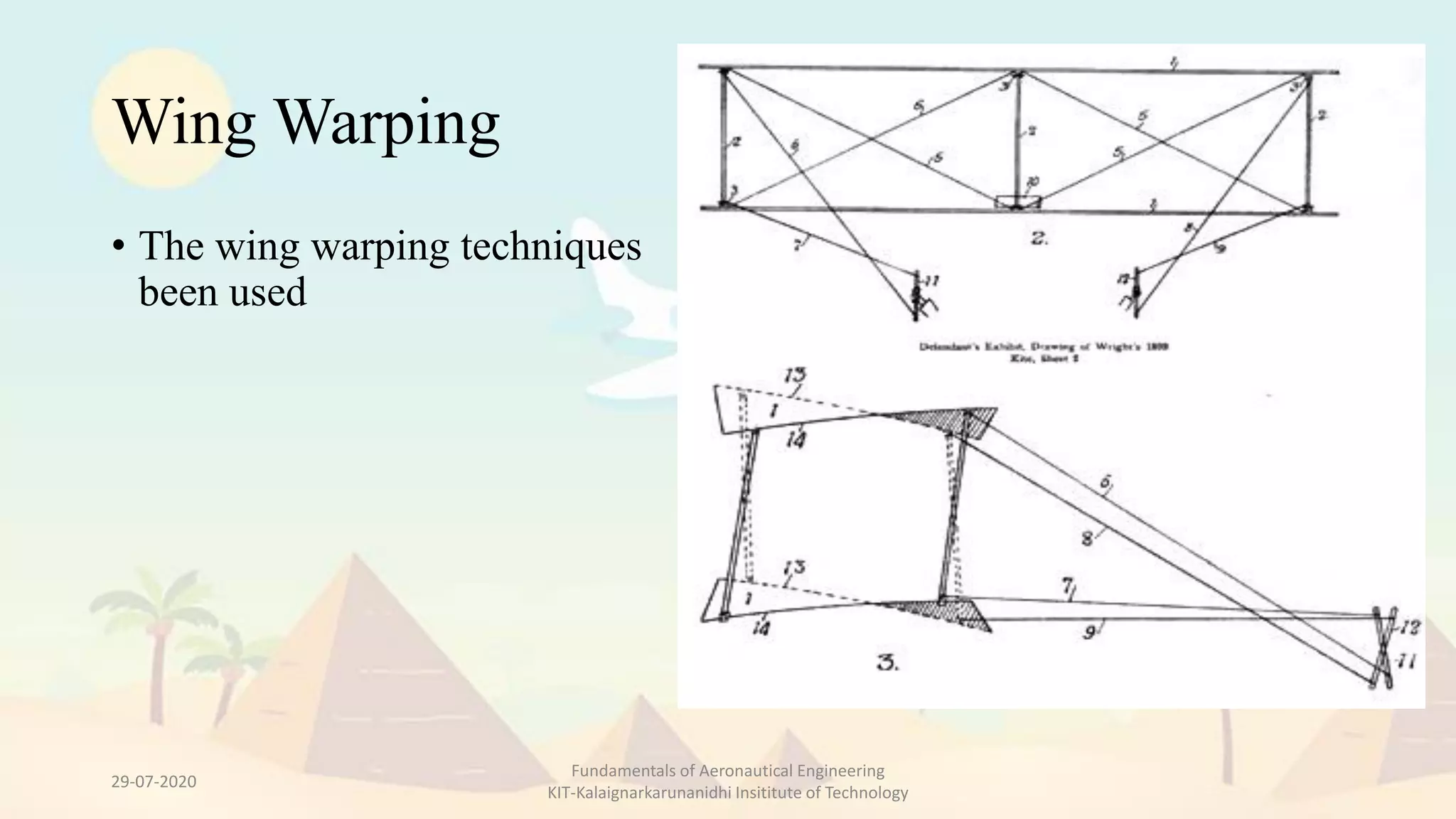
Wing Warping
• The wing warping techniques
been used
29-07-2020
Fundamentals of Aeronautical Engineering
KIT-Kalaignarkarunanidhi Insititute of Technology
1901
• The Wrights test their second
glider at Kitty Hawk. and it
also performs poorly.
• At home in Dayton, Ohio, they
build a wind tunnel and
conduct research on wing
shapes.
29-07-2020
Fundamentals of Aeronautical Engineering
KIT-Kalaignarkarunanidhi Insititute of Technology
1902
• The Wright build a third glider based on
their wind tunnel tests and it flies well.
• They refine their control system at Kitty
Hawk.
29-07-2020
Fundamentals of Aeronautical Engineering
KIT-Kalaignarkarunanidhi Insititute of Technology
1903
• The Wright brothers make the
first controlled, sustained
powered flight at Kitty Hawk.
• Samuel Langley of the
Smithsonian Institution also
tries to fly a manned version of
his Aerodrome and fails
29-07-2020
Fundamentals of Aeronautical Engineering
KIT-Kalaignarkarunanidhi Insititute of Technology
1904 Wright Flyer II
• The Wrights begin to refine their
powered airplane, making test flights
at Huffman Prairie near Dayton, Ohio
• Now it is Known as Wright Patterson
Airforce base
• Longest Flight last for 5min 4sec
traversing more than 4426m
29-07-2020
Fundamentals of Aeronautical Engineering
KIT-Kalaignarkarunanidhi Insititute of Technology
1905 Wright Flyer III
• Wing area is smaller than the Flyer II
• Airfoil camber is increased ,biplane and
double rudder
• The Wright brothers develop the first
practical airplane and demonstrate it before a
small audience.
• They offer their invention to the U.S. Army,
but the Army is not interested.
• More than 40 flight
• Longest Duration 38min 3Sec covering
38640m
29-07-2020
Fundamentals of Aeronautical Engineering
KIT-Kalaignarkarunanidhi Insititute of Technology
1906
The U.S. Patent Office grants a patent to
the Wright Brothers on their airplane
control system.
29-07-2020
Fundamentals of Aeronautical Engineering
KIT-Kalaignarkarunanidhi Insititute of Technology
1907
• Wright type A airplane similar to the
Flyer III but has a engine of 40hp
29-07-2020
Fundamentals of Aeronautical Engineering
KIT-Kalaignarkarunanidhi Insititute of Technology
1908
• The Wright Brothers procure
contracts for the sale of airplanes
from French investors and the
U.S. Army, provided they can
demonstrate their invention.
• Wilber flew to France made
around 104 flight in France land
29-07-2020
Fundamentals of Aeronautical Engineering
KIT-Kalaignarkarunanidhi Insititute of Technology
1908
• The Wright brothers demonstrate a two-
passenger airplane in Europe and
America. While Orville was experiencing
similar success in US
• Demonstration for Fort Meyer near
Washington ,Columbia ,Longest flight :
1hr 14min
• Orville crashes during a demonstration
flight, propeller crashed and is badly
injured. His passenger, Lt. Thomas
Selfridge, becomes the first person to die
in an airplane crash.
29-07-2020
Fundamentals of Aeronautical Engineering
KIT-Kalaignarkarunanidhi Insititute of Technology
1909
• The Wrights demonstrate a new airplane and the
U.S. Army buys its first military aircraft. The
Wrights begin to manufacture airplanes and
teach pilots.
• Two technical features where adopted by Wright
Machine : Lateral control and propeller
29-07-2020
Fundamentals of Aeronautical Engineering
KIT-Kalaignarkarunanidhi Insititute of Technology
DIAGRAM OF PLANE
ORVILLES ACCOUNT
• Five people witnessed the flights: One was John T. Daniels (who took the famous
"first flight" photo using Orville's pre-positioned camera). Another was Johnny
Moore, a teenage boy who lived in the area.
WILBURS EARLY DEATH
• Wilbur became ill on a business trip to Boston in April 1912. This was thought by
some to be due to eating bad shellfish at a banquet.
• After returning to Dayton, he was diagnosed with typhoid fever. He lingered in
and out of consciousness for several weeks until he died at home on May 30, at
age 45.
• His father wrote about Wilbur :
"A short life, full of consequences. An unfailing intellect, imperturbable temper,
great self-reliance and as great modesty, seeing the right clearly, pursuing it
steadfastly, he lived and died."[
ORVILLES LATER LIFE
• Orville made his last flight as a pilot in 1918. He retired from business and
became an elder statesman of aviation.
• On April 19, 1944 a plane, piloted by Howard Hughes and Jack Frye, flew from
Burbank, California, to Washington, D.C. On the return trip, the airliner stopped at
Wright Field to give Orville Wright his last airplane flight, more than 40 years
after his historic first flight. He may even have briefly handled the controls.
ORVILLES DEATH
• Orville died on January 30, 1948, after his
second heart attack. He had lived from the horse-
and-buggy age to the dawn of supersonic flight.
• He was followed a day later by John T. Daniels,
the Coast Guardsman who took their famous first
flight photo.
• Both brothers are buried at the family plot at
Woodland Cemetery, Dayton, Ohio.
Wilbur and Orville Wright flying
1901 glider as a kite.
Wright Brothers National Memorial
Kill Devil Hills, North Carolina
• The brothers never
married.
• Wilbur Wright died at age
45 of typhoid.
• Orville Wright died of a
heart attack at age 77.
Learning to Fly: Wright Brother Adventure
29-07-2020
Fundamentals of Aeronautical Engineering
KIT-Kalaignarkarunanidhi Insititute of Technology
Source
1. Aeronautics–An Educator’s Guide with Activities in Science,
Mathematics, and Technology Education
2. http://firstflight.open.ac.uk/history/index.php
3. https://science.howstuffworks.com/transport/flight/modern/hot-air-
balloon.htm#pt6
4. http://www.ornithopter.org/index.shtml
5. Bellis, Mary. "The Early History of Flight." ThoughtCo, Feb. 11, 2020,
thoughtco.com/early-history-of-flight-4072777.
6. https://www.thoughtco.com/early-history-of-flight-4072777
7. https://www.thoughtco.com/biography-of-wilbur-wright-1992687
8. http://www.wright-
brothers.org/History_Wing/Wright_Story/Wright_Timeline/Wright_Timel
ine_1900_1909.htm
29-07-2020
Fundamentals of Aeronautical Engineering
KIT-Kalaignarkarunanidhi Insititute of Technology

ELEMENTS OF AERONAUTICS

  • 1.
    Fundamental of Aeronautical Engineering 29-07-2020 Fundamentalsof Aeronautical Engineering KIT-Kalaignarkarunanidhi Insititute of Technology Prepared By Ms.K.Niranjana Assistant Professor Department of Aeronautical Engineering KIT-Kalaignarkarunanidhi Institute of Technology
  • 2.
    UNIT- I HISTORY OFFLIGHT Balloon flight – ornithopers - Early Airplanes by Wright Brothers, biplanes and monoplanes, Developments in aerodynamics, materials, structures and propulsion over the years. 29-07-2020 Fundamentals of Aeronautical Engineering KIT-Kalaignarkarunanidhi Insititute of Technology
  • 3.
    “Birds fly, sowhy can’t I?” • That question was probably first asked by cave dwellers watching a bird swoop through the air. Perhaps even then, people understood the advantages of human flight. • The desire to defy gravity and experience the freedom of flight compelled early attempts to unravel the mysterious technique the birds had mastered proficiently. 29-07-2020 Fundamentals of Aeronautical Engineering KIT-Kalaignarkarunanidhi Insititute of Technology
  • 4.
    Myths Flight ofFantasy Greek Myth Daedalus and Icarus Wings Fastened with Wax 29-07-2020 Fundamentals of Aeronautical Engineering KIT-Kalaignarkarunanidhi Insititute of Technology
  • 5.
    29-07-2020 Fundamentals of AeronauticalEngineering KIT-Kalaignarkarunanidhi Insititute of Technology
  • 6.
    Early dreams ofpowered flight...??? Eighteenth century BC The flying chariot of Ki-Kung-Shi 29-07-2020 Fundamentals of Aeronautical Engineering KIT-Kalaignarkarunanidhi Insititute of Technology
  • 7.
    Aerial Steam Carriage •Henson's 1842 design based on the ideas of Sir George Cayley • The patent drawings, and imaginative sketches derived from them, received world-wide publicity. • The plane never left the drawing board, but still inspired widespread research and experimentation. 29-07-2020 Fundamentals of Aeronautical Engineering KIT-Kalaignarkarunanidhi Insititute of Technology
  • 8.
    Eole’s Flight • ClementAder's Eole was the first piloted aeroplane to take off under its own power, for a brief uncontrolled hop in 1890. • The Eole had a light but powerful 20HP steam engine and bat like wings. Unfortunately it had little flight control and no forward vision for the pilot. 29-07-2020 Fundamentals of Aeronautical Engineering KIT-Kalaignarkarunanidhi Insititute of Technology …..came closer to reality
  • 9.
    Flyer • In 1893Phillips' first model 'flyer' had 40 narrow wings, and only just lifted when driven round a circular track at 40mph by a steam engine. However its double surfaced aerofoil represents an important stage in the development of flight. • His results and designs would have influenced the Wright Brother's understanding of their own wind tunnel data. 29-07-2020 Fundamentals of Aeronautical Engineering KIT-Kalaignarkarunanidhi Insititute of Technology
  • 10.
    To the excitingworld of aeronautics!!!! •The term aeronautics originated in France •Derived from Greek words for “air” and “to sail.” •It is the study of flight and the operation of aircraft. 29-07-2020 Fundamentals of Aeronautical Engineering KIT-Kalaignarkarunanidhi Insititute of Technology
  • 11.
    29-07-2020 Fundamentals of AeronauticalEngineering KIT-Kalaignarkarunanidhi Insititute of Technology 400 B.C. The first kites were invented by the Chinese. Timeline for Key Event History of Flight 1485 Leonardo da Vinci designed the ornithopter (a wing flapping aircraft).
  • 12.
    29-07-2020 Fundamentals of AeronauticalEngineering KIT-Kalaignarkarunanidhi Insititute of Technology 1849 Sir George Cayley, “The Father of Aerial Navigation,” designed the first three wing glider that lifted a person off the ground. 1783 Joseph and Etienne Montgolfier launched the first passengers a duck, a sheep, and a rooster—in a hot air balloon.
  • 13.
    29-07-2020 Fundamentals of AeronauticalEngineering KIT-Kalaignarkarunanidhi Insititute of Technology 1891 Otto Lilienthal built the first practical glider for long flights. 1903 The Wright Brothers developed the first motor-powered airplane that a pilot could control.
  • 14.
    29-07-2020 Fundamentals of AeronauticalEngineering KIT-Kalaignarkarunanidhi Insititute of Technology 1907 Paul Cornu built the first free flying helicopter. 1919 Lieutenant-Commander A.C. Reed and his crew were the first to fly across the Atlantic Ocean, making several stops, in the Curtiss Flying Boat.
  • 15.
    29-07-2020 Fundamentals of AeronauticalEngineering KIT-Kalaignarkarunanidhi Insititute of Technology 1927 Charles Lindbergh was the first person to fly across the Atlantic Ocean nonstop. 1935 Amelia Earhart was the first person to fly solo across the Pacific Ocean from Hawaii to California
  • 16.
    29-07-2020 Fundamentals of AeronauticalEngineering KIT-Kalaignarkarunanidhi Insititute of Technology 1947 Chuck Yeager became the first pilot to break the sound barrier. 1979 The Gossamer Albatross was the first craft powered by a human (Bryan Allen) to fly across the English Channel.
  • 17.
    29-07-2020 Fundamentals of AeronauticalEngineering KIT-Kalaignarkarunanidhi Insititute of Technology 1997 The NASA/AeroVironment Pathfinder became the first solar- powered aircraft to fly above the troposphere. 1986 Dick Rutan and Jeana Yeager flew Voyager around the world nonstop without refueling.
  • 18.
    29-07-2020 Fundamentals of AeronauticalEngineering KIT-Kalaignarkarunanidhi Insititute of Technology 400 B.C. The first kites were invented by the Chinese. 1485 Leonardo da Vinci designed the ornithopter (a wing flapping aircraft). 1783 Joseph and Etienne Montgolfier launched the first passengers—a duck, a sheep, and a rooster in a hot air balloon. 1849 Sir George Cayley, “The Father of Aerial Navigation,” designed the first three wing glider that lifted a person off the ground. 1891 Otto Lilienthal built the first practical glider for long flights. 1903 The Wright Brothers developed the first motor-powered airplane that a pilot could control. 1907 Paul Cornu built the first free flying helicopter. 1919 Lieutenant-Commander A.C. Reed and his crew were the first to fly across the Atlantic Ocean, making several stops, in the Curtiss Flying Boat. 1927 Charles Lindbergh was the first person to fly across the Atlantic Ocean nonstop. 1935 Amelia Earhart was the first person to fly solo across the Pacific Ocean from Hawaii to California. 1947 Chuck Yeager became the first pilot to break the sound barrier. 1979 The Gossamer Albatross was the first craft powered by a human (Bryan Allen) to fly across the English Channel. 1986 Dick Rutan and Jeana Yeager flew Voyager around the world nonstop without refueling. 1997 The NASA/AeroVironment Pathfinder became the first solar-powered aircraft to fly above the troposphere.
  • 19.
    HOT AIR BALLOONS •Oldest successful aeronautic design. • The first unmanned balloons were the Kongming lanterns and the Nazca Lines balloons. 29-07-2020
  • 20.
    First manned balloon •The first manned balloon was the Montgolfier balloon created by Joseph Michel Montgolfier. • It's first tethered flight, a flight with people aboard, was on October 15, 1783. It was then used in the French military as an observation post at the Battle of Fleurus (1794). • Tested with first passengers are a duck, a sheep, and a rooster 29-07-2020 Fundamentals of Aeronautical Engineering KIT-Kalaignarkarunanidhi Insititute of Technology
  • 21.
    • Joseph MichelMontgolfier filled a silk bag with air in his house, and it rose up to his ceiling. This proved that flight with hot air balloons was possible. 29-07-2020 Fundamentals of Aeronautical Engineering KIT-Kalaignarkarunanidhi Insititute of Technology
  • 22.
    Working Principle ofHot Air Balloon 29-07-2020 Fundamentals of Aeronautical Engineering KIT-Kalaignarkarunanidhi Insititute of Technology
  • 23.
    Hot air balloonsare based on a very basic scientific principle: • Warmer air rises in cooler air. • Hot air is lighter than cool air, because it has less mass per unit of volume. • A cubic foot of air weighs roughly 28 grams (about an ounce). If you heat that air by 100 degrees F, it weighs about 7 grams less. • Therefore, each cubic foot of air contained in a hot air balloon can lift about 7 grams. That's not much, and this is why hot air balloons are so huge -- to lift 1,000 pounds, you need about 65,000 cubic feet of hot air. 29-07-2020 Fundamentals of Aeronautical Engineering KIT-Kalaignarkarunanidhi Insititute of Technology
  • 24.
    Buoyancy Effect 29-07-2020 Fundamentals ofAeronautical Engineering KIT-Kalaignarkarunanidhi Insititute of Technology
  • 25.
    Three essential parts: •Burner, which heats the air • The balloon envelope, which holds the air • The basket, which carries the passengers. Other Parts of the Hot air balloon • Coating • Fuel Tanks • Parachute Valve • Instrumentation 29-07-2020 Fundamentals of Aeronautical Engineering KIT-Kalaignarkarunanidhi Insititute of Technology
  • 26.
    Burner • Positioned underan open balloon envelope. • Modern hot air balloons heat the air by burning propane, the same substance commonly used in outdoor cooking grills. • The propane is stored in compressed liquid form, in lightweight cylinders positioned in the balloon basket. The intake hose runs down to the bottom of the cylinder, so it can draw the liquid out. • Because the propane is highly compressed in the cylinders, it flows quickly through the hoses to the heating coil. 29-07-2020 Fundamentals of Aeronautical Engineering KIT-Kalaignarkarunanidhi Insititute of Technology
  • 27.
    Burner 29-07-2020 Fundamentals of AeronauticalEngineering KIT-Kalaignarkarunanidhi Insititute of Technology
  • 28.
    • The heatingcoil is simply a length of steel tubing arranged in a coil around the burner. • When the balloonist starts up the burner, the propane flows out in liquid form and is ignited by a pilot light. • As the flame burns, it heats up the metal in the surrounding tubing. When the tubing becomes hot, it heats the propane flowing through it. This changes the propane from a liquid to a gas, before it is ignited. This gas makes for a more powerful flame and more efficient fuel consumption. 29-07-2020 Fundamentals of Aeronautical Engineering KIT-Kalaignarkarunanidhi Insititute of Technology
  • 29.
    Envelope • It isconstructed from long nylon gores, reinforced with sewn-in webbing. • The gores, which extend from the base of the envelope to the crown, are made up of a number of smaller panels. • Nylon works very well in balloons because it is lightweight,high melting temperature. • The skirt, the nylon at the base of the envelope, is coated with special fire- resistant material, to keep the flame from igniting the balloon. 29-07-2020 Fundamentals of Aeronautical Engineering KIT-Kalaignarkarunanidhi Insititute of Technology
  • 30.
    Wicker Basket • Wickerbasket for the passenger compartment. • Wicker works very well because it is sturdy, flexible and relatively lightweight. • The flexibility helps with balloon landings: In a basket made of more rigid material, passengers would feel the brunt of the impact force. Wicker material flexes a little, absorbing some of the energy. 29-07-2020 Fundamentals of Aeronautical Engineering KIT-Kalaignarkarunanidhi Insititute of Technology
  • 31.
    Piloting a Balloon •Essentially, these are the only controls -- heat to make the balloon rise and venting to make it sink. • This raises an interesting question: If pilots can only move hot air balloons up and down, how do they get the balloon from place to place? • As it turns out, pilots can maneuver horizontally by changing their vertical position, because wind blows in different directions at different altitudes. To move in a particular direction, a pilot ascends and descends to the appropriate level, and rides with the wind. Since wind speed generally increases as you get higher in the atmosphere, pilots can also control horizontal speed by changing altitude. 29-07-2020 Fundamentals of Aeronautical Engineering KIT-Kalaignarkarunanidhi Insititute of Technology
  • 32.
    Launching and Landing 29-07-2020 Fundamentalsof Aeronautical Engineering KIT-Kalaignarkarunanidhi Insititute of Technology Once the balloon envelope is down on the ground, the crew begins pushing the air out. When the balloon is flattened, the crew packs it into a stuff sack. This whole process is a lot like packing up a giant sleeping bag.
  • 33.
    ORNITHOPTER • The word"ornithopter" means "bird wing". • An ornithopter doesn't need to have feathers, though. • What makes it birdlike is the flapping motion. • Airplanes and helicopters use rotating propellers. • Instead of rotation, the ornithopter imitates the reciprocating motion of a bird's wing. 29-07-2020 Fundamentals of Aeronautical Engineering KIT-Kalaignarkarunanidhi Insititute of Technology
  • 34.
    Timeline of Ornithopter •Until the nineteenth century, Leonardo da Vinci was generally known only as a painter. • Among the many subjects Leonardo studied, the possibility of human mechanical flight held particular fascination. 29-07-2020 Fundamentals of Aeronautical Engineering KIT-Kalaignarkarunanidhi Insititute of Technology
  • 35.
    • He producedmore than 35,000 words and 500 sketches dealing with flying machines, the nature of air, and bird flight. • These investigations of flight are scattered throughout the many da Vinci codices and manuscript collections • Produce one short codex almost entirely on the subject in 1505-1506, the Codice sul volo degli uccelli (Codex on the Flight of Birds) which is a handwritten manuscript mirror image • Work Manuscript is been stored in ???? 29-07-2020 Fundamentals of Aeronautical Engineering KIT-Kalaignarkarunanidhi Insititute of Technology British Library in London
  • 36.
    In Indian Epic????? • The Sanskrit epic Ramayana describes an ornithopter, the Pushpaka Vimana. • The first writings on trying to use the idea of flapping flight date all the way back, but there were not any recorded designs made from the descriptions in the writing. 29-07-2020 Fundamentals of Aeronautical Engineering KIT-Kalaignarkarunanidhi Insititute of Technology
  • 37.
    Da Vinci sketchesof the ornithopter • It has used a system of pulleys and gears powered by the arms and legs that would make the wings move in the fashion that a bird’s wing does. • Da Vinci’s design was not based on an idea of having a wing attached to each arm of a human and having that person flapping their arms up and down because he discovered that humans were not strong enough to generate the power needed to fly. 29-07-2020 Fundamentals of Aeronautical Engineering KIT-Kalaignarkarunanidhi Insititute of Technology
  • 38.
    • The amountof lift needed to put a human in the air was physically impossible to achieve so the lift to drag ratio compared to that of a bird was much too small due to the lack of lift generated. • The only way to overcome that factor was to add the system of pulleys that would multiply the force exerted by the human’s arms and legs and transfer that power to the wings to make them flap fast enough to generate the lift needed to fly. • Da Vinci did not make a full scale model of his design, but many other future innovators in flight would try to perfect da Vinci’s design and build a machine that would allow humans to fly through the phenomenon of flapping flight. 29-07-2020 Fundamentals of Aeronautical Engineering KIT-Kalaignarkarunanidhi Insititute of Technology
  • 39.
    NASA's Mars CuriosityRover and Leonardo da Vinci's Codex • July 24, 2012 • An etched version of Leonardo da Vinci's self-portrait on the Microchip to be placed aboard NASA's Mars Curiosity Rover. • Leonardo da Vinci's Codex on Bird Flight, a document from about 1505 was reproduced on a microscopic scale and fastened to the chip on Curiosity. Leonardo's self-portrait is also on the rover, along with some essays, drawings, and other submissions from finalists and semi- finalists who participated in the "Send Your Name to Mars" rover naming contest opportunity. 29-07-2020 Fundamentals of Aeronautical Engineering KIT-Kalaignarkarunanidhi Insititute of Technology
  • 40.
    29-07-2020 Fundamentals of AeronauticalEngineering KIT-Kalaignarkarunanidhi Insititute of Technology
  • 41.
    Purpose of Ornithopter •Carry cameras and other payloads. • Save lives by chasing birds away from airport runways. • Building ornithopter is an excellent hands on experience for students, as well as great enjoyment for hobbyists 29-07-2020 Fundamentals of Aeronautical Engineering KIT-Kalaignarkarunanidhi Insititute of Technology
  • 42.
    Other Uses • Forestrymonitoring • Security reason • Bird eye view • Maps • Location tracing • As a spy 29-07-2020 Fundamentals of Aeronautical Engineering KIT-Kalaignarkarunanidhi Insititute of Technology
  • 43.
    Major Types ofOrnithopter • Free Flight Ornithopters • Radio Controlled Ornithopters • Manned Ornithopters 29-07-2020 Fundamentals of Aeronautical Engineering KIT-Kalaignarkarunanidhi Insititute of Technology
  • 44.
    Free Flight Ornithopters •Simplest and least expensive to build. • They are powered by winding up a rubber band. • Great for a school competition to see who can get the longest flight time. • Building and flying these ornithopters is a great way for kids to learn about science and work as a team. 29-07-2020 Fundamentals of Aeronautical Engineering KIT-Kalaignarkarunanidhi Insititute of Technology
  • 45.
    29-07-2020 Fundamentals of AeronauticalEngineering KIT-Kalaignarkarunanidhi Insititute of Technology
  • 46.
    Radio Controlled Ornithopters •Powered by electric motor and battery • Size range from 10 cm wingspan micro air vehicles to the size of an eagle • Radio controlled, and usually the tail is used for steering. • They can be purchased as a ready made toy, or built by the hobbyist. 29-07-2020 Fundamentals of Aeronautical Engineering KIT-Kalaignarkarunanidhi Insititute of Technology
  • 47.
    How to Design& Build Ornithopters • Perhaps you will want to try something more advanced, like a radio controlled ornithopter. • The information comes from The Ornithopter Design Manual, fifth edition, by Nathan Chronister, published by the Ornithopter Society in 2008. Parts of the Radio controlled Ornithopter • Power Systems • Gear Design • Flapping Mechanism • Wings • Stability and Control 29-07-2020 Fundamentals of Aeronautical Engineering KIT-Kalaignarkarunanidhi Insititute of Technology
  • 48.
    Power Systems: • Choosingthe right motor and battery are both essential for building a successful ornithopter. Ex: RC 2627 3500KV 4200KV brushless BLDC outrunner motor for remote control hobby model 29-07-2020 Fundamentals of Aeronautical Engineering KIT-Kalaignarkarunanidhi Insititute of Technology
  • 49.
    Gear Design • Unlessyou use a rubber band for power, you'll probably need to gear down the motor, to give it enough torque to flap the wings. • The gearbox can be one of the most challenging parts of your ornithopter to build. The information here will make it much easier. 29-07-2020 Fundamentals of Aeronautical Engineering KIT-Kalaignarkarunanidhi Insititute of Technology
  • 50.
    The Flapping Mechanism •Conversion of the rotary motion of your motor into an oscillating wing motion. • This is what makes your device an ornithopter instead of an airplane or helicopter! • Several different mechanisms and construction techniques are described. 29-07-2020 Fundamentals of Aeronautical Engineering KIT-Kalaignarkarunanidhi Insititute of Technology
  • 51.
    Wings: • When buildingornithopters, an efficient wing design can make the difference between failure and success. • There are several general types of ornithopter wing. 29-07-2020 Fundamentals of Aeronautical Engineering KIT-Kalaignarkarunanidhi Insititute of Technology
  • 52.
    Stability and Control: •It's pretty easy to stabilize a free-flight ornithopter, but when you add radio control, some surprising things happen. • Often the ornithopter refuses to come out of a turn! Just as there are several ways to steer an ornithopter, there are also some things you can do to avoid these problems. 29-07-2020 Fundamentals of Aeronautical Engineering KIT-Kalaignarkarunanidhi Insititute of Technology
  • 53.
    Manned Ornithopters • AdalbertSchmid's manned ornithopters flown during World War II • Old idea it requires advanced technology to make a manned ornithopter fly. • Manned ornithopters could offer a maneuverable, quiet, and efficient means of transportation, with some advantages over the helicopter. • The Ornithopter Society, started by Patrick Deshaye in 1984 - Accurate information about the history of ornithopters - Information on how to build ornithopters - Resources for educators, to promote the development of ornithopter technology - To provide a lasting record of accomplishments in the field. 29-07-2020 Fundamentals of Aeronautical Engineering KIT-Kalaignarkarunanidhi Insititute of Technology
  • 54.
    29-07-2020 Fundamentals of AeronauticalEngineering KIT-Kalaignarkarunanidhi Insititute of Technology
  • 55.
    How do BirdsFly? 29-07-2020 Fundamentals of Aeronautical Engineering KIT-Kalaignarkarunanidhi Insititute of Technology
  • 56.
    Aviation fuels • Aviationfuels are fuels used for aircraft propulsion. A basic distinction is made between four different aviation fuels: • Jet fuel (Jet A-1, kerosene) • Kerosene-gasoline mixture (Jet B) • Aviation gasoline (avgas) • Biokerosene 29-07-2020 Fundamentals of Aeronautical Engineering KIT-Kalaignarkarunanidhi Insititute of Technology
  • 57.
    Propellent • A propellantor propellent is a chemical substance used in the production of energy or pressurized gas that is subsequently used to create movement of a fluid or to generate propulsion of a vehicle, projectile, or other object. 29-07-2020 Fundamentals of Aeronautical Engineering KIT-Kalaignarkarunanidhi Insititute of Technology
  • 58.
  • 59.
    CHILDHOOD • There were7 children in their family. Wilbur was the 3rd child was born in 1867 at Millville, Indiana and Orville the 6th child 1871 in the place Dayton, Ohio. • In 1878 their father, a bishop in the Church of the United Brethren in Christ • Mother was a home maker but they have a great interest towards mechanical techniques and she was working in her father car carriage shop • Even she used to make home appliances and toys for her kids
  • 60.
    The Wright House,7 Hawthorne Street , Dayton, Ohio
  • 61.
  • 62.
    INTRODUCTION  Two Americanbrothers, inventors, and aviation pioneers  Credited with inventing and building the world's first successful powered airplane.  Neither went to university or ever married.
  • 63.
    NEWSPAPER • Orville droppedout of high school after his third year to start a newspaper business in 1889, having designed and built his own printing press with Wilbur's help. • Wilbur joined the shop, and in March the brothers started a weekly newspaper, the West Side News.
  • 64.
    • Later issuesnamed Orville as publisher and Wilbur as editor. • In April 1890 they changed the paper to a daily, The Evening Item, but it lasted only four months because it wasn’t successful. 29-07-2020 Fundamentals of Aeronautical Engineering KIT-Kalaignarkarunanidhi Insititute of Technology
  • 65.
    Orville Interest TowardsCycling • Prize Winning Cyclist • Wilbur Wright begins to sell and repair bicycles, perhaps inspired by a huge gathering of the American Wheelmen that takes place in Dayton on July 4 and 5. • Later, Orville joins him. They keep the printing business, letting childhood friend Ed Sines run it. • The Wrights gear up to manufacture their own bicycles, the "St. Clair" and the "Van Cleve." The bike business is profitable. 29-07-2020 Fundamentals of Aeronautical Engineering KIT-Kalaignarkarunanidhi Insititute of Technology
  • 66.
    • The brothersopened a repair and sales shop in December 1892 called the Wright Cycle Exchange which changed to the Wright Cycle Company and began manufacturing their own brand in 1896. • They did this because of the bike craze in 1890s which was started by the invention of the safety bicycle and its advantages over the penny-farthing design. • The Bicycles also gave them ideas for their plane like the way of shifting your weight from one side to the other to turn. The Bicycle Shop
  • 67.
    PLANE MOTIVATION • Inthe 1890s they saw newspaper articles of McClure's Magazine and photographs of the dramatic glides by Otto Lilienthal in Germany. • 1896 brought three important flying events. • Samuel Langley successfully flew an unmanned steam-powered fixed-wing model aircraft. • Octave Chanute and others flew gliders over the sand dunes along the shore of Lake Michigan. • In August, Lilienthal was killed in the fall of his glider. • In May 1899 Wilbur wrote to the Smithsonian Museum requesting Lilienthal’s reports and flight test results ,They received the brief bibliography of flying including the work of Chanute and Langley
  • 68.
  • 69.
    1899 • Study ofbird flight as a guide on path towards mechanical flight. • Regain their lateral balance to turn by gust of wind by torsion of the tips of the wings • Therefore the wing twist to control airplanes in lateral motion. 29-07-2020 Fundamentals of Aeronautical Engineering KIT-Kalaignarkarunanidhi Insititute of Technology
  • 70.
    1900 • The Wrightbrothers fly their biplane kite with the wingspan of 1.5m at Kitty Hawk, North Carolina to test their control system. • It does not produce enough lift to make more than a handful of flights. • Kitty hawk was the area suggested by the U.S.Bureau is an ideal spot for glider experiment 29-07-2020 Fundamentals of Aeronautical Engineering KIT-Kalaignarkarunanidhi Insititute of Technology
  • 71.
    Wing Warping • Thewing warping techniques been used 29-07-2020 Fundamentals of Aeronautical Engineering KIT-Kalaignarkarunanidhi Insititute of Technology
  • 72.
    1901 • The Wrightstest their second glider at Kitty Hawk. and it also performs poorly. • At home in Dayton, Ohio, they build a wind tunnel and conduct research on wing shapes. 29-07-2020 Fundamentals of Aeronautical Engineering KIT-Kalaignarkarunanidhi Insititute of Technology
  • 73.
    1902 • The Wrightbuild a third glider based on their wind tunnel tests and it flies well. • They refine their control system at Kitty Hawk. 29-07-2020 Fundamentals of Aeronautical Engineering KIT-Kalaignarkarunanidhi Insititute of Technology
  • 74.
    1903 • The Wrightbrothers make the first controlled, sustained powered flight at Kitty Hawk. • Samuel Langley of the Smithsonian Institution also tries to fly a manned version of his Aerodrome and fails 29-07-2020 Fundamentals of Aeronautical Engineering KIT-Kalaignarkarunanidhi Insititute of Technology
  • 75.
    1904 Wright FlyerII • The Wrights begin to refine their powered airplane, making test flights at Huffman Prairie near Dayton, Ohio • Now it is Known as Wright Patterson Airforce base • Longest Flight last for 5min 4sec traversing more than 4426m 29-07-2020 Fundamentals of Aeronautical Engineering KIT-Kalaignarkarunanidhi Insititute of Technology
  • 76.
    1905 Wright FlyerIII • Wing area is smaller than the Flyer II • Airfoil camber is increased ,biplane and double rudder • The Wright brothers develop the first practical airplane and demonstrate it before a small audience. • They offer their invention to the U.S. Army, but the Army is not interested. • More than 40 flight • Longest Duration 38min 3Sec covering 38640m 29-07-2020 Fundamentals of Aeronautical Engineering KIT-Kalaignarkarunanidhi Insititute of Technology
  • 77.
    1906 The U.S. PatentOffice grants a patent to the Wright Brothers on their airplane control system. 29-07-2020 Fundamentals of Aeronautical Engineering KIT-Kalaignarkarunanidhi Insititute of Technology
  • 78.
    1907 • Wright typeA airplane similar to the Flyer III but has a engine of 40hp 29-07-2020 Fundamentals of Aeronautical Engineering KIT-Kalaignarkarunanidhi Insititute of Technology
  • 79.
    1908 • The WrightBrothers procure contracts for the sale of airplanes from French investors and the U.S. Army, provided they can demonstrate their invention. • Wilber flew to France made around 104 flight in France land 29-07-2020 Fundamentals of Aeronautical Engineering KIT-Kalaignarkarunanidhi Insititute of Technology
  • 80.
    1908 • The Wrightbrothers demonstrate a two- passenger airplane in Europe and America. While Orville was experiencing similar success in US • Demonstration for Fort Meyer near Washington ,Columbia ,Longest flight : 1hr 14min • Orville crashes during a demonstration flight, propeller crashed and is badly injured. His passenger, Lt. Thomas Selfridge, becomes the first person to die in an airplane crash. 29-07-2020 Fundamentals of Aeronautical Engineering KIT-Kalaignarkarunanidhi Insititute of Technology
  • 81.
    1909 • The Wrightsdemonstrate a new airplane and the U.S. Army buys its first military aircraft. The Wrights begin to manufacture airplanes and teach pilots. • Two technical features where adopted by Wright Machine : Lateral control and propeller 29-07-2020 Fundamentals of Aeronautical Engineering KIT-Kalaignarkarunanidhi Insititute of Technology
  • 82.
  • 83.
    ORVILLES ACCOUNT • Fivepeople witnessed the flights: One was John T. Daniels (who took the famous "first flight" photo using Orville's pre-positioned camera). Another was Johnny Moore, a teenage boy who lived in the area.
  • 84.
    WILBURS EARLY DEATH •Wilbur became ill on a business trip to Boston in April 1912. This was thought by some to be due to eating bad shellfish at a banquet. • After returning to Dayton, he was diagnosed with typhoid fever. He lingered in and out of consciousness for several weeks until he died at home on May 30, at age 45. • His father wrote about Wilbur : "A short life, full of consequences. An unfailing intellect, imperturbable temper, great self-reliance and as great modesty, seeing the right clearly, pursuing it steadfastly, he lived and died."[
  • 85.
    ORVILLES LATER LIFE •Orville made his last flight as a pilot in 1918. He retired from business and became an elder statesman of aviation. • On April 19, 1944 a plane, piloted by Howard Hughes and Jack Frye, flew from Burbank, California, to Washington, D.C. On the return trip, the airliner stopped at Wright Field to give Orville Wright his last airplane flight, more than 40 years after his historic first flight. He may even have briefly handled the controls.
  • 86.
    ORVILLES DEATH • Orvilledied on January 30, 1948, after his second heart attack. He had lived from the horse- and-buggy age to the dawn of supersonic flight. • He was followed a day later by John T. Daniels, the Coast Guardsman who took their famous first flight photo. • Both brothers are buried at the family plot at Woodland Cemetery, Dayton, Ohio.
  • 87.
    Wilbur and OrvilleWright flying 1901 glider as a kite. Wright Brothers National Memorial Kill Devil Hills, North Carolina
  • 88.
    • The brothersnever married. • Wilbur Wright died at age 45 of typhoid. • Orville Wright died of a heart attack at age 77.
  • 89.
    Learning to Fly:Wright Brother Adventure 29-07-2020 Fundamentals of Aeronautical Engineering KIT-Kalaignarkarunanidhi Insititute of Technology
  • 90.
    Source 1. Aeronautics–An Educator’sGuide with Activities in Science, Mathematics, and Technology Education 2. http://firstflight.open.ac.uk/history/index.php 3. https://science.howstuffworks.com/transport/flight/modern/hot-air- balloon.htm#pt6 4. http://www.ornithopter.org/index.shtml 5. Bellis, Mary. "The Early History of Flight." ThoughtCo, Feb. 11, 2020, thoughtco.com/early-history-of-flight-4072777. 6. https://www.thoughtco.com/early-history-of-flight-4072777 7. https://www.thoughtco.com/biography-of-wilbur-wright-1992687 8. http://www.wright- brothers.org/History_Wing/Wright_Story/Wright_Timeline/Wright_Timel ine_1900_1909.htm 29-07-2020 Fundamentals of Aeronautical Engineering KIT-Kalaignarkarunanidhi Insititute of Technology