Group Members:
Muhammad Shan Saleem
Muhammad Ayaz
1
Objectives:
 To design a mathematical model for the collapse of Tacoma
bridge and analyze its cause.
 To simulate the system in Matlab and analyze the waveform
results.
2
Introduction
 In the summer of 1940, the Tacoma Narrows Suspension Bridge in
the State of Washington was completed and opened to traffic.
 Almost immediately, observers noticed that the wind blowing across
the roadway would sometimes set up large vertical vibrations in the
roadbed.
 Finally, on November 7, 1940, during a powerful storm, the
oscillations increased beyond any previously observed, and the
bridge was evacuated.
3
Introduction (Contd.)
 The entire span was eventually shaken apart by the large vibrations,
and the bridge collapsed.
4
Possible Cause ???
 The noted engineer von Karman was asked to determine the cause of
the collapse.
 He claimed that the wind blowing across the roadway separated into
vortices (wind swirls) alternately above and below the roadbed,
thereby setting up a periodic, vertical force acting on the bridge.
 It was this force that caused the oscillations.
5
Possible Cause (Contd.)
 Others further hypothesized that the frequency of this forcing
function exactly matched the natural frequency of the bridge,
thus leading to resonance, large oscillations, and destruction.
 For almost fifty years, resonance was blamed as the cause of
the collapse of the bridge
 Although the von Karman group denied this, stating that “it is
very improbable that resonance with alternating vortices plays
an important role in the oscillations of suspension bridges”
6
Mathematical Modeling
 Consider a single vertical cable of the suspension bridge.
We assume that it acts like a spring, but with different
characteristics in tension and compression, and with no
damping.
 When stretched, the cable acts like a spring with Hooke’s
constant, b, while, when compressed, it acts like a spring
with a different Hooke’s constant, a.
 We assume that the cable in compression exerts a smaller
force on the roadway than when stretched the same
distance.
7
Modeling (Contd.)
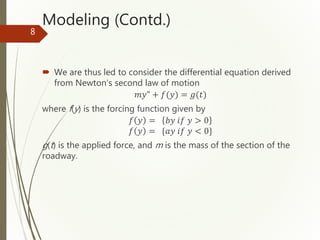
 We are thus led to consider the differential equation derived
from Newton’s second law of motion
𝑚𝑦" + 𝑓(𝑦) = 𝑔(𝑡)
where f(y) is the forcing function given by
𝑓 𝑦 = 𝑏𝑦 𝑖𝑓 𝑦 > 0
𝑓 𝑦 = {𝑎𝑦 𝑖𝑓 𝑦 < 0}
g(t) is the applied force, and m is the mass of the section of the
roadway.
8
Modeling (Contd.)
 We will assume that m= 1 kg, b= 4 N/m, a=1N/m, and g(t) =
sin(4t) N
 Therefore we must solve initial value problem
𝑦" + 4𝑦 = sin 4𝑡 𝑦(0) = 0; 𝑦′(0) = 0.01
 After solving above problem, we get the following solution
𝑦 𝑡 = sin 2𝑡 [
1
2
0.01 +
1
3
−
1
6
cos 2𝑡 ]
 We note that the first positive value of t for which y(t) is again
equal to zero is 𝑡 = 𝝅/2, so above equation holds on [0, 𝝅/2]
9
Modeling (Contd.)
 After t=𝝅/2, y becomes negative, so we must now solve the new
problem
𝑦" + 𝑦 = sin 4𝑡 𝑦(𝝅/2) = 0; 𝑦′(𝝅/2) = −(0.01 + 2/3)
 Proceeding as previous, the solution of above problem is
𝑦 𝑡 = cos 𝑡[ 0.01 +
2
5
−
4
15
sin 𝑡 cos 2𝑡]
 We note that the first positive value of t for which y(t) is again equal
to zero is 𝑡 = 3𝝅/2, so above equation holds on [0, 3𝝅/2]
 Here our first cycle is completed, for next cycles the derived
problems will remain same but the initial conditions will change,
 The first value at which the system is equal to zero is our initial
conditions for next interval.
10
Simulation
 The whole model is implemented and simulated in Matlab
script.
 Solutions of initial value problems derived using
mathematical modeling is obtained by implementation of
2nd order differential equations in Matlab.
 Results obtained are then plotted in their respected
intervals.
 Detailed calculations are also performed by hand and is
attached with report.
11
Plot for 1st cycle
 For 0 to 𝝅/2 the derived initial value problem was
𝑦" + 4𝑦 = sin 4𝑡 𝑦(0) = 0; 𝑦′(0) = 0.01
 For 𝝅/2 to 3𝝅/2 the derived initial value problem was
𝑦" + 𝑦 = sin 4𝑡 𝑦(𝝅/2) = 0; 𝑦′(𝝅/2) = −(0.01 + 2/3)
Plotting graphs in Matlab
12
Plot for 1st & 2nd cycle
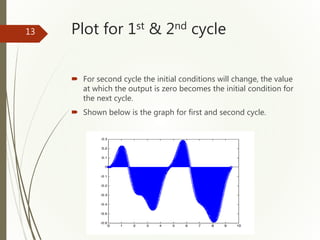
 For second cycle the initial conditions will change, the value
at which the output is zero becomes the initial condition for
the next cycle.
 Shown below is the graph for first and second cycle.
13
Results
 It is not surprising then that the amplitude of oscillations
will increase over time,
 Since the amplitude of (one term in) the solution during any
one cycle is directly related to the velocity at the beginning
of the cycle.
 It should be clear at this point that the large oscillations
causing the destruction of the Tacoma Narrows Suspension
Bridge were not the result of resonance.
14
References
 1. Lewis, G. N., “Tacoma Narrows Suspension Bridge Collapse” in A First Course in
Differential Equations, Dennis G. Zill, 253–256. Boston: PWS-Kent, 1993.
 2. Braun, M., Differential Equations and Their Applications, 167–169. New
York:Springer-Verlag, 1978.
 3. Amman, O. H., T. von Karman, and G. B. Woodruff, The Failure of the Tacoma
Narrows Bridge. Washington D.C.: Federal Works Agency, 1941.
 4. Lazer, A. C., and P. J. McKenna. Large amplitude periodic oscillations in
suspension bridges: Some new connections with nonlinear analysis. SIAM Review
32 (December 1990): 537–578.
 5. Peterson, I., Rock and roll bridge. Science News 137 (1991): 344–346.
 6. McKenna, P. J., Large torsional oscillations in suspension bridges revisited: Fixing
an old approximation. American Mathematical Monthly 106 (1999):1–18.
15

Tacoma narrow bridge math Modeling

  • 1.
    Group Members: Muhammad ShanSaleem Muhammad Ayaz 1
  • 2.
    Objectives:  To designa mathematical model for the collapse of Tacoma bridge and analyze its cause.  To simulate the system in Matlab and analyze the waveform results. 2
  • 3.
    Introduction  In thesummer of 1940, the Tacoma Narrows Suspension Bridge in the State of Washington was completed and opened to traffic.  Almost immediately, observers noticed that the wind blowing across the roadway would sometimes set up large vertical vibrations in the roadbed.  Finally, on November 7, 1940, during a powerful storm, the oscillations increased beyond any previously observed, and the bridge was evacuated. 3
  • 4.
    Introduction (Contd.)  Theentire span was eventually shaken apart by the large vibrations, and the bridge collapsed. 4
  • 5.
    Possible Cause ??? The noted engineer von Karman was asked to determine the cause of the collapse.  He claimed that the wind blowing across the roadway separated into vortices (wind swirls) alternately above and below the roadbed, thereby setting up a periodic, vertical force acting on the bridge.  It was this force that caused the oscillations. 5
  • 6.
    Possible Cause (Contd.) Others further hypothesized that the frequency of this forcing function exactly matched the natural frequency of the bridge, thus leading to resonance, large oscillations, and destruction.  For almost fifty years, resonance was blamed as the cause of the collapse of the bridge  Although the von Karman group denied this, stating that “it is very improbable that resonance with alternating vortices plays an important role in the oscillations of suspension bridges” 6
  • 7.
    Mathematical Modeling  Considera single vertical cable of the suspension bridge. We assume that it acts like a spring, but with different characteristics in tension and compression, and with no damping.  When stretched, the cable acts like a spring with Hooke’s constant, b, while, when compressed, it acts like a spring with a different Hooke’s constant, a.  We assume that the cable in compression exerts a smaller force on the roadway than when stretched the same distance. 7
  • 8.
    Modeling (Contd.)  Weare thus led to consider the differential equation derived from Newton’s second law of motion 𝑚𝑦" + 𝑓(𝑦) = 𝑔(𝑡) where f(y) is the forcing function given by 𝑓 𝑦 = 𝑏𝑦 𝑖𝑓 𝑦 > 0 𝑓 𝑦 = {𝑎𝑦 𝑖𝑓 𝑦 < 0} g(t) is the applied force, and m is the mass of the section of the roadway. 8
  • 9.
    Modeling (Contd.)  Wewill assume that m= 1 kg, b= 4 N/m, a=1N/m, and g(t) = sin(4t) N  Therefore we must solve initial value problem 𝑦" + 4𝑦 = sin 4𝑡 𝑦(0) = 0; 𝑦′(0) = 0.01  After solving above problem, we get the following solution 𝑦 𝑡 = sin 2𝑡 [ 1 2 0.01 + 1 3 − 1 6 cos 2𝑡 ]  We note that the first positive value of t for which y(t) is again equal to zero is 𝑡 = 𝝅/2, so above equation holds on [0, 𝝅/2] 9
  • 10.
    Modeling (Contd.)  Aftert=𝝅/2, y becomes negative, so we must now solve the new problem 𝑦" + 𝑦 = sin 4𝑡 𝑦(𝝅/2) = 0; 𝑦′(𝝅/2) = −(0.01 + 2/3)  Proceeding as previous, the solution of above problem is 𝑦 𝑡 = cos 𝑡[ 0.01 + 2 5 − 4 15 sin 𝑡 cos 2𝑡]  We note that the first positive value of t for which y(t) is again equal to zero is 𝑡 = 3𝝅/2, so above equation holds on [0, 3𝝅/2]  Here our first cycle is completed, for next cycles the derived problems will remain same but the initial conditions will change,  The first value at which the system is equal to zero is our initial conditions for next interval. 10
  • 11.
    Simulation  The wholemodel is implemented and simulated in Matlab script.  Solutions of initial value problems derived using mathematical modeling is obtained by implementation of 2nd order differential equations in Matlab.  Results obtained are then plotted in their respected intervals.  Detailed calculations are also performed by hand and is attached with report. 11
  • 12.
    Plot for 1stcycle  For 0 to 𝝅/2 the derived initial value problem was 𝑦" + 4𝑦 = sin 4𝑡 𝑦(0) = 0; 𝑦′(0) = 0.01  For 𝝅/2 to 3𝝅/2 the derived initial value problem was 𝑦" + 𝑦 = sin 4𝑡 𝑦(𝝅/2) = 0; 𝑦′(𝝅/2) = −(0.01 + 2/3) Plotting graphs in Matlab 12
  • 13.
    Plot for 1st& 2nd cycle  For second cycle the initial conditions will change, the value at which the output is zero becomes the initial condition for the next cycle.  Shown below is the graph for first and second cycle. 13
  • 14.
    Results  It isnot surprising then that the amplitude of oscillations will increase over time,  Since the amplitude of (one term in) the solution during any one cycle is directly related to the velocity at the beginning of the cycle.  It should be clear at this point that the large oscillations causing the destruction of the Tacoma Narrows Suspension Bridge were not the result of resonance. 14
  • 15.
    References  1. Lewis,G. N., “Tacoma Narrows Suspension Bridge Collapse” in A First Course in Differential Equations, Dennis G. Zill, 253–256. Boston: PWS-Kent, 1993.  2. Braun, M., Differential Equations and Their Applications, 167–169. New York:Springer-Verlag, 1978.  3. Amman, O. H., T. von Karman, and G. B. Woodruff, The Failure of the Tacoma Narrows Bridge. Washington D.C.: Federal Works Agency, 1941.  4. Lazer, A. C., and P. J. McKenna. Large amplitude periodic oscillations in suspension bridges: Some new connections with nonlinear analysis. SIAM Review 32 (December 1990): 537–578.  5. Peterson, I., Rock and roll bridge. Science News 137 (1991): 344–346.  6. McKenna, P. J., Large torsional oscillations in suspension bridges revisited: Fixing an old approximation. American Mathematical Monthly 106 (1999):1–18. 15