Title of Presentation
Presentation Date
Name of Person, Assistant Director
Revised Total Coliform Rule
March 2, 2017
Texas Water Conservation Association
Charles R. Maddox, P.E.
Topics
• Total Coliform Rule (TCR) basics and sampling
• Where did the Revised Total Coliform Rule
(RTCR) come from?
• What was the TCR rule previously?
• What are the rules now under the “Revised”
TCR?
• How does it affect or change operations at your
utility?
TCR Basics
• Probably the most basic monitoring & sampling
requirement common to all systems
• A.K.A. a bacteriological sample
• Test is for Total Coliform & E. coli
• Monthly number of samples per month based on
population served (34 categories) for instance:
– 1 to 1,000 1
– 8,501-12,900 10
– 25,001 – 33,000 30
– 78,001 – 970,000 270
• Chlorine residual test done at the same time
TCR Sampling
• Distribution system sample – we use customer’s
outside hose bibs
• Special bact sample bottle/container needed
• 100 ml minimum per sample
• No chlorine in sample (bottle has chlorine
inactivation agent added)
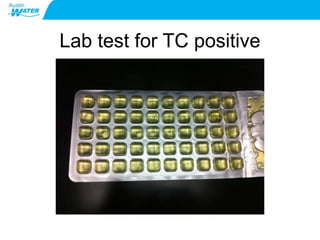
Lab test for TC positive
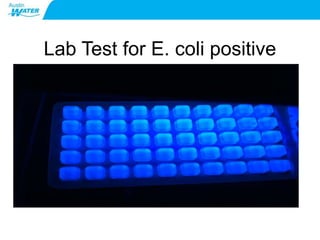
Lab Test for E. coli positive
Where did the RTCR come from?
• EPA 6 year review process for TCR started in
2003
• Established a TCR Federal Advisory Committee
• 2008 Committee Agreement in Principle set out
rule change framework
• EPA Final RTCR published February 13, 2013
• Effective date of April 1, 2016
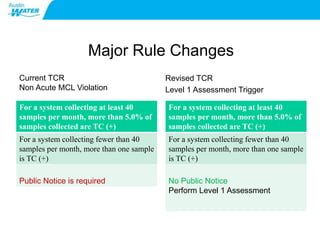
Major Rule Changes
Current TCR
Non Acute MCL Violation
For a system collecting at least 40
samples per month, more than 5.0% of
samples collected are TC (+)
For a system collecting fewer than 40
samples per month, more than one sample
is TC (+)
Public Notice is required
For a system collecting at least 40
samples per month, more than 5.0% of
samples collected are TC (+)
For a system collecting fewer than 40
samples per month, more than one sample
is TC (+)
No Public Notice
Perform Level 1 Assessment
Revised TCR
Level 1 Assessment Trigger
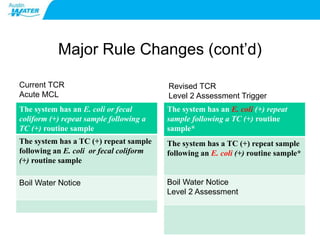
Major Rule Changes (cont’d)
Current TCR
Acute MCL
The system has an E. coli or fecal
coliform (+) repeat sample following a
TC (+) routine sample
The system has a TC (+) repeat sample
following an E. coli or fecal coliform
(+) routine sample
Boil Water Notice
Revised TCR
Level 2 Assessment Trigger
The system has an E. coli (+) repeat
sample following a TC (+) routine
sample*
The system has a TC (+) repeat sample
following an E. coli (+) routine sample*
Boil Water Notice
Level 2 Assessment
Major Rule Changes (cont’d)
• Advantages to these changes:
– When had more than 1 or >5% positive, and exceeded MCL then
just stopped sampling and gave public notice
– Public notice confusing and alarming to public, and rarely
accomplished anything
– Now with Level 1 & 2, review operations to see if you can find a
cause, termed “sanitary defect” in rules
– A proactive “find and fix” approach
• No major changes for groundwater triggered monitoring
What is a Level 1 Assesment?
• Checklist form for:
– Review sampling procedures
– Chlorine residuals, flushing
– System pressures, main repairs
– Storage, vents, screens, overflows
– Cross connections
– Source and treatment
• Groundwater – well integrity, vents, seals, security
• Surface Water – treatment, heavy rainfall, plant water quality
monitoring
• Who can do it?
– Water utility owner, operator
What is a Level 2 Assessment?
• More in depth review, physically looking at facilities, and
reviewing treatment & monitoring data, distribution
system operation
• Who can do it?
– TCEQ
– Third party approved by TCEQ
– Water utility if approved by TCEQ
– No approval process currently in place by TCEQ
TCEQ Level 1 & 2 Forms are Lengthy
• Level 1 Form
– 72 pages of instructions
– 100 checklist items
• Level 2 Form
– No instructions posted on website
– 345 checklist items
• Some comparisons:
– 2008 Agreement In Principle concept examples:
• Level 1 – 21 items/categories
• Level 2 – 75 items/categories
– EPA Region 8
• Level 1 – 65 items/categories
• Level 2 – 91 items/categories
Timelines
• EPA rule effective April 1, 2016
• TCEQ received primacy rule extension from EPA
to February 17, 2017
• Joint responsibility between TCEQ & EPA
• TCEQ rules published in Texas Register on
October 17, 2016
• Final TCEQ rules effective March 30,
2017(scheduled)
Takeaways/Impacts on utilities
• RTCR is a good rule change
• Pay attention to your monthly sampling process
• Familiarize yourself with the Level 1 and 2 forms
• Use the concepts in forms when you have
positive bacteriological samples even though
you don’t exceed an MCL
• Provide feedback to TCEQ on forms, they are
still in “draft”
• I hope you don’t have to fill one of them out!
Questions/Comments?
Charlie Maddox
Austin Water
512-972-0021
Charlie.Maddox@austintexas.gov

Revised Total Coliform Rule, Charles Maddox, P.E.

  • 1.
    Title of Presentation PresentationDate Name of Person, Assistant Director Revised Total Coliform Rule March 2, 2017 Texas Water Conservation Association Charles R. Maddox, P.E.
  • 2.
    Topics • Total ColiformRule (TCR) basics and sampling • Where did the Revised Total Coliform Rule (RTCR) come from? • What was the TCR rule previously? • What are the rules now under the “Revised” TCR? • How does it affect or change operations at your utility?
  • 3.
    TCR Basics • Probablythe most basic monitoring & sampling requirement common to all systems • A.K.A. a bacteriological sample • Test is for Total Coliform & E. coli • Monthly number of samples per month based on population served (34 categories) for instance: – 1 to 1,000 1 – 8,501-12,900 10 – 25,001 – 33,000 30 – 78,001 – 970,000 270 • Chlorine residual test done at the same time
  • 4.
    TCR Sampling • Distributionsystem sample – we use customer’s outside hose bibs • Special bact sample bottle/container needed • 100 ml minimum per sample • No chlorine in sample (bottle has chlorine inactivation agent added)
  • 7.
    Lab test forTC positive
  • 8.
    Lab Test forE. coli positive
  • 9.
    Where did theRTCR come from? • EPA 6 year review process for TCR started in 2003 • Established a TCR Federal Advisory Committee • 2008 Committee Agreement in Principle set out rule change framework • EPA Final RTCR published February 13, 2013 • Effective date of April 1, 2016
  • 10.
    Major Rule Changes CurrentTCR Non Acute MCL Violation For a system collecting at least 40 samples per month, more than 5.0% of samples collected are TC (+) For a system collecting fewer than 40 samples per month, more than one sample is TC (+) Public Notice is required For a system collecting at least 40 samples per month, more than 5.0% of samples collected are TC (+) For a system collecting fewer than 40 samples per month, more than one sample is TC (+) No Public Notice Perform Level 1 Assessment Revised TCR Level 1 Assessment Trigger
  • 11.
    Major Rule Changes(cont’d) Current TCR Acute MCL The system has an E. coli or fecal coliform (+) repeat sample following a TC (+) routine sample The system has a TC (+) repeat sample following an E. coli or fecal coliform (+) routine sample Boil Water Notice Revised TCR Level 2 Assessment Trigger The system has an E. coli (+) repeat sample following a TC (+) routine sample* The system has a TC (+) repeat sample following an E. coli (+) routine sample* Boil Water Notice Level 2 Assessment
  • 12.
    Major Rule Changes(cont’d) • Advantages to these changes: – When had more than 1 or >5% positive, and exceeded MCL then just stopped sampling and gave public notice – Public notice confusing and alarming to public, and rarely accomplished anything – Now with Level 1 & 2, review operations to see if you can find a cause, termed “sanitary defect” in rules – A proactive “find and fix” approach • No major changes for groundwater triggered monitoring
  • 13.
    What is aLevel 1 Assesment? • Checklist form for: – Review sampling procedures – Chlorine residuals, flushing – System pressures, main repairs – Storage, vents, screens, overflows – Cross connections – Source and treatment • Groundwater – well integrity, vents, seals, security • Surface Water – treatment, heavy rainfall, plant water quality monitoring • Who can do it? – Water utility owner, operator
  • 14.
    What is aLevel 2 Assessment? • More in depth review, physically looking at facilities, and reviewing treatment & monitoring data, distribution system operation • Who can do it? – TCEQ – Third party approved by TCEQ – Water utility if approved by TCEQ – No approval process currently in place by TCEQ
  • 15.
    TCEQ Level 1& 2 Forms are Lengthy • Level 1 Form – 72 pages of instructions – 100 checklist items • Level 2 Form – No instructions posted on website – 345 checklist items • Some comparisons: – 2008 Agreement In Principle concept examples: • Level 1 – 21 items/categories • Level 2 – 75 items/categories – EPA Region 8 • Level 1 – 65 items/categories • Level 2 – 91 items/categories
  • 16.
    Timelines • EPA ruleeffective April 1, 2016 • TCEQ received primacy rule extension from EPA to February 17, 2017 • Joint responsibility between TCEQ & EPA • TCEQ rules published in Texas Register on October 17, 2016 • Final TCEQ rules effective March 30, 2017(scheduled)
  • 17.
    Takeaways/Impacts on utilities •RTCR is a good rule change • Pay attention to your monthly sampling process • Familiarize yourself with the Level 1 and 2 forms • Use the concepts in forms when you have positive bacteriological samples even though you don’t exceed an MCL • Provide feedback to TCEQ on forms, they are still in “draft” • I hope you don’t have to fill one of them out!
  • 18.