Systems Engineering for Project Managers

What you need to know, what you may think that you
know which ain‟t so and what the main challenges are

INCOSE/APM Joint Workshop – 15 January 2013

Prof Mike Wilkinson
Atkins Technical Director


                        Copyright © 2013 Atkins Ltd
Introduction

My Current Roles
Technical Director         Atkins
Technical Director         Niteworks
Immediate Past-President   INCOSE UK
Visiting Professor         Loughborough University

My Background and History
Technical Direction     Technical Infrastructure/Governance
Business Management     Systems & Costing
Technical Consultancy   IT/Telecoms/Systems
Academic Research       Theoretical Physics


What follows is a personal perspective – not endorsed by Atkins,
INCOSE or anybody else!


                                             Copyright © 2013 Atkins Ltd
What is Systems Engineering?
•   “Systems engineering is a discipline that concentrates on the design and
    application of the whole (system) as distinct from the parts. It involves
    looking at a problem in its entirety, taking into account all the facets and all
    the variables and relating the social to the technical aspect.” [Simon Ramo,
    quoted by RISE]

•   “Systems engineering is an iterative process of top-down synthesis,
    development, and operation of a real-world system that satisfies, in a near
    optimal manner, the full range of requirements for the system.” [Howard
    Eisner, in Essentials of Project and Systems Engineering Management,
    Wiley, 2008]

•   “Systems engineering is an interdisciplinary approach and means to enable
    the realization of successful systems.” [INCOSE Systems Engineering
    Handbook]


            Big Idea: SE is both systemic and systematic


                                                   Copyright © 2013 Atkins Ltd
What is a system?
• “A system is a combination of interacting elements
  organized to achieve one or more stated purposes.”
  [INCOSE Systems Engineering Handbook]

• “A system is an open set of complementary, interacting
  parts with properties, capabilities, and behaviours
  emerging both from the parts and from their
  interactions.”
  [Hitchins, “Putting Systems to Work”]
   Big Idea: Systems have property of emergence – the
         whole is greater than the sum of the parts


                                  Copyright © 2013 Atkins Ltd
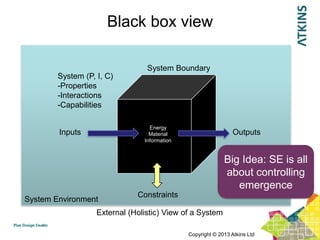
Black box view

                                 System Boundary
        System (P, I, C)
        -Properties
        -Interactions
        -Capabilities

                                  Energy
        Inputs                    Material                      Outputs
                                Information


                                                            Big Idea: SE is all
                                                            about controlling
                                                               emergence
                              Constraints
System Environment
                   External (Holistic) View of a System

                                              Copyright © 2013 Atkins Ltd
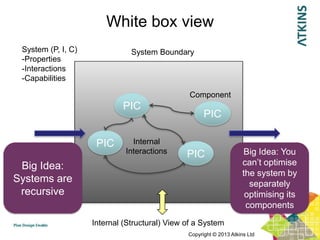
White box view
 System (P, I, C)              System Boundary
 -Properties
 -Interactions
 -Capabilities

                                                Component
                            PIC
                                                     PIC

                     PIC       Internal
                             Interactions      PIC                   Big Idea: You
 Big Idea:                                                           can‟t optimise
                                                                     the system by
Systems are                                                            separately
 recursive                                                            optimising its
                                                                      components
                    Internal (Structural) View of a System
                                               Copyright © 2013 Atkins Ltd
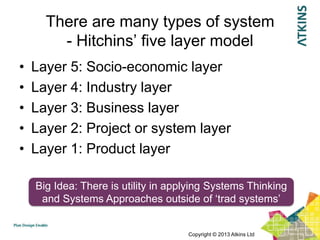
There are many types of system
        - Hitchins‟ five layer model
•   Layer 5: Socio-economic layer
•   Layer 4: Industry layer
•   Layer 3: Business layer
•   Layer 2: Project or system layer
•   Layer 1: Product layer

    Big Idea: There is utility in applying Systems Thinking
     and Systems Approaches outside of „trad systems‟


                                     Copyright © 2013 Atkins Ltd
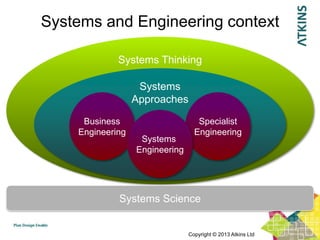
Systems and Engineering context

             Systems Thinking

                   Systems
                  Approaches

     Business                      Specialist
    Engineering                   Engineering
                   Systems
                  Engineering


             Systems Science


                                Copyright © 2013 Atkins Ltd
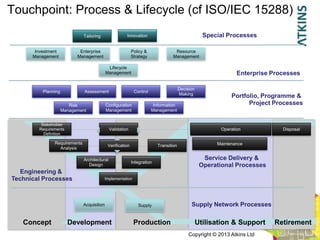
Touchpoint: Process & Lifecycle (cf ISO/IEC 15288)
                              Tailoring                Innovation                                   Special Processes

       Investment           Enterprise                      Policy &               Resource
      Management           Management                       Strategy              Management

                                             Lifecycle
                                            Management                                                          Enterprise Processes

                                                                                       Decision
          Planning            Assessment                     Control
                                                                                       Making
                                                                                                              Portfolio, Programme &
                        Risk                Configuration              Information                                  Project Processes
                     Management             Management                 Management


         Stakeholder
        Requirements                          Validation                                                 Operation            Disposal
          Definition

               Requirements                                                                             Maintenance
                                             Verification                 Transition
                 Analysis

                              Architectural                                                         Service Delivery &
                                                            Integration
                                Design                                                             Operational Processes
   Engineering &
Technical Processes                       Implementation


                              Acquisition                      Supply                        Supply Network Processes

   Concept             Development                           Production                           Utilisation & Support    Retirement
                                                                                            Copyright © 2013 Atkins Ltd
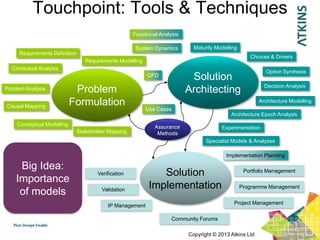
Touchpoint: Tools & Techniques
                                                     Functional Analysis

                                                      System Dynamics        Maturity Modelling
     Requirements Definition
                                                                                                     Choices & Drivers
                                  Requirements Modelling
  Contextual Analysis
                                                                                                           Option Synthesis
                                                           QFD
                                                                            Solution
                                                                                                           Decision Analysis
Problem Analysis            Problem                                        Architecting
Causal Mapping
                           Formulation                                                                   Architecture Modelling
                                                           Use Cases
                                                                                            Architecture Epoch Analysis
    Conceptual Modelling
                                                              Assurance                 Experimentation
                               Stakeholder Mapping             Methods
                                                                                  Specialist Models & Analyses

                                                                                          Implementation Planning

     Big Idea:
                                      Verification             Solution                            Portfolio Management
    Importance
                                                            Implementation                        Programme Management
     of models                          Validation


                                          IP Management                                      Project Management

                                                                     Community Forums

                                                                           Copyright © 2013 Atkins Ltd
Other Touchpoints

• Competencies and traits
   – Big picture, breadth, knowledge, communications,
     leadership, etc
• Artefacts
   – WBS, tasks definitions, risk register/management
     plan, stakeholder engagement plan, etc
• Responsibilities
   – Requirements management, risk management,
     stakeholder engagement, etc

[see NASA PM SE competency framework]
[see Eileen Arnold, “Systems Engineering and Project Management
Intersects and Confusion” INCOSE IS12]


                                        Copyright © 2013 Atkins Ltd
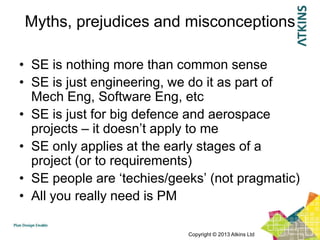
Myths, prejudices and misconceptions

• SE is nothing more than common sense
• SE is just engineering, we do it as part of
  Mech Eng, Software Eng, etc
• SE is just for big defence and aerospace
  projects – it doesn‟t apply to me
• SE only applies at the early stages of a
  project (or to requirements)
• SE people are „techies/geeks‟ (not pragmatic)
• All you really need is PM

                            Copyright © 2013 Atkins Ltd
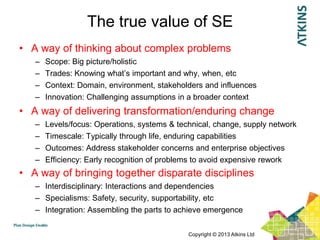
The true value of SE
• A way of thinking about complex problems
   –   Scope: Big picture/holistic
   –   Trades: Knowing what‟s important and why, when, etc
   –   Context: Domain, environment, stakeholders and influences
   –   Innovation: Challenging assumptions in a broader context
• A way of delivering transformation/enduring change
   –   Levels/focus: Operations, systems & technical, change, supply network
   –   Timescale: Typically through life, enduring capabilities
   –   Outcomes: Address stakeholder concerns and enterprise objectives
   –   Efficiency: Early recognition of problems to avoid expensive rework
• A way of bringing together disparate disciplines
   – Interdisciplinary: Interactions and dependencies
   – Specialisms: Safety, security, supportability, etc
   – Integration: Assembling the parts to achieve emergence

                                              Copyright © 2013 Atkins Ltd
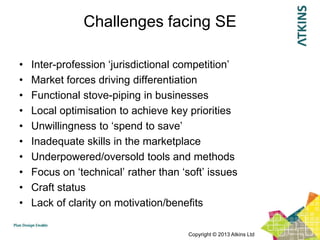
Challenges facing SE

•   Inter-profession „jurisdictional competition‟
•   Market forces driving differentiation
•   Functional stove-piping in businesses
•   Local optimisation to achieve key priorities
•   Unwillingness to „spend to save‟
•   Inadequate skills in the marketplace
•   Underpowered/oversold tools and methods
•   Focus on „technical‟ rather than „soft‟ issues
•   Craft status
•   Lack of clarity on motivation/benefits

                                       Copyright © 2013 Atkins Ltd
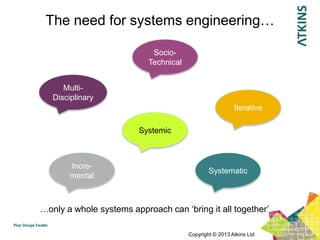
The need for systems engineering…

                            Socio-
                           Technical


      Multi-
   Disciplinary
                                                         Iterative

                         Systemic


        Incre-
                                               Systematic
        mental


…only a whole systems approach can „bring it all together‟

                                       Copyright © 2013 Atkins Ltd

Systems engineering for project managers - what you need to know

  • 1.
    Systems Engineering forProject Managers What you need to know, what you may think that you know which ain‟t so and what the main challenges are INCOSE/APM Joint Workshop – 15 January 2013 Prof Mike Wilkinson Atkins Technical Director Copyright © 2013 Atkins Ltd
  • 2.
    Introduction My Current Roles TechnicalDirector Atkins Technical Director Niteworks Immediate Past-President INCOSE UK Visiting Professor Loughborough University My Background and History Technical Direction Technical Infrastructure/Governance Business Management Systems & Costing Technical Consultancy IT/Telecoms/Systems Academic Research Theoretical Physics What follows is a personal perspective – not endorsed by Atkins, INCOSE or anybody else! Copyright © 2013 Atkins Ltd
  • 3.
    What is SystemsEngineering? • “Systems engineering is a discipline that concentrates on the design and application of the whole (system) as distinct from the parts. It involves looking at a problem in its entirety, taking into account all the facets and all the variables and relating the social to the technical aspect.” [Simon Ramo, quoted by RISE] • “Systems engineering is an iterative process of top-down synthesis, development, and operation of a real-world system that satisfies, in a near optimal manner, the full range of requirements for the system.” [Howard Eisner, in Essentials of Project and Systems Engineering Management, Wiley, 2008] • “Systems engineering is an interdisciplinary approach and means to enable the realization of successful systems.” [INCOSE Systems Engineering Handbook] Big Idea: SE is both systemic and systematic Copyright © 2013 Atkins Ltd
  • 4.
    What is asystem? • “A system is a combination of interacting elements organized to achieve one or more stated purposes.” [INCOSE Systems Engineering Handbook] • “A system is an open set of complementary, interacting parts with properties, capabilities, and behaviours emerging both from the parts and from their interactions.” [Hitchins, “Putting Systems to Work”] Big Idea: Systems have property of emergence – the whole is greater than the sum of the parts Copyright © 2013 Atkins Ltd
  • 5.
    Black box view System Boundary System (P, I, C) -Properties -Interactions -Capabilities Energy Inputs Material Outputs Information Big Idea: SE is all about controlling emergence Constraints System Environment External (Holistic) View of a System Copyright © 2013 Atkins Ltd
  • 6.
    White box view System (P, I, C) System Boundary -Properties -Interactions -Capabilities Component PIC PIC PIC Internal Interactions PIC Big Idea: You Big Idea: can‟t optimise the system by Systems are separately recursive optimising its components Internal (Structural) View of a System Copyright © 2013 Atkins Ltd
  • 7.
    There are manytypes of system - Hitchins‟ five layer model • Layer 5: Socio-economic layer • Layer 4: Industry layer • Layer 3: Business layer • Layer 2: Project or system layer • Layer 1: Product layer Big Idea: There is utility in applying Systems Thinking and Systems Approaches outside of „trad systems‟ Copyright © 2013 Atkins Ltd
  • 8.
    Systems and Engineeringcontext Systems Thinking Systems Approaches Business Specialist Engineering Engineering Systems Engineering Systems Science Copyright © 2013 Atkins Ltd
  • 9.
    Touchpoint: Process &Lifecycle (cf ISO/IEC 15288) Tailoring Innovation Special Processes Investment Enterprise Policy & Resource Management Management Strategy Management Lifecycle Management Enterprise Processes Decision Planning Assessment Control Making Portfolio, Programme & Risk Configuration Information Project Processes Management Management Management Stakeholder Requirements Validation Operation Disposal Definition Requirements Maintenance Verification Transition Analysis Architectural Service Delivery & Integration Design Operational Processes Engineering & Technical Processes Implementation Acquisition Supply Supply Network Processes Concept Development Production Utilisation & Support Retirement Copyright © 2013 Atkins Ltd
  • 10.
    Touchpoint: Tools &Techniques Functional Analysis System Dynamics Maturity Modelling Requirements Definition Choices & Drivers Requirements Modelling Contextual Analysis Option Synthesis QFD Solution Decision Analysis Problem Analysis Problem Architecting Causal Mapping Formulation Architecture Modelling Use Cases Architecture Epoch Analysis Conceptual Modelling Assurance Experimentation Stakeholder Mapping Methods Specialist Models & Analyses Implementation Planning Big Idea: Verification Solution Portfolio Management Importance Implementation Programme Management of models Validation IP Management Project Management Community Forums Copyright © 2013 Atkins Ltd
  • 11.
    Other Touchpoints • Competenciesand traits – Big picture, breadth, knowledge, communications, leadership, etc • Artefacts – WBS, tasks definitions, risk register/management plan, stakeholder engagement plan, etc • Responsibilities – Requirements management, risk management, stakeholder engagement, etc [see NASA PM SE competency framework] [see Eileen Arnold, “Systems Engineering and Project Management Intersects and Confusion” INCOSE IS12] Copyright © 2013 Atkins Ltd
  • 12.
    Myths, prejudices andmisconceptions • SE is nothing more than common sense • SE is just engineering, we do it as part of Mech Eng, Software Eng, etc • SE is just for big defence and aerospace projects – it doesn‟t apply to me • SE only applies at the early stages of a project (or to requirements) • SE people are „techies/geeks‟ (not pragmatic) • All you really need is PM Copyright © 2013 Atkins Ltd
  • 13.
    The true valueof SE • A way of thinking about complex problems – Scope: Big picture/holistic – Trades: Knowing what‟s important and why, when, etc – Context: Domain, environment, stakeholders and influences – Innovation: Challenging assumptions in a broader context • A way of delivering transformation/enduring change – Levels/focus: Operations, systems & technical, change, supply network – Timescale: Typically through life, enduring capabilities – Outcomes: Address stakeholder concerns and enterprise objectives – Efficiency: Early recognition of problems to avoid expensive rework • A way of bringing together disparate disciplines – Interdisciplinary: Interactions and dependencies – Specialisms: Safety, security, supportability, etc – Integration: Assembling the parts to achieve emergence Copyright © 2013 Atkins Ltd
  • 14.
    Challenges facing SE • Inter-profession „jurisdictional competition‟ • Market forces driving differentiation • Functional stove-piping in businesses • Local optimisation to achieve key priorities • Unwillingness to „spend to save‟ • Inadequate skills in the marketplace • Underpowered/oversold tools and methods • Focus on „technical‟ rather than „soft‟ issues • Craft status • Lack of clarity on motivation/benefits Copyright © 2013 Atkins Ltd
  • 15.
    The need forsystems engineering… Socio- Technical Multi- Disciplinary Iterative Systemic Incre- Systematic mental …only a whole systems approach can „bring it all together‟ Copyright © 2013 Atkins Ltd