Physics topic for senior secondary or
A-Level Physics
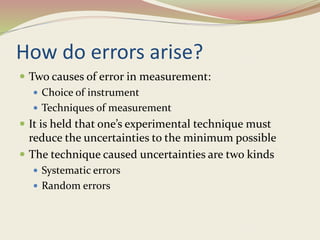
How do errors arise?
 Two causes of error in measurement:
 Choice of instrument
 Techniques of measurement
 It is held that one’s experimental technique must
reduce the uncertainties to the minimum possible
 The technique caused uncertainties are two kinds
 Systematic errors
 Random errors
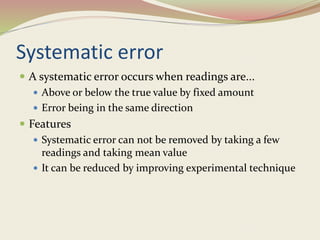
Systematic error
 A systematic error occurs when readings are...
 Above or below the true value by fixed amount
 Error being in the same direction
 Features
 Systematic error can not be removed by taking a few
readings and taking mean value
 It can be reduced by improving experimental technique
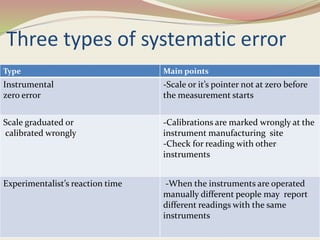
Three types of systematic error
Type Main points
Instrumental
zero error
-Scale or it’s pointer not at zero before
the measurement starts
Scale graduated or
calibrated wrongly
-Calibrations are marked wrongly at the
instrument manufacturing site
-Check for reading with other
instruments
Experimentalist’s reaction time -When the instruments are operated
manually different people may report
different readings with the same
instruments
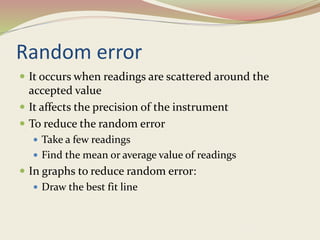
Random error
 It occurs when readings are scattered around the
accepted value
 It affects the precision of the instrument
 To reduce the random error
 Take a few readings
 Find the mean or average value of readings
 In graphs to reduce random error:
 Draw the best fit line
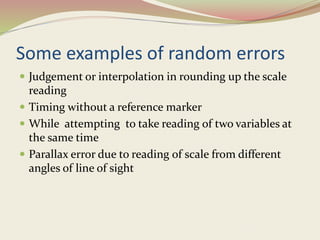
Some examples of random errors
 Judgement or interpolation in rounding up the scale
reading
 Timing without a reference marker
 While attempting to take reading of two variables at
the same time
 Parallax error due to reading of scale from different
angles of line of sight
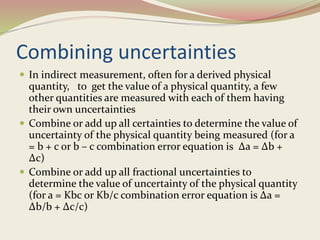
Combining uncertainties
 In indirect measurement, often for a derived physical
quantity, to get the value of a physical quantity, a few
other quantities are measured with each of them having
their own uncertainties
 Combine or add up all certainties to determine the value of
uncertainty of the physical quantity being measured (for a
= b + c or b – c combination error equation is Δa = Δb +
Δc)
 Combine or add up all fractional uncertainties to
determine the value of uncertainty of the physical quantity
(for a = Kbc or Kb/c combination error equation is Δa =
Δb/b + Δc/c)
Two simple rule statements for
combining uncertainties
 Rule 1
 For the physical quantities which are added or
subtracted to give final results, add up absolute
uncertainties
 For For the physical quantities which are either
multiplied or divided, add up the fractional
uncertainties

Systematic and random errors in measurement.pptx

  • 1.
    Physics topic forsenior secondary or A-Level Physics
  • 2.
    How do errorsarise?  Two causes of error in measurement:  Choice of instrument  Techniques of measurement  It is held that one’s experimental technique must reduce the uncertainties to the minimum possible  The technique caused uncertainties are two kinds  Systematic errors  Random errors
  • 3.
    Systematic error  Asystematic error occurs when readings are...  Above or below the true value by fixed amount  Error being in the same direction  Features  Systematic error can not be removed by taking a few readings and taking mean value  It can be reduced by improving experimental technique
  • 4.
    Three types ofsystematic error Type Main points Instrumental zero error -Scale or it’s pointer not at zero before the measurement starts Scale graduated or calibrated wrongly -Calibrations are marked wrongly at the instrument manufacturing site -Check for reading with other instruments Experimentalist’s reaction time -When the instruments are operated manually different people may report different readings with the same instruments
  • 5.
    Random error  Itoccurs when readings are scattered around the accepted value  It affects the precision of the instrument  To reduce the random error  Take a few readings  Find the mean or average value of readings  In graphs to reduce random error:  Draw the best fit line
  • 6.
    Some examples ofrandom errors  Judgement or interpolation in rounding up the scale reading  Timing without a reference marker  While attempting to take reading of two variables at the same time  Parallax error due to reading of scale from different angles of line of sight
  • 7.
    Combining uncertainties  Inindirect measurement, often for a derived physical quantity, to get the value of a physical quantity, a few other quantities are measured with each of them having their own uncertainties  Combine or add up all certainties to determine the value of uncertainty of the physical quantity being measured (for a = b + c or b – c combination error equation is Δa = Δb + Δc)  Combine or add up all fractional uncertainties to determine the value of uncertainty of the physical quantity (for a = Kbc or Kb/c combination error equation is Δa = Δb/b + Δc/c)
  • 8.
    Two simple rulestatements for combining uncertainties  Rule 1  For the physical quantities which are added or subtracted to give final results, add up absolute uncertainties  For For the physical quantities which are either multiplied or divided, add up the fractional uncertainties