SYSTEM OF PARTICLES AND ROTATIONAL
MOTION
SUBJECT: PHYSICS
CLASS: XI
MODULE 1 OF 3
Module 1 of 3
System ofParticles and Rotational Motion
In this module, we will discuss the meaning of angular velocity, angular acceleration and the
equations of motion for rotationalmotion.
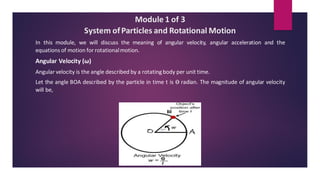
Angular Velocity (ω)
Angular velocity is the angle described by a rotatingbody per unit time.
Let the angle BOA described by the particle in time t is ϴ radian. The magnitude of angular velocity
will be,
𝜔 =
𝛳
𝑡
If the particle describes one complete revolution then,
𝜔 =
2π
𝑡
Here, t = 𝑇. Therefore,
𝜔 =
2π
𝑇
If the particle describes n revolutions in one second then,
n =
1
𝑇
Hence, 𝜔 = 2πn
The angular velocity is measured in radian second-1.
Its dimensional formula is [T-1].
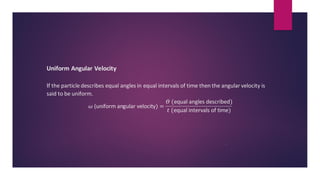
Uniform Angular Velocity
If the particle describes equal angles in equal intervals of time then the angular velocity is
said to be uniform.
𝜔 (uniform angular velocity) =
𝛳 (equal angles described)
𝑡 (equal intervals of time)
.
Angular acceleration (α)
Angular accelerationis the rate of changeof angular velocity with time.
It is a vector quantity and denoted by α.
α =
change in angular velocity
time
α =
𝜔2 − 𝜔1
𝑡 − 0
=
2π𝑛2 − 2π𝑛1
𝑡 − 0
=
2π(𝑛2 − 𝑛1)
𝑡
Here, n2 and n1 are the number of revolutions made by the particle in one second.
Angular accelerationis measured in radian sec-2.
Its dimensional formula is [T-2].
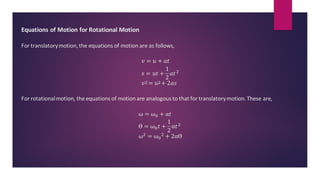
Equations of Motion for Rotational Motion
For translatorymotion,the equations of motion are as follows,
𝑣 = 𝑢 + 𝑎𝑡
𝑠 = 𝑢𝑡 +
1
2
𝑎𝑡2
𝑣2 = 𝑢2+ 2𝑎𝑠
For rotationalmotion, the equations of motion are analogous to that for translatorymotion.These are,
ω = ω0 + α𝑡
ϴ = ω0𝑡 +
1
2
α𝑡2
ω2 = ω0
2 + 2αϴ
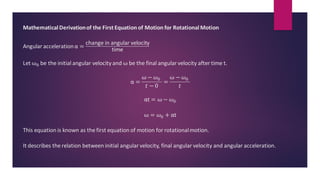
MathematicalDerivationof the First Equation of Motion for RotationalMotion
Angular accelerationα =
change in angular velocity
time
Let ω0 be the initial angular velocity and ω be the final angular velocity after time t.
α =
ω − 𝜔0
𝑡 − 0
=
ω − 𝜔0
𝑡
αt = ω − 𝜔0
ω = 𝜔0 + αt
This equation is known as the first equation of motion for rotationalmotion.
It describes the relation between initial angular velocity, final angular velocity and angular acceleration.
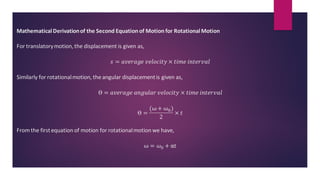
MathematicalDerivationof the Second Equation of Motion for RotationalMotion
For translatorymotion,the displacement is given as,
𝑠 = 𝑎𝑣𝑒𝑟𝑎𝑔𝑒 𝑣𝑒𝑙𝑜𝑐𝑖𝑡𝑦 × 𝑡𝑖𝑚𝑒 𝑖𝑛𝑡𝑒𝑟𝑣𝑎𝑙
Similarly for rotationalmotion, the angular displacementis given as,
ϴ = 𝑎𝑣𝑒𝑟𝑎𝑔𝑒 𝑎𝑛𝑔𝑢𝑙𝑎𝑟 𝑣𝑒𝑙𝑜𝑐𝑖𝑡𝑦 × 𝑡𝑖𝑚𝑒 𝑖𝑛𝑡𝑒𝑟𝑣𝑎𝑙
ϴ =
(ω + ω0)
2
× 𝑡
From the firstequation of motion for rotationalmotion we have,
ω = 𝜔0 + αt
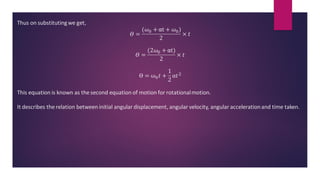
Thus on substitutingwe get,
𝛳 =
(𝜔0 + αt + 𝜔0)
2
× 𝑡
𝛳 =
(2𝜔0 + αt)
2
× 𝑡
ϴ = ω0𝑡 +
1
2
α𝑡2
This equation is known as the second equation of motion for rotationalmotion.
It describes the relation between initial angular displacement, angular velocity, angular accelerationand time taken.
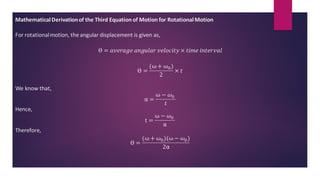
MathematicalDerivationof the Third Equation of Motion for RotationalMotion
For rotationalmotion, the angular displacement is given as,
ϴ = 𝑎𝑣𝑒𝑟𝑎𝑔𝑒 𝑎𝑛𝑔𝑢𝑙𝑎𝑟 𝑣𝑒𝑙𝑜𝑐𝑖𝑡𝑦 × 𝑡𝑖𝑚𝑒 𝑖𝑛𝑡𝑒𝑟𝑣𝑎𝑙
ϴ =
(ω + ω0)
2
× 𝑡
We know that,
α =
ω − 𝜔0
𝑡
Hence,
t =
ω − 𝜔0
α
Therefore,
ϴ =
(ω + ω0)(ω − 𝜔0)
2α
𝛳 =
𝜔2 − 𝜔0
2
2𝛼
2𝛼𝛳 = 𝜔2 − 𝜔0
2
𝜔2 = 𝜔0
2 + 2𝛼𝛳
This equation is known as the third equation of motion for rotationalmotion.
It describes the relation between initial angular velocity, final angular velocity, angular accelerationand angular
displacement.
We shall now discuss some problems based on these equations of motion.
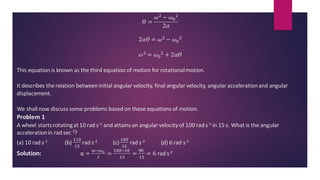
Problem 1
A wheel startsrotatingat10 rad s-1 and attainsan angular velocity of 100 rad s-1 in 15 s. What is the angular
accelerationin rad sec-2?
(a) 10 rad s-2 (b)
110
15
rad s-2 (c)
100
15
rad s-2 (d) 6 rad s-2
Solution: α =
ω−𝜔0
𝑡
=
100−10
15
=
90
15
= 6 rad s-2
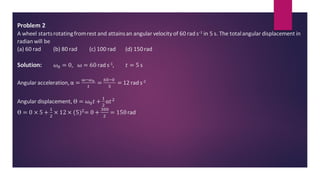
Problem 2
A wheel startsrotatingfromrest and attainsan angular velocity of 60 rad s-1 in 5 s. The totalangular displacement in
radian will be
(a) 60 rad (b) 80 rad (c) 100 rad (d) 150rad
Solution: 𝜔0 = 0, ω = 60 rad s-1, 𝑡 = 5 s
Angular acceleration, α =
ω−𝜔0
𝑡
=
60−0
5
= 12 rad s-2
Angular displacement, ϴ = ω0𝑡 +
1
2
α𝑡2
ϴ = 0 × 5 +
1
2
× 12 × (5)2= 0 +
300
2
= 150rad
.
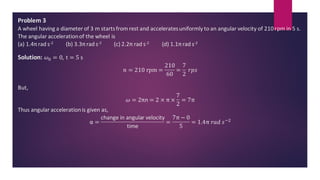
Problem 3
A wheel having a diameter of 3 m startsfrom rest and acceleratesuniformly to an angular velocity of 210rpm in 5 s.
The angular accelerationof the wheel is
(a) 1.4πrad s-2 (b) 3.3πrad s-2 (c) 2.2π rad s-2 (d) 1.1πrad s-2
Solution: 𝜔0 = 0, t = 5 s
𝑛 = 210 rpm =
210
60
=
7
2
𝑟𝑝𝑠
But,
𝜔 = 2πn = 2 × π ×
7
2
= 7π
Thus angular accelerationis given as,
α =
change in angular velocity
time
=
7π − 0
5
= 1.4π 𝑟𝑎𝑑 𝑠−2
THANK YOU

System of particles class 11 physics presentation

  • 1.
    SYSTEM OF PARTICLESAND ROTATIONAL MOTION SUBJECT: PHYSICS CLASS: XI MODULE 1 OF 3
  • 2.
    Module 1 of3 System ofParticles and Rotational Motion In this module, we will discuss the meaning of angular velocity, angular acceleration and the equations of motion for rotationalmotion. Angular Velocity (ω) Angular velocity is the angle described by a rotatingbody per unit time. Let the angle BOA described by the particle in time t is ϴ radian. The magnitude of angular velocity will be,
  • 3.
    𝜔 = 𝛳 𝑡 If theparticle describes one complete revolution then, 𝜔 = 2π 𝑡 Here, t = 𝑇. Therefore, 𝜔 = 2π 𝑇 If the particle describes n revolutions in one second then, n = 1 𝑇 Hence, 𝜔 = 2πn The angular velocity is measured in radian second-1. Its dimensional formula is [T-1].
  • 4.
    Uniform Angular Velocity Ifthe particle describes equal angles in equal intervals of time then the angular velocity is said to be uniform. 𝜔 (uniform angular velocity) = 𝛳 (equal angles described) 𝑡 (equal intervals of time) .
  • 5.
    Angular acceleration (α) Angularaccelerationis the rate of changeof angular velocity with time. It is a vector quantity and denoted by α. α = change in angular velocity time α = 𝜔2 − 𝜔1 𝑡 − 0 = 2π𝑛2 − 2π𝑛1 𝑡 − 0 = 2π(𝑛2 − 𝑛1) 𝑡 Here, n2 and n1 are the number of revolutions made by the particle in one second. Angular accelerationis measured in radian sec-2. Its dimensional formula is [T-2].
  • 6.
    Equations of Motionfor Rotational Motion For translatorymotion,the equations of motion are as follows, 𝑣 = 𝑢 + 𝑎𝑡 𝑠 = 𝑢𝑡 + 1 2 𝑎𝑡2 𝑣2 = 𝑢2+ 2𝑎𝑠 For rotationalmotion, the equations of motion are analogous to that for translatorymotion.These are, ω = ω0 + α𝑡 ϴ = ω0𝑡 + 1 2 α𝑡2 ω2 = ω0 2 + 2αϴ
  • 7.
    MathematicalDerivationof the FirstEquation of Motion for RotationalMotion Angular accelerationα = change in angular velocity time Let ω0 be the initial angular velocity and ω be the final angular velocity after time t. α = ω − 𝜔0 𝑡 − 0 = ω − 𝜔0 𝑡 αt = ω − 𝜔0 ω = 𝜔0 + αt This equation is known as the first equation of motion for rotationalmotion. It describes the relation between initial angular velocity, final angular velocity and angular acceleration.
  • 8.
    MathematicalDerivationof the SecondEquation of Motion for RotationalMotion For translatorymotion,the displacement is given as, 𝑠 = 𝑎𝑣𝑒𝑟𝑎𝑔𝑒 𝑣𝑒𝑙𝑜𝑐𝑖𝑡𝑦 × 𝑡𝑖𝑚𝑒 𝑖𝑛𝑡𝑒𝑟𝑣𝑎𝑙 Similarly for rotationalmotion, the angular displacementis given as, ϴ = 𝑎𝑣𝑒𝑟𝑎𝑔𝑒 𝑎𝑛𝑔𝑢𝑙𝑎𝑟 𝑣𝑒𝑙𝑜𝑐𝑖𝑡𝑦 × 𝑡𝑖𝑚𝑒 𝑖𝑛𝑡𝑒𝑟𝑣𝑎𝑙 ϴ = (ω + ω0) 2 × 𝑡 From the firstequation of motion for rotationalmotion we have, ω = 𝜔0 + αt
  • 9.
    Thus on substitutingweget, 𝛳 = (𝜔0 + αt + 𝜔0) 2 × 𝑡 𝛳 = (2𝜔0 + αt) 2 × 𝑡 ϴ = ω0𝑡 + 1 2 α𝑡2 This equation is known as the second equation of motion for rotationalmotion. It describes the relation between initial angular displacement, angular velocity, angular accelerationand time taken.
  • 10.
    MathematicalDerivationof the ThirdEquation of Motion for RotationalMotion For rotationalmotion, the angular displacement is given as, ϴ = 𝑎𝑣𝑒𝑟𝑎𝑔𝑒 𝑎𝑛𝑔𝑢𝑙𝑎𝑟 𝑣𝑒𝑙𝑜𝑐𝑖𝑡𝑦 × 𝑡𝑖𝑚𝑒 𝑖𝑛𝑡𝑒𝑟𝑣𝑎𝑙 ϴ = (ω + ω0) 2 × 𝑡 We know that, α = ω − 𝜔0 𝑡 Hence, t = ω − 𝜔0 α Therefore, ϴ = (ω + ω0)(ω − 𝜔0) 2α
  • 11.
    𝛳 = 𝜔2 −𝜔0 2 2𝛼 2𝛼𝛳 = 𝜔2 − 𝜔0 2 𝜔2 = 𝜔0 2 + 2𝛼𝛳 This equation is known as the third equation of motion for rotationalmotion. It describes the relation between initial angular velocity, final angular velocity, angular accelerationand angular displacement. We shall now discuss some problems based on these equations of motion. Problem 1 A wheel startsrotatingat10 rad s-1 and attainsan angular velocity of 100 rad s-1 in 15 s. What is the angular accelerationin rad sec-2? (a) 10 rad s-2 (b) 110 15 rad s-2 (c) 100 15 rad s-2 (d) 6 rad s-2 Solution: α = ω−𝜔0 𝑡 = 100−10 15 = 90 15 = 6 rad s-2
  • 12.
    Problem 2 A wheelstartsrotatingfromrest and attainsan angular velocity of 60 rad s-1 in 5 s. The totalangular displacement in radian will be (a) 60 rad (b) 80 rad (c) 100 rad (d) 150rad Solution: 𝜔0 = 0, ω = 60 rad s-1, 𝑡 = 5 s Angular acceleration, α = ω−𝜔0 𝑡 = 60−0 5 = 12 rad s-2 Angular displacement, ϴ = ω0𝑡 + 1 2 α𝑡2 ϴ = 0 × 5 + 1 2 × 12 × (5)2= 0 + 300 2 = 150rad .
  • 13.
    Problem 3 A wheelhaving a diameter of 3 m startsfrom rest and acceleratesuniformly to an angular velocity of 210rpm in 5 s. The angular accelerationof the wheel is (a) 1.4πrad s-2 (b) 3.3πrad s-2 (c) 2.2π rad s-2 (d) 1.1πrad s-2 Solution: 𝜔0 = 0, t = 5 s 𝑛 = 210 rpm = 210 60 = 7 2 𝑟𝑝𝑠 But, 𝜔 = 2πn = 2 × π × 7 2 = 7π Thus angular accelerationis given as, α = change in angular velocity time = 7π − 0 5 = 1.4π 𝑟𝑎𝑑 𝑠−2
  • 14.