Syntactic Change through
Translation: a Corpus-Based
Approach to Language Change
Mario Bisiada
University of Manchester
Corpus Research Seminar, 10th
of
November 2011
University of Lancaster
Translation and language
change
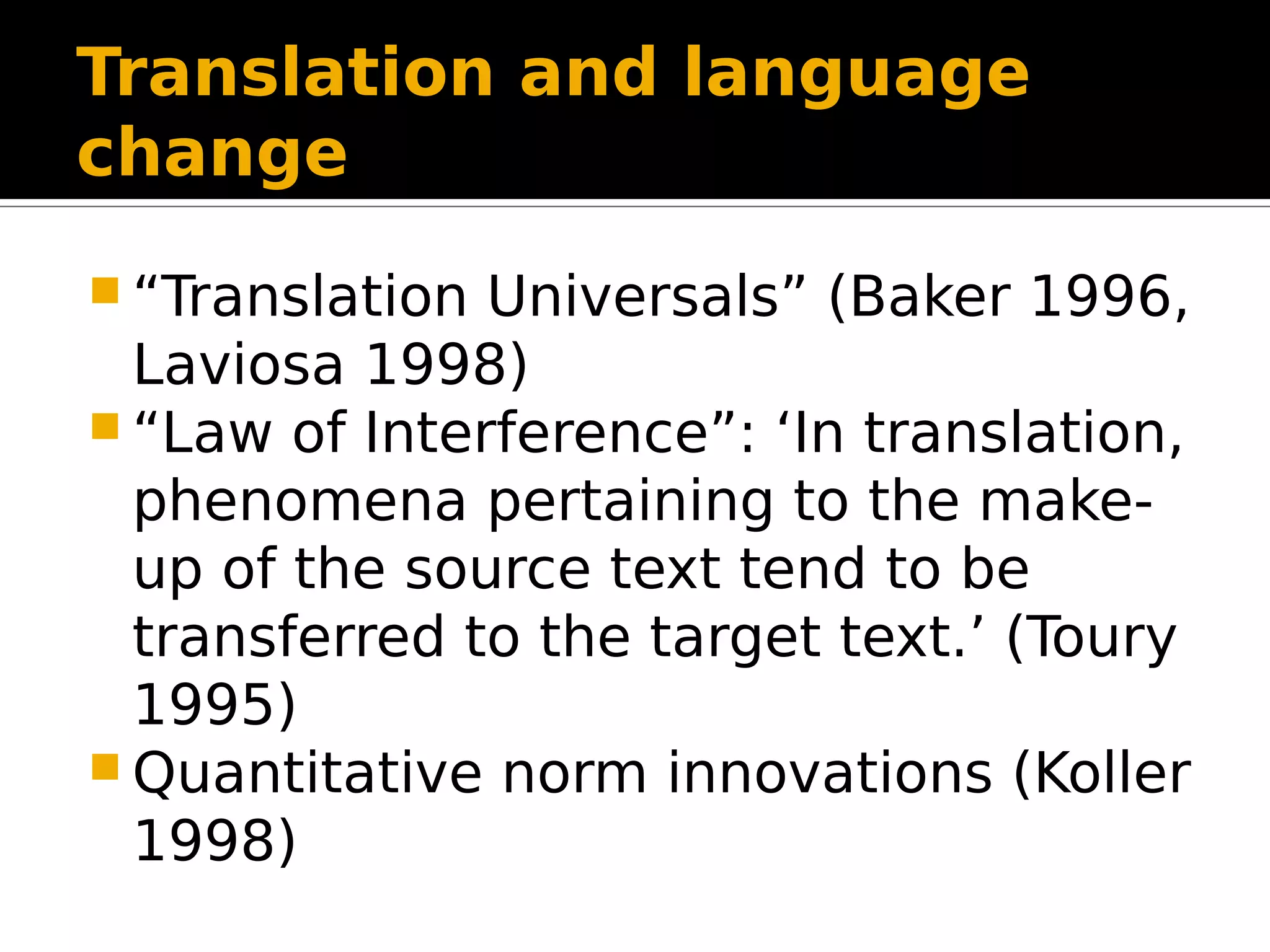
 “Translation Universals” (Baker 1996,
Laviosa 1998)
 “Law of Interference”: ‘In translation,
phenomena pertaining to the make-
up of the source text tend to be
transferred to the target text.’ (Toury
1995)
 Quantitative norm innovations (Koller
1998)
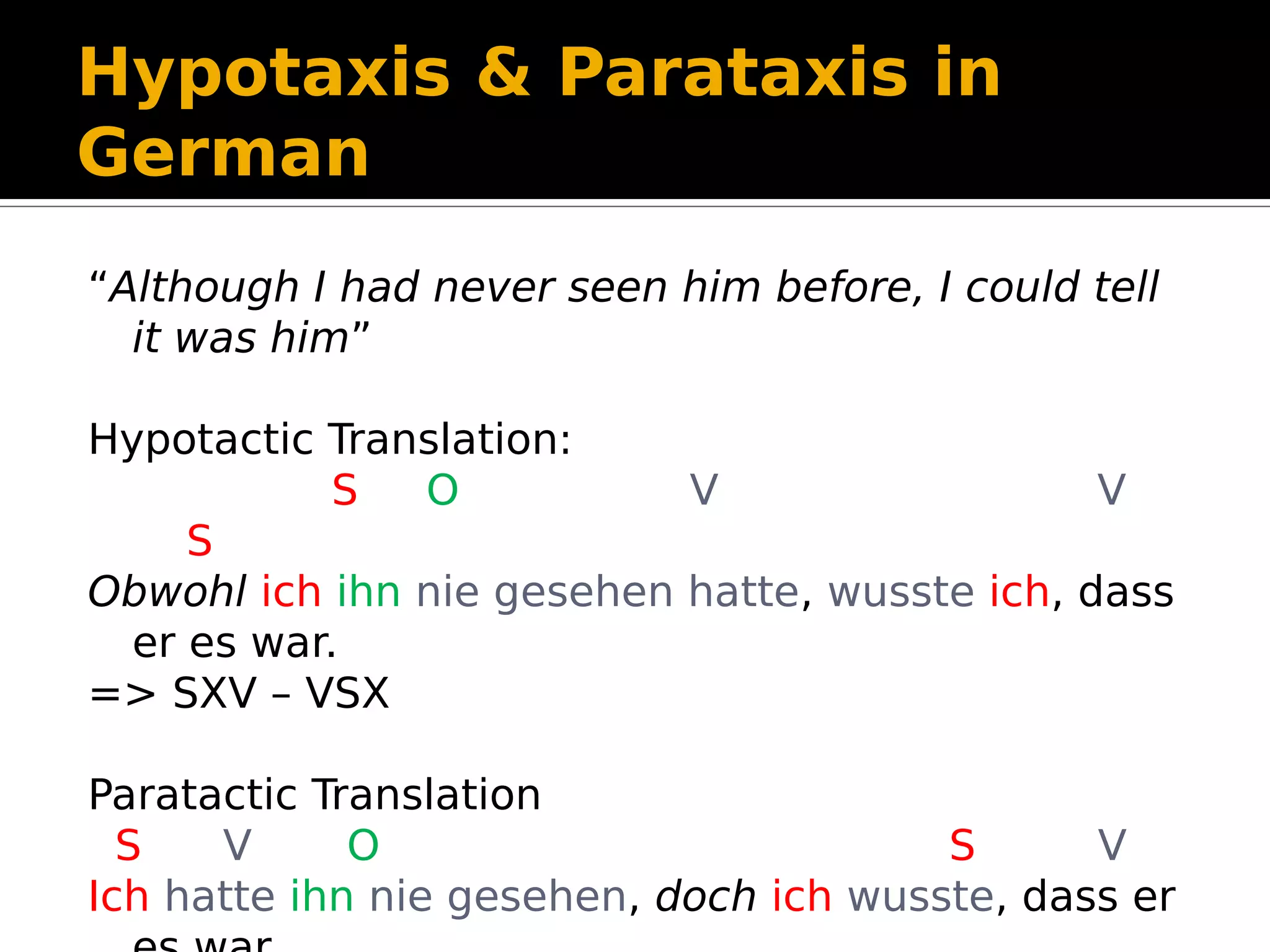
Hypotaxis & Parataxis in
German
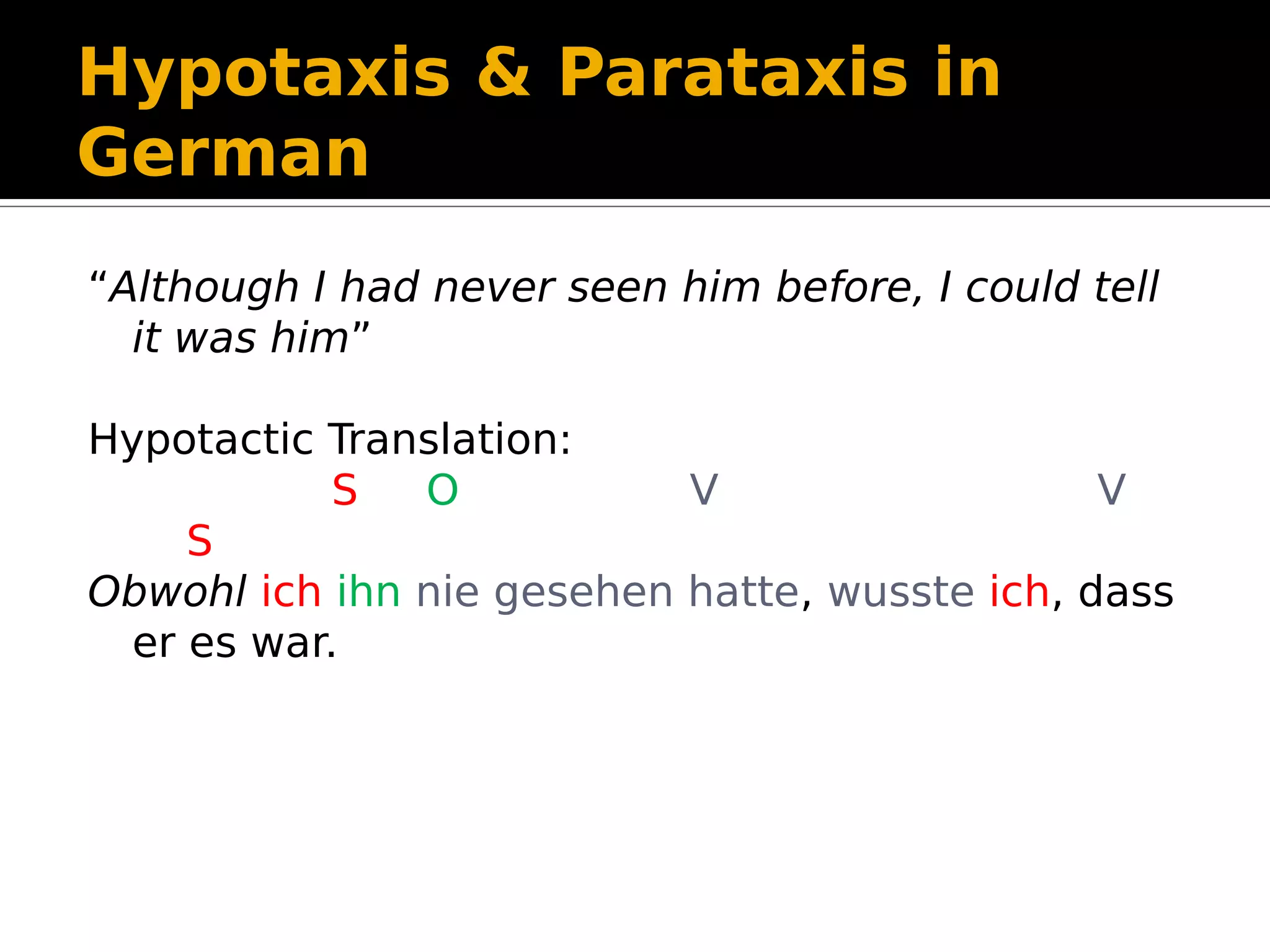
“Although I had never seen him before, I could tell
it was him”
Hypotactic Translation:
S O V V
S
Obwohl ich ihn nie gesehen hatte, wusste ich, dass
er es war.
Hypotaxis & Parataxis in
German
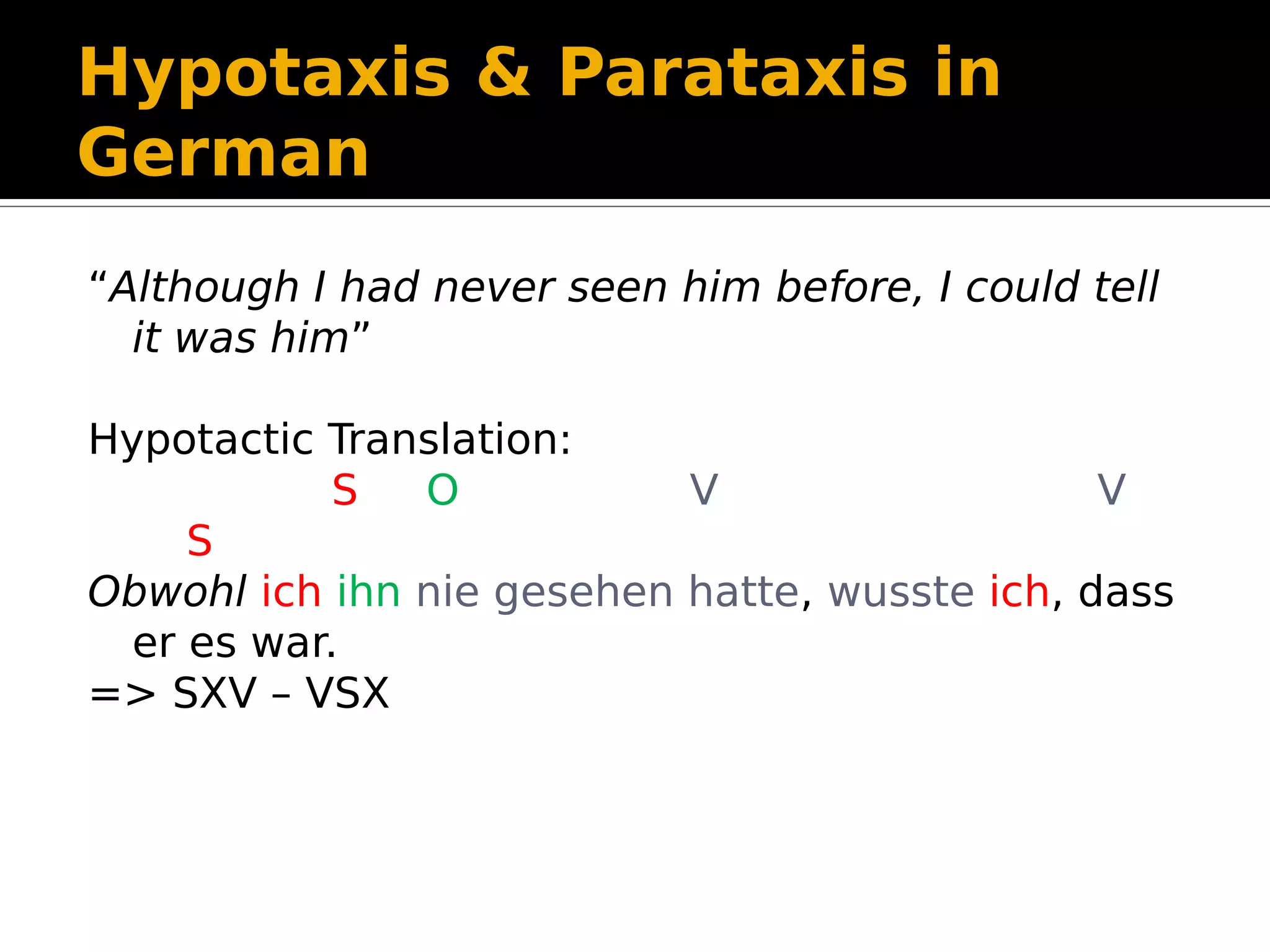
“Although I had never seen him before, I could tell
it was him”
Hypotactic Translation:
S O V V
S
Obwohl ich ihn nie gesehen hatte, wusste ich, dass
er es war.
=> SXV – VSX
Hypotaxis & Parataxis in
German
“Although I had never seen him before, I could tell
it was him”
Hypotactic Translation:
S O V V
S
Obwohl ich ihn nie gesehen hatte, wusste ich, dass
er es war.
=> SXV – VSX
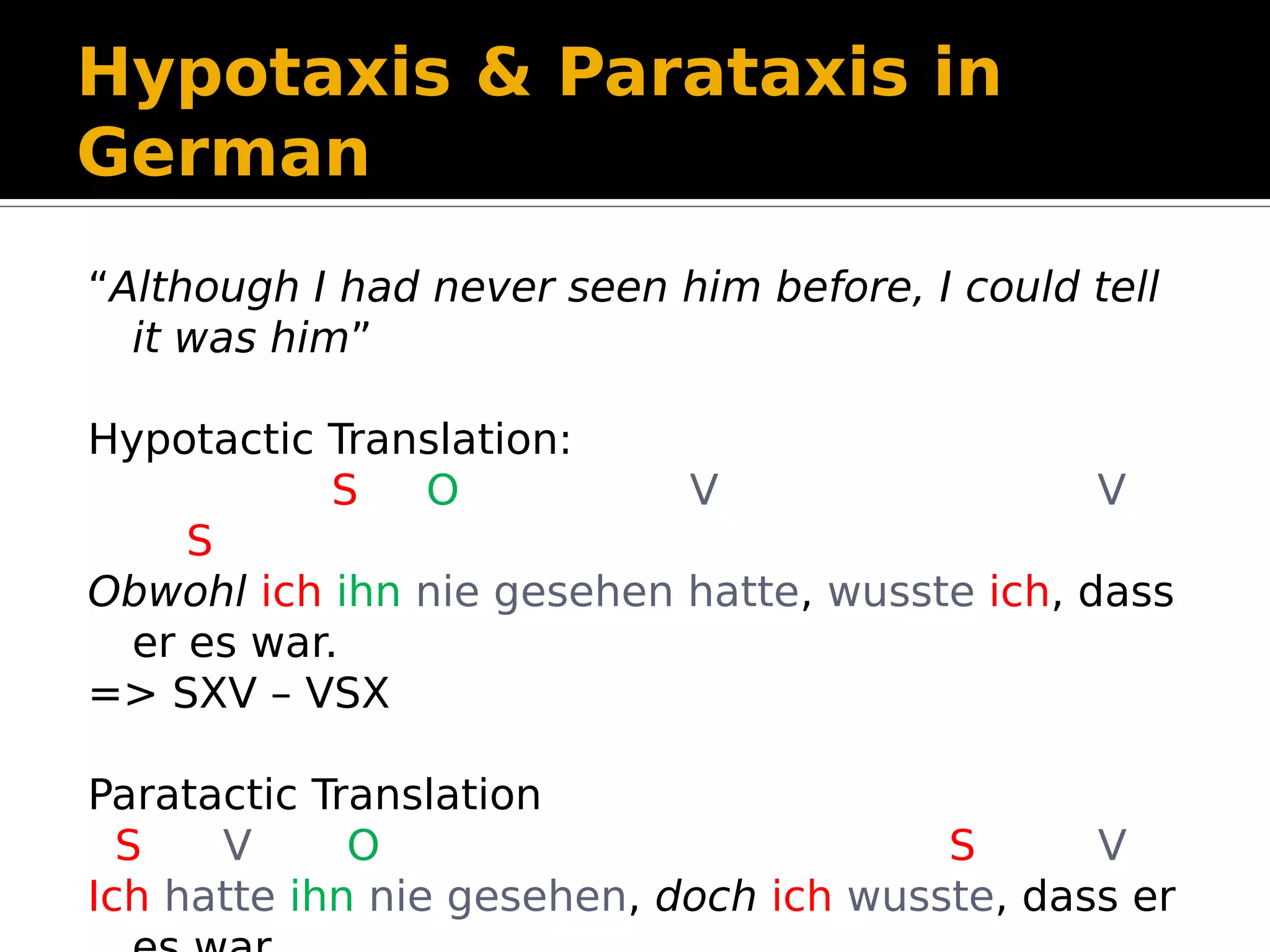
Paratactic Translation
S V O S V
Ich hatte ihn nie gesehen, doch ich wusste, dass er
Hypotaxis & Parataxis in
German
“Although I had never seen him before, I could tell
it was him”
Hypotactic Translation:
S O V V
S
Obwohl ich ihn nie gesehen hatte, wusste ich, dass
er es war.
=> SXV – VSX
Paratactic Translation
S V O S V
Ich hatte ihn nie gesehen, doch ich wusste, dass er
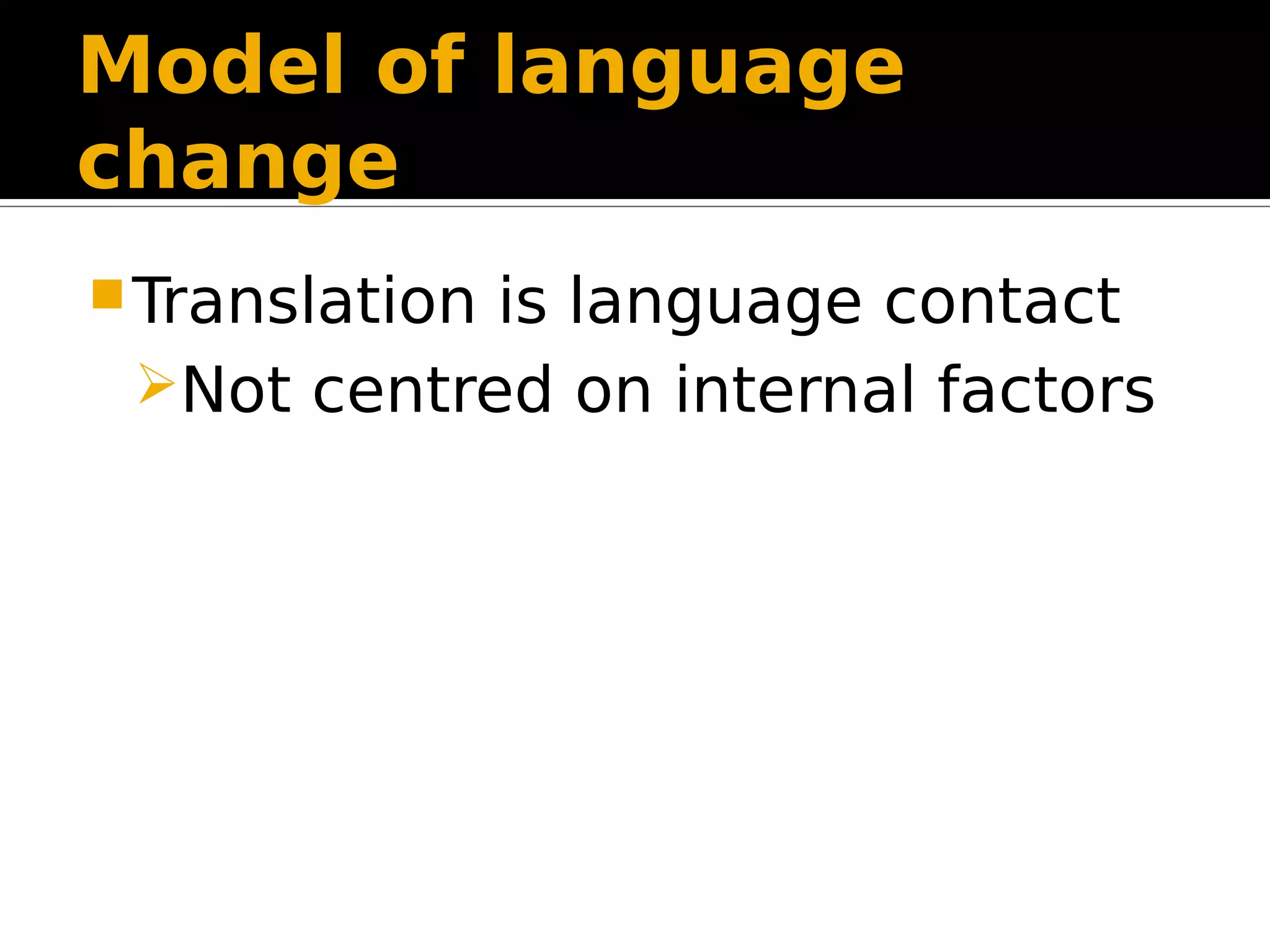
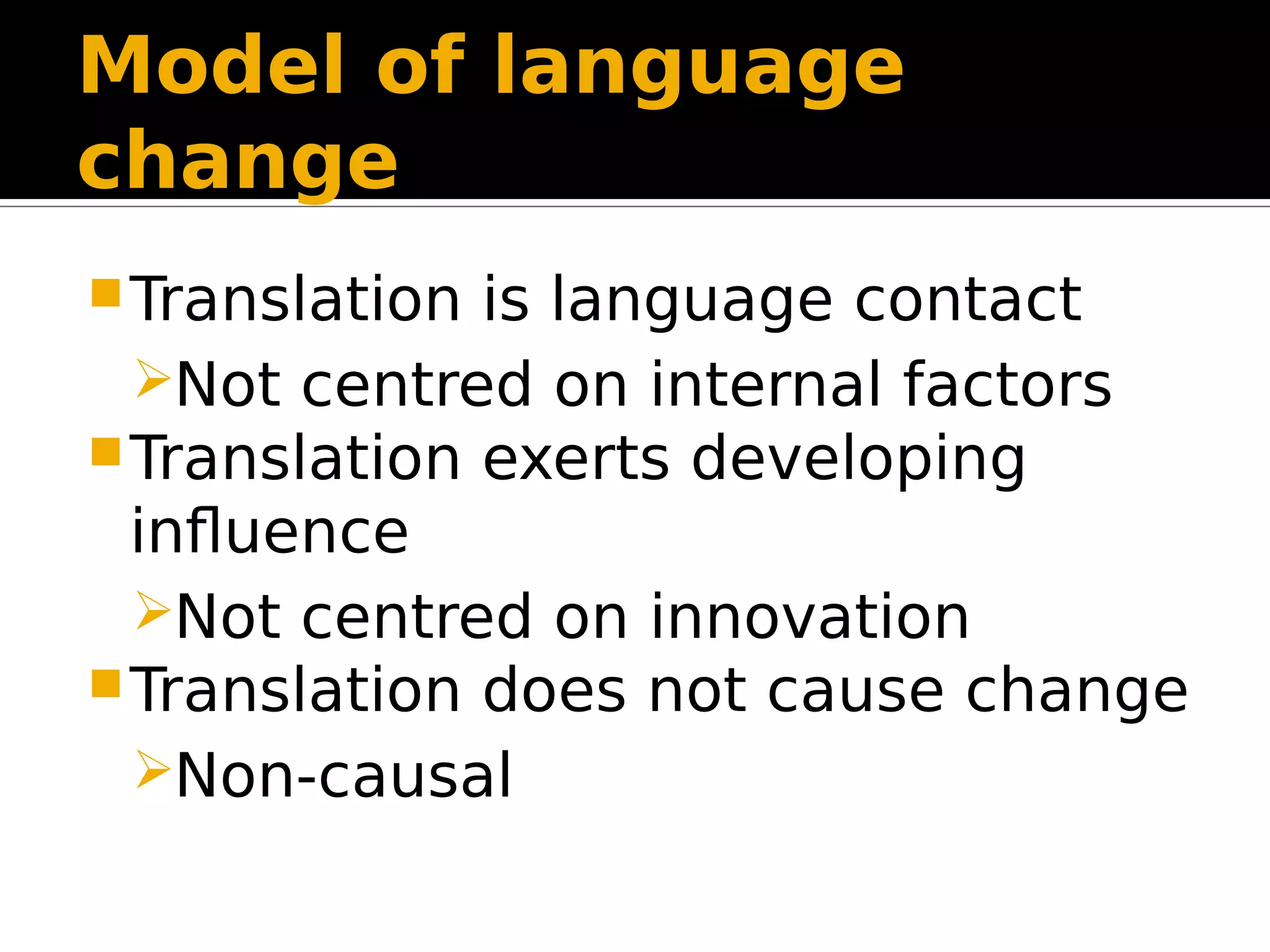
Model of language
change
Translation is language contact
Not centred on internal factors
Model of language
change
Translation is language contact
Not centred on internal factors
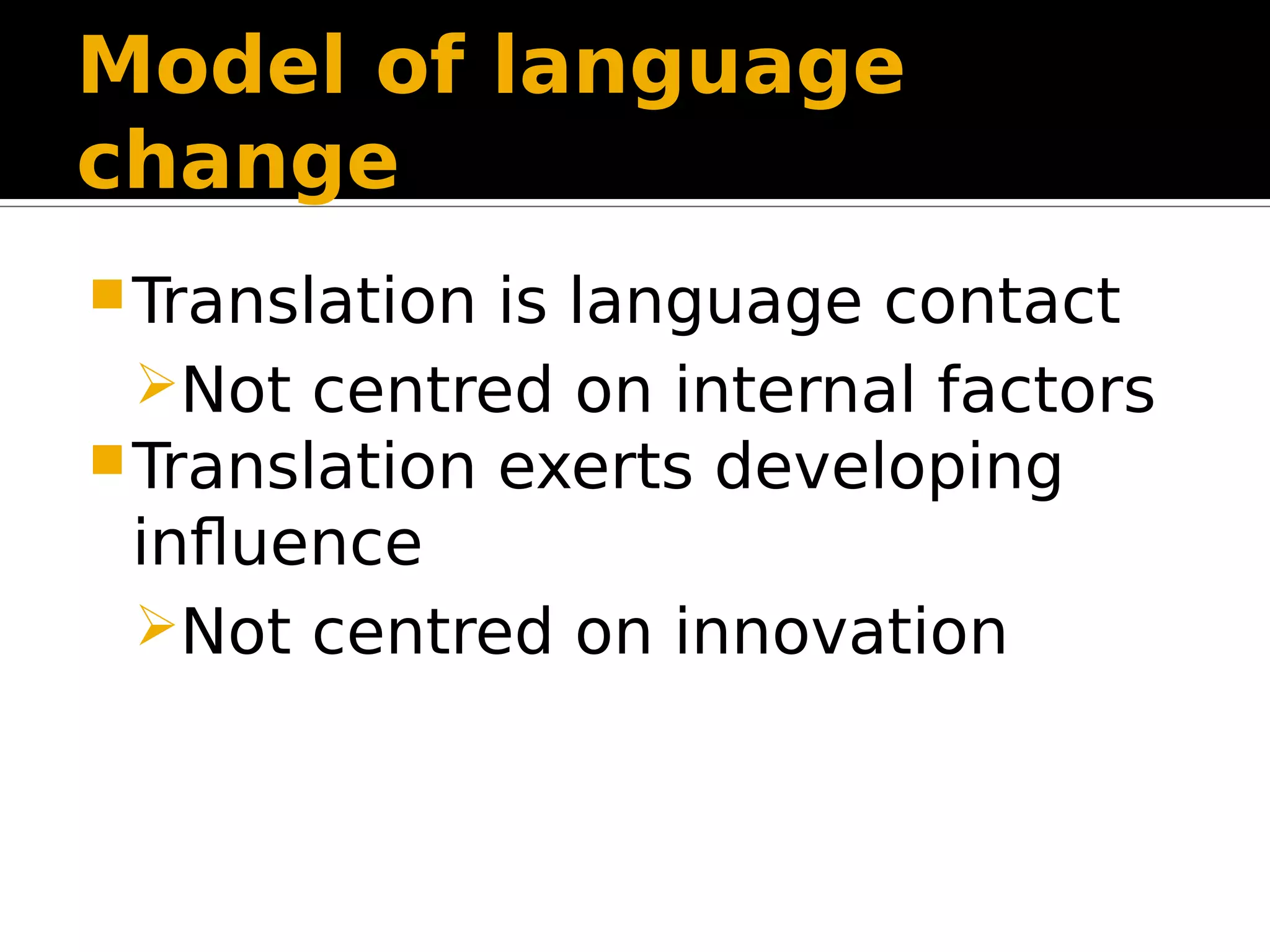
Translation exerts developing
influence
Not centred on innovation
Model of language
change
Translation is language contact
Not centred on internal factors
Translation exerts developing
influence
Not centred on innovation
Translation does not cause change
Non-causal
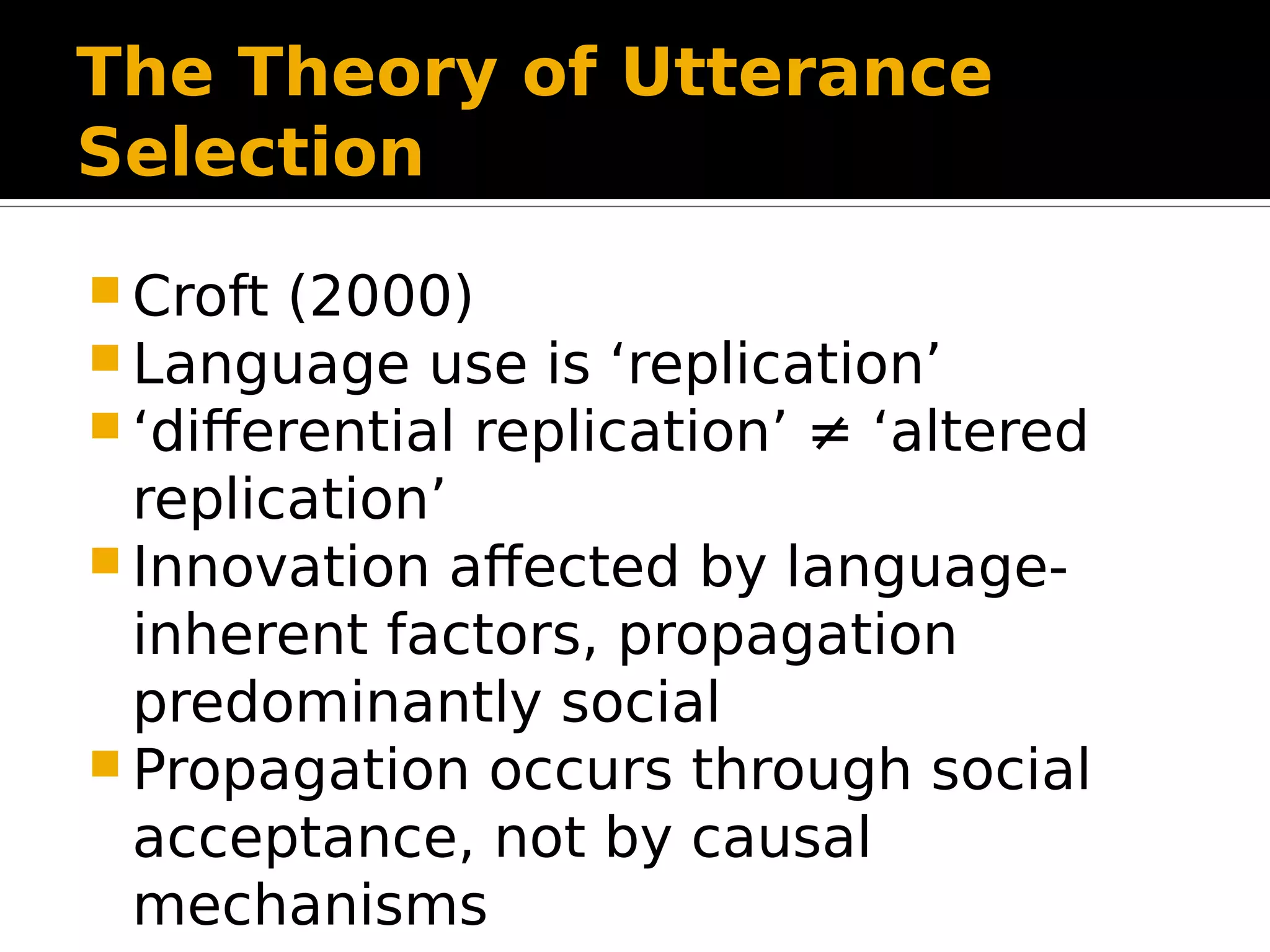
The Theory of Utterance
Selection
 Croft (2000)
 Language use is ‘replication’
 ‘differential replication’ ≠ ‘altered
replication’
 Innovation affected by language-
inherent factors, propagation
predominantly social
 Propagation occurs through social
acceptance, not by causal
mechanisms
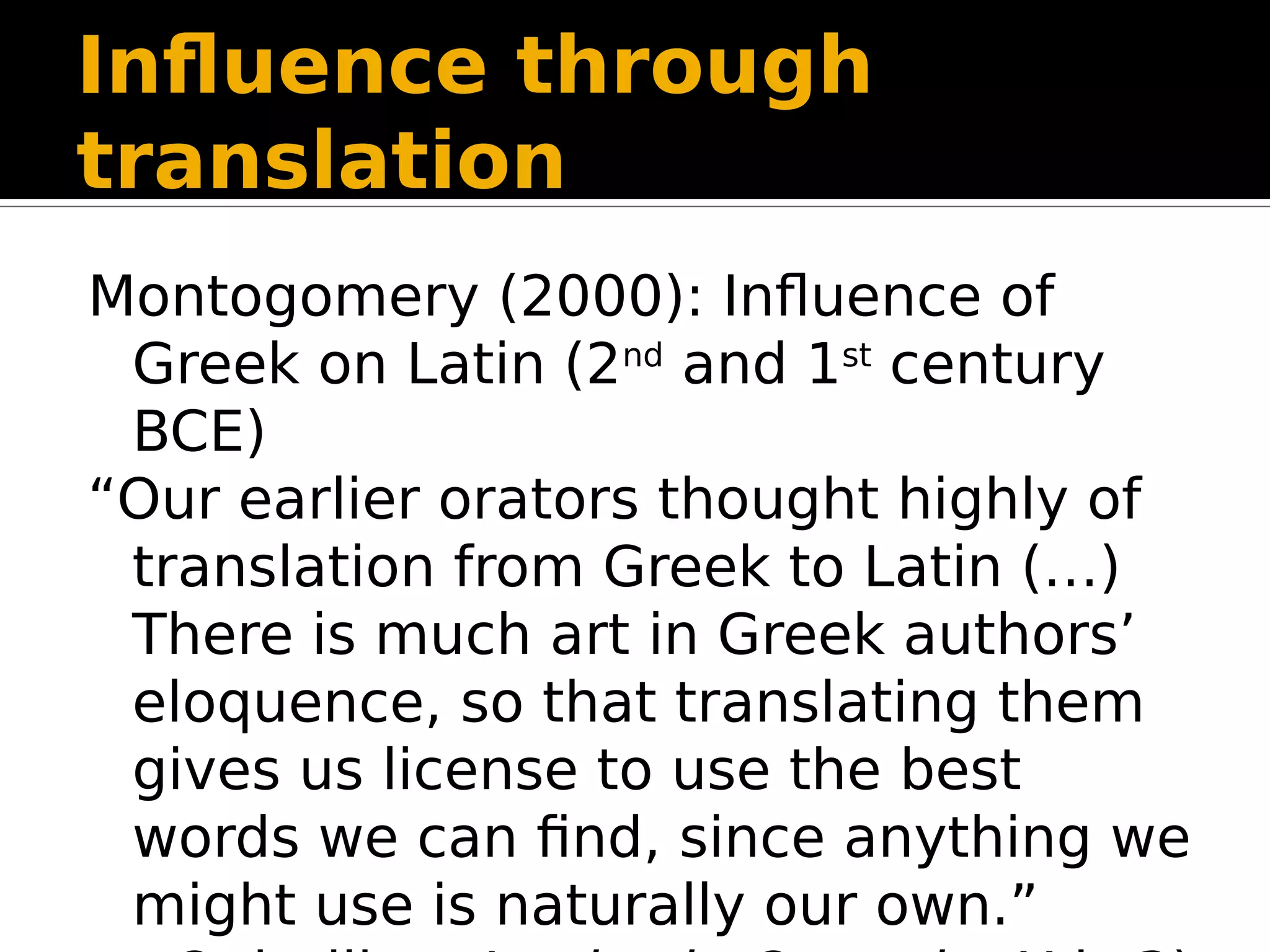
Influence through
translation
Montogomery (2000): Influence of
Greek on Latin (2nd
and 1st
century
BCE)
“Our earlier orators thought highly of
translation from Greek to Latin (…)
There is much art in Greek authors’
eloquence, so that translating them
gives us license to use the best
words we can find, since anything we
might use is naturally our own.”
Influence through
translation
Darwin Correspondence Project Database
Letter 224, dated 28 Oct 1833
www.darwinproject.ac.uk/entry-224/
“I thought in the first part (of this last journal)
that you had, probably from reading so
much of Humboldt, got his phraseology &
occasionly [sic] made use of the kind of
flowery French expressions which he uses,
instead of your own simple straight forward
& far more agreeable style.”
Question
How can we investigate
whether translation has an
effect on the preference of
syntactic patterns?
Research Method
Combine corpus linguistics
and translation studies
Diachronic translation
corpora
Research Method
 Two-step corpus study
1. Diachronic comparison of
translation choices
Research Method
 Two-step corpus study
1. Diachronic comparison of
translation choices
2. Compare findings with non-
translated German texts
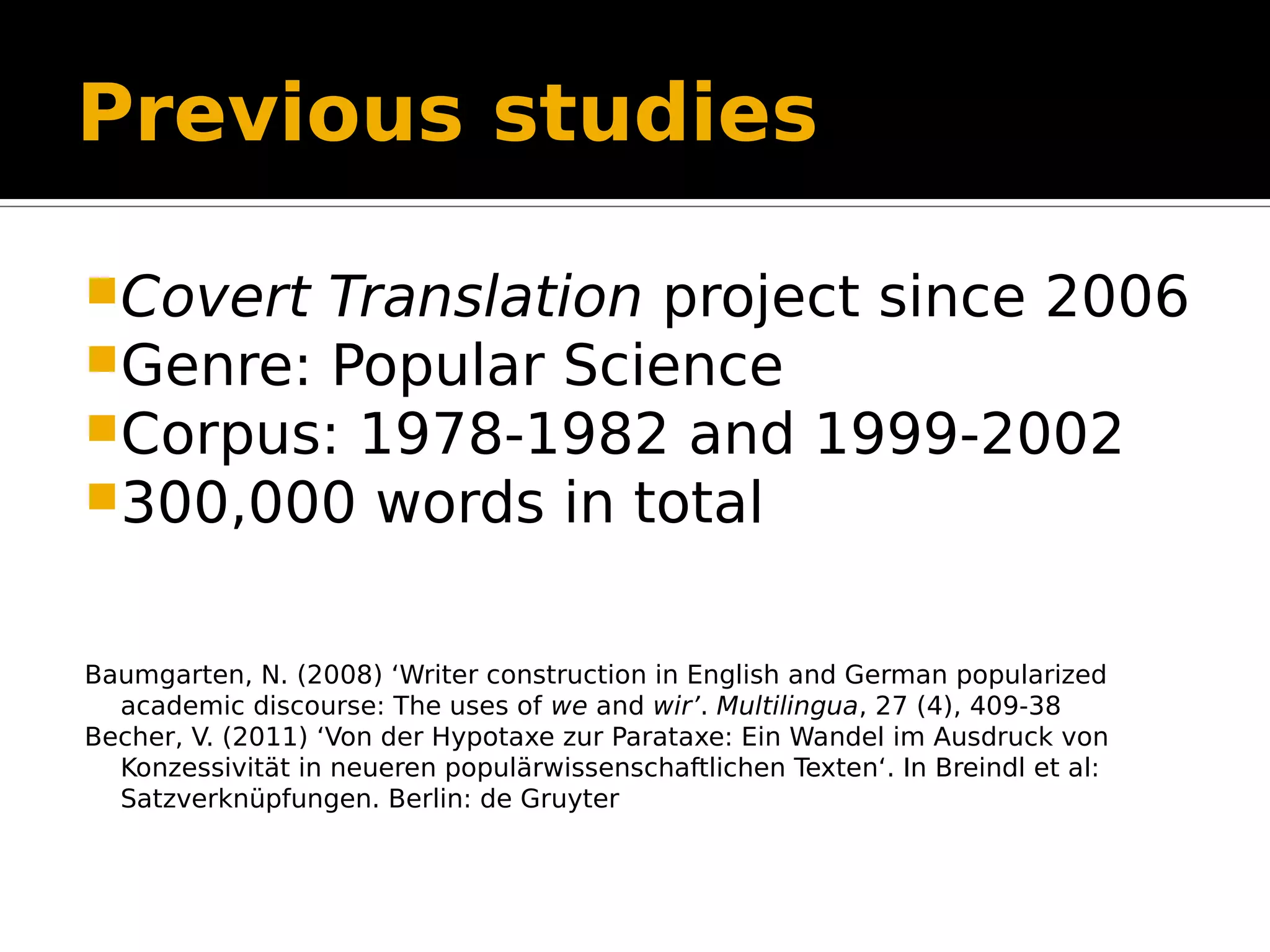
Previous studies
Covert Translation project since 2006
Genre: Popular Science
Corpus: 1978-1982 and 1999-2002
300,000 words in total
Baumgarten, N. (2008) ‘Writer construction in English and German popularized
academic discourse: The uses of we and wir’. Multilingua, 27 (4), 409-38
Becher, V. (2011) ‘Von der Hypotaxe zur Parataxe: Ein Wandel im Ausdruck von
Konzessivität in neueren populärwissenschaftlichen Texten‘. In Breindl et al:
Satzverknüpfungen. Berlin: de Gruyter
Previous studies
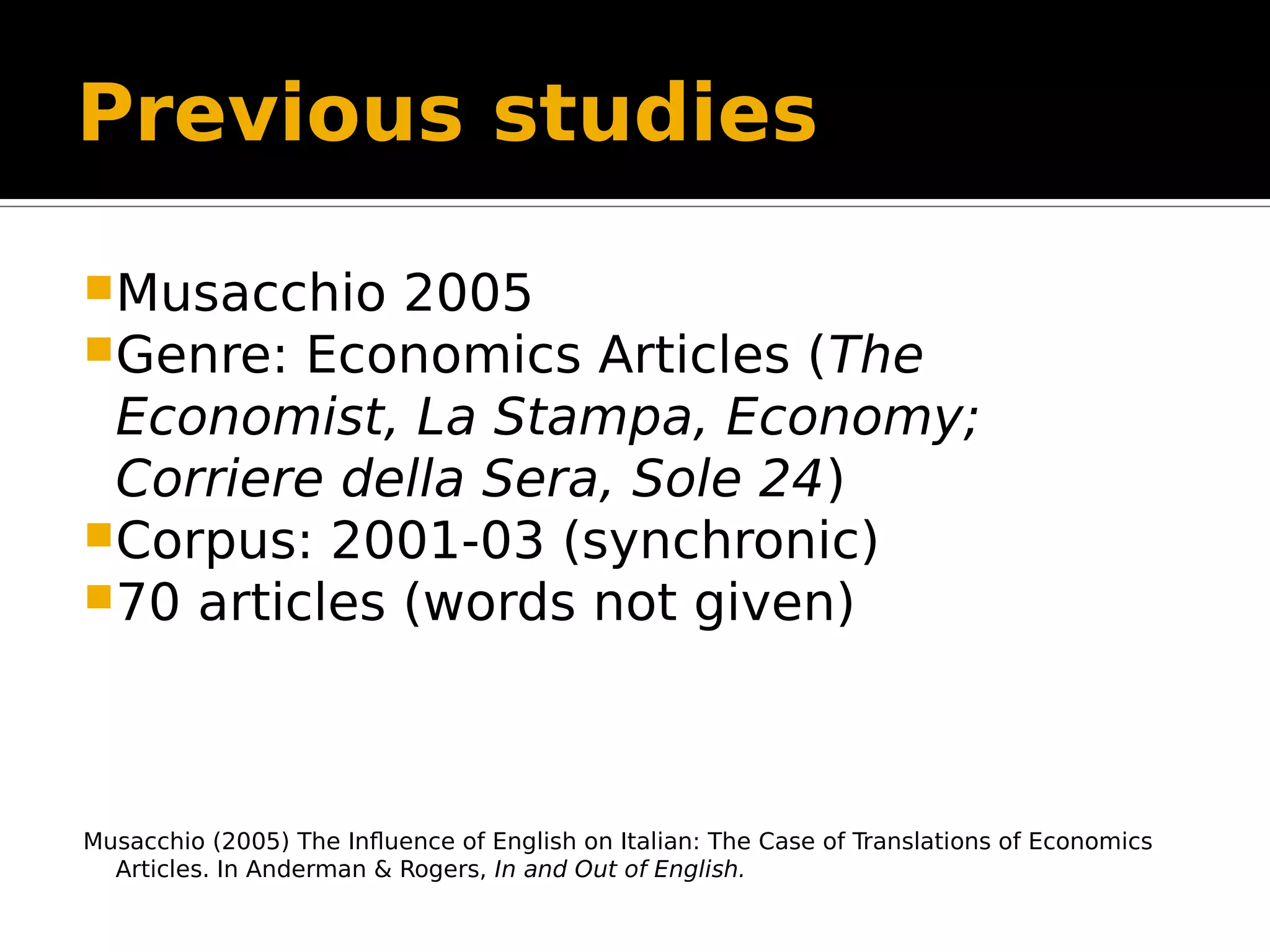
Musacchio 2005
Genre: Economics Articles (The
Economist, La Stampa, Economy;
Corriere della Sera, Sole 24)
Corpus: 2001-03 (synchronic)
70 articles (words not given)
Musacchio (2005) The Influence of English on Italian: The Case of Translations of Economics
Articles. In Anderman & Rogers, In and Out of English.
From Hypotaxis to
Parataxis
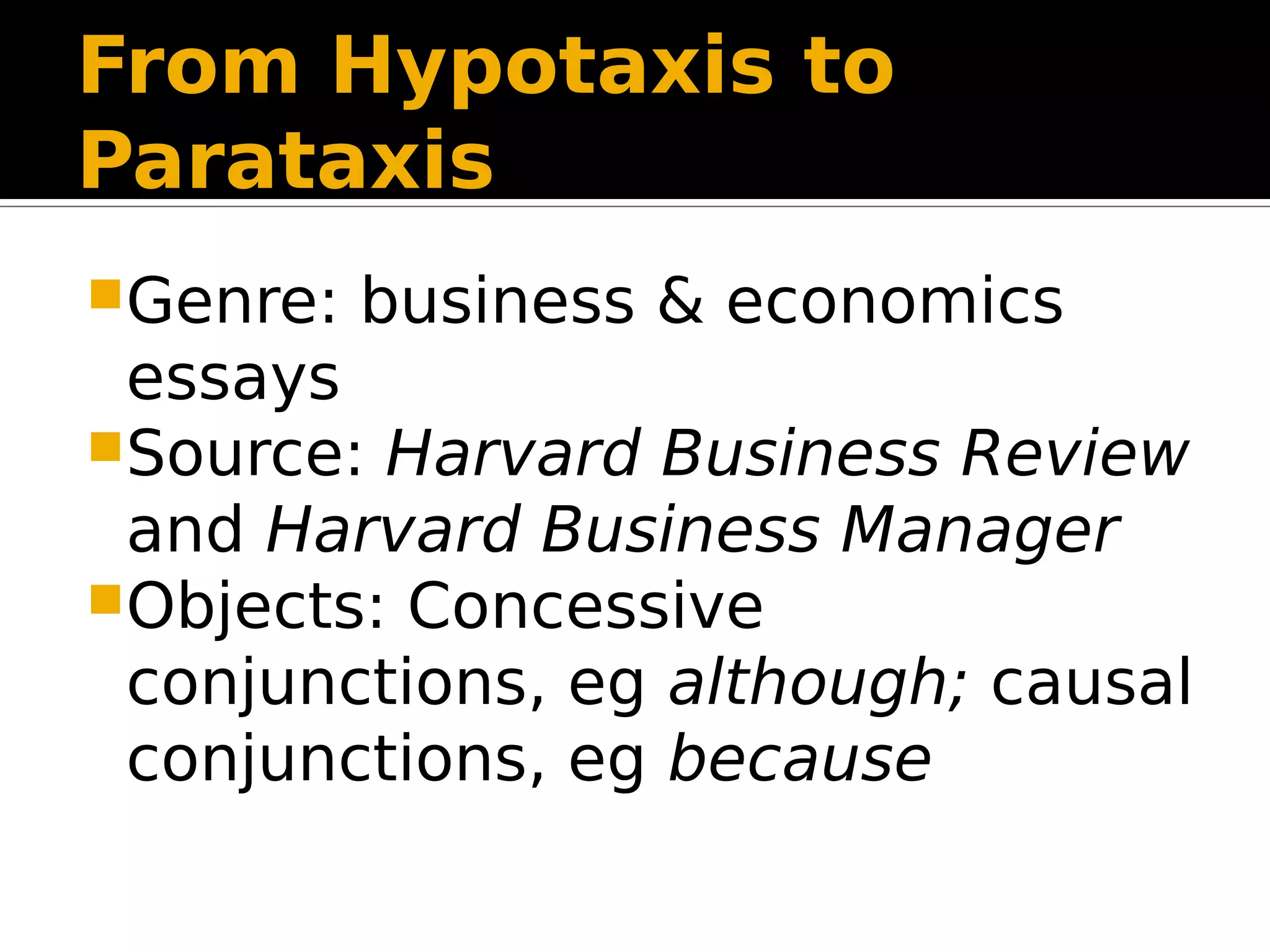
Genre: business & economics
essays
Source: Harvard Business Review
and Harvard Business Manager
Objects: Concessive
conjunctions, eg although; causal
conjunctions, eg because
From Hypotaxis to
Parataxis
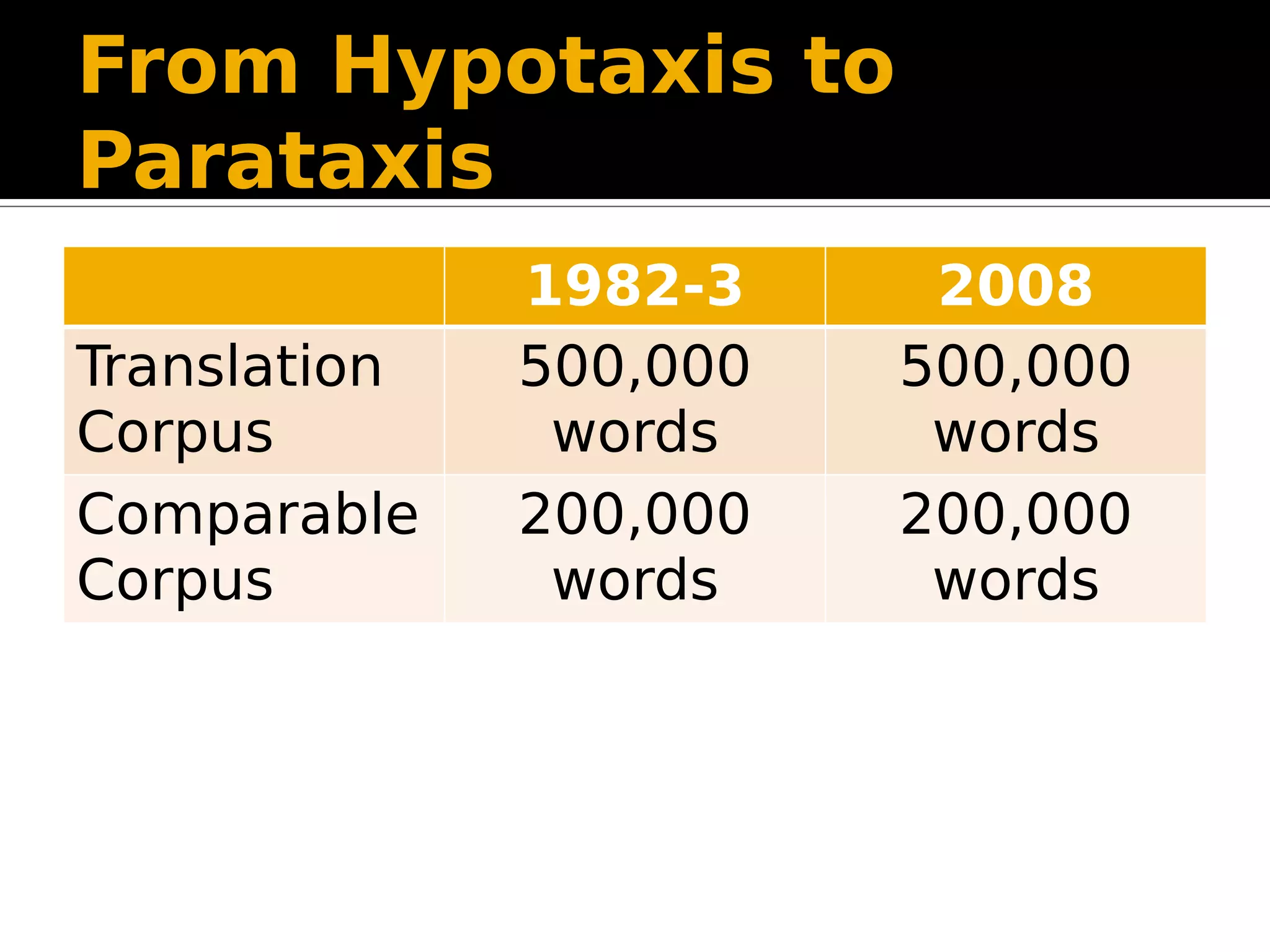
1982-3 2008
Translation
Corpus
500,000
words
500,000
words
Comparable
Corpus
200,000
words
200,000
words
My study
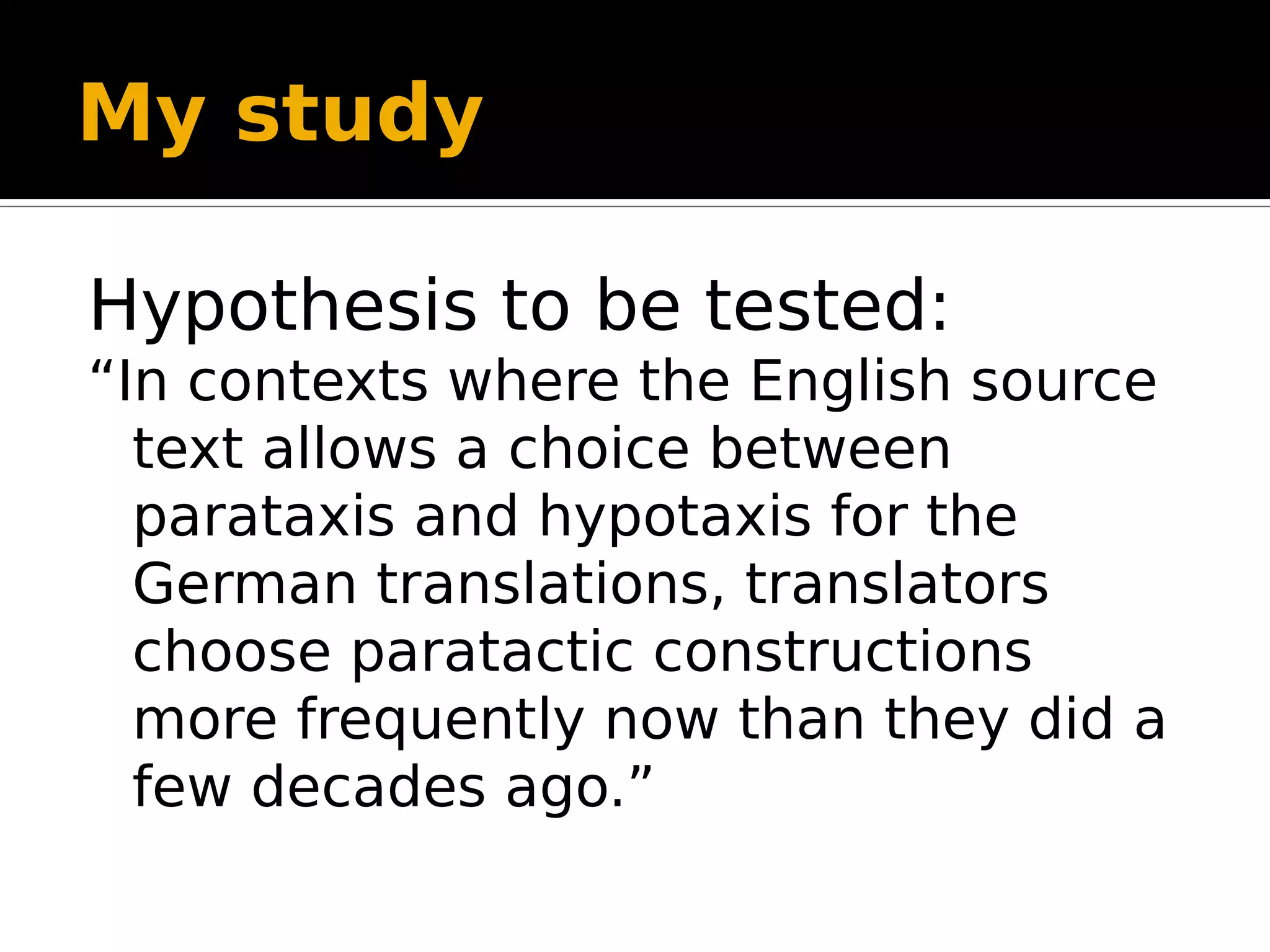
Hypothesis to be tested:
“In contexts where the English source
text allows a choice between
parataxis and hypotaxis for the
German translations, translators
choose paratactic constructions
more frequently now than they did a
few decades ago.”
Conclusion
 There is tentative evidence that
translation may contribute to
syntactic change
 This change manifests itself in the
shift of preferences
 More research is needed on other
languages and genres, eg newspaper
articles, non-fiction books and novels
Thank you for your
attention!
Questions or Challenges?

Syntactic change through translation: A corpus-based approach to language change

  • 1.
    Syntactic Change through Translation:a Corpus-Based Approach to Language Change Mario Bisiada University of Manchester Corpus Research Seminar, 10th of November 2011 University of Lancaster
  • 2.
    Translation and language change “Translation Universals” (Baker 1996, Laviosa 1998)  “Law of Interference”: ‘In translation, phenomena pertaining to the make- up of the source text tend to be transferred to the target text.’ (Toury 1995)  Quantitative norm innovations (Koller 1998)
  • 3.
    Hypotaxis & Parataxisin German “Although I had never seen him before, I could tell it was him” Hypotactic Translation: S O V V S Obwohl ich ihn nie gesehen hatte, wusste ich, dass er es war.
  • 4.
    Hypotaxis & Parataxisin German “Although I had never seen him before, I could tell it was him” Hypotactic Translation: S O V V S Obwohl ich ihn nie gesehen hatte, wusste ich, dass er es war. => SXV – VSX
  • 5.
    Hypotaxis & Parataxisin German “Although I had never seen him before, I could tell it was him” Hypotactic Translation: S O V V S Obwohl ich ihn nie gesehen hatte, wusste ich, dass er es war. => SXV – VSX Paratactic Translation S V O S V Ich hatte ihn nie gesehen, doch ich wusste, dass er
  • 6.
    Hypotaxis & Parataxisin German “Although I had never seen him before, I could tell it was him” Hypotactic Translation: S O V V S Obwohl ich ihn nie gesehen hatte, wusste ich, dass er es war. => SXV – VSX Paratactic Translation S V O S V Ich hatte ihn nie gesehen, doch ich wusste, dass er
  • 7.
    Model of language change Translationis language contact Not centred on internal factors
  • 8.
    Model of language change Translationis language contact Not centred on internal factors Translation exerts developing influence Not centred on innovation
  • 9.
    Model of language change Translationis language contact Not centred on internal factors Translation exerts developing influence Not centred on innovation Translation does not cause change Non-causal
  • 10.
    The Theory ofUtterance Selection  Croft (2000)  Language use is ‘replication’  ‘differential replication’ ≠ ‘altered replication’  Innovation affected by language- inherent factors, propagation predominantly social  Propagation occurs through social acceptance, not by causal mechanisms
  • 11.
    Influence through translation Montogomery (2000):Influence of Greek on Latin (2nd and 1st century BCE) “Our earlier orators thought highly of translation from Greek to Latin (…) There is much art in Greek authors’ eloquence, so that translating them gives us license to use the best words we can find, since anything we might use is naturally our own.”
  • 12.
    Influence through translation Darwin CorrespondenceProject Database Letter 224, dated 28 Oct 1833 www.darwinproject.ac.uk/entry-224/ “I thought in the first part (of this last journal) that you had, probably from reading so much of Humboldt, got his phraseology & occasionly [sic] made use of the kind of flowery French expressions which he uses, instead of your own simple straight forward & far more agreeable style.”
  • 13.
    Question How can weinvestigate whether translation has an effect on the preference of syntactic patterns?
  • 14.
    Research Method Combine corpuslinguistics and translation studies Diachronic translation corpora
  • 15.
    Research Method  Two-stepcorpus study 1. Diachronic comparison of translation choices
  • 16.
    Research Method  Two-stepcorpus study 1. Diachronic comparison of translation choices 2. Compare findings with non- translated German texts
  • 17.
    Previous studies Covert Translationproject since 2006 Genre: Popular Science Corpus: 1978-1982 and 1999-2002 300,000 words in total Baumgarten, N. (2008) ‘Writer construction in English and German popularized academic discourse: The uses of we and wir’. Multilingua, 27 (4), 409-38 Becher, V. (2011) ‘Von der Hypotaxe zur Parataxe: Ein Wandel im Ausdruck von Konzessivität in neueren populärwissenschaftlichen Texten‘. In Breindl et al: Satzverknüpfungen. Berlin: de Gruyter
  • 18.
    Previous studies Musacchio 2005 Genre:Economics Articles (The Economist, La Stampa, Economy; Corriere della Sera, Sole 24) Corpus: 2001-03 (synchronic) 70 articles (words not given) Musacchio (2005) The Influence of English on Italian: The Case of Translations of Economics Articles. In Anderman & Rogers, In and Out of English.
  • 19.
    From Hypotaxis to Parataxis Genre:business & economics essays Source: Harvard Business Review and Harvard Business Manager Objects: Concessive conjunctions, eg although; causal conjunctions, eg because
  • 20.
    From Hypotaxis to Parataxis 1982-32008 Translation Corpus 500,000 words 500,000 words Comparable Corpus 200,000 words 200,000 words
  • 21.
    My study Hypothesis tobe tested: “In contexts where the English source text allows a choice between parataxis and hypotaxis for the German translations, translators choose paratactic constructions more frequently now than they did a few decades ago.”
  • 22.
    Conclusion  There istentative evidence that translation may contribute to syntactic change  This change manifests itself in the shift of preferences  More research is needed on other languages and genres, eg newspaper articles, non-fiction books and novels
  • 23.
    Thank you foryour attention! Questions or Challenges?