A SYNOPSIS
ON
DISSERTATION REPORT ENTITLED
“CATALYSIS”
Submitted by
SHRADDHA VERMA
Regd.No.s - 38742/15
Under the guidance of
Dr.Sasmita Samal
Head of Department
(CHEMISTRY)
For the Degree of BACHELOR OF SCIENCE
In
CHEMISTRY
2018
Department of Chemistry
GOVERNMENT AUTONOMOUS COLLEGE
PANPOSH, ROURKELA
A SYNOPSIS
ON
DISSERTATION REPORT ENTITLED
“CATALYSIS”
Submitted by Guided by
SHRADDHA VERMA Dr.Sasmita Samal
Regd.No.S - 38742/15 Head of Department
(Chemistry)
INTRODUCTION
The systematic study of the effect of various foreign substances on the
rates of chemical reactions was first made by Berzelius in 1835. He
suggested the term catalyst for such substances. In Greek, kata =
wholly, lein = to loosen.
CATALYST
Substances, which accelerate the rate of a chemical reaction and
themselves remain chemically and quantitatively unchanged after the
reaction, are known as catalysts. For example, MnO2 acts as a catalyst
for the following reaction
The phenomenon of increase in the rate of a reaction that results from
the addition of a catalyst is known as catalysis. The action of the catalyst
can be explained on the basis of intermediate complex theory.
According to this theory, a catalyst participates in a chemical reaction by
forming temporary bonds with the reactant resulting in an intermediate
complex which decomposes to yield product and the catalyst.
It is believed that the catalyst provides an alternative pathway or reaction
mechanism by reducing the activation energy between reactants and
products and hence lowering the potential energy barrier, and the
reaction rate is increased .
Although a catalyst lowers the activation energy Ea for a reaction, it
does not affect the energy difference ΔH between the products and
reactants. It is clear from Arrhenius equation, lower the value of
activation energy (Ea) faster will be the rate of a reaction.
(Note: Arrhenius equation is K = A e-Ea/RT, where A is the Arrhenius
factor or the frequency factor, R is gas constant, Ea is activation energy.)
OBJECTIVE
The objective of writing this project is to clarify the basic concept of
“Catalysis”. A narrow perspective of “Catalyst” and its process
“Catalysis” has been discussed by briefly explaining the following
topics-
• Catalyst
• Types of Catalyst (based on the effect of rate’s of reactions)
• Types of Catalytic Reactions
• Discussing past date introduction dates i.e., its “History”,
Principals ruling the mechanism of Catalysis and Background
involving, reactions from which the very concept of “Catalysis”
and its field of application in Organic to In-organic reactions are
explained with examples.
The later part of the project clarifies the concept of “Biocatalyst-
Enzymes”. It is an important topic and has been added in this project
because of its similar nature and activity to catalyst and proteins present
in our body.
* The section of Enzyme helps to answer the following questions:-
What are Enzymes? Are Enzymes similar to catalyst? Is the nature of
Enzymes similar to Proteins? Mechanism of Enzymatic Reactions?
MOTIVATION
The motivation to work on this Dissertation Topic Entitled “Catalysis”
was my own keen interest on understanding the basic concepts of
Catalyst, its efficient working mechanism in the reactions, its nature and
characteristics.
SUMMARY
In order to summaries the presented ideas and concept on
“CATALYSIS” following Questions, terms and their pre-structured
definitions are enough.
What are Catalyst?
A catalyst would be that substance which gives an option of a shortcut,
bypassing that lengthy, energy consuming reaction pathways . By giving
a new alternate route, reaction can proceed going towards “A...saving
time and energy process.” In other words, a catalyst is a substance that
increases the rate of a reaction, without being used up itself. Remember
that if it got used up, then it would be a reactant.
This process is called 'Catalysis'.
Biocatalysts are called ‘Enzymes’.
Depending upon the Catalyst nature i.e., whether it increases or decrease
the rate of reaction, it is of two types: POSITIVE AND NEGATIVE
CATALYST as per the name Positive(enhancing the rate) and Negative
(decreasing the rate).
Similarly, the catalytic reactions are of two types:
HETEROGENEOUS AND HOMOGENEOUS CATALYTIC
REACTIONS. Homogenous in case both , catalyst and reactants are of
same physical state and different in Heterogeneous catalytic reactions.
As for the nature and characteristics following points sum up all the
attributes of a Catalyst:-
i. Regenerated again at the end of the reaction.
ii. Needed in small amount.
iii. Do not alter the reaction equilibrium.
iv. It’s not an initiator.
v. Specific and Selective in action
vi. Do not alter the nature of the product.
vii. It is Adsorbed not Absorbed on the surface of the reactant.
Now, in case of the Biocatalyst – Enzymes, its nature ( similar to
proteins) and characteristics can be summarized as:
i. Has usual proportions of C, H,N and S.
ii. Ampholytes in the electric field.
iii. Gets denatured under unfavorable temperature or pH.
iv. Forms anti-bodies in bodies.
v. Lose their activities in presence of electrolytes and UV Rays.
Fischer’s Lock and Key Model and Koshland’s induced fit model
theories help to explain the mechanism of enzyme activity.
According to the Fischer’s Lock and Key Model, the union between the
reactant (substrate) and the enzyme takes place at the site more or less in
a manner in which a key fits a lock results in the formation of the
enzyme-substrate complex which later undergoes chemical and
conformational changes and breaks to give enzyme and product.
Whereas, Koshland’s induced fit model contradict the Fischer’s model.
The unfortunate feature of the Fischer’s model is the rigidity of the
active site and its presumed to be pre-shaped to fit the substrate.
According to the Koshland’s model, the substrate induces
conformational changes in the enzyme and it is made to fit the substrate.
Lastly, the summary on Enzyme Kinetics as explained from Michaelis-
Menten Equation.
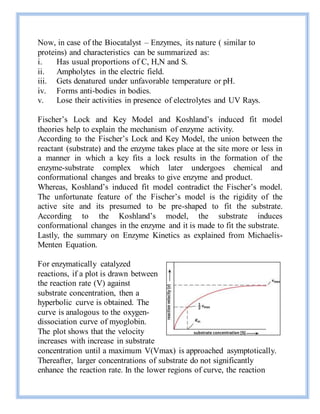
For enzymatically catalyzed
reactions, if a plot is drawn between
the reaction rate (V) against
substrate concentration, then a
hyperbolic curve is obtained. The
curve is analogous to the oxygen-
dissociation curve of myoglobin.
The plot shows that the velocity
increases with increase in substrate
concentration until a maximum V(Vmax) is approached asymptotically.
Thereafter, larger concentrations of substrate do not significantly
enhance the reaction rate. In the lower regions of curve, the reaction
approaches first order kinetics. It shows that V is a direct function of
[substrate] because the active sites of the enzyme molecules are not
saturated. At the upper portion of the plot, the reaction reaches zero
order kinetics because the active sites of all the enzyme molecules are
saturated and thus, the reaction rate is independent of further increase in
the concentration of the substrate. For the intermediate part of the curve,
the enzyme approaches substrate saturation, kinetic are mixed zero and
first order kinetics. Thus enzyme assays are designed to follow zero
order kinetics to avoid the influence of substrate concentration on
reactions velocity.

SYNOPSIS ON CATALYST

  • 1.
    A SYNOPSIS ON DISSERTATION REPORTENTITLED “CATALYSIS” Submitted by SHRADDHA VERMA Regd.No.s - 38742/15 Under the guidance of Dr.Sasmita Samal Head of Department (CHEMISTRY) For the Degree of BACHELOR OF SCIENCE In CHEMISTRY 2018 Department of Chemistry GOVERNMENT AUTONOMOUS COLLEGE PANPOSH, ROURKELA
  • 2.
    A SYNOPSIS ON DISSERTATION REPORTENTITLED “CATALYSIS” Submitted by Guided by SHRADDHA VERMA Dr.Sasmita Samal Regd.No.S - 38742/15 Head of Department (Chemistry)
  • 3.
    INTRODUCTION The systematic studyof the effect of various foreign substances on the rates of chemical reactions was first made by Berzelius in 1835. He suggested the term catalyst for such substances. In Greek, kata = wholly, lein = to loosen. CATALYST Substances, which accelerate the rate of a chemical reaction and themselves remain chemically and quantitatively unchanged after the reaction, are known as catalysts. For example, MnO2 acts as a catalyst for the following reaction The phenomenon of increase in the rate of a reaction that results from the addition of a catalyst is known as catalysis. The action of the catalyst can be explained on the basis of intermediate complex theory. According to this theory, a catalyst participates in a chemical reaction by forming temporary bonds with the reactant resulting in an intermediate complex which decomposes to yield product and the catalyst. It is believed that the catalyst provides an alternative pathway or reaction mechanism by reducing the activation energy between reactants and
  • 4.
    products and hencelowering the potential energy barrier, and the reaction rate is increased . Although a catalyst lowers the activation energy Ea for a reaction, it does not affect the energy difference ΔH between the products and reactants. It is clear from Arrhenius equation, lower the value of activation energy (Ea) faster will be the rate of a reaction. (Note: Arrhenius equation is K = A e-Ea/RT, where A is the Arrhenius factor or the frequency factor, R is gas constant, Ea is activation energy.)
  • 5.
    OBJECTIVE The objective ofwriting this project is to clarify the basic concept of “Catalysis”. A narrow perspective of “Catalyst” and its process “Catalysis” has been discussed by briefly explaining the following topics- • Catalyst • Types of Catalyst (based on the effect of rate’s of reactions) • Types of Catalytic Reactions • Discussing past date introduction dates i.e., its “History”, Principals ruling the mechanism of Catalysis and Background involving, reactions from which the very concept of “Catalysis” and its field of application in Organic to In-organic reactions are explained with examples. The later part of the project clarifies the concept of “Biocatalyst- Enzymes”. It is an important topic and has been added in this project because of its similar nature and activity to catalyst and proteins present in our body. * The section of Enzyme helps to answer the following questions:- What are Enzymes? Are Enzymes similar to catalyst? Is the nature of Enzymes similar to Proteins? Mechanism of Enzymatic Reactions? MOTIVATION The motivation to work on this Dissertation Topic Entitled “Catalysis” was my own keen interest on understanding the basic concepts of Catalyst, its efficient working mechanism in the reactions, its nature and characteristics.
  • 6.
    SUMMARY In order tosummaries the presented ideas and concept on “CATALYSIS” following Questions, terms and their pre-structured definitions are enough. What are Catalyst? A catalyst would be that substance which gives an option of a shortcut, bypassing that lengthy, energy consuming reaction pathways . By giving a new alternate route, reaction can proceed going towards “A...saving time and energy process.” In other words, a catalyst is a substance that increases the rate of a reaction, without being used up itself. Remember that if it got used up, then it would be a reactant. This process is called 'Catalysis'. Biocatalysts are called ‘Enzymes’. Depending upon the Catalyst nature i.e., whether it increases or decrease the rate of reaction, it is of two types: POSITIVE AND NEGATIVE CATALYST as per the name Positive(enhancing the rate) and Negative (decreasing the rate). Similarly, the catalytic reactions are of two types: HETEROGENEOUS AND HOMOGENEOUS CATALYTIC REACTIONS. Homogenous in case both , catalyst and reactants are of same physical state and different in Heterogeneous catalytic reactions. As for the nature and characteristics following points sum up all the attributes of a Catalyst:- i. Regenerated again at the end of the reaction. ii. Needed in small amount. iii. Do not alter the reaction equilibrium. iv. It’s not an initiator. v. Specific and Selective in action vi. Do not alter the nature of the product. vii. It is Adsorbed not Absorbed on the surface of the reactant.
  • 7.
    Now, in caseof the Biocatalyst – Enzymes, its nature ( similar to proteins) and characteristics can be summarized as: i. Has usual proportions of C, H,N and S. ii. Ampholytes in the electric field. iii. Gets denatured under unfavorable temperature or pH. iv. Forms anti-bodies in bodies. v. Lose their activities in presence of electrolytes and UV Rays. Fischer’s Lock and Key Model and Koshland’s induced fit model theories help to explain the mechanism of enzyme activity. According to the Fischer’s Lock and Key Model, the union between the reactant (substrate) and the enzyme takes place at the site more or less in a manner in which a key fits a lock results in the formation of the enzyme-substrate complex which later undergoes chemical and conformational changes and breaks to give enzyme and product. Whereas, Koshland’s induced fit model contradict the Fischer’s model. The unfortunate feature of the Fischer’s model is the rigidity of the active site and its presumed to be pre-shaped to fit the substrate. According to the Koshland’s model, the substrate induces conformational changes in the enzyme and it is made to fit the substrate. Lastly, the summary on Enzyme Kinetics as explained from Michaelis- Menten Equation. For enzymatically catalyzed reactions, if a plot is drawn between the reaction rate (V) against substrate concentration, then a hyperbolic curve is obtained. The curve is analogous to the oxygen- dissociation curve of myoglobin. The plot shows that the velocity increases with increase in substrate concentration until a maximum V(Vmax) is approached asymptotically. Thereafter, larger concentrations of substrate do not significantly enhance the reaction rate. In the lower regions of curve, the reaction
  • 8.
    approaches first orderkinetics. It shows that V is a direct function of [substrate] because the active sites of the enzyme molecules are not saturated. At the upper portion of the plot, the reaction reaches zero order kinetics because the active sites of all the enzyme molecules are saturated and thus, the reaction rate is independent of further increase in the concentration of the substrate. For the intermediate part of the curve, the enzyme approaches substrate saturation, kinetic are mixed zero and first order kinetics. Thus enzyme assays are designed to follow zero order kinetics to avoid the influence of substrate concentration on reactions velocity.