EFFICACY OF INTRAVENOUS LIDOCAINE IN PREVENTING
  FENTANYL-INDUCED COUGH BEFORE INDUCTION OF
  ANAESTHESIA: A RANDOMISED CONTROLLED TRIAL

SYNOPSIS OF THE STUDY ENVISAGED FOR THE THESIS FOR THE
 DEGREE OF DOCTOR OF THE MEDICINE, ANAESTHESIOLOGY
                          BY:
             DR. PRALAY SHANKAR GHOSH
          DEPARTMENT OF ANAESTHESIOLOGY
     NORTH BENGAL MEDICAL COLLEGE AND HOSPITAL
                 P.O.-SUSHRUTANAGAR
                   DIST: DARJEELING
                   SESSION: 2010-2013
               UNDER THE GUIDENCE OF:
          PROFESSOR (DR.) SEKHAR RANJAN BASU
                  PROFESSOR & HEAD
           DEPARTMENT OF ANAESTHESIOLOGY
      NORTH BENGAL MEDICAL COLLEGE AND HOSPITAL
                 AND CO-GUIDENCE OF:
                DR. GOUTAM CHOUDHURI
                 ASSOCIATE PROFESSOR
           DEPARTMENT OF ANAESTHESIOLOGY
      NORTH BENGAL MEDICAL COLLEGE AND HOSPITAL


  UNDER THE WEST BENGAL UNIVERSITY OF HEALTH SCIENCES
               SALT LAKE, KOLKATA, INDIA
EFFICACY OF INTRAVENOUS LIDOCAINE IN PREVENTING
  FENTANYL-INDUCED COUGH BEFORE INDUCTION OF
  ANAESTHESIA: A RANDOMISED CONTROLLED TRIAL
                                           .
Introduction:
Fentanyl citrate is a synthetic narcotic analgesic. It induces intense analgesia with a
rapid onset, short duration of action, minimal cardiovascular depression and
minimal histamine release (due to the citrate in fentanyl citrate). It has high
potency and a short half-life and thus is a reasonably good agent to suppress the
haemodynamic perturbations associated with the laryngoscopy and intubation in
patients undergoing surgery1. It is widely used during induction of general
anaesthesia and in the perioperative period.

But one of its important side effect is cough2. This tussive effect may be of concern
specially in patients with increased intracranial pressure, open eye injury or
increased intraabdominal pressure3.

Mechanism of this cough is inhibition of central sympathetic outflow causing vagal
predominance, resulting in cough and reflex bronchoconstriction. Pulmonary
chemoreflex stimulation and histamine release are the other possible mechanisms.

Different studies have shown the incidence of such cough to be 28-65% in Asiatic
population, after intravenous injection of fentanyl in doses ranging from 2-5
mcg/kg .given over 1-5 seconds.4

Different techniques and drug therapy have been employed to reduce the cough
with varying degree of success. Uses of ketamine, clonidine or dexamethasone
before fentanyl injection have been found to be successful in various studies.
Inhalational salbutamol3 reduces the cough incidence due to its beta adrenergic
stimulatory effect over bronchial smooth muscle. Recent studies revealed role of
pre-emptive injection of lower dose of fentanyl. Huffing maneuver, a forced
expiration against closed glottis and slower injection rate have resulted in
decreased cough incidence.
Lidocaine is a local anaesthetic agent with an amide group. Intravenous lidocaine
was found to be effective in suppressing cough associated with endotracheal
intubation and extubation5. In this study, we will try to investigate this property of
intravenous lidocaine by injecting it before fentanyl injection to reduce the
incidence of fentanyl-induced cough.

 Though usually self-limited, fentanyl-induced cough may be life-threatening in
patients with certain co-existing diseases6 and so the problem must be strictly dealt
with by the attending anaesthesiologists. Previous study by Pandey CK et al.
suggested risk reduction of 21.12% for fentanyl-induced coughing after
pretreatment with IV lidocaine. Our study for that purpose will be carried out with
this hypothesis that, the incidence of fentanyl-induced cough can be reduced by
30% using lidocaine intravenously before intravenous fentanyl prior to induction
of general anaesthesia, by reducing the dose of fentanyl as well as the speed of
injection.

Aims and objectives of the study:
This study will be carried out to determine the efficacy of intravenous lidocaine in
patients undergoing elective surgery under general anaesthesia, compared to
placebo, in respect to-

a) Reduction in the incidence of fentanyl-induced cough (primary outcome)
b) Decrease in haemodynamic alterations during intubation (secondary outcome)
c) Minimizing the adverse effects if any (secondary outcome)


Materials and methods:
1. Study area:

The study will be carried out on patients undergoing elective surgery under general
anaesthesia. It will be conducted in the department of anaesthesiology of North
Bengal Medical College to see the effect of intravenous lidocaine on the incidence
of cough induced by fentanyl before induction of general anaesthesia. From the
previous records, we are expecting at least 900 elective surgeries during the study
period.
2. Study population:

Case definition- Adult patients of either age of ASA status I-II aged between 18-65
years, scheduled to undergo elective surgery.

Exclusion criteria:

   1.   Impaired kidney or liver functions
   2.   A history of bronchial asthma and chronic obstructive pulmonary disease
   3.   A history of smoking
   4.   A history of chronic cough
   5.   Respiratory tract infection
   6.   Hypertensive patients on angiotensin converting enzyme inhibitors
   7.   A hypersensitivity to local anaesthetics
   8.   Seizure disorders


3. Study period:

The study will be started after getting permission from Hospital Ethical Committee
and approval of West Bengal University of Health Sciences. It will span
approximately one year from July 2011 to June 2012.

4. Sample size:

Sample size of the study is 44 in each group based on the following parameters
1. α value 0.05
2. Power of the study 80%

As there is possibility of a dropout of 10%, 96 patients will be enrolled in the
study.
We are expecting a difference of at least 30% in reduction of cough from a
previous study.


5. Sample design:
Patients will be randomly allocated into two equal groups (Group L and Group S)
by computer generated block randomisation.

6. Study design:

Prospective randomised double blinded study. Here both the patients who will
receive the drug and the person who will inject and observe the effect of the drug
will be unaware of study protocol.

7. Parameters to be studied:

a) Severity of the cough, if present, in terms of mild (1-2), moderate (3-4) and
severe (5 or >5) gradation.
b) Haemodynamic stability in terms of heart rate, mean arterial pressure, SpO2 and
EtCO2 changes at 0(at intubation), 3 and 5 minutes after intubation.
c) Adverse effects- respiratory depression, bradycardia, convulsion etc.

8. Study tools:

a) Proforma of written informed consent and data collection
b) Anaesthetic machine and other necessary equipments for airway management
c) Tools of monitoring i.e. electrocardiogram, NIBP, pulse oxymeter,
capnometer etc.
d) Drugs- tab. diazepam, tab. ranitidine, inj. propofol
          inj. midazolam, inj. lidocaine, inj. fentanyl, inj. vecuronium
          inhalational isoflurane, inj. metoclopramide
e) an emergency airway cart.

9. Study technique:

The study will be conducted after getting permission from Hospital Ethical
Committee and approval of West Bengal University of Health sciences. Eligible
patients will be included into the study considering both inclusion and exclusion
criteria. Written informed consent will be obtained from all patients included in the
study after proper discussion of the study procedure in their own languages at the
preoperative visits. Patients will be randomly allocated to two groups, receiving
either Inj. lidocaine (group L), or normal saline (group S).

Interventions:
Each patient will be advised to take tab. diazepam 5 mg, tab. ranitidine 300 mg on
the night before surgery. The patient will be transferred to operation theatre on
scheduled time and lactated ringers’ solution will be started through an intravenous
line. Monitors will be attached to the patient and the baseline vital parameters will
be measured. The patient will be then pre-medicated with Inj. ranitidine (50 mg)
iv, inj. glycopyrrolate (0.2 mg) iv and inj. midazolam (2 mg) IV.

Both the drug and the placebo (normal saline) will be prepared in unlabelled 5cc
syringes as colourless liquids and will be handed over to an anaesthesiologist who
is unaware of the study protocol. He will inject the drugs while the patient will also
be unaware, making the study double blind. Inj. lidocaine will be given
intravenously in a dose of 1.5 mg/kg over 5 seconds one minute before injecting
intravenous fentanyl 2µg/kg which will be injected over 10 seconds. The same
person injecting the drugs will observe and grade cough (if any) accordingly. The
period of observation will be 3 minutes and then, induction will be done with Inj.
thiopentone (3-5mg/kg). the patient will then be intubated with inj. vecuronium.
his /her vitals will again be recorded (at 0, 3 and 5 minutes after intubation) to see
changes from the basal values. Any adverse effect, if occurs, will also be recorded
and steps will be taken according to the severity.

10. Analysis of data:

Data will be analysed with appropriate statistical methods.

REVIEW OF LITERATURE:
1. In 1985, Yukioka H et al.5 in their study suggested the role of Inj. lidocaine to
suppress the cough reflex alongwith with the mechanically-induced and
chemically-induced airway reflexes.

2. Bohrer et al4. In 1990, suggested that fentanyl-induced cough may be due to
stimulation of pulmonary chemoreflex and J receptors by fentanyl.

3.In 1992, Gin and Chui et al2. observed a young patient with acute extradural
haematoma to have continuous coughing for five seconds after fentanyl injection
during induction. The cough was suppressed by thiopentone.
4. In 1998, Ko SH et al.1 suggested use of fentanyl at a dose of 2 mcg/kg 5 minutes
before intubation (time for peak analgesic effect) to haemodynamic responses to
tracheal intubation.

5. In 2001, Tweed et al.6 suggested that coughing during induction of anaesthesia
may increase intracranial pressure, intraperitoneal pressure and intraocular
pressure. Such cough, when continuous, may require sedatives and muscle
relaxants.

6. Agarwal A et al.3 in the year 2003 suggested role of lidocaine, ephedrine, beta-2
receptor agonist, ketamine and clonidine in suppressing fentanyl-induced cough
due to the broncho-relaxant effect on airway smooth muscle.


REFERENCES:
1.Ko SH, Kim DC, Han YJ, Song HS. Small dose fentanyl: optimal time of
injection for blunting the circulatory responses to tracheal intubation. Anesth
Analg 1998;86:658-61.

2. Gin T, Chui PT. Coughing after fentanyl [letter]. Can J Anaesth 1992;39: 406.

3. Agarwal A, Azim A, Ambesh S, et al. Salbutamol, beclomethasone or sodium
chromoglycate suppress coughing induced by iv fentanyl. Can J anesth 2003;50:
297-300.

4. H Bohrer, F Fleischer, P Werning, (1990). Tussive effect of a fentanyl bolus
administered through a central venous catheter. Anaesthesia 1990;45: 18-21.

5. Yukioka H, Hyashi M, Yoshimoto N, et al. IV lidocaine as a suppressant of
coughing during tracheal intubation. Anesth Analg 1985;64: 1189-92.

6. Tweed WA, Dakin D. Explosive coughing after fentanyl injection. Anesth Analg
2001;92:1442-3.
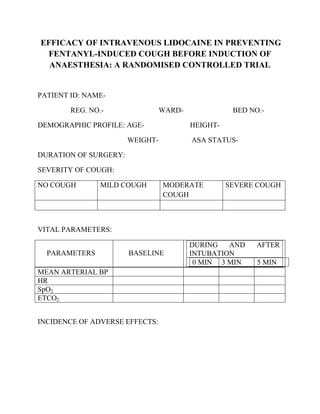
EFFICACY OF INTRAVENOUS LIDOCAINE IN PREVENTING
 FENTANYL-INDUCED COUGH BEFORE INDUCTION OF
  ANAESTHESIA: A RANDOMISED CONTROLLED TRIAL


PATIENT ID: NAME-

        REG. NO.-                WARD-              BED NO.-

DEMOGRAPHIC PROFILE: AGE-                HEIGHT-

                       WEIGHT-           ASA STATUS-

DURATION OF SURGERY:

SEVERITY OF COUGH:

NO COUGH        MILD COUGH       MODERATE          SEVERE COUGH
                                 COUGH


VITAL PARAMETERS:

                                         DURING   AND     AFTER
  PARAMETERS           BASELINE          INTUBATION
                                          0 MIN 3 MIN     5 MIN
MEAN ARTERIAL BP
HR
SpO2
ETCO2


INCIDENCE OF ADVERSE EFFECTS:

Synopsis

  • 1.
    EFFICACY OF INTRAVENOUSLIDOCAINE IN PREVENTING FENTANYL-INDUCED COUGH BEFORE INDUCTION OF ANAESTHESIA: A RANDOMISED CONTROLLED TRIAL SYNOPSIS OF THE STUDY ENVISAGED FOR THE THESIS FOR THE DEGREE OF DOCTOR OF THE MEDICINE, ANAESTHESIOLOGY BY: DR. PRALAY SHANKAR GHOSH DEPARTMENT OF ANAESTHESIOLOGY NORTH BENGAL MEDICAL COLLEGE AND HOSPITAL P.O.-SUSHRUTANAGAR DIST: DARJEELING SESSION: 2010-2013 UNDER THE GUIDENCE OF: PROFESSOR (DR.) SEKHAR RANJAN BASU PROFESSOR & HEAD DEPARTMENT OF ANAESTHESIOLOGY NORTH BENGAL MEDICAL COLLEGE AND HOSPITAL AND CO-GUIDENCE OF: DR. GOUTAM CHOUDHURI ASSOCIATE PROFESSOR DEPARTMENT OF ANAESTHESIOLOGY NORTH BENGAL MEDICAL COLLEGE AND HOSPITAL UNDER THE WEST BENGAL UNIVERSITY OF HEALTH SCIENCES SALT LAKE, KOLKATA, INDIA
  • 2.
    EFFICACY OF INTRAVENOUSLIDOCAINE IN PREVENTING FENTANYL-INDUCED COUGH BEFORE INDUCTION OF ANAESTHESIA: A RANDOMISED CONTROLLED TRIAL . Introduction: Fentanyl citrate is a synthetic narcotic analgesic. It induces intense analgesia with a rapid onset, short duration of action, minimal cardiovascular depression and minimal histamine release (due to the citrate in fentanyl citrate). It has high potency and a short half-life and thus is a reasonably good agent to suppress the haemodynamic perturbations associated with the laryngoscopy and intubation in patients undergoing surgery1. It is widely used during induction of general anaesthesia and in the perioperative period. But one of its important side effect is cough2. This tussive effect may be of concern specially in patients with increased intracranial pressure, open eye injury or increased intraabdominal pressure3. Mechanism of this cough is inhibition of central sympathetic outflow causing vagal predominance, resulting in cough and reflex bronchoconstriction. Pulmonary chemoreflex stimulation and histamine release are the other possible mechanisms. Different studies have shown the incidence of such cough to be 28-65% in Asiatic population, after intravenous injection of fentanyl in doses ranging from 2-5 mcg/kg .given over 1-5 seconds.4 Different techniques and drug therapy have been employed to reduce the cough with varying degree of success. Uses of ketamine, clonidine or dexamethasone before fentanyl injection have been found to be successful in various studies. Inhalational salbutamol3 reduces the cough incidence due to its beta adrenergic stimulatory effect over bronchial smooth muscle. Recent studies revealed role of pre-emptive injection of lower dose of fentanyl. Huffing maneuver, a forced expiration against closed glottis and slower injection rate have resulted in decreased cough incidence.
  • 3.
    Lidocaine is alocal anaesthetic agent with an amide group. Intravenous lidocaine was found to be effective in suppressing cough associated with endotracheal intubation and extubation5. In this study, we will try to investigate this property of intravenous lidocaine by injecting it before fentanyl injection to reduce the incidence of fentanyl-induced cough. Though usually self-limited, fentanyl-induced cough may be life-threatening in patients with certain co-existing diseases6 and so the problem must be strictly dealt with by the attending anaesthesiologists. Previous study by Pandey CK et al. suggested risk reduction of 21.12% for fentanyl-induced coughing after pretreatment with IV lidocaine. Our study for that purpose will be carried out with this hypothesis that, the incidence of fentanyl-induced cough can be reduced by 30% using lidocaine intravenously before intravenous fentanyl prior to induction of general anaesthesia, by reducing the dose of fentanyl as well as the speed of injection. Aims and objectives of the study: This study will be carried out to determine the efficacy of intravenous lidocaine in patients undergoing elective surgery under general anaesthesia, compared to placebo, in respect to- a) Reduction in the incidence of fentanyl-induced cough (primary outcome) b) Decrease in haemodynamic alterations during intubation (secondary outcome) c) Minimizing the adverse effects if any (secondary outcome) Materials and methods: 1. Study area: The study will be carried out on patients undergoing elective surgery under general anaesthesia. It will be conducted in the department of anaesthesiology of North Bengal Medical College to see the effect of intravenous lidocaine on the incidence of cough induced by fentanyl before induction of general anaesthesia. From the previous records, we are expecting at least 900 elective surgeries during the study period.
  • 4.
    2. Study population: Casedefinition- Adult patients of either age of ASA status I-II aged between 18-65 years, scheduled to undergo elective surgery. Exclusion criteria: 1. Impaired kidney or liver functions 2. A history of bronchial asthma and chronic obstructive pulmonary disease 3. A history of smoking 4. A history of chronic cough 5. Respiratory tract infection 6. Hypertensive patients on angiotensin converting enzyme inhibitors 7. A hypersensitivity to local anaesthetics 8. Seizure disorders 3. Study period: The study will be started after getting permission from Hospital Ethical Committee and approval of West Bengal University of Health Sciences. It will span approximately one year from July 2011 to June 2012. 4. Sample size: Sample size of the study is 44 in each group based on the following parameters 1. α value 0.05 2. Power of the study 80% As there is possibility of a dropout of 10%, 96 patients will be enrolled in the study. We are expecting a difference of at least 30% in reduction of cough from a previous study. 5. Sample design:
  • 5.
    Patients will berandomly allocated into two equal groups (Group L and Group S) by computer generated block randomisation. 6. Study design: Prospective randomised double blinded study. Here both the patients who will receive the drug and the person who will inject and observe the effect of the drug will be unaware of study protocol. 7. Parameters to be studied: a) Severity of the cough, if present, in terms of mild (1-2), moderate (3-4) and severe (5 or >5) gradation. b) Haemodynamic stability in terms of heart rate, mean arterial pressure, SpO2 and EtCO2 changes at 0(at intubation), 3 and 5 minutes after intubation. c) Adverse effects- respiratory depression, bradycardia, convulsion etc. 8. Study tools: a) Proforma of written informed consent and data collection b) Anaesthetic machine and other necessary equipments for airway management c) Tools of monitoring i.e. electrocardiogram, NIBP, pulse oxymeter, capnometer etc. d) Drugs- tab. diazepam, tab. ranitidine, inj. propofol inj. midazolam, inj. lidocaine, inj. fentanyl, inj. vecuronium inhalational isoflurane, inj. metoclopramide e) an emergency airway cart. 9. Study technique: The study will be conducted after getting permission from Hospital Ethical Committee and approval of West Bengal University of Health sciences. Eligible patients will be included into the study considering both inclusion and exclusion criteria. Written informed consent will be obtained from all patients included in the study after proper discussion of the study procedure in their own languages at the preoperative visits. Patients will be randomly allocated to two groups, receiving either Inj. lidocaine (group L), or normal saline (group S). Interventions:
  • 6.
    Each patient willbe advised to take tab. diazepam 5 mg, tab. ranitidine 300 mg on the night before surgery. The patient will be transferred to operation theatre on scheduled time and lactated ringers’ solution will be started through an intravenous line. Monitors will be attached to the patient and the baseline vital parameters will be measured. The patient will be then pre-medicated with Inj. ranitidine (50 mg) iv, inj. glycopyrrolate (0.2 mg) iv and inj. midazolam (2 mg) IV. Both the drug and the placebo (normal saline) will be prepared in unlabelled 5cc syringes as colourless liquids and will be handed over to an anaesthesiologist who is unaware of the study protocol. He will inject the drugs while the patient will also be unaware, making the study double blind. Inj. lidocaine will be given intravenously in a dose of 1.5 mg/kg over 5 seconds one minute before injecting intravenous fentanyl 2µg/kg which will be injected over 10 seconds. The same person injecting the drugs will observe and grade cough (if any) accordingly. The period of observation will be 3 minutes and then, induction will be done with Inj. thiopentone (3-5mg/kg). the patient will then be intubated with inj. vecuronium. his /her vitals will again be recorded (at 0, 3 and 5 minutes after intubation) to see changes from the basal values. Any adverse effect, if occurs, will also be recorded and steps will be taken according to the severity. 10. Analysis of data: Data will be analysed with appropriate statistical methods. REVIEW OF LITERATURE: 1. In 1985, Yukioka H et al.5 in their study suggested the role of Inj. lidocaine to suppress the cough reflex alongwith with the mechanically-induced and chemically-induced airway reflexes. 2. Bohrer et al4. In 1990, suggested that fentanyl-induced cough may be due to stimulation of pulmonary chemoreflex and J receptors by fentanyl. 3.In 1992, Gin and Chui et al2. observed a young patient with acute extradural haematoma to have continuous coughing for five seconds after fentanyl injection during induction. The cough was suppressed by thiopentone.
  • 7.
    4. In 1998,Ko SH et al.1 suggested use of fentanyl at a dose of 2 mcg/kg 5 minutes before intubation (time for peak analgesic effect) to haemodynamic responses to tracheal intubation. 5. In 2001, Tweed et al.6 suggested that coughing during induction of anaesthesia may increase intracranial pressure, intraperitoneal pressure and intraocular pressure. Such cough, when continuous, may require sedatives and muscle relaxants. 6. Agarwal A et al.3 in the year 2003 suggested role of lidocaine, ephedrine, beta-2 receptor agonist, ketamine and clonidine in suppressing fentanyl-induced cough due to the broncho-relaxant effect on airway smooth muscle. REFERENCES: 1.Ko SH, Kim DC, Han YJ, Song HS. Small dose fentanyl: optimal time of injection for blunting the circulatory responses to tracheal intubation. Anesth Analg 1998;86:658-61. 2. Gin T, Chui PT. Coughing after fentanyl [letter]. Can J Anaesth 1992;39: 406. 3. Agarwal A, Azim A, Ambesh S, et al. Salbutamol, beclomethasone or sodium chromoglycate suppress coughing induced by iv fentanyl. Can J anesth 2003;50: 297-300. 4. H Bohrer, F Fleischer, P Werning, (1990). Tussive effect of a fentanyl bolus administered through a central venous catheter. Anaesthesia 1990;45: 18-21. 5. Yukioka H, Hyashi M, Yoshimoto N, et al. IV lidocaine as a suppressant of coughing during tracheal intubation. Anesth Analg 1985;64: 1189-92. 6. Tweed WA, Dakin D. Explosive coughing after fentanyl injection. Anesth Analg 2001;92:1442-3.
  • 8.
    EFFICACY OF INTRAVENOUSLIDOCAINE IN PREVENTING FENTANYL-INDUCED COUGH BEFORE INDUCTION OF ANAESTHESIA: A RANDOMISED CONTROLLED TRIAL PATIENT ID: NAME- REG. NO.- WARD- BED NO.- DEMOGRAPHIC PROFILE: AGE- HEIGHT- WEIGHT- ASA STATUS- DURATION OF SURGERY: SEVERITY OF COUGH: NO COUGH MILD COUGH MODERATE SEVERE COUGH COUGH VITAL PARAMETERS: DURING AND AFTER PARAMETERS BASELINE INTUBATION 0 MIN 3 MIN 5 MIN MEAN ARTERIAL BP HR SpO2 ETCO2 INCIDENCE OF ADVERSE EFFECTS: