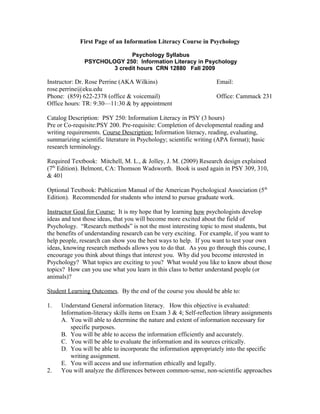
First Page of an Information Literacy Course in Psychology
Psychology Syllabus
PSYCHOLOGY 250: Information Literacy in Psychology
3 credit hours CRN 12880 Fall 2009
Instructor: Dr. Rose Perrine (AKA Wilkins) Email:
rose.perrine@eku.edu
Phone: (859) 622-2378 (office & voicemail) Office: Cammack 231
Office hours: TR: 9:30—11:30 & by appointment
Catalog Description: PSY 250: Information Literacy in PSY (3 hours)
Pre or Co-requisite:PSY 200. Pre-requisite: Completion of developmental reading and
writing requirements. Course Description: Information literacy, reading, evaluating,
summarizing scientific literature in Psychology; scientific writing (APA format); basic
research terminology.
Required Textbook: Mitchell, M. L., & Jolley, J. M. (2009) Research design explained
(7th
Edition). Belmont, CA: Thomson Wadsworth. Book is used again in PSY 309, 310,
& 401
Optional Textbook: Publication Manual of the American Psychological Association (5th
Edition). Recommended for students who intend to pursue graduate work.
Instructor Goal for Course: It is my hope that by learning how psychologists develop
ideas and test those ideas, that you will become more excited about the field of
Psychology. “Research methods” is not the most interesting topic to most students, but
the benefits of understanding research can be very exciting. For example, if you want to
help people, research can show you the best ways to help. If you want to test your own
ideas, knowing research methods allows you to do that. As you go through this course, I
encourage you think about things that interest you. Why did you become interested in
Psychology? What topics are exciting to you? What would you like to know about those
topics? How can you use what you learn in this class to better understand people (or
animals)?
Student Learning Outcomes. By the end of the course you should be able to:
1. Understand General information literacy. How this objective is evaluated:
Information-literacy skills items on Exam 3 & 4; Self-reflection library assignments
A. You will able to determine the nature and extent of information necessary for
specific purposes.
B. You will be able to access the information efficiently and accurately.
C. You will be able to evaluate the information and its sources critically.
D. You will be able to incorporate the information appropriately into the specific
writing assignment.
E. You will access and use information ethically and legally.
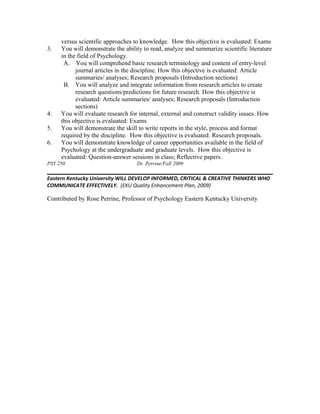
2. You will analyze the differences between common-sense, non-scientific approaches
versus scientific approaches to knowledge. How this objective is evaluated: Exams
3. You will demonstrate the ability to read, analyze and summarize scientific literature
in the field of Psychology.
A. You will comprehend basic research terminology and content of entry-level
journal articles in the discipline. How this objective is evaluated: Article
summaries/ analyses; Research proposals (Introduction sections)
B. You will analyze and integrate information from research articles to create
research questions/predictions for future research. How this objective is
evaluated: Article summaries/ analyses; Research proposals (Introduction
sections)
4. You will evaluate research for internal, external and construct validity issues. How
this objective is evaluated: Exams
5. You will demonstrate the skill to write reports in the style, process and format
required by the discipline. How this objective is evaluated: Research proposals.
6. You will demonstrate knowledge of career opportunities available in the field of
Psychology at the undergraduate and graduate levels. How this objective is
evaluated: Question-answer sessions in class; Reflective papers.
PSY 250 Dr. Perrine/Fall 2009
Eastern Kentucky University WILL DEVELOP INFORMED, CRITICAL & CREATIVE THINKERS WHO
COMMUNICATE EFFECTIVELY. (EKU Quality Enhancement Plan, 2009)
Contributed by Rose Perrine, Professor of Psychology Eastern Kentucky University

Syllabus Example

  • 1.
    First Page ofan Information Literacy Course in Psychology Psychology Syllabus PSYCHOLOGY 250: Information Literacy in Psychology 3 credit hours CRN 12880 Fall 2009 Instructor: Dr. Rose Perrine (AKA Wilkins) Email: rose.perrine@eku.edu Phone: (859) 622-2378 (office & voicemail) Office: Cammack 231 Office hours: TR: 9:30—11:30 & by appointment Catalog Description: PSY 250: Information Literacy in PSY (3 hours) Pre or Co-requisite:PSY 200. Pre-requisite: Completion of developmental reading and writing requirements. Course Description: Information literacy, reading, evaluating, summarizing scientific literature in Psychology; scientific writing (APA format); basic research terminology. Required Textbook: Mitchell, M. L., & Jolley, J. M. (2009) Research design explained (7th Edition). Belmont, CA: Thomson Wadsworth. Book is used again in PSY 309, 310, & 401 Optional Textbook: Publication Manual of the American Psychological Association (5th Edition). Recommended for students who intend to pursue graduate work. Instructor Goal for Course: It is my hope that by learning how psychologists develop ideas and test those ideas, that you will become more excited about the field of Psychology. “Research methods” is not the most interesting topic to most students, but the benefits of understanding research can be very exciting. For example, if you want to help people, research can show you the best ways to help. If you want to test your own ideas, knowing research methods allows you to do that. As you go through this course, I encourage you think about things that interest you. Why did you become interested in Psychology? What topics are exciting to you? What would you like to know about those topics? How can you use what you learn in this class to better understand people (or animals)? Student Learning Outcomes. By the end of the course you should be able to: 1. Understand General information literacy. How this objective is evaluated: Information-literacy skills items on Exam 3 & 4; Self-reflection library assignments A. You will able to determine the nature and extent of information necessary for specific purposes. B. You will be able to access the information efficiently and accurately. C. You will be able to evaluate the information and its sources critically. D. You will be able to incorporate the information appropriately into the specific writing assignment. E. You will access and use information ethically and legally. 2. You will analyze the differences between common-sense, non-scientific approaches
  • 2.
    versus scientific approachesto knowledge. How this objective is evaluated: Exams 3. You will demonstrate the ability to read, analyze and summarize scientific literature in the field of Psychology. A. You will comprehend basic research terminology and content of entry-level journal articles in the discipline. How this objective is evaluated: Article summaries/ analyses; Research proposals (Introduction sections) B. You will analyze and integrate information from research articles to create research questions/predictions for future research. How this objective is evaluated: Article summaries/ analyses; Research proposals (Introduction sections) 4. You will evaluate research for internal, external and construct validity issues. How this objective is evaluated: Exams 5. You will demonstrate the skill to write reports in the style, process and format required by the discipline. How this objective is evaluated: Research proposals. 6. You will demonstrate knowledge of career opportunities available in the field of Psychology at the undergraduate and graduate levels. How this objective is evaluated: Question-answer sessions in class; Reflective papers. PSY 250 Dr. Perrine/Fall 2009 Eastern Kentucky University WILL DEVELOP INFORMED, CRITICAL & CREATIVE THINKERS WHO COMMUNICATE EFFECTIVELY. (EKU Quality Enhancement Plan, 2009) Contributed by Rose Perrine, Professor of Psychology Eastern Kentucky University