“ Themes and Issues in Psychology” First year module: 2011 / 12
Module structure? Detailed description on ‘blackboard’. Year long.  30 credits.  4 Assessments. Class presentation; ‘time controlled assessment’ (multiple choice questionnaire); 1 essay – 2 submissions. Subjects will be explored in seminars before a lecture: Priority on exploration, supporting the development of your own views, and demonstrating ‘research’ in action.  (You know more than you think.) The distribution of notes is ‘electronic’.
Intended Learning Outcomes On successful completion of the module the student will be able to: Summarise the origins of science and psychology and their impact on our conceptions and practice of psychology Explore a range of aspects of human experience from a psychological perspective Identify the characteristics of different disciplines of psychology and their gains and limitations in studying selected topics. Explore selected topics of general and historical psychological interest . Demonstrate an appreciation of some of the major debates in psychology.
Module Overview “ The mind is not a vessel to be filled, but a fire to be kindled”  (Plutarch)
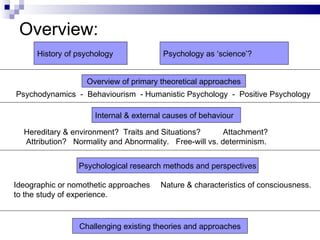
Overview: History of psychology Psychology as ‘science’? Internal & external causes of behaviour  Hereditary & environment?  Traits and Situations?  Attachment? Attribution?  Normality and Abnormality.  Free-will vs. determinism. Psychological research methods and perspectives Ideographic or nomothetic approaches to the study of experience. Nature & characteristics of consciousness. Challenging existing theories and approaches Overview of primary theoretical approaches Psychodynamics  -  Behaviourism  - Humanistic Psychology  -  Positive Psychology
Module background? New in 2008/9.  Acts as a preparation for material, ideas and modules in year 2 and 3. Some similarities with A2 and AS syllabus. Therefore, builds on what you may know. Feedback is welcome.  E.g. ‘Speed up’?  ‘Slow down’?  Recap?  Clarify content? You will be coached on assessment requirements.
Potential contribution to you as psychology students? Influences of history, society and disciplines like science and philosophy on psychology. (‘External fingerprints’.) Overview of 4 psychological approaches (often described as the four ‘Forces’. Behaviourism, Psychodynamics, Humanistic, and Positive Psychology. Strengths and limitations of psychological approaches (and when they may overlap). Cross-disciplinary thinking
Potential contribution to you as psychology students (2) Developing the skill to think and write across disciplines in psychology. “ What part of ‘psychology’ is yours?” You will start to learn where you are most ‘at home’ in psychology – and how you can ‘think’ in a way that will make that ‘home’ more open and effective. “ How do I become who I am?” We will ‘map’ or diagram together over the year what we can learn about personal functioning and development. Module resources in different media.
‘ Employability’: Self Awareness What do I want and what am I capable of achieving? Students need to: Identify knowledge, abilities and employability skills developed by the degree Identify personal skills and how these can be utilized Identify interests, values and personality within the framework of vocational and life planning Develop the ability to reflect and make better use of any particular skill set (strengths and weaknesses) Awareness that ‘self-concept’ can change during their degree course.
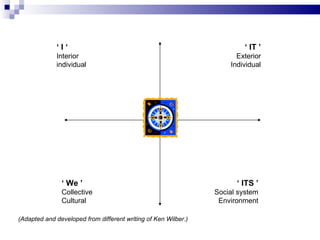
‘  I ‘ Interior individual ‘  IT ’ Exterior Individual ‘  We ’ Collective Cultural ‘  ITS ’ Social system Environment (Adapted and developed from different writing of Ken Wilber.)
How do I become who I am?
The focus of our interaction? A movement between several levels or types of learning: Psychological ‘approaches ’; e.g. social, cognitive etc. ‘ Thinking skills ’: utility or usefulness; evaluation, positioning, limitation etc. Contextual influences : Cultural – historical – professional awareness. Academic discipline : Writing. Coaching – increasing your skills.  Focus on ‘employability’?
The focus of our interaction? (2) Exploration Talking ideas through we will go ‘beyond the books’. ‘ Low risk’, high gain.
Seminars Balance of approaches Reflection.  Notes.  Discussion.  You learn in conversation and activity. Seminars = ‘speaking’ Exploring. Discussing. Building a ‘map’ or key points.  A summary of each topic. Resource for year 2 and 3.
Lectures ‘ Wordy’ notes Intended to act as ‘essence’ or study guide. Pace will leave time for questions
‘ Standards of Behaviour’ Key assumption : You are adults. You want to learn. You are here to participate in this work. “ I am not here to manage your behaviour”
If you want to …. … sit and talk with friends. … sit and work on your mobile phone. You are welcome to do so …. SOMEWHERE  ELSE.
Books
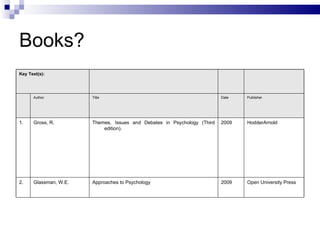
Books? Key Text(s): Author Title Date Publisher 1. Gross, R. Themes, Issues and Debates in Psychology (Third edition).  2009 HodderArnold 2. Glassman, W.E. Approaches to Psychology 2009 Open University Press
Sources of books? Blackwells (Ground floor North wing) www.amazon.co.uk Check the book title … …  then look under ‘used and new’.  Often some good deals. www.bookdepository.co.uk More competitive prices than ‘Amazon’. Free postage?  Approx 1 week for delivery.
Support as a Student?
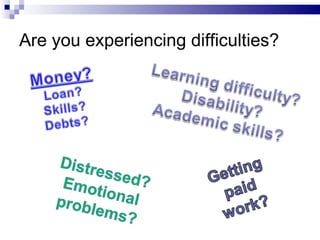
Are you experiencing difficulties?
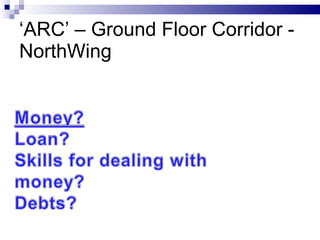
‘ ARC’ – Ground Floor Corridor - NorthWing
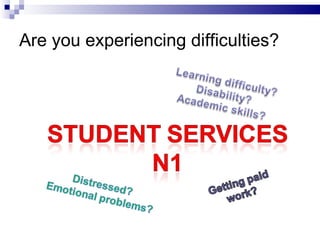
Key locations for Support Student Services – N1 Careers, Counselling, Disability Service. Learning Development Unit – G3.06 Please remember – you do not need to be ‘in crisis’ to get support!
Self-care?  Care for your colleagues? Difficulties in reading, writing, concentration, memory? Student Support / Learning Development Unit (e.g. Dyslexia screening? Counselling Service?  Mentoring? Careers?  Money Advice?) The module is year-long. Sustained attendance is necessary. If you are struggling, or see someone struggling (not attending), please say something.  Let’s seek ways to solve problems together.

Themes and issues overview and approach 2011 version

  • 1.
    “ Themes andIssues in Psychology” First year module: 2011 / 12
  • 2.
    Module structure? Detaileddescription on ‘blackboard’. Year long. 30 credits. 4 Assessments. Class presentation; ‘time controlled assessment’ (multiple choice questionnaire); 1 essay – 2 submissions. Subjects will be explored in seminars before a lecture: Priority on exploration, supporting the development of your own views, and demonstrating ‘research’ in action. (You know more than you think.) The distribution of notes is ‘electronic’.
  • 3.
    Intended Learning OutcomesOn successful completion of the module the student will be able to: Summarise the origins of science and psychology and their impact on our conceptions and practice of psychology Explore a range of aspects of human experience from a psychological perspective Identify the characteristics of different disciplines of psychology and their gains and limitations in studying selected topics. Explore selected topics of general and historical psychological interest . Demonstrate an appreciation of some of the major debates in psychology.
  • 4.
    Module Overview “The mind is not a vessel to be filled, but a fire to be kindled” (Plutarch)
  • 5.
    Overview: History ofpsychology Psychology as ‘science’? Internal & external causes of behaviour Hereditary & environment? Traits and Situations? Attachment? Attribution? Normality and Abnormality. Free-will vs. determinism. Psychological research methods and perspectives Ideographic or nomothetic approaches to the study of experience. Nature & characteristics of consciousness. Challenging existing theories and approaches Overview of primary theoretical approaches Psychodynamics - Behaviourism - Humanistic Psychology - Positive Psychology
  • 6.
    Module background? Newin 2008/9. Acts as a preparation for material, ideas and modules in year 2 and 3. Some similarities with A2 and AS syllabus. Therefore, builds on what you may know. Feedback is welcome. E.g. ‘Speed up’? ‘Slow down’? Recap? Clarify content? You will be coached on assessment requirements.
  • 7.
    Potential contribution toyou as psychology students? Influences of history, society and disciplines like science and philosophy on psychology. (‘External fingerprints’.) Overview of 4 psychological approaches (often described as the four ‘Forces’. Behaviourism, Psychodynamics, Humanistic, and Positive Psychology. Strengths and limitations of psychological approaches (and when they may overlap). Cross-disciplinary thinking
  • 8.
    Potential contribution toyou as psychology students (2) Developing the skill to think and write across disciplines in psychology. “ What part of ‘psychology’ is yours?” You will start to learn where you are most ‘at home’ in psychology – and how you can ‘think’ in a way that will make that ‘home’ more open and effective. “ How do I become who I am?” We will ‘map’ or diagram together over the year what we can learn about personal functioning and development. Module resources in different media.
  • 9.
    ‘ Employability’: SelfAwareness What do I want and what am I capable of achieving? Students need to: Identify knowledge, abilities and employability skills developed by the degree Identify personal skills and how these can be utilized Identify interests, values and personality within the framework of vocational and life planning Develop the ability to reflect and make better use of any particular skill set (strengths and weaknesses) Awareness that ‘self-concept’ can change during their degree course.
  • 10.
    ‘ I‘ Interior individual ‘ IT ’ Exterior Individual ‘ We ’ Collective Cultural ‘ ITS ’ Social system Environment (Adapted and developed from different writing of Ken Wilber.)
  • 11.
    How do Ibecome who I am?
  • 12.
    The focus ofour interaction? A movement between several levels or types of learning: Psychological ‘approaches ’; e.g. social, cognitive etc. ‘ Thinking skills ’: utility or usefulness; evaluation, positioning, limitation etc. Contextual influences : Cultural – historical – professional awareness. Academic discipline : Writing. Coaching – increasing your skills. Focus on ‘employability’?
  • 13.
    The focus ofour interaction? (2) Exploration Talking ideas through we will go ‘beyond the books’. ‘ Low risk’, high gain.
  • 14.
    Seminars Balance ofapproaches Reflection. Notes. Discussion. You learn in conversation and activity. Seminars = ‘speaking’ Exploring. Discussing. Building a ‘map’ or key points. A summary of each topic. Resource for year 2 and 3.
  • 15.
    Lectures ‘ Wordy’notes Intended to act as ‘essence’ or study guide. Pace will leave time for questions
  • 16.
    ‘ Standards ofBehaviour’ Key assumption : You are adults. You want to learn. You are here to participate in this work. “ I am not here to manage your behaviour”
  • 17.
    If you wantto …. … sit and talk with friends. … sit and work on your mobile phone. You are welcome to do so …. SOMEWHERE ELSE.
  • 18.
  • 19.
    Books? Key Text(s):Author Title Date Publisher 1. Gross, R. Themes, Issues and Debates in Psychology (Third edition). 2009 HodderArnold 2. Glassman, W.E. Approaches to Psychology 2009 Open University Press
  • 20.
    Sources of books?Blackwells (Ground floor North wing) www.amazon.co.uk Check the book title … … then look under ‘used and new’. Often some good deals. www.bookdepository.co.uk More competitive prices than ‘Amazon’. Free postage? Approx 1 week for delivery.
  • 21.
    Support as aStudent?
  • 22.
    Are you experiencingdifficulties?
  • 23.
    Are you experiencingdifficulties?
  • 24.
    ‘ ARC’ –Ground Floor Corridor - NorthWing
  • 25.
    Key locations forSupport Student Services – N1 Careers, Counselling, Disability Service. Learning Development Unit – G3.06 Please remember – you do not need to be ‘in crisis’ to get support!
  • 26.
    Self-care? Carefor your colleagues? Difficulties in reading, writing, concentration, memory? Student Support / Learning Development Unit (e.g. Dyslexia screening? Counselling Service? Mentoring? Careers? Money Advice?) The module is year-long. Sustained attendance is necessary. If you are struggling, or see someone struggling (not attending), please say something. Let’s seek ways to solve problems together.