 A technique that enables organisations or
individual to move from everyday problems and
traditional strategies to a fresh prospective.
 SWOT analysis looks at your strengths and
weaknesses, and the opportunities and threats
your business faces. SWOT can help your
company face its greatest challenges and find its
most promising new markets.
 Characteristics of the business or individual that give it an
advantage over others in the industry.
 Positive tangible and intangible attributes, internal to an
organization or individual.
 Beneficial aspects of the organization or the capabilities of an
organization, process capabilities, financial resources, products and
services, customer goodwill and brand loyalty.
 Examples - Abundant financial resources, Well-known brand name,
Lower costs [raw materials or processes], Superior management
talent, Better marketing skills, Good distribution skills, Committed
employees.
 Characteristics that place the firm or individual at a disadvantage
relative to others.
 Detract the organization from its ability to attain the core goal and
influence its growth.
 Weaknesses are the factors which do not meet the standards we feel
they should meet. However, weaknesses are controllable. They must
be minimized and eliminated.
 Examples - Limited financial resources, Very narrow product line,
Limited distribution, Higher costs, Weak market image, Poor
marketing skills, Limited management skills, Under-trained
employees.
 External attractive factors that represent reasons your business is
likely to prosper.
 Chances to make greater profits in the environment - External
attractive factors that represent the reason for an organization to
exist & develop.
 Arise when an organization can take benefit of conditions in its
environment to plan and execute strategies that enable it to become
more profitable.
 Organization should be careful and recognize the opportunities and
grasp them whenever they arise.
 Examples - Rapid market growth, Rival firms are complacent,
Changing customer needs/tastes, New uses for product discovered,
Economic boom, Government deregulation, Sales decline for a
substitute product .
 External elements in the environment that could cause
trouble for the business - External factors, beyond an
organization’s control.
 Arise when conditions in external environment jeopardize the
reliability and profitability of the organization’s business.
 Examples - Entry of foreign competitors, Introduction of new
substitute products, Product life cycle in decline, Changing
customer needs/tastes, Rival firms adopt new strategies,
Increased government regulation, Economic downturn
 To help decision makers share and compare ideas.
 To bring a clearer common purpose and understanding of
factors for success.
 To organize the important factors linked to success and
failure in the business world.
 To help individual or organization to understand their
strengths and weaknesses.
 It promotes strategic thinking
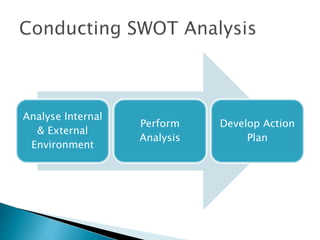
Analyse Internal
& External
Environment
Perform
Analysis
Develop Action
Plan
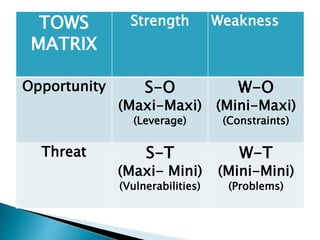
TOWS
MATRIX
Strength Weakness
Opportunity S-O
(Maxi-Maxi)
(Leverage)
W-O
(Mini-Maxi)
(Constraints)
Threat S-T
(Maxi- Mini)
(Vulnerabilities)
W-T
(Mini-Mini)
(Problems)
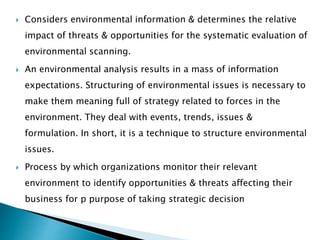
 Considers environmental information & determines the relative
impact of threats & opportunities for the systematic evaluation of
environmental scanning.
 An environmental analysis results in a mass of information
expectations. Structuring of environmental issues is necessary to
make them meaning full of strategy related to forces in the
environment. They deal with events, trends, issues &
formulation. In short, it is a technique to structure environmental
issues.
 Process by which organizations monitor their relevant
environment to identify opportunities & threats affecting their
business for p purpose of taking strategic decision
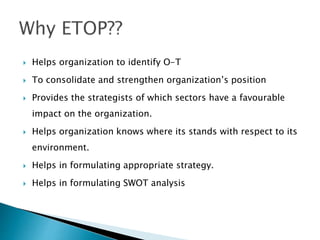
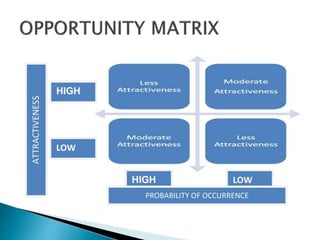
 Helps organization to identify O-T
 To consolidate and strengthen organization’s position
 Provides the strategists of which sectors have a favourable
impact on the organization.
 Helps organization knows where its stands with respect to its
environment.
 Helps in formulating appropriate strategy.
 Helps in formulating SWOT analysis
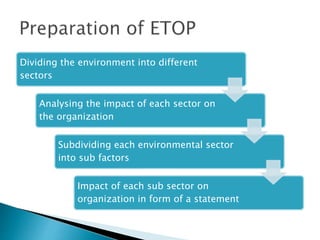
Dividing the environment into different
sectors
Analysing the impact of each sector on
the organization
Subdividing each environmental sector
into sub factors
Impact of each sub sector on
organization in form of a statement
The profile is a technique of environment
analysis was organizations make of profile of
their external environment. ETOP analysis
provides information about environment
threats & opportunities & their impact on
strategic opportunities for the company. The
profile contains mainly 3 issues:
Forecasting
 Predicting the future events
 Analysing their impact on present plans
business organizations analyse the
environment but applying various techniques
to forecast government is used to formulate
business plans & strategies.
Verbal Written Information
 Verbal information is collected but hearing & written
information is collected by reading articles, journals,
newspaper, newsletters etc.., common sources of information
are radio, television, workforce, outsiders.
 It informs changes in the environment & prepares business
organization to incorporate than in their business plans &
strategies.
Management Information System
 A formal method of making available to
management to management the accurate & timely
information necessary to facilitate the decision
making proceeds & enable the organization
planning, control & operational functions to be
carried out effectively.
 It helps in making decisions based on future
environment.
It presents the impact of each environmental
factor like economic, political & social on the
organization. The important factors are as
follows:
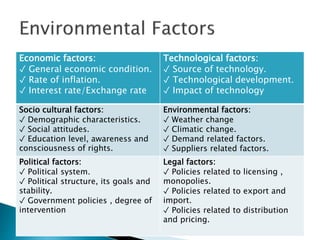
Economic factors:
✓ General economic condition.
✓ Rate of inflation.
✓ Interest rate/Exchange rate
Technological factors:
✓ Source of technology.
✓ Technological development.
✓ Impact of technology
Socio cultural factors:
✓ Demographic characteristics.
✓ Social attitudes.
✓ Education level, awareness and
consciousness of rights.
Environmental factors:
✓ Weather change
✓ Climatic change.
✓ Demand related factors.
✓ Suppliers related factors.
Political factors:
✓ Political system.
✓ Political structure, its goals and
stability.
✓ Government policies , degree of
intervention
Legal factors:
✓ Policies related to licensing ,
monopolies.
✓ Policies related to export and
import.
✓ Policies related to distribution
and pricing.
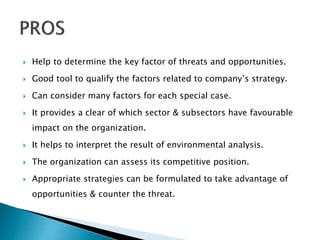
 Help to determine the key factor of threats and opportunities.
 Good tool to qualify the factors related to company’s strategy.
 Can consider many factors for each special case.
 It provides a clear of which sector & subsectors have favourable
impact on the organization.
 It helps to interpret the result of environmental analysis.
 The organization can assess its competitive position.
 Appropriate strategies can be formulated to take advantage of
opportunities & counter the threat.
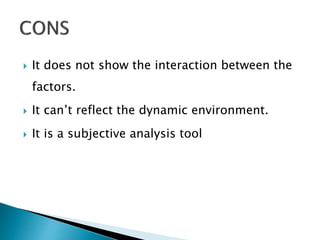
 It does not show the interaction between the
factors.
 It can’t reflect the dynamic environment.
 It is a subjective analysis tool

SWOT ANALYSIS.pptx on MBA first semister

  • 2.
     A techniquethat enables organisations or individual to move from everyday problems and traditional strategies to a fresh prospective.  SWOT analysis looks at your strengths and weaknesses, and the opportunities and threats your business faces. SWOT can help your company face its greatest challenges and find its most promising new markets.
  • 4.
     Characteristics ofthe business or individual that give it an advantage over others in the industry.  Positive tangible and intangible attributes, internal to an organization or individual.  Beneficial aspects of the organization or the capabilities of an organization, process capabilities, financial resources, products and services, customer goodwill and brand loyalty.  Examples - Abundant financial resources, Well-known brand name, Lower costs [raw materials or processes], Superior management talent, Better marketing skills, Good distribution skills, Committed employees.
  • 5.
     Characteristics thatplace the firm or individual at a disadvantage relative to others.  Detract the organization from its ability to attain the core goal and influence its growth.  Weaknesses are the factors which do not meet the standards we feel they should meet. However, weaknesses are controllable. They must be minimized and eliminated.  Examples - Limited financial resources, Very narrow product line, Limited distribution, Higher costs, Weak market image, Poor marketing skills, Limited management skills, Under-trained employees.
  • 6.
     External attractivefactors that represent reasons your business is likely to prosper.  Chances to make greater profits in the environment - External attractive factors that represent the reason for an organization to exist & develop.  Arise when an organization can take benefit of conditions in its environment to plan and execute strategies that enable it to become more profitable.  Organization should be careful and recognize the opportunities and grasp them whenever they arise.  Examples - Rapid market growth, Rival firms are complacent, Changing customer needs/tastes, New uses for product discovered, Economic boom, Government deregulation, Sales decline for a substitute product .
  • 7.
     External elementsin the environment that could cause trouble for the business - External factors, beyond an organization’s control.  Arise when conditions in external environment jeopardize the reliability and profitability of the organization’s business.  Examples - Entry of foreign competitors, Introduction of new substitute products, Product life cycle in decline, Changing customer needs/tastes, Rival firms adopt new strategies, Increased government regulation, Economic downturn
  • 8.
     To helpdecision makers share and compare ideas.  To bring a clearer common purpose and understanding of factors for success.  To organize the important factors linked to success and failure in the business world.  To help individual or organization to understand their strengths and weaknesses.  It promotes strategic thinking
  • 9.
  • 10.
  • 12.
     Considers environmentalinformation & determines the relative impact of threats & opportunities for the systematic evaluation of environmental scanning.  An environmental analysis results in a mass of information expectations. Structuring of environmental issues is necessary to make them meaning full of strategy related to forces in the environment. They deal with events, trends, issues & formulation. In short, it is a technique to structure environmental issues.  Process by which organizations monitor their relevant environment to identify opportunities & threats affecting their business for p purpose of taking strategic decision
  • 13.
     Helps organizationto identify O-T  To consolidate and strengthen organization’s position  Provides the strategists of which sectors have a favourable impact on the organization.  Helps organization knows where its stands with respect to its environment.  Helps in formulating appropriate strategy.  Helps in formulating SWOT analysis
  • 14.
    Dividing the environmentinto different sectors Analysing the impact of each sector on the organization Subdividing each environmental sector into sub factors Impact of each sub sector on organization in form of a statement
  • 15.
    The profile isa technique of environment analysis was organizations make of profile of their external environment. ETOP analysis provides information about environment threats & opportunities & their impact on strategic opportunities for the company. The profile contains mainly 3 issues:
  • 16.
    Forecasting  Predicting thefuture events  Analysing their impact on present plans business organizations analyse the environment but applying various techniques to forecast government is used to formulate business plans & strategies.
  • 17.
    Verbal Written Information Verbal information is collected but hearing & written information is collected by reading articles, journals, newspaper, newsletters etc.., common sources of information are radio, television, workforce, outsiders.  It informs changes in the environment & prepares business organization to incorporate than in their business plans & strategies.
  • 18.
    Management Information System A formal method of making available to management to management the accurate & timely information necessary to facilitate the decision making proceeds & enable the organization planning, control & operational functions to be carried out effectively.  It helps in making decisions based on future environment.
  • 19.
    It presents theimpact of each environmental factor like economic, political & social on the organization. The important factors are as follows:
  • 20.
    Economic factors: ✓ Generaleconomic condition. ✓ Rate of inflation. ✓ Interest rate/Exchange rate Technological factors: ✓ Source of technology. ✓ Technological development. ✓ Impact of technology Socio cultural factors: ✓ Demographic characteristics. ✓ Social attitudes. ✓ Education level, awareness and consciousness of rights. Environmental factors: ✓ Weather change ✓ Climatic change. ✓ Demand related factors. ✓ Suppliers related factors. Political factors: ✓ Political system. ✓ Political structure, its goals and stability. ✓ Government policies , degree of intervention Legal factors: ✓ Policies related to licensing , monopolies. ✓ Policies related to export and import. ✓ Policies related to distribution and pricing.
  • 23.
     Help todetermine the key factor of threats and opportunities.  Good tool to qualify the factors related to company’s strategy.  Can consider many factors for each special case.  It provides a clear of which sector & subsectors have favourable impact on the organization.  It helps to interpret the result of environmental analysis.  The organization can assess its competitive position.  Appropriate strategies can be formulated to take advantage of opportunities & counter the threat.
  • 24.
     It doesnot show the interaction between the factors.  It can’t reflect the dynamic environment.  It is a subjective analysis tool