Bermuda’s Economy and
Business Outlook
Chamber of Commerce
December 2011
Chamber
The Bermuda
Of Commerce
Agenda
 A little history: the Chamber’s 2010 findings
 Current developments and emerging issues
 Solutions
Bermuda’s Economy
 Relies on foreign exchange revenue
 International Business and Tourism are the
main sources of this revenue
 Local business depends on these sectors to
ensure our quality of life
State of the Economy
 In decline since 2008
 Our two economic pillars are shrinking
 Local businesses face uncertainty in
planning
 Government debt levels prevent it from
“jump-starting” or stimulating recovery
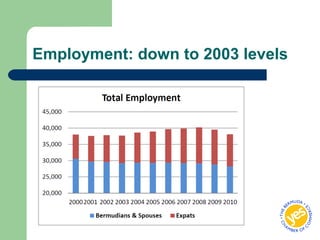
Employment: down to 2003 levels
©2011 Bermuda Realty Company Limited, All Rights Reserved.
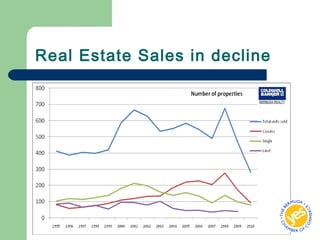
Real Estate Sales in decline
©2011 Bermuda Realty Company Limited, All Rights Reserved.
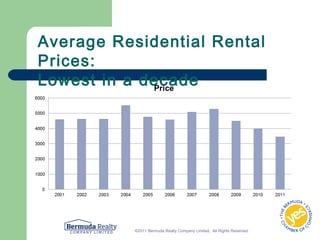
Average Residential Rental
Prices:
Lowest in a decade
Commercial Real Estate Market:
Squeezed
 Inventory at a historic high
 Four years supply of space available/under
construction at historic absorption rates
 Prices for office space down about 15%
 Landlords offering incentives to fill newly-built
space
Source: Bermuda Realty Company Limited
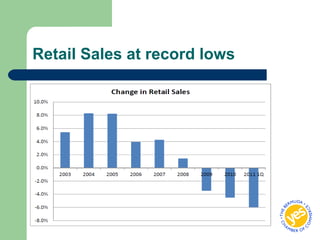
Retail Sales at record lows
Last year’s action points: Goals
 Reduce Government debt
 Regain international competitiveness
 Create new businesses (international and
domestic)
Last year’s action points:
Suggestions to Government
 Remove term limits for international and local
companies
 Create a Tourism Authority
 Privatize some Government services
 Implement existing legislation to make
Government services more efficient
Action point results
 Term limits only relaxed and for IB only
 Tourism Authority – maybe in 2012
 No privatization of Government services
 Tourism arrivals rose but IB shrank
 Government is now creating “task forces” to
study business ideas
Current developments and
emerging issues
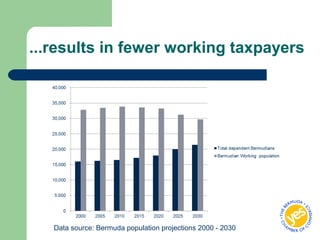
 Bermudian population is rapidly ageing
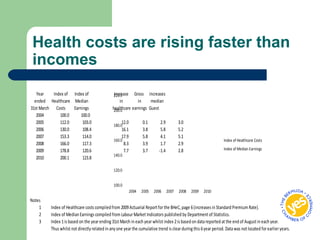
 Health costs rising faster than incomes
 Decline in the number of expatriate workers
Rapidly ageing population…
Data source: Bermuda population projections 2000 - 2030
...results in fewer working taxpayers
Data source: Bermuda population projections 2000 - 2030
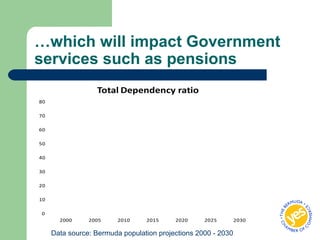
…which will impact Government
services such as pensions
0
10
20
30
40
50
60
70
80
2000 2005 2010 2015 2020 2025 2030
Total Dependency ratio
Data source: Bermuda population projections 2000 - 2030
Health costs are rising faster than
incomes
Year Index of Index of Increase Gross increases
ended Healthcare Median in in median
31st March Costs Earnings healthcare earnings Guest
2004 100.0 100.0
2005 112.0 103.0 12.0 0.1 2.9 3.0
2006 130.0 108.4 16.1 3.8 5.8 5.2
2007 153.3 114.0 17.9 5.8 4.1 5.1
2008 166.0 117.3 8.3 3.9 1.7 2.9
2009 178.8 120.6 7.7 3.7 -1.4 2.8
2010 200.1 123.8
Notes
1 Index of Healthcare costs compiled from 2009Actuarial Report forthe BHeC, page 6(increases in Standard Premium Rate).
2 Index of MedianEarnings compiled from LabourMarket Indicators published by Department of Statistics.
3 Index 1is based on the yearending 31st March in each yearwhilst index 2is based on datareported at the end of Augustin each year.
Thus whilst not directly related in any one yearthe cumulative trend is clearduringthis 6yearperiod. Datawas notlocated forearlieryears.
100.0
120.0
140.0
160.0
180.0
200.0
220.0
2004 2005 2006 2007 2008 2009 2010
Index of Healthcare Costs
Index of Median Earnings
The number of expatriate workers
is declining
 August 2008: 10,367 expatriate workers
 August 2010: 9,065 expatriate workers
o A loss of 1,302 people in two years (12.6%)
 Since that time the pace has increased
o More losses in IB
o Unemployed Bermudians led to some job categories being closed or
restricted for foreigners
Work permit losses impact the
economy
 Work permit holders create jobs
 From 1990 – 2008, one extra job was created for
every 5 work permits issued
 This correlation is now working against us
 Every 500 work permits that lapse or are
cancelled = 100 additional jobs lost
Expatriate workers are younger
than Bermudians….
 Average age of an expatriate worker: 38.7 years
 Average age of a Bermudian worker: 46.0 years
(Source: Government of Bermuda August 2010 Employment Survey)
…and use fewer social services
 Loss of younger workers, who use less
health care, increases the per head costs to
the rest of us
 Rapidly ageing local population accentuates
the problem
Impact on Government finances (1)
 Government is borrowing to fund daily
expenses as well as capital projects
 Shrinking economy reduces revenues as the
tax base shrinks (fewer taxpayers)
 Unemployment and reduced incomes leads
to higher demands for Government social
assistance
Impact on Government finances (2)
 Government faces increased debt service
costs as national debt climbs (now $1,230M)
 Government faces increased employment
costs as cost of health care and pensions
climbs
 Without growth in the private sector there is
no escape from this
Summary
 We are in a difficult position
 The choices that we make now will have a
material impact on the living standards of our
children
 We need to move with speed but we must
ensure we include all perspectives and reach
a consensus that works for Bermuda
Are we alone? Views from outside
“ ….. voters expressed discontent over the rising cost of
living and competition with foreigners for jobs and
housing…….While we have always put Singaporeans
first, let us not turn negative on foreigners. Singapore has
prospered because we have been open to the world and
alive to economic competition and change.
This is how we have attracted investment, created jobs for
ourselves and made Singapore a vibrant city.”
Singapore Prime Minister Lee Hsieng Loong 8th
August 2011.
Are we alone? Views from outside
“ The wealth of nations comes not from what we
spend but what we sow: what we set aside to be
invested in productive capacity.
If spending created wealth, Greece would be rich.
Neither consumers nor governments can spend
their way to prosperity.”
Caroline Baum, Bloomberg columnist (December 2011)
Before we start to chart our way
forward we should review our past.
“We can’t solve problems by using the
same kind of thinking we used when we
created them.”
Albert Einstein
Before we start to chart our way
forward we should review our past
“In the extremely competitive global environment
in which we now live, we must constantly remind
ourselves, as a bank and as a service
community, the only thing we have to sell is
ourselves.
Success is solely dependent on providing
excellent service at reasonable prices in a
friendly way.”
Letter to shareholders 15th
April 1988, the Bank of Bermuda Limited.
How do we move forward?
 Policy choices
Policy choices (1)
 Much of our domestic economic and business
architecture dates from the 1950’s and 1960’s
 The Companies Act 1969 defined exempted
companies and introduced 60/40
 The Bermuda dollar was created by the Bermuda
Monetary Authority Act 1969
 The Immigration and Protection Act (1956)
controlled foreign labor and land sales
Policy choices (2)
 Since that time we have mainly built upon,
updated and refined those fundamental policies
 Much of the subsequent policy direction has been
to deal with the issues created by economic
growth
 In other words: we have mainly focused on
slowing growth
Policy choices (3)
 We now need to carefully examine these policies
 We should abandon those that impede progress
 Those that promote progress
o Should become priorities
o Should be made relevant for today’s situation
2012 Agenda items
 Infrastructure projects
 Gambling and other tourism ideas
 Real estate ownership rules
 60 /40 ownership rule
 Privatization of some Government functions
 New jobs
Infrastructure
 Bermuda needs appropriate infrastructure in
order to compete internationally
 We need a 20-year strategy
 We must pay for it – no one from overseas will,
as ostensibly we are richer than them
 Could be funded by domestic bond market
Gambling and Tourism
 Those who support gambling need to establish
what it would look like:
o How many casinos; who owns them; who are the
gamblers; social support for addicts etc.
 Those who oppose need to articulate their vision
of how the tourism industry is to prosper in 2015
Real estate
 We currently have a myriad of rules for different
people; paying different taxes and allowed to
buy different assets
 We have 1,500 empty residential units
 We have a large volume of debt and a dwindling
supply of income
 We need a strategy that works for all of
Bermuda
60 / 40 ownership rule
 Relaxing the rule could supply new capital for
local business
 Government needs input from business owners
before a meaningful discussion can take place
 The Chamber includes many business owners
 You need to make your views known
Privatization
 Post Office revenue in current year is
$5.4m; costs are $15.0m
 Ferry service revenue in current year is
$1.3m; costs are $7.6m
 Bus service revenue in current year is
$7.9m; costs are $18.4m
 In each case there are substantial employee
benefit costs not included in Budget numbers
New Jobs
 Bermudian unemployment now at 6%
 Lower tax revenues mean Government
cannot support 4,000 civil servants
 Need to attract 4,000 new work permit
holders in order to pay National Debt; fund
Government; meet pension and health costs
New Jobs (2)
 Current private sector workforce: 30,000
 Perhaps as many as 10,000 new jobs needed in
next five years
 This is the size of the task facing the private
sector
Conclusion
 Private sector must provide the solutions
 The Chamber represents your interests to
Government
 We have divisions representing all areas of
the Bermuda economy
 Give us your ideas
 Get involved and create the future

Economics Presentation Dec 2011 FINAL

  • 1.
    Bermuda’s Economy and BusinessOutlook Chamber of Commerce December 2011 Chamber The Bermuda Of Commerce
  • 2.
    Agenda  A littlehistory: the Chamber’s 2010 findings  Current developments and emerging issues  Solutions
  • 3.
    Bermuda’s Economy  Relieson foreign exchange revenue  International Business and Tourism are the main sources of this revenue  Local business depends on these sectors to ensure our quality of life
  • 4.
    State of theEconomy  In decline since 2008  Our two economic pillars are shrinking  Local businesses face uncertainty in planning  Government debt levels prevent it from “jump-starting” or stimulating recovery
  • 5.
  • 6.
    ©2011 Bermuda RealtyCompany Limited, All Rights Reserved. Real Estate Sales in decline
  • 7.
    ©2011 Bermuda RealtyCompany Limited, All Rights Reserved. Average Residential Rental Prices: Lowest in a decade
  • 8.
    Commercial Real EstateMarket: Squeezed  Inventory at a historic high  Four years supply of space available/under construction at historic absorption rates  Prices for office space down about 15%  Landlords offering incentives to fill newly-built space Source: Bermuda Realty Company Limited
  • 9.
    Retail Sales atrecord lows
  • 10.
    Last year’s actionpoints: Goals  Reduce Government debt  Regain international competitiveness  Create new businesses (international and domestic)
  • 11.
    Last year’s actionpoints: Suggestions to Government  Remove term limits for international and local companies  Create a Tourism Authority  Privatize some Government services  Implement existing legislation to make Government services more efficient
  • 12.
    Action point results Term limits only relaxed and for IB only  Tourism Authority – maybe in 2012  No privatization of Government services  Tourism arrivals rose but IB shrank  Government is now creating “task forces” to study business ideas
  • 13.
    Current developments and emergingissues  Bermudian population is rapidly ageing  Health costs rising faster than incomes  Decline in the number of expatriate workers
  • 14.
    Rapidly ageing population… Datasource: Bermuda population projections 2000 - 2030
  • 15.
    ...results in fewerworking taxpayers Data source: Bermuda population projections 2000 - 2030
  • 16.
    …which will impactGovernment services such as pensions 0 10 20 30 40 50 60 70 80 2000 2005 2010 2015 2020 2025 2030 Total Dependency ratio Data source: Bermuda population projections 2000 - 2030
  • 17.
    Health costs arerising faster than incomes Year Index of Index of Increase Gross increases ended Healthcare Median in in median 31st March Costs Earnings healthcare earnings Guest 2004 100.0 100.0 2005 112.0 103.0 12.0 0.1 2.9 3.0 2006 130.0 108.4 16.1 3.8 5.8 5.2 2007 153.3 114.0 17.9 5.8 4.1 5.1 2008 166.0 117.3 8.3 3.9 1.7 2.9 2009 178.8 120.6 7.7 3.7 -1.4 2.8 2010 200.1 123.8 Notes 1 Index of Healthcare costs compiled from 2009Actuarial Report forthe BHeC, page 6(increases in Standard Premium Rate). 2 Index of MedianEarnings compiled from LabourMarket Indicators published by Department of Statistics. 3 Index 1is based on the yearending 31st March in each yearwhilst index 2is based on datareported at the end of Augustin each year. Thus whilst not directly related in any one yearthe cumulative trend is clearduringthis 6yearperiod. Datawas notlocated forearlieryears. 100.0 120.0 140.0 160.0 180.0 200.0 220.0 2004 2005 2006 2007 2008 2009 2010 Index of Healthcare Costs Index of Median Earnings
  • 18.
    The number ofexpatriate workers is declining  August 2008: 10,367 expatriate workers  August 2010: 9,065 expatriate workers o A loss of 1,302 people in two years (12.6%)  Since that time the pace has increased o More losses in IB o Unemployed Bermudians led to some job categories being closed or restricted for foreigners
  • 19.
    Work permit lossesimpact the economy  Work permit holders create jobs  From 1990 – 2008, one extra job was created for every 5 work permits issued  This correlation is now working against us  Every 500 work permits that lapse or are cancelled = 100 additional jobs lost
  • 20.
    Expatriate workers areyounger than Bermudians….  Average age of an expatriate worker: 38.7 years  Average age of a Bermudian worker: 46.0 years (Source: Government of Bermuda August 2010 Employment Survey)
  • 21.
    …and use fewersocial services  Loss of younger workers, who use less health care, increases the per head costs to the rest of us  Rapidly ageing local population accentuates the problem
  • 22.
    Impact on Governmentfinances (1)  Government is borrowing to fund daily expenses as well as capital projects  Shrinking economy reduces revenues as the tax base shrinks (fewer taxpayers)  Unemployment and reduced incomes leads to higher demands for Government social assistance
  • 23.
    Impact on Governmentfinances (2)  Government faces increased debt service costs as national debt climbs (now $1,230M)  Government faces increased employment costs as cost of health care and pensions climbs  Without growth in the private sector there is no escape from this
  • 24.
    Summary  We arein a difficult position  The choices that we make now will have a material impact on the living standards of our children  We need to move with speed but we must ensure we include all perspectives and reach a consensus that works for Bermuda
  • 25.
    Are we alone?Views from outside “ ….. voters expressed discontent over the rising cost of living and competition with foreigners for jobs and housing…….While we have always put Singaporeans first, let us not turn negative on foreigners. Singapore has prospered because we have been open to the world and alive to economic competition and change. This is how we have attracted investment, created jobs for ourselves and made Singapore a vibrant city.” Singapore Prime Minister Lee Hsieng Loong 8th August 2011.
  • 26.
    Are we alone?Views from outside “ The wealth of nations comes not from what we spend but what we sow: what we set aside to be invested in productive capacity. If spending created wealth, Greece would be rich. Neither consumers nor governments can spend their way to prosperity.” Caroline Baum, Bloomberg columnist (December 2011)
  • 27.
    Before we startto chart our way forward we should review our past. “We can’t solve problems by using the same kind of thinking we used when we created them.” Albert Einstein
  • 28.
    Before we startto chart our way forward we should review our past “In the extremely competitive global environment in which we now live, we must constantly remind ourselves, as a bank and as a service community, the only thing we have to sell is ourselves. Success is solely dependent on providing excellent service at reasonable prices in a friendly way.” Letter to shareholders 15th April 1988, the Bank of Bermuda Limited.
  • 29.
    How do wemove forward?  Policy choices
  • 30.
    Policy choices (1) Much of our domestic economic and business architecture dates from the 1950’s and 1960’s  The Companies Act 1969 defined exempted companies and introduced 60/40  The Bermuda dollar was created by the Bermuda Monetary Authority Act 1969  The Immigration and Protection Act (1956) controlled foreign labor and land sales
  • 31.
    Policy choices (2) Since that time we have mainly built upon, updated and refined those fundamental policies  Much of the subsequent policy direction has been to deal with the issues created by economic growth  In other words: we have mainly focused on slowing growth
  • 32.
    Policy choices (3) We now need to carefully examine these policies  We should abandon those that impede progress  Those that promote progress o Should become priorities o Should be made relevant for today’s situation
  • 33.
    2012 Agenda items Infrastructure projects  Gambling and other tourism ideas  Real estate ownership rules  60 /40 ownership rule  Privatization of some Government functions  New jobs
  • 34.
    Infrastructure  Bermuda needsappropriate infrastructure in order to compete internationally  We need a 20-year strategy  We must pay for it – no one from overseas will, as ostensibly we are richer than them  Could be funded by domestic bond market
  • 35.
    Gambling and Tourism Those who support gambling need to establish what it would look like: o How many casinos; who owns them; who are the gamblers; social support for addicts etc.  Those who oppose need to articulate their vision of how the tourism industry is to prosper in 2015
  • 36.
    Real estate  Wecurrently have a myriad of rules for different people; paying different taxes and allowed to buy different assets  We have 1,500 empty residential units  We have a large volume of debt and a dwindling supply of income  We need a strategy that works for all of Bermuda
  • 37.
    60 / 40ownership rule  Relaxing the rule could supply new capital for local business  Government needs input from business owners before a meaningful discussion can take place  The Chamber includes many business owners  You need to make your views known
  • 38.
    Privatization  Post Officerevenue in current year is $5.4m; costs are $15.0m  Ferry service revenue in current year is $1.3m; costs are $7.6m  Bus service revenue in current year is $7.9m; costs are $18.4m  In each case there are substantial employee benefit costs not included in Budget numbers
  • 39.
    New Jobs  Bermudianunemployment now at 6%  Lower tax revenues mean Government cannot support 4,000 civil servants  Need to attract 4,000 new work permit holders in order to pay National Debt; fund Government; meet pension and health costs
  • 40.
    New Jobs (2) Current private sector workforce: 30,000  Perhaps as many as 10,000 new jobs needed in next five years  This is the size of the task facing the private sector
  • 41.
    Conclusion  Private sectormust provide the solutions  The Chamber represents your interests to Government  We have divisions representing all areas of the Bermuda economy  Give us your ideas  Get involved and create the future

Editor's Notes

  • #7 Peak in 2008 included 35 Loughland units and 44 fractional units
  • #8 There is no central reporting for rentals islandwide. This is CBBR data which would be representative of what conditions mirror on the island.