International Research Journal of Engineering and Technology (IRJET) e-ISSN: 2395 -0056
Volume: 04 Issue: 06 | June-2017 www.irjet.net p-ISSN: 2395-0072
© 2017, IRJET | Impact Factor value: 5.181 | ISO 9001:2008 Certified Journal | Page 123
Switched DC Sources Based Novel Multilevel Inverter
Tekale Anil A.1, Ghule Puja R.2, Thombare Shubhangi s.3, Agale Priyanka B.4
1Asst. Professor, Electrical Engg Dept, HSBPVT’s COE. Kashti, Maharashtra, India.
2,3,4Student, Electrical Engg Dept, HSBPVT’s COE. Kashti, Maharashtra, India.
---------------------------------------------------------------------***---------------------------------------------------------------------
Abstract – This paper we are represent the five-level
inverter, it reduces the no. of switches and gives the large
no. of output levels. It comprises two input dc sources
connected in opposite polarities with one another through
power switches. Each input dc level presents in the stepped
load voltage either separately or in additive combinations
with other input levels.
This approach results in reduced number of power switches
as compared to existing topologies. The operating principle
of the proposed topology is demonstrated with the help of a
single –phase five-level inverter. An exhaustive comparison
of the proposed topology is made against the existing
cascaded H-bridge topology.
Key Words: Existing topologies, five-level inverter, reduced
component count, pulse width modulation (PWM), total
harmonic distortion (THD).
1. INTRODUCTION
In the last few decades, five-level voltage-source
inverters have come forth as a viable solution for high-
power dc-to-ac conversion applications [1]. A five-level
inverter is a linkage structure of multiple input dc levels
(obtained from dc sources and/or capacitors) and power
semiconductor devices to synthesize a staircase
waveform. Voltage stresses practiced by the power
switches are lower as compared to the overall operating
voltage level [2]. In addition, the multilevel waveform has
improved harmonic profile as compared to a two-level
waveform obtained from ordinary inverters. Other
benefits of MLIs are reduced dv/dt stress on the load and
possibility of fault-tolerant operation [3]. Researchers are
also exploring approaches to employ MLIs for low-power
applications [4]. The nature of the multilevel waveform is
enhanced by increasing the number of levels. However, in
existing topology used large number of power switches
and complex gate drive circuit. This increases complexity
of system and cost and reduces the reliability and
efficiency of system. For a efficient system requires reduce
the number of switches and gate drive circuit [5].
However, there is a expressive increase in the number of
power switches, the number of switches conducting
concomitantly, and the overall cost of the system with the
increase in the number of output levels. Researchers,
therefore, proceed to focus on reducing the component
count in multilevel topologies through several approaches.
In this paper, a new topology is proposed in which
alternate dc sources are linked in adverse polarities via
power switches. This approach significantly lessens the
number of power switches needed as compared to the
existing topologies. Furthermore, for regular input dc
sources, the proposed topology presents similarity with
the CHB topology in two forms: 1) it’s necessities multiple
isolated input dc voltages; and 2) input dc voltage levels
can be concrete into complete additional values. Thus, the
topology can be used as a utility interface for renewable
energy systems where a more number of isolated dc
sources are available [2], [7], [9]. It can be used in
medium-voltage drive applications where a phase-shifting
transformer with multiple secondary windings is generally
applied (primarily for the reduction of line current
distortion), thus providing isolated dc sources [6]. The
applications of the proposed topology for battery-powered
(such as electric vehicles and submarine propulsion). This
paper is arranged as follows. Section 2 introduces the
generalized structure of the proposed topology with
mathematical formulations. The operating principle of the
topology is also defined in this section with the help of a
five-level single phase inverter. Terms for the calculation
of losses are present in Section 3. A comparison of the
proposed topology with existing topologies is presented in
Section 4. In Section 5 conclusions are summarized.
2. PROPOSED MULTILEVEL TOPOLOGY
In that section, we are introduced the structure of
proposed topology, and its operating principle is
illustrated with the help of a single-phase five-level
inverter. Terms’ for output voltage, source currents,
voltage stresses, etc., are also introduced.
2.1 Generalized Structure
Fig.1 shows that a generalized single phase structure
of five-level inverter. its having a n number of DC sources .
linkage structure of sources as like a positive terminal of
one DC source connected to negative terminal of another
DC source , in this way we are linkage the n number of DC
source .in fig. 1 shows input sources as like Ej ( where j=1 to
n) . Source current indicated of each source as like ij( t) .
We are uses power switches in that as like MOSFET,
IGBT.AND ANTIPARALLEL DIODES are used across with
power switches. In fig.1 we shows IGBT switches with an
anti-parallel diodes and complementary pairs are
designated as like as (Tj ,Tj
’) ( where, j=1 to n+1). In fig. 1
indicated nodal voltage and current are VL (t) and iL (t)
respectively.
International Research Journal of Engineering and Technology (IRJET) e-ISSN: 2395 -0056
Volume: 04 Issue: 06 | June-2017 www.irjet.net p-ISSN: 2395-0072
© 2017, IRJET | Impact Factor value: 5.181 | ISO 9001:2008 Certified Journal | Page 124
Fig -1: Generalized single-phase construction of the
proposed topology.
2.2 Working Principle
The working principle of the proposed topology is
defined with the help of a single-phase inverter with two
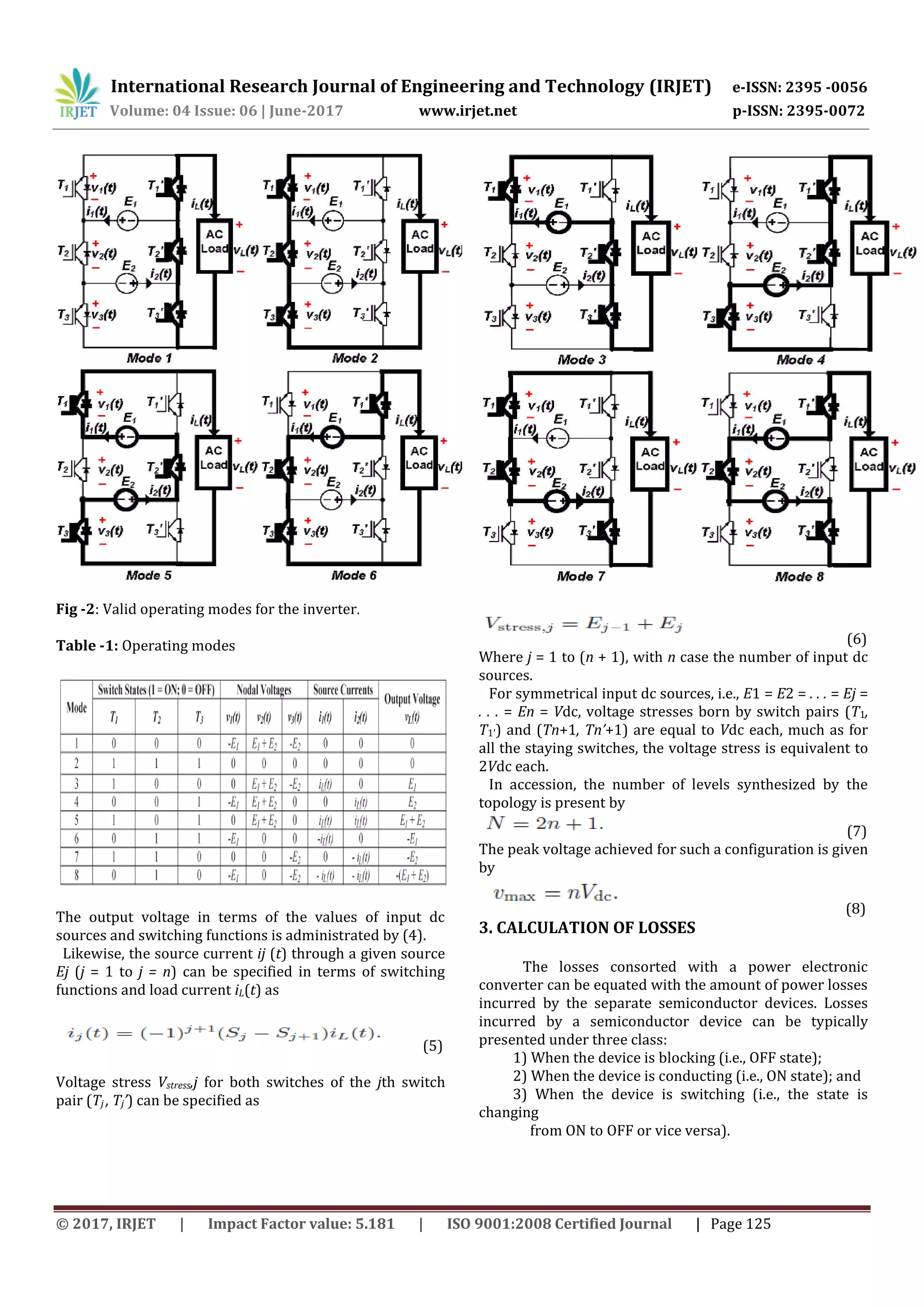
input dc sources E1 and E2, as shown in Fig. 2. It has three
couples of active switches (Tj, Tj’) (j = 1, 2, 3). Since the
elements of these couples are counterparty and it’s having
eight valid operating modes. These modes are shown in
Fig. 3 and are briefed in Table 1 along with nodal voltages
and source currents. Using these operating modes shown
in Fig. 3, the load is supplied with five levels, viz., ±Vdc,
±2Vdc, and zero for E1 = E2 = Vdc. With such a regular
source configuration, modes 3 and 4 become excessive for
output level +Vdc, while modes 6 and 7 become redundant
for output level −Vdc. It is main to note here that, for
whole positive voltage levels and one “zero” level (modes
1, 3, 4, and 5), switch T2’ always conducts, while for whole
negative voltage levels and another “zero” level (modes 2,
6, 7, and 8), switch T2 always conducts. Accordingly, it is
possible to operate these two switches at the fundamental
frequency to acquire five output levels. To do so, modes 1,
3 (or 4), and 5 need to be applied for the synthesis of
positive levels (including a “zero” level), and modes 2, 6
(or 7), and 8 need to be applied for the synthesis of
negative voltage levels (contains a “zero” level). It is also
important to declare here that dc source voltages have
been assumed to be equal in this work. In usage, they
might differ (e.g., due to different states of charge of
batteries or due to shading of some cells if the sources are
becoming from a photovoltaic (PV) system). To account
for
Fig -2: Single-phase inverter based on the proposed
topology with couple input sources.
this deviation, both hardware-based solutions (e.g., using
separate dc–dc converters [8]) and control-algorithm-
based solutions (e.g., battery adjusting methodology [19])
can be appliance.
2.3 Mathematical Formulations
According to Fig. 1, switches Tj and Tj’ (j = 1 to n + 1)
operate correspondingly. Let Sj be a switching function
complementarily to switch Tj presented as
(1)
Then, the load terminal voltage vl (t) can be specified in
terms of nodal voltages vj (t) as
(2)
Where
(3)
Using j = 1 to j = n + 1 & E0 = En+1 = 0 as there are no such
sources.
Using (2) and (3)
(4)
International Research Journal of Engineering and Technology (IRJET) e-ISSN: 2395 -0056
Volume: 04 Issue: 06 | June-2017 www.irjet.net p-ISSN: 2395-0072
© 2017, IRJET | Impact Factor value: 5.181 | ISO 9001:2008 Certified Journal | Page 125
Fig -2: Valid operating modes for the inverter.
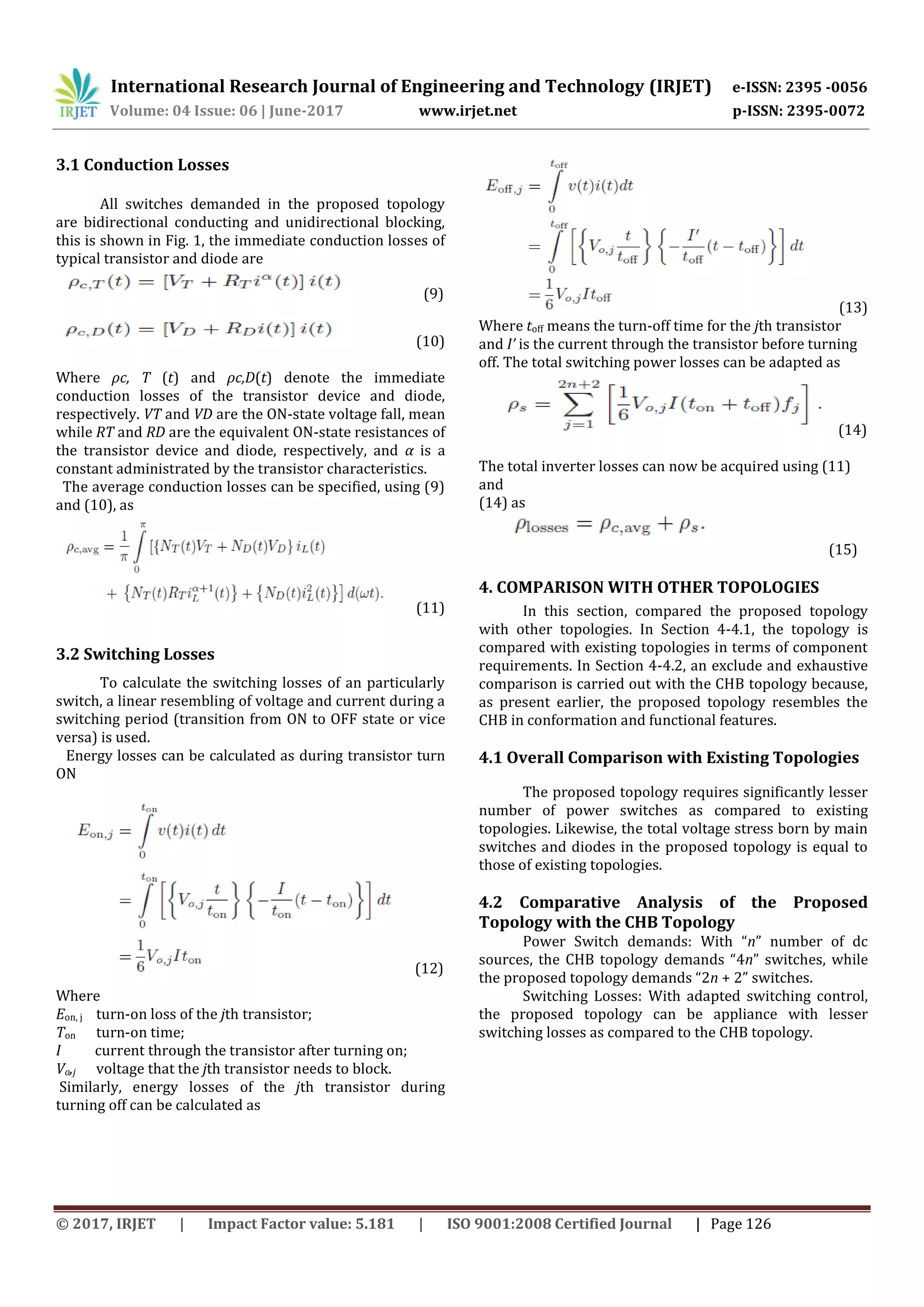
Table -1: Operating modes
The output voltage in terms of the values of input dc
sources and switching functions is administrated by (4).
Likewise, the source current ij (t) through a given source
Ej (j = 1 to j = n) can be specified in terms of switching
functions and load current iL(t) as
(5)
Voltage stress Vstress,j for both switches of the jth switch
pair (Tj , Tj’) can be specified as
(6)
Where j = 1 to (n + 1), with n case the number of input dc
sources.
For symmetrical input dc sources, i.e., E1 = E2 = . . . = Ej =
. . . = En = Vdc, voltage stresses born by switch pairs (T1,
T1’) and (Tn+1, Tn’+1) are equal to Vdc each, much as for
all the staying switches, the voltage stress is equivalent to
2Vdc each.
In accession, the number of levels synthesized by the
topology is present by
(7)
The peak voltage achieved for such a configuration is given
by
(8)
3. CALCULATION OF LOSSES
The losses consorted with a power electronic
converter can be equated with the amount of power losses
incurred by the separate semiconductor devices. Losses
incurred by a semiconductor device can be typically
presented under three class:
1) When the device is blocking (i.e., OFF state);
2) When the device is conducting (i.e., ON state); and
3) When the device is switching (i.e., the state is
changing
from ON to OFF or vice versa).
International Research Journal of Engineering and Technology (IRJET) e-ISSN: 2395 -0056
Volume: 04 Issue: 06 | June-2017 www.irjet.net p-ISSN: 2395-0072
© 2017, IRJET | Impact Factor value: 5.181 | ISO 9001:2008 Certified Journal | Page 126
3.1 Conduction Losses
All switches demanded in the proposed topology
are bidirectional conducting and unidirectional blocking,
this is shown in Fig. 1, the immediate conduction losses of
typical transistor and diode are
(9)
(10)
Where ρc, T (t) and ρc,D(t) denote the immediate
conduction losses of the transistor device and diode,
respectively. VT and VD are the ON-state voltage fall, mean
while RT and RD are the equivalent ON-state resistances of
the transistor device and diode, respectively, and α is a
constant administrated by the transistor characteristics.
The average conduction losses can be specified, using (9)
and (10), as
(11)
3.2 Switching Losses
To calculate the switching losses of an particularly
switch, a linear resembling of voltage and current during a
switching period (transition from ON to OFF state or vice
versa) is used.
Energy losses can be calculated as during transistor turn
ON
(12)
Where
Eon, j turn-on loss of the jth transistor;
Ton turn-on time;
I current through the transistor after turning on;
Vo,j voltage that the jth transistor needs to block.
Similarly, energy losses of the jth transistor during
turning off can be calculated as
(13)
Where toff means the turn-off time for the jth transistor
and I’ is the current through the transistor before turning
off. The total switching power losses can be adapted as
(14)
The total inverter losses can now be acquired using (11)
and
(14) as
(15)
4. COMPARISON WITH OTHER TOPOLOGIES
In this section, compared the proposed topology
with other topologies. In Section 4-4.1, the topology is
compared with existing topologies in terms of component
requirements. In Section 4-4.2, an exclude and exhaustive
comparison is carried out with the CHB topology because,
as present earlier, the proposed topology resembles the
CHB in conformation and functional features.
4.1 Overall Comparison with Existing Topologies
The proposed topology requires significantly lesser
number of power switches as compared to existing
topologies. Likewise, the total voltage stress born by main
switches and diodes in the proposed topology is equal to
those of existing topologies.
4.2 Comparative Analysis of the Proposed
Topology with the CHB Topology
Power Switch demands: With “n” number of dc
sources, the CHB topology demands “4n” switches, while
the proposed topology demands “2n + 2” switches.
Switching Losses: With adapted switching control,
the proposed topology can be appliance with lesser
switching losses as compared to the CHB topology.
International Research Journal of Engineering and Technology (IRJET) e-ISSN: 2395 -0056
Volume: 04 Issue: 06 | June-2017 www.irjet.net p-ISSN: 2395-0072
© 2017, IRJET | Impact Factor value: 5.181 | ISO 9001:2008 Certified Journal | Page 127
Table -2: Comparison between Existing Topology with
Proposed Topology
5. CONCLUSION
A Five-Level inverter are gaining attention, exertion
are being directed toward attenuating the device count for
increased number of output levels. A novel topology for
Five-Level inverter has been proposed in this paper to
attenuate the device count. The operating principle of the
proposed topology has been illustrated and mathematical
formulations suiting to output voltage, source currents,
voltage stresses on switches, and power losses have been
eliminate. Comparisons of the proposed topology with
existing topologies acknowledge that the proposed
topology significantly reduces the number of power
switches and associated gate driver circuits.
REFERENCES
[1] S. Kouro, M. Malinowski, K. Gopakumar, J. Pou, L.
Franquelo, B. Wu, J. Rodriguez, M. Perez, and Leon, “Recent
advances and industrial applications of multilevel
converters,” IEEE Trans. Ind. Electron., vol. 57, no. 8, pp.
2553–2580, Aug. 2010.
[2] G. Buticchi, E. Lorenzani, and Franceschini, “A five-level
single-phase grid-connected converter for renewable
distributed systems,” IEEE Trans. Ind. Electron., vol. 60,
no. 3, pp. 906–918, Mar. 2013.
[3] J. Rodriguez, J. Lai, and F. ZhengPeng, “Multilevel
inverters: A survey of topologies, controls, applications,”
IEEE Trans. Ind. Electron., vol. 49, no. 4, pp. 724–738, Aug.
2002.
[4] S. De, D. Banerjee, K. Siva Kumar, K. Gopakumar, R.
Ramchand, and Patel, “Multilevel inverters for low-power
application,” IET Power Electronics, vol. 4, no. 4, pp. 384–
392, Apr. 2011.
[5] M. Malinowski, K. Gopakumar, J. Rodriguez, “A survey
on cascaded multilevel inverters,” IEEE Trans. Ind.
Electron., vol. 57, no. 7, pp. 2197–2206, Jul. 2010.
[6] J. Rodriguez, S. Bernet, J. O. Pontt, and S. Kouro,
“Multilevel voltage-source-converter topologies for
industrial medium-voltage drives,” IEEE Trans. Ind.
Electron., vol. 54, no. 6, pp. 2930–2945, Dec. 2007.
[7] L. M. Tolbert and F. Peng, “Multilevel converters as a
utility interface for renewable energy systems,” in Proc.
IEEE Power Eng. Soc. Summer Meeting, 2000, vol. 2, pp.
1271–1274.
[8] J. Ebrahimi, and G. B. Gharehpetian, “A new multilevel
converter topology with reduced number of power
electronic components,” IEEE Trans. Ind. Electron., vol. 59,
no. 2, pp. 655–667, Feb. 2012.
[9] Y. Hinago , “A switched-capacitor inverter using series/
parallel conversion with inductive load,” IEEE Trans. Ind.
Electron., vol. 59, no. 2, pp. 878–887, Feb. 2012.

Switched DC Sources Based Novel Multilevel Inverter

  • 1.
    International Research Journalof Engineering and Technology (IRJET) e-ISSN: 2395 -0056 Volume: 04 Issue: 06 | June-2017 www.irjet.net p-ISSN: 2395-0072 © 2017, IRJET | Impact Factor value: 5.181 | ISO 9001:2008 Certified Journal | Page 123 Switched DC Sources Based Novel Multilevel Inverter Tekale Anil A.1, Ghule Puja R.2, Thombare Shubhangi s.3, Agale Priyanka B.4 1Asst. Professor, Electrical Engg Dept, HSBPVT’s COE. Kashti, Maharashtra, India. 2,3,4Student, Electrical Engg Dept, HSBPVT’s COE. Kashti, Maharashtra, India. ---------------------------------------------------------------------***--------------------------------------------------------------------- Abstract – This paper we are represent the five-level inverter, it reduces the no. of switches and gives the large no. of output levels. It comprises two input dc sources connected in opposite polarities with one another through power switches. Each input dc level presents in the stepped load voltage either separately or in additive combinations with other input levels. This approach results in reduced number of power switches as compared to existing topologies. The operating principle of the proposed topology is demonstrated with the help of a single –phase five-level inverter. An exhaustive comparison of the proposed topology is made against the existing cascaded H-bridge topology. Key Words: Existing topologies, five-level inverter, reduced component count, pulse width modulation (PWM), total harmonic distortion (THD). 1. INTRODUCTION In the last few decades, five-level voltage-source inverters have come forth as a viable solution for high- power dc-to-ac conversion applications [1]. A five-level inverter is a linkage structure of multiple input dc levels (obtained from dc sources and/or capacitors) and power semiconductor devices to synthesize a staircase waveform. Voltage stresses practiced by the power switches are lower as compared to the overall operating voltage level [2]. In addition, the multilevel waveform has improved harmonic profile as compared to a two-level waveform obtained from ordinary inverters. Other benefits of MLIs are reduced dv/dt stress on the load and possibility of fault-tolerant operation [3]. Researchers are also exploring approaches to employ MLIs for low-power applications [4]. The nature of the multilevel waveform is enhanced by increasing the number of levels. However, in existing topology used large number of power switches and complex gate drive circuit. This increases complexity of system and cost and reduces the reliability and efficiency of system. For a efficient system requires reduce the number of switches and gate drive circuit [5]. However, there is a expressive increase in the number of power switches, the number of switches conducting concomitantly, and the overall cost of the system with the increase in the number of output levels. Researchers, therefore, proceed to focus on reducing the component count in multilevel topologies through several approaches. In this paper, a new topology is proposed in which alternate dc sources are linked in adverse polarities via power switches. This approach significantly lessens the number of power switches needed as compared to the existing topologies. Furthermore, for regular input dc sources, the proposed topology presents similarity with the CHB topology in two forms: 1) it’s necessities multiple isolated input dc voltages; and 2) input dc voltage levels can be concrete into complete additional values. Thus, the topology can be used as a utility interface for renewable energy systems where a more number of isolated dc sources are available [2], [7], [9]. It can be used in medium-voltage drive applications where a phase-shifting transformer with multiple secondary windings is generally applied (primarily for the reduction of line current distortion), thus providing isolated dc sources [6]. The applications of the proposed topology for battery-powered (such as electric vehicles and submarine propulsion). This paper is arranged as follows. Section 2 introduces the generalized structure of the proposed topology with mathematical formulations. The operating principle of the topology is also defined in this section with the help of a five-level single phase inverter. Terms for the calculation of losses are present in Section 3. A comparison of the proposed topology with existing topologies is presented in Section 4. In Section 5 conclusions are summarized. 2. PROPOSED MULTILEVEL TOPOLOGY In that section, we are introduced the structure of proposed topology, and its operating principle is illustrated with the help of a single-phase five-level inverter. Terms’ for output voltage, source currents, voltage stresses, etc., are also introduced. 2.1 Generalized Structure Fig.1 shows that a generalized single phase structure of five-level inverter. its having a n number of DC sources . linkage structure of sources as like a positive terminal of one DC source connected to negative terminal of another DC source , in this way we are linkage the n number of DC source .in fig. 1 shows input sources as like Ej ( where j=1 to n) . Source current indicated of each source as like ij( t) . We are uses power switches in that as like MOSFET, IGBT.AND ANTIPARALLEL DIODES are used across with power switches. In fig.1 we shows IGBT switches with an anti-parallel diodes and complementary pairs are designated as like as (Tj ,Tj ’) ( where, j=1 to n+1). In fig. 1 indicated nodal voltage and current are VL (t) and iL (t) respectively.
  • 2.
    International Research Journalof Engineering and Technology (IRJET) e-ISSN: 2395 -0056 Volume: 04 Issue: 06 | June-2017 www.irjet.net p-ISSN: 2395-0072 © 2017, IRJET | Impact Factor value: 5.181 | ISO 9001:2008 Certified Journal | Page 124 Fig -1: Generalized single-phase construction of the proposed topology. 2.2 Working Principle The working principle of the proposed topology is defined with the help of a single-phase inverter with two input dc sources E1 and E2, as shown in Fig. 2. It has three couples of active switches (Tj, Tj’) (j = 1, 2, 3). Since the elements of these couples are counterparty and it’s having eight valid operating modes. These modes are shown in Fig. 3 and are briefed in Table 1 along with nodal voltages and source currents. Using these operating modes shown in Fig. 3, the load is supplied with five levels, viz., ±Vdc, ±2Vdc, and zero for E1 = E2 = Vdc. With such a regular source configuration, modes 3 and 4 become excessive for output level +Vdc, while modes 6 and 7 become redundant for output level −Vdc. It is main to note here that, for whole positive voltage levels and one “zero” level (modes 1, 3, 4, and 5), switch T2’ always conducts, while for whole negative voltage levels and another “zero” level (modes 2, 6, 7, and 8), switch T2 always conducts. Accordingly, it is possible to operate these two switches at the fundamental frequency to acquire five output levels. To do so, modes 1, 3 (or 4), and 5 need to be applied for the synthesis of positive levels (including a “zero” level), and modes 2, 6 (or 7), and 8 need to be applied for the synthesis of negative voltage levels (contains a “zero” level). It is also important to declare here that dc source voltages have been assumed to be equal in this work. In usage, they might differ (e.g., due to different states of charge of batteries or due to shading of some cells if the sources are becoming from a photovoltaic (PV) system). To account for Fig -2: Single-phase inverter based on the proposed topology with couple input sources. this deviation, both hardware-based solutions (e.g., using separate dc–dc converters [8]) and control-algorithm- based solutions (e.g., battery adjusting methodology [19]) can be appliance. 2.3 Mathematical Formulations According to Fig. 1, switches Tj and Tj’ (j = 1 to n + 1) operate correspondingly. Let Sj be a switching function complementarily to switch Tj presented as (1) Then, the load terminal voltage vl (t) can be specified in terms of nodal voltages vj (t) as (2) Where (3) Using j = 1 to j = n + 1 & E0 = En+1 = 0 as there are no such sources. Using (2) and (3) (4)
  • 3.
    International Research Journalof Engineering and Technology (IRJET) e-ISSN: 2395 -0056 Volume: 04 Issue: 06 | June-2017 www.irjet.net p-ISSN: 2395-0072 © 2017, IRJET | Impact Factor value: 5.181 | ISO 9001:2008 Certified Journal | Page 125 Fig -2: Valid operating modes for the inverter. Table -1: Operating modes The output voltage in terms of the values of input dc sources and switching functions is administrated by (4). Likewise, the source current ij (t) through a given source Ej (j = 1 to j = n) can be specified in terms of switching functions and load current iL(t) as (5) Voltage stress Vstress,j for both switches of the jth switch pair (Tj , Tj’) can be specified as (6) Where j = 1 to (n + 1), with n case the number of input dc sources. For symmetrical input dc sources, i.e., E1 = E2 = . . . = Ej = . . . = En = Vdc, voltage stresses born by switch pairs (T1, T1’) and (Tn+1, Tn’+1) are equal to Vdc each, much as for all the staying switches, the voltage stress is equivalent to 2Vdc each. In accession, the number of levels synthesized by the topology is present by (7) The peak voltage achieved for such a configuration is given by (8) 3. CALCULATION OF LOSSES The losses consorted with a power electronic converter can be equated with the amount of power losses incurred by the separate semiconductor devices. Losses incurred by a semiconductor device can be typically presented under three class: 1) When the device is blocking (i.e., OFF state); 2) When the device is conducting (i.e., ON state); and 3) When the device is switching (i.e., the state is changing from ON to OFF or vice versa).
  • 4.
    International Research Journalof Engineering and Technology (IRJET) e-ISSN: 2395 -0056 Volume: 04 Issue: 06 | June-2017 www.irjet.net p-ISSN: 2395-0072 © 2017, IRJET | Impact Factor value: 5.181 | ISO 9001:2008 Certified Journal | Page 126 3.1 Conduction Losses All switches demanded in the proposed topology are bidirectional conducting and unidirectional blocking, this is shown in Fig. 1, the immediate conduction losses of typical transistor and diode are (9) (10) Where ρc, T (t) and ρc,D(t) denote the immediate conduction losses of the transistor device and diode, respectively. VT and VD are the ON-state voltage fall, mean while RT and RD are the equivalent ON-state resistances of the transistor device and diode, respectively, and α is a constant administrated by the transistor characteristics. The average conduction losses can be specified, using (9) and (10), as (11) 3.2 Switching Losses To calculate the switching losses of an particularly switch, a linear resembling of voltage and current during a switching period (transition from ON to OFF state or vice versa) is used. Energy losses can be calculated as during transistor turn ON (12) Where Eon, j turn-on loss of the jth transistor; Ton turn-on time; I current through the transistor after turning on; Vo,j voltage that the jth transistor needs to block. Similarly, energy losses of the jth transistor during turning off can be calculated as (13) Where toff means the turn-off time for the jth transistor and I’ is the current through the transistor before turning off. The total switching power losses can be adapted as (14) The total inverter losses can now be acquired using (11) and (14) as (15) 4. COMPARISON WITH OTHER TOPOLOGIES In this section, compared the proposed topology with other topologies. In Section 4-4.1, the topology is compared with existing topologies in terms of component requirements. In Section 4-4.2, an exclude and exhaustive comparison is carried out with the CHB topology because, as present earlier, the proposed topology resembles the CHB in conformation and functional features. 4.1 Overall Comparison with Existing Topologies The proposed topology requires significantly lesser number of power switches as compared to existing topologies. Likewise, the total voltage stress born by main switches and diodes in the proposed topology is equal to those of existing topologies. 4.2 Comparative Analysis of the Proposed Topology with the CHB Topology Power Switch demands: With “n” number of dc sources, the CHB topology demands “4n” switches, while the proposed topology demands “2n + 2” switches. Switching Losses: With adapted switching control, the proposed topology can be appliance with lesser switching losses as compared to the CHB topology.
  • 5.
    International Research Journalof Engineering and Technology (IRJET) e-ISSN: 2395 -0056 Volume: 04 Issue: 06 | June-2017 www.irjet.net p-ISSN: 2395-0072 © 2017, IRJET | Impact Factor value: 5.181 | ISO 9001:2008 Certified Journal | Page 127 Table -2: Comparison between Existing Topology with Proposed Topology 5. CONCLUSION A Five-Level inverter are gaining attention, exertion are being directed toward attenuating the device count for increased number of output levels. A novel topology for Five-Level inverter has been proposed in this paper to attenuate the device count. The operating principle of the proposed topology has been illustrated and mathematical formulations suiting to output voltage, source currents, voltage stresses on switches, and power losses have been eliminate. Comparisons of the proposed topology with existing topologies acknowledge that the proposed topology significantly reduces the number of power switches and associated gate driver circuits. REFERENCES [1] S. Kouro, M. Malinowski, K. Gopakumar, J. Pou, L. Franquelo, B. Wu, J. Rodriguez, M. Perez, and Leon, “Recent advances and industrial applications of multilevel converters,” IEEE Trans. Ind. Electron., vol. 57, no. 8, pp. 2553–2580, Aug. 2010. [2] G. Buticchi, E. Lorenzani, and Franceschini, “A five-level single-phase grid-connected converter for renewable distributed systems,” IEEE Trans. Ind. Electron., vol. 60, no. 3, pp. 906–918, Mar. 2013. [3] J. Rodriguez, J. Lai, and F. ZhengPeng, “Multilevel inverters: A survey of topologies, controls, applications,” IEEE Trans. Ind. Electron., vol. 49, no. 4, pp. 724–738, Aug. 2002. [4] S. De, D. Banerjee, K. Siva Kumar, K. Gopakumar, R. Ramchand, and Patel, “Multilevel inverters for low-power application,” IET Power Electronics, vol. 4, no. 4, pp. 384– 392, Apr. 2011. [5] M. Malinowski, K. Gopakumar, J. Rodriguez, “A survey on cascaded multilevel inverters,” IEEE Trans. Ind. Electron., vol. 57, no. 7, pp. 2197–2206, Jul. 2010. [6] J. Rodriguez, S. Bernet, J. O. Pontt, and S. Kouro, “Multilevel voltage-source-converter topologies for industrial medium-voltage drives,” IEEE Trans. Ind. Electron., vol. 54, no. 6, pp. 2930–2945, Dec. 2007. [7] L. M. Tolbert and F. Peng, “Multilevel converters as a utility interface for renewable energy systems,” in Proc. IEEE Power Eng. Soc. Summer Meeting, 2000, vol. 2, pp. 1271–1274. [8] J. Ebrahimi, and G. B. Gharehpetian, “A new multilevel converter topology with reduced number of power electronic components,” IEEE Trans. Ind. Electron., vol. 59, no. 2, pp. 655–667, Feb. 2012. [9] Y. Hinago , “A switched-capacitor inverter using series/ parallel conversion with inductive load,” IEEE Trans. Ind. Electron., vol. 59, no. 2, pp. 878–887, Feb. 2012.