Financial Innovations and Market Mechanisms for Coping with Climate Change SVRK Prabhakar Senior Policy Researcher, Adaptation Team, NRM Group Presented at International Conference on Adaptation to Climate Change and Food Security in West Asia and North Africa, Kuwait City, 13-16 Nov 2011 Institute for Global Environmental Strategies, Hayama, Japan
Outline Adaptation costs and finances National financial sources Way forward Note for words used: Developed, developing
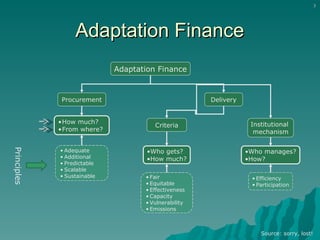
Adaptation Finance Principles Source: sorry, lost! Adaptation Finance Procurement Delivery Adequate Additional Predictable Scalable Sustainable Institutional  mechanism Criteria Who gets? How much? How much? From where? Who manages? How? Fair Equitable Effectiveness Capacity Vulnerability Emissions Efficiency Participation
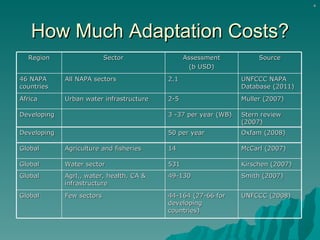
How Much Adaptation Costs? Region Sector Assessment (b USD) Source 46 NAPA countries All NAPA sectors 2.1 UNFCCC NAPA Database (2011) Africa Urban water infrastructure 2-5 Muller (2007) Developing 3 -37 per year (WB) Stern review (2007) Developing 50 per year Oxfam (2008) Global Agriculture and fisheries 14 McCarl (2007) Global Water sector 531 Kirschen (2007) Global Agrl., water, health, CA & infrastructure 49-130 Smith (2007) Global Few sectors 44-164 (27-66 for developing countries) UNFCCC (2008)
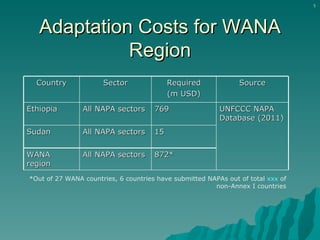
Adaptation Costs for WANA Region *Out of 27 WANA countries, 6 countries have submitted NAPAs out of total  xxx  of non-Annex I countries Country Sector Required (m USD) Source Ethiopia All NAPA sectors 769 UNFCCC NAPA Database (2011) Sudan All NAPA sectors 15 WANA region All NAPA sectors 872*
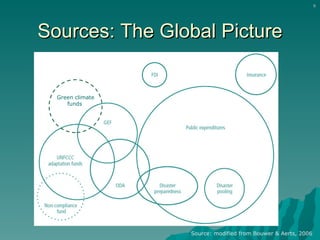
Sources: The Global Picture Source: modified from Bouwer & Aerts, 2006 Green climate funds
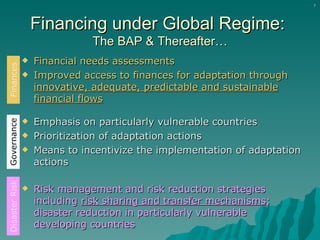
Financing under Global Regime:  The BAP & Thereafter… Financial needs assessments  Improved access to finances for adaptation through  innovative, adequate, predictable and sustainable financial flows Emphasis on particularly vulnerable countries Prioritization of adaptation actions Means to incentivize the implementation of adaptation actions Risk management and risk reduction strategies including  risk sharing and transfer mechanisms ; disaster reduction in particularly vulnerable developing countries Finances Governance Disaster Risk
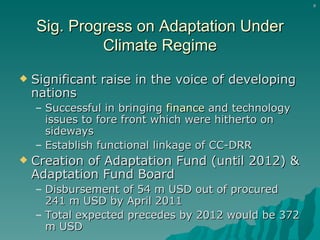
Sig. Progress on Adaptation Under Climate Regime Significant raise in the voice of developing nations Successful in bringing  finance  and technology issues to fore front which were hitherto on sideways Establish functional linkage of CC-DRR Creation of Adaptation Fund (until 2012) & Adaptation Fund Board Disbursement of 54 m USD out of procured 241 m USD by April 2011 Total expected precedes by 2012 would be 372 m USD
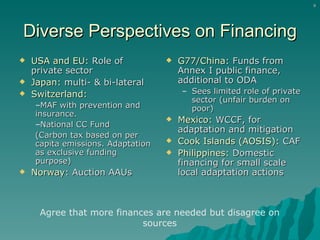
Diverse Perspectives on Financing USA and EU:  Role of private sector Japan:  multi- & bi-lateral Switzerland:   MAF with prevention and insurance.  National CC Fund (Carbon tax based on per capita emissions. Adaptation as exclusive funding purpose) Norway:  Auction AAUs G77/China:  Funds from Annex I public finance, additional to ODA  Sees limited role of private sector (unfair burden on poor) Mexico:  WCCF, for adaptation and mitigation Cook Islands (AOSIS):  CAF Philippines:  Domestic financing for small scale local adaptation actions Agree that more finances are needed but disagree on sources
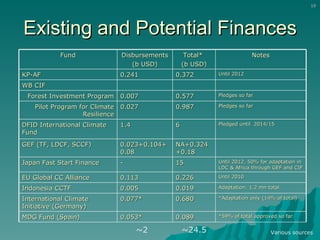
Existing and Potential Finances ~2 ~24.5 Various sources Fund Disbursements (b USD) Total*  (b USD) Notes KP-AF 0.241 0.372 Until 2012 WB CIF Forest Investment Program 0.007 0.577 Pledges so far Pilot Program for Climate Resilience 0.027 0.987 Pledges so far DFID International Climate Fund 1.4 6 Pledged until  2014/15 GEF (TF, LDCF, SCCF) 0.023+0.104+0.08 NA+0.324+0.18 Japan Fast Start Finance - 15 Until 2012, 50% for adaptation in LDC & Africa through GEF and CIF EU Global CC Alliance 0.113 0.226 Until 2010 Indonesia CCTF 0.005 0.019 Adaptation: 1.2 mn total International Climate Initiative (Germany) 0.077* 0.680 *Adaptation only (14% of total) MDG Fund (Spain) 0.053* 0.089 *59% of total approved so far
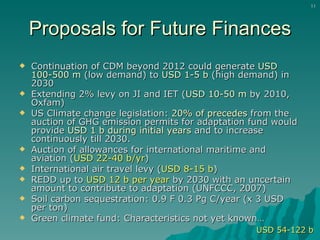
Proposals for Future Finances Continuation of CDM beyond 2012 could generate  USD 100-500 m  (low demand) to  USD 1-5 b  (high demand) in 2030  Extending 2% levy on JI and IET ( USD 10-50 m  by 2010, Oxfam) US Climate change legislation:  20% of precedes  from the auction of GHG emission permits for adaptation fund would provide  USD 1 b during initial years  and to increase continuously till 2030. Auction of allowances for international maritime and aviation ( USD 22-40 b/yr )  International air travel levy ( USD 8-15 b ) REDD up to  USD 12 b   per year  by 2030 with an uncertain amount to contribute to adaptation (UNFCCC, 2007) Soil carbon sequestration:  0.9 F 0.3 Pg C/year (x 3 USD per ton) Green climate fund: Characteristics not yet known… USD 54-122 b
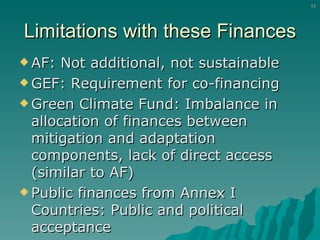
Limitations with these Finances AF: Not additional, not sustainable GEF: Requirement for co-financing Green Climate Fund: Imbalance in allocation of finances between mitigation and adaptation components, lack of direct access (similar to AF) Public finances from Annex I Countries: Public and political acceptance
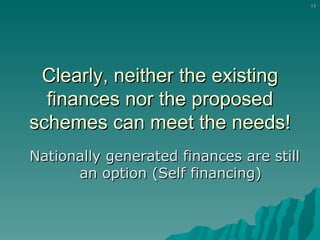
Clearly, neither the existing finances nor the proposed schemes can meet the needs! Nationally generated finances are still an option (Self financing)
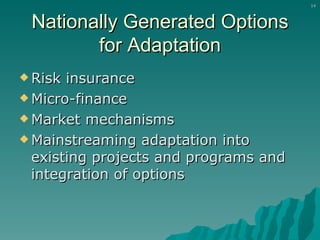
Nationally Generated Options for Adaptation Risk insurance Micro-finance Market mechanisms Mainstreaming adaptation into existing projects and programs and integration of options
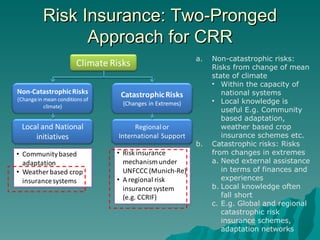
Risk Insurance: Two-Pronged Approach for CRR Non-catastrophic risks: Risks from change of mean state of climate Within the capacity of national systems Local knowledge is useful E.g. Community based adaptation, weather based crop insurance schemes etc. Catastrophic risks: Risks from changes in extremes Need external assistance in terms of finances and experiences Local knowledge often fall short E.g. Global and regional catastrophic risk insurance schemes, adaptation networks
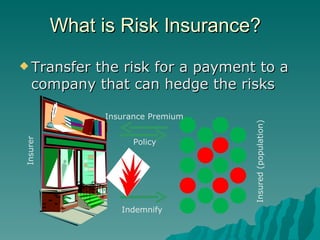
What is Risk Insurance? Transfer the risk for a payment to a company that can hedge the risks Indemnify Insurance Premium  Insured (population) Insurer Policy
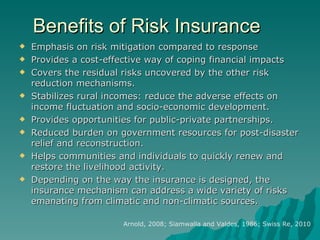
Benefits of Risk Insurance Emphasis on risk mitigation compared to response Provides a cost-effective way of coping financial impacts Covers the residual risks uncovered by the other risk reduction mechanisms. Stabilizes rural incomes: reduce the adverse effects on income fluctuation and socio-economic development. Provides opportunities for public-private partnerships. Reduced burden on government resources for post-disaster relief and reconstruction. Helps communities and individuals to quickly renew and restore the livelihood activity. Depending on the way the insurance is designed, the insurance mechanism can address a wide variety of risks emanating from climatic and non-climatic sources. Arnold, 2008; Siamwalla and Valdes, 1986; Swiss Re, 2010
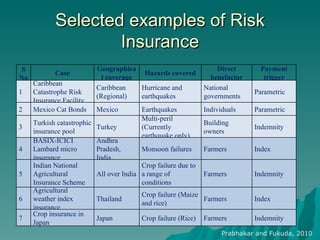
Selected examples of Risk Insurance Prabhakar and Fukuda, 2010 S No Case Geographical coverage Hazards covered Direct benefactor Payment trigger 1 Caribbean Catastrophe Risk Insurance Facility Caribbean (Regional) Hurricane and earthquakes National governments Parametric 2 Mexico Cat Bonds Mexico Earthquakes Individuals Parametric 3 Turkish catastrophic insurance pool Turkey Multi-peril (Currently earthquake only) Building owners Indemnity 4 BASIX-ICICI Lambard micro insurance Andhra Pradesh, India Monsoon failures Farmers Index  5 Indian National Agricultural Insurance Scheme  All over India Crop failure due to a range of conditions Farmers Indemnity 6 Agricultural weather index insurance Thailand Crop failure (Maize and rice) Farmers Index 7 Crop insurance in Japan Japan Crop failure (Rice) Farmers Indemnity
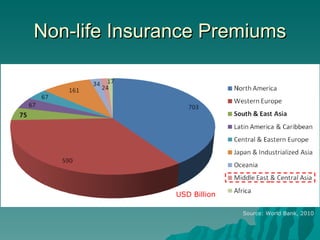
Non-life Insurance Premiums USD Billion Source: World Bank, 2010
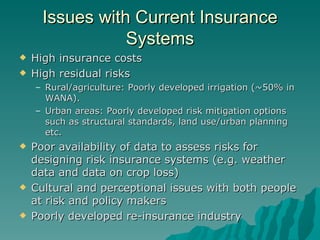
Issues with Current Insurance Systems High insurance costs High residual risks Rural/agriculture: Poorly developed irrigation (~50% in WANA). Urban areas: Poorly developed risk mitigation options such as structural standards, land use/urban planning etc. Poor availability of data to assess risks for designing risk insurance systems (e.g. weather data and data on crop loss) Cultural and perceptional issues with both people at risk and policy makers Poorly developed re-insurance industry
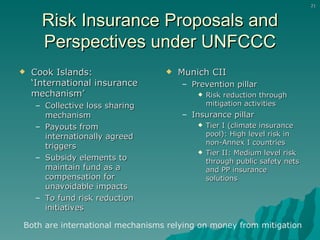
Risk Insurance Proposals and Perspectives under UNFCCC Cook Islands: ‘International insurance mechanism’ Collective loss sharing mechanism Payouts from internationally agreed triggers Subsidy elements to maintain fund as a compensation for unavoidable impacts To fund risk reduction initiatives Munich CII Prevention pillar Risk reduction through mitigation activities Insurance pillar Tier I (climate insurance pool): High level risk in non-Annex I countries Tier II: Medium level risk through public safety nets and PP insurance solutions Both are international mechanisms relying on money from mitigation
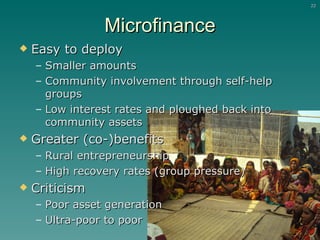
Microfinance Easy to deploy  Smaller amounts Community involvement through self-help groups Low interest rates and ploughed back into community assets Greater (co-)benefits Rural entrepreneurship High recovery rates (group pressure) Criticism  Poor asset generation Ultra-poor to poor
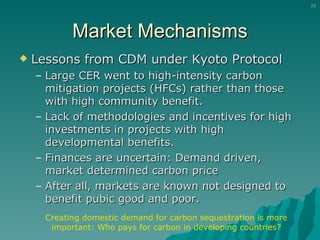
Market Mechanisms Lessons from CDM under Kyoto Protocol Large CER went to high-intensity carbon mitigation projects (HFCs) rather than those with high community benefit. Lack of methodologies and incentives for high investments in projects with high developmental benefits. Finances are uncertain: Demand driven, market determined carbon price After all, markets are known not designed to benefit pubic good and poor. Creating domestic demand for carbon sequestration is more important: Who pays for carbon in developing countries?
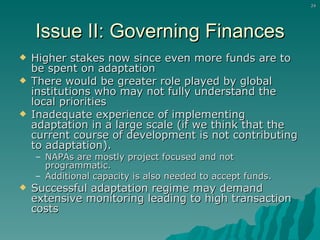
Issue II: Governing Finances Higher stakes now since even more funds are to be spent on adaptation There would be greater role played by global institutions who may not fully understand the local priorities Inadequate experience of implementing adaptation in a large scale (if we think that the current course of development is not contributing to adaptation). NAPAs are mostly project focused and not programmatic. Additional capacity is also needed to accept funds. Successful adaptation regime may demand extensive monitoring leading to high transaction costs
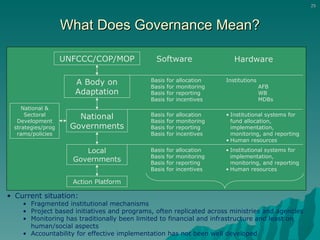
What Does Governance Mean? Current situation:   Fragmented institutional mechanisms Project based initiatives and programs, often replicated across ministries and agencies Monitoring has traditionally been limited to financial and infrastructure and least on human/social aspects Accountability for effective implementation has not been well developed UNFCCC/COP/MOP A Body on Adaptation National Governments National & Sectoral Development strategies /programs/policies Basis for allocation Basis for monitoring Basis for reporting Basis for incentives Basis for allocation Basis for monitoring Basis for reporting Basis for incentives Software Hardware Institutions AFB WB MDBs Institutional systems for fund allocation, implementation, monitoring, and reporting Human resources Local Governments Action Platform Basis for allocation Basis for monitoring Basis for reporting Basis for incentives Institutional systems for implementation, monitoring, and reporting Human resources
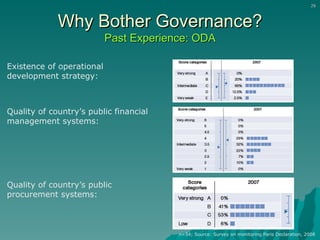
Existence of operational development strategy: Quality of country’s public financial management systems: Quality of country’s public procurement systems: n=54; Source: Survey on monitoring Paris Declaration, 2008 Why Bother Governance? Past Experience: ODA
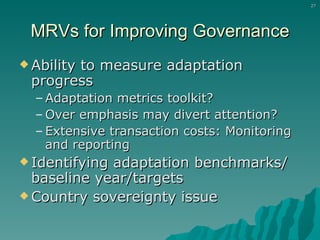
MRVs for Improving Governance Ability to measure adaptation progress Adaptation metrics toolkit? Over emphasis may divert attention? Extensive transaction costs: Monitoring and reporting Identifying adaptation benchmarks/ baseline year/targets Country sovereignty issue
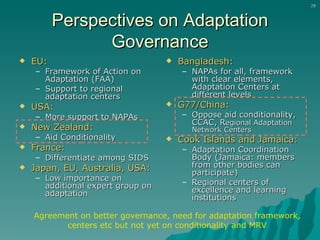
Perspectives on Adaptation Governance EU:   Framework of Action on Adaptation (FAA) Support to regional adaptation centers USA:   More support to NAPAs New Zealand:   Aid Conditionality  France:   Differentiate among SIDS Japan, EU, Australia, USA: Low importance on additional expert group on adaptation Bangladesh:   NAPAs for all, framework with clear elements, Adaptation Centers at different levels G77/China:   Oppose aid conditionality, CCAC, R egional Adaptation Network Centers Cook Islands and Jamaica: Adaptation Coordination Body (Jamaica: members from other bodies can participate) Regional centers of excellence and learning institutions Agreement on better governance, need for adaptation framework, centers etc but not yet on conditionality and MRV
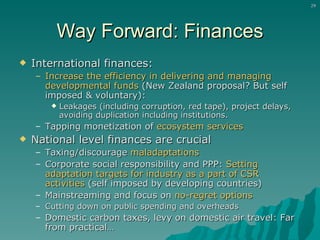
Way Forward: Finances International finances: Increase the efficiency in delivering and managing developmental funds  (New Zealand proposal? But self imposed & voluntary):  Leakages (including corruption, red tape), project delays, avoiding duplication including institutions.  Tapping monetization of  ecosystem services National level finances are crucial Taxing/discourage  maladaptations Corporate social responsibility and PPP:  Setting adaptation targets for industry as a part of CSR activities  (self imposed by developing countries) Mainstreaming and focus on  no-regret options Cutting down on public spending and overheads Domestic carbon taxes, levy on domestic air travel: Far from practical…
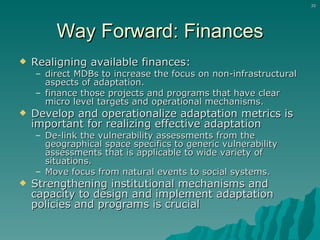
Way Forward: Finances Realigning available finances:  direct MDBs to increase the focus on non-infrastructural aspects of adaptation. finance those projects and programs that have clear micro level targets and operational mechanisms. Develop and operationalize adaptation metrics is important for realizing effective adaptation De-link the vulnerability assessments from the geographical space specifics to generic vulnerability assessments that is applicable to wide variety of situations. Move focus from natural events to social systems. Strengthening institutional mechanisms and capacity to design and implement adaptation policies and programs is crucial
Way Forward: Governance Having binding targets under adaptation can improve the accountability Mechanism to reward and recognize successful adaptation combined with MRVs Need to differentiate among developing countries using the same principles as polluter pays and common but differentiated responsibilities
Way Forward… Close working of GFDRR and UNFCCC (e.g. technical body on DRR) NAPAs to report on disaster risks Inclusion of disaster risks as one of the criteria to differentiate among developing countries for prioritization of actions The disaster risk quantification work can assist in developing a better MRV regime for adaptation Reducing risk financing costs: Promote disaster risk mitigation measures (e.g. structural and non-structural mitigation programs) in combination with risk insurance  Promote savings linked insurance programs with frequent returns…
Thank You [email_address]