An Efficient Backup and
Replication of Storage
Takashi HOSHINO
Cybozu Labs, Inc.
2013-05-29@LinuxConJapan
rev.20130529a
Self-introduction
• Takashi HOSHINO
– Works at Cybozu Labs, Inc.
• Technical interests
– Database, storage, distributed algorithms
• Current work
– WalB: Today’s talk!
2
Contents
• Motivation
• Architecture
• Alternative solutions
• Algorithm
• Performance evaluation
• Summary
3
Contents
• Motivation
• Architecture
• Alternative solutions
• Algorithm
• Performance evaluation
• Summary
4
Motivation
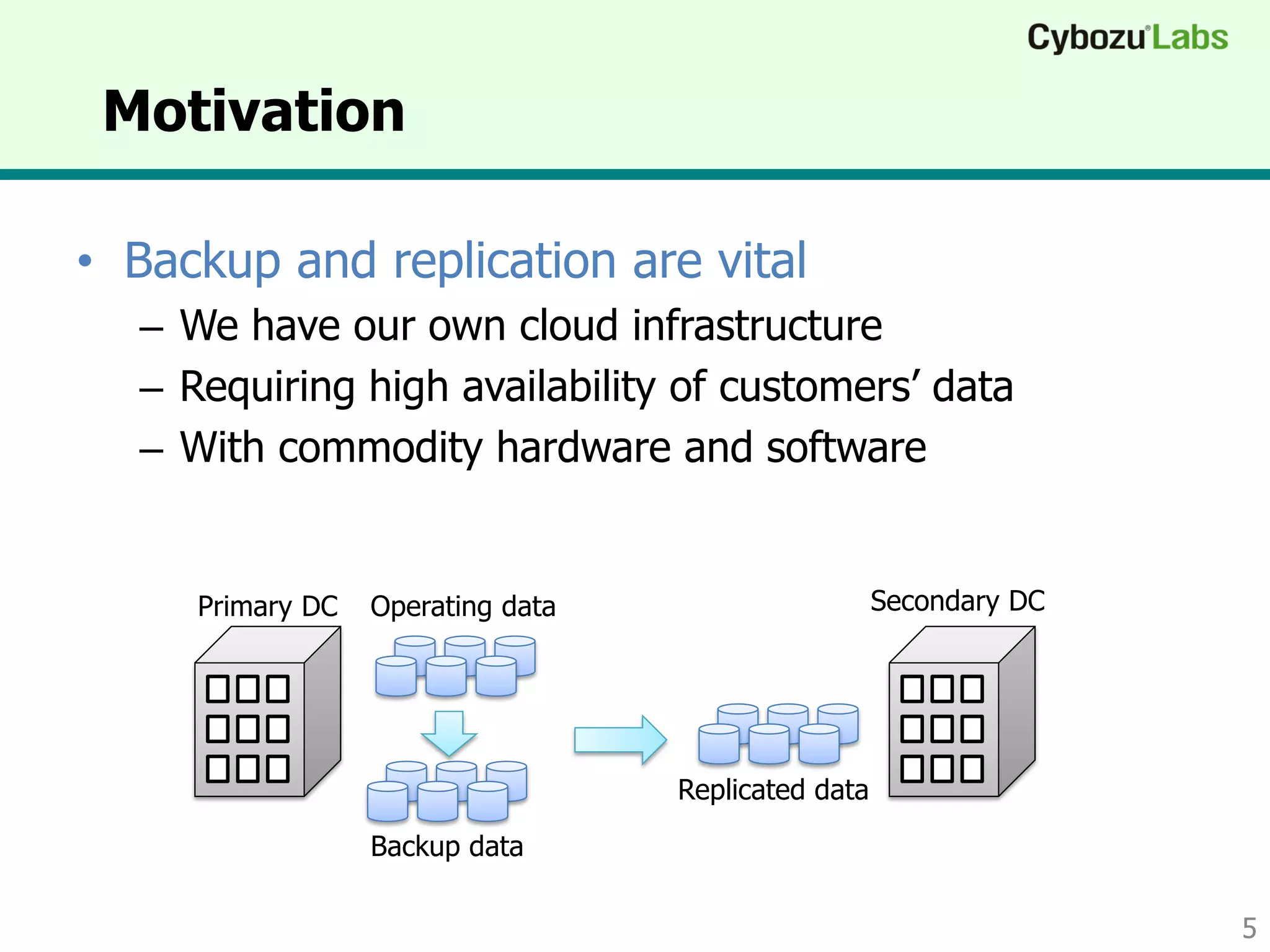
• Backup and replication are vital
– We have our own cloud infrastructure
– Requiring high availability of customers’ data
– With cost-effective commodity hardware and software
5
Operating data
Backup data
Replicated data
Primary DC Secondary DC
Requirements
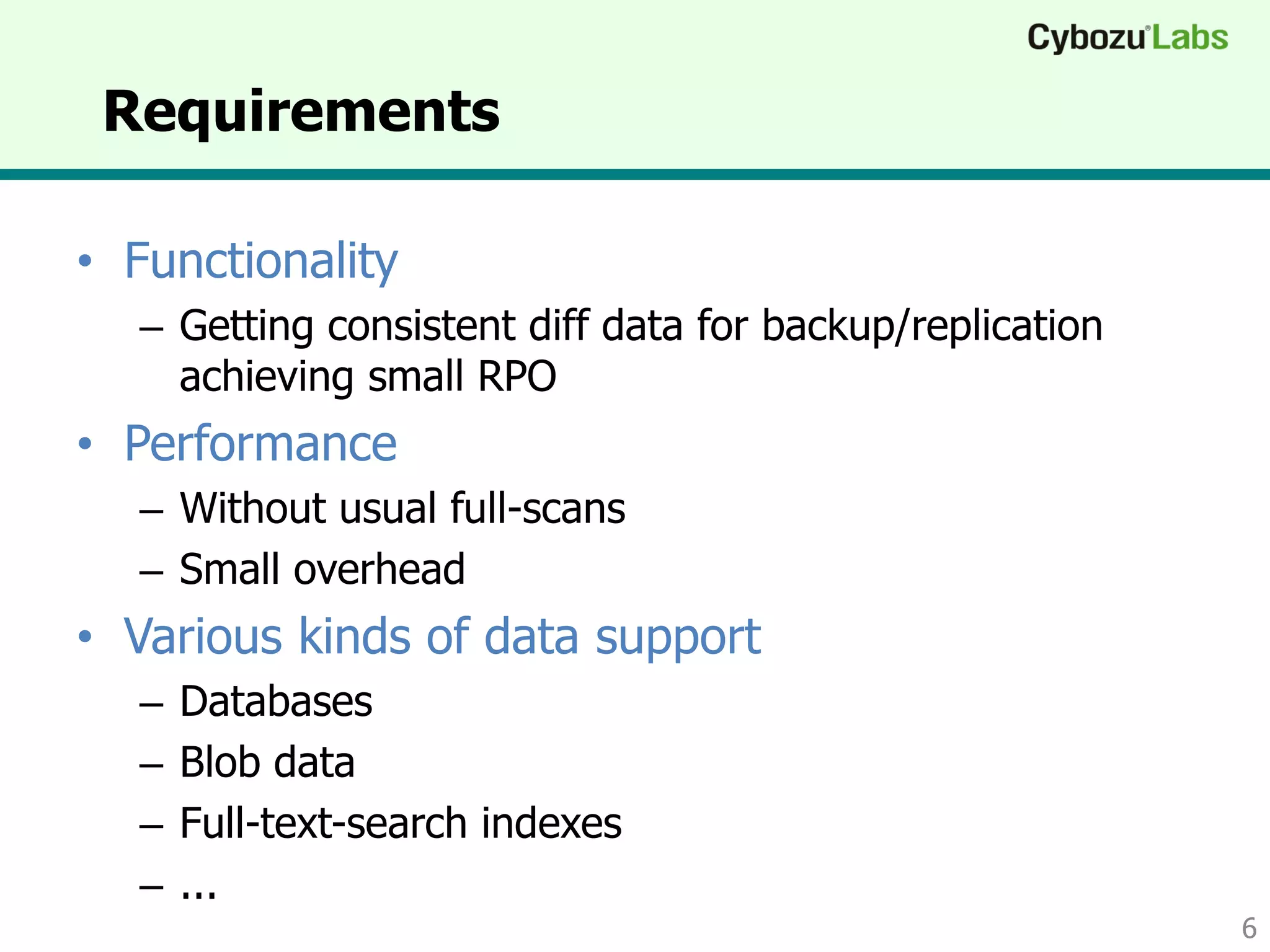
• Functionality
– Getting consistent diff data for backup/replication
achieving small RPO
• Performance
– Without usual full-scans
– Small overhead
• Various kinds of data support
– Databases
– Blob data
– Full-text-search indexes
– ...
6
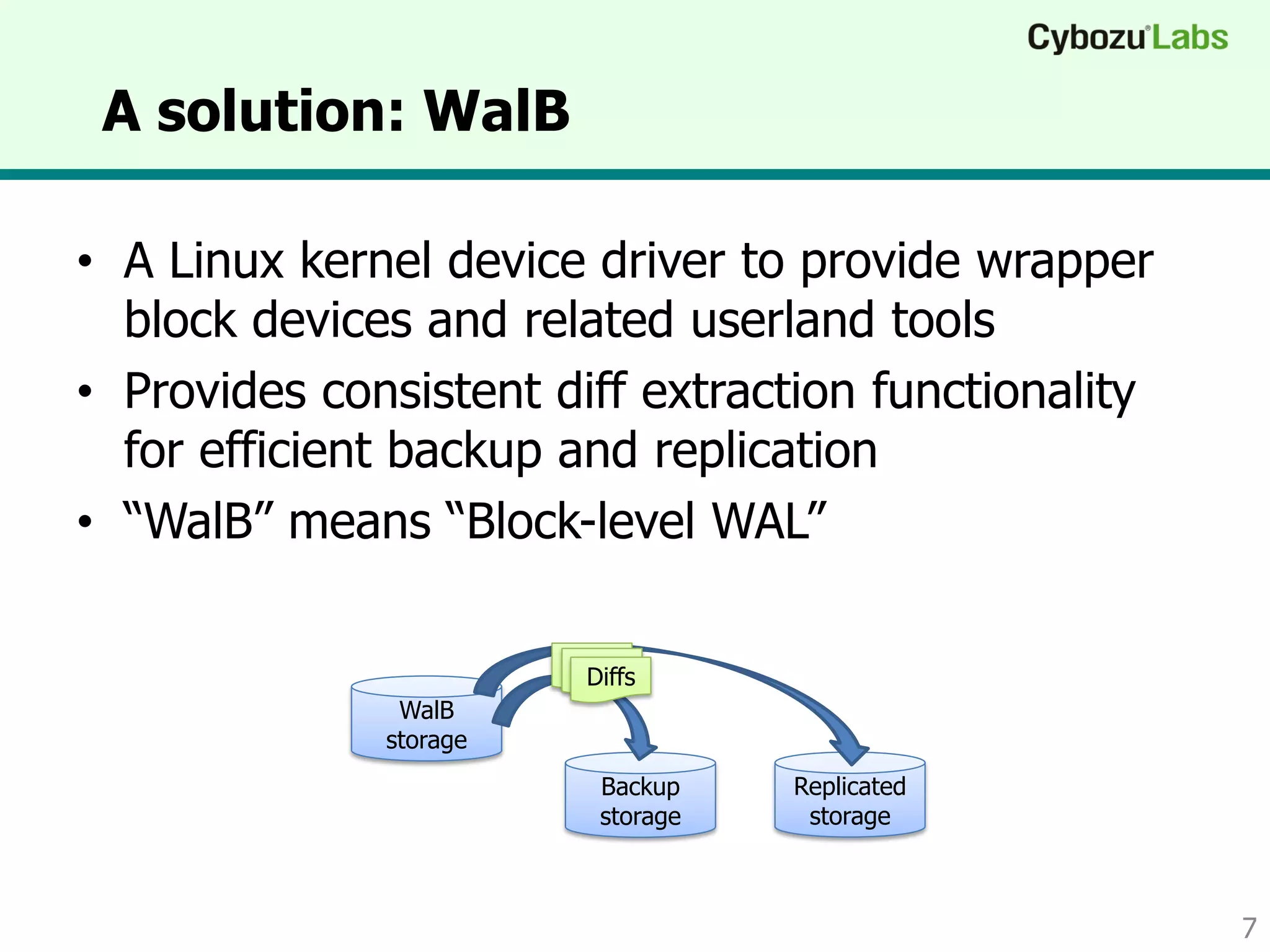
• A Linux kernel device driver to provide wrapper
block devices and related userland tools
• Provides consistent diff extraction functionality
for efficient backup and replication
• “WalB” means “Block-level WAL”
A solution: WalB
7
WalB
storage
Backup
storage
Replicated
storage
Diffs
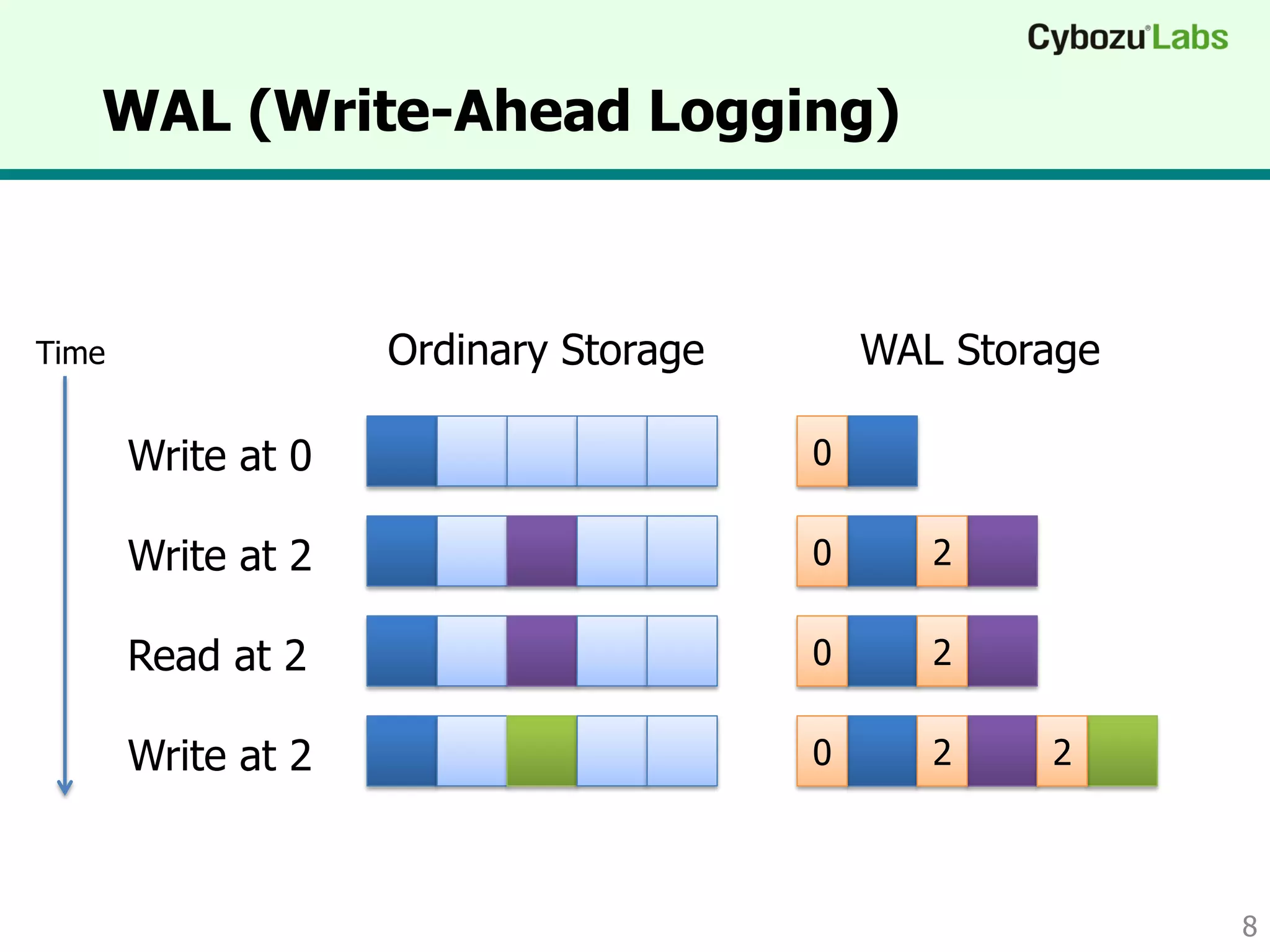
WAL (Write-Ahead Logging)
8
Ordinary Storage WAL Storage
Write at 0
Write at 2
Read at 2
Write at 2
0
0 2
0 2
0 2 2
Time
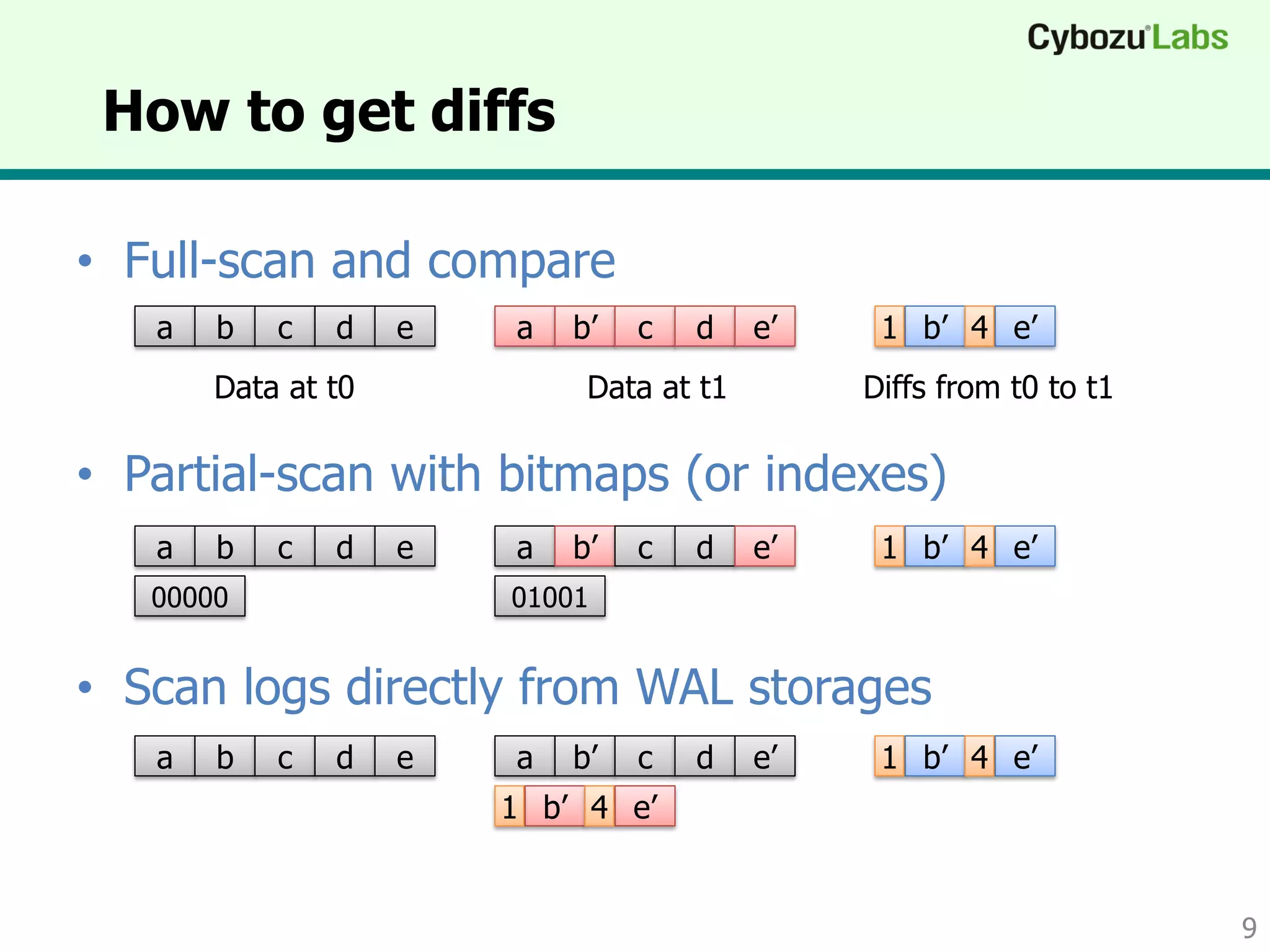
How to get diffs
• Full-scan and compare
• Partial-scan with bitmaps (or indexes)
• Scan logs directly from WAL storages
9
a b c d e a b’ c d e’ b’ e’1 4
00000 01001
a b c d e a b’ c d e’ b’ e’1 4
b’ e’1 4
Data at t0 Data at t1 Diffs from t0 to t1
Contents
• Motivation
• Architecture
• Alternative solutions
• Algorithm
• Performance evaluation
• Summary
10
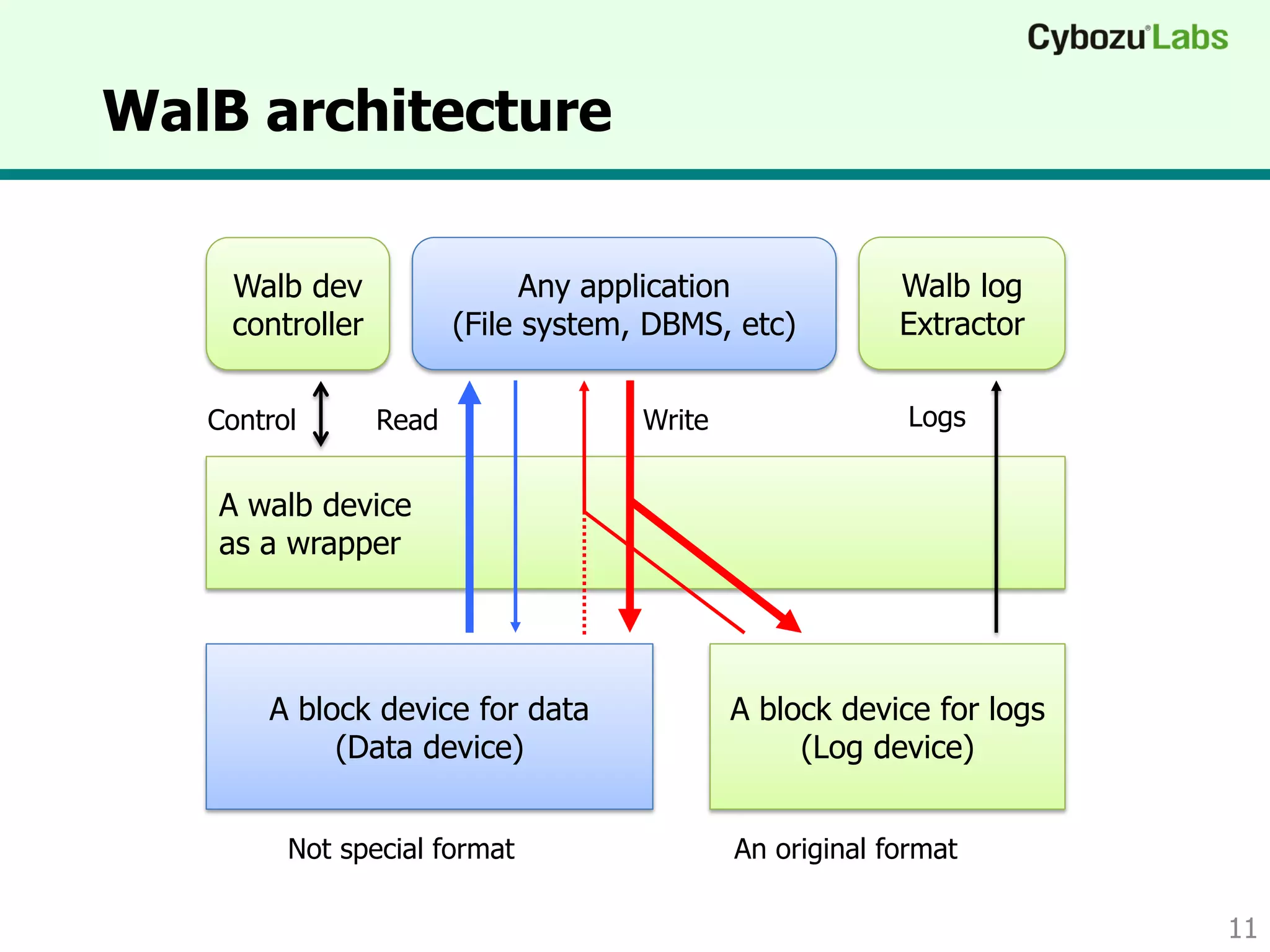
WalB architecture
A walb device
as a wrapper
A block device for data
(Data device)
A block device for logs
(Log device)
Read Write Logs
Not special format An original format
Any application
(File system, DBMS, etc)
Walb log
Extractor
Walb dev
controller
Control
11
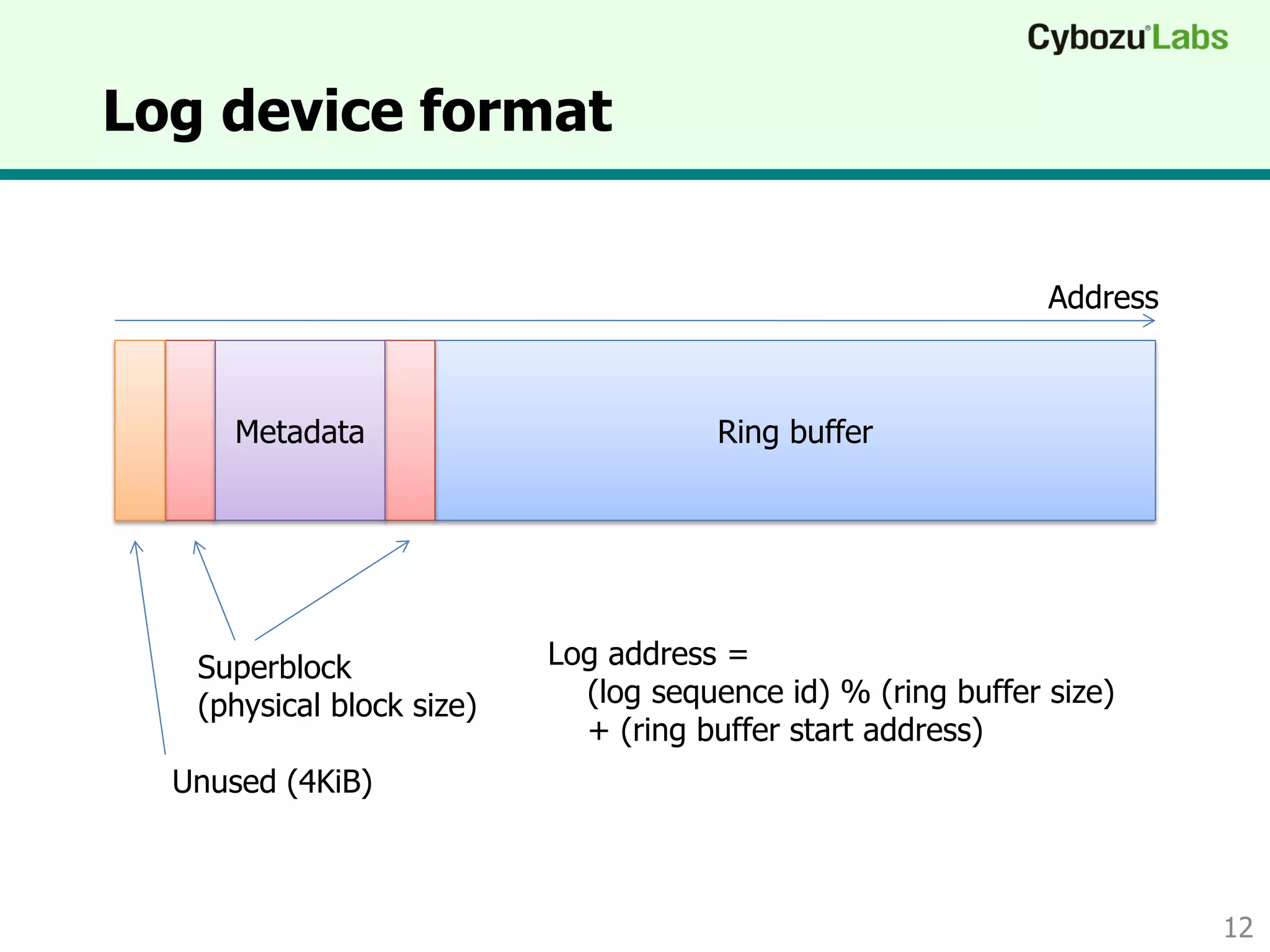
Log device format
12
Ring bufferMetadata
Address
Superblock
(physical block size)
Unused (4KiB)
Log address =
(log sequence id) % (ring buffer size)
+ (ring buffer start address)
Checksum
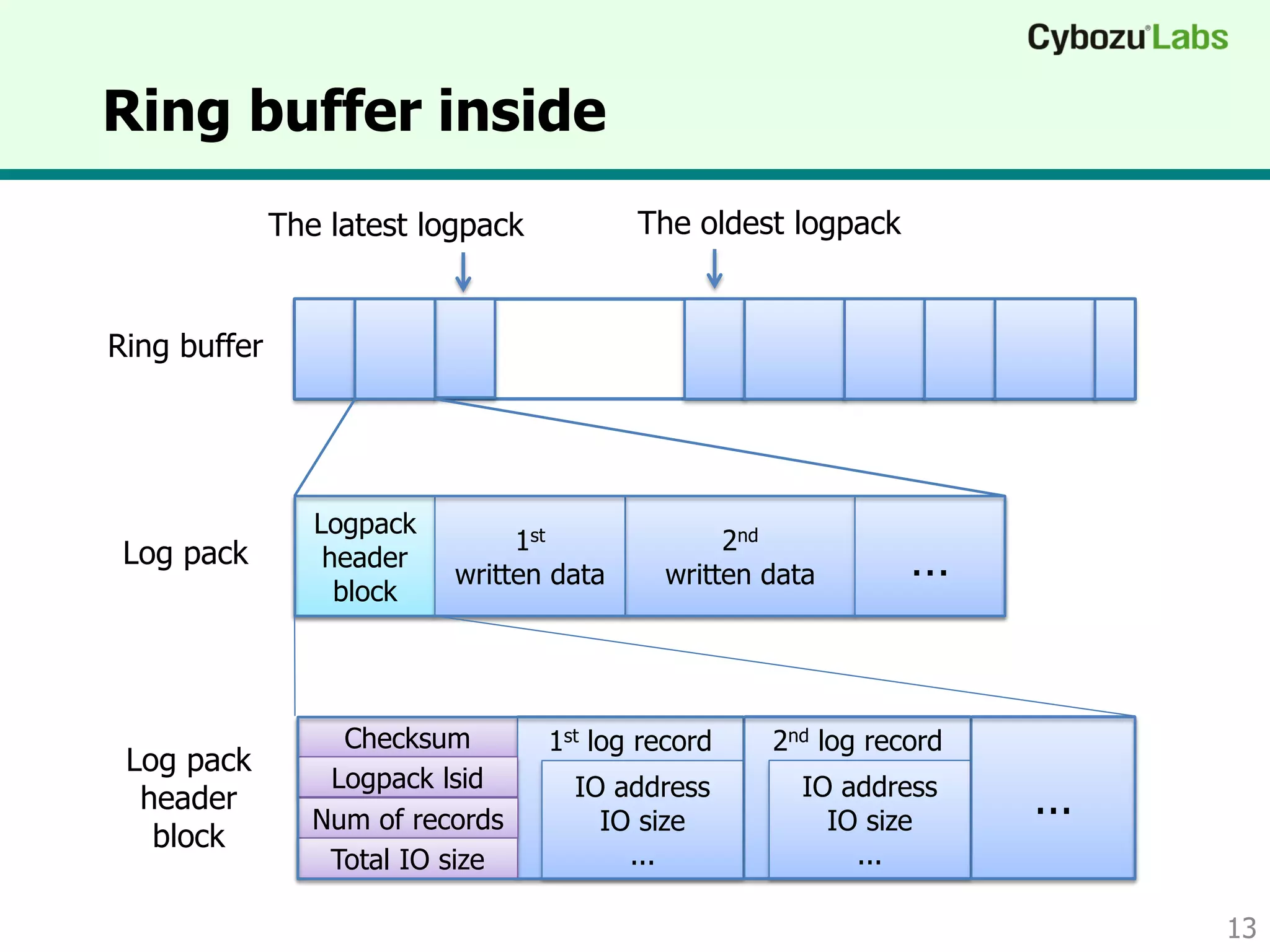
Ring buffer inside
13
2nd
written data
Ring buffer
Log pack
Logpack
header
block
1st
written data …
The oldest logpackThe latest logpack
1st log record
IO address
IO size
...
Logpack lsid
Log pack
header
block
Num of records
Total IO size
2nd log record
IO address
IO size
...
...
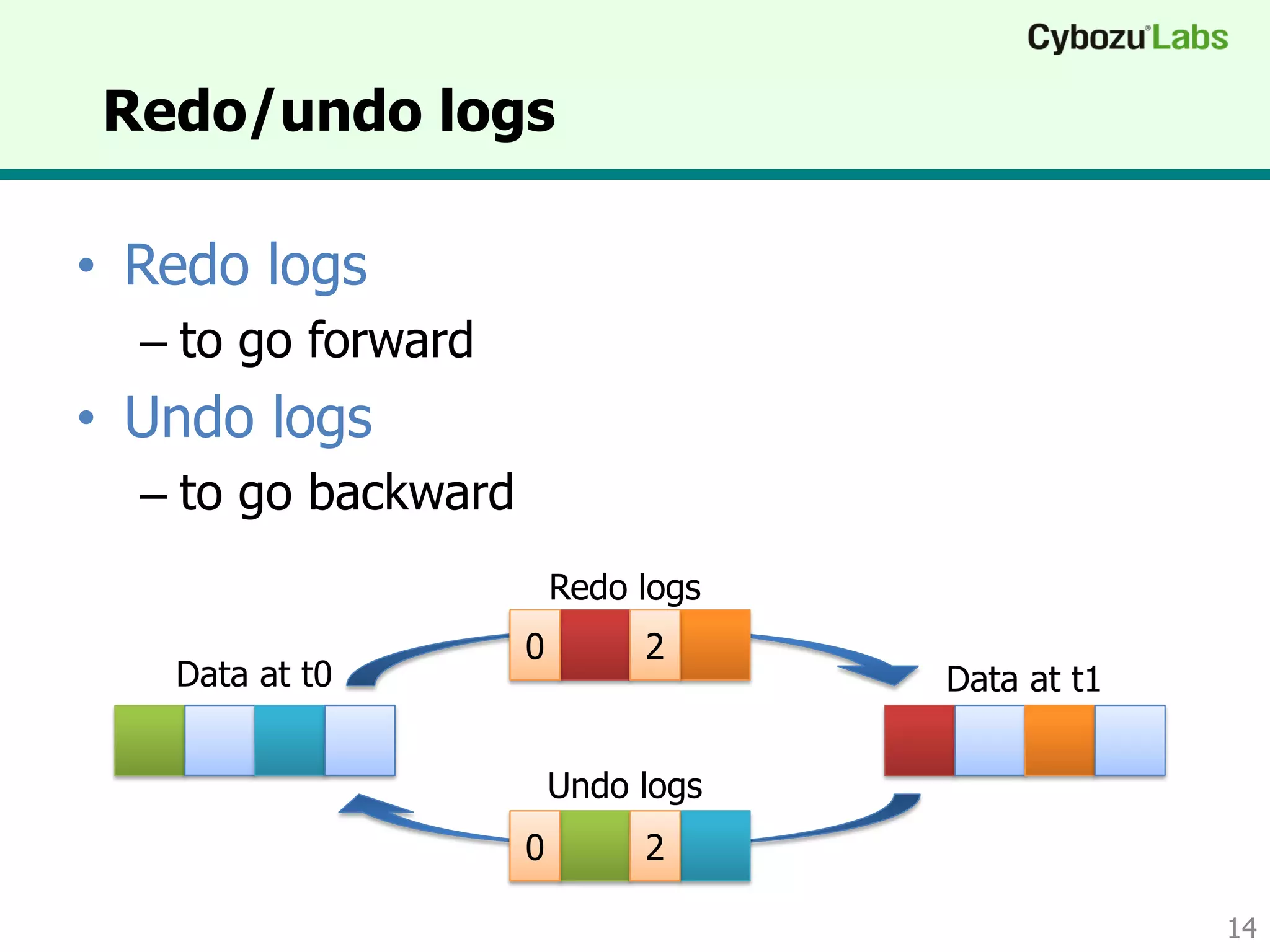
Redo/undo logs
• Redo logs
– to go forward
• Undo logs
– to go backward
14
0 2
Data at t0
0 2
Data at t1
Redo logs
Undo logs
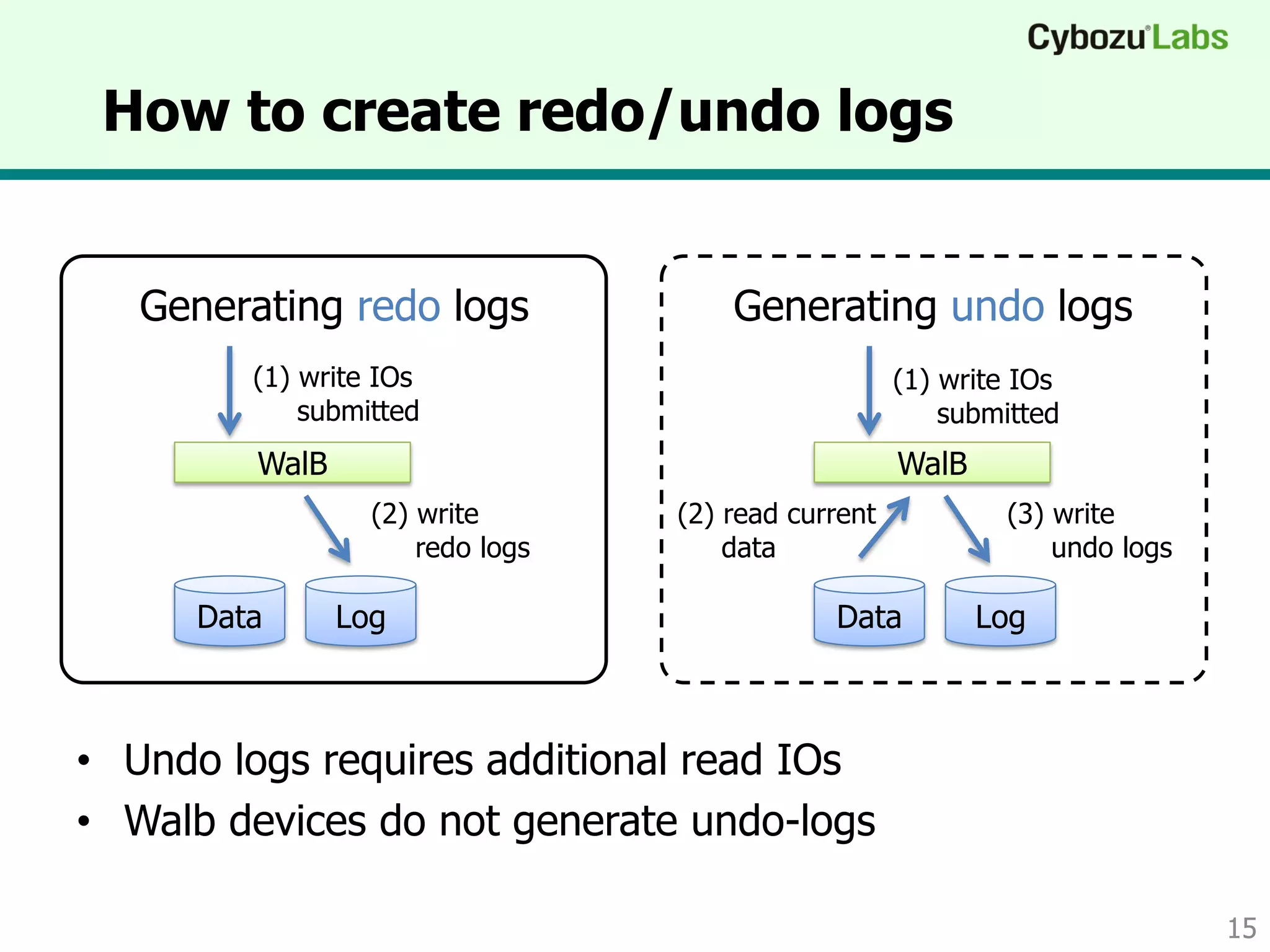
How to create redo/undo logs
• Undo logs requires additional read IOs
• Walb devices do not generate undo-logs
15
Data Log
WalB
(1) write IOs
submitted
(2) read current
data
(3) write
undo logs
Data Log
WalB
(1) write IOs
submitted
(2) write
redo logs
Generating redo logs Generating undo logs
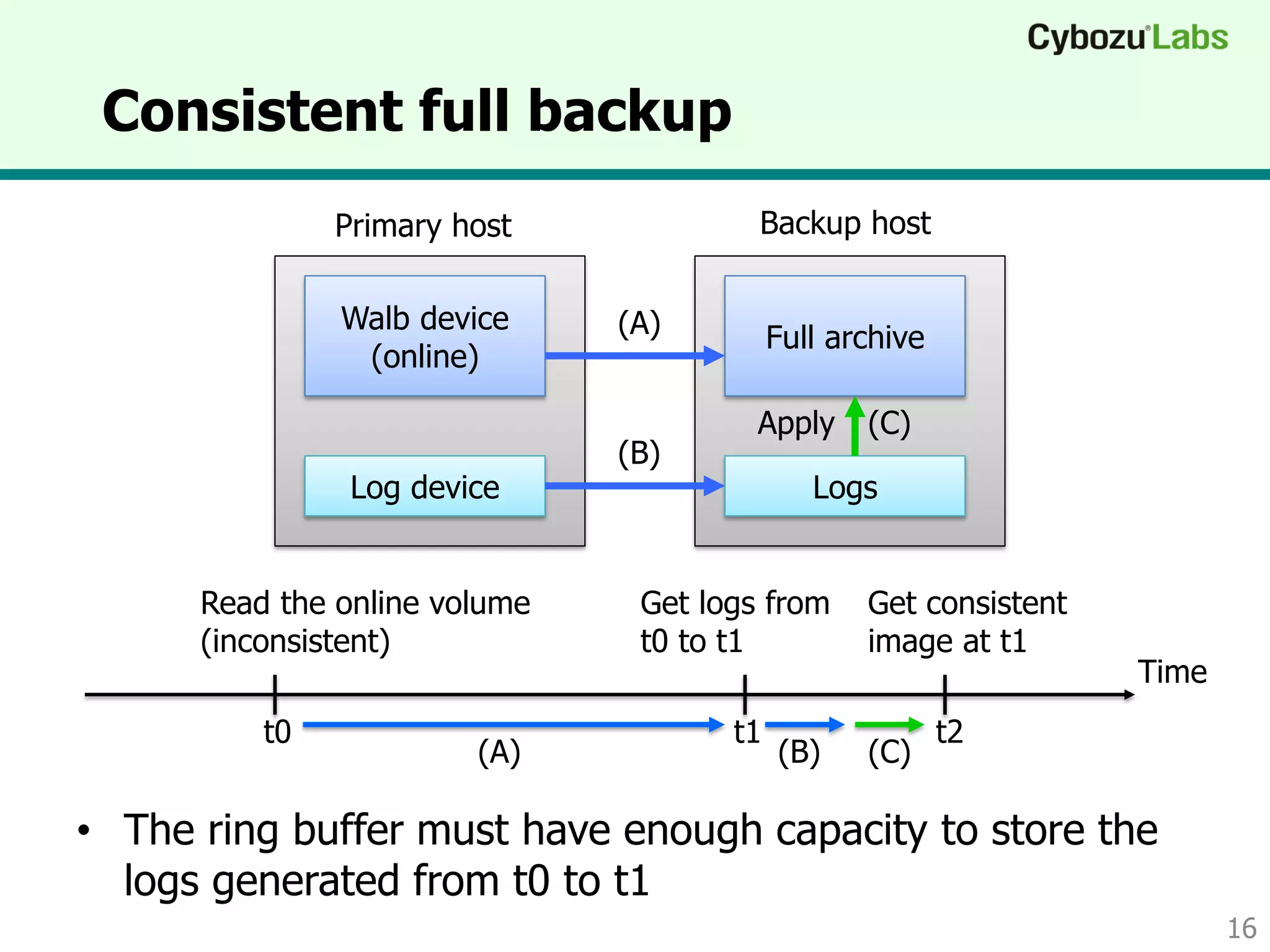
Consistent full backup
• The ring buffer must have enough capacity to store the
logs generated from t0 to t1
Primary host Backup host
Walb device
(online)
Log device
Full archive
Logs
Apply
(A)
(B)
Read the online volume
(inconsistent)
t1
Get consistent
image at t1
(C)
(A) (B) (C)
Time
t0 t2
Get logs from
t0 to t1
16
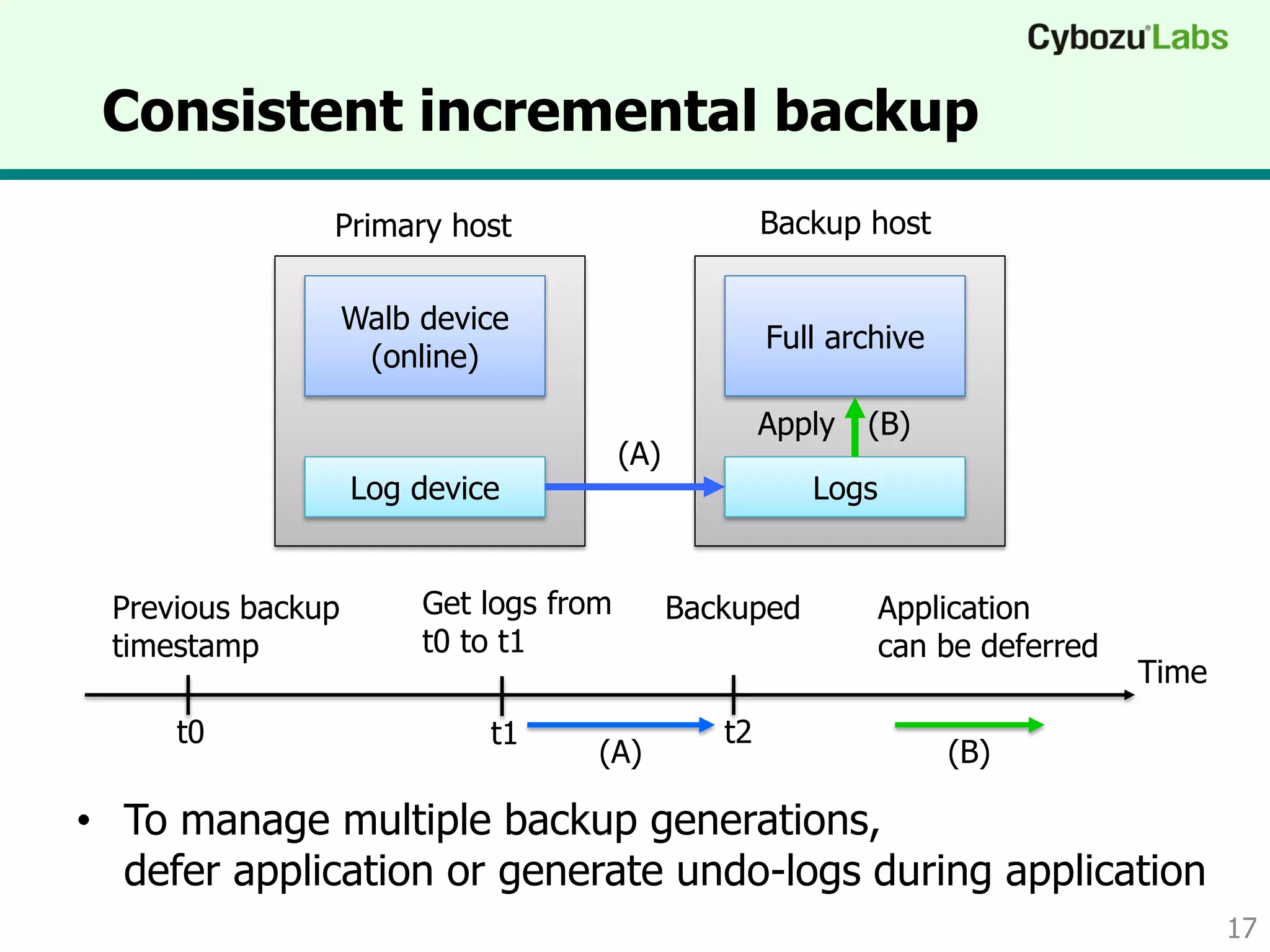
Consistent incremental backup
• To manage multiple backup generations,
defer application or generate undo-logs during application
Primary host Backup host
Walb device
(online)
Log device
Full archive
Logs
Apply
(A)
Get logs from
t0 to t1
(B)
(A) (B)
Time
t0 t2t1
Previous backup
timestamp
Backuped Application
can be deferred
17
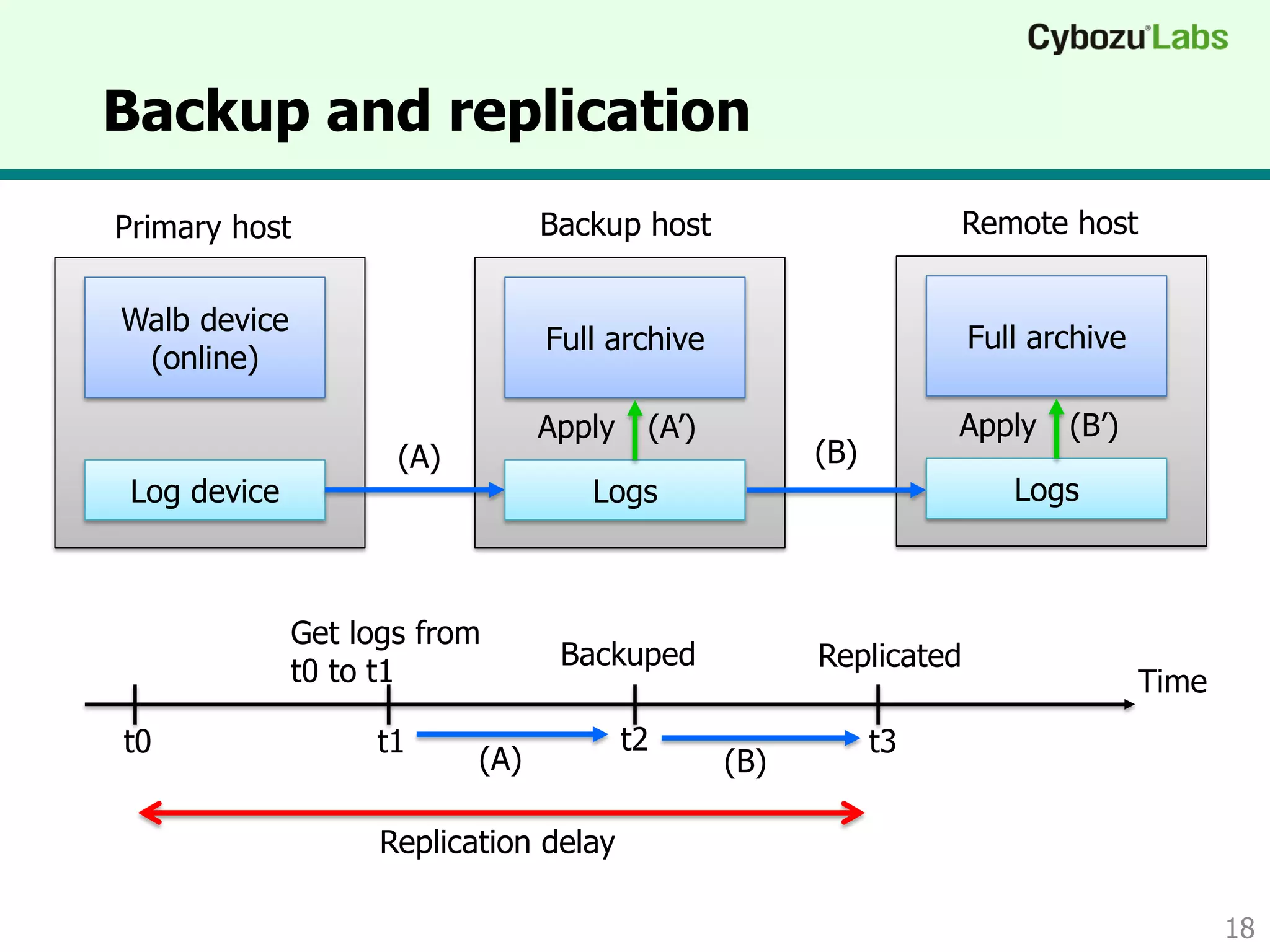
Backup and replication
18
Primary host Backup host
Walb device
(online)
Log device
Full archive
Logs
Apply
(A)
Get logs from
t0 to t1 Replicated
(A’)
(A)
Time
t1 t3
Remote host
Full archive
Logs
Apply (B’)
(B)
(B)
t2
Backuped
t0
Replication delay
Contents
• Motivation
• Architecture
• Alternative solutions
• Algorithm
• Performance evaluation
• Summary
19
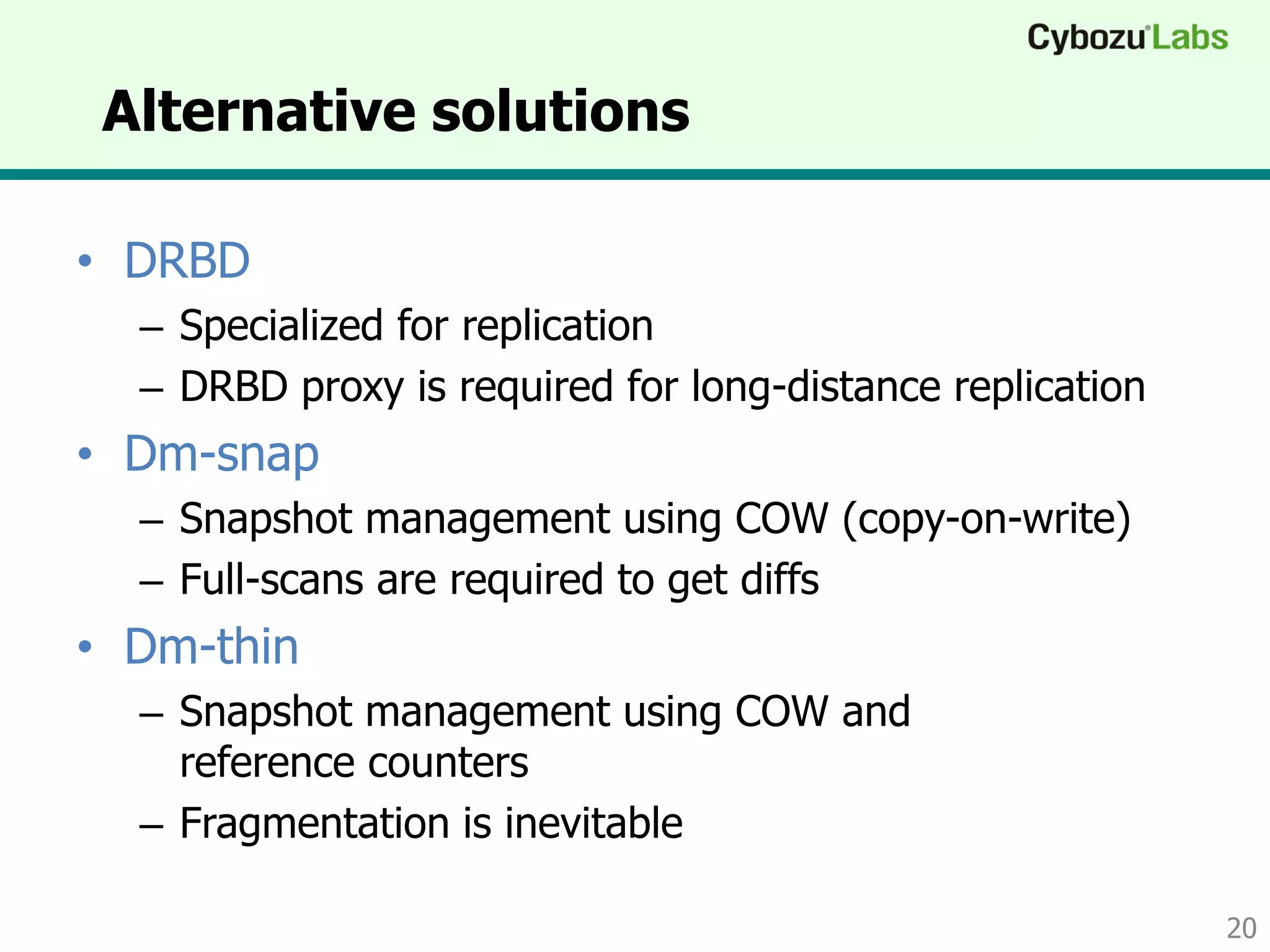
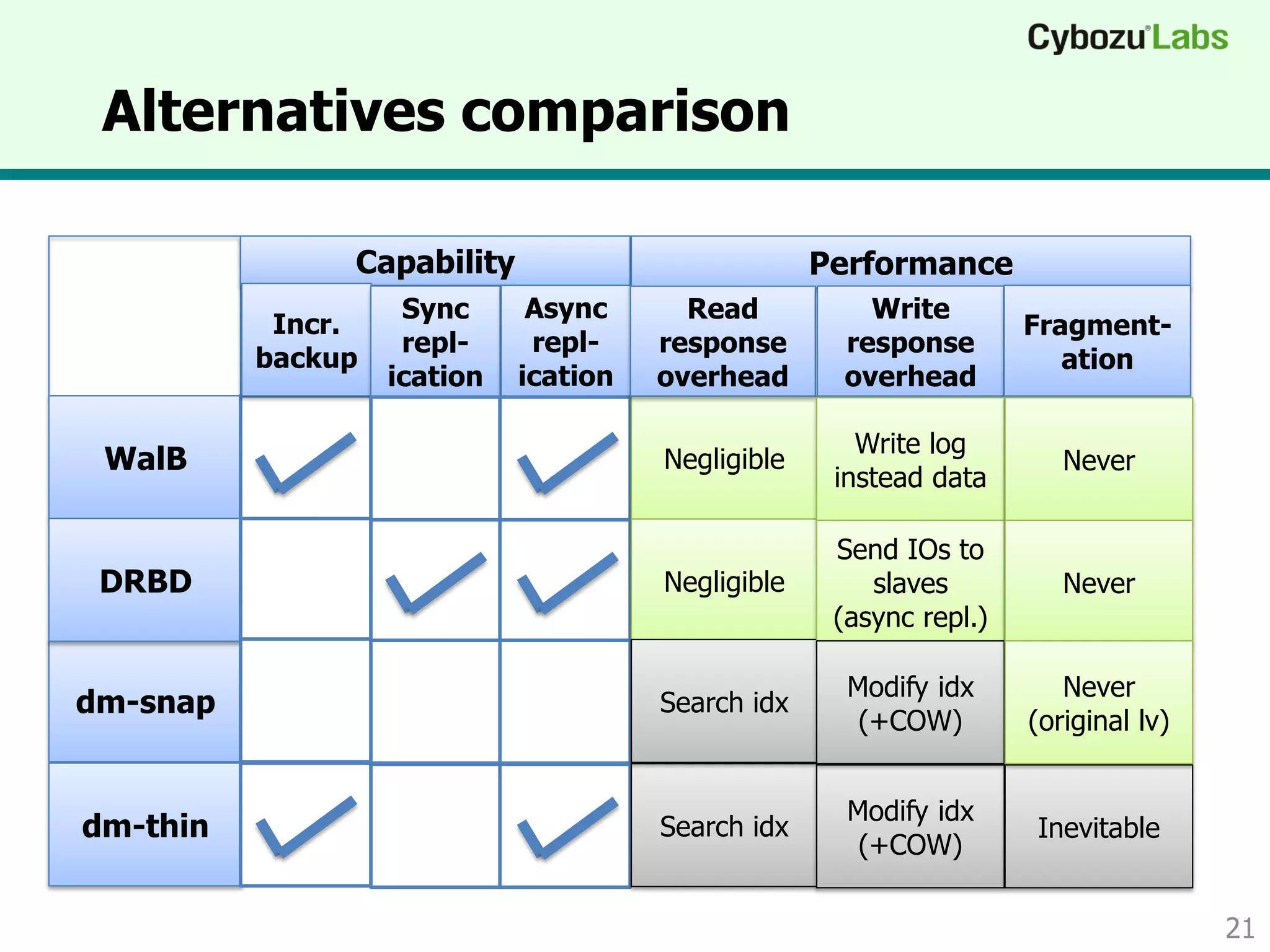
Alternative solutions
• DRBD
– Specialized for replication
– DRBD proxy is required for long-distance replication
• Dm-snap
– Snapshot management using COW (copy-on-write)
– Full-scans are required to get diffs
• Dm-thin
– Snapshot management using COW and
reference counters
– Fragmentation is inevitable
20
Alternatives comparison
WalB
dm-snap
Capability
dm-thin
21
DRBD
Incr.
backup
Sync
repl-
ication
Async
repl-
ication
Performance
Negligible
Search idx
Negligible
Read
response
overhead
Search idx
Write
response
overhead
Fragment-
ation
Write log
instead data
Modify idx
(+COW)
Send IOs to
slaves
(async repl.)
Modify idx
(+COW)
Never
Inevitable
Never
Never
(original lv)
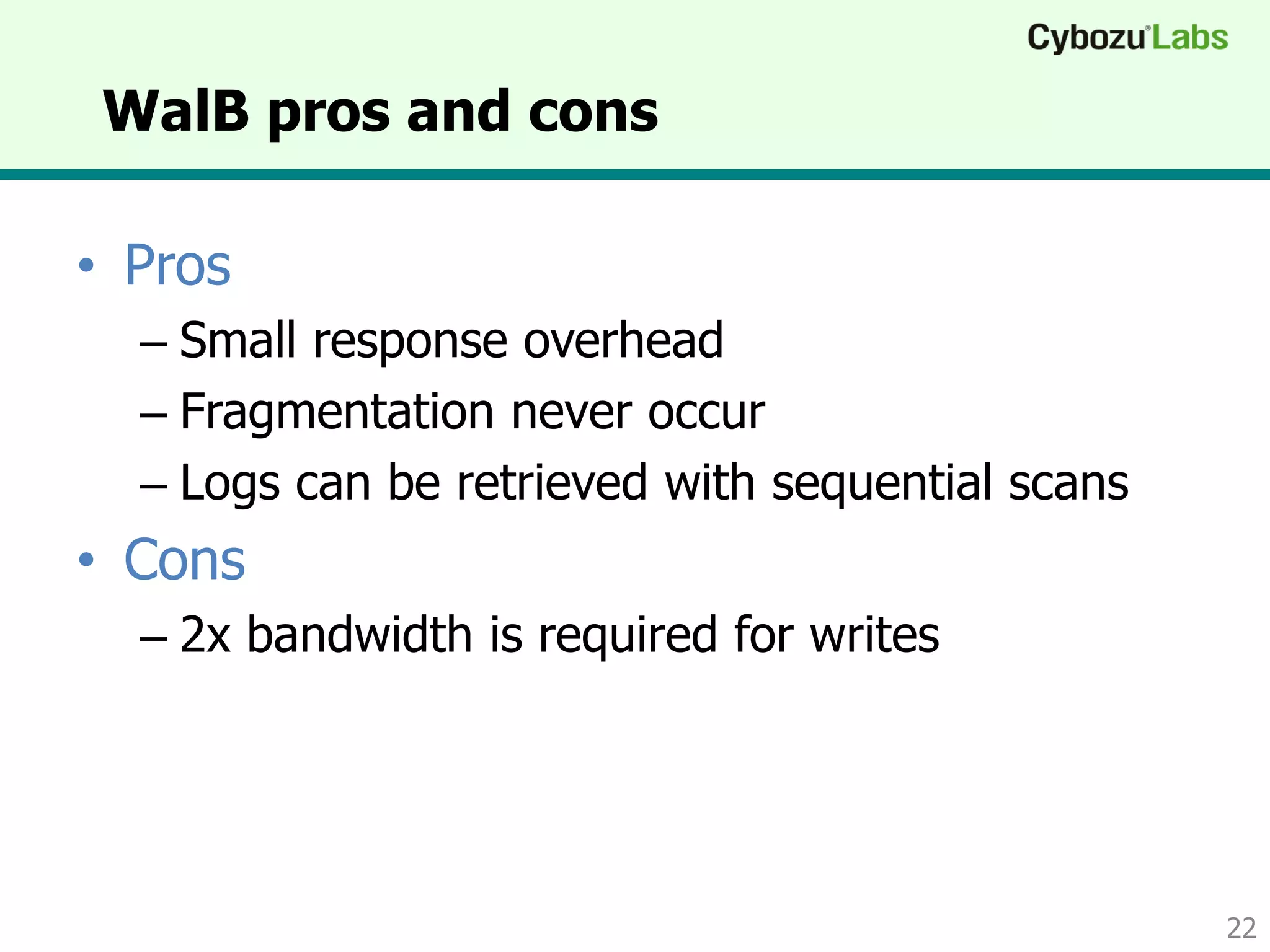
WalB pros and cons
• Pros
– Small response overhead
– Fragmentation never occur
– Logs can be retrieved with sequential scans
• Cons
– 2x bandwidth is required for writes
22
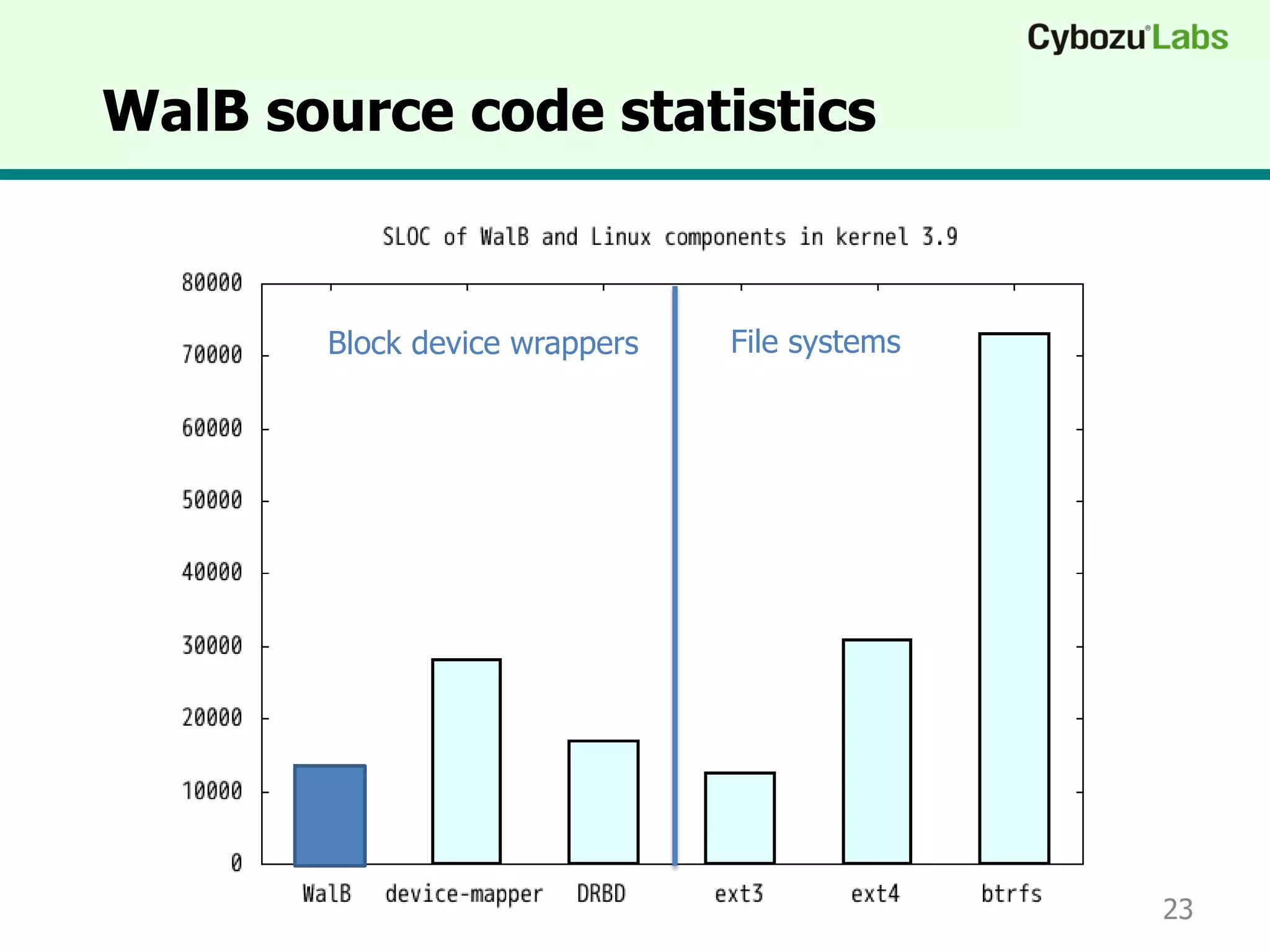
WalB source code statistics
23
File systemsBlock device wrappers
Contents
• Motivation
• Architecture
• Alternative solutions
• Algorithm
• Performance evaluation
• Summary
24
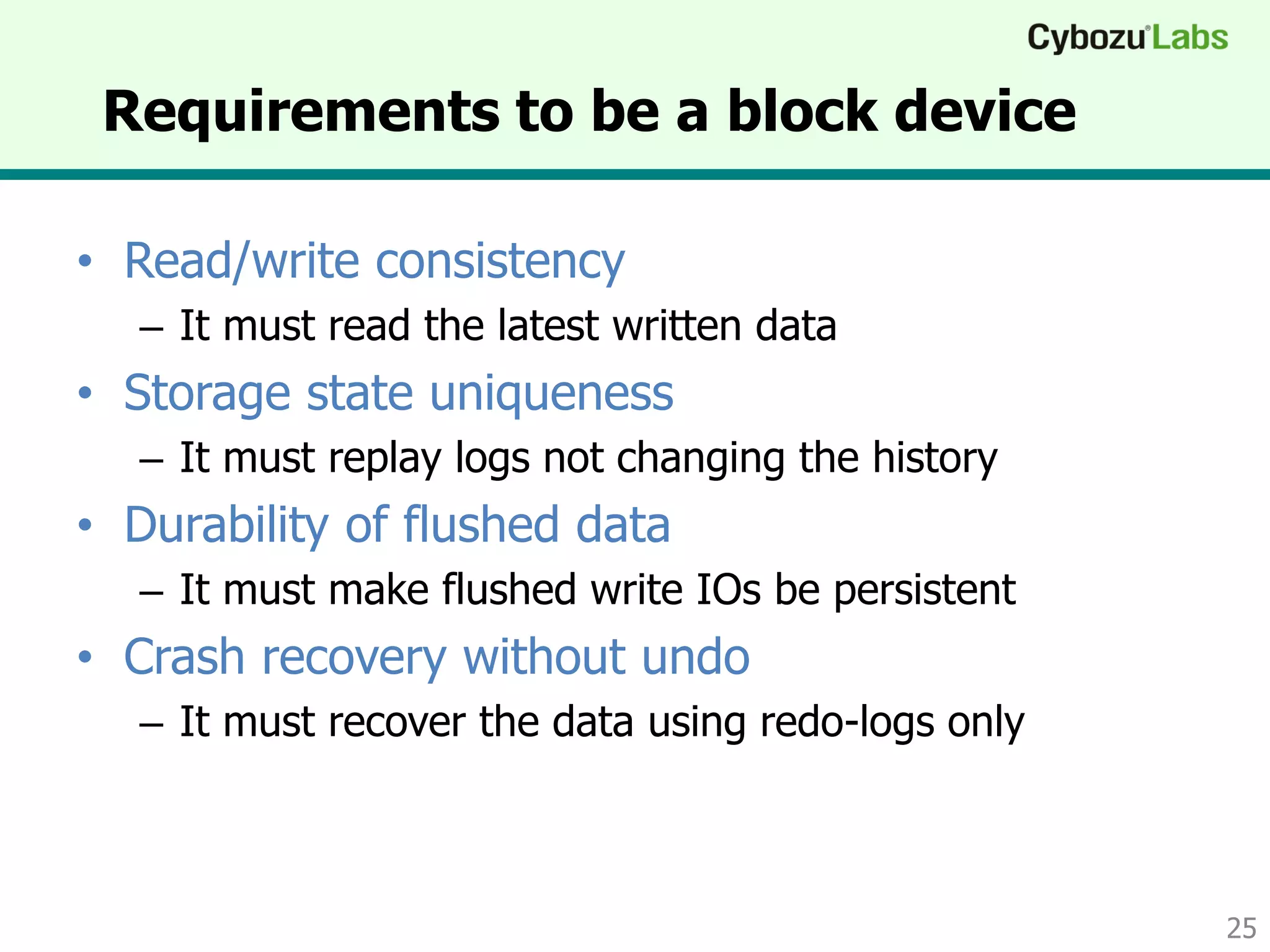
Requirements to be a block device
• Read/write consistency
– It must read the latest written data
• Storage state uniqueness
– It must replay logs not changing the history
• Durability of flushed data
– It must make flushed write IOs be persistent
• Crash recovery without undo
– It must recover the data using redo-logs only
25
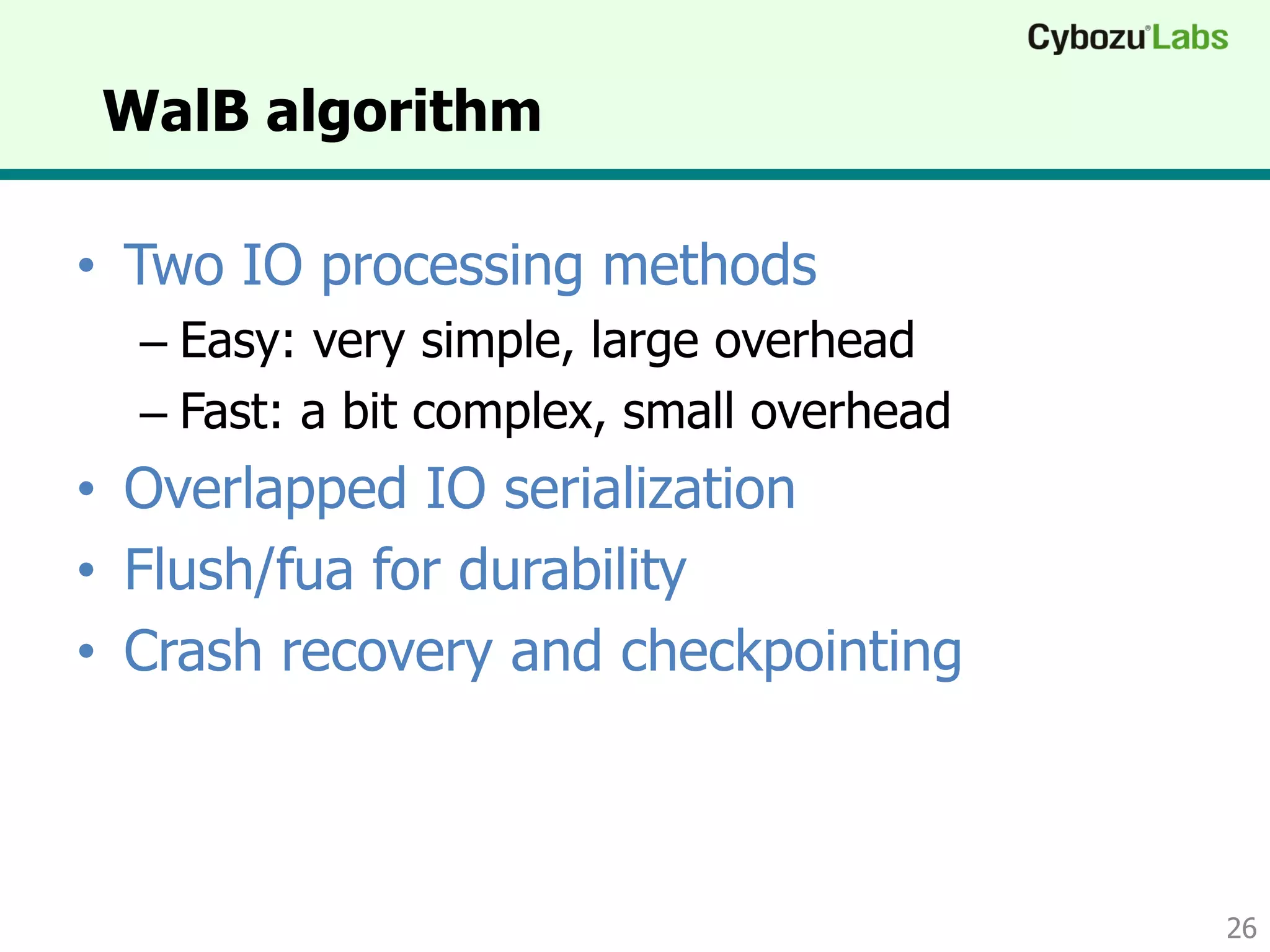
WalB algorithm
• Two IO processing methods
– Easy: very simple, large overhead
– Fast: a bit complex, small overhead
• Overlapped IO serialization
• Flush/fua for durability
• Crash recovery and checkpointing
26
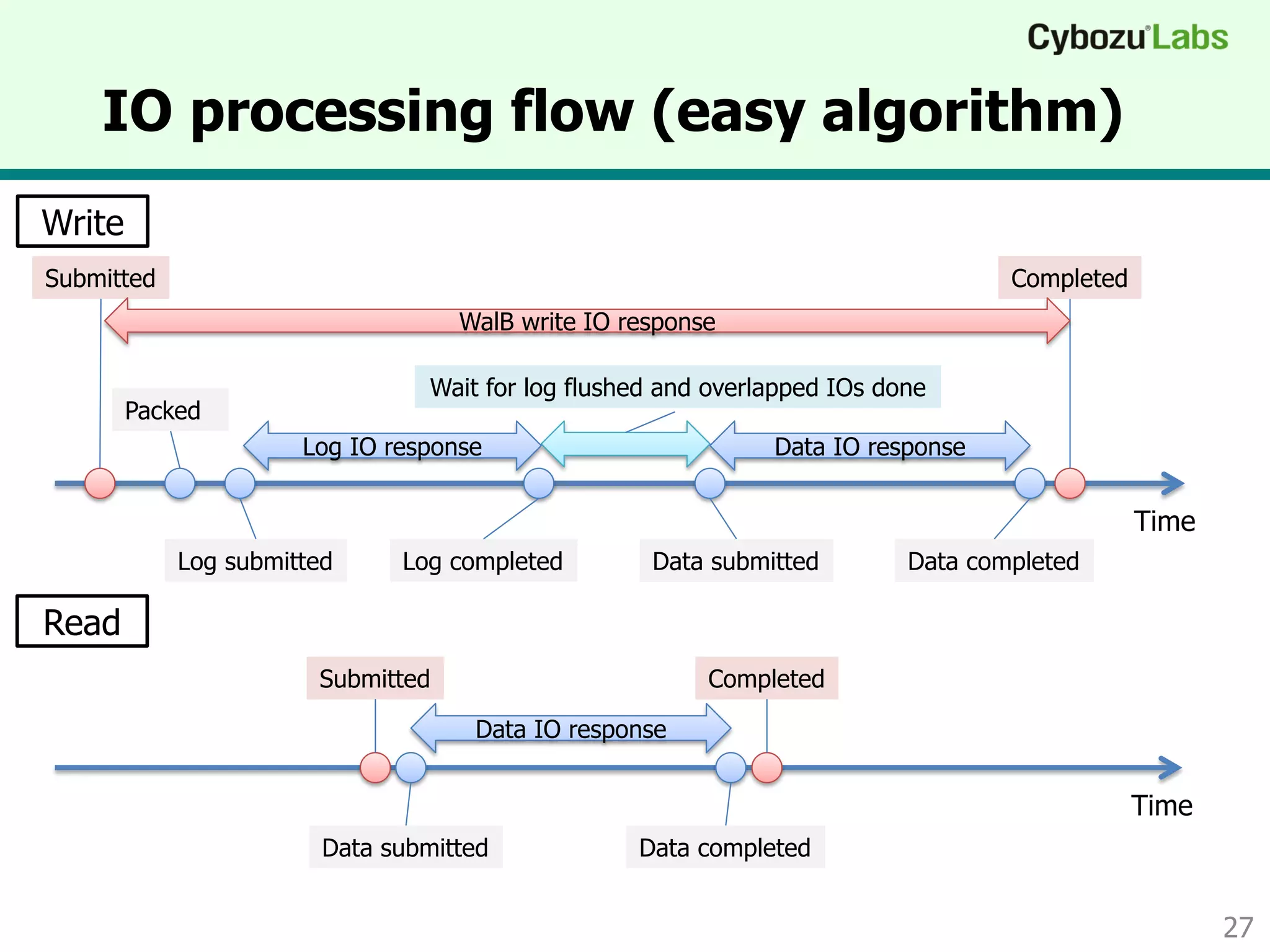
IO processing flow (easy algorithm)
27
Submitted
Time
Completed
Packed
Log submitted Log completed
Wait for log flushed and overlapped IOs done
Data submitted Data completed
Write
Submitted
Time
Completed
Data submitted Data completed
Read
Log IO response Data IO response
WalB write IO response
Data IO response
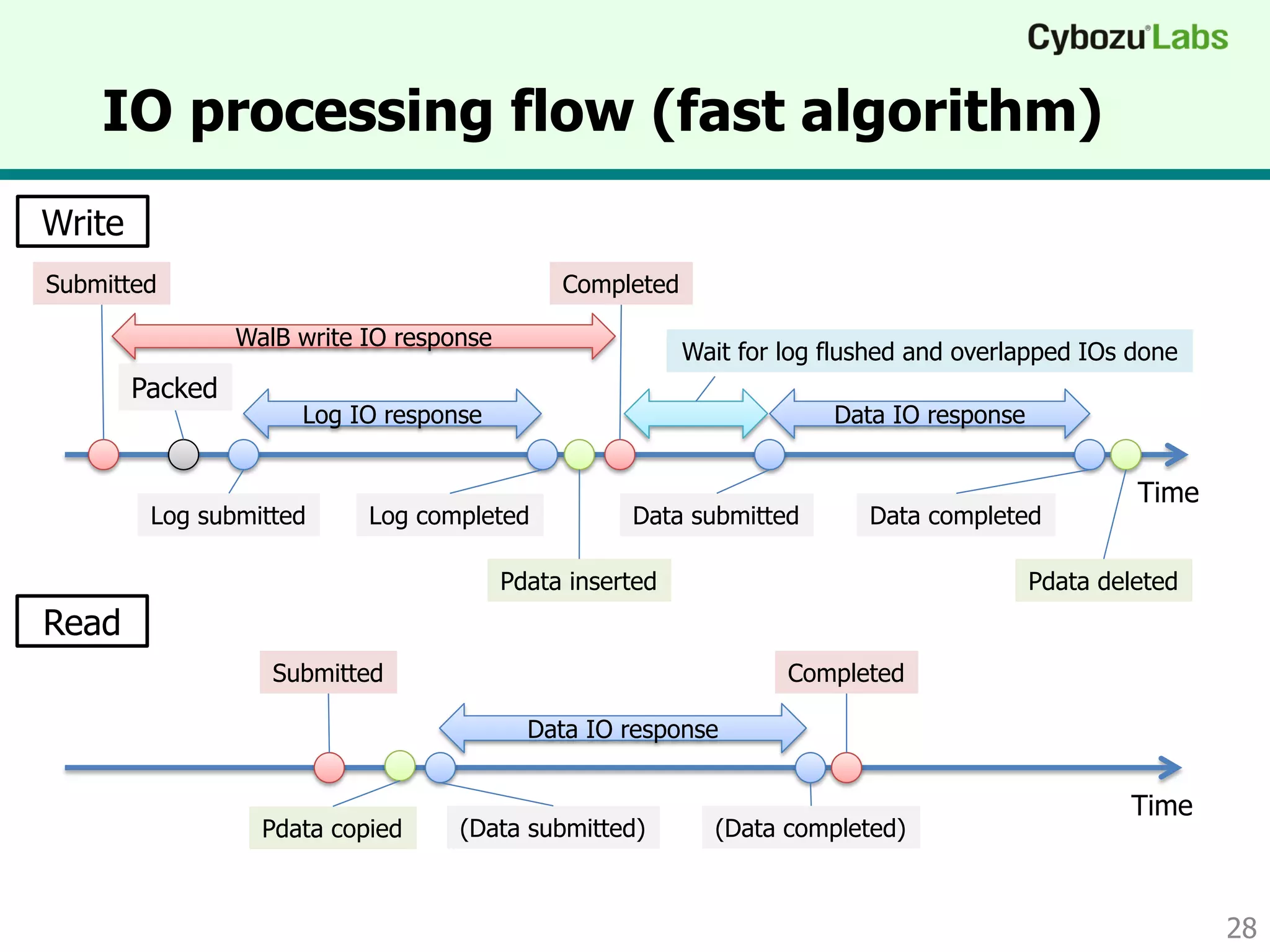
IO processing flow (fast algorithm)
28
Submitted
Time
Completed
Packed
Log submitted Log completed
Wait for log flushed and overlapped IOs done
Data submitted Data completed
Log IO response Data IO response
WalB write IO response
Pdata inserted Pdata deleted
Write
Submitted
Time
Completed
(Data submitted) (Data completed)
Read
Pdata copied
Data IO response
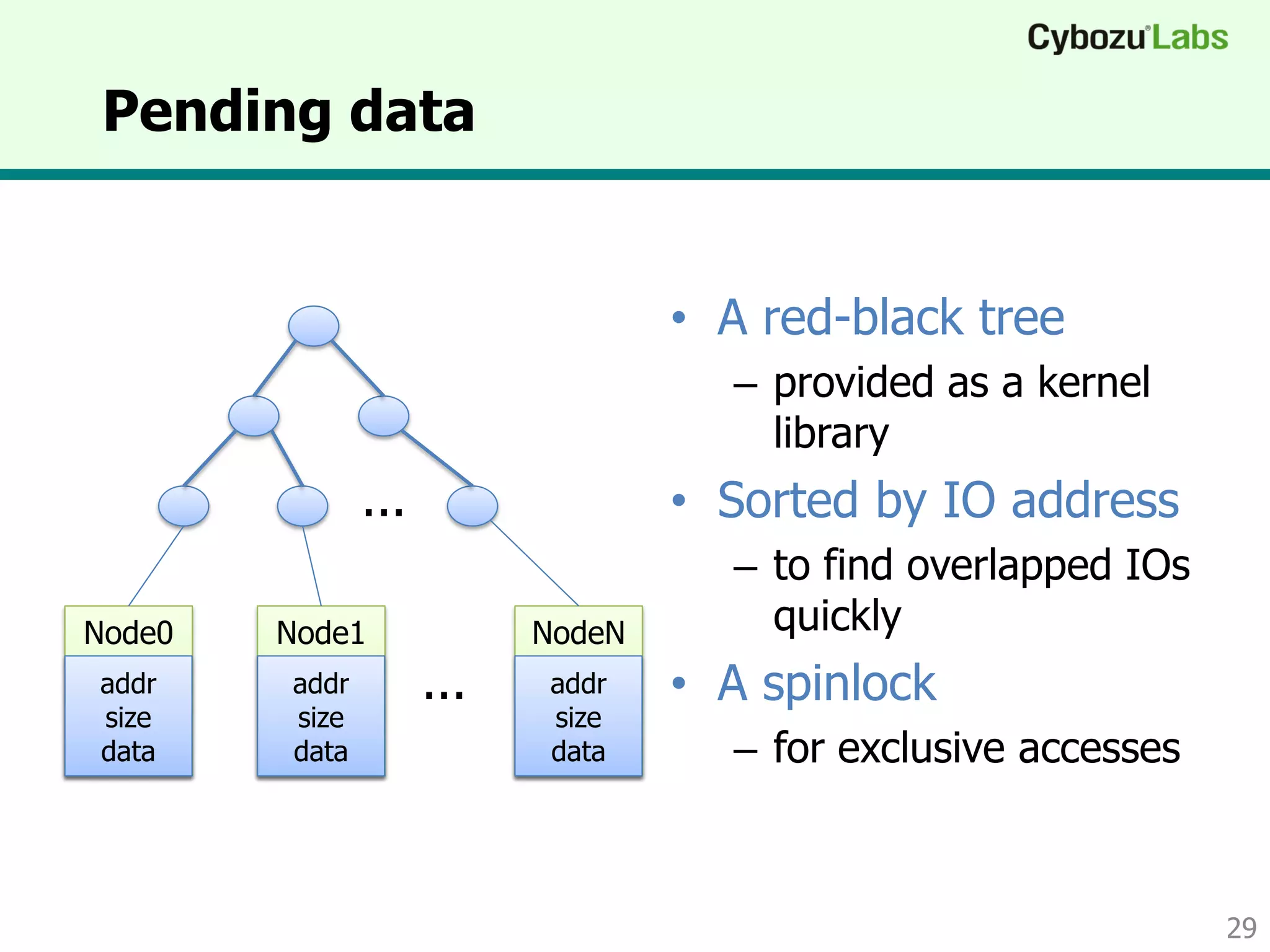
Pending data
• A red-black tree
– provided as a kernel
library
• Sorted by IO address
– to find overlapped IOs
quickly
• A spinlock
– for exclusive accesses
29
Node0
addr
size
data
NodeN
addr
size
data
Node1
addr
size
data
...
...
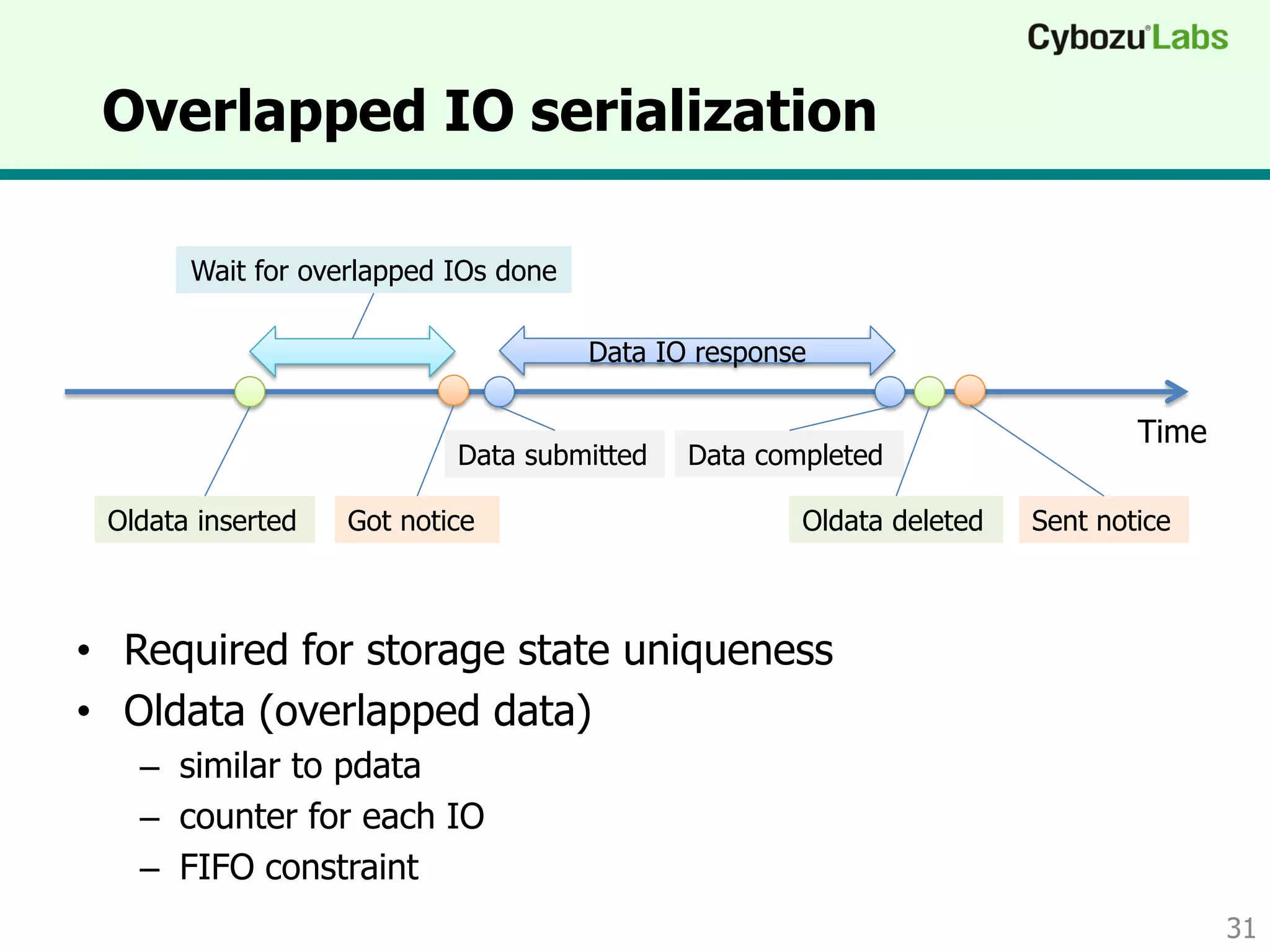
Overlapped IO serialization
• Required for storage state uniqueness
• Oldata (overlapped data)
– similar to pdata
– counter for each IO
– FIFO constraint
31
Time
Wait for overlapped IOs done
Data submitted Data completed
Data IO response
Oldata inserted Oldata deletedGot notice Sent notice
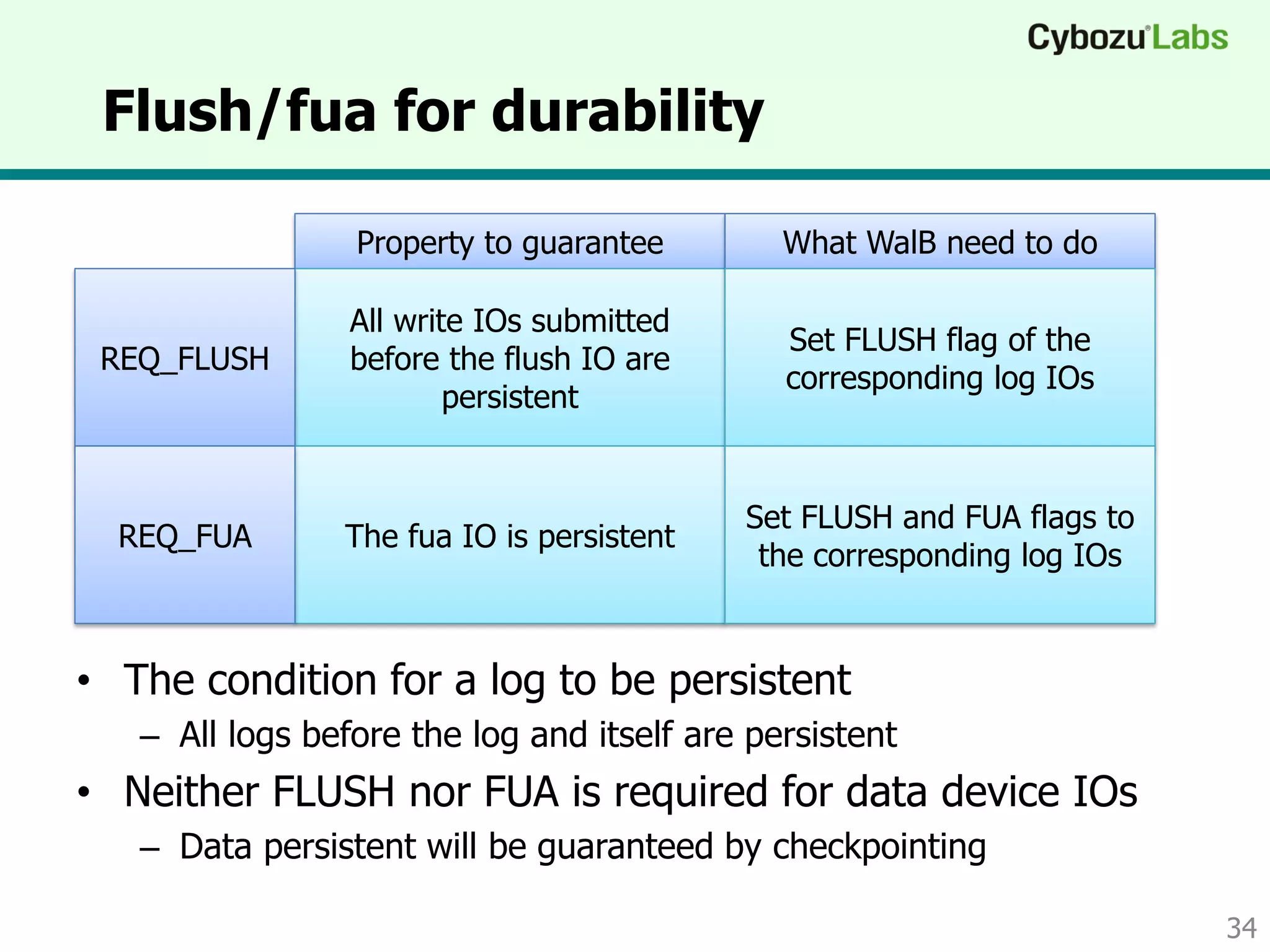
Flush/fua for durability
• The condition for a log to be persistent
– All logs before the log and itself are persistent
• Neither FLUSH nor FUA is required for data device IOs
– Data device persistence will be guaranteed by checkpointing
34
Property to guarantee
All write IOs submitted
before the flush IO are
persistent
REQ_FLUSH
What WalB need to do
The fua IO is persistentREQ_FUA
Set FLUSH flag of the
corresponding log IOs
Set FLUSH and FUA flags to
the corresponding log IOs
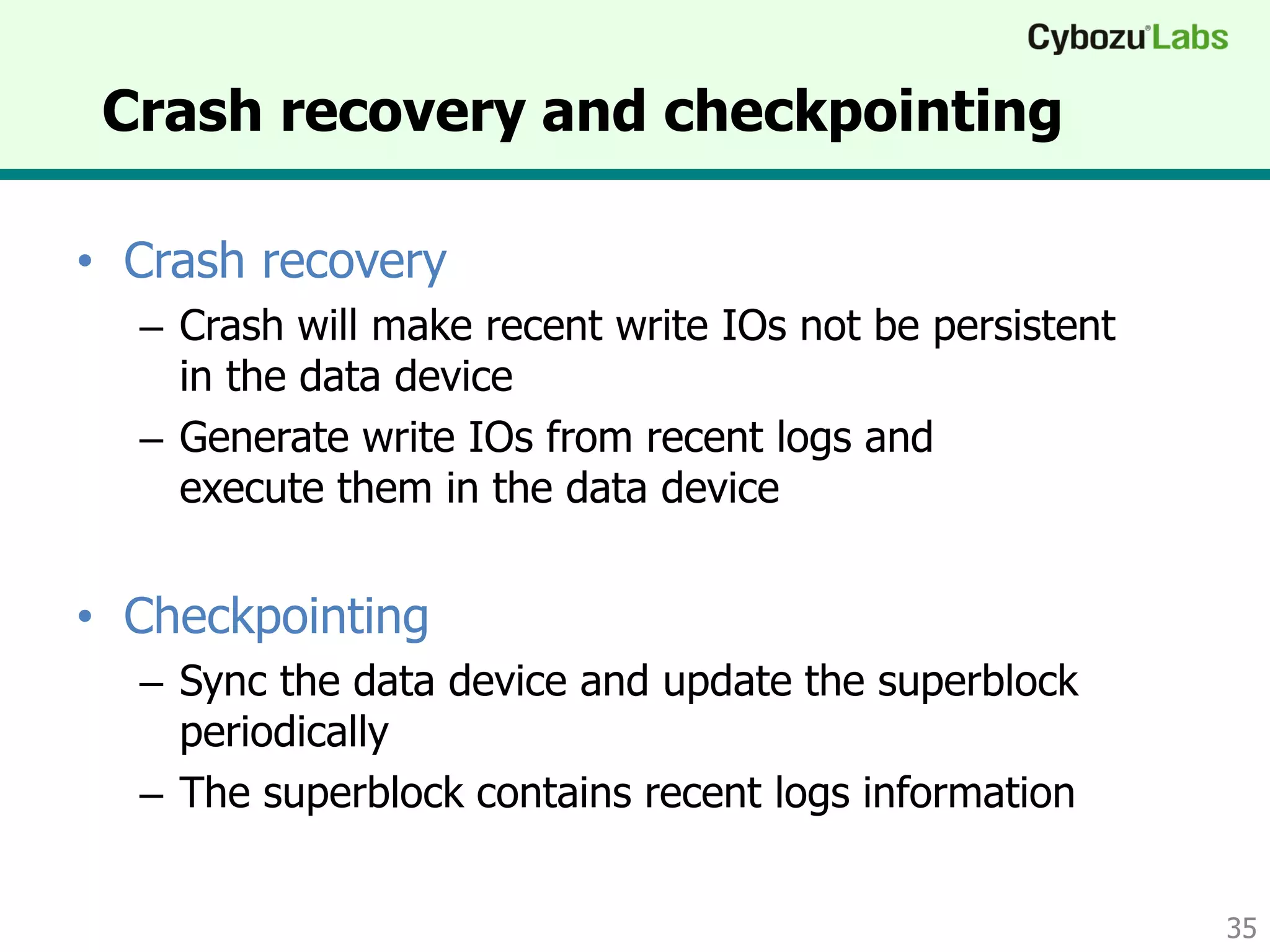
Crash recovery and checkpointing
• Crash recovery
– Crash will make recent write IOs not be persistent
in the data device
– Generate write IOs from recent logs and
execute them in the data device
• Checkpointing
– Sync the data device and update the superblock
periodically
– The superblock contains recent logs information
35
Contents
• Motivation
• Architecture
• Alternative solutions
• Algorithm
• Performance evaluation
• Summary
36
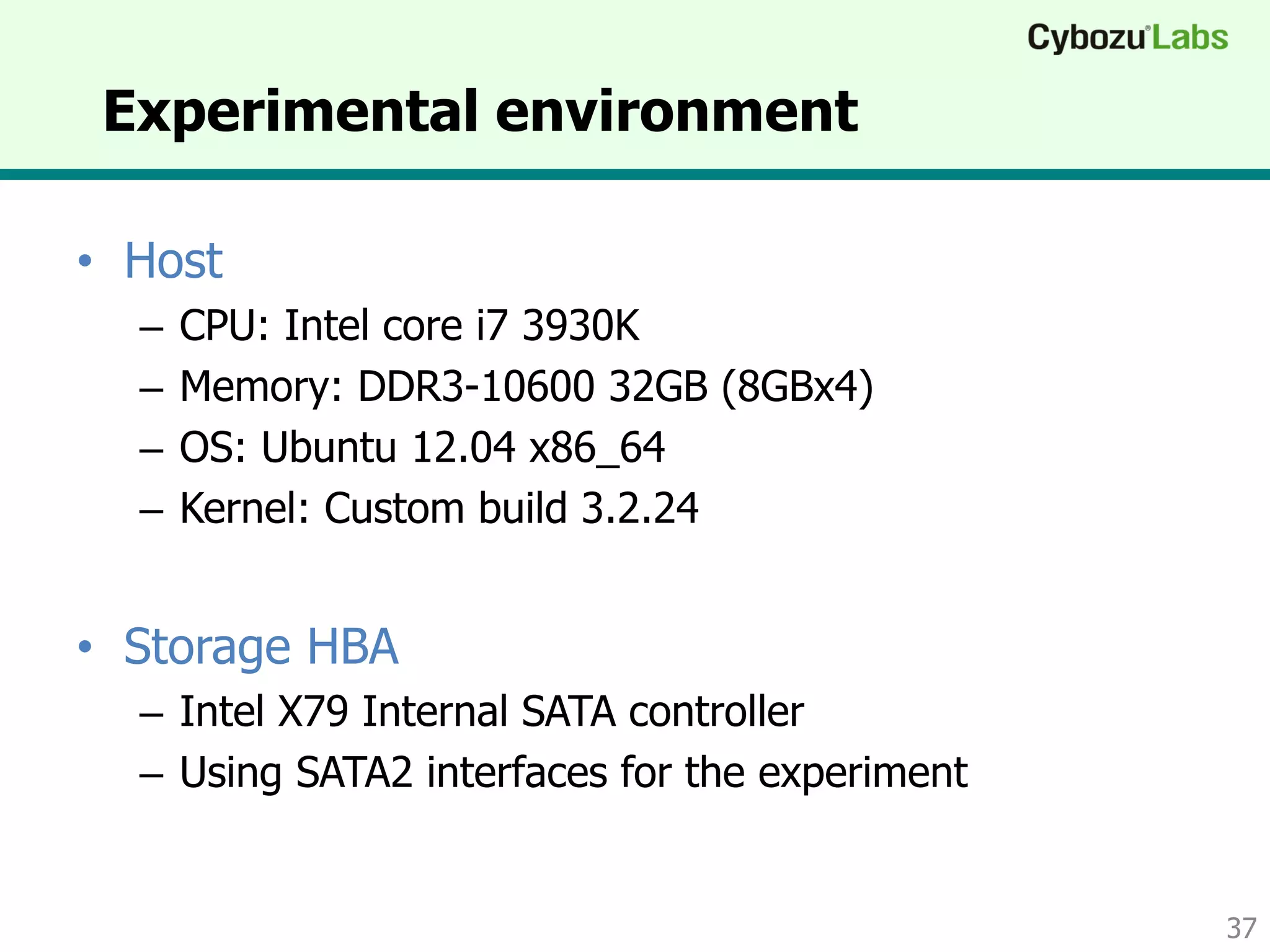
Experimental environment
• Host
– CPU: Intel core i7 3930K
– Memory: DDR3-10600 32GB (8GBx4)
– OS: Ubuntu 12.04 x86_64
– Kernel: Custom build 3.2.24
• Storage HBA
– Intel X79 Internal SATA controller
– Using SATA2 interfaces for the experiment
37
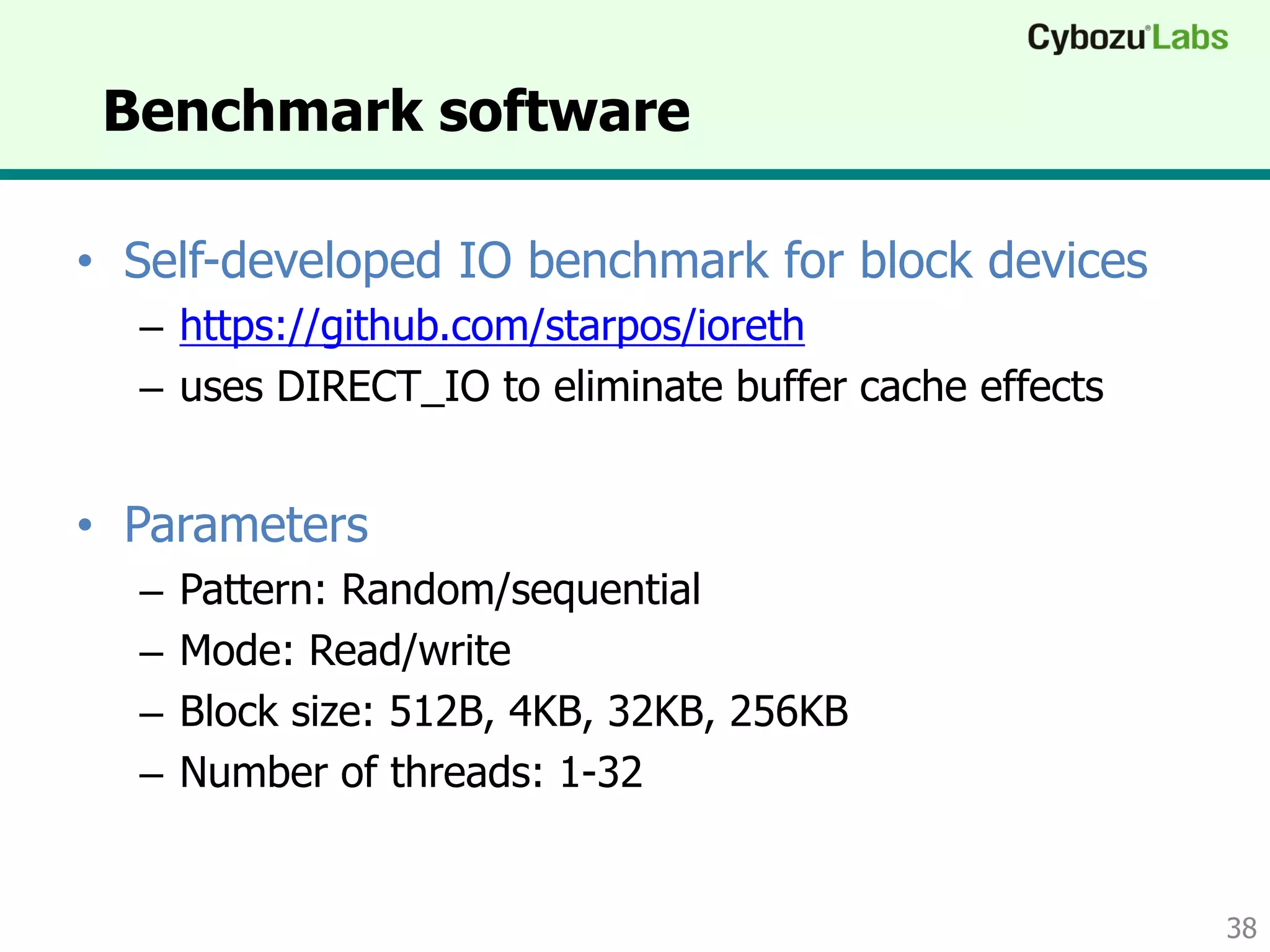
Benchmark software
• Self-developed IO benchmark for block devices
– https://github.com/starpos/ioreth
– uses DIRECT_IO to eliminate buffer cache effects
• Parameters
– Pattern: Random/sequential
– Mode: Read/write
– Block size: 512B, 4KB, 32KB, 256KB
– Concurrency: 1-32
38
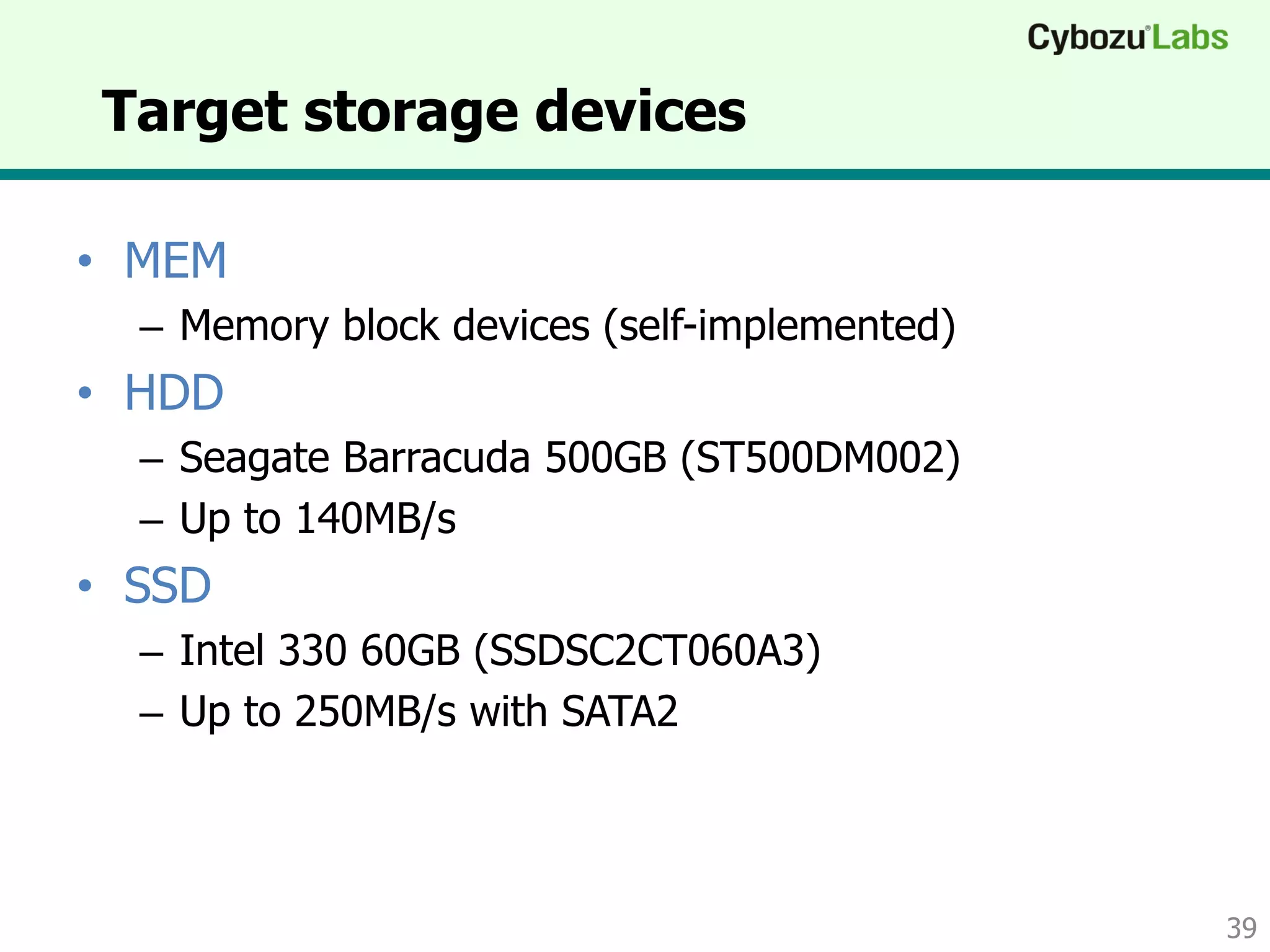
Target storage devices
• MEM
– Memory block devices (self-implemented)
• HDD
– Seagate Barracuda 500GB (ST500DM002)
– Up to 140MB/s
• SSD
– Intel 330 60GB (SSDSC2CT060A3)
– Up to 250MB/s with SATA2
39
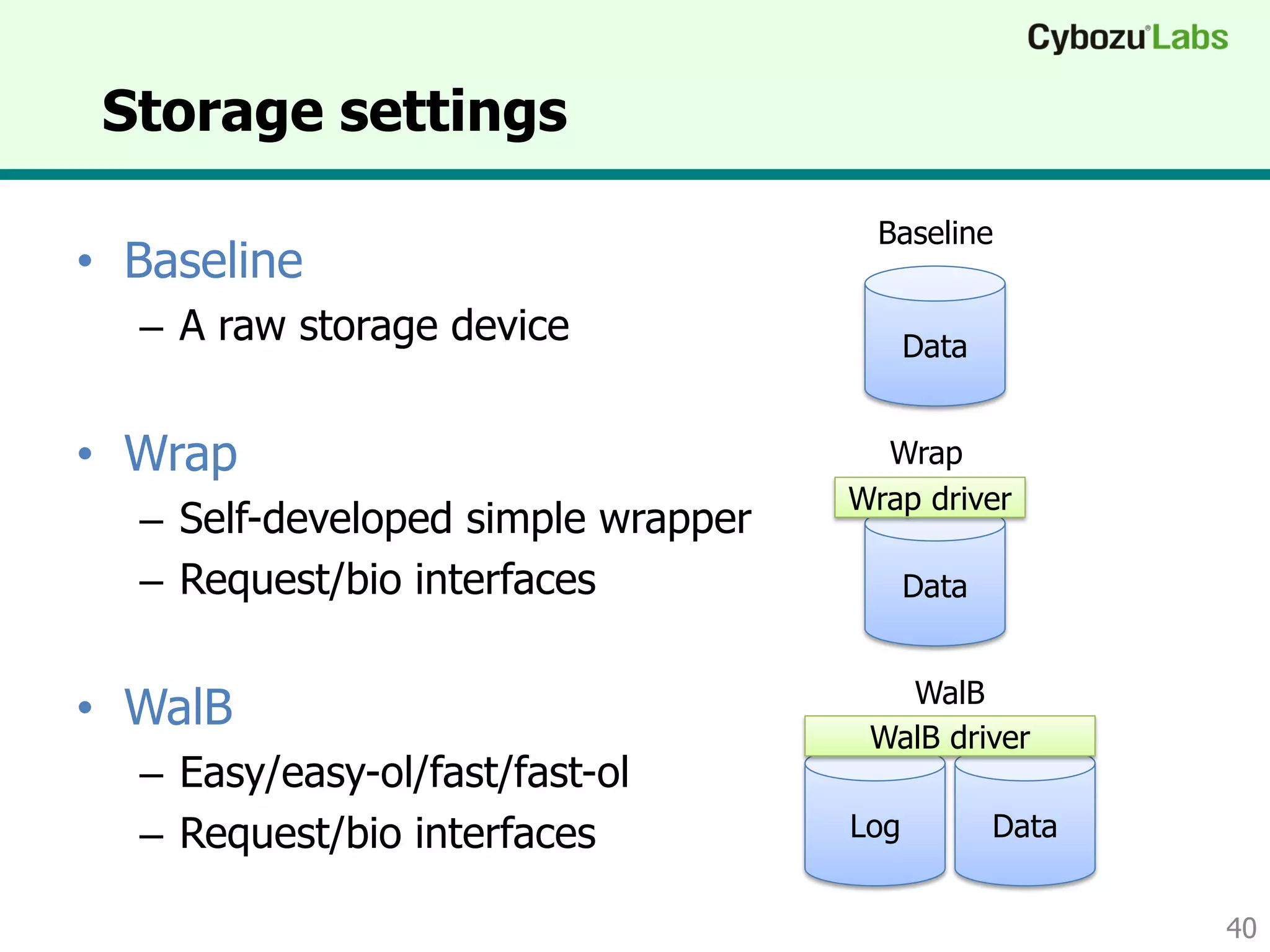
Storage settings
• Baseline
– A raw storage device
• Wrap
– Self-developed simple wrapper
– Request/bio interfaces
• WalB
– Easy/easy-ol/fast/fast-ol
– Request/bio interfaces
40
Log Data
Data
Baseline
WalB driver
WalB
Data
Wrap
Wrap driver
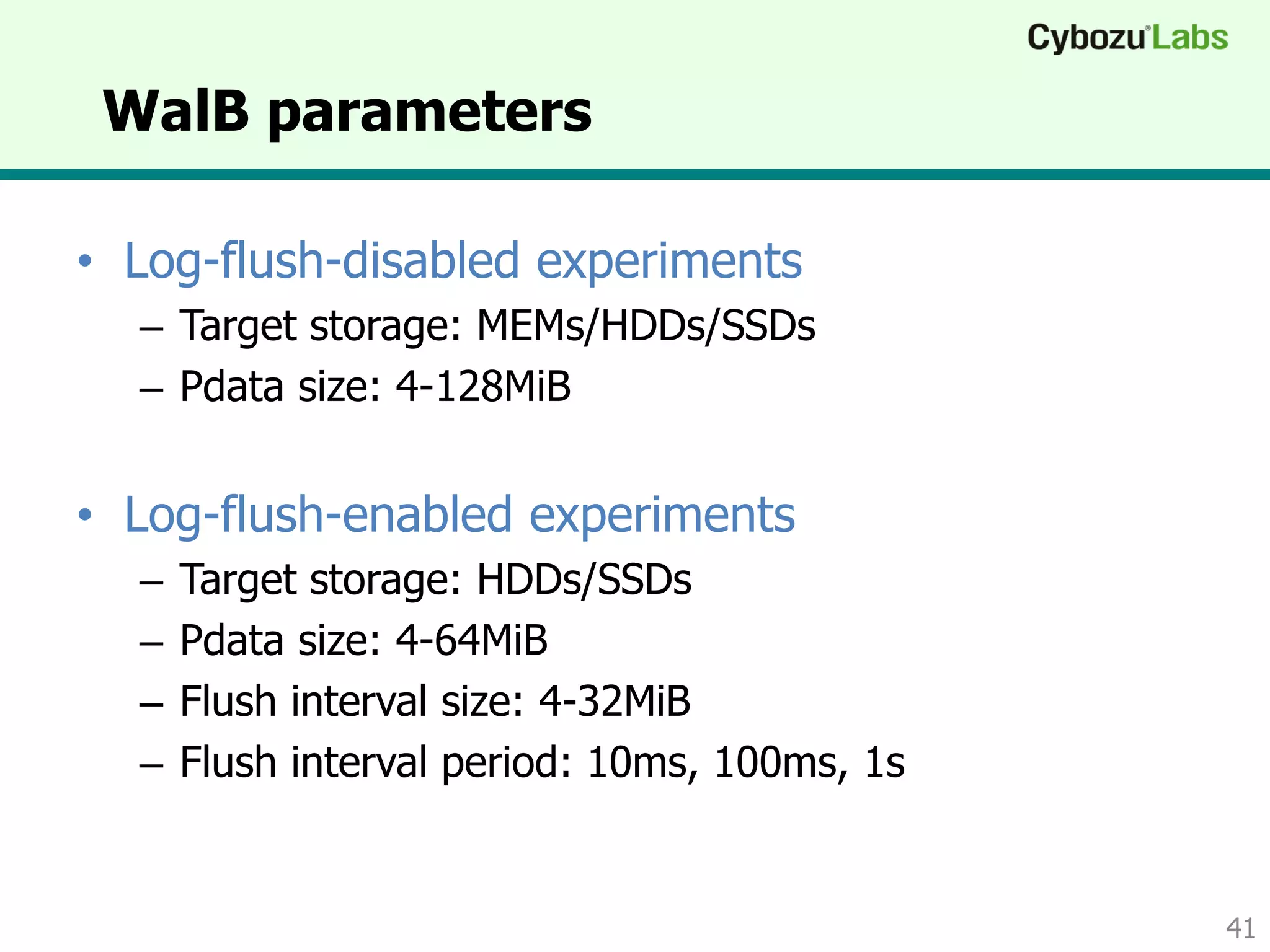
WalB parameters
• Log-flush-disabled experiments
– Target storage: MEMs/HDDs/SSDs
– Pdata size: 4-128MiB
• Log-flush-enabled experiments
– Target storage: HDDs/SSDs
– Pdata size: 4-64MiB
– Flush interval size: 4-32MiB
– Flush interval period: 10ms, 100ms, 1s
41
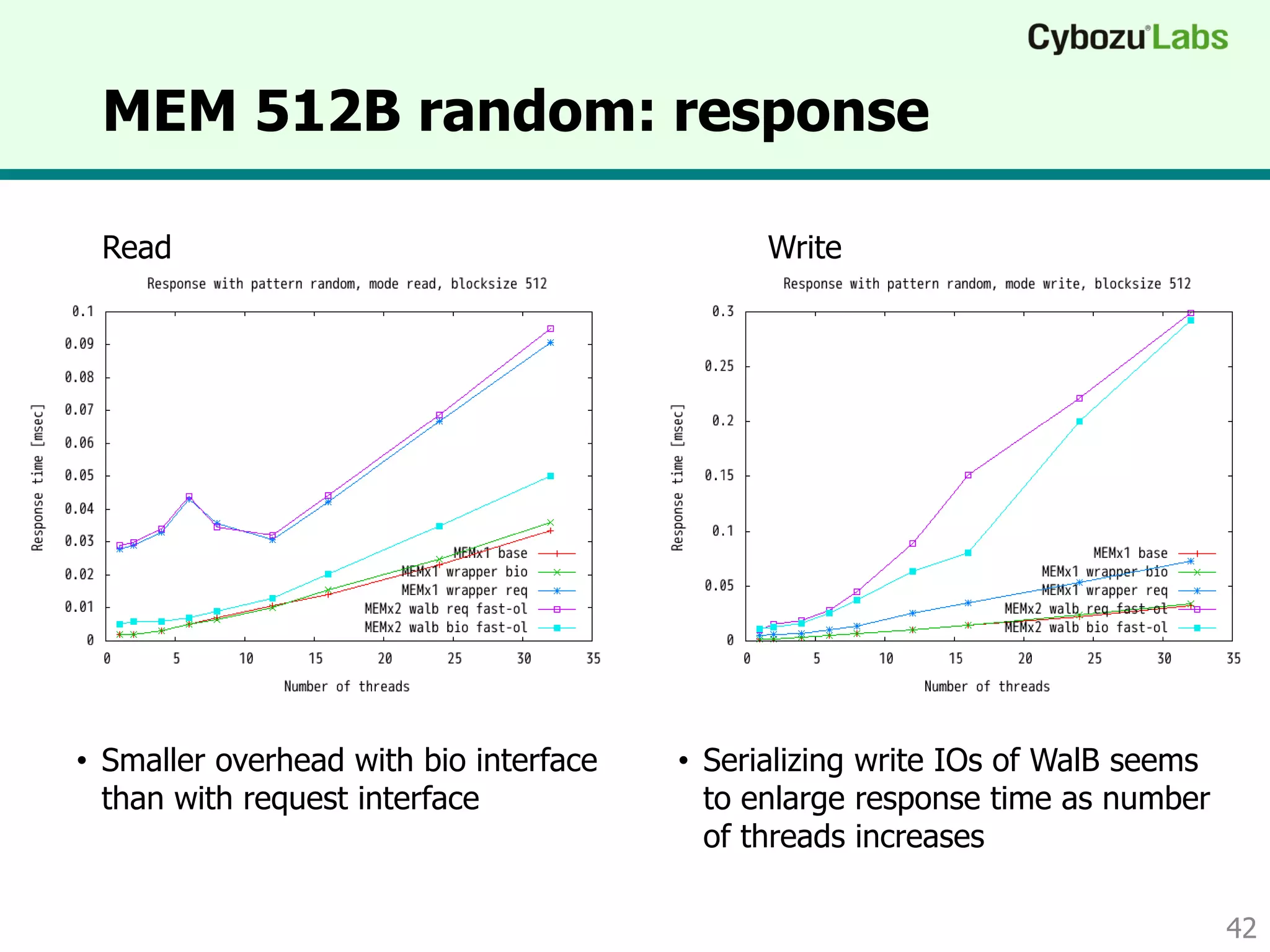
MEM 512B random: response
42
Read Write
• Smaller overhead with bio interface
than with request interface
• Serializing write IOs of WalB seems
to enlarge response time as number
of threads increases
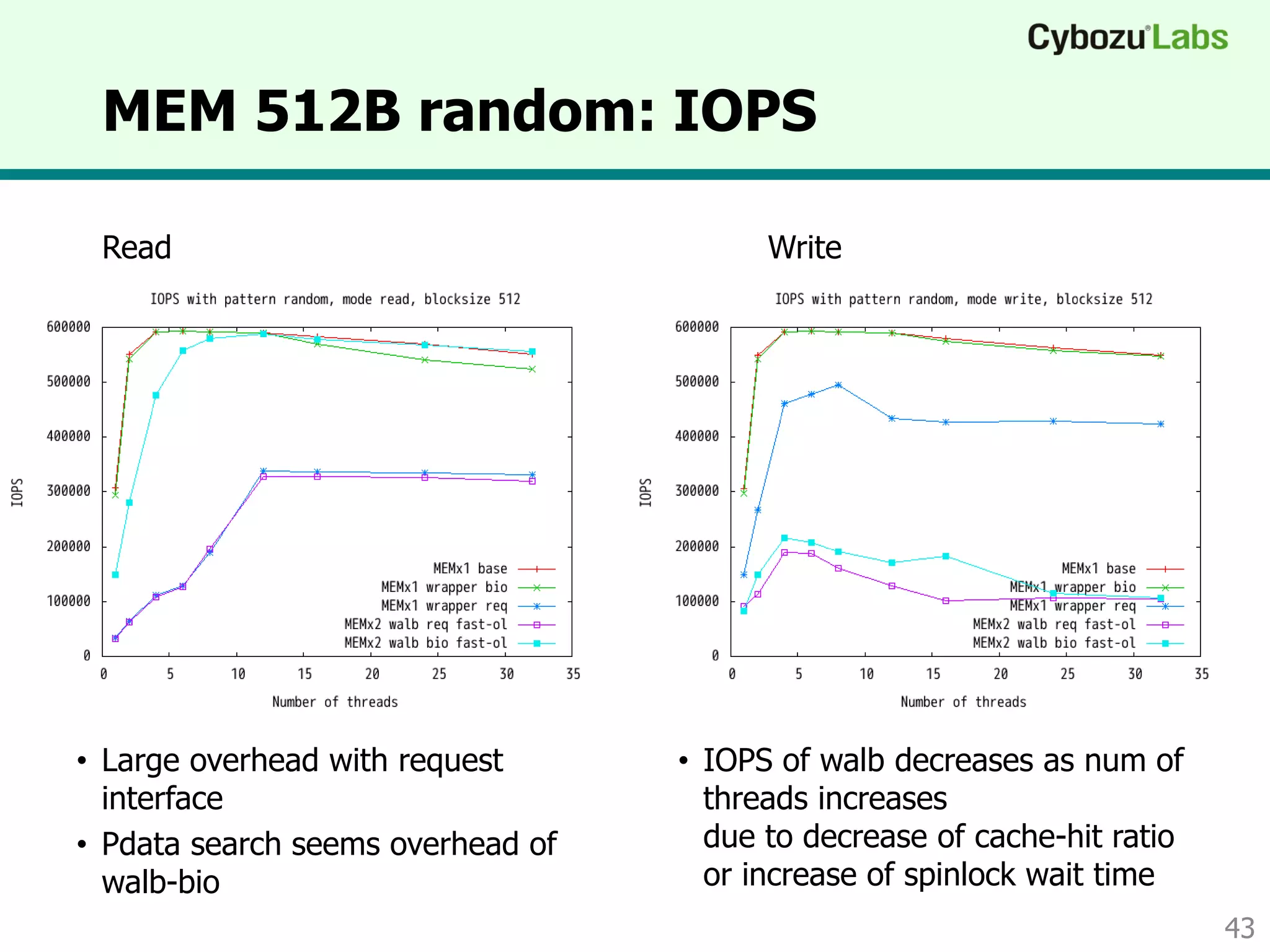
MEM 512B random: IOPS
43
Read Write
• Large overhead with request
interface
• Pdata search seems overhead of
walb-bio
• IOPS of walb decreases as num of
threads increases
due to decrease of cache-hit ratio
or increase of spinlock wait time
Queue length Queue length
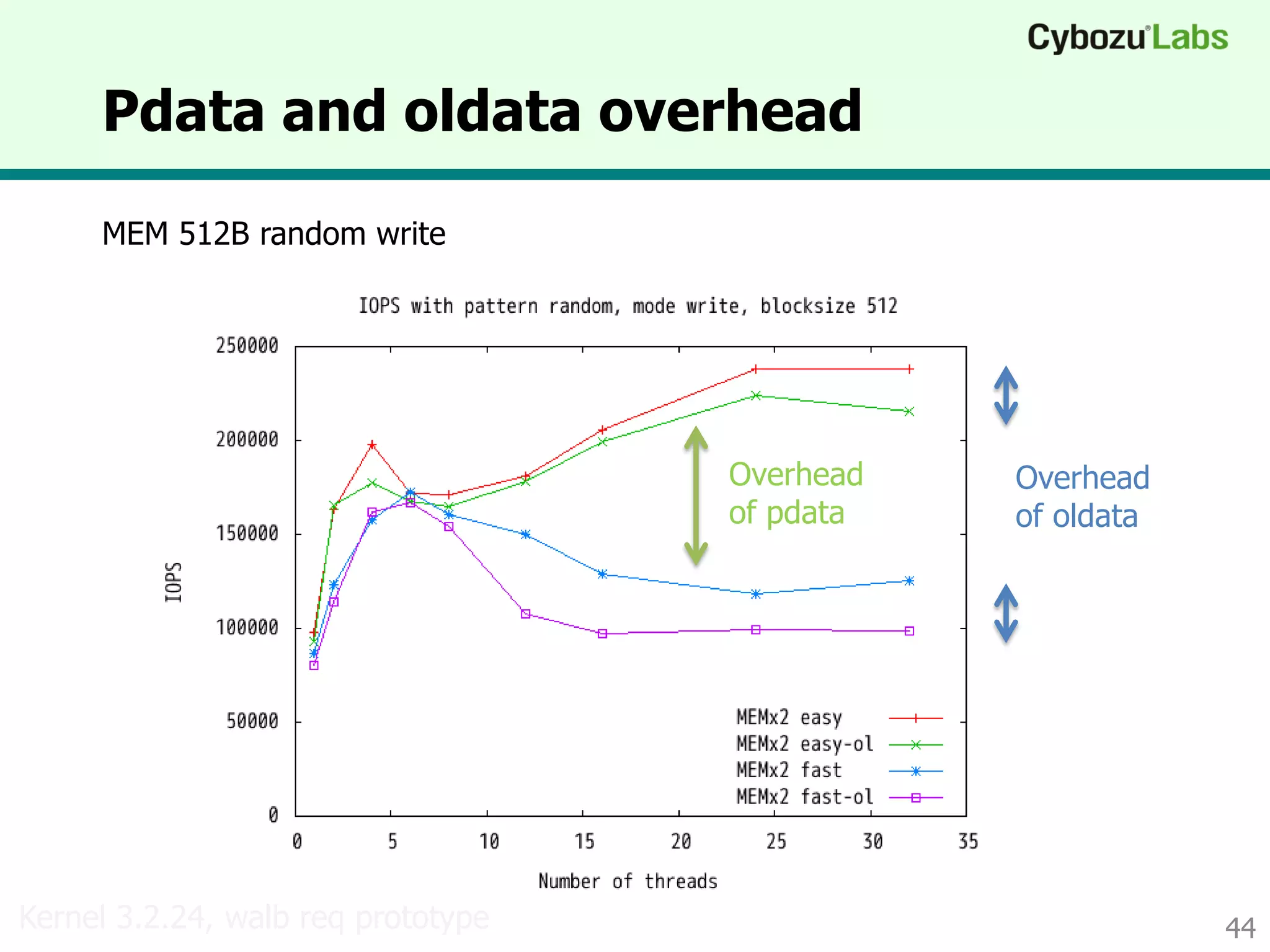
Pdata and oldata overhead
44
MEM 512B random write
Kernel 3.2.24, walb req prototype
Overhead
of oldata
Overhead
of pdata
Queue length
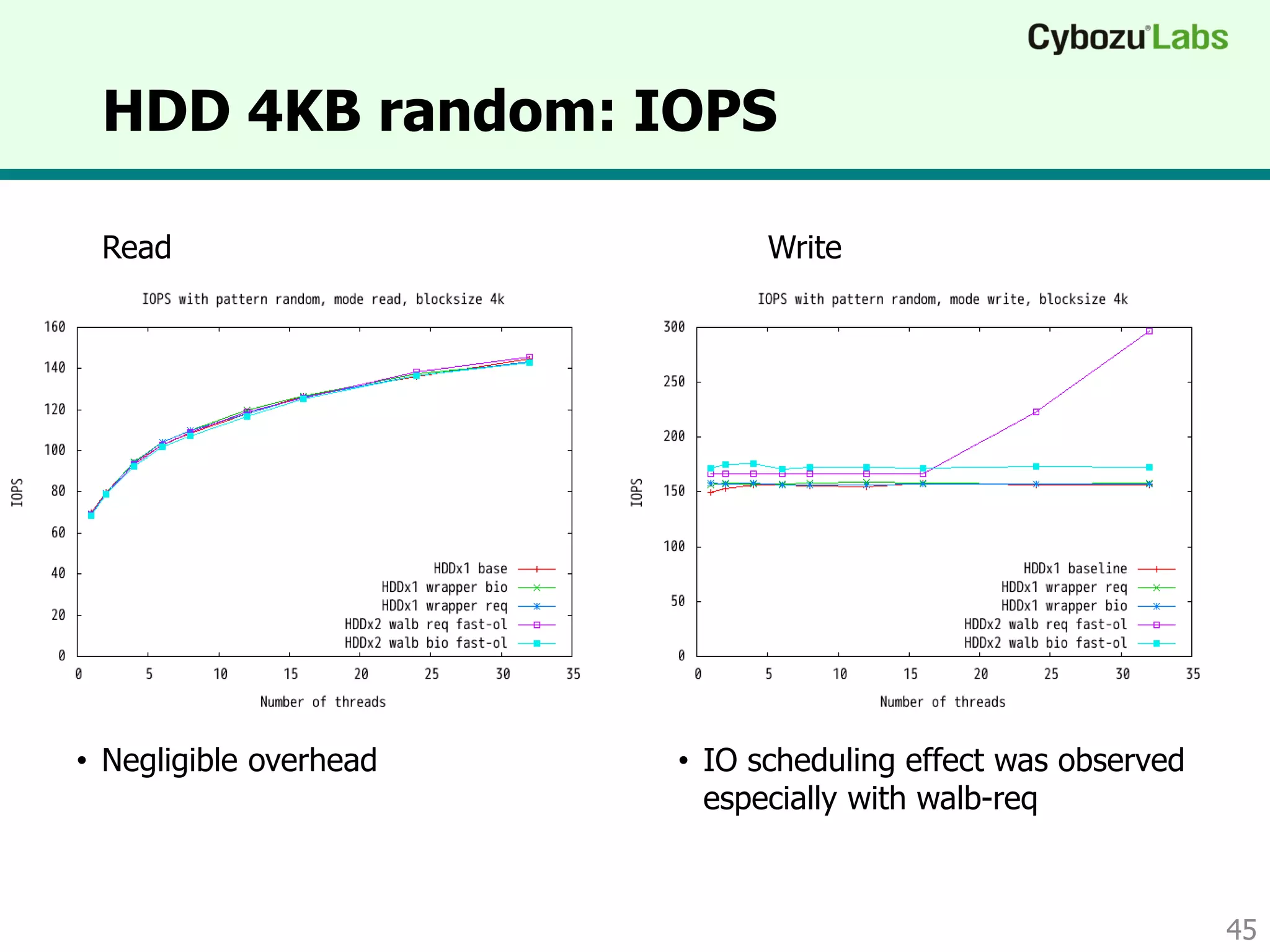
HDD 4KB random: IOPS
45
Read Write
• Negligible overhead • IO scheduling effect was observed
especially with walb-req
Queue length Queue length
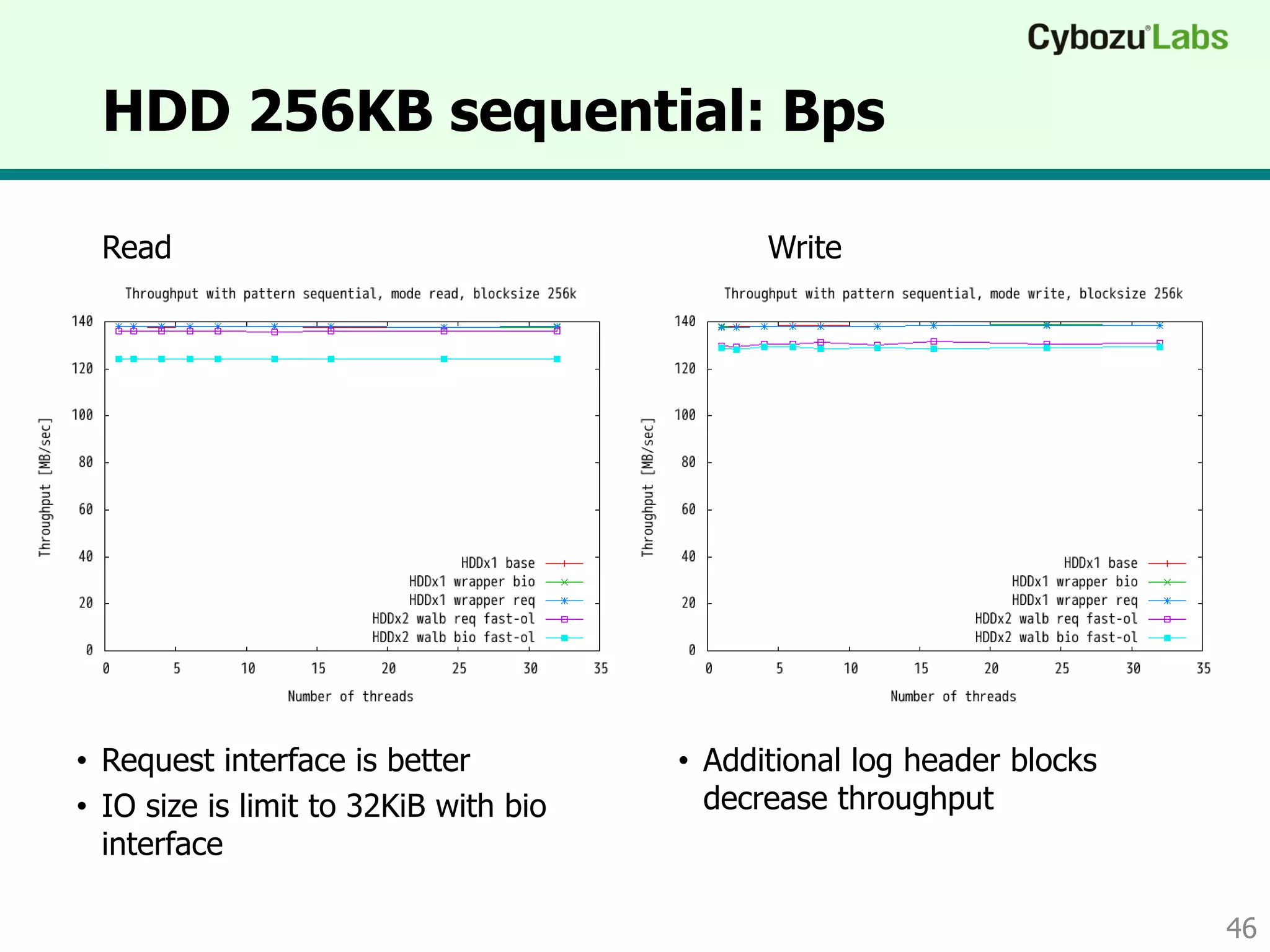
HDD 256KB sequential: Bps
46
Read Write
• Request interface is better
• IO size is limit to 32KiB with bio
interface
• Additional log header blocks
decrease throughput
Queue length Queue length
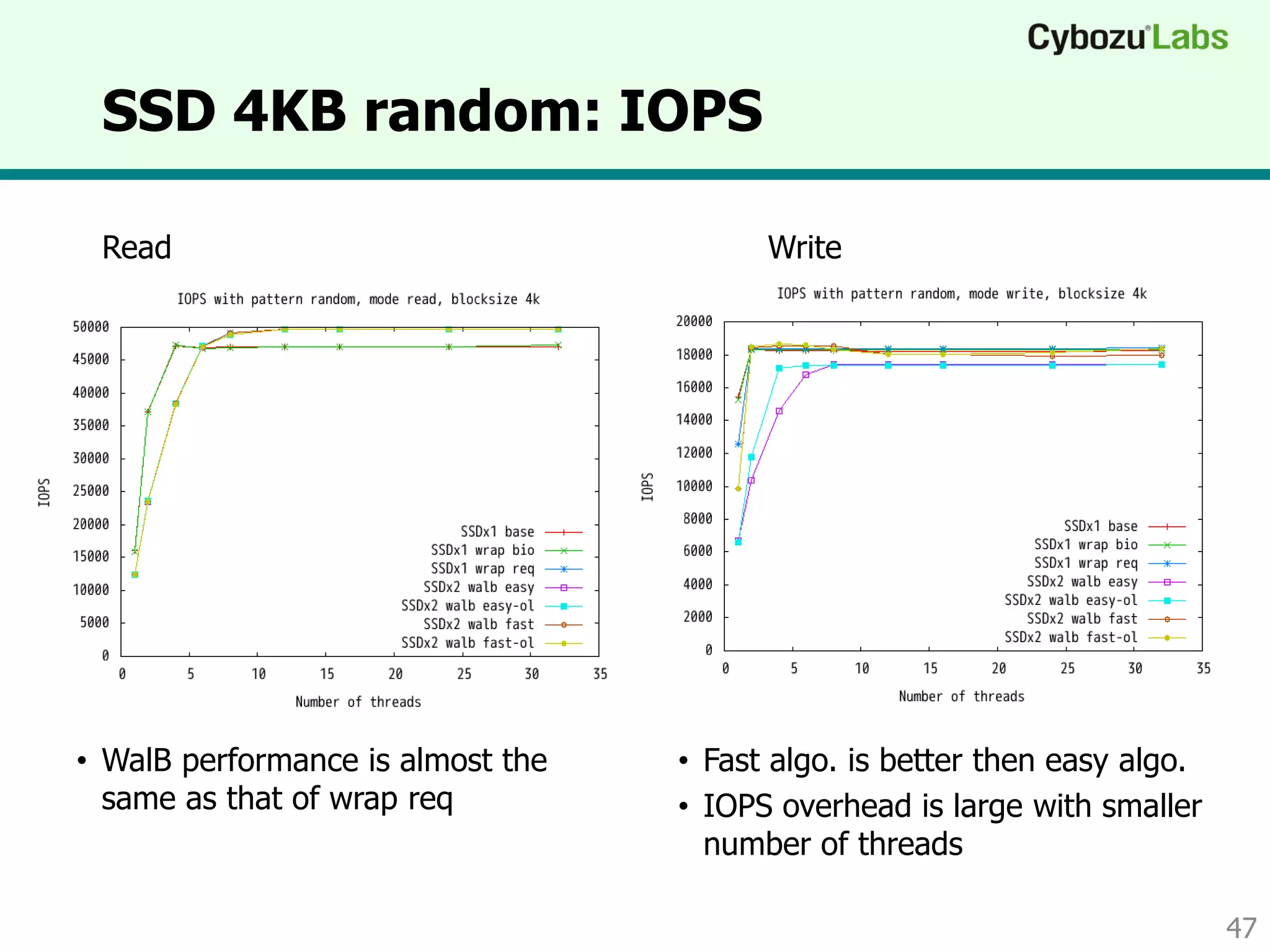
SSD 4KB random: IOPS
47
Read Write
• WalB performance is almost the
same as that of wrap req
• Fast algo. is better then easy algo.
• IOPS overhead is large with smaller
number of threads
Queue length Queue length
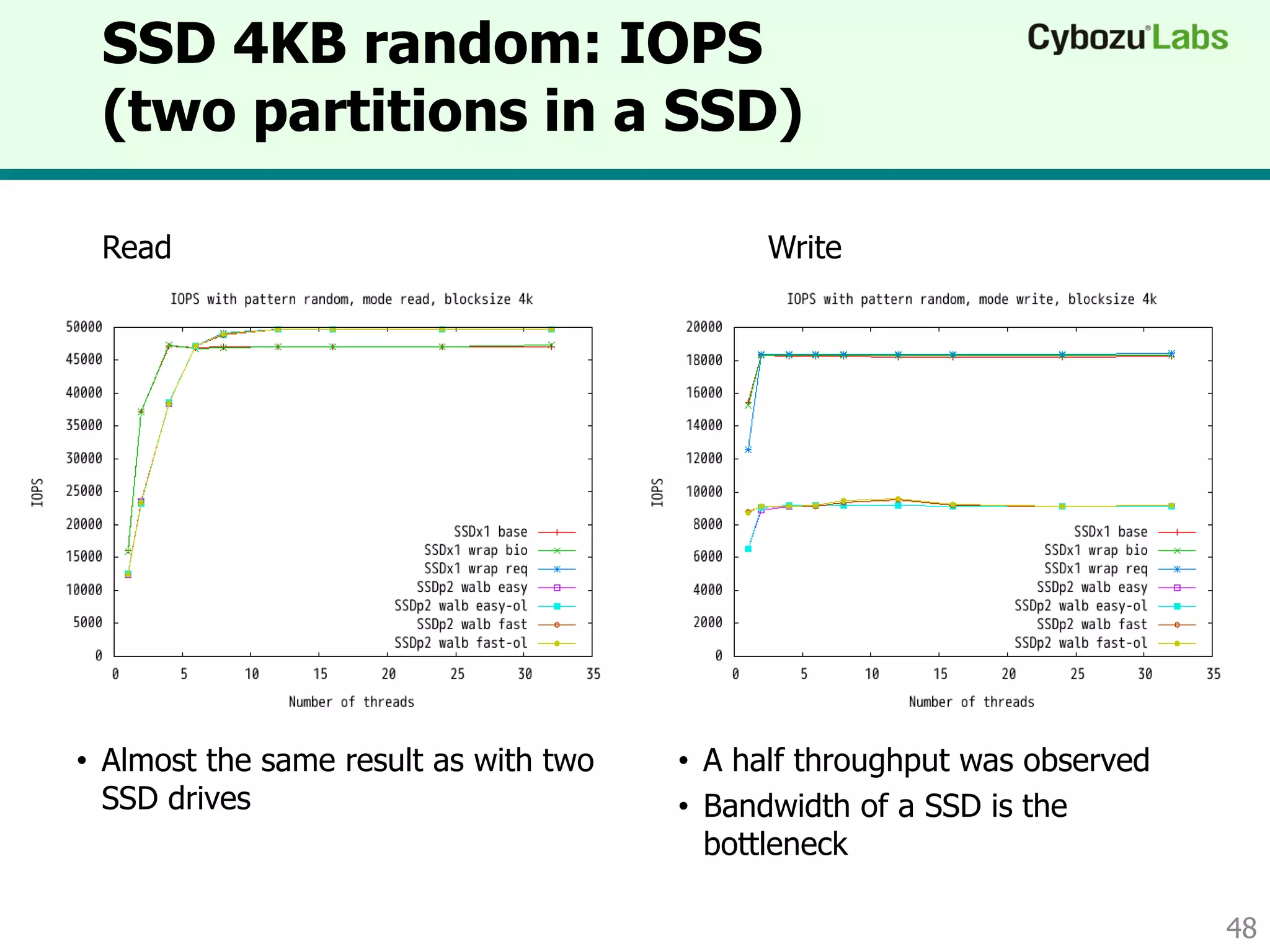
SSD 4KB random: IOPS
(two partitions in a SSD)
48
Read Write
• Almost the same result as with two
SSD drives
• A half throughput was observed
• Bandwidth of a SSD is the
bottleneck
Queue length Queue length
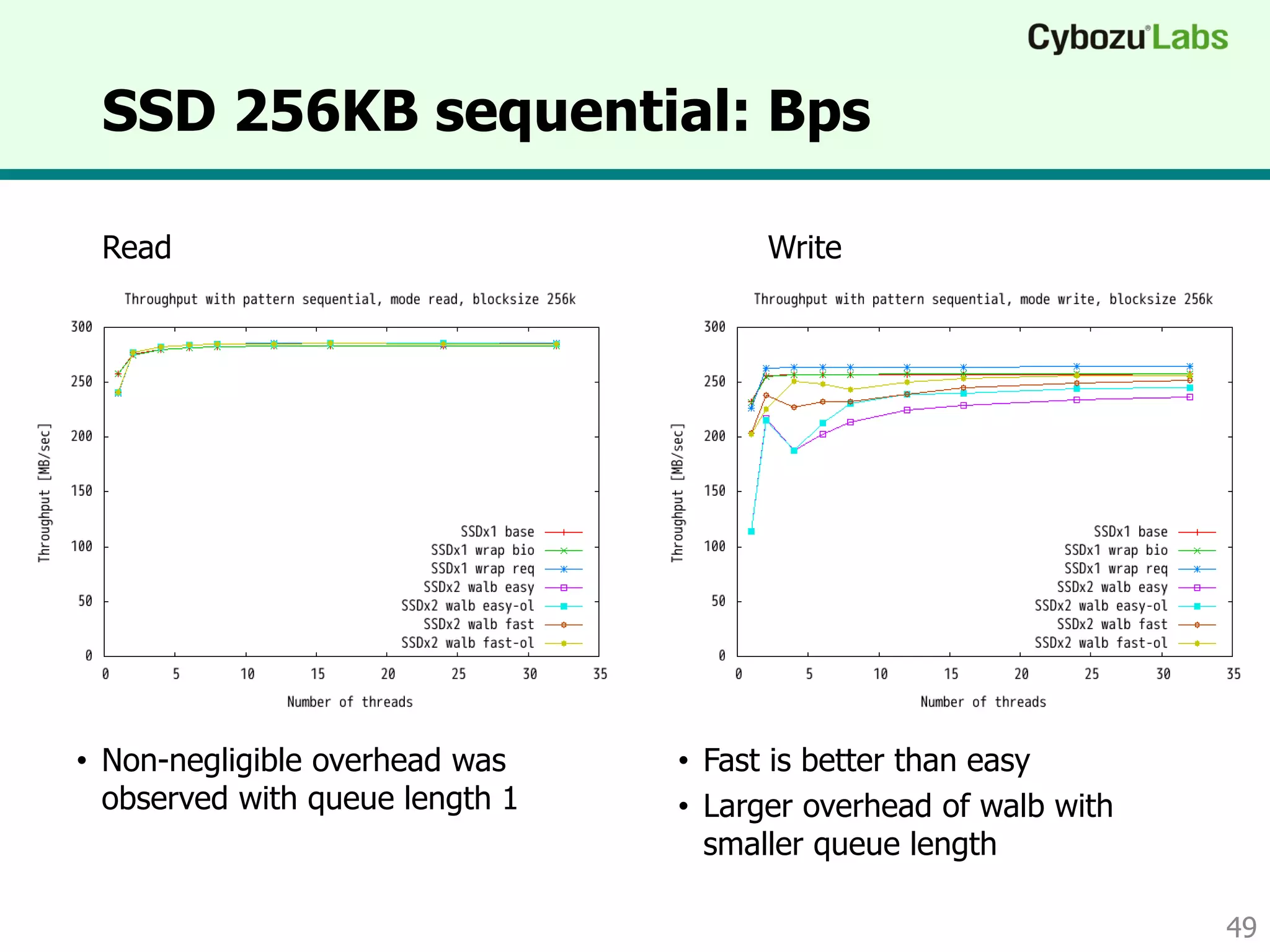
SSD 256KB sequential: Bps
49
Read Write
• Non-negligible overhead was
observed with queue length 1
• Fast is better than easy
• Larger overhead of walb with
smaller queue length
Queue length Queue length
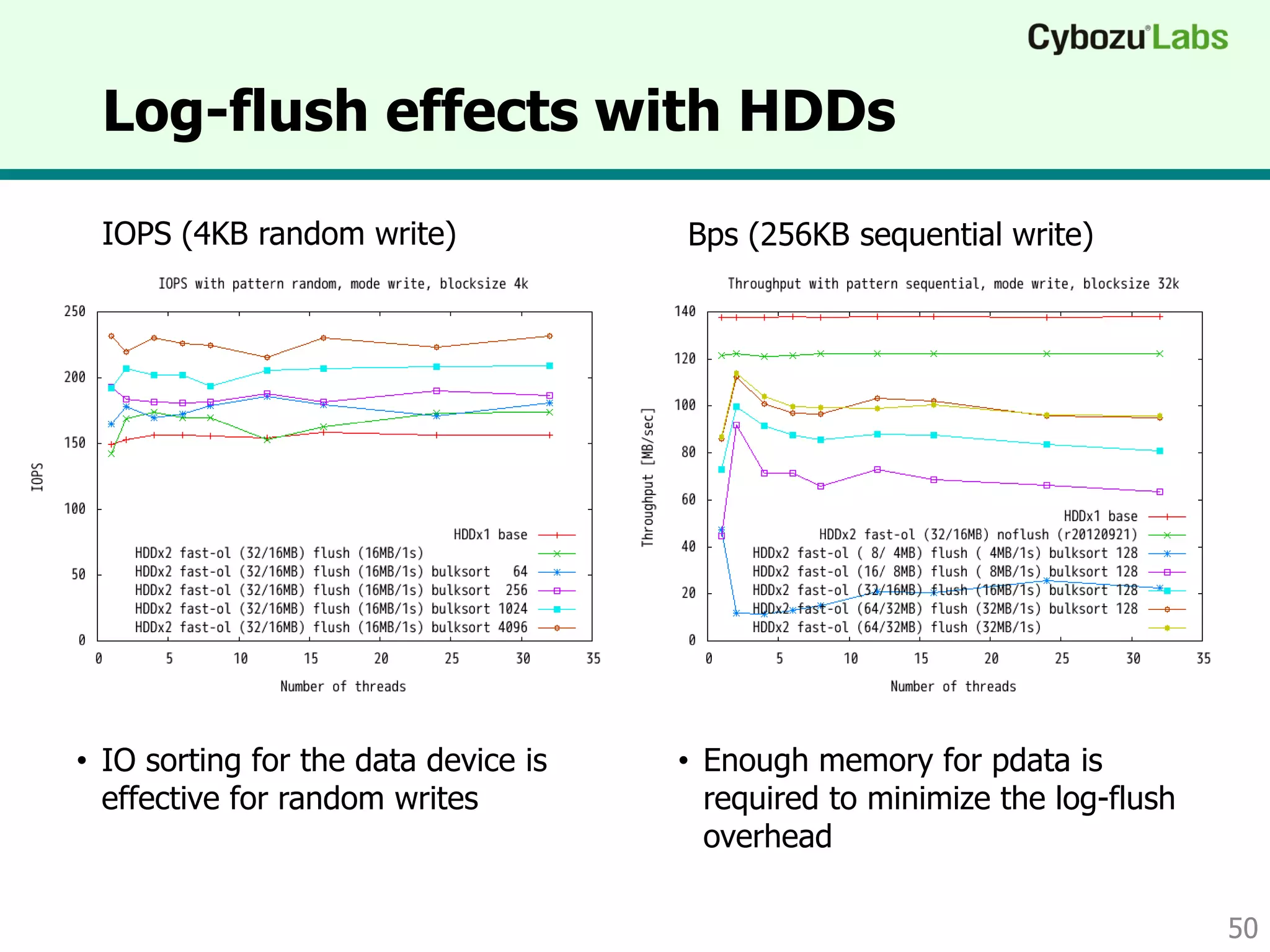
Log-flush effects with HDDs
50
IOPS (4KB random write) Bps (256KB sequential write)
• IO sorting for the data device is
effective for random writes
• Enough memory for pdata is
required to minimize the log-flush
overhead
Queue length Queue length
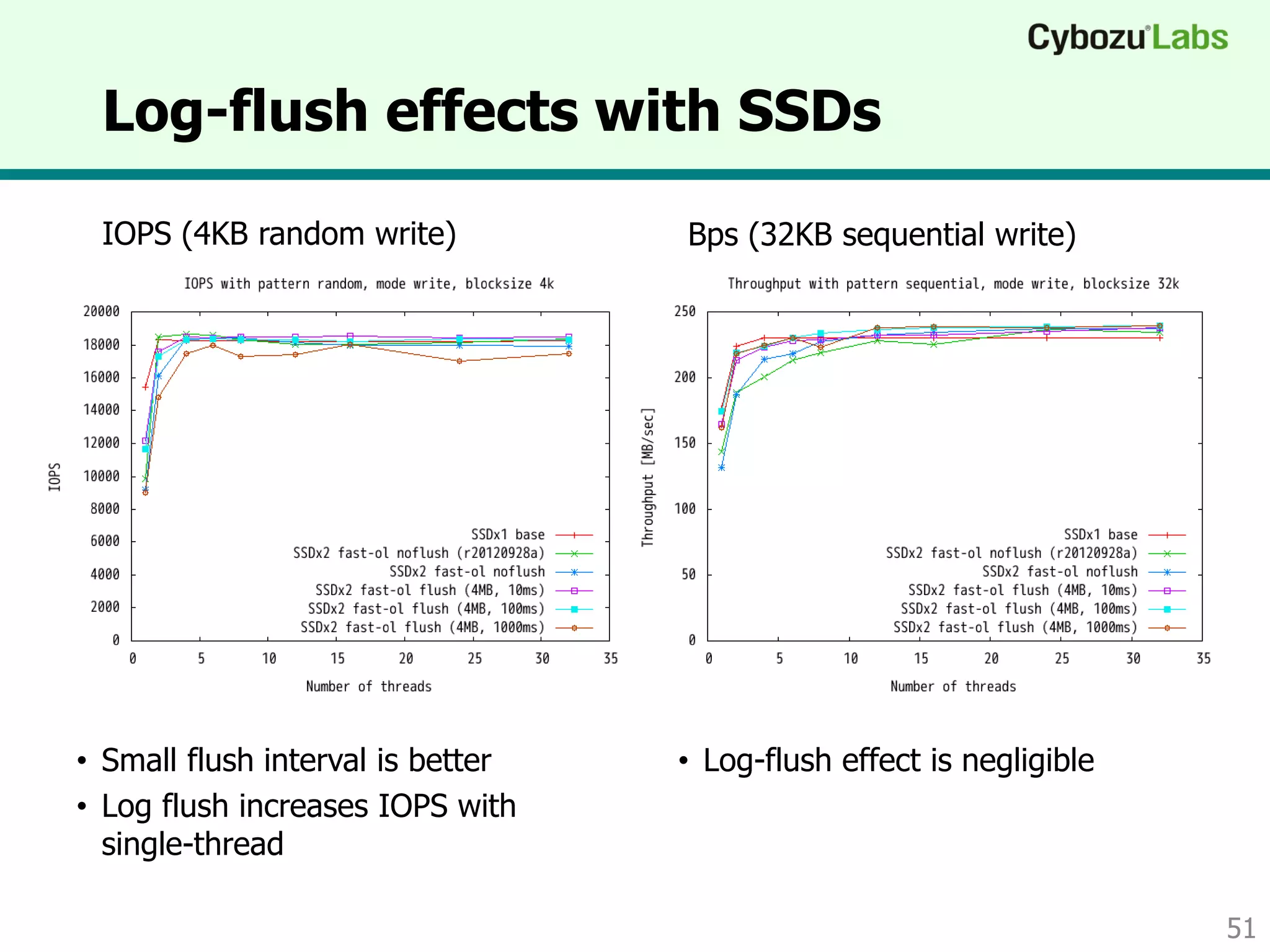
Log-flush effects with SSDs
51
IOPS (4KB random write) Bps (32KB sequential write)
• Small flush interval is better
• Log flush increases IOPS with
single-thread
• Log-flush effect is negligible
Queue length Queue length
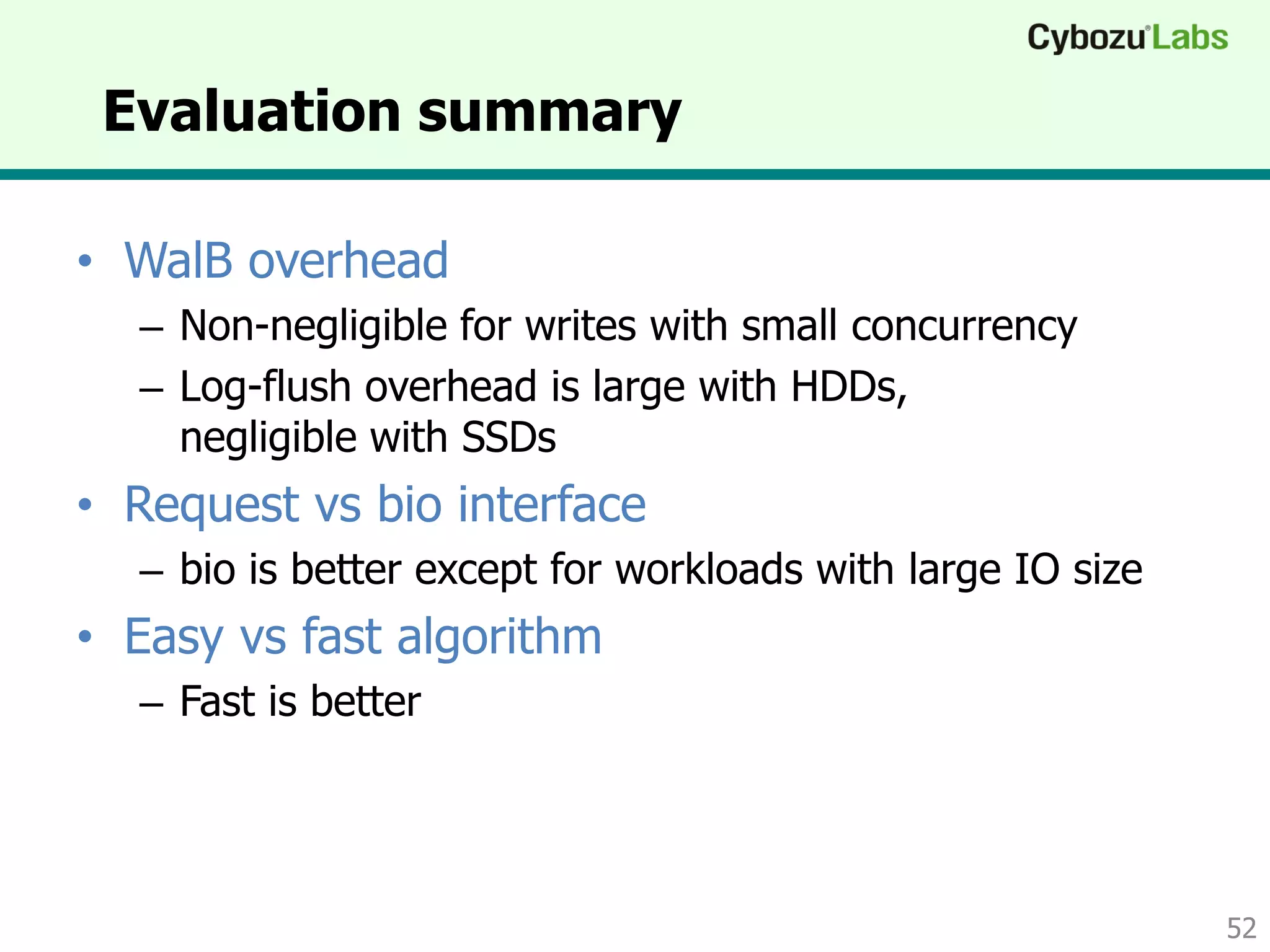
Evaluation summary
• WalB overhead
– Non-negligible for writes with small concurrency
– Log-flush overhead is large with HDDs,
negligible with SSDs
• Request vs bio interface
– bio is better except for workloads with large IO size
• Easy vs fast algorithm
– Fast is better
52
Contents
• Motivation
• Architecture
• Alternative solutions
• Algorithm
• Performance evaluation
• Summary
53
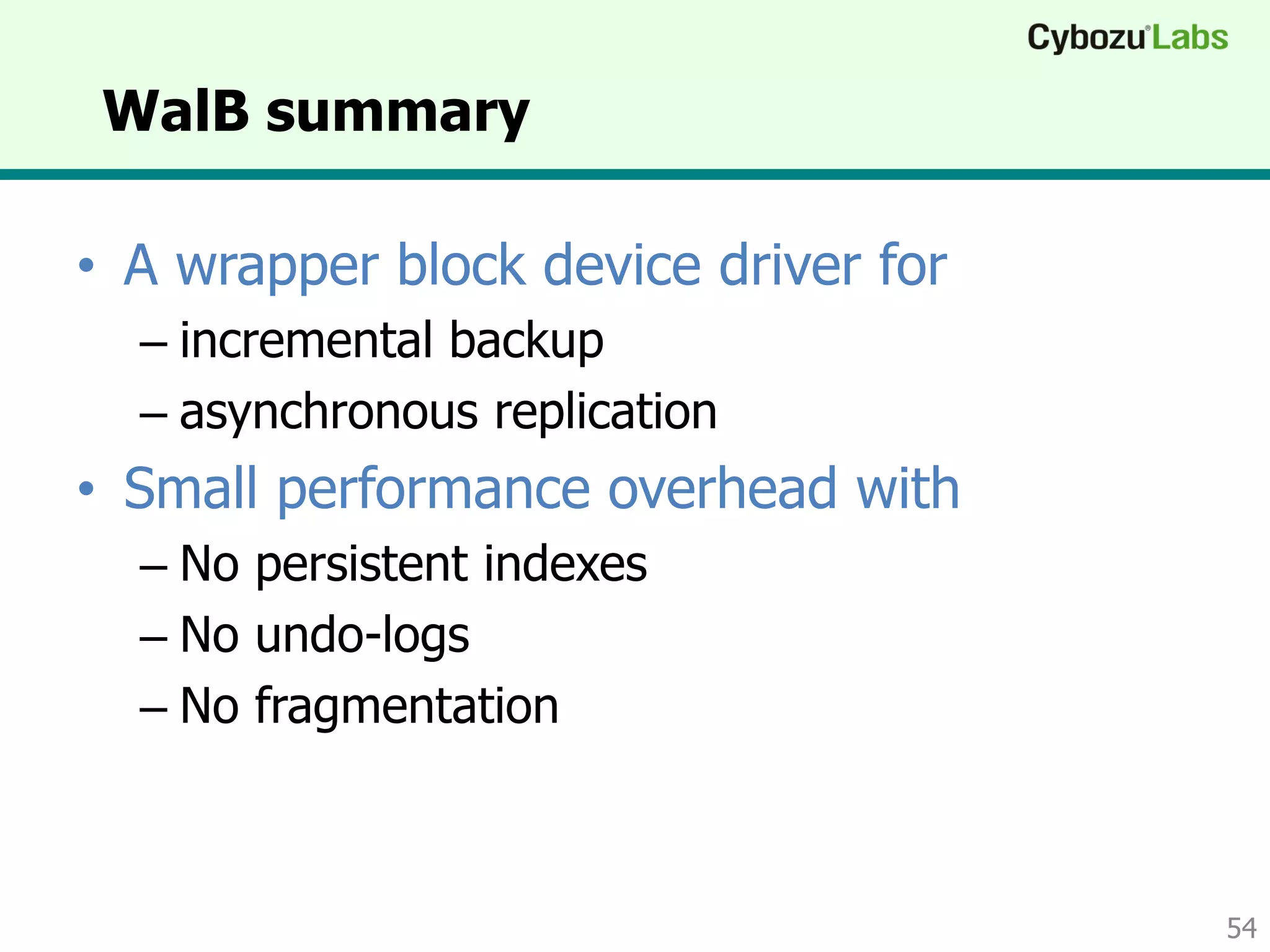
WalB summary
• A wrapper block device driver for
– incremental backup
– asynchronous replication
• Small performance overhead with
– No persistent indexes
– No undo-logs
– No fragmentation
54
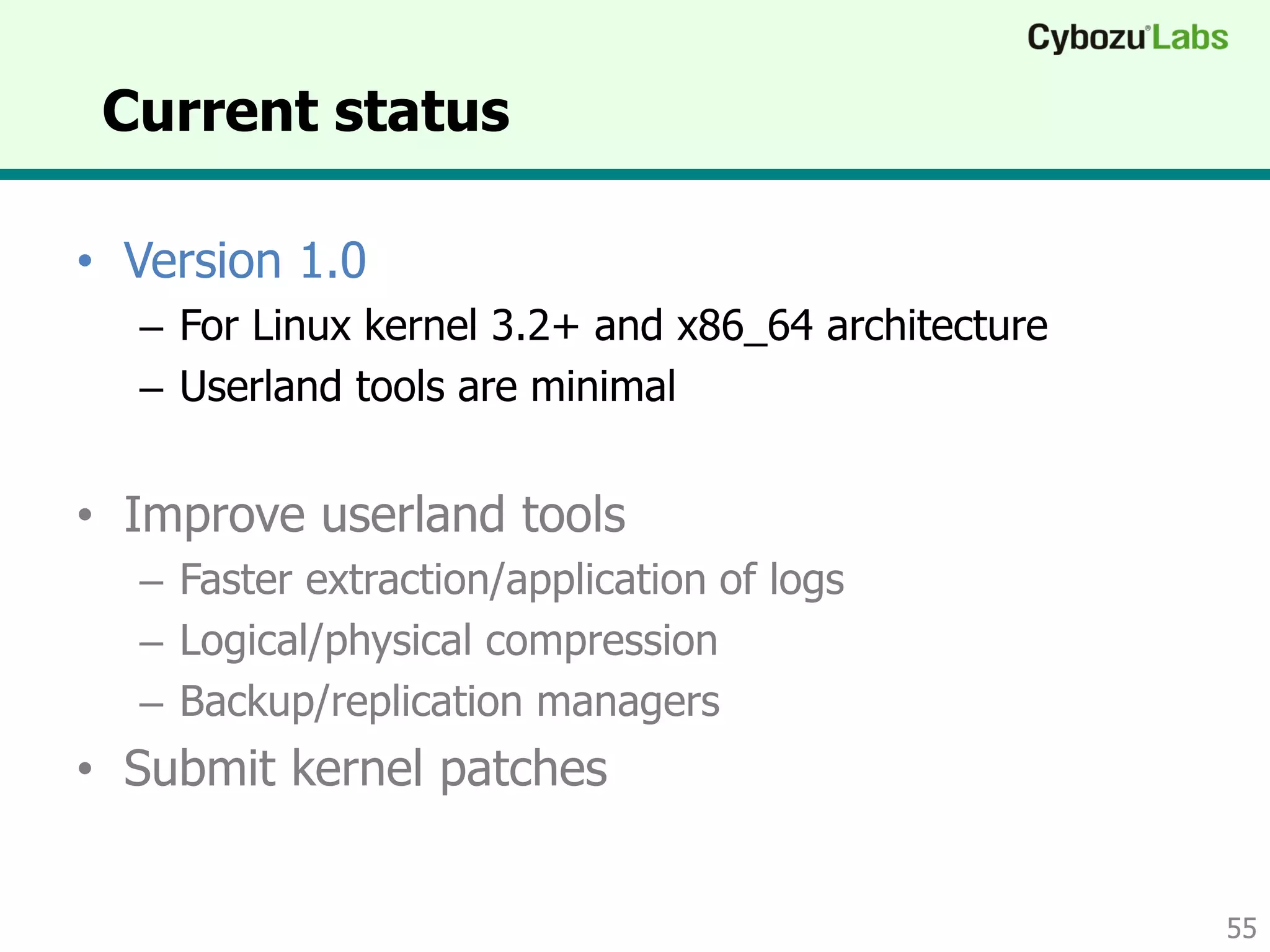
Current status
• Version 1.0
– For Linux kernel 3.2+ and x86_64 architecture
– Userland tools are minimal
• Improve userland tools
– Faster extraction/application of logs
– Logical/physical compression
– Backup/replication managers
• Submit kernel patches
55
Future work
• Add all-zero flag to the log record format
– to avoid all-zero blocks storing to the log device
• Add bitmap management
– to avoid full-scans in ring buffer overflow
• (Support snapshot access)
– by implementing pluggable persistent address indexes
• (Support thin provisioning)
– if a clever defragmentation algorithm was available
56
Thank you for your attention!
• GitHub repository:
– https://github.com/starpos/walb/
• Contact to me:
– Email: hoshino AT labs.cybozu.co.jp
– Twitter: @starpoz (hashtag: #walbdev)
57

An Efficient Backup and Replication of Storage

  • 1.
    An Efficient Backupand Replication of Storage Takashi HOSHINO Cybozu Labs, Inc. 2013-05-29@LinuxConJapan rev.20130529a
  • 2.
    Self-introduction • Takashi HOSHINO –Works at Cybozu Labs, Inc. • Technical interests – Database, storage, distributed algorithms • Current work – WalB: Today’s talk! 2
  • 3.
    Contents • Motivation • Architecture •Alternative solutions • Algorithm • Performance evaluation • Summary 3
  • 4.
    Contents • Motivation • Architecture •Alternative solutions • Algorithm • Performance evaluation • Summary 4
  • 5.
    Motivation • Backup andreplication are vital – We have our own cloud infrastructure – Requiring high availability of customers’ data – With cost-effective commodity hardware and software 5 Operating data Backup data Replicated data Primary DC Secondary DC
  • 6.
    Requirements • Functionality – Gettingconsistent diff data for backup/replication achieving small RPO • Performance – Without usual full-scans – Small overhead • Various kinds of data support – Databases – Blob data – Full-text-search indexes – ... 6
  • 7.
    • A Linuxkernel device driver to provide wrapper block devices and related userland tools • Provides consistent diff extraction functionality for efficient backup and replication • “WalB” means “Block-level WAL” A solution: WalB 7 WalB storage Backup storage Replicated storage Diffs
  • 8.
    WAL (Write-Ahead Logging) 8 OrdinaryStorage WAL Storage Write at 0 Write at 2 Read at 2 Write at 2 0 0 2 0 2 0 2 2 Time
  • 9.
    How to getdiffs • Full-scan and compare • Partial-scan with bitmaps (or indexes) • Scan logs directly from WAL storages 9 a b c d e a b’ c d e’ b’ e’1 4 a b c d e a b’ c d e’ b’ e’1 4 00000 01001 a b c d e a b’ c d e’ b’ e’1 4 b’ e’1 4 Data at t0 Data at t1 Diffs from t0 to t1
  • 10.
    Contents • Motivation • Architecture •Alternative solutions • Algorithm • Performance evaluation • Summary 10
  • 11.
    WalB architecture A walbdevice as a wrapper A block device for data (Data device) A block device for logs (Log device) Read Write Logs Not special format An original format Any application (File system, DBMS, etc) Walb log Extractor Walb dev controller Control 11
  • 12.
    Log device format 12 RingbufferMetadata Address Superblock (physical block size) Unused (4KiB) Log address = (log sequence id) % (ring buffer size) + (ring buffer start address)
  • 13.
    Checksum Ring buffer inside 13 2nd writtendata Ring buffer Log pack Logpack header block 1st written data … The oldest logpackThe latest logpack 1st log record IO address IO size ... Logpack lsid Log pack header block Num of records Total IO size 2nd log record IO address IO size ... ...
  • 14.
    Redo/undo logs • Redologs – to go forward • Undo logs – to go backward 14 0 2 Data at t0 0 2 Data at t1 Redo logs Undo logs
  • 15.
    How to createredo/undo logs • Undo logs requires additional read IOs • Walb devices do not generate undo-logs 15 Data Log WalB (1) write IOs submitted (2) read current data (3) write undo logs Data Log WalB (1) write IOs submitted (2) write redo logs Generating redo logs Generating undo logs
  • 16.
    Consistent full backup •The ring buffer must have enough capacity to store the logs generated from t0 to t1 Primary host Backup host Walb device (online) Log device Full archive Logs Apply (A) (B) Read the online volume (inconsistent) t1 Get consistent image at t1 (C) (A) (B) (C) Time t0 t2 Get logs from t0 to t1 16
  • 17.
    Consistent incremental backup •To manage multiple backup generations, defer application or generate undo-logs during application Primary host Backup host Walb device (online) Log device Full archive Logs Apply (A) Get logs from t0 to t1 (B) (A) (B) Time t0 t2t1 Previous backup timestamp Backuped Application can be deferred 17
  • 18.
    Backup and replication 18 Primaryhost Backup host Walb device (online) Log device Full archive Logs Apply (A) Get logs from t0 to t1 Replicated (A’) (A) Time t1 t3 Remote host Full archive Logs Apply (B’) (B) (B) t2 Backuped t0 Replication delay
  • 19.
    Contents • Motivation • Architecture •Alternative solutions • Algorithm • Performance evaluation • Summary 19
  • 20.
    Alternative solutions • DRBD –Specialized for replication – DRBD proxy is required for long-distance replication • Dm-snap – Snapshot management using COW (copy-on-write) – Full-scans are required to get diffs • Dm-thin – Snapshot management using COW and reference counters – Fragmentation is inevitable 20
  • 21.
    Alternatives comparison WalB dm-snap Capability dm-thin 21 DRBD Incr. backup Sync repl- ication Async repl- ication Performance Negligible Search idx Negligible Read response overhead Searchidx Write response overhead Fragment- ation Write log instead data Modify idx (+COW) Send IOs to slaves (async repl.) Modify idx (+COW) Never Inevitable Never Never (original lv)
  • 22.
    WalB pros andcons • Pros – Small response overhead – Fragmentation never occur – Logs can be retrieved with sequential scans • Cons – 2x bandwidth is required for writes 22
  • 23.
    WalB source codestatistics 23 File systemsBlock device wrappers
  • 24.
    Contents • Motivation • Architecture •Alternative solutions • Algorithm • Performance evaluation • Summary 24
  • 25.
    Requirements to bea block device • Read/write consistency – It must read the latest written data • Storage state uniqueness – It must replay logs not changing the history • Durability of flushed data – It must make flushed write IOs be persistent • Crash recovery without undo – It must recover the data using redo-logs only 25
  • 26.
    WalB algorithm • TwoIO processing methods – Easy: very simple, large overhead – Fast: a bit complex, small overhead • Overlapped IO serialization • Flush/fua for durability • Crash recovery and checkpointing 26
  • 27.
    IO processing flow(easy algorithm) 27 Submitted Time Completed Packed Log submitted Log completed Wait for log flushed and overlapped IOs done Data submitted Data completed Write Submitted Time Completed Data submitted Data completed Read Log IO response Data IO response WalB write IO response Data IO response
  • 28.
    IO processing flow(fast algorithm) 28 Submitted Time Completed Packed Log submitted Log completed Wait for log flushed and overlapped IOs done Data submitted Data completed Log IO response Data IO response WalB write IO response Pdata inserted Pdata deleted Write Submitted Time Completed (Data submitted) (Data completed) Read Pdata copied Data IO response
  • 29.
    Pending data • Ared-black tree – provided as a kernel library • Sorted by IO address – to find overlapped IOs quickly • A spinlock – for exclusive accesses 29 Node0 addr size data NodeN addr size data Node1 addr size data ... ...
  • 30.
    Overlapped IO serialization •Required for storage state uniqueness • Oldata (overlapped data) – similar to pdata – counter for each IO – FIFO constraint 31 Time Wait for overlapped IOs done Data submitted Data completed Data IO response Oldata inserted Oldata deletedGot notice Sent notice
  • 31.
    Flush/fua for durability •The condition for a log to be persistent – All logs before the log and itself are persistent • Neither FLUSH nor FUA is required for data device IOs – Data device persistence will be guaranteed by checkpointing 34 Property to guarantee All write IOs submitted before the flush IO are persistent REQ_FLUSH What WalB need to do The fua IO is persistentREQ_FUA Set FLUSH flag of the corresponding log IOs Set FLUSH and FUA flags to the corresponding log IOs
  • 32.
    Crash recovery andcheckpointing • Crash recovery – Crash will make recent write IOs not be persistent in the data device – Generate write IOs from recent logs and execute them in the data device • Checkpointing – Sync the data device and update the superblock periodically – The superblock contains recent logs information 35
  • 33.
    Contents • Motivation • Architecture •Alternative solutions • Algorithm • Performance evaluation • Summary 36
  • 34.
    Experimental environment • Host –CPU: Intel core i7 3930K – Memory: DDR3-10600 32GB (8GBx4) – OS: Ubuntu 12.04 x86_64 – Kernel: Custom build 3.2.24 • Storage HBA – Intel X79 Internal SATA controller – Using SATA2 interfaces for the experiment 37
  • 35.
    Benchmark software • Self-developedIO benchmark for block devices – https://github.com/starpos/ioreth – uses DIRECT_IO to eliminate buffer cache effects • Parameters – Pattern: Random/sequential – Mode: Read/write – Block size: 512B, 4KB, 32KB, 256KB – Concurrency: 1-32 38
  • 36.
    Target storage devices •MEM – Memory block devices (self-implemented) • HDD – Seagate Barracuda 500GB (ST500DM002) – Up to 140MB/s • SSD – Intel 330 60GB (SSDSC2CT060A3) – Up to 250MB/s with SATA2 39
  • 37.
    Storage settings • Baseline –A raw storage device • Wrap – Self-developed simple wrapper – Request/bio interfaces • WalB – Easy/easy-ol/fast/fast-ol – Request/bio interfaces 40 Log Data Data Baseline WalB driver WalB Data Wrap Wrap driver
  • 38.
    WalB parameters • Log-flush-disabledexperiments – Target storage: MEMs/HDDs/SSDs – Pdata size: 4-128MiB • Log-flush-enabled experiments – Target storage: HDDs/SSDs – Pdata size: 4-64MiB – Flush interval size: 4-32MiB – Flush interval period: 10ms, 100ms, 1s 41
  • 39.
    MEM 512B random:response 42 Read Write • Smaller overhead with bio interface than with request interface • Serializing write IOs of WalB seems to enlarge response time as number of threads increases
  • 40.
    MEM 512B random:IOPS 43 Read Write • Large overhead with request interface • Pdata search seems overhead of walb-bio • IOPS of walb decreases as num of threads increases due to decrease of cache-hit ratio or increase of spinlock wait time Queue length Queue length
  • 41.
    Pdata and oldataoverhead 44 MEM 512B random write Kernel 3.2.24, walb req prototype Overhead of oldata Overhead of pdata Queue length
  • 42.
    HDD 4KB random:IOPS 45 Read Write • Negligible overhead • IO scheduling effect was observed especially with walb-req Queue length Queue length
  • 43.
    HDD 256KB sequential:Bps 46 Read Write • Request interface is better • IO size is limit to 32KiB with bio interface • Additional log header blocks decrease throughput Queue length Queue length
  • 44.
    SSD 4KB random:IOPS 47 Read Write • WalB performance is almost the same as that of wrap req • Fast algo. is better then easy algo. • IOPS overhead is large with smaller number of threads Queue length Queue length
  • 45.
    SSD 4KB random:IOPS (two partitions in a SSD) 48 Read Write • Almost the same result as with two SSD drives • A half throughput was observed • Bandwidth of a SSD is the bottleneck Queue length Queue length
  • 46.
    SSD 256KB sequential:Bps 49 Read Write • Non-negligible overhead was observed with queue length 1 • Fast is better than easy • Larger overhead of walb with smaller queue length Queue length Queue length
  • 47.
    Log-flush effects withHDDs 50 IOPS (4KB random write) Bps (256KB sequential write) • IO sorting for the data device is effective for random writes • Enough memory for pdata is required to minimize the log-flush overhead Queue length Queue length
  • 48.
    Log-flush effects withSSDs 51 IOPS (4KB random write) Bps (32KB sequential write) • Small flush interval is better • Log flush increases IOPS with single-thread • Log-flush effect is negligible Queue length Queue length
  • 49.
    Evaluation summary • WalBoverhead – Non-negligible for writes with small concurrency – Log-flush overhead is large with HDDs, negligible with SSDs • Request vs bio interface – bio is better except for workloads with large IO size • Easy vs fast algorithm – Fast is better 52
  • 50.
    Contents • Motivation • Architecture •Alternative solutions • Algorithm • Performance evaluation • Summary 53
  • 51.
    WalB summary • Awrapper block device driver for – incremental backup – asynchronous replication • Small performance overhead with – No persistent indexes – No undo-logs – No fragmentation 54
  • 52.
    Current status • Version1.0 – For Linux kernel 3.2+ and x86_64 architecture – Userland tools are minimal • Improve userland tools – Faster extraction/application of logs – Logical/physical compression – Backup/replication managers • Submit kernel patches 55
  • 53.
    Future work • Addall-zero flag to the log record format – to avoid all-zero blocks storing to the log device • Add bitmap management – to avoid full-scans in ring buffer overflow • (Support snapshot access) – by implementing pluggable persistent address indexes • (Support thin provisioning) – if a clever defragmentation algorithm was available 56
  • 54.
    Thank you foryour attention! • GitHub repository: – https://github.com/starpos/walb/ • Contact to me: – Email: hoshino AT labs.cybozu.co.jp – Twitter: @starpoz (hashtag: #walbdev) 57