1
Scope 3 GHG Emissions
Management for Value Chain
Presented by Mr. Zhou Lu
CTI Group
August 17th
, 2021
2
WELCOME
Mr. Zhou Lu – Vice President, CTI Group
3
CONTENTS
Background
What are the Scopes of emissions?
Why Scope 3 emissions matter?
How we account scope 3 emissions?
How can CTI Group help?
4
BACKGROUND——
NET-ZERO TARGETS
Targets
5
In response, various targets have been set both internationally
and domestically:
 Kyoto Protocol 2005 - (UK 12.5% reduction in first target period
2008-2012 from 1990 baseline)
 Paris Climate Agreement 2016 - limit global warming to well
below 2°C and pursuing efforts to limit it to 1.5°C
 EU - to be climate-neutral by 2050 (net-zero greenhouse gas
emissions)
 UK - All greenhouse gas emissions to ‘Net-zero’ by 2050– The
Climate Change Act 2008 (2050 Target Amendment) Order 2019
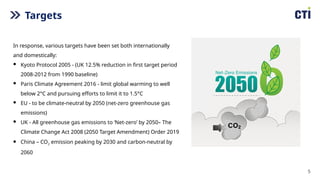
 China – CO2 emission peaking by 2030 and carbon-neutral by
2060
6
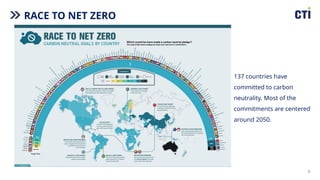
RACE TO NET ZERO
137 countries have
committed to carbon
neutrality. Most of the
commitments are centered
around 2050.
7
What are the Scopes of
Emissions?
GHG Protocol
8
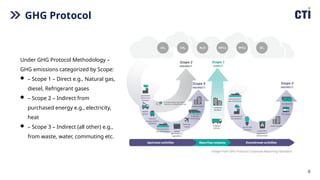
Under GHG Protocol Methodology –
GHG emissions categorized by Scope:
 – Scope 1 – Direct e.g., Natural gas,
diesel, Refrigerant gases
 – Scope 2 – Indirect from
purchased energy e.g., electricity,
heat
 – Scope 3 – Indirect (all other) e.g.,
from waste, water, commuting etc.
Image from GHG Protocol Corporate Reporting Standard
9
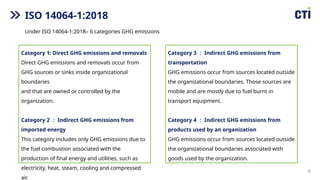
ISO 14064-1:2018
Category 1: Direct GHG emissions and removals
Direct GHG emissions and removals occur from
GHG sources or sinks inside organizational
boundaries
and that are owned or controlled by the
organization.
Category 2 : Indirect GHG emissions from
imported energy
This category includes only GHG emissions due to
the fuel combustion associated with the
production of final energy and utilities, such as
electricity, heat, steam, cooling and compressed
air.
Category 3 : Indirect GHG emissions from
transportation
GHG emissions occur from sources located outside
the organizational boundaries. Those sources are
mobile and are mostly due to fuel burnt in
transport equipment.
Category 4 : Indirect GHG emissions from
products used by an organization
GHG emissions occur from sources located outside
the organizational boundaries associated with
goods used by the organization.
Under ISO 14064-1:2018– 6 categories GHG emissions
10
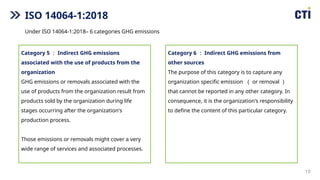
ISO 14064-1:2018
Category 5 : Indirect GHG emissions
associated with the use of products from the
organization
GHG emissions or removals associated with the
use of products from the organization result from
products sold by the organization during life
stages occurring after the organization's
production process.
Those emissions or removals might cover a very
wide range of services and associated processes.
Category 6 : Indirect GHG emissions from
other sources
The purpose of this category is to capture any
organization specific emission ( or removal )
that cannot be reported in any other category. In
consequence, it is the organization's responsibility
to define the content of this particular category.
Under ISO 14064-1:2018– 6 categories GHG emissions
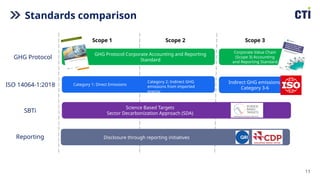
Standards comparison
11
Scope 1 Scope 2 Scope 3
GHG Protocol
Corporate Value Chain
(Scope 3) Accounting
and Reporting Standard
GHG Protocol Corporate Accounting and Reporting
Standard
ISO 14064-1:2018 Indirect GHG emissions:
Category 3-6
Category 1: Direct Emissions
Category 2: Indirect GHG
emissions from imported
energy
SBTi
Science Based Targets
Sector Decarbonization Approach (SDA)
Reporting Disclosure through reporting initiatives
12
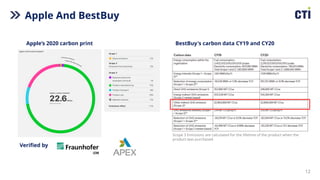
Apple And BestBuy
Apple’s 2020 carbon print
Verified by
BestBuy's carbon data CY19 and CY20
Scope 3 Emissions are calculated for the lifetime of the product when the
product was purchased.
13
Why Scope 3 emissions
matter?
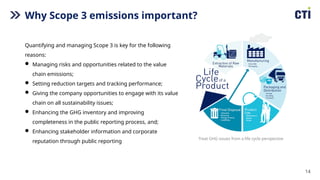
Why Scope 3 emissions important?
14
Quantifying and managing Scope 3 is key for the following
reasons:
 Managing risks and opportunities related to the value
chain emissions;
 Setting reduction targets and tracking performance;
 Giving the company opportunities to engage with its value
chain on all sustainability issues;
 Enhancing the GHG inventory and improving
completeness in the public reporting process, and;
 Enhancing stakeholder information and corporate
reputation through public reporting
Treat GHG issues from a life cycle perspective
15
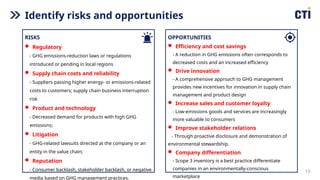
Identify risks and opportunities
RISKS
 Regulatory
- GHG emissions-reduction laws or regulations
introduced or pending in local regions
 Supply chain costs and reliability
- Suppliers passing higher energy- or emissions-related
costs to customers; supply chain business interruption
risk
 Product and technology
- Decreased demand for products with high GHG
emissions;
 Litigation
- GHG-related lawsuits directed at the company or an
entity in the value chain;
 Reputation
- Consumer backlash, stakeholder backlash, or negative
media based on GHG management practices,
OPPORTUNITIES
 Efficiency and cost savings
- A reduction in GHG emissions often corresponds to
decreased costs and an increased efficiency
 Drive innovation
- A comprehensive approach to GHG management
provides new incentives for innovation in supply chain
management and product design
 Increase sales and customer loyalty
- Low-emissions goods and services are increasingly
more valuable to consumers
 Improve stakeholder relations
- Through proactive disclosure and demonstration of
environmental stewardship.
 Company differentiation
- Scope 3 inventory is a best practice differentiate
companies in an environmentally-conscious
marketplace
16
How We Manage Scope 3
Emissions ?
17
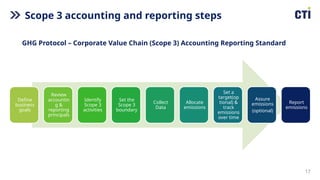
Scope 3 accounting and reporting steps
Define
business
goals
Review
accountin
g &
reporting
principals
Identify
Scope 3
activities
Set the
Scope 3
boundary
Collect
Data
Allocate
emissions
Set a
target(op
tional) &
track
emissions
over time
Assure
emissions
(optional)
Report
emissions
GHG Protocol – Corporate Value Chain (Scope 3) Accounting Reporting Standard
18
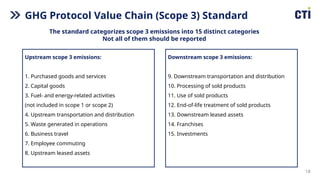
GHG Protocol Value Chain (Scope 3) Standard
Upstream scope 3 emissions:
1. Purchased goods and services
2. Capital goods
3. Fuel- and energy-related activities
(not included in scope 1 or scope 2)
4. Upstream transportation and distribution
5. Waste generated in operations
6. Business travel
7. Employee commuting
8. Upstream leased assets
Downstream scope 3 emissions:
9. Downstream transportation and distribution
10. Processing of sold products
11. Use of sold products
12. End-of-life treatment of sold products
13. Downstream leased assets
14. Franchises
15. Investments
The standard categorizes scope 3 emissions into 15 distinct categories
Not all of them should be reported
19
GHG Protocol Value Chain (Scope 3) Standard
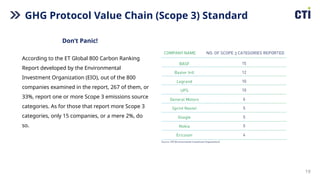
According to the ET Global 800 Carbon Ranking
Report developed by the Environmental
Investment Organization (EIO), out of the 800
companies examined in the report, 267 of them, or
33%, report one or more Scope 3 emissions source
categories. As for those that report more Scope 3
categories, only 15 companies, or a mere 2%, do
so.
Don’t Panic!
20
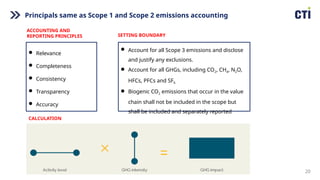
Principals same as Scope 1 and Scope 2 emissions accounting
 Relevance
 Completeness
 Consistency
 Transparency
 Accuracy
ACCOUNTING AND
REPORTING PRINCIPLES SETTING BOUNDARY
 Account for all Scope 3 emissions and disclose
and justify any exclusions.
 Account for all GHGs, including CO2, CH4, N2O,
HFCs, PFCs and SF6
 Biogenic CO2 emissions that occur in the value
chain shall not be included in the scope but
shall be included and separately reported
CALCULATION
21
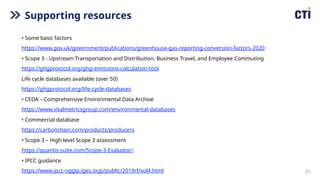
Supporting resources
• Some basic factors
https://www.gov.uk/government/publications/greenhouse-gas-reporting-conversion-factors-2020
• Scope 3 - Upstream Transportation and Distribution, Business Travel, and Employee Commuting
https://ghgprotocol.org/ghg-emissions-calculation-tool
Life cycle databases available (over 50)
https://ghgprotocol.org/life-cycle-databases
• CEDA – Comprehensive Environmental Data Archive
https://www.vitalmetricsgroup.com/environmental-databases
• Commercial database
https://carbonchain.com/products/producers
• Scope 3 – High level Scope 3 assessment
https://quantis-suite.com/Scope-3-Evaluator/
• IPCC guidance
https://www.ipcc-nggip.iges.or.jp/public/2019rf/vol4.html
22
How can CTI Group help?
About CTI Group
23
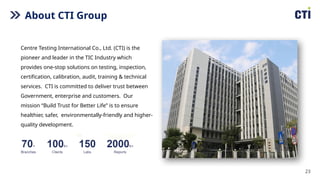
Centre Testing International Co., Ltd. (CTI) is the
pioneer and leader in the TIC Industry which
provides one-stop solutions on testing, inspection,
certification, calibration, audit, training & technical
services. CTI is committed to deliver trust between
Government, enterprise and customers. Our
mission “Build Trust for Better Life” is to ensure
healthier, safer, environmentally-friendly and higher-
quality development.
24
CTI Certification
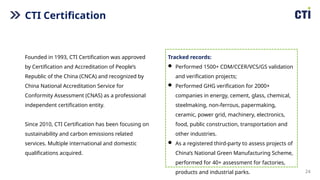
Founded in 1993, CTI Certification was approved
by Certification and Accreditation of People’s
Republic of the China (CNCA) and recognized by
China National Accreditation Service for
Conformity Assessment (CNAS) as a professional
independent certification entity.
Since 2010, CTI Certification has been focusing on
sustainability and carbon emissions related
services. Multiple international and domestic
qualifications acquired.
Tracked records:
 Performed 1500+ CDM/CCER/VCS/GS validation
and verification projects;
 Performed GHG verification for 2000+
companies in energy, cement, glass, chemical,
steelmaking, non-ferrous, papermaking,
ceramic, power grid, machinery, electronics,
food, public construction, transportation and
other industries.
 As a registered third-party to assess projects of
China’s National Green Manufacturing Scheme,
performed for 40+ assessment for factories,
products and industrial parks.
25
Work with renowned partner
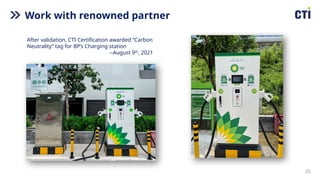
After validation, CTI Certification awarded “Carbon
Neutrality” tag for BP’s Charging station
--August 9th
, 2021
26
Keeping up with international trends
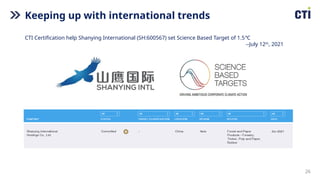
CTI Certification help Shanying International (SH:600567) set Science Based Target of 1.5℃
--July 12th
, 2021
27
Deep understanding of climate change
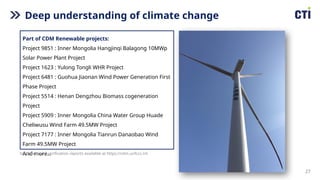
Part of CDM Renewable projects:
Project 9851 : Inner Mongolia Hangjinqi Balagong 10MWp
Solar Power Plant Project
Project 1623 : Yulong Tongli WHR Project
Project 6481 : Guohua Jiaonan Wind Power Generation First
Phase Project
Project 5514 : Henan Dengzhou Biomass cogeneration
Project
Project 5909 : Inner Mongolia China Water Group Huade
Cheliwusu Wind Farm 49.5MW Project
Project 7177 : Inner Mongolia Tianrun Danaobao Wind
Farm 49.5MW Project
And more…
Validation and verification reports available at https://cdm.unfccc.int
28
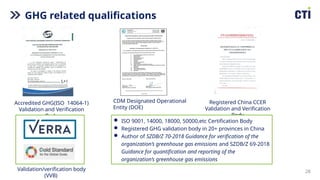
GHG related qualifications
Accredited GHG(ISO 14064-1)
Validation and Verification
Body
CDM Designated Operational
Entity (DOE)
Registered China CCER
Validation and Verification
Body
Validation/verification body
(VVB)
 ISO 9001, 14000, 18000, 50000,etc Certification Body
 Registered GHG validation body in 20+ provinces in China
 Author of SZDB/Z 70-2018 Guidance for verification of the
organization’s greenhouse gas emissions and SZDB/Z 69-2018
Guidance for quantification and reporting of the
organization’s greenhouse gas emissions
29
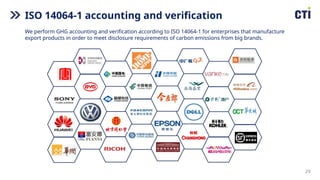
ISO 14064-1 accounting and verification
We perform GHG accounting and verification according to ISO 14064-1 for enterprises that manufacture
export products in order to meet disclosure requirements of carbon emissions from big brands.
30
Highly customized consulting services
 Help fill GHG emissions survey questionaries from
clients according to GHG Protocol series standards;
 Product carbon footprint assessment;
 Supply chain and life cycle assessment;
 GHG emission reductions analysis according to ISO
14064-2;
 CDM/CCER/VCS Methodology development;
 Help set and submit Science Based Target to SBTi;
 Prepare GHG inventories reports for governments;
 Develop regional policies to address climate change
as a think tank
 And ….
Due to the latest China’s 30/60 policy, variety needs concerning GHGs have been surging. We perform
highly customized consulting services for companies and governments that want to improve their GHG
performance.
31
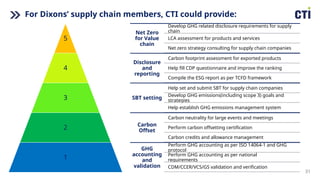
For Dixons’ supply chain members, CTI could provide:
31
5
4
3
2
1
Net Zero
for Value
chain
Develop GHG related disclosure requirements for supply
chain
LCA assessment for products and services
Net zero strategy consulting for supply chain companies
Disclosure
and
reporting
Carbon footprint assessment for exported products
Help fill CDP questionnaire and improve the ranking
Compile the ESG report as per TCFD framework
SBT setting
Help set and submit SBT for supply chain companies
Develop GHG emissions(including scope 3) goals and
strategies
Help establish GHG emissions management system
Carbon
Offset
Carbon neutrality for large events and meetings
Perform carbon offsetting certification
Carbon credits and allowance management
GHG
accounting
and
validation
Perform GHG accounting as per ISO 14064-1 and GHG
protocol
Perform GHG accounting as per national
requirements
CDM/CCER/VCS/GS validation and verification
32
Q&A
33
Thanks!