Challenges	for	Internalising	
SCP	in	Business		
Strategy	
Resource	efficiency	and	waste	
minimisa;on	across	the	value	chain	
Rajat	Batra	
STENUM	Asia	Sustainable	Development	Society	
19	April,	2016
Value	chain	
Or	…
Value	chain
Value	chain	sustainability	
Why?	
•  to	create,	protect	and	grow	long-term	
environmental,	social	and	economic	value	for	
all	stakeholders	involved	in	bringing	products	
and	services	to	market
Value	chain	sustainability	
Why?	
•  to	create,	protect	and	grow	long-term	
environmental,	social	and	economic	value	for	
all	stakeholders	involved	in	bringing	products	
and	services	to	market	
Benefits	
•  reduced	carbon	footprint,	reduced	energy,	
and	reduced	resource	consumpFon	
The	United	NaFons	Global	Compact
Benefits	CONTINUED…	
•  BePer	risk	anFcipaFon	and	management	
•  Lower	disrupFon	to	supply	…	
•  “Informal”	or	“social”	license	to	operate	within	communiFes	
•  Reduced	costs	and	enhanced	efficiency	and	producFvity	
•  Improved	working	condiFons	can	reduce	turnover	and	improve	
quality	and	reliability	
•  Environmental	responsibility	improves	efficiency	and	profitability	
•  Corporate	brand	and	values,	and	customer	and	consumer	
confidence	and	loyalty	are	protected	and	enhanced	
•  Process	and	product	innovaFon.	Empowered	suppliers	uncover	
opportuniFes	for	developing	sustainable	products	and	services	
	
Examples	from	leading	companies	show	that	good	supply	chain	
management	can	increase	shareholder	value	
The	United	NaFons	Global	Compact
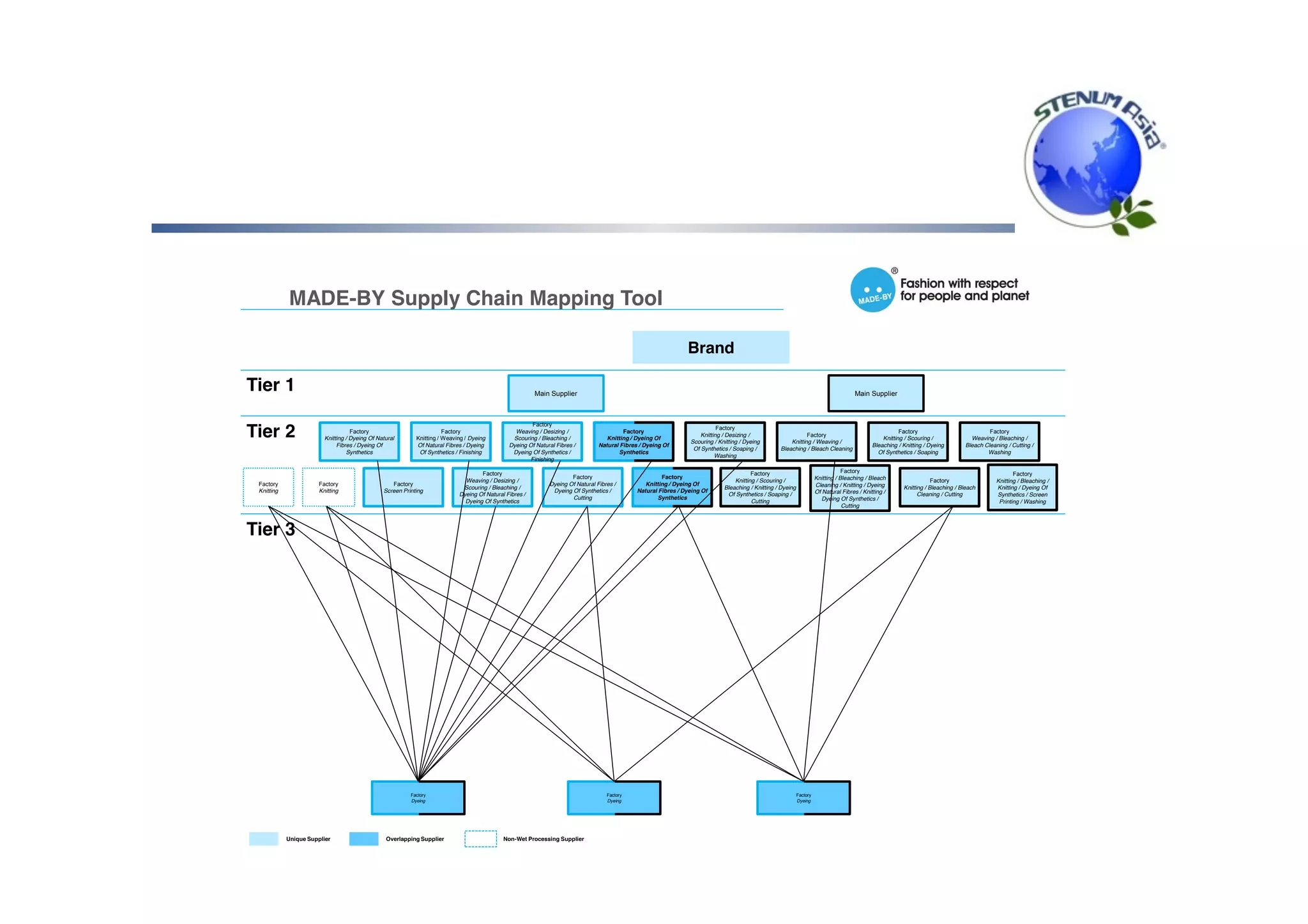
Tier 2
Factory
Knitting / Dyeing Of
Natural Fibres / Dyeing Of
Synthetics
Factory
Knitting / Weaving / Dyeing
Of Natural Fibres / Dyeing
Of Synthetics / Finishing
Factory
Weaving / Desizing /
Scouring / Bleaching /
Dyeing Of Natural Fibres /
Dyeing Of Synthetics /
Finishing
Factory
Knitting
Factory
Knitting
Factory
Dyeing Of Natural Fibres /
Dyeing Of Synthetics /
Cutting
Factory
Screen Printing
Factory
Weaving / Desizing /
Scouring / Bleaching /
Dyeing Of Natural Fibres /
Dyeing Of Synthetics
Factory
Knitting / Dyeing Of Natural
Fibres / Dyeing Of
Synthetics
Factory
Knitting / Dyeing Of
Natural Fibres / Dyeing Of
Synthetics
Factory
Knitting / Desizing /
Scouring / Knitting / Dyeing
Of Synthetics / Soaping /
Washing
Factory
Knitting / Weaving /
Bleaching / Bleach Cleaning
Factory
Knitting / Scouring /
Bleaching / Knitting / Dyeing
Of Synthetics / Soaping
Factory
Knitting / Scouring /
Bleaching / Knitting / Dyeing
Of Synthetics / Soaping /
Cutting
Factory
Knitting / Bleaching / Bleach
Cleaning / Knitting / Dyeing
Of Natural Fibres / Knitting /
Dyeing Of Synthetics /
Cutting
Factory
Knitting / Bleaching / Bleach
Cleaning / Cutting
Factory
Knitting / Bleaching /
Knitting / Dyeing Of
Synthetics / Screen
Printing / Washing
Factory
Weaving / Bleaching /
Bleach Cleaning / Cutting /
Washing
Brand
Tier 1
Tier 3
Main Supplier Main Supplier
Factory
Dyeing
Factory
Dyeing
Factory
Dyeing
Overlapping SupplierUnique Supplier Non-Wet Processing Supplier
MADE-BY Supply Chain Mapping Tool
SCP	in	value	chain…		


Projects	funded	by
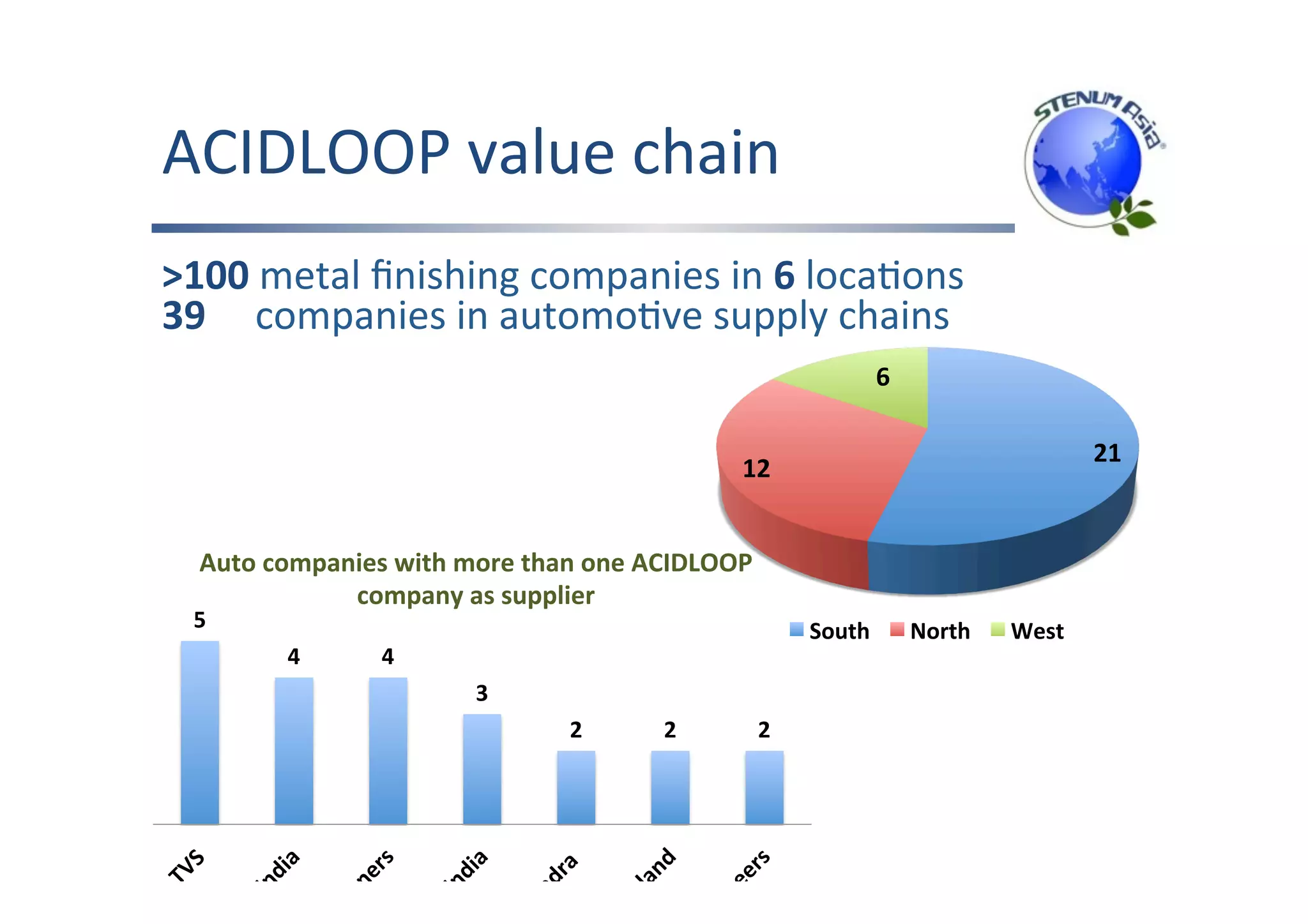
ACIDLOOP	value	chain	
21	
12	
6	
South	 North	 West	
39					companies	in	automoFve	supply	chains	
5	
4	 4	
3	
2	 2	 2	
Auto	companies	with	more	than	one	ACIDLOOP	
company	as	supplier	
>100	metal	finishing	companies	in	6	locaFons
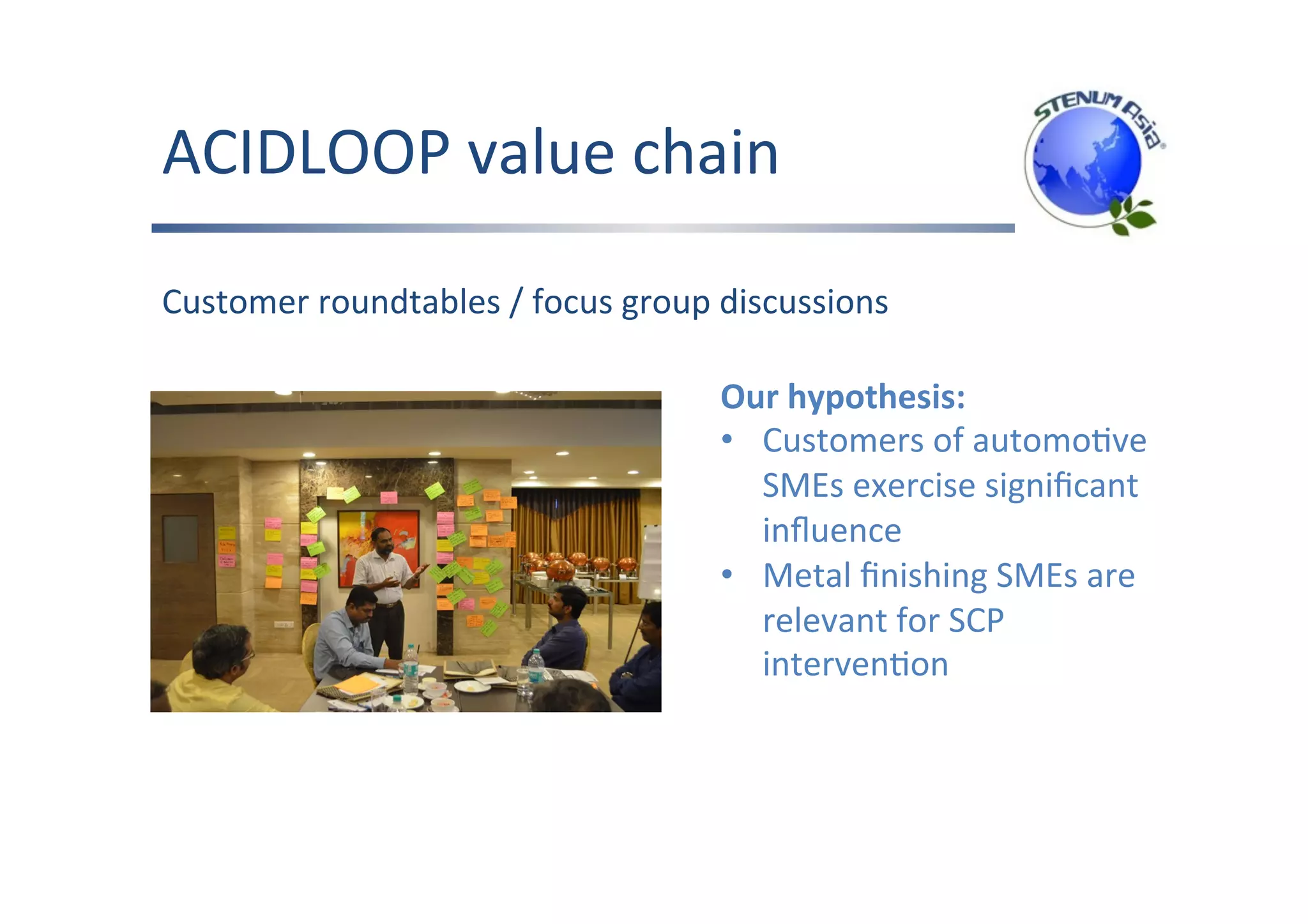
ACIDLOOP	value	chain	
Customer	roundtables	/	focus	group	discussions	
Our	hypothesis:	
•  Customers	of	automoFve	
SMEs	exercise	significant	
influence	
•  Metal	finishing	SMEs	are	
relevant	for	SCP	
intervenFon
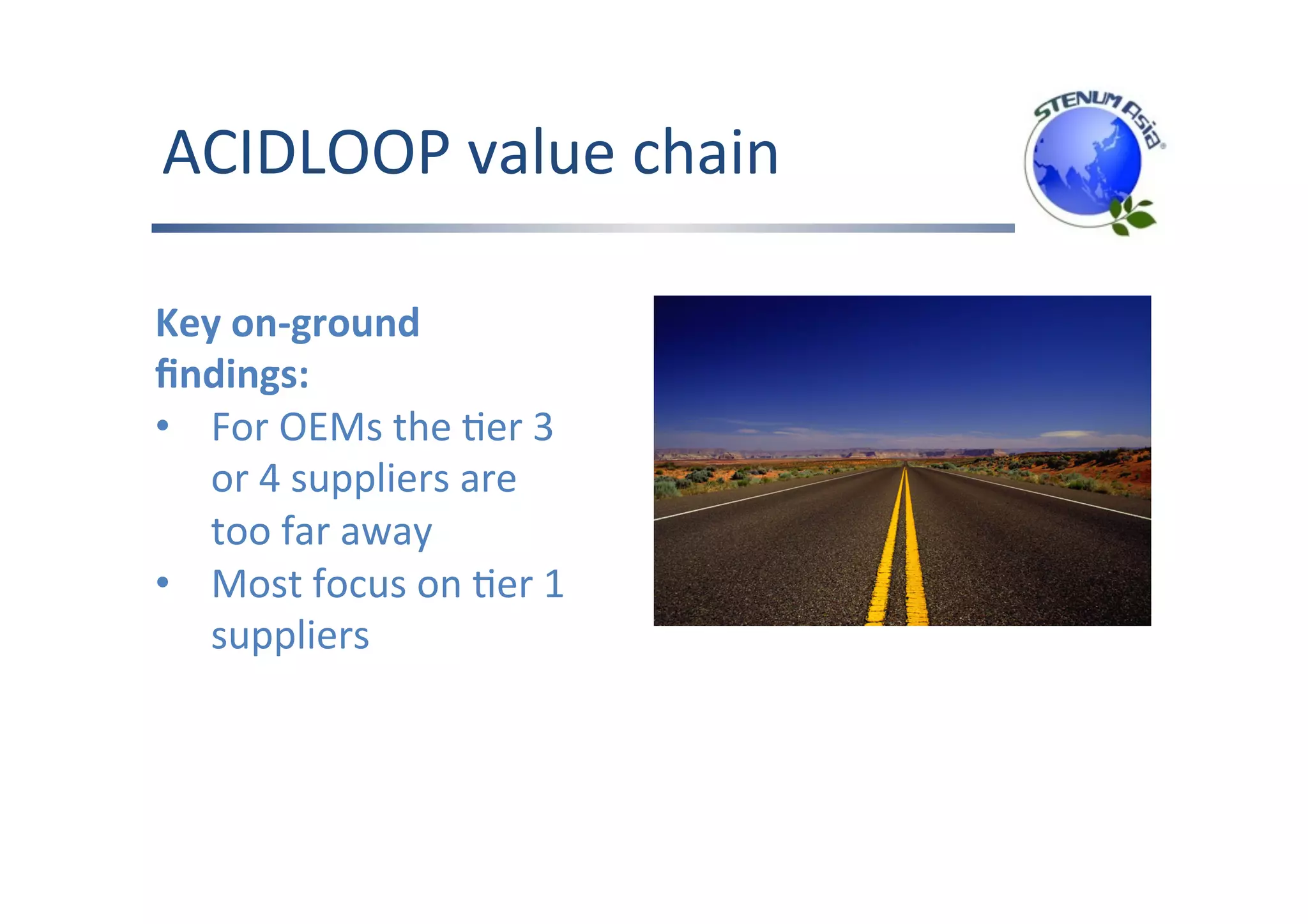
ACIDLOOP	value	chain	
Key	on-ground	
findings:	
•  For	OEMs	the	Fer	3	
or	4	suppliers	are	
too	far	away	
•  Most	focus	on	Fer	1	
suppliers
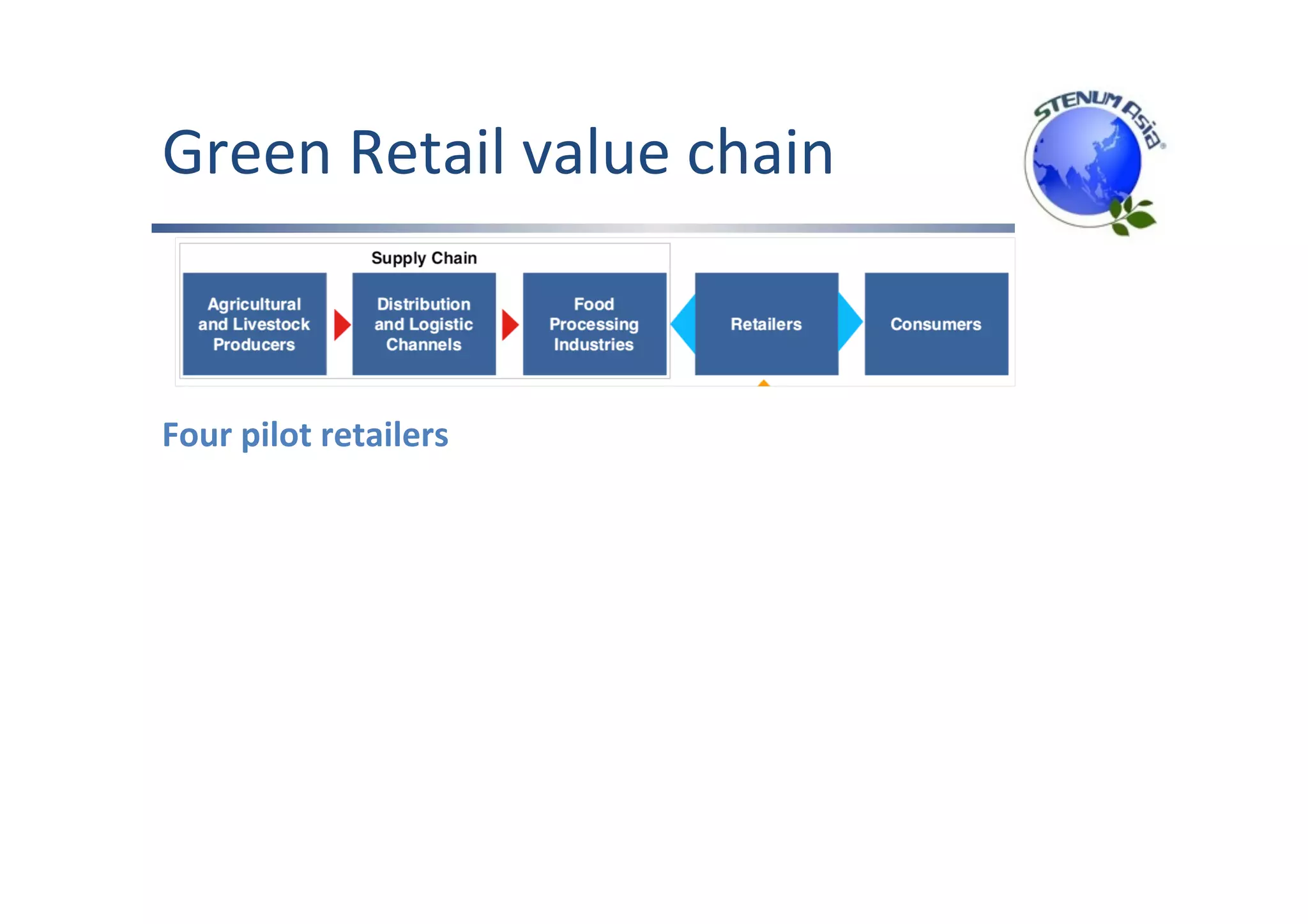
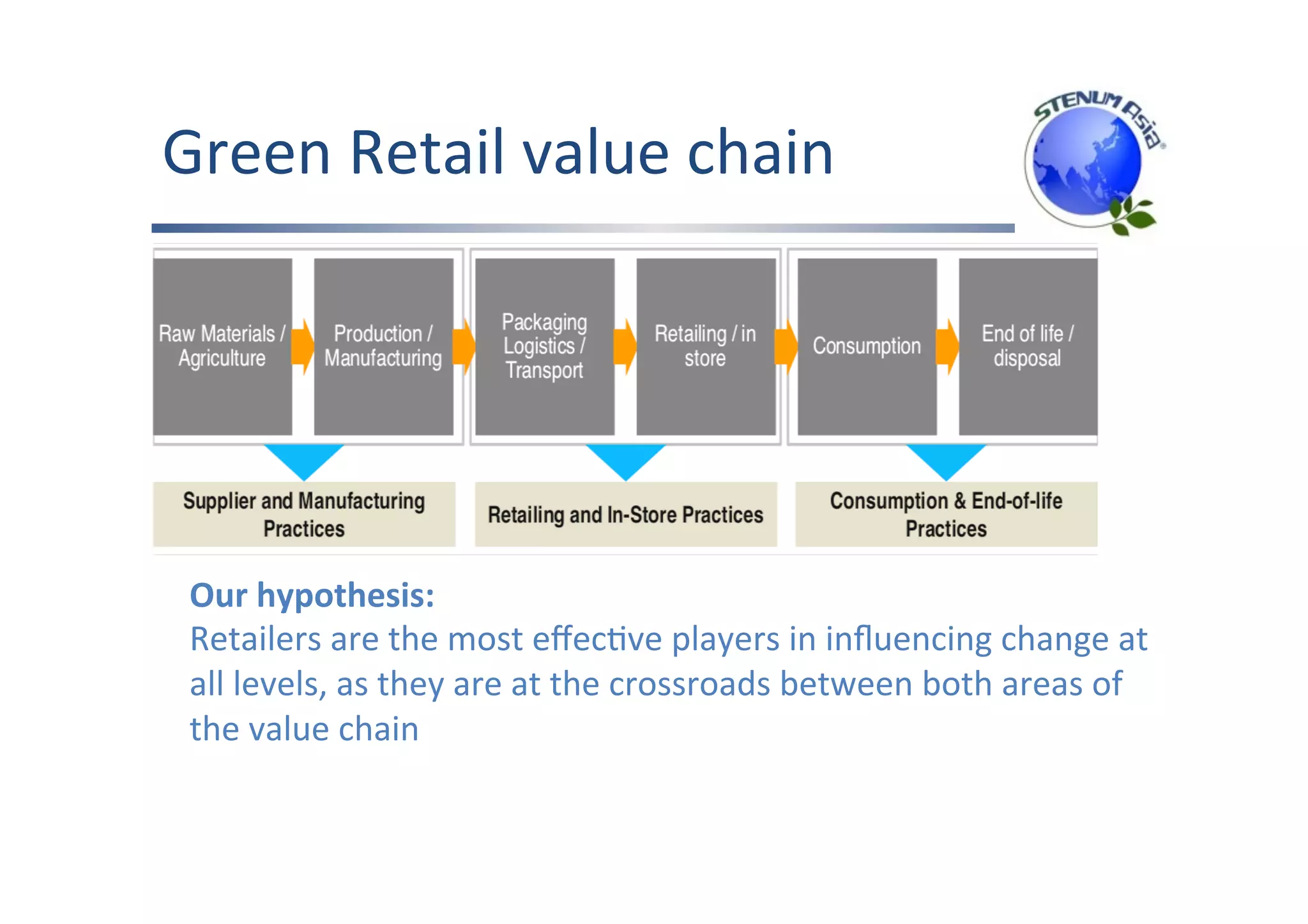
Green	Retail	value	chain	
Four	pilot	retailers
Green	Retail	value	chain	
Four	pilot	retailers	
Our	hypothesis:	
Retailers	are	the	most	effecFve	players	in	influencing	change	at	
all	levels,	as	they	are	at	the	crossroads	between	both	areas	of	
the	value	chain
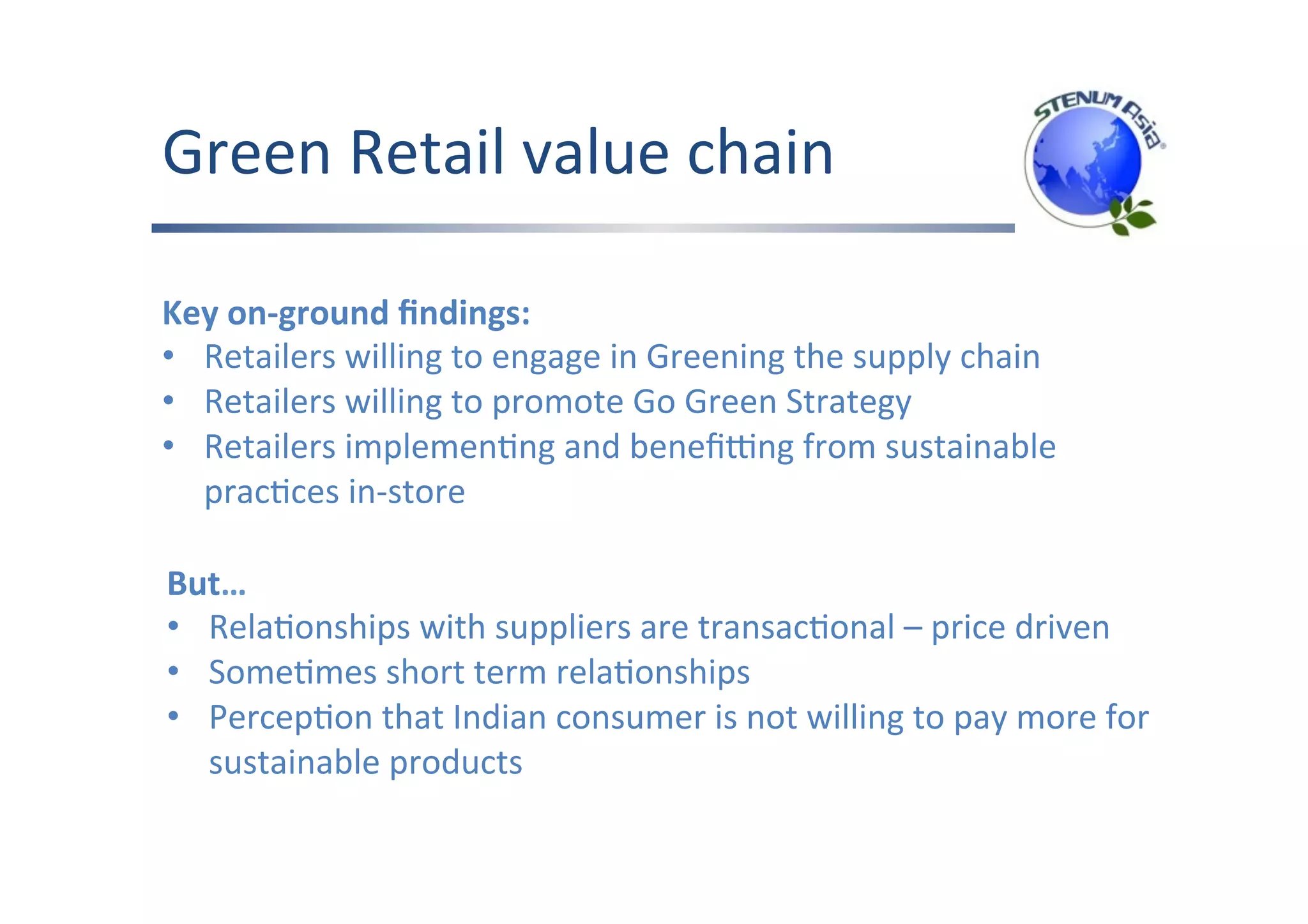
Green	Retail	value	chain	
Key	on-ground	findings:	
•  Retailers	willing	to	engage	in	Greening	the	supply	chain	
•  Retailers	willing	to	promote	Go	Green	Strategy	
•  Retailers	implemenFng	and	benefiang	from	sustainable	
pracFces	in-store	
	
But…	
•  RelaFonships	with	suppliers	are	transacFonal	–	price	driven	
•  SomeFmes	short	term	relaFonships	
•  PercepFon	that	Indian	consumer	is	not	willing	to	pay	more	for	
sustainable	products
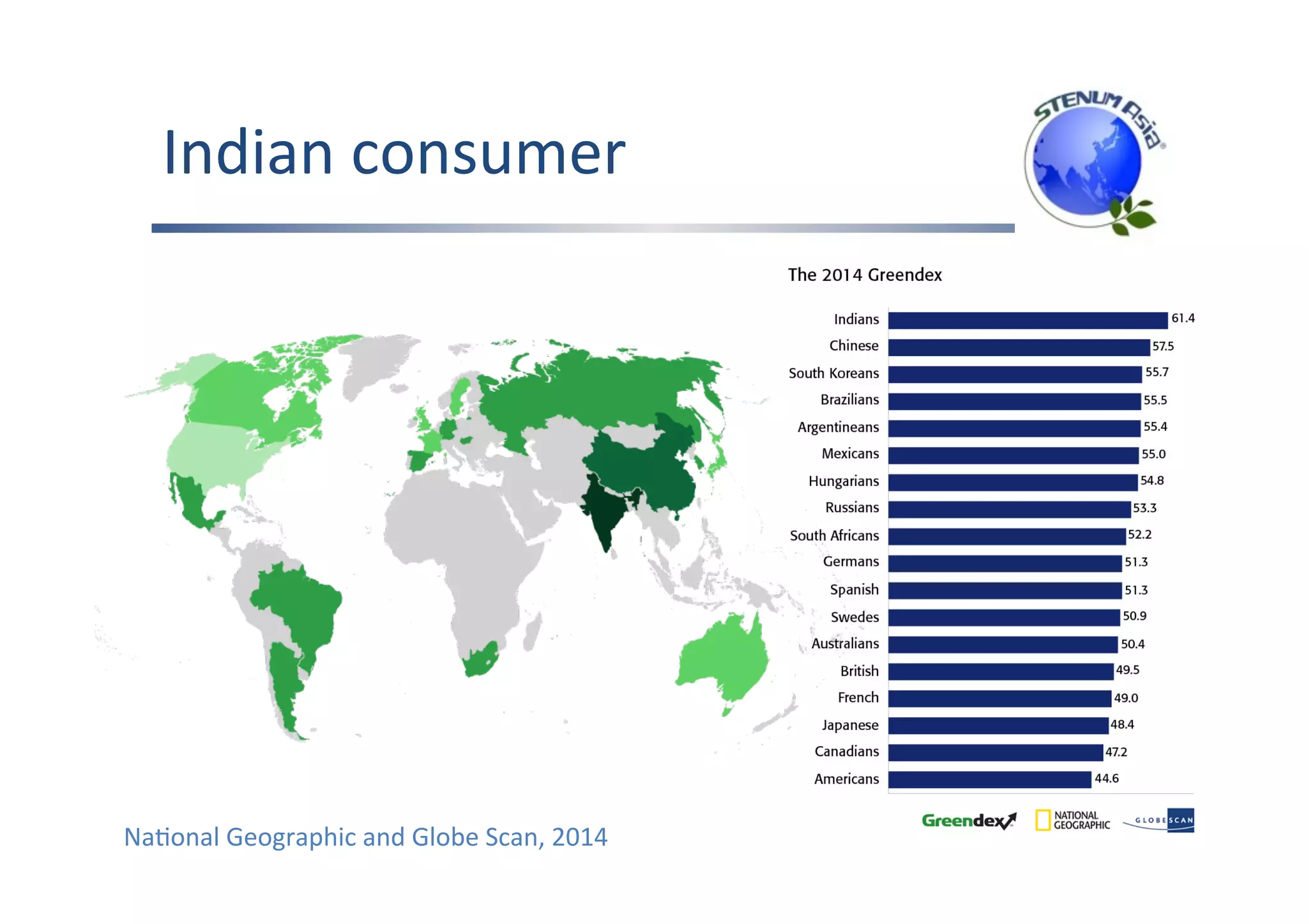
Indian	consumer	
NaFonal	Geographic	and	Globe	Scan,	2014
Indian	consumer	
30
Communicating green products to consumers in India to
promote Sustainable Consumption and Production
Figure 9: Barriers to Buying decisions
From the above analysis it can be concluded that the most important factor that
Awareness is
low
43%
Green products
are expensive
19%
Less
availability
24%
Green products
may not be of
good quality
2%
Not sure
whether its
really green
12%
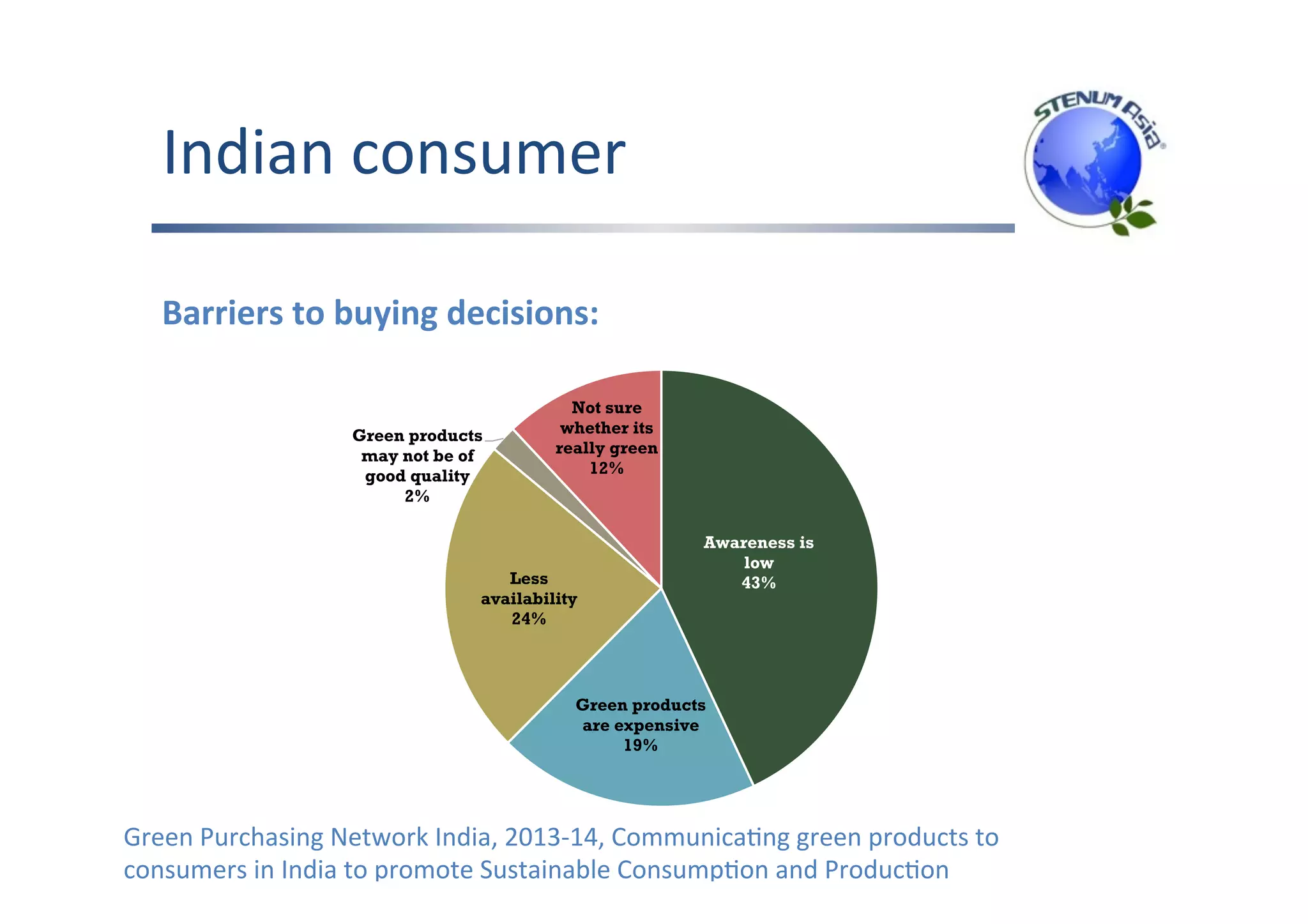
Barriers	to	buying	decisions:	
Green	Purchasing	Network	India,	2013-14,	CommunicaFng	green	products	to	
consumers	in	India	to	promote	Sustainable	ConsumpFon	and	ProducFon
Success	stories	of	
Resource	Efficiency	in	the	value	chain
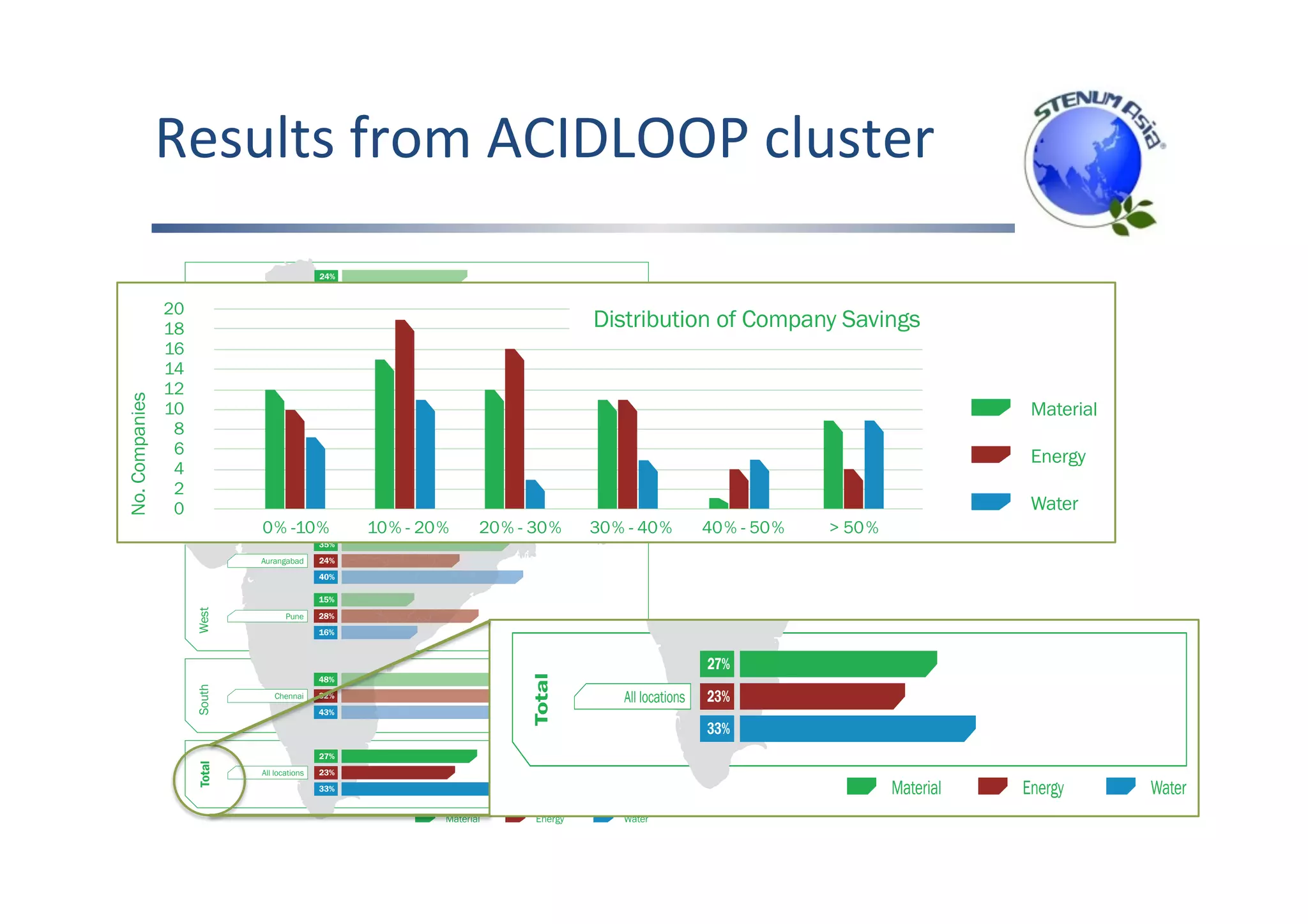
Results	from	ACIDLOOP	cluster		
NorthWestSouth
24%
25%
30%
Chandigarh-Mohali
Gurgaon
13%
14%
45%
Faridabad
18%
13%
21%
Ahmedabad
35%
25%
Vadodara
35%
24%
40%
Aurangabad
15%
28%
16%
Pune
48%
32%
43%
Chennai
All locations
27%
23%
33%
Total
SUCCESSFUL RECP MEASURES
A wide variety of RECP improvement measures was
suggested to the companies over the course of the direct
engagement phase. Many measures were then implemented
by the companies in close consultation and cooperation
with the local counterpart.
On the following three pages, we would li
some of the measures that we have implem
ACIDLOOP project. Many more good and b
be found in the Good and Best Practice
Measures in the Metal Finishing Sector.
KEY RESULTS OF THE DIRECT COMPANY SUPPORT
Showing the impact of the ACIDLOOP approach was very
important from the beginning of the project. During the
first assessment of companies, the ACIDLOOP consultants
therefore collected data on what amount of resources the
company was using, and how much energy and water it
consumed. This consumption data was correlated with
the production output.
At the end of the project period – after the RECP measures
identified had been implemented by the companies – the
consultants again measured the consumption of input materials
per output produced (specific consumption). The ACIDLOOP team
is very proud to have achieved significant savings in specific
consumption of input resources across all regions. As can be
seen in the figure below material, energy and water consumption
decreased on an average by more than 20% in all regions.
Before: Steel wires were used for hanging the metal parts to be plated in
the electroplating bath. Problems associated with this approach included:
― Steel wire was consumed during plating.
― Loading of parts to be plated was time consuming.
― The orientation of the parts could not be controlled.
Replacement of Wires with Jigs in Plating Baths
Location: Faridabad | Process: Electroplating
After: The ACIDLOOP team suggested the replacement of all steel wires
with reusable jigs. Benefits from this approach included:
― The time required for loading was reduced which
increased the productivity.
― The orientation of parts could now be controlled which
improved the quality of the plating process.
Rs. 1,00,000 for hangers
Rs 84,000 from reduced costs for
wires and less product losses 14 m
0% -10%
20
18
16
14
12
10
8
6
4
2
0
10% - 20% 20% - 30% 30% - 40% 40% - 50% > 50%
No.Companies
Distribution of Company Savings
Costs of interventions Annual savings Payback time
Cost and benefits:
Material, water and
energy savings of
ACIDLOOP companies
Material Energy Water
11%
19%
23%
25
SUCCESSFUL RECP MEASURES
A wide variety of RECP improvement measures was
suggested to the companies over the course of the direct
engagement phase. Many measures were then implemented
by the companies in close consultation and cooperation
with the local counterpart.
On the following three pages, we would like to present you
some of the measures that we have implemented during the
ACIDLOOP project. Many more good and best practices can
be found in the Good and Best Practice Module for RECP
Measures in the Metal Finishing Sector.
C H A P T E R 5
Replacement of Wires with Jigs in Plating Baths
Location: Faridabad | Process: Electroplating
0% -10%
20
18
16
14
12
10
8
6
4
2
0
10% - 20% 20% - 30% 30% - 40% 40% - 50% > 50%
No.Companies
Distribution of Company Savings
Material
Energy
Water
WestSouth
18%
13%
21%
Ahmedabad
35%
25%
Vadodara
35%
24%
40%
Aurangabad
15%
28%
16%
Pune
48%
32%
43%
Chennai
All locations
27%
23%
33%
Total
Material Energy Water
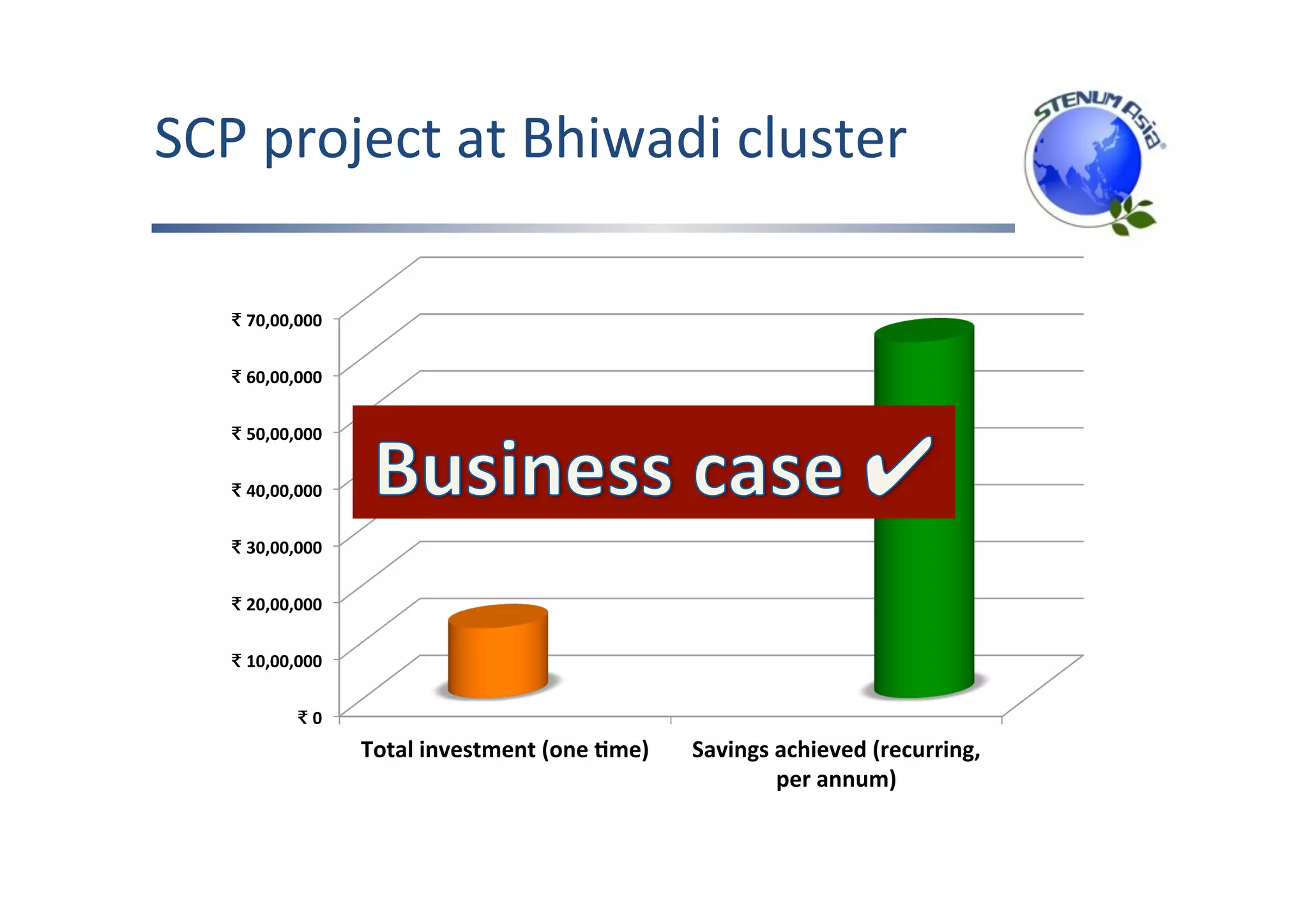
SCP	project	at	Bhiwadi	cluster		
	0	
	10,00,000	
	20,00,000	
	30,00,000	
	40,00,000	
	50,00,000	
	60,00,000	
	70,00,000	
Total	investment	(one	;me)	 Savings	achieved	(recurring,	
per	annum)
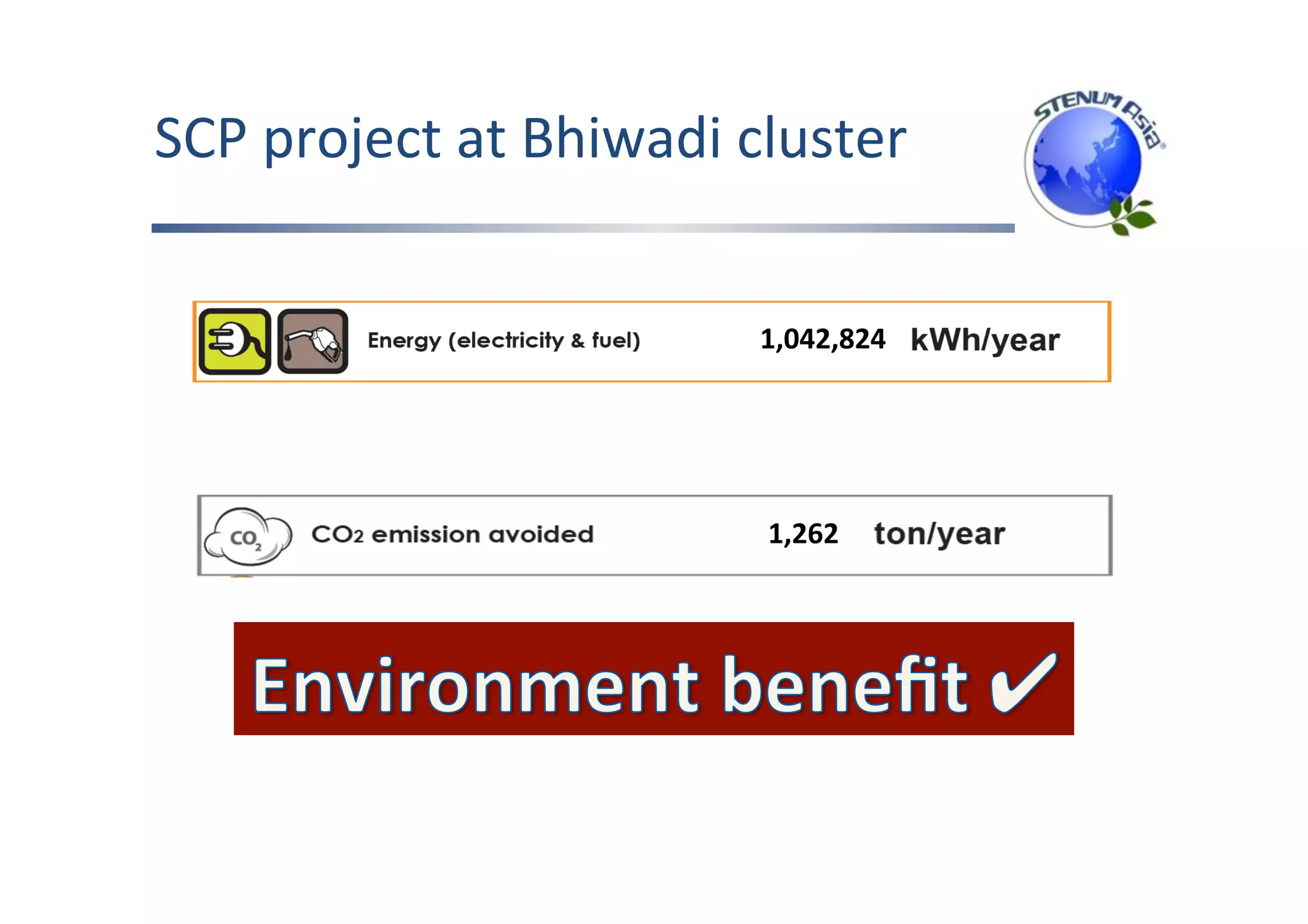
SCP	project	at	Bhiwadi	cluster		
1,262	
1,042,824
Resource	efficiency	in	value	
chain	-	examples	
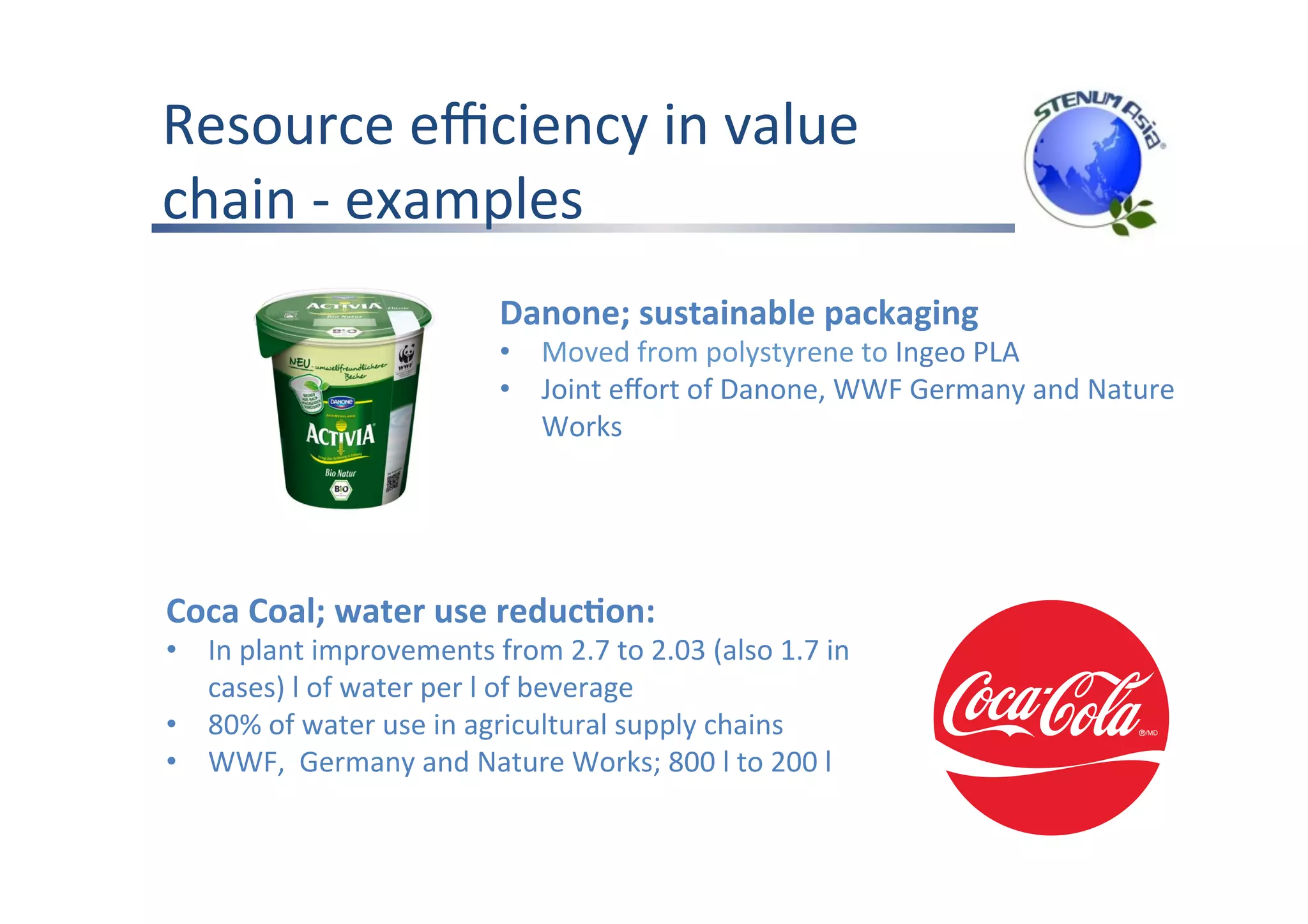
Danone;	sustainable	packaging	
•  Moved	from	polystyrene	to	Ingeo	PLA	
•  Joint	effort	of	Danone,	WWF	Germany	and	Nature	
Works	
	
Coca	Coal;	water	use	reduc;on:	
•  In	plant	improvements	from	2.7	to	2.03	(also	1.7	in	
cases)	l	of	water	per	l	of	beverage	
•  80%	of	water	use	in	agricultural	supply	chains	
•  WWF,		Germany	and	Nature	Works;	800	l	to	200	l
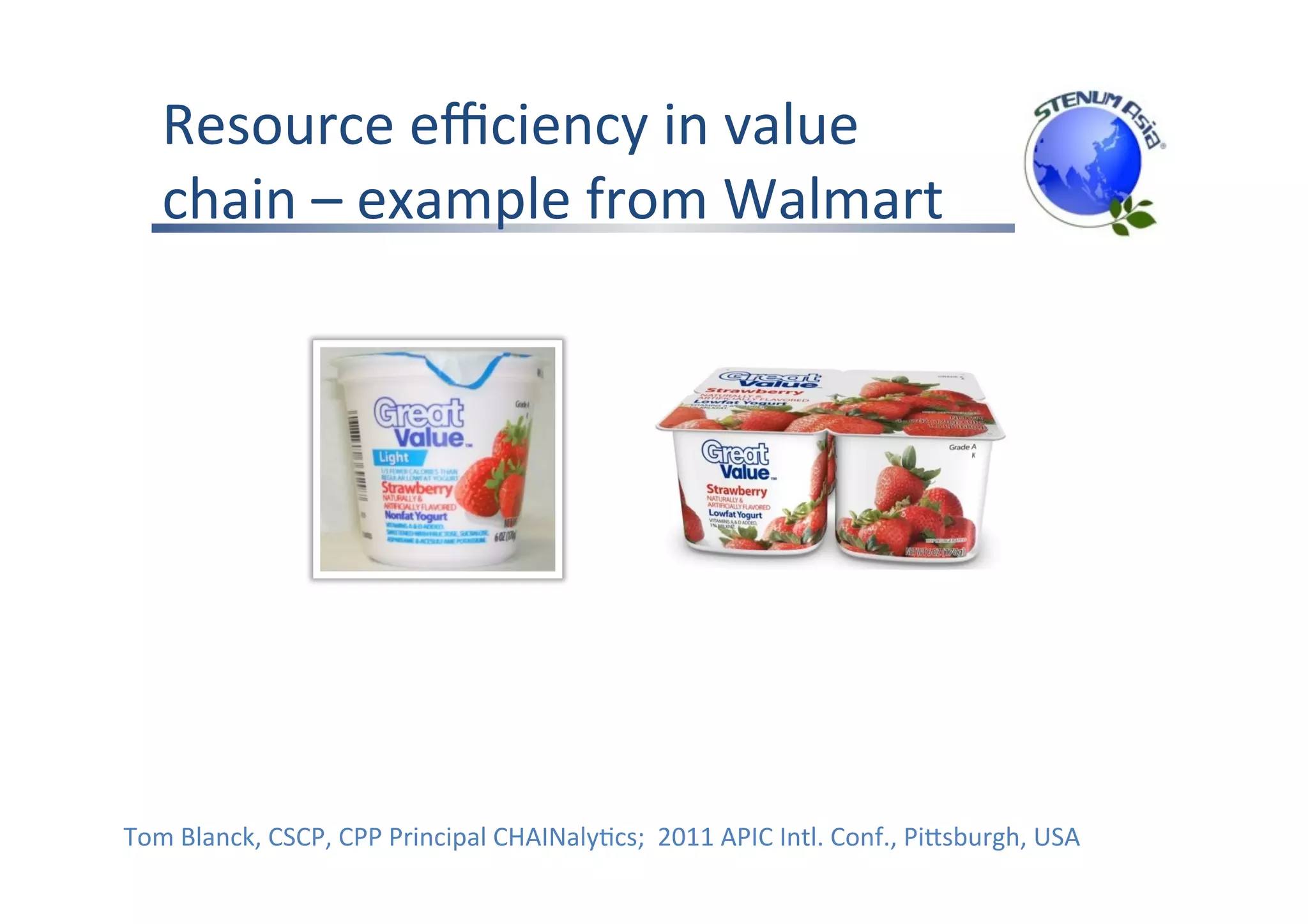
Example 1: Yogurt
OBJECTIVE
• Increase Sustainability, Improve Walmart Scorecard
Resource	efficiency	in	value	
chain	–	example	from	Walmart	
Tom	Blanck,	CSCP,	CPP	Principal	CHAINalyFcs;		2011	APIC	Intl.	Conf.,	PiPsburgh,	USA
e 1: Yogurt
ore Product per Pallet
lers “Weight Out” vs. “Cube Out”
000 Fewer Pallets
d 17 MM ft2+ Corrugated Materials
s Corrugate: 50% More Product
Case
Weight = 50% Less
ons Packaging Weight Reduction
% Savings
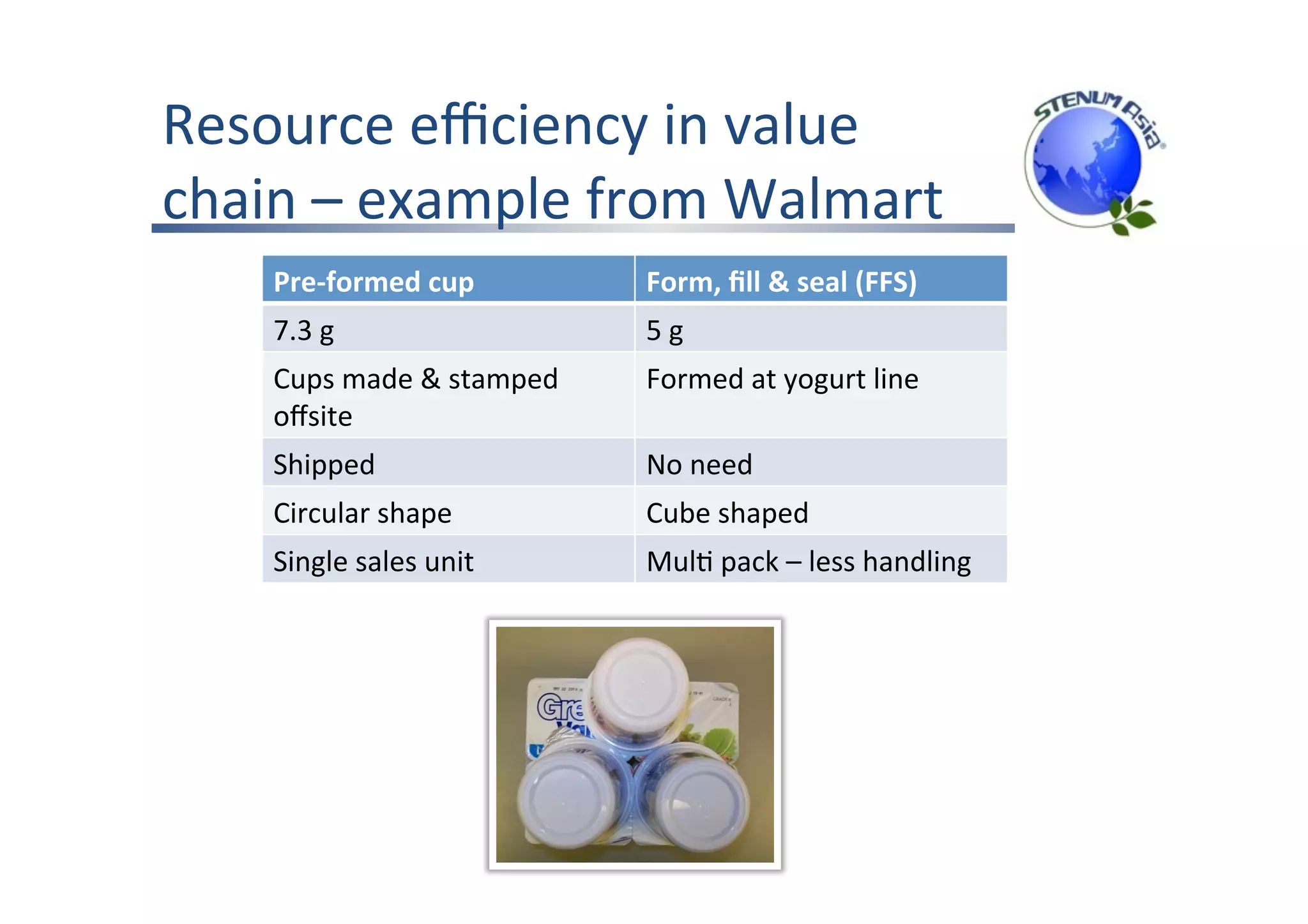
Pre-formed	cup	 Form,	fill	&	seal	(FFS)	
7.3	g	 5	g	
Cups	made	&	stamped	
offsite	
Formed	at	yogurt	line	
Shipped	 No	need	
Circular	shape	 Cube	shaped	
Single	sales	unit	 MulF	pack	–	less	handling	
Resource	efficiency	in	value	
chain	–	example	from	Walmart
Resource	efficiency	in	value	
chain	–	example	from	Walmart	
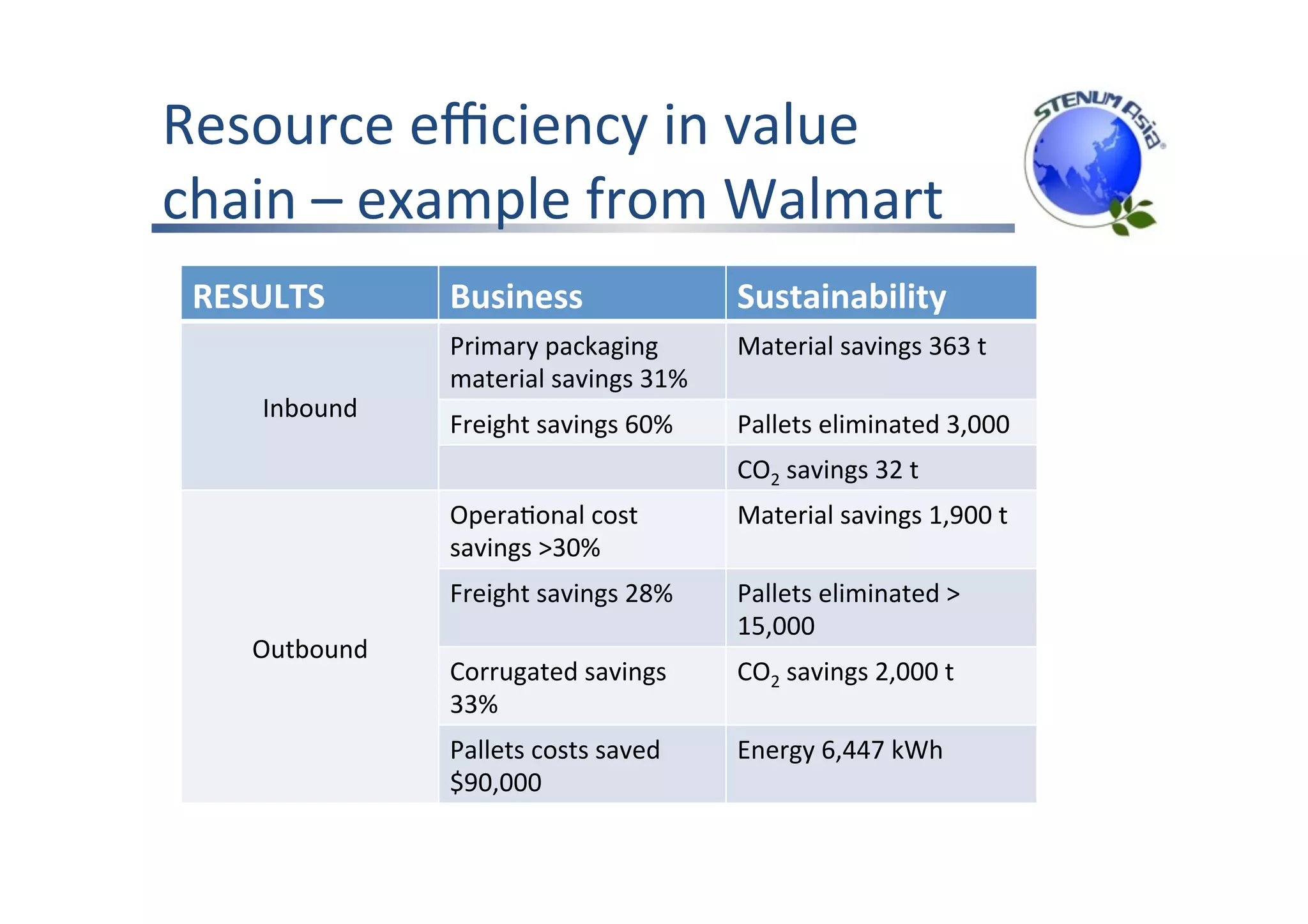
RESULTS	 Business	 Sustainability	
Inbound	
Primary	packaging	
material	savings	31%	
Material	savings	363	t	
Freight	savings	60%	 Pallets	eliminated	3,000	
CO2	savings	32	t	
Outbound	
OperaFonal	cost	
savings	>30%	
Material	savings	1,900	t	
Freight	savings	28%	 Pallets	eliminated	>	
15,000	
Corrugated	savings	
33%	
CO2	savings	2,000	t	
Pallets	costs	saved	
$90,000	
Energy	6,447	kWh
Summary	
Key	challenges	
	
•  Longer	term	relaFonships	
•  Build	trust	
•  Closeness	to	the	key	stakeholder	
•  Champion	the	cause
Thank	you!		


For	addiFonal	informaFon,	please	contact	
rajat.batra@stenum-asia.org	
Projects	funded	by

Sustainable Consumption and Production in value chains