“What gets measured, gets managed”
Adrian Segens
Managing Director
asegens@ecochain.com
Materials
Distribution
ManufactureEnd of Life
Use
Lifecycle thinking
©EcoChain Technologies 2018
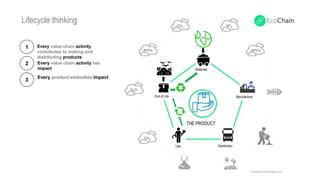
Every value chain activity
contributes to making and
distributing products
1
CH4
N2O
HFCsPFPs
SF6CO2
Every value chain activity has
impact
2
Every product embodies impact
3
THE PRODUCT
Materials
Distribution
Manufacture
Use
Lifecycle thinking
©EcoChain Technologies 2018
End of Life
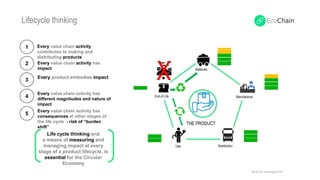
Every value chain activity
contributes to making and
distributing products
1
Every value chain activity has
impact
2
Every product embodies impact
3
Every value chain activity has
different magnitudes and nature of
impact
4
Life cycle thinking and
a means of measuring and
managing impact at every
stage of a product lifecycle, is
essential for the Circular
Economy
Every value chain activity has
consequences at other stages of
the life cycle - risk of “burden
shift”
5
X
THE PRODUCT
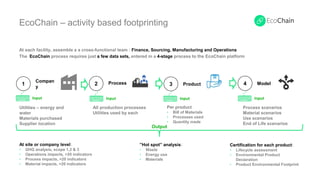
At site or company level:
• GHG analysis, scope 1,2 & 3
• Operations impacts, >20 indicators
• Process impacts, >20 indicators
• Material impacts, >20 indicators
At each facility, assemble a a cross-functional team : Finance, Sourcing, Manufacturing and Operations
The EcoChain process requires just a few data sets, entered in a 4-stage process to the EcoChain platform
Compan
y
1
Certification for each product:
• Lifecycle assessment
• Environmental Product
Declaration
• Product Environmental Footprint
EcoChain – activity based footprinting
Utilities – energy and
water
Materials purchased
Supplier location
Input
Per product
• Bill of Materials
• Processes used
• Quantity made
Input
All production processes
Utilities used by each
Input
Process scenarios
Material scenarios
Use scenarios
End of Life scenarios
Input
Model4Product3Process2
Output
”Hot spot” analysis:
• Waste
• Energy use
• Materials
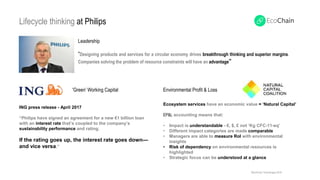
Ecosystem services have an economic value = ‘Natural Capital’
EP&L accounting means that:
• Impact is understandable - €, $, £ not ‘Kg CFC-11-eq’
• Different impact categories are made comparable
• Managers are able to measure RoI with environmental
insights
• Risk of dependency on environmental resources is
highlighted
• Strategic focus can be understood at a glance
ING press release - April 2017
“Philips have signed an agreement for a new €1 billion loan
with an interest rate that’s coupled to the company’s
sustainability performance and rating.
If the rating goes up, the interest rate goes down—
and vice versa.”
'Green’ Working Capital
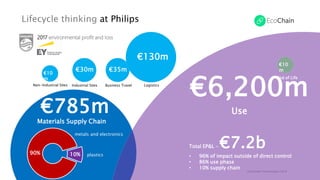
Lifecycle thinking at Philips
Leadership
“Designing products and services for a circular economy drives breakthrough thinking and superior margins.
Companies solving the problem of resource constraints will have an advantage”
©EcoChain Technologies 2018
Environmental Profit & Loss
Lifecycle thinking at Philips
©EcoChain Technologies 2018
Industrial Sites
€30m
Non-Industrial Sites
€10m
€10
m
Business Travel
€35m
Logistics
€130m
Materials Supply Chain
€785m
90% 10%
metals and electronics
plastics
Use
€6,200m
Total EP&L - €7.2b
• 96% of impact outside of direct control
• 86% use phase
• 10% supply chain
End of Life
€10
m
2017 environmental profit and loss
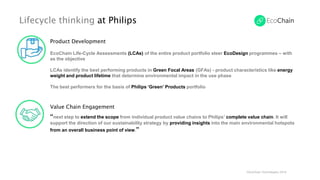
Lifecycle thinking at Philips
©EcoChain Technologies 2018
Product Development
EcoChain Life-Cycle Assessments (LCAs) of the entire product portfolio steer EcoDesign programmes – with
as the objective
LCAs identify the best performing products in Green Focal Areas (GFAs) - product characteristics like energy
weight and product lifetime that determine environmental impact in the use phase
The best performers for the basis of Philips ‘Green’ Products portfolio
Value Chain Engagement
“next step to extend the scope from individual product value chains to Philips’ complete value chain. It will
support the direction of our sustainability strategy by providing insights into the main environmental hotspots
from an overall business point of view.”
Just the start…
©EcoChain Technologies 2018
“The idea of natural capital is now mainstream.
Companies appreciate that there are benefits for
business, but…
what is required is the magnitude of the
win-win for business to become more
apparent
Prof. Mark Reed
Newcastle University

Life Cycle Thinking - Measuring and Managing

  • 1.
    “What gets measured,gets managed” Adrian Segens Managing Director asegens@ecochain.com
  • 2.
    Materials Distribution ManufactureEnd of Life Use Lifecyclethinking ©EcoChain Technologies 2018 Every value chain activity contributes to making and distributing products 1 CH4 N2O HFCsPFPs SF6CO2 Every value chain activity has impact 2 Every product embodies impact 3 THE PRODUCT
  • 3.
    Materials Distribution Manufacture Use Lifecycle thinking ©EcoChain Technologies2018 End of Life Every value chain activity contributes to making and distributing products 1 Every value chain activity has impact 2 Every product embodies impact 3 Every value chain activity has different magnitudes and nature of impact 4 Life cycle thinking and a means of measuring and managing impact at every stage of a product lifecycle, is essential for the Circular Economy Every value chain activity has consequences at other stages of the life cycle - risk of “burden shift” 5 X THE PRODUCT
  • 4.
    At site orcompany level: • GHG analysis, scope 1,2 & 3 • Operations impacts, >20 indicators • Process impacts, >20 indicators • Material impacts, >20 indicators At each facility, assemble a a cross-functional team : Finance, Sourcing, Manufacturing and Operations The EcoChain process requires just a few data sets, entered in a 4-stage process to the EcoChain platform Compan y 1 Certification for each product: • Lifecycle assessment • Environmental Product Declaration • Product Environmental Footprint EcoChain – activity based footprinting Utilities – energy and water Materials purchased Supplier location Input Per product • Bill of Materials • Processes used • Quantity made Input All production processes Utilities used by each Input Process scenarios Material scenarios Use scenarios End of Life scenarios Input Model4Product3Process2 Output ”Hot spot” analysis: • Waste • Energy use • Materials
  • 5.
    Ecosystem services havean economic value = ‘Natural Capital’ EP&L accounting means that: • Impact is understandable - €, $, £ not ‘Kg CFC-11-eq’ • Different impact categories are made comparable • Managers are able to measure RoI with environmental insights • Risk of dependency on environmental resources is highlighted • Strategic focus can be understood at a glance ING press release - April 2017 “Philips have signed an agreement for a new €1 billion loan with an interest rate that’s coupled to the company’s sustainability performance and rating. If the rating goes up, the interest rate goes down— and vice versa.” 'Green’ Working Capital Lifecycle thinking at Philips Leadership “Designing products and services for a circular economy drives breakthrough thinking and superior margins. Companies solving the problem of resource constraints will have an advantage” ©EcoChain Technologies 2018 Environmental Profit & Loss
  • 6.
    Lifecycle thinking atPhilips ©EcoChain Technologies 2018 Industrial Sites €30m Non-Industrial Sites €10m €10 m Business Travel €35m Logistics €130m Materials Supply Chain €785m 90% 10% metals and electronics plastics Use €6,200m Total EP&L - €7.2b • 96% of impact outside of direct control • 86% use phase • 10% supply chain End of Life €10 m 2017 environmental profit and loss
  • 7.
    Lifecycle thinking atPhilips ©EcoChain Technologies 2018 Product Development EcoChain Life-Cycle Assessments (LCAs) of the entire product portfolio steer EcoDesign programmes – with as the objective LCAs identify the best performing products in Green Focal Areas (GFAs) - product characteristics like energy weight and product lifetime that determine environmental impact in the use phase The best performers for the basis of Philips ‘Green’ Products portfolio Value Chain Engagement “next step to extend the scope from individual product value chains to Philips’ complete value chain. It will support the direction of our sustainability strategy by providing insights into the main environmental hotspots from an overall business point of view.”
  • 8.
    Just the start… ©EcoChainTechnologies 2018 “The idea of natural capital is now mainstream. Companies appreciate that there are benefits for business, but… what is required is the magnitude of the win-win for business to become more apparent Prof. Mark Reed Newcastle University

Editor's Notes

  • #5 EcoChain is built around our unique methodology -Activity-Based Footprinting. A scientifically validated technique that assesses the environmental impacts associated with all the stages of a product's life cycle, from raw material extraction, through materials processing, manufacture, distribution, use, maintenance to disposal or recycling. Unlike conventional tools, EcoChain enables manufacturers to calculate the full Life Cycle Assessments (LCAs) of their entire product range simultaneously to give a full insight into the eco-efficiency of a factory. If required, these LCAs can then be certified and published, to match sustainable products with sustainable procurement initiatives.