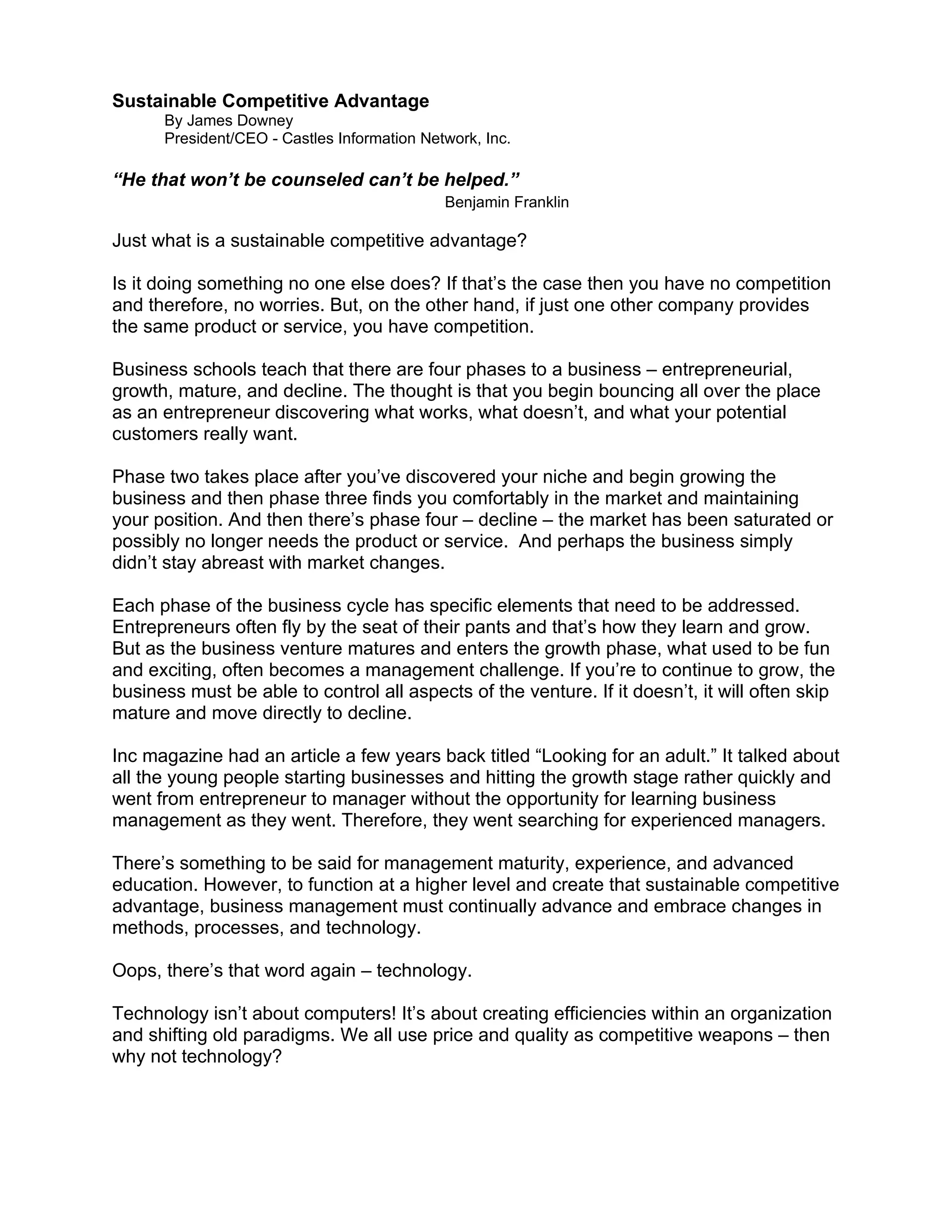
Sustainable Competitive Advantage
      By James Downey
      President/CEO - Castles Information Network, Inc.

“He that won’t be counseled can’t be helped.”
                                             Benjamin Franklin

Just what is a sustainable competitive advantage?

Is it doing something no one else does? If that’s the case then you have no competition
and therefore, no worries. But, on the other hand, if just one other company provides
the same product or service, you have competition.

Business schools teach that there are four phases to a business – entrepreneurial,
growth, mature, and decline. The thought is that you begin bouncing all over the place
as an entrepreneur discovering what works, what doesn’t, and what your potential
customers really want.

Phase two takes place after you’ve discovered your niche and begin growing the
business and then phase three finds you comfortably in the market and maintaining
your position. And then there’s phase four – decline – the market has been saturated or
possibly no longer needs the product or service. And perhaps the business simply
didn’t stay abreast with market changes.

Each phase of the business cycle has specific elements that need to be addressed.
Entrepreneurs often fly by the seat of their pants and that’s how they learn and grow.
But as the business venture matures and enters the growth phase, what used to be fun
and exciting, often becomes a management challenge. If you’re to continue to grow, the
business must be able to control all aspects of the venture. If it doesn’t, it will often skip
mature and move directly to decline.

Inc magazine had an article a few years back titled “Looking for an adult.” It talked about
all the young people starting businesses and hitting the growth stage rather quickly and
went from entrepreneur to manager without the opportunity for learning business
management as they went. Therefore, they went searching for experienced managers.

There’s something to be said for management maturity, experience, and advanced
education. However, to function at a higher level and create that sustainable competitive
advantage, business management must continually advance and embrace changes in
methods, processes, and technology.

Oops, there’s that word again – technology.

Technology isn’t about computers! It’s about creating efficiencies within an organization
and shifting old paradigms. We all use price and quality as competitive weapons – then
why not technology?
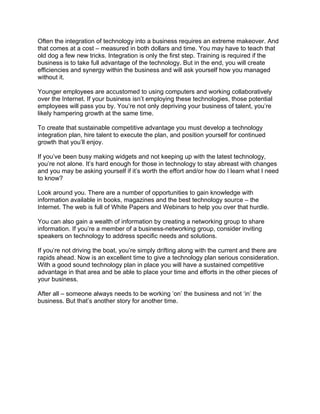
Often the integration of technology into a business requires an extreme makeover. And
that comes at a cost – measured in both dollars and time. You may have to teach that
old dog a few new tricks. Integration is only the first step. Training is required if the
business is to take full advantage of the technology. But in the end, you will create
efficiencies and synergy within the business and will ask yourself how you managed
without it.

Younger employees are accustomed to using computers and working collaboratively
over the Internet. If your business isn’t employing these technologies, those potential
employees will pass you by. You’re not only depriving your business of talent, you’re
likely hampering growth at the same time.

To create that sustainable competitive advantage you must develop a technology
integration plan, hire talent to execute the plan, and position yourself for continued
growth that you’ll enjoy.

If you’ve been busy making widgets and not keeping up with the latest technology,
you’re not alone. It’s hard enough for those in technology to stay abreast with changes
and you may be asking yourself if it’s worth the effort and/or how do I learn what I need
to know?

Look around you. There are a number of opportunities to gain knowledge with
information available in books, magazines and the best technology source – the
Internet. The web is full of White Papers and Webinars to help you over that hurdle.

You can also gain a wealth of information by creating a networking group to share
information. If you’re a member of a business-networking group, consider inviting
speakers on technology to address specific needs and solutions.

If you’re not driving the boat, you’re simply drifting along with the current and there are
rapids ahead. Now is an excellent time to give a technology plan serious consideration.
With a good sound technology plan in place you will have a sustained competitive
advantage in that area and be able to place your time and efforts in the other pieces of
your business.

After all – someone always needs to be working ‘on’ the business and not ‘in’ the
business. But that’s another story for another time.

Sustainable Competitive Advantage

  • 1.
    Sustainable Competitive Advantage By James Downey President/CEO - Castles Information Network, Inc. “He that won’t be counseled can’t be helped.” Benjamin Franklin Just what is a sustainable competitive advantage? Is it doing something no one else does? If that’s the case then you have no competition and therefore, no worries. But, on the other hand, if just one other company provides the same product or service, you have competition. Business schools teach that there are four phases to a business – entrepreneurial, growth, mature, and decline. The thought is that you begin bouncing all over the place as an entrepreneur discovering what works, what doesn’t, and what your potential customers really want. Phase two takes place after you’ve discovered your niche and begin growing the business and then phase three finds you comfortably in the market and maintaining your position. And then there’s phase four – decline – the market has been saturated or possibly no longer needs the product or service. And perhaps the business simply didn’t stay abreast with market changes. Each phase of the business cycle has specific elements that need to be addressed. Entrepreneurs often fly by the seat of their pants and that’s how they learn and grow. But as the business venture matures and enters the growth phase, what used to be fun and exciting, often becomes a management challenge. If you’re to continue to grow, the business must be able to control all aspects of the venture. If it doesn’t, it will often skip mature and move directly to decline. Inc magazine had an article a few years back titled “Looking for an adult.” It talked about all the young people starting businesses and hitting the growth stage rather quickly and went from entrepreneur to manager without the opportunity for learning business management as they went. Therefore, they went searching for experienced managers. There’s something to be said for management maturity, experience, and advanced education. However, to function at a higher level and create that sustainable competitive advantage, business management must continually advance and embrace changes in methods, processes, and technology. Oops, there’s that word again – technology. Technology isn’t about computers! It’s about creating efficiencies within an organization and shifting old paradigms. We all use price and quality as competitive weapons – then why not technology?
  • 2.
    Often the integrationof technology into a business requires an extreme makeover. And that comes at a cost – measured in both dollars and time. You may have to teach that old dog a few new tricks. Integration is only the first step. Training is required if the business is to take full advantage of the technology. But in the end, you will create efficiencies and synergy within the business and will ask yourself how you managed without it. Younger employees are accustomed to using computers and working collaboratively over the Internet. If your business isn’t employing these technologies, those potential employees will pass you by. You’re not only depriving your business of talent, you’re likely hampering growth at the same time. To create that sustainable competitive advantage you must develop a technology integration plan, hire talent to execute the plan, and position yourself for continued growth that you’ll enjoy. If you’ve been busy making widgets and not keeping up with the latest technology, you’re not alone. It’s hard enough for those in technology to stay abreast with changes and you may be asking yourself if it’s worth the effort and/or how do I learn what I need to know? Look around you. There are a number of opportunities to gain knowledge with information available in books, magazines and the best technology source – the Internet. The web is full of White Papers and Webinars to help you over that hurdle. You can also gain a wealth of information by creating a networking group to share information. If you’re a member of a business-networking group, consider inviting speakers on technology to address specific needs and solutions. If you’re not driving the boat, you’re simply drifting along with the current and there are rapids ahead. Now is an excellent time to give a technology plan serious consideration. With a good sound technology plan in place you will have a sustained competitive advantage in that area and be able to place your time and efforts in the other pieces of your business. After all – someone always needs to be working ‘on’ the business and not ‘in’ the business. But that’s another story for another time.