This programme has been funded with
support from the European Commission
START UP IN STEM
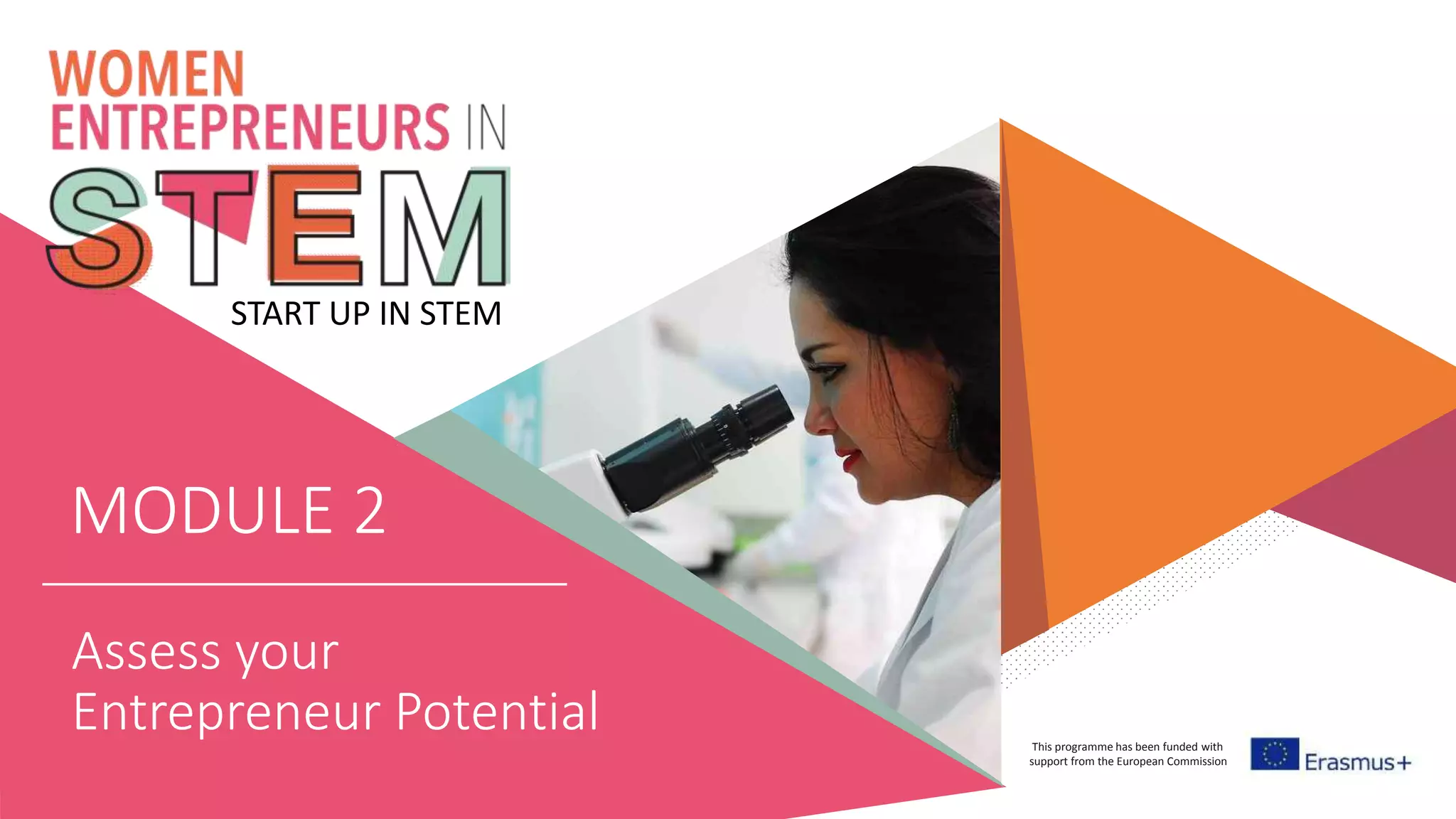
MODULE 2
Assess your
Entrepreneur Potential
Entrepreneurial Potential,
Personality,
Self Motivation,
Strengths & Weaknesses,
Leadership & Resilience
Tests
Section 1
• In this module, you find
out if you have what it
takes to be a STEM
entrepreneur and if having
your own business is the right
professional choice for you.
• We introduce you to an online
series of 7 assessments so you can
define your goals and what steps you
need to take to acquire them.
• It doesn’t’ stop there, you will reflect on
if you have the right personality traits and
qualities considered compatible with a
successful entrepreneur. You will discover
what motivates you, what makes you tick
and how resilient you are
• You will learn formal approaches to
validating and incubation STEM
entrepreneurship ideas
Section 2 Validating and
incubating STEM
entrepreneurship ideas
Women Entrepreneurs in STEM | www.stementrepreneurs.eu
”
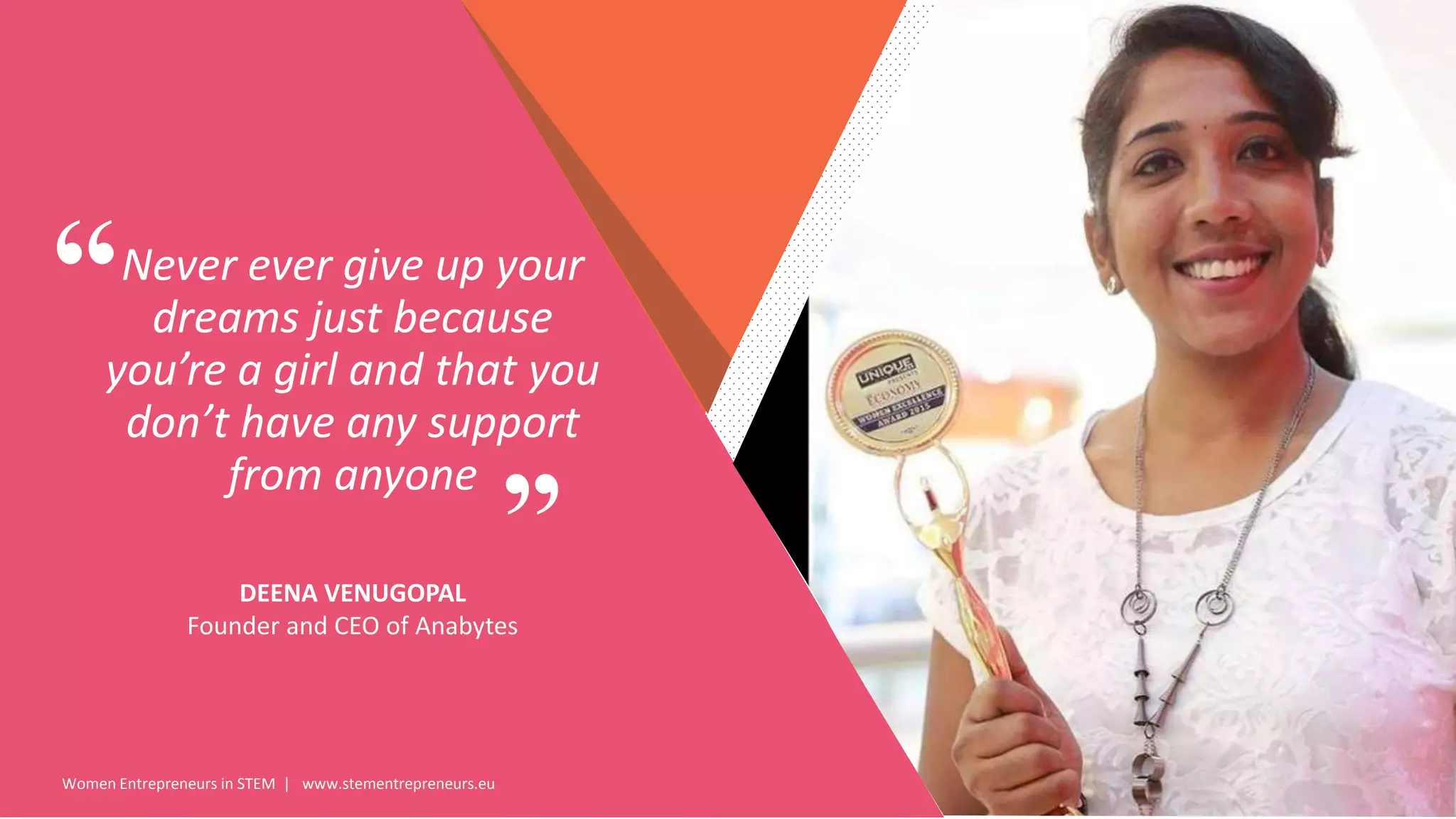
“Never ever give up your
dreams just because
you’re a girl and that you
don’t have any support
from anyone
DEENA VENUGOPAL
Founder and CEO of Anabytes
Women Entrepreneurs in STEM | www.stementrepreneurs.eu
SECTION 1:
Entrepreneurial Potential,
Personality,
Self Motivation,
Strengths & Weaknesses,
Leadership & Resilience Tests
Women Entrepreneurs in STEM | www.stementrepreneurs.eu
Assess your STEM
Entrepreneurial Potential
Learnt skill or an innate talent?
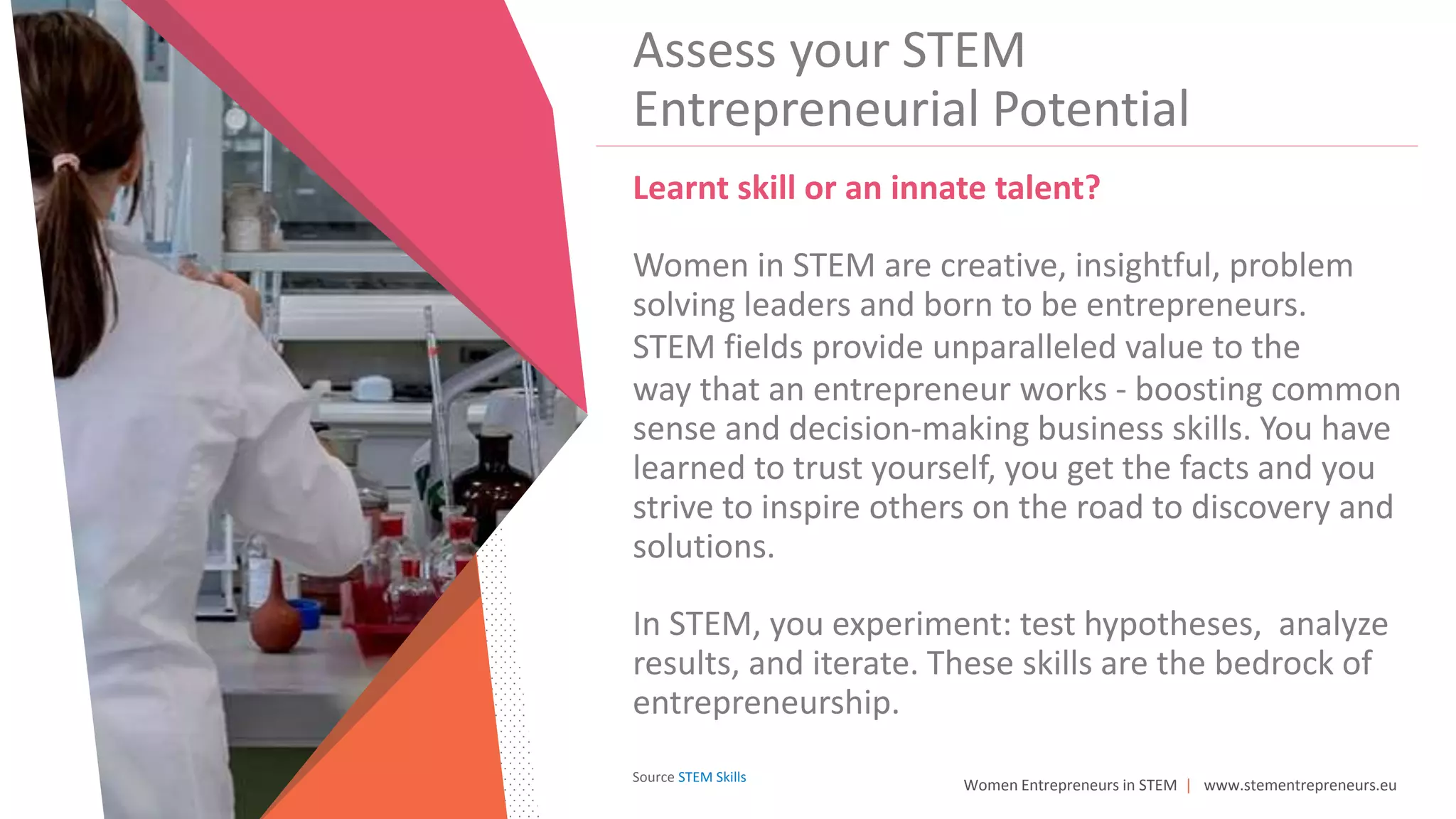
Women in STEM are creative, insightful, problem
solving leaders and born to be entrepreneurs.
STEM fields provide unparalleled value to the
way that an entrepreneur works - boosting common
sense and decision-making business skills. You have
learned to trust yourself, you get the facts and you
strive to inspire others on the road to discovery and
solutions.
In STEM, you experiment: test hypotheses, analyze
results, and iterate. These skills are the bedrock of
entrepreneurship.
Source STEM Skills
Women Entrepreneurs in STEM | www.stementrepreneurs.eu
Assess your STEM
Entrepreneurial Potential
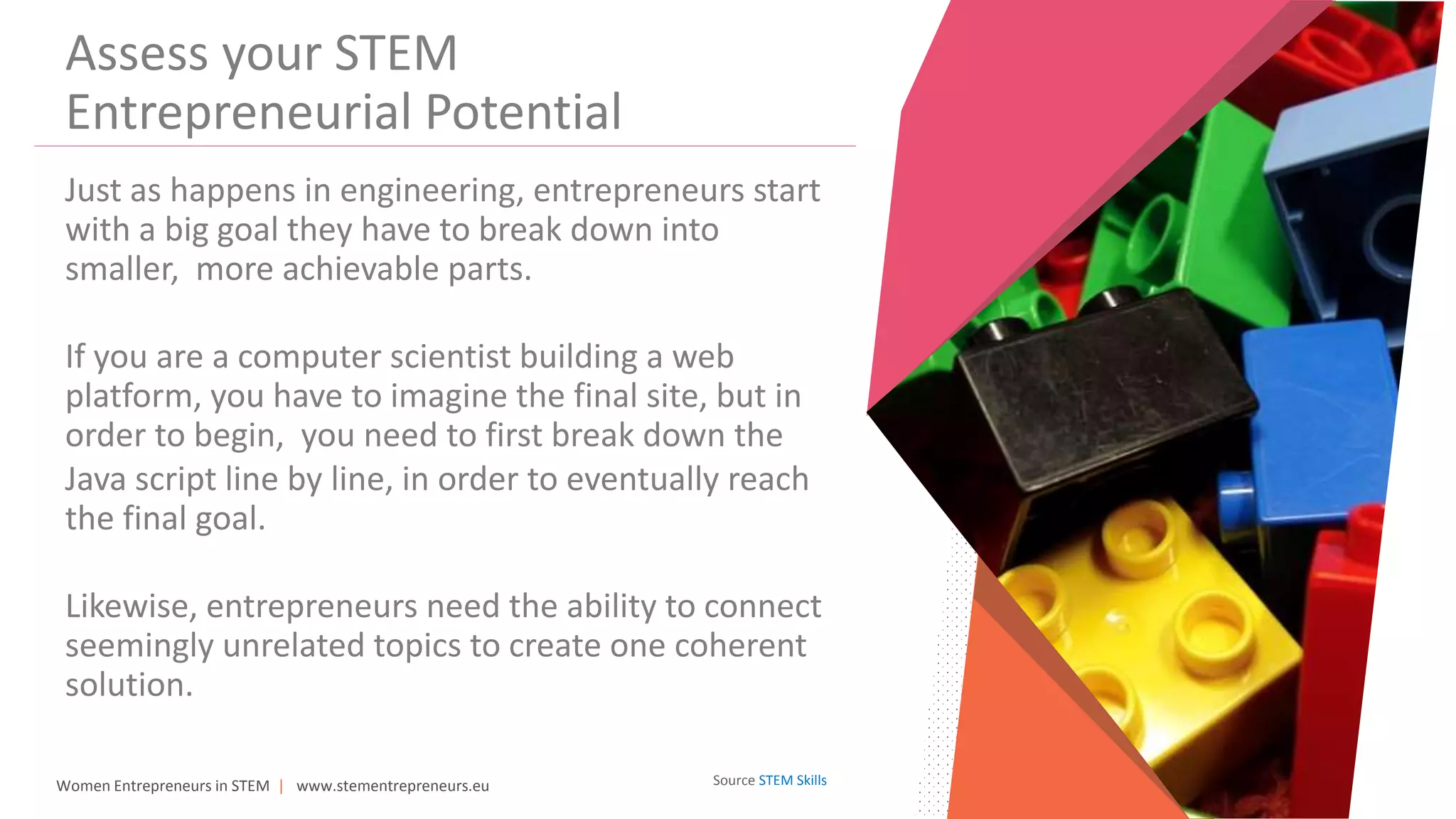
Just as happens in engineering, entrepreneurs start
with a big goal they have to break down into
smaller, more achievable parts.
If you are a computer scientist building a web
platform, you have to imagine the final site, but in
order to begin, you need to first break down the
Java script line by line, in order to eventually reach
the final goal.
Likewise, entrepreneurs need the ability to connect
seemingly unrelated topics to create one coherent
solution.
Source STEM Skills
Women Entrepreneurs in STEM | www.stementrepreneurs.eu
Assess your STEM Entrepreneurial Potential
Entrepreneur Self Assessments: What You Need to Know.
If you're starting or leading a company, it's beneficial to know
yourself inside and out. Assessing yourself with professional
self assessment tools can:
• Help you understand how you work best, so you can make
appropriate changes.
• Help your stakeholders to understand what motivates and
drives you.
• Help you recognize when you need help.
• Help you choose who to hire to compliment your strengths
and weaknesses.
Women Entrepreneurs in STEM | www.stementrepreneurs.eu
Assess your STEM Entrepreneurial Potential
Why are personality tests so important to an aspiring entrepreneur?
Self assessments help individuals get in touch with what their core
competencies are and how those may overlap with what’s needed to
take on running a business.
While your personality is highly relevant in your success, it’s not the
only defining factor which we explore in greater detail in this training
module.
We now introduce you to an online series of 7 assessments so you
can define your entrepreneurial aptitude and goals and what are the
skills you need to progress.
Women Entrepreneurs in STEM | www.stementrepreneurs.eu
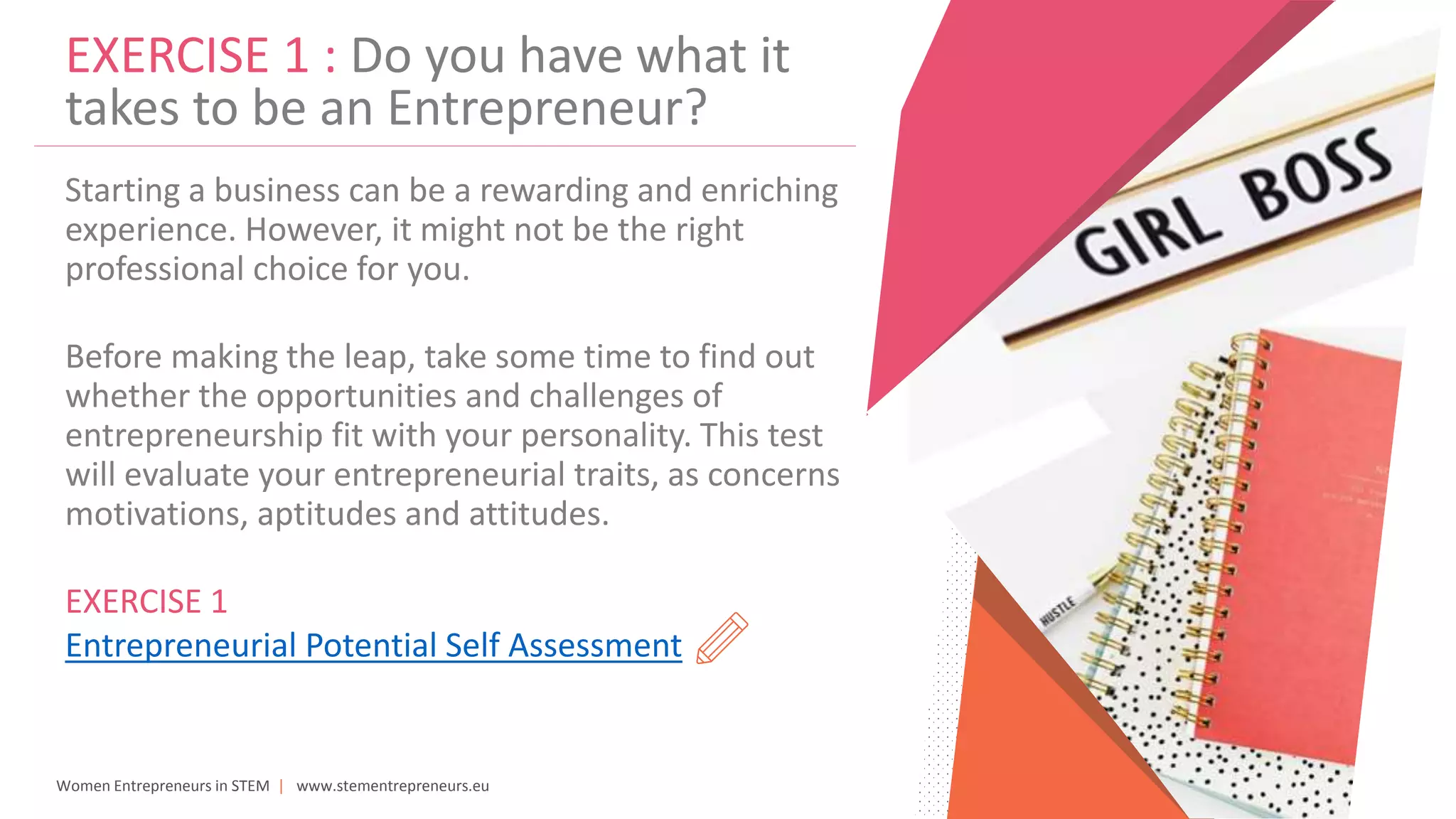
EXERCISE 1 : Do you have what it
takes to be an Entrepreneur?
Starting a business can be a rewarding and enriching
experience. However, it might not be the right
professional choice for you.
Before making the leap, take some time to find out
whether the opportunities and challenges of
entrepreneurship fit with your personality. This test
will evaluate your entrepreneurial traits, as concerns
motivations, aptitudes and attitudes.
EXERCISE 1
Entrepreneurial Potential Self Assessment
Women Entrepreneurs in STEM | www.stementrepreneurs.eu
Do you have what it takes to
be an Entrepreneur?
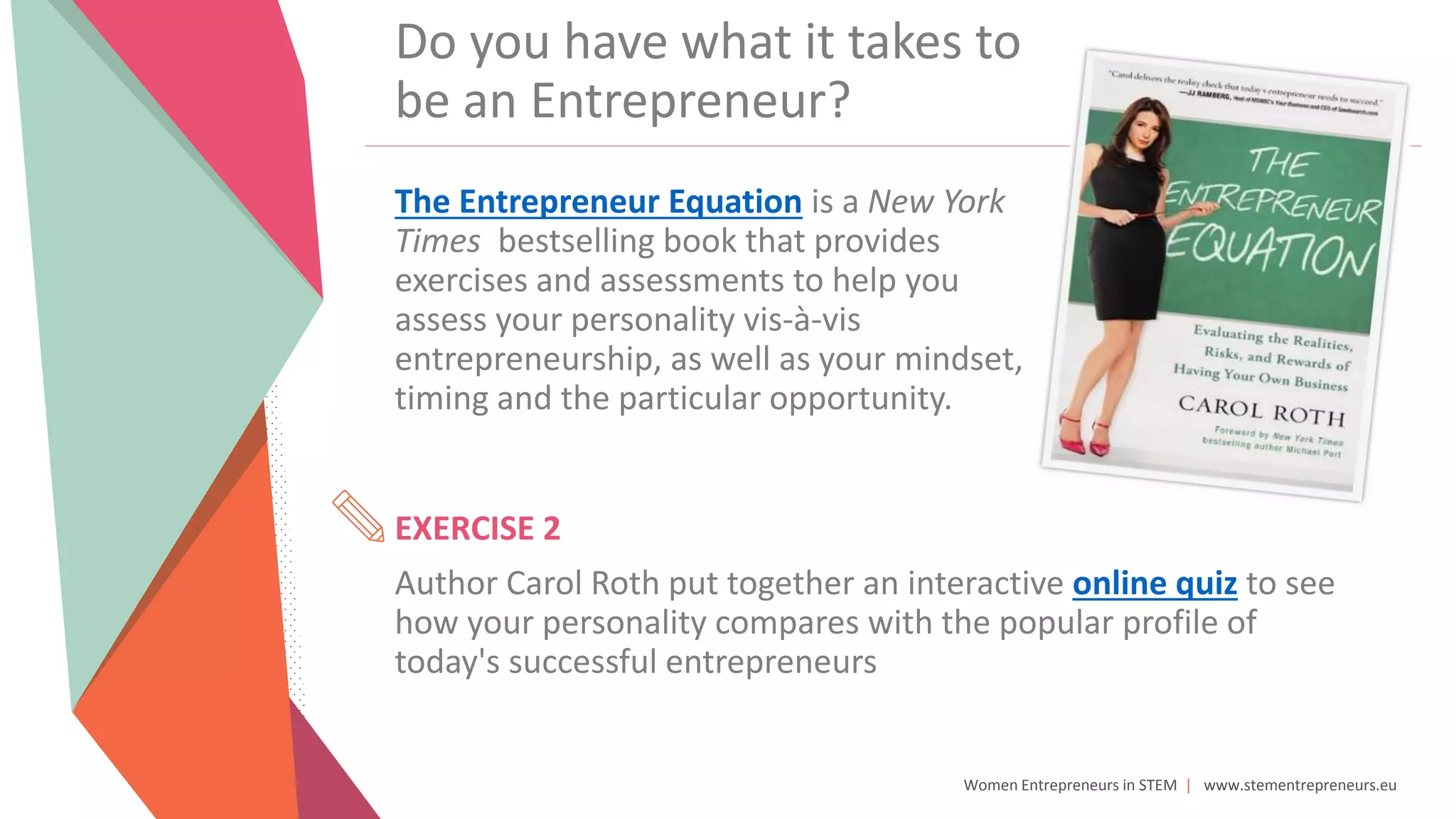
The Entrepreneur Equation is a New York
Times bestselling book that provides
exercises and assessments to help you
assess your personality vis-à-vis
entrepreneurship, as well as your mindset,
timing and the particular opportunity.
EXERCISE 2
Author Carol Roth put together an interactive online quiz to see
how your personality compares with the popular profile of
today's successful entrepreneurs
Women Entrepreneurs in STEM | www.stementrepreneurs.eu
What Kind of Entrepreneur are You?
An Entrepreneur Personality Test is designed to assess the
personality traits associated with entrepreneurial ability, in order to
provide insight into the current qualities possessed by the
candidate that are considered to be compatible with a successful
entrepreneurial career across the key headings of :
Achievement Striving Industriousness
Passion Taking Control Creativity
Women Entrepreneurs in STEM | www.stementrepreneurs.eu
What Kind of Entrepreneur are You?
The summaries provided in the entrepreneur questionnaire will
give you an understanding of the strength of the characteristics
they already possess, as well as a bearing on the areas that may
require improvement, in order to aid in the development of a
successful entrepreneurial career.
EXERCISE 3 Entrepreneur Personality Test
Women Entrepreneurs in STEM | www.stementrepreneurs.eu
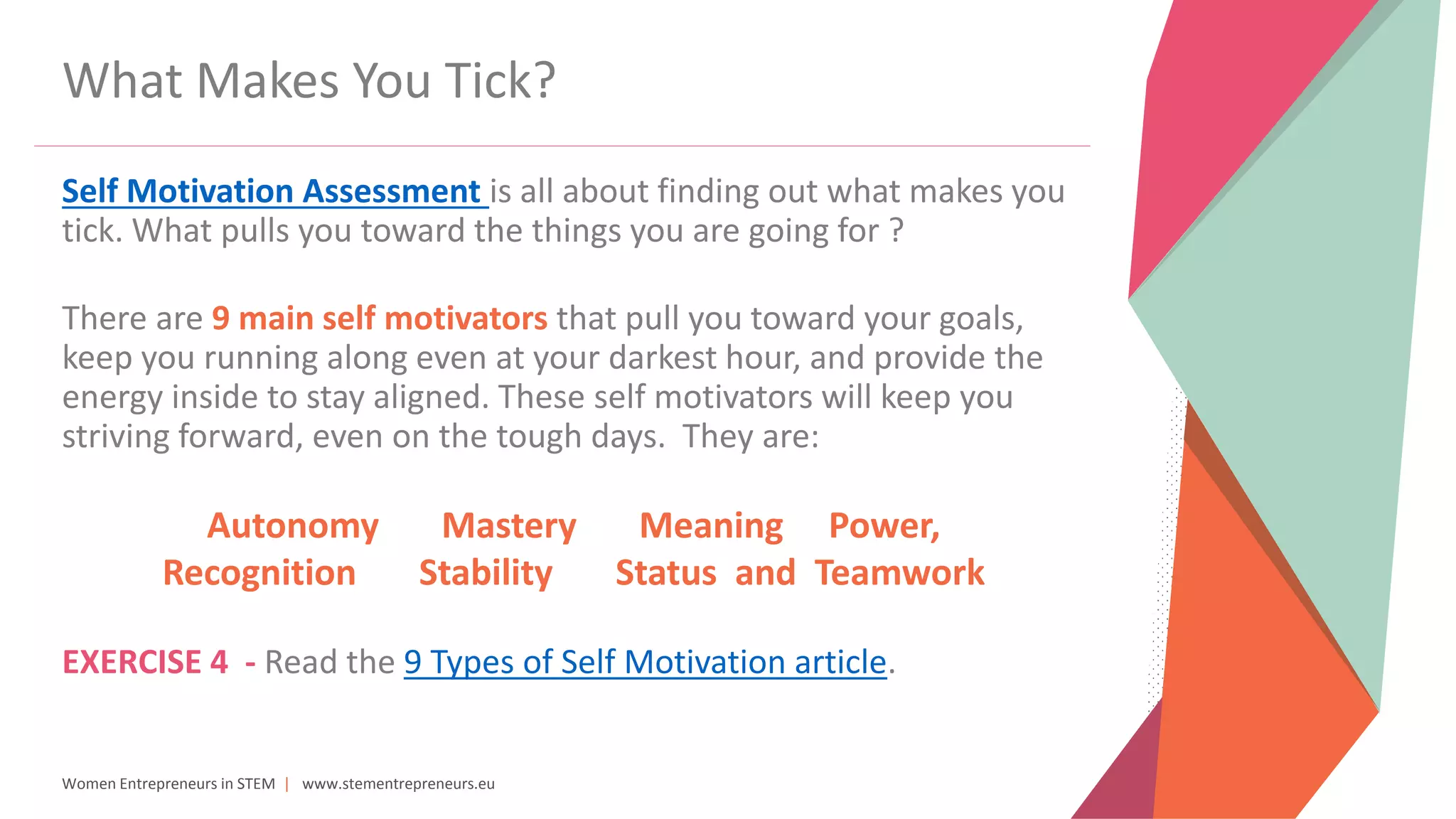
What Makes You Tick?
Self Motivation Assessment is all about finding out what makes you
tick. What pulls you toward the things you are going for ?
There are 9 main self motivators that pull you toward your goals,
keep you running along even at your darkest hour, and provide the
energy inside to stay aligned. These self motivators will keep you
striving forward, even on the tough days. They are:
Autonomy Mastery Meaning Power,
Recognition Stability Status and Teamwork
EXERCISE 4 - Read the 9 Types of Self Motivation article.
Women Entrepreneurs in STEM | www.stementrepreneurs.eu
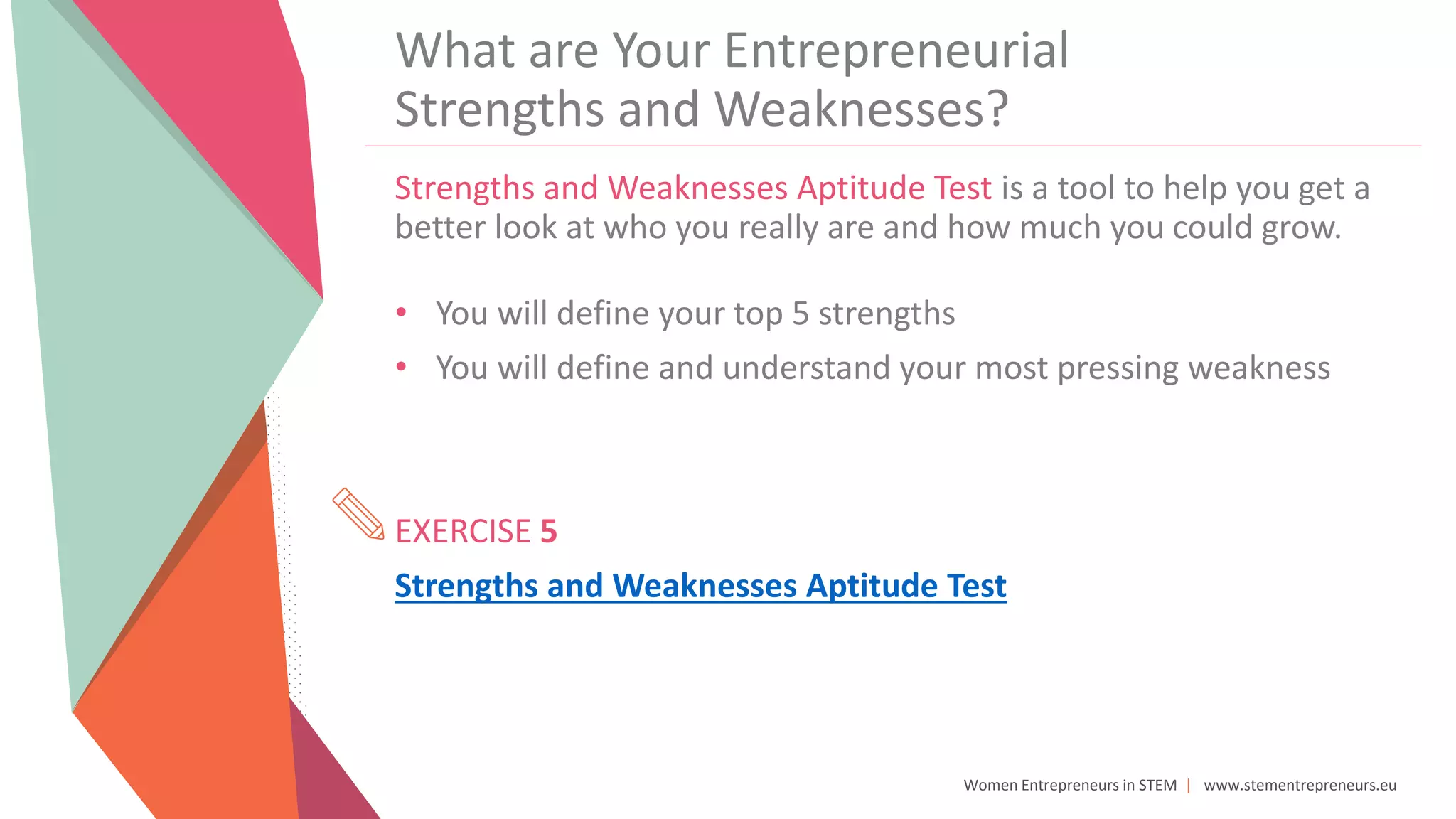
What are Your Entrepreneurial
Strengths and Weaknesses?
Strengths and Weaknesses Aptitude Test is a tool to help you get a
better look at who you really are and how much you could grow.
• You will define your top 5 strengths
• You will define and understand your most pressing weakness
EXERCISE 5
Strengths and Weaknesses Aptitude Test
Women Entrepreneurs in STEM | www.stementrepreneurs.eu
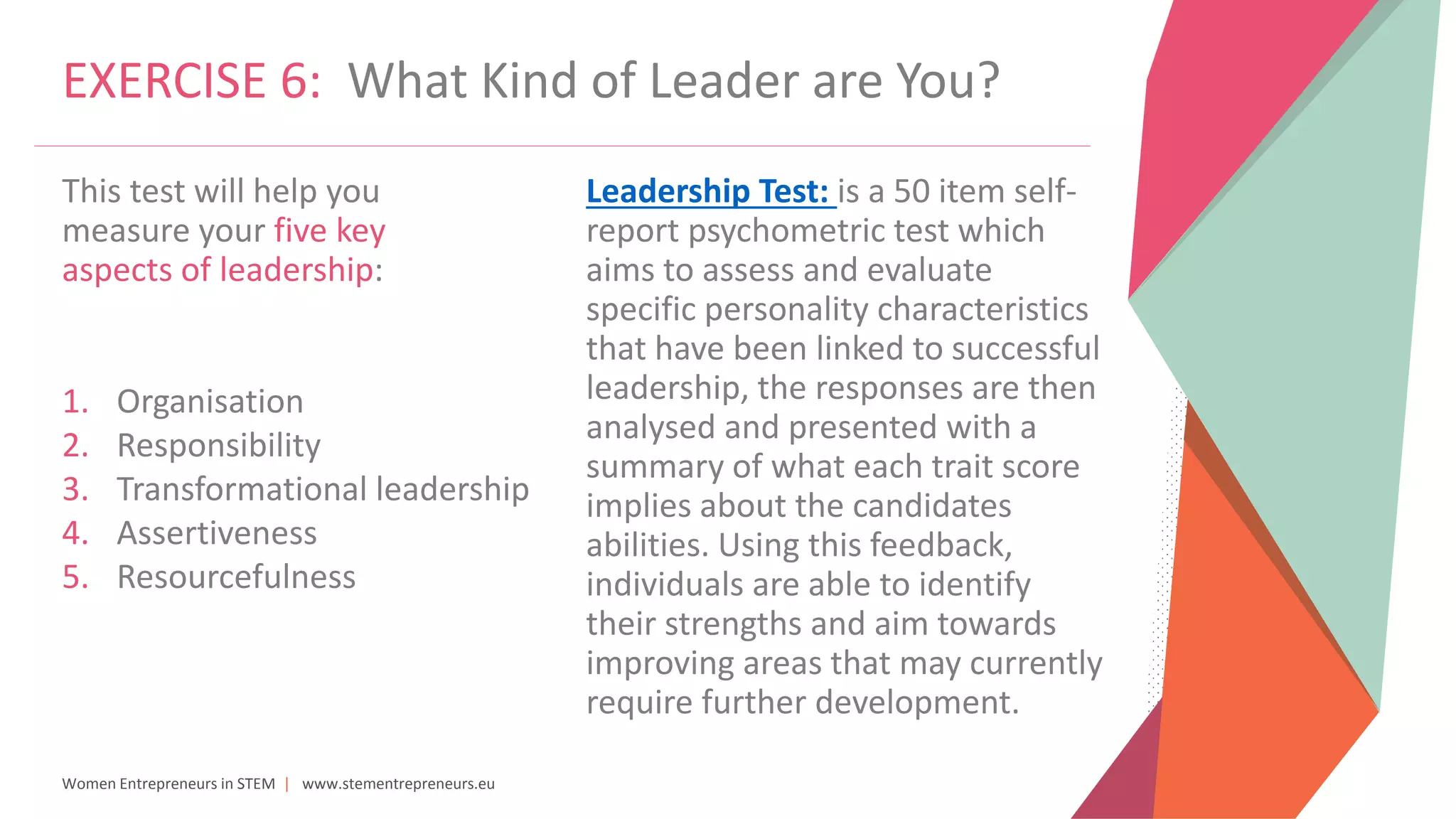
EXERCISE 6: What Kind of Leader are You?
This test will help you
measure your five key
aspects of leadership:
1. Organisation
2. Responsibility
3. Transformational leadership
4. Assertiveness
5. Resourcefulness
Leadership Test: is a 50 item self-
report psychometric test which
aims to assess and evaluate
specific personality characteristics
that have been linked to successful
leadership, the responses are then
analysed and presented with a
summary of what each trait score
implies about the candidates
abilities. Using this feedback,
individuals are able to identify
their strengths and aim towards
improving areas that may currently
require further development.
Women Entrepreneurs in STEM | www.stementrepreneurs.eu
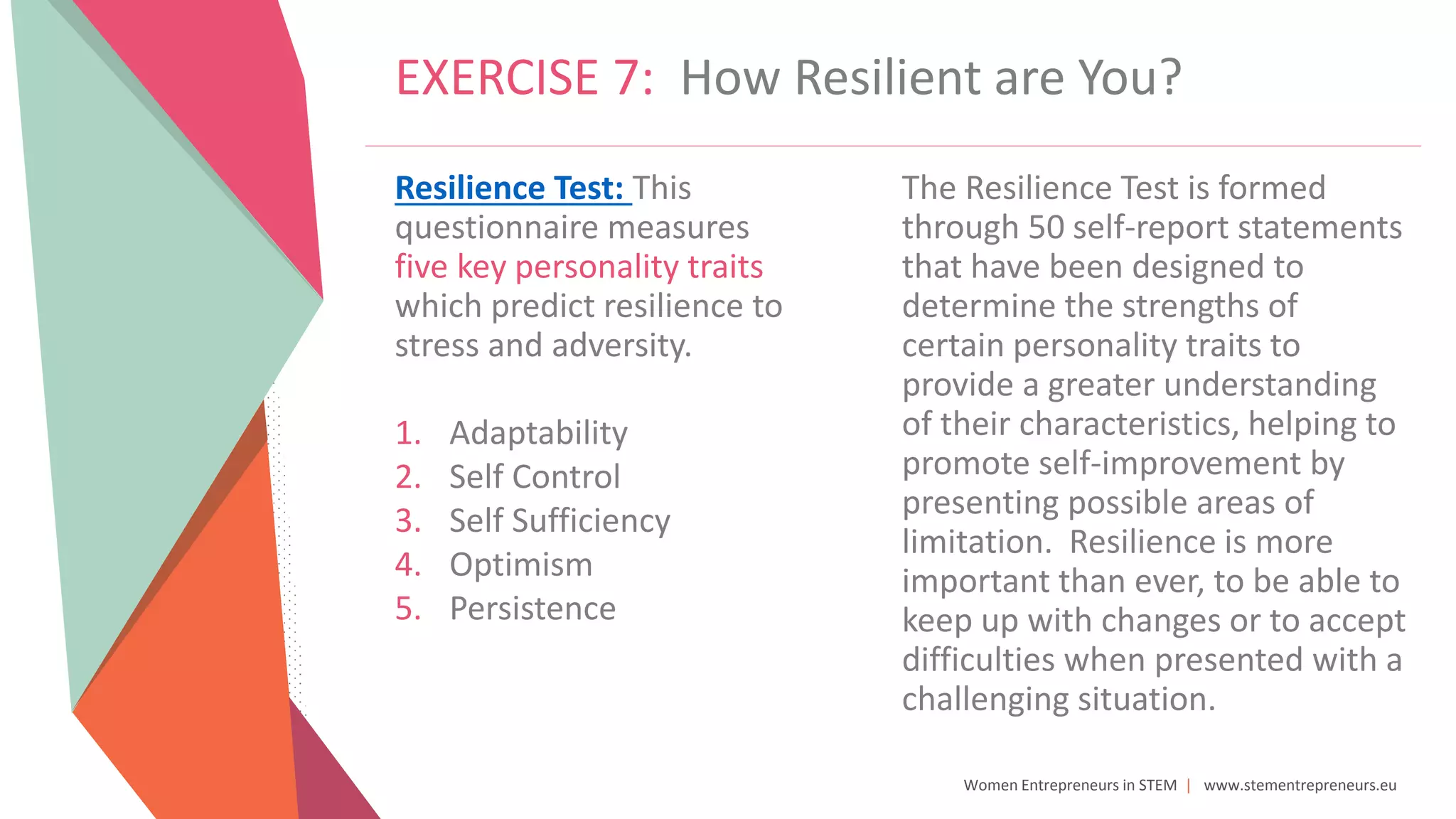
EXERCISE 7: How Resilient are You?
Resilience Test: This
questionnaire measures
five key personality traits
which predict resilience to
stress and adversity.
1. Adaptability
2. Self Control
3. Self Sufficiency
4. Optimism
5. Persistence
The Resilience Test is formed
through 50 self-report statements
that have been designed to
determine the strengths of
certain personality traits to
provide a greater understanding
of their characteristics, helping to
promote self-improvement by
presenting possible areas of
limitation. Resilience is more
important than ever, to be able to
keep up with changes or to accept
difficulties when presented with a
challenging situation.
Women Entrepreneurs in STEM | www.stementrepreneurs.eu
SECTION 2:
Validating and
incubating STEM
entrepreneurship ideas
The Idea Validation and Proof of Concept process
is key to figuring out the potential, the risks,
and how much of a game changer your business idea is
Women Entrepreneurs in STEM | www.stementrepreneurs.eu
Validating and
incubating STEM ideas
Some headline principles/best practice learnings
before we formally look at validating and incubating
your STEM business idea. Focus on solving real
problems rather than building technologies.
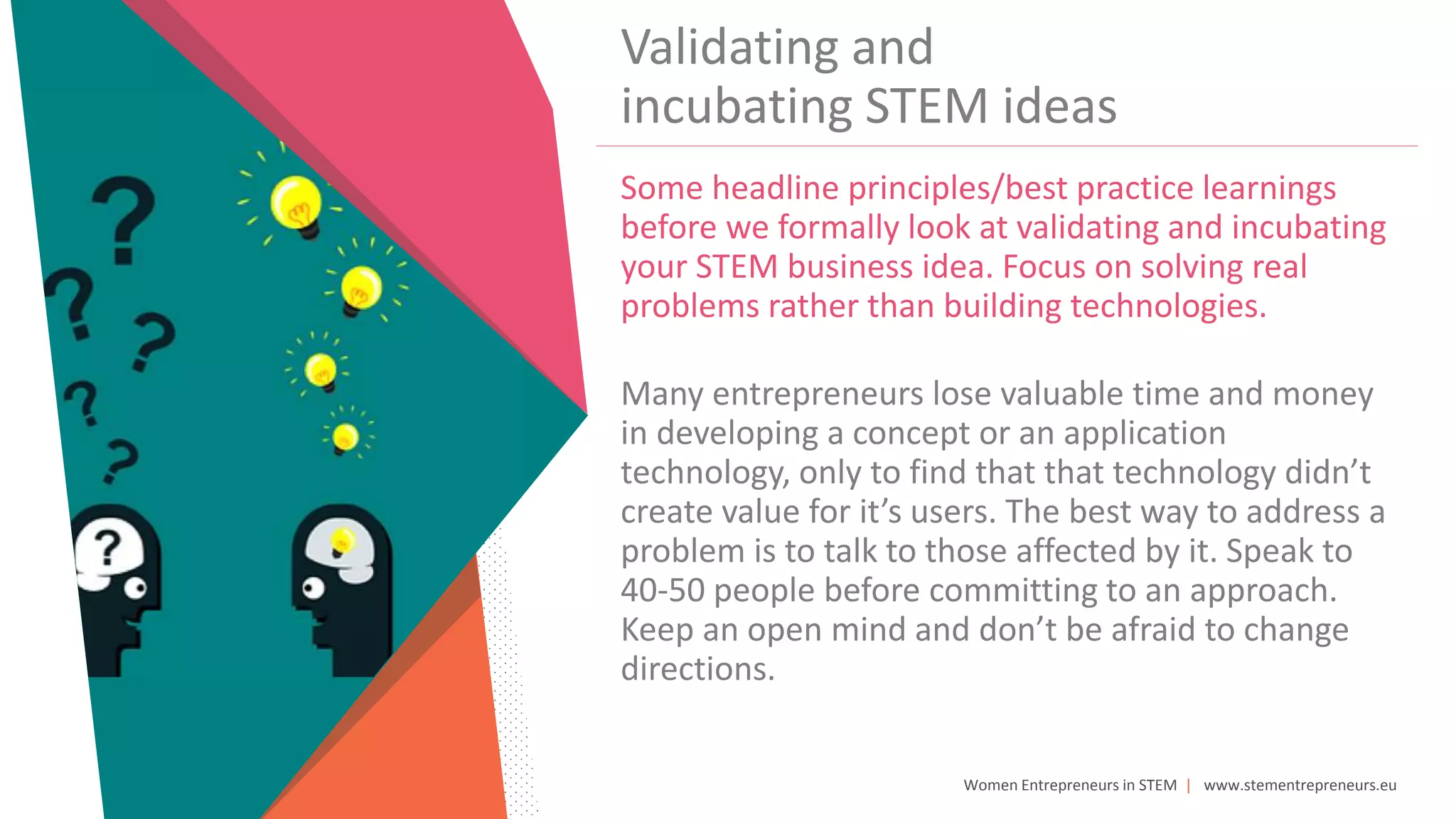
Many entrepreneurs lose valuable time and money
in developing a concept or an application
technology, only to find that that technology didn’t
create value for it’s users. The best way to address a
problem is to talk to those affected by it. Speak to
40-50 people before committing to an approach.
Keep an open mind and don’t be afraid to change
directions.
Women Entrepreneurs in STEM | www.stementrepreneurs.eu
Every industry, and every business, faces
constant change. As you evolve your
business from idea to start up, experiment
in stages, make small changes and pilot
projects to try out new ideas before
committing your whole enterprise to them.
Then evaluate the results of your
experiment to see if it had the predicted
effect and make adjustments if it did not.
Grow what works and prune what doesn’t.
Experiment in Stages
Women Entrepreneurs in STEM | www.stementrepreneurs.eu
Find the metrics that matter most
Hard work diluted over multiple directions is not
likely to yield great results. Spend some time
thinking through what success really looks like
for your business, and which numbers you need
to move to really be successful.
Then create a strategy that focuses on those
elements. That's a better recipe for success than
pursuing every opportunity that comes along.
Women Entrepreneurs in STEM | www.stementrepreneurs.eu
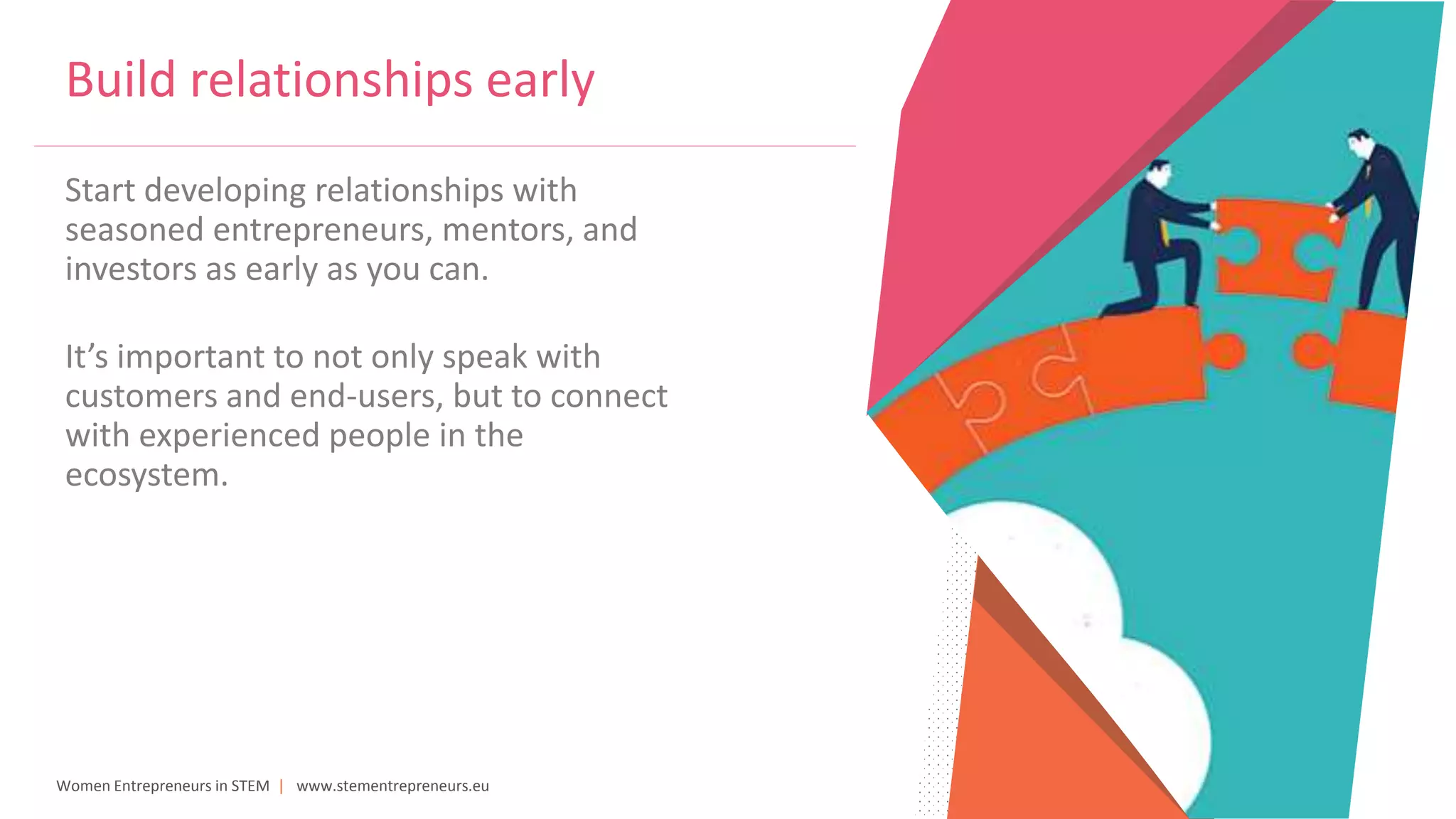
Build relationships early
Start developing relationships with
seasoned entrepreneurs, mentors, and
investors as early as you can.
It’s important to not only speak with
customers and end-users, but to connect
with experienced people in the
ecosystem.
Women Entrepreneurs in STEM | www.stementrepreneurs.eu
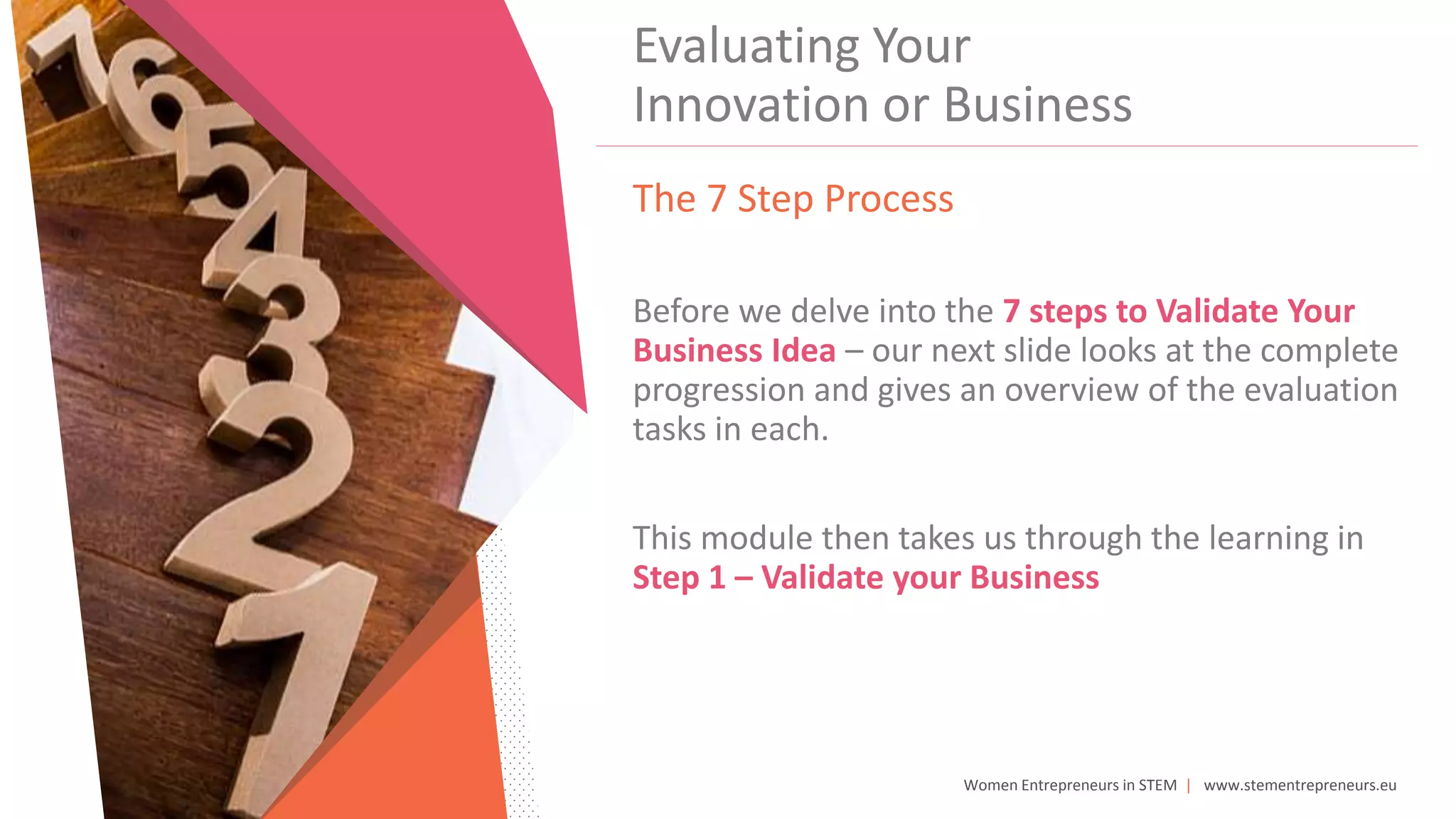
Evaluating Your
Innovation or Business
The 7 Step Process
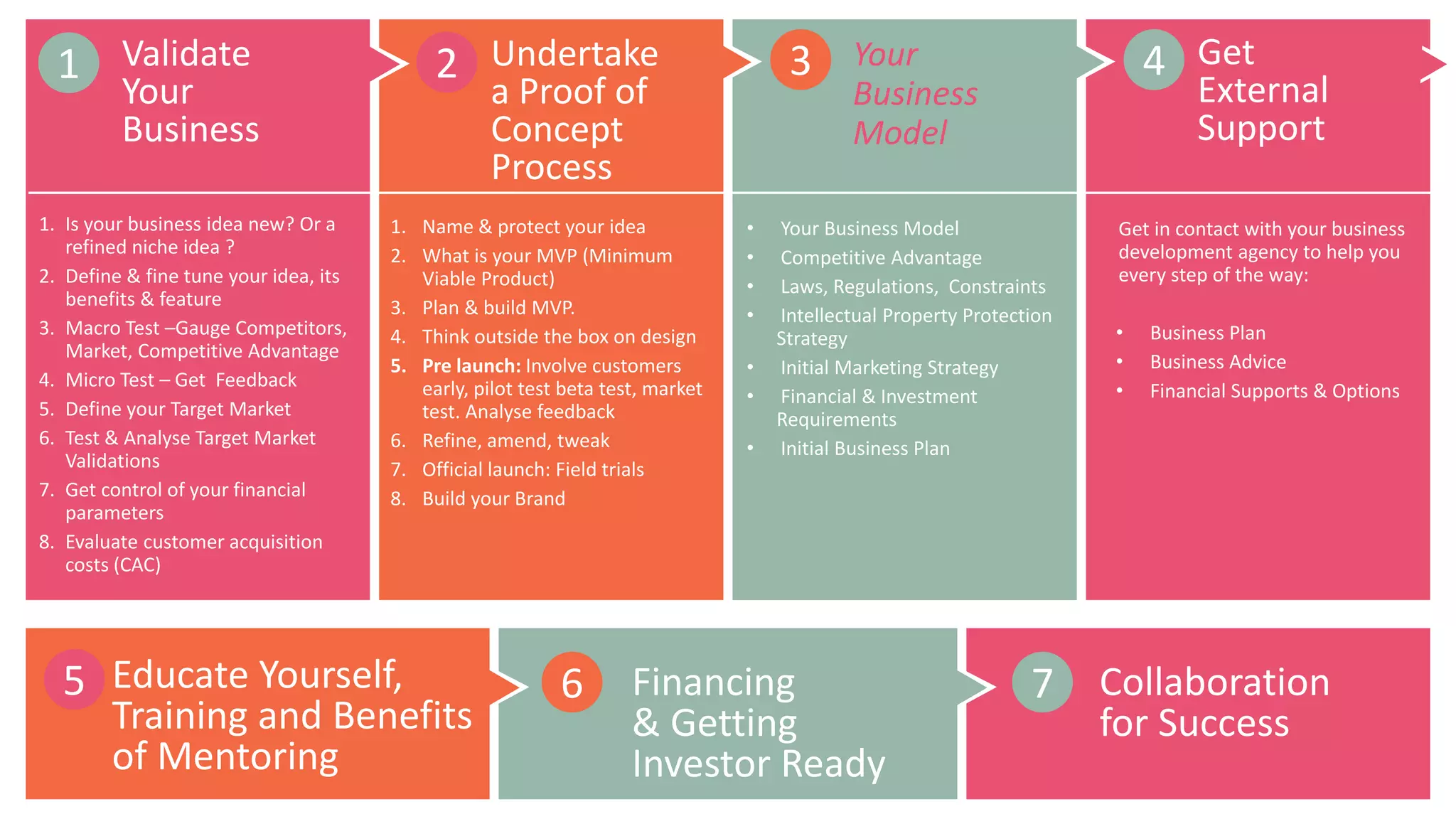
Before we delve into the 7 steps to Validate Your
Business Idea – our next slide looks at the complete
progression and gives an overview of the evaluation
tasks in each.
This module then takes us through the learning in
Step 1 – Validate your Business
1. Is your business idea new? Or a
refined niche idea ?
2. Define & fine tune your idea, its
benefits & feature
3. Macro Test –Gauge Competitors,
Market, Competitive Advantage
4. Micro Test – Get Feedback
5. Define your Target Market
6. Test & Analyse Target Market
Validations
7. Get control of your financial
parameters
8. Evaluate customer acquisition
costs (CAC)
Validate
Your
Business
1. Name & protect your idea
2. What is your MVP (Minimum
Viable Product)
3. Plan & build MVP.
4. Think outside the box on design
5. Pre launch: Involve customers
early, pilot test beta test, market
test. Analyse feedback
6. Refine, amend, tweak
7. Official launch: Field trials
8. Build your Brand
Undertake
a Proof of
Concept
Process
• Your Business Model
• Competitive Advantage
• Laws, Regulations, Constraints
• Intellectual Property Protection
Strategy
• Initial Marketing Strategy
• Financial & Investment
Requirements
• Initial Business Plan
Your
Business
Model
Get in contact with your business
development agency to help you
every step of the way:
• Business Plan
• Business Advice
• Financial Supports & Options
Get
External
Support
1 2 3 4
5 6 7Educate Yourself,
Training and Benefits
of Mentoring
Financing
& Getting
Investor Ready
Collaboration
for Success
Women Entrepreneurs in STEM | www.stementrepreneurs.eu
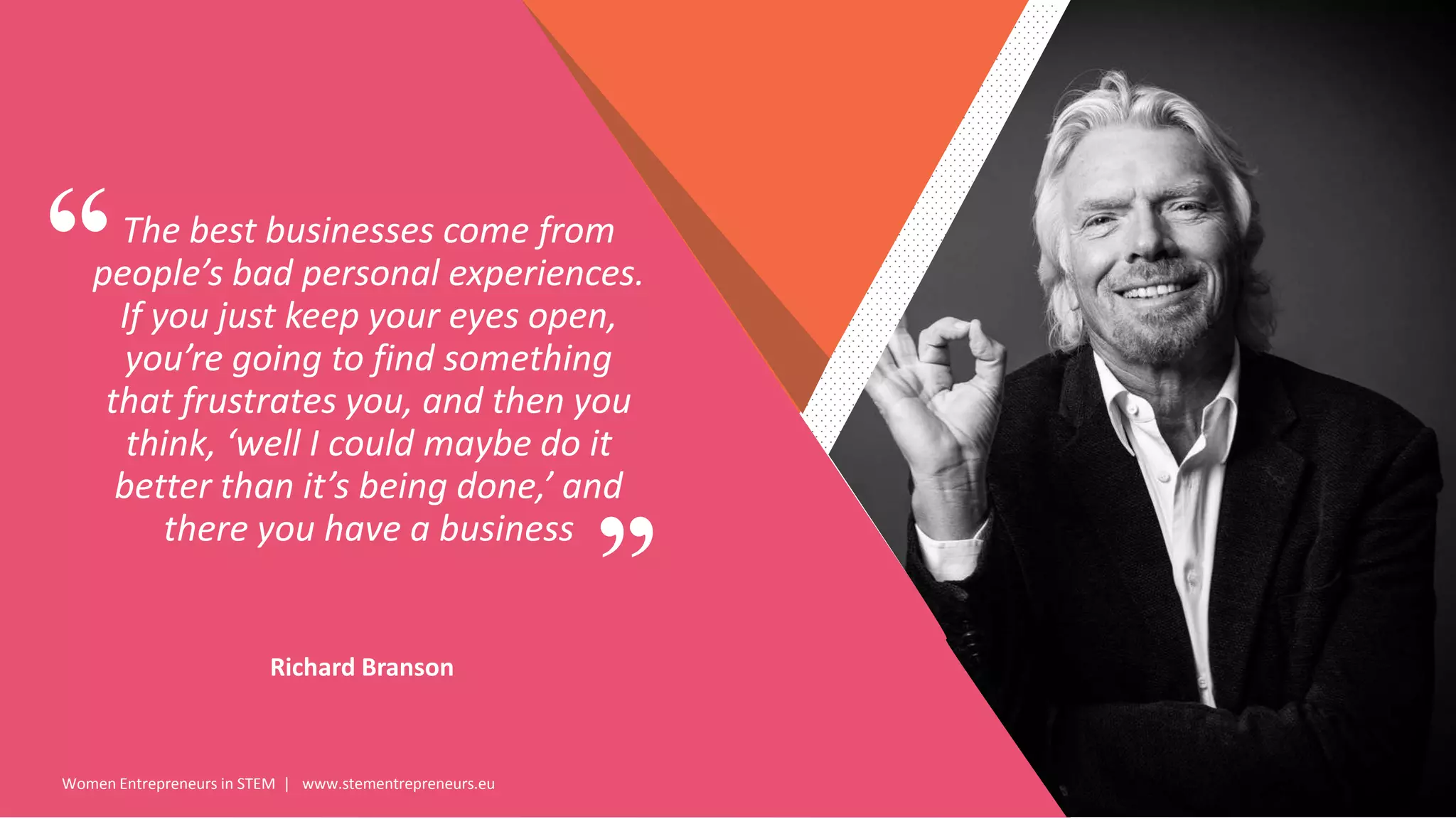
”
“The best businesses come from
people’s bad personal experiences.
If you just keep your eyes open,
you’re going to find something
that frustrates you, and then you
think, ‘well I could maybe do it
better than it’s being done,’ and
there you have a business
Richard Branson
Women Entrepreneurs in STEM | www.stementrepreneurs.eu
What is Idea Validation ?
Idea Validation is the process of testing
and validating your idea prior to launching your
business, product or service. It can also be used to
test your business name and branding.
Validation is designed to give you reasonable
certainty your business will have a sustainable,
growing, paying customer base in a sort time
period, rather than wasting months or years
building a final product nobody will pay for. It’s as
much a way of thinking, as it is a step-by-step
process.
Women Entrepreneurs in STEM | www.stementrepreneurs.eu
What is Idea Validation ?
The end result validation attempts to achieve a
basic proof of concept of your idea—a
minimum viable product that solves the most
simple form of the problem you're attempting
to address.
Validation isn’t a guarantee of success and it
most certainly isn’t easy. Validation is designed
to give you your first paying customers
and foundation for future growth.
It takes work to build confidence, inspire trust
and convince a community that you'll be able to
deliver enough value in exchange for the price
you're asking
Women Entrepreneurs in STEM | www.stementrepreneurs.eu
”
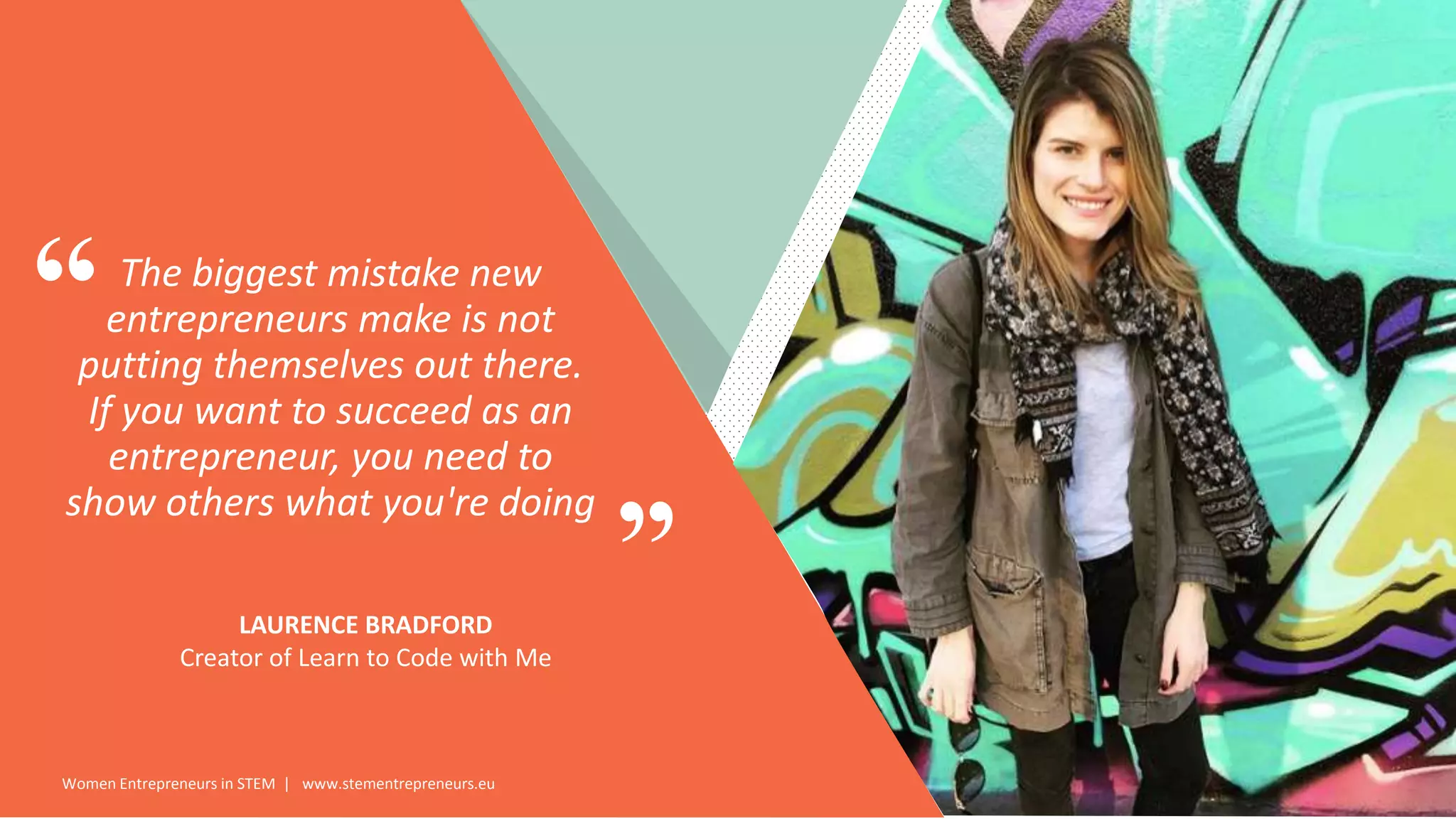
“The biggest mistake new
entrepreneurs make is not
putting themselves out there.
If you want to succeed as an
entrepreneur, you need to
show others what you're doing
LAURENCE BRADFORD
Creator of Learn to Code with Me
Women Entrepreneurs in STEM | www.stementrepreneurs.eu
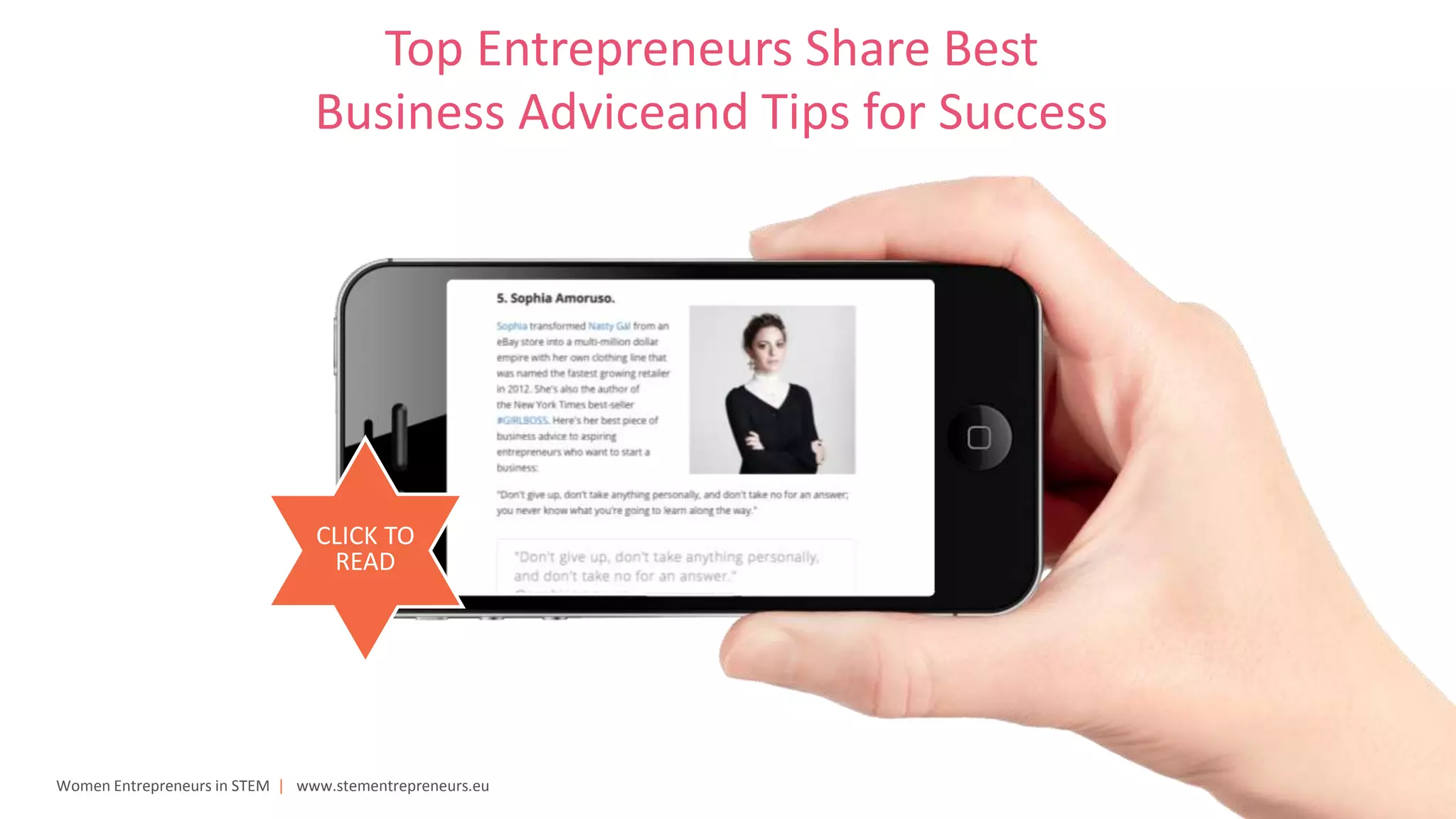
Top Entrepreneurs Share Best
Business Adviceand Tips for Success
CLICK TO
READ
Women Entrepreneurs in STEM | www.stementrepreneurs.eu
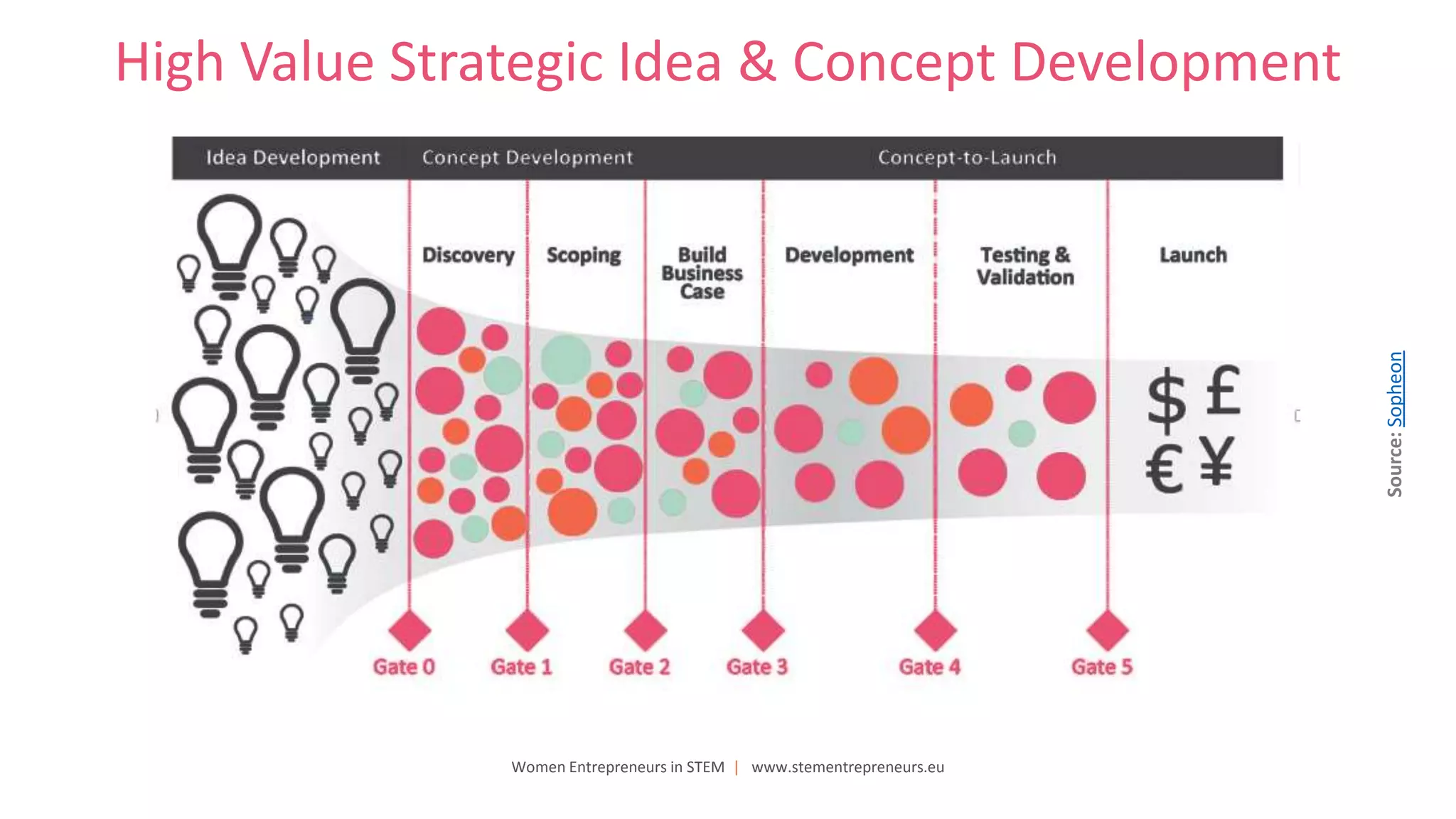
High Value Strategic Idea & Concept Development
Source:Sopheon
Women Entrepreneurs in STEM | www.stementrepreneurs.eu
”
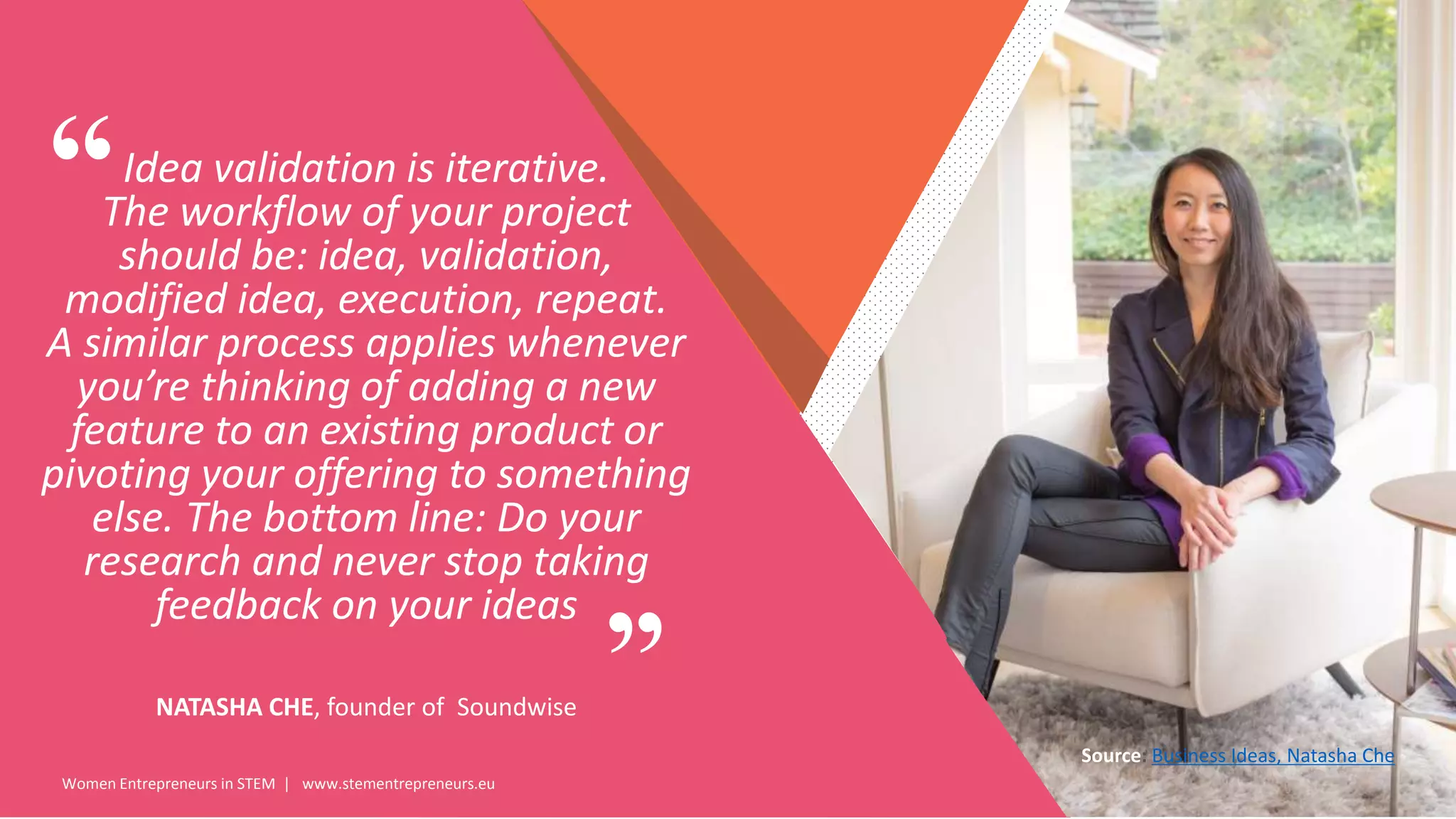
“Idea validation is iterative.
The workflow of your project
should be: idea, validation,
modified idea, execution, repeat.
A similar process applies whenever
you’re thinking of adding a new
feature to an existing product or
pivoting your offering to something
else. The bottom line: Do your
research and never stop taking
feedback on your ideas
NATASHA CHE, founder of Soundwise
Source: Business Ideas, Natasha Che
Women Entrepreneurs in STEM | www.stementrepreneurs.eu
Validate Your Business Idea
Interview with Natasha Che
Have an idea to change the universe ? Its time to call up investors,
assemble a team…stop right there!
Before plunging into execution, you should confirm you’re solving a
problem and/or meeting a need that people want to pay for. Idea
validation should be done on both macro and micro levels. And if
you do it right, you won’t need to spend your PayPal balance on any
of that.
Natasha’s key tips ……. Source: Business Ideas, Natasha Che
Women Entrepreneurs in STEM | www.stementrepreneurs.eu
Validate Your Business Idea
Natasha Che’s key tips…
1. Look for it
Does it already exist? Even the simplest search for the keywords
of your product or service idea on Google or YouTube, can yield
interesting results. If it does exist do not give up on your
inspiration. Perhaps there are ways to improve on the existing
product?
• Can you offer value to the business already producing it?
• Could the market be satisfied better/ smarter?
If you answered "yes," move to the next step.
Women Entrepreneurs in STEM | www.stementrepreneurs.eu
2. The Macro Test - Validate the big picture first
• How large is the market?
• Who are your potential competitors?
• Are you differentiated enough?
Check Google Trends. Sign up for Google Alerts. Sign up for
Google AdWords and use the Keyword Planner tool for
inspiration. Google “XYZ industry report” or “XYZ market
analysis” to get stats and data about your market. Pay attention
to the related search terms Google shows you at the bottom of
your search result page. Do research on a company that does
something similar to yours and its competitors. Google “product
X versus.” Research!!
READ How to use the Keyword Planner tool effectively
Validate Your Business Idea
Natasha Che’s key tips…
Women Entrepreneurs in STEM | www.stementrepreneurs.eu
Validate Your Business Idea
Natasha Che’s key tips…
3. Can you answer yes to these questions?
What you want to find at this stage is not
necessarily a large market size but rather …
 Is there an upward trend in volume and
industry growth related to your idea?
 Can you find existing players in your market
that are already doing well to demonstrate
there’s indeed market demand?
 Are there meaningful differences between
what’s in the market and what you’re thinking
of offering? (“I don’t know that for sure yet”.
“Seems to be” is good enough for now).
Women Entrepreneurs in STEM | www.stementrepreneurs.eu
4. The Micro Test
Now it’s time to, as Steve Blank put it, “get out
of the building.”
Go and talk to 20 people about your idea.
Open with “Hi, I’m a researcher doing a
project on XYZ. Can I ask you a few
questions?”
Ask your trust worthy honest friends and
family to ask them for their honest feedback.
Validate Your Business Idea
Natasha Che’s key tips…
Women Entrepreneurs in STEM | www.stementrepreneurs.eu
Validate Your Business Idea
Natasha Che’s key tips…
4. The Micro Test
If they say yes, the next question is to ask their consumption
habit in your product category.
• Do they use XYZ product (your competitor)? Why or why not?
• When do they use XYZ? Is there anything frustrating about
using XYZ?
Their answers will tell you if they are your target customer and if
there is anything missing in the market that you can offer. Once
you understand who you are talking to, explain your idea to them
succinctly, ask “what do you think of this” and then shut up and
listen. Be very suspicious when people tell you “that’s a great
idea” this could be a thumbs down, if it is – ask why?
Women Entrepreneurs in STEM | www.stementrepreneurs.eu
Ryan Robinson
embarked on a
30-day challenge
to validate a
business idea,
limiting his spend
to less than €500
to make that
happen. You can
do this too,
what do you
have to lose?
9 ways to Validate Your
Business Idea in 30 days
Source: Validate Business Ideas, Ryan Robinson
CLICK
FOR
PODCAST
1. Find a Profitable Niche (That You Care About).
2. Leverage Your Strengths and Outsource Your
Weaknesses.
3. Create an Early Feedback Group.
4. Have One-on-One Conversations With Your
Target Market.
5. Develop a Competitive Advantage.
6. Grow Your Email List.
7. Build a Proof of Concept.
8. Launch and Get Pre-Orders From Your Email List.
9. Continue Building and Tweaking With Feedback
Women Entrepreneurs in STEM | www.stementrepreneurs.eu
9 Ways to Validate A Business Idea
Top Questions to Ask Your Target Market
• What are you most looking to
achieve (as it pertains to your
topic area)?
• What are some of the current
solutions you're using, or have
used in the past?
• What frustrates you most about
current solutions out there?
• What features would you most
like to see (as it pertains to your
topic area)?
• Do you have any fears (as it
pertains to your topic area)
holding you back?
• Would you be willing to pay for a
solution that does XYZ for you?
Here are a few of the top questions you should be asking your target
market, with the goal of learning more about their motivations and
needs as it pertains to your business idea:
Use Google Sheet to keep track of your feedback group, so that you can add notes
with their answers to these key questions, get graphs, filter information etc.
Source: Validate Business Ideas, Ryan Robinson
Women Entrepreneurs in STEM | www.stementrepreneurs.eu
Validate Your Business Idea
TASK The Micro Test*
Good ideas can be validated from discussions amongst peers, teams,
and other communities-of-interest. Start by getting early feedback
from your target market to make sure you are doing/building
something they actually need and want enough to pay for.
Step 1: Develop an initial list of consultees (min 20) what they think
about your idea so you get a good idea what your pitch is, the main
problems you are seeking to address, finding out about your
competitors, identifying frustration
Step 2: Be prepared and write up a list of specific questions starting
with how, what, why, when, who, where (Who was involved?
What happened? Where did it take place? When did it take place?
Why did that happen? Robinson has developed a list of 20 key
questions that you can adapt.
Also see 12 Great Customer Interview Questions as a Guide
Women Entrepreneurs in STEM | www.stementrepreneurs.eu
TASK* Validate Your Business Idea
Ask Yourself These 20 Questions
TASK Validate Your Business Idea by Answering these 20 questions.
Treat the questions like a check list, they can be answered at different
stages of your startup process. Here are some of the questions to get
you started:
1. What problem are you solving?
2. How many specific benefits for your product or idea can you list?
3. Can you state, in clear language, the key features of your product or
service?
4. Who are your potential competitors?
5. What key features does my product have that others will have a
hard time copying?
6. Do you have access to the various resources you need to launch a
business?
Women Entrepreneurs in STEM | www.stementrepreneurs.eu
Define your target market
The more narrow you can define your target market, the better.
This process is known as creating a niche and is key to success for
even the biggest companies. There are two basic markets you can
sell to: consumer (B2C) and business (B2B). Lynda Falkenstein
promotes a seven-step process, five of which are relevant to us:
1. Make a wish list.
With whom do you want to do business? Be as specific as you
can: Identify the geographic range and the types of businesses
or customers you want your business to target. If you don't
know whom you want to do business with, you can't make
contact. "You must recognize that you can't do business with
everybody," cautions Falkenstein. Otherwise, you risk
exhausting yourself and confusing your customers.
Women Entrepreneurs in STEM | www.stementrepreneurs.eu
Define your target market
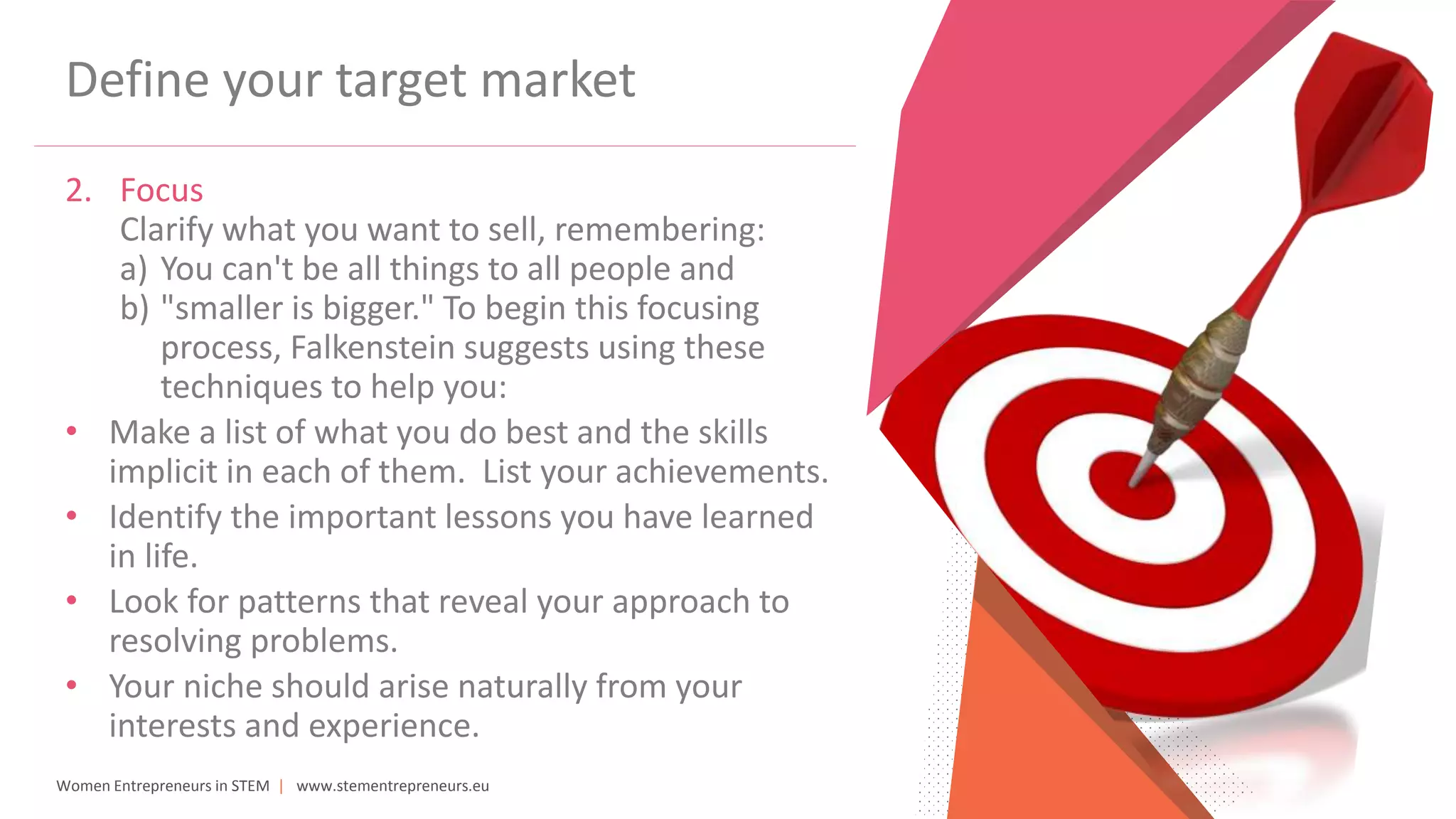
2. Focus
Clarify what you want to sell, remembering:
a) You can't be all things to all people and
b) "smaller is bigger." To begin this focusing
process, Falkenstein suggests using these
techniques to help you:
• Make a list of what you do best and the skills
implicit in each of them. List your achievements.
• Identify the important lessons you have learned
in life.
• Look for patterns that reveal your approach to
resolving problems.
• Your niche should arise naturally from your
interests and experience.
Women Entrepreneurs in STEM | www.stementrepreneurs.eu
Define your target market
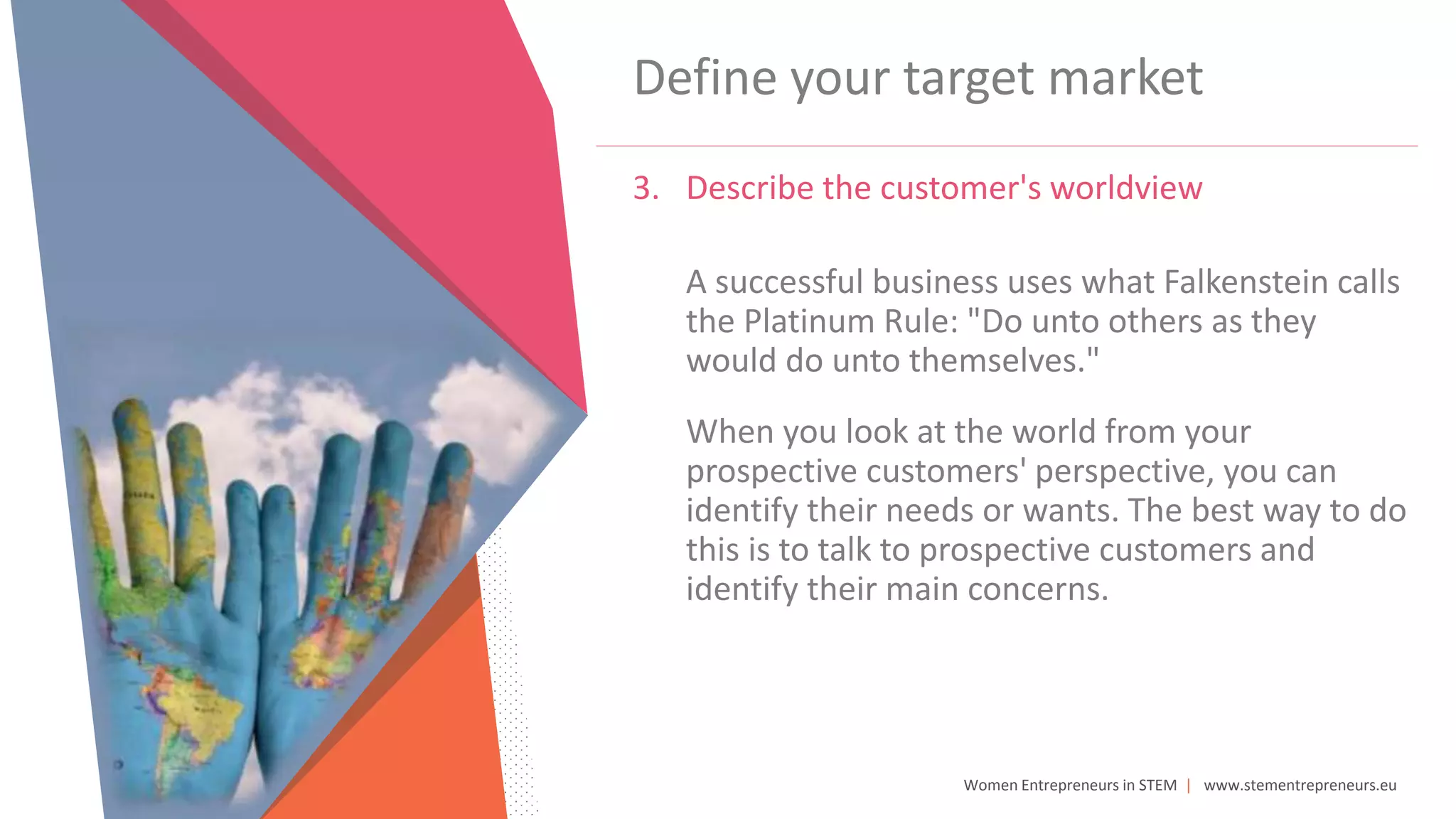
3. Describe the customer's worldview
A successful business uses what Falkenstein calls
the Platinum Rule: "Do unto others as they
would do unto themselves."
When you look at the world from your
prospective customers' perspective, you can
identify their needs or wants. The best way to do
this is to talk to prospective customers and
identify their main concerns.
Women Entrepreneurs in STEM | www.stementrepreneurs.eu
Define your target market
4. Synthesize
At this stage, your niche should begin to take shape as your ideas
and the client's needs coalesce to create something new. A good
niche has five qualities:
• It takes you where you want to go -- in other words, it
conforms to your long-term vision.
• Somebody else wants it -- namely, customers.
• It's carefully planned.
• It's one-of-a-kind, the "only game in town."
• It evolves, allowing you to develop different profit centres and
still retain the core business, thus ensuring long-term success
Define your target market
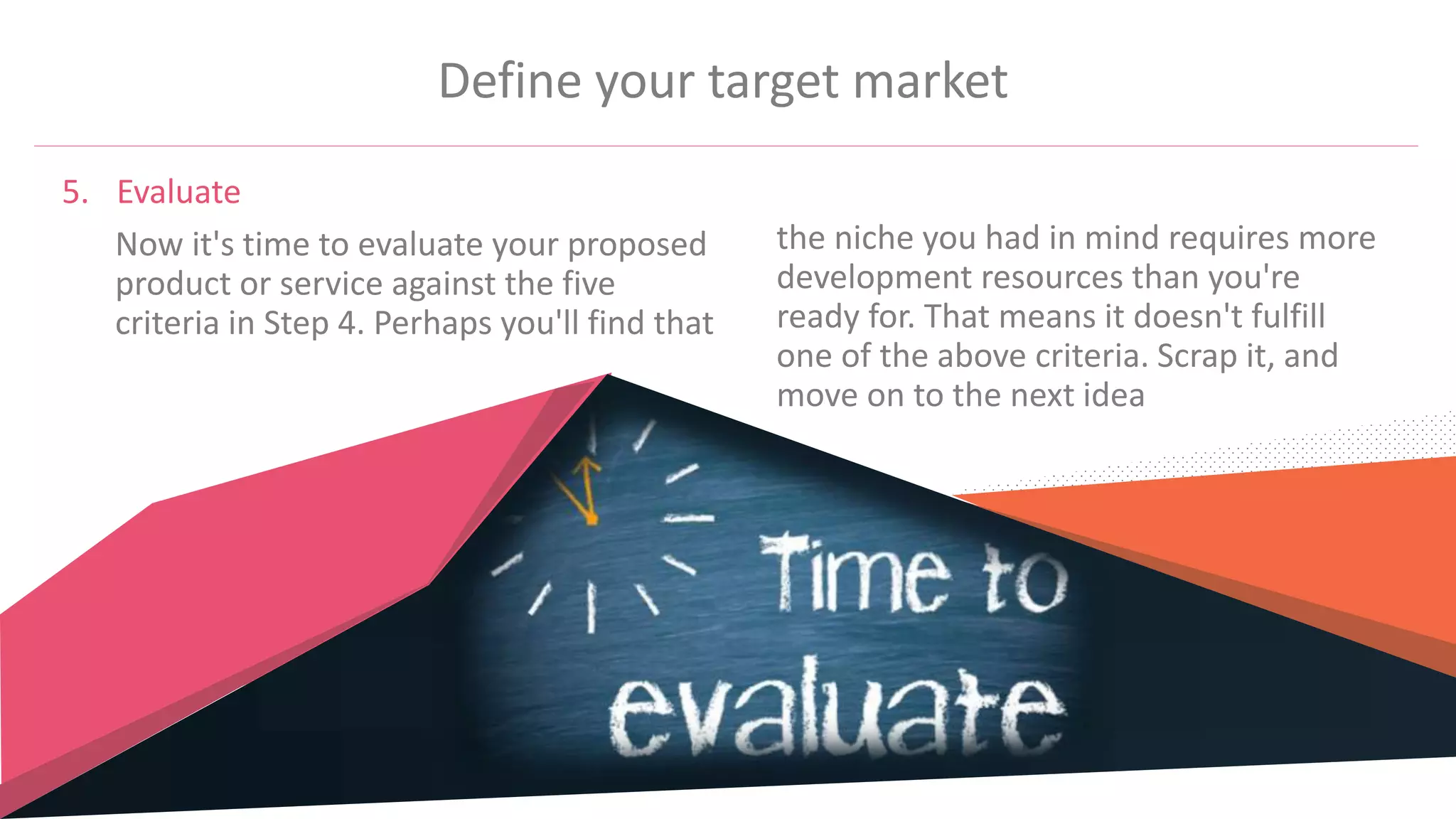
5. Evaluate
Now it's time to evaluate your proposed
product or service against the five
criteria in Step 4. Perhaps you'll find that
the niche you had in mind requires more
development resources than you're
ready for. That means it doesn't fulfill
one of the above criteria. Scrap it, and
move on to the next idea
Women Entrepreneurs in STEM | www.stementrepreneurs.eu
Test Target Market Validations
Market validation is a series of interviews of people in your target
market. These interviews are used to test your product concept against
your potential target market niche. The advantages of performing
market validation:
• Assessment as to whether a
target audience is appropriate
for your product
• A test for your positioning
• A way to generate new ideas for
positioning
• A test to see if your product
provides real value for the
target market
• A way to learn new value
statements
• A deeper understanding of your
target market
• An better understanding of your
target market's purchase
behaviour
Women Entrepreneurs in STEM | www.stementrepreneurs.eu
Test Target Market Validations
Barbara Tallent is an authority in this area. As a
guide, if you are testing a consumer product, you
may want hundreds of interviews.
a business-to-business product, you can often get a
good market validation out of 20-30 interviews.
TIP Pick the number of interviews that you want
and multiply it by three to get the number of
contacts you will need.
Women Entrepreneurs in STEM | www.stementrepreneurs.eu
Test Target Market Validations
How to Find People to Interview
• Cold calling: The most direct method is cold-calling companies. Ask
for the person with the appropriate title and tell them that you are
seeking their advice on a new product. People are more likely to talk
to you if you are seeking their advice than they will be if you are
trying to sell them a product.
• Advertising: On-line advertising is the fast and very targeted. To find
the right audience through use advertising in an electronic
publication that goes to your target market. You may need an
incentive for people to sign up for the interview.
Women Entrepreneurs in STEM | www.stementrepreneurs.eu
Test Target Market Validations
How to Find People to Interview
• Use your network: Your industry contacts and their contacts.
Be sure to let your interviewees know when you plan on
conducting the interviews. Set up appointments as soon as
possible and let them know how much of their time it will take.
It is ideal to do some number of the interviews in person. You
will always get more information from someone who is sitting in
front of you than you will get over the phone.
Web surveys come with a word of caution - the type of
information that you are trying to get is too
Women Entrepreneurs in STEM | www.stementrepreneurs.eu
Test Target Market Validations
Building the Question Set
The most important part of the market validation is the questions
that you ask and how you ask them. Unlike a scientific survey, you
are trying to understand the emotions of your target market. You
will want to ask open-ended questions that get them to talking
about how and why they do things and what will make them buy
your product.
Whether you are trying to validate your target market or your
positioning, a fundamental question that you should always ask
is, "What keeps you up at night?“ The answer may have nothing
to do with your product, but it will tell you where their priorities
will be when considering any product or service.
Women Entrepreneurs in STEM | www.stementrepreneurs.eu
Test Target Market Validations
Building the Question Set
• Beyond the basic first question, you will need to construct
questions that allow you to try out your product positioning
and/or target market. Here are some example questions:
• Are you familiar with [product/space]?
• Use your positioning statement, then ask, "Do you see value in
this [product/service] for your organization?"
• Are you planning to invest in this [product/service] this year?
Next year?
• Who is responsible in your organization for implementing
products or services in this space
Women Entrepreneurs in STEM | www.stementrepreneurs.eu
Test Target Market Validations
Building the Question Set
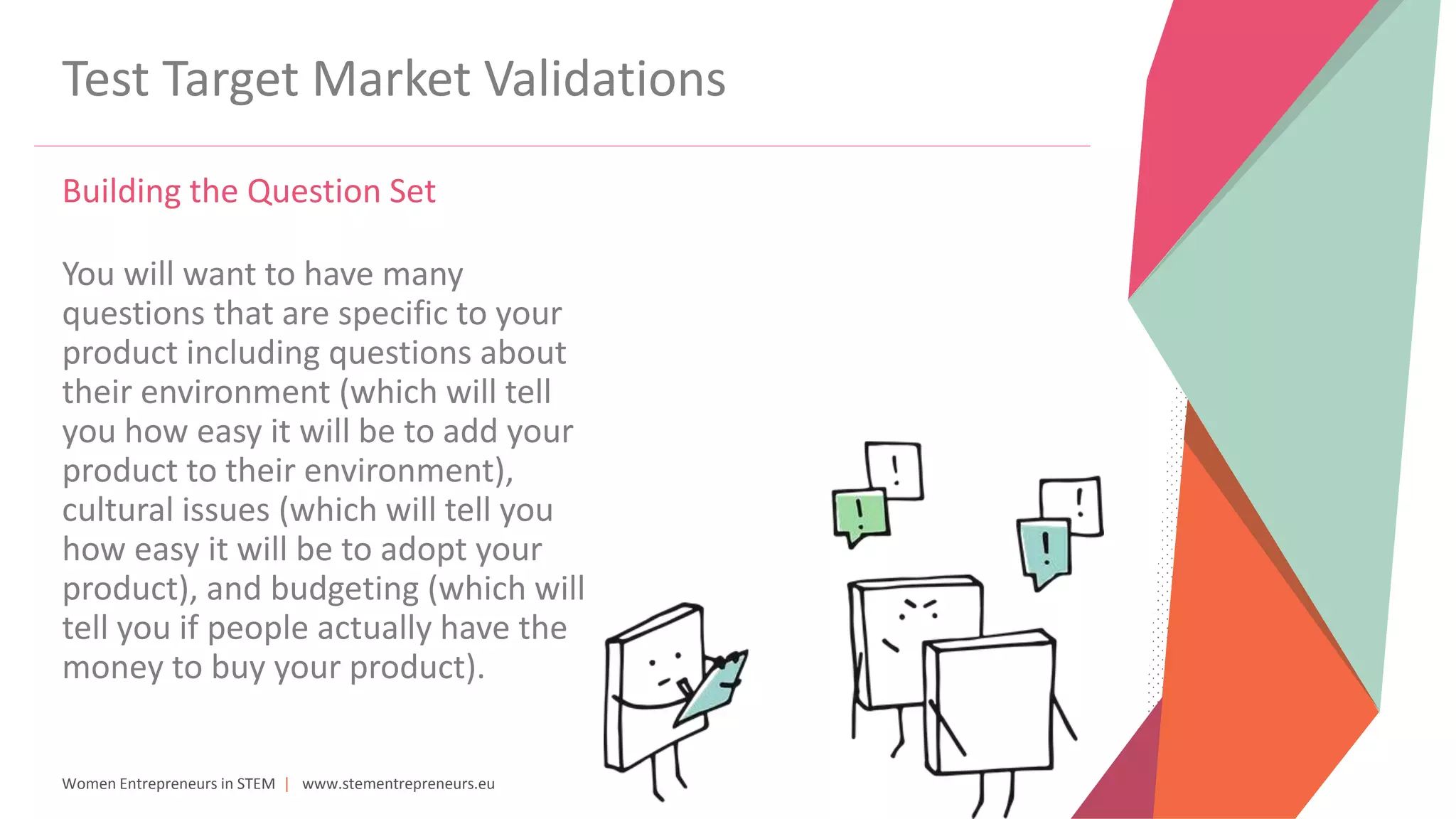
You will want to have many
questions that are specific to your
product including questions about
their environment (which will tell
you how easy it will be to add your
product to their environment),
cultural issues (which will tell you
how easy it will be to adopt your
product), and budgeting (which will
tell you if people actually have the
money to buy your product).
Women Entrepreneurs in STEM | www.stementrepreneurs.eu
Test Target Market Validations
Testing the Question Set
It is important to test the question
set. I have never had it completely
right the first time. Also the first
couple interviews will probably
make you realize that there is
other information that you want
to gather. Run three to five test
interviews, then review your
questions and make sure that you
are getting the results that you
want from the questions. The
following are some things to
consider during this review:
• Are the questions open-ended
enough to start a dialog? Are
some questions unnecessary?
• Is this the right target market?
How long are the interviews
taking?
• Have I uncovered something
in these interviews that I need
to ask some more detail
about? Which questions were
misunderstood and how can
they be reworded?
Women Entrepreneurs in STEM | www.stementrepreneurs.eu
Test Target Market Validations
Conducting the Interviews
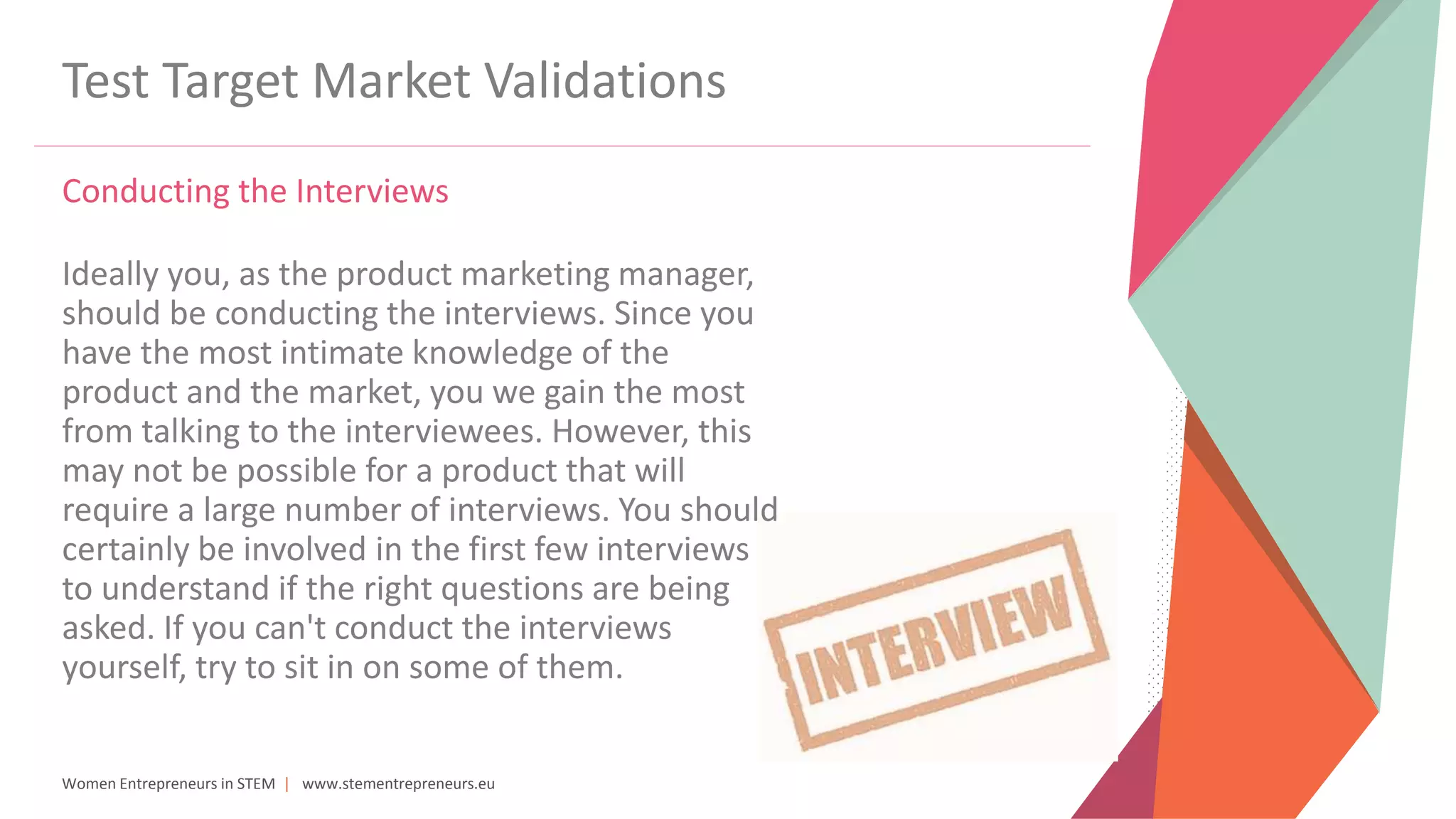
Ideally you, as the product marketing manager,
should be conducting the interviews. Since you
have the most intimate knowledge of the
product and the market, you we gain the most
from talking to the interviewees. However, this
may not be possible for a product that will
require a large number of interviews. You should
certainly be involved in the first few interviews
to understand if the right questions are being
asked. If you can't conduct the interviews
yourself, try to sit in on some of them.
Women Entrepreneurs in STEM | www.stementrepreneurs.eu
Test Target Market Validations
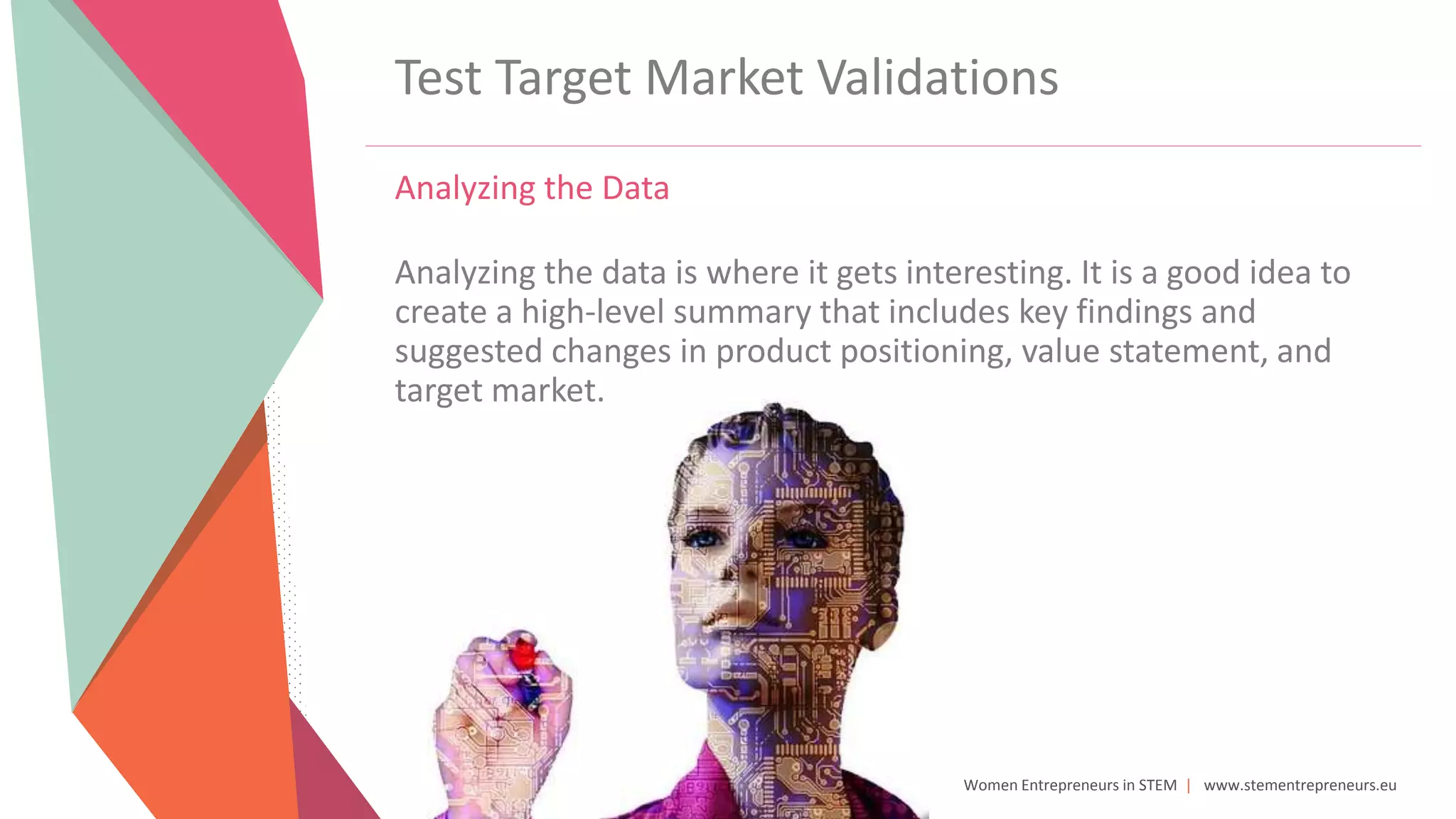
Analyzing the Data
Analyzing the data is where it gets interesting. It is a good idea to
create a high-level summary that includes key findings and
suggested changes in product positioning, value statement, and
target market.
Get control of your financial parameters
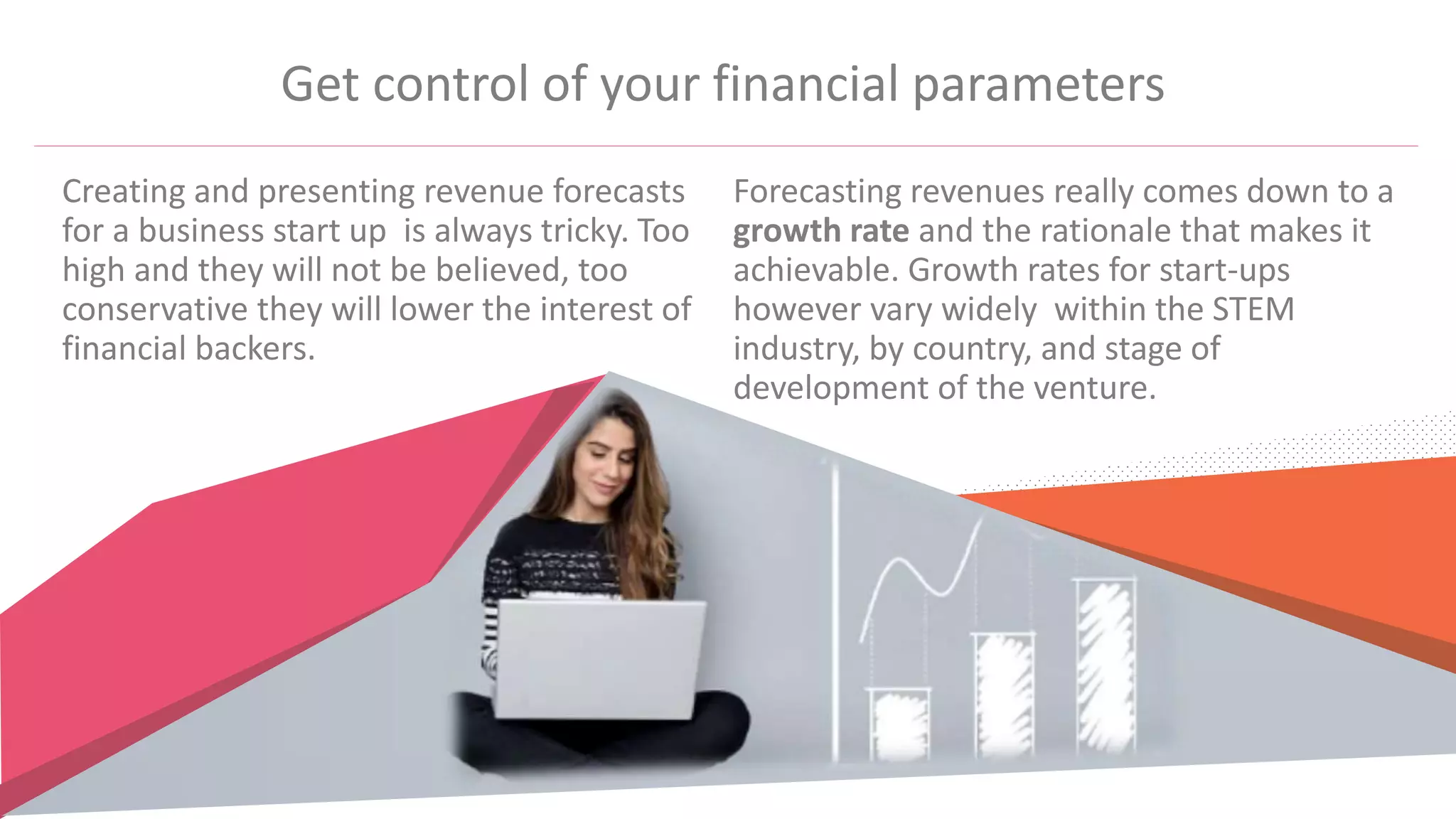
Creating and presenting revenue forecasts
for a business start up is always tricky. Too
high and they will not be believed, too
conservative they will lower the interest of
financial backers.
Forecasting revenues really comes down to a
growth rate and the rationale that makes it
achievable. Growth rates for start-ups
however vary widely within the STEM
industry, by country, and stage of
development of the venture.
Women Entrepreneurs in STEM | www.stementrepreneurs.eu
Get control of your financial parameters
Revenue forecasts need to factor in STEM sectors with different
• setup times
• adoption speed
• sales cycles
• market opportunities.
Different countries have different home-market sizes, access to
funding and talent etc. so you research needs a robust reflection of all
these factors.
Women Entrepreneurs in STEM | www.stementrepreneurs.eu
Evaluate customer acquisition costs (CAC)
Customer acquisition cost (CAC) is a metric that has been growing in
use, along with the emergence of online businesses. It means the
price you pay to acquire a new customer. In its simplest form, it can
be worked out by:
Dividing the total costs associated with acquisition by total new
customers, within a specific time period
Successful web businesses have long understood these metrics as
they can easily measure them. However there is a lot of value in
looking at these same metrics for all other businesses. To compute
the cost to acquire a customer, you take your entire cost of sales and
marketing over a given period, including salaries and other related
expenses, and divide it by the number of customers that you
acquired in that period.
Women Entrepreneurs in STEM | www.stementrepreneurs.eu
What I Have Learned?
• I better understand my entrepreneurial potential after taking
multiple different Self Assessments e.g. Personality Test,
Entrepreneurial Potential Test, Self Motivation Assessment,
Strengths and Weaknesses Aptitude Test, Leadership Test and
resilience Test
• I understand how to validate and incubate my STEM idea. I know
what Idea validation is and isn’t, what to look for, key tips, key
questions and tests. I can validate my business in 30 days
• I know how to evaluate my business and innovation via the 7
Step Process. I also know how to build a Hight Value Strategic
Idea and Concept Development process.
• I understand my target market better, how to research them, key
questions, how to conduct an interview and validate and assess
the results
Stementrepreneurs
www.stementrepreneurs.eu
Next Up…
Module 3
http://stementrepreneurs.eu/contact
Accelerating your STEM start up

Module 2 - Assess your entrepreneur potential.

  • 1.
    This programme hasbeen funded with support from the European Commission START UP IN STEM MODULE 2 Assess your Entrepreneur Potential
  • 2.
    Entrepreneurial Potential, Personality, Self Motivation, Strengths& Weaknesses, Leadership & Resilience Tests Section 1 • In this module, you find out if you have what it takes to be a STEM entrepreneur and if having your own business is the right professional choice for you. • We introduce you to an online series of 7 assessments so you can define your goals and what steps you need to take to acquire them. • It doesn’t’ stop there, you will reflect on if you have the right personality traits and qualities considered compatible with a successful entrepreneur. You will discover what motivates you, what makes you tick and how resilient you are • You will learn formal approaches to validating and incubation STEM entrepreneurship ideas Section 2 Validating and incubating STEM entrepreneurship ideas
  • 3.
    Women Entrepreneurs inSTEM | www.stementrepreneurs.eu ” “Never ever give up your dreams just because you’re a girl and that you don’t have any support from anyone DEENA VENUGOPAL Founder and CEO of Anabytes
  • 4.
    Women Entrepreneurs inSTEM | www.stementrepreneurs.eu SECTION 1: Entrepreneurial Potential, Personality, Self Motivation, Strengths & Weaknesses, Leadership & Resilience Tests
  • 5.
    Women Entrepreneurs inSTEM | www.stementrepreneurs.eu Assess your STEM Entrepreneurial Potential Learnt skill or an innate talent? Women in STEM are creative, insightful, problem solving leaders and born to be entrepreneurs. STEM fields provide unparalleled value to the way that an entrepreneur works - boosting common sense and decision-making business skills. You have learned to trust yourself, you get the facts and you strive to inspire others on the road to discovery and solutions. In STEM, you experiment: test hypotheses, analyze results, and iterate. These skills are the bedrock of entrepreneurship. Source STEM Skills
  • 6.
    Women Entrepreneurs inSTEM | www.stementrepreneurs.eu Assess your STEM Entrepreneurial Potential Just as happens in engineering, entrepreneurs start with a big goal they have to break down into smaller, more achievable parts. If you are a computer scientist building a web platform, you have to imagine the final site, but in order to begin, you need to first break down the Java script line by line, in order to eventually reach the final goal. Likewise, entrepreneurs need the ability to connect seemingly unrelated topics to create one coherent solution. Source STEM Skills
  • 7.
    Women Entrepreneurs inSTEM | www.stementrepreneurs.eu Assess your STEM Entrepreneurial Potential Entrepreneur Self Assessments: What You Need to Know. If you're starting or leading a company, it's beneficial to know yourself inside and out. Assessing yourself with professional self assessment tools can: • Help you understand how you work best, so you can make appropriate changes. • Help your stakeholders to understand what motivates and drives you. • Help you recognize when you need help. • Help you choose who to hire to compliment your strengths and weaknesses.
  • 8.
    Women Entrepreneurs inSTEM | www.stementrepreneurs.eu Assess your STEM Entrepreneurial Potential Why are personality tests so important to an aspiring entrepreneur? Self assessments help individuals get in touch with what their core competencies are and how those may overlap with what’s needed to take on running a business. While your personality is highly relevant in your success, it’s not the only defining factor which we explore in greater detail in this training module. We now introduce you to an online series of 7 assessments so you can define your entrepreneurial aptitude and goals and what are the skills you need to progress.
  • 9.
    Women Entrepreneurs inSTEM | www.stementrepreneurs.eu EXERCISE 1 : Do you have what it takes to be an Entrepreneur? Starting a business can be a rewarding and enriching experience. However, it might not be the right professional choice for you. Before making the leap, take some time to find out whether the opportunities and challenges of entrepreneurship fit with your personality. This test will evaluate your entrepreneurial traits, as concerns motivations, aptitudes and attitudes. EXERCISE 1 Entrepreneurial Potential Self Assessment
  • 10.
    Women Entrepreneurs inSTEM | www.stementrepreneurs.eu Do you have what it takes to be an Entrepreneur? The Entrepreneur Equation is a New York Times bestselling book that provides exercises and assessments to help you assess your personality vis-à-vis entrepreneurship, as well as your mindset, timing and the particular opportunity. EXERCISE 2 Author Carol Roth put together an interactive online quiz to see how your personality compares with the popular profile of today's successful entrepreneurs
  • 11.
    Women Entrepreneurs inSTEM | www.stementrepreneurs.eu What Kind of Entrepreneur are You? An Entrepreneur Personality Test is designed to assess the personality traits associated with entrepreneurial ability, in order to provide insight into the current qualities possessed by the candidate that are considered to be compatible with a successful entrepreneurial career across the key headings of : Achievement Striving Industriousness Passion Taking Control Creativity
  • 12.
    Women Entrepreneurs inSTEM | www.stementrepreneurs.eu What Kind of Entrepreneur are You? The summaries provided in the entrepreneur questionnaire will give you an understanding of the strength of the characteristics they already possess, as well as a bearing on the areas that may require improvement, in order to aid in the development of a successful entrepreneurial career. EXERCISE 3 Entrepreneur Personality Test
  • 13.
    Women Entrepreneurs inSTEM | www.stementrepreneurs.eu What Makes You Tick? Self Motivation Assessment is all about finding out what makes you tick. What pulls you toward the things you are going for ? There are 9 main self motivators that pull you toward your goals, keep you running along even at your darkest hour, and provide the energy inside to stay aligned. These self motivators will keep you striving forward, even on the tough days. They are: Autonomy Mastery Meaning Power, Recognition Stability Status and Teamwork EXERCISE 4 - Read the 9 Types of Self Motivation article.
  • 14.
    Women Entrepreneurs inSTEM | www.stementrepreneurs.eu What are Your Entrepreneurial Strengths and Weaknesses? Strengths and Weaknesses Aptitude Test is a tool to help you get a better look at who you really are and how much you could grow. • You will define your top 5 strengths • You will define and understand your most pressing weakness EXERCISE 5 Strengths and Weaknesses Aptitude Test
  • 15.
    Women Entrepreneurs inSTEM | www.stementrepreneurs.eu EXERCISE 6: What Kind of Leader are You? This test will help you measure your five key aspects of leadership: 1. Organisation 2. Responsibility 3. Transformational leadership 4. Assertiveness 5. Resourcefulness Leadership Test: is a 50 item self- report psychometric test which aims to assess and evaluate specific personality characteristics that have been linked to successful leadership, the responses are then analysed and presented with a summary of what each trait score implies about the candidates abilities. Using this feedback, individuals are able to identify their strengths and aim towards improving areas that may currently require further development.
  • 16.
    Women Entrepreneurs inSTEM | www.stementrepreneurs.eu EXERCISE 7: How Resilient are You? Resilience Test: This questionnaire measures five key personality traits which predict resilience to stress and adversity. 1. Adaptability 2. Self Control 3. Self Sufficiency 4. Optimism 5. Persistence The Resilience Test is formed through 50 self-report statements that have been designed to determine the strengths of certain personality traits to provide a greater understanding of their characteristics, helping to promote self-improvement by presenting possible areas of limitation. Resilience is more important than ever, to be able to keep up with changes or to accept difficulties when presented with a challenging situation.
  • 17.
    Women Entrepreneurs inSTEM | www.stementrepreneurs.eu SECTION 2: Validating and incubating STEM entrepreneurship ideas
  • 18.
    The Idea Validationand Proof of Concept process is key to figuring out the potential, the risks, and how much of a game changer your business idea is
  • 19.
    Women Entrepreneurs inSTEM | www.stementrepreneurs.eu Validating and incubating STEM ideas Some headline principles/best practice learnings before we formally look at validating and incubating your STEM business idea. Focus on solving real problems rather than building technologies. Many entrepreneurs lose valuable time and money in developing a concept or an application technology, only to find that that technology didn’t create value for it’s users. The best way to address a problem is to talk to those affected by it. Speak to 40-50 people before committing to an approach. Keep an open mind and don’t be afraid to change directions.
  • 20.
    Women Entrepreneurs inSTEM | www.stementrepreneurs.eu Every industry, and every business, faces constant change. As you evolve your business from idea to start up, experiment in stages, make small changes and pilot projects to try out new ideas before committing your whole enterprise to them. Then evaluate the results of your experiment to see if it had the predicted effect and make adjustments if it did not. Grow what works and prune what doesn’t. Experiment in Stages
  • 21.
    Women Entrepreneurs inSTEM | www.stementrepreneurs.eu Find the metrics that matter most Hard work diluted over multiple directions is not likely to yield great results. Spend some time thinking through what success really looks like for your business, and which numbers you need to move to really be successful. Then create a strategy that focuses on those elements. That's a better recipe for success than pursuing every opportunity that comes along.
  • 22.
    Women Entrepreneurs inSTEM | www.stementrepreneurs.eu Build relationships early Start developing relationships with seasoned entrepreneurs, mentors, and investors as early as you can. It’s important to not only speak with customers and end-users, but to connect with experienced people in the ecosystem.
  • 23.
    Women Entrepreneurs inSTEM | www.stementrepreneurs.eu Evaluating Your Innovation or Business The 7 Step Process Before we delve into the 7 steps to Validate Your Business Idea – our next slide looks at the complete progression and gives an overview of the evaluation tasks in each. This module then takes us through the learning in Step 1 – Validate your Business
  • 24.
    1. Is yourbusiness idea new? Or a refined niche idea ? 2. Define & fine tune your idea, its benefits & feature 3. Macro Test –Gauge Competitors, Market, Competitive Advantage 4. Micro Test – Get Feedback 5. Define your Target Market 6. Test & Analyse Target Market Validations 7. Get control of your financial parameters 8. Evaluate customer acquisition costs (CAC) Validate Your Business 1. Name & protect your idea 2. What is your MVP (Minimum Viable Product) 3. Plan & build MVP. 4. Think outside the box on design 5. Pre launch: Involve customers early, pilot test beta test, market test. Analyse feedback 6. Refine, amend, tweak 7. Official launch: Field trials 8. Build your Brand Undertake a Proof of Concept Process • Your Business Model • Competitive Advantage • Laws, Regulations, Constraints • Intellectual Property Protection Strategy • Initial Marketing Strategy • Financial & Investment Requirements • Initial Business Plan Your Business Model Get in contact with your business development agency to help you every step of the way: • Business Plan • Business Advice • Financial Supports & Options Get External Support 1 2 3 4 5 6 7Educate Yourself, Training and Benefits of Mentoring Financing & Getting Investor Ready Collaboration for Success
  • 25.
    Women Entrepreneurs inSTEM | www.stementrepreneurs.eu ” “The best businesses come from people’s bad personal experiences. If you just keep your eyes open, you’re going to find something that frustrates you, and then you think, ‘well I could maybe do it better than it’s being done,’ and there you have a business Richard Branson
  • 26.
    Women Entrepreneurs inSTEM | www.stementrepreneurs.eu What is Idea Validation ? Idea Validation is the process of testing and validating your idea prior to launching your business, product or service. It can also be used to test your business name and branding. Validation is designed to give you reasonable certainty your business will have a sustainable, growing, paying customer base in a sort time period, rather than wasting months or years building a final product nobody will pay for. It’s as much a way of thinking, as it is a step-by-step process.
  • 27.
    Women Entrepreneurs inSTEM | www.stementrepreneurs.eu What is Idea Validation ? The end result validation attempts to achieve a basic proof of concept of your idea—a minimum viable product that solves the most simple form of the problem you're attempting to address. Validation isn’t a guarantee of success and it most certainly isn’t easy. Validation is designed to give you your first paying customers and foundation for future growth. It takes work to build confidence, inspire trust and convince a community that you'll be able to deliver enough value in exchange for the price you're asking
  • 28.
    Women Entrepreneurs inSTEM | www.stementrepreneurs.eu ” “The biggest mistake new entrepreneurs make is not putting themselves out there. If you want to succeed as an entrepreneur, you need to show others what you're doing LAURENCE BRADFORD Creator of Learn to Code with Me
  • 29.
    Women Entrepreneurs inSTEM | www.stementrepreneurs.eu Top Entrepreneurs Share Best Business Adviceand Tips for Success CLICK TO READ
  • 30.
    Women Entrepreneurs inSTEM | www.stementrepreneurs.eu High Value Strategic Idea & Concept Development Source:Sopheon
  • 31.
    Women Entrepreneurs inSTEM | www.stementrepreneurs.eu ” “Idea validation is iterative. The workflow of your project should be: idea, validation, modified idea, execution, repeat. A similar process applies whenever you’re thinking of adding a new feature to an existing product or pivoting your offering to something else. The bottom line: Do your research and never stop taking feedback on your ideas NATASHA CHE, founder of Soundwise Source: Business Ideas, Natasha Che
  • 32.
    Women Entrepreneurs inSTEM | www.stementrepreneurs.eu Validate Your Business Idea Interview with Natasha Che Have an idea to change the universe ? Its time to call up investors, assemble a team…stop right there! Before plunging into execution, you should confirm you’re solving a problem and/or meeting a need that people want to pay for. Idea validation should be done on both macro and micro levels. And if you do it right, you won’t need to spend your PayPal balance on any of that. Natasha’s key tips ……. Source: Business Ideas, Natasha Che
  • 33.
    Women Entrepreneurs inSTEM | www.stementrepreneurs.eu Validate Your Business Idea Natasha Che’s key tips… 1. Look for it Does it already exist? Even the simplest search for the keywords of your product or service idea on Google or YouTube, can yield interesting results. If it does exist do not give up on your inspiration. Perhaps there are ways to improve on the existing product? • Can you offer value to the business already producing it? • Could the market be satisfied better/ smarter? If you answered "yes," move to the next step.
  • 34.
    Women Entrepreneurs inSTEM | www.stementrepreneurs.eu 2. The Macro Test - Validate the big picture first • How large is the market? • Who are your potential competitors? • Are you differentiated enough? Check Google Trends. Sign up for Google Alerts. Sign up for Google AdWords and use the Keyword Planner tool for inspiration. Google “XYZ industry report” or “XYZ market analysis” to get stats and data about your market. Pay attention to the related search terms Google shows you at the bottom of your search result page. Do research on a company that does something similar to yours and its competitors. Google “product X versus.” Research!! READ How to use the Keyword Planner tool effectively Validate Your Business Idea Natasha Che’s key tips…
  • 35.
    Women Entrepreneurs inSTEM | www.stementrepreneurs.eu Validate Your Business Idea Natasha Che’s key tips… 3. Can you answer yes to these questions? What you want to find at this stage is not necessarily a large market size but rather …  Is there an upward trend in volume and industry growth related to your idea?  Can you find existing players in your market that are already doing well to demonstrate there’s indeed market demand?  Are there meaningful differences between what’s in the market and what you’re thinking of offering? (“I don’t know that for sure yet”. “Seems to be” is good enough for now).
  • 36.
    Women Entrepreneurs inSTEM | www.stementrepreneurs.eu 4. The Micro Test Now it’s time to, as Steve Blank put it, “get out of the building.” Go and talk to 20 people about your idea. Open with “Hi, I’m a researcher doing a project on XYZ. Can I ask you a few questions?” Ask your trust worthy honest friends and family to ask them for their honest feedback. Validate Your Business Idea Natasha Che’s key tips…
  • 37.
    Women Entrepreneurs inSTEM | www.stementrepreneurs.eu Validate Your Business Idea Natasha Che’s key tips… 4. The Micro Test If they say yes, the next question is to ask their consumption habit in your product category. • Do they use XYZ product (your competitor)? Why or why not? • When do they use XYZ? Is there anything frustrating about using XYZ? Their answers will tell you if they are your target customer and if there is anything missing in the market that you can offer. Once you understand who you are talking to, explain your idea to them succinctly, ask “what do you think of this” and then shut up and listen. Be very suspicious when people tell you “that’s a great idea” this could be a thumbs down, if it is – ask why?
  • 38.
    Women Entrepreneurs inSTEM | www.stementrepreneurs.eu Ryan Robinson embarked on a 30-day challenge to validate a business idea, limiting his spend to less than €500 to make that happen. You can do this too, what do you have to lose? 9 ways to Validate Your Business Idea in 30 days Source: Validate Business Ideas, Ryan Robinson CLICK FOR PODCAST 1. Find a Profitable Niche (That You Care About). 2. Leverage Your Strengths and Outsource Your Weaknesses. 3. Create an Early Feedback Group. 4. Have One-on-One Conversations With Your Target Market. 5. Develop a Competitive Advantage. 6. Grow Your Email List. 7. Build a Proof of Concept. 8. Launch and Get Pre-Orders From Your Email List. 9. Continue Building and Tweaking With Feedback
  • 39.
    Women Entrepreneurs inSTEM | www.stementrepreneurs.eu 9 Ways to Validate A Business Idea Top Questions to Ask Your Target Market • What are you most looking to achieve (as it pertains to your topic area)? • What are some of the current solutions you're using, or have used in the past? • What frustrates you most about current solutions out there? • What features would you most like to see (as it pertains to your topic area)? • Do you have any fears (as it pertains to your topic area) holding you back? • Would you be willing to pay for a solution that does XYZ for you? Here are a few of the top questions you should be asking your target market, with the goal of learning more about their motivations and needs as it pertains to your business idea: Use Google Sheet to keep track of your feedback group, so that you can add notes with their answers to these key questions, get graphs, filter information etc. Source: Validate Business Ideas, Ryan Robinson
  • 40.
    Women Entrepreneurs inSTEM | www.stementrepreneurs.eu Validate Your Business Idea TASK The Micro Test* Good ideas can be validated from discussions amongst peers, teams, and other communities-of-interest. Start by getting early feedback from your target market to make sure you are doing/building something they actually need and want enough to pay for. Step 1: Develop an initial list of consultees (min 20) what they think about your idea so you get a good idea what your pitch is, the main problems you are seeking to address, finding out about your competitors, identifying frustration Step 2: Be prepared and write up a list of specific questions starting with how, what, why, when, who, where (Who was involved? What happened? Where did it take place? When did it take place? Why did that happen? Robinson has developed a list of 20 key questions that you can adapt. Also see 12 Great Customer Interview Questions as a Guide
  • 41.
    Women Entrepreneurs inSTEM | www.stementrepreneurs.eu TASK* Validate Your Business Idea Ask Yourself These 20 Questions TASK Validate Your Business Idea by Answering these 20 questions. Treat the questions like a check list, they can be answered at different stages of your startup process. Here are some of the questions to get you started: 1. What problem are you solving? 2. How many specific benefits for your product or idea can you list? 3. Can you state, in clear language, the key features of your product or service? 4. Who are your potential competitors? 5. What key features does my product have that others will have a hard time copying? 6. Do you have access to the various resources you need to launch a business?
  • 42.
    Women Entrepreneurs inSTEM | www.stementrepreneurs.eu Define your target market The more narrow you can define your target market, the better. This process is known as creating a niche and is key to success for even the biggest companies. There are two basic markets you can sell to: consumer (B2C) and business (B2B). Lynda Falkenstein promotes a seven-step process, five of which are relevant to us: 1. Make a wish list. With whom do you want to do business? Be as specific as you can: Identify the geographic range and the types of businesses or customers you want your business to target. If you don't know whom you want to do business with, you can't make contact. "You must recognize that you can't do business with everybody," cautions Falkenstein. Otherwise, you risk exhausting yourself and confusing your customers.
  • 43.
    Women Entrepreneurs inSTEM | www.stementrepreneurs.eu Define your target market 2. Focus Clarify what you want to sell, remembering: a) You can't be all things to all people and b) "smaller is bigger." To begin this focusing process, Falkenstein suggests using these techniques to help you: • Make a list of what you do best and the skills implicit in each of them. List your achievements. • Identify the important lessons you have learned in life. • Look for patterns that reveal your approach to resolving problems. • Your niche should arise naturally from your interests and experience.
  • 44.
    Women Entrepreneurs inSTEM | www.stementrepreneurs.eu Define your target market 3. Describe the customer's worldview A successful business uses what Falkenstein calls the Platinum Rule: "Do unto others as they would do unto themselves." When you look at the world from your prospective customers' perspective, you can identify their needs or wants. The best way to do this is to talk to prospective customers and identify their main concerns.
  • 45.
    Women Entrepreneurs inSTEM | www.stementrepreneurs.eu Define your target market 4. Synthesize At this stage, your niche should begin to take shape as your ideas and the client's needs coalesce to create something new. A good niche has five qualities: • It takes you where you want to go -- in other words, it conforms to your long-term vision. • Somebody else wants it -- namely, customers. • It's carefully planned. • It's one-of-a-kind, the "only game in town." • It evolves, allowing you to develop different profit centres and still retain the core business, thus ensuring long-term success
  • 46.
    Define your targetmarket 5. Evaluate Now it's time to evaluate your proposed product or service against the five criteria in Step 4. Perhaps you'll find that the niche you had in mind requires more development resources than you're ready for. That means it doesn't fulfill one of the above criteria. Scrap it, and move on to the next idea
  • 47.
    Women Entrepreneurs inSTEM | www.stementrepreneurs.eu Test Target Market Validations Market validation is a series of interviews of people in your target market. These interviews are used to test your product concept against your potential target market niche. The advantages of performing market validation: • Assessment as to whether a target audience is appropriate for your product • A test for your positioning • A way to generate new ideas for positioning • A test to see if your product provides real value for the target market • A way to learn new value statements • A deeper understanding of your target market • An better understanding of your target market's purchase behaviour
  • 48.
    Women Entrepreneurs inSTEM | www.stementrepreneurs.eu Test Target Market Validations Barbara Tallent is an authority in this area. As a guide, if you are testing a consumer product, you may want hundreds of interviews. a business-to-business product, you can often get a good market validation out of 20-30 interviews. TIP Pick the number of interviews that you want and multiply it by three to get the number of contacts you will need.
  • 49.
    Women Entrepreneurs inSTEM | www.stementrepreneurs.eu Test Target Market Validations How to Find People to Interview • Cold calling: The most direct method is cold-calling companies. Ask for the person with the appropriate title and tell them that you are seeking their advice on a new product. People are more likely to talk to you if you are seeking their advice than they will be if you are trying to sell them a product. • Advertising: On-line advertising is the fast and very targeted. To find the right audience through use advertising in an electronic publication that goes to your target market. You may need an incentive for people to sign up for the interview.
  • 50.
    Women Entrepreneurs inSTEM | www.stementrepreneurs.eu Test Target Market Validations How to Find People to Interview • Use your network: Your industry contacts and their contacts. Be sure to let your interviewees know when you plan on conducting the interviews. Set up appointments as soon as possible and let them know how much of their time it will take. It is ideal to do some number of the interviews in person. You will always get more information from someone who is sitting in front of you than you will get over the phone. Web surveys come with a word of caution - the type of information that you are trying to get is too
  • 51.
    Women Entrepreneurs inSTEM | www.stementrepreneurs.eu Test Target Market Validations Building the Question Set The most important part of the market validation is the questions that you ask and how you ask them. Unlike a scientific survey, you are trying to understand the emotions of your target market. You will want to ask open-ended questions that get them to talking about how and why they do things and what will make them buy your product. Whether you are trying to validate your target market or your positioning, a fundamental question that you should always ask is, "What keeps you up at night?“ The answer may have nothing to do with your product, but it will tell you where their priorities will be when considering any product or service.
  • 52.
    Women Entrepreneurs inSTEM | www.stementrepreneurs.eu Test Target Market Validations Building the Question Set • Beyond the basic first question, you will need to construct questions that allow you to try out your product positioning and/or target market. Here are some example questions: • Are you familiar with [product/space]? • Use your positioning statement, then ask, "Do you see value in this [product/service] for your organization?" • Are you planning to invest in this [product/service] this year? Next year? • Who is responsible in your organization for implementing products or services in this space
  • 53.
    Women Entrepreneurs inSTEM | www.stementrepreneurs.eu Test Target Market Validations Building the Question Set You will want to have many questions that are specific to your product including questions about their environment (which will tell you how easy it will be to add your product to their environment), cultural issues (which will tell you how easy it will be to adopt your product), and budgeting (which will tell you if people actually have the money to buy your product).
  • 54.
    Women Entrepreneurs inSTEM | www.stementrepreneurs.eu Test Target Market Validations Testing the Question Set It is important to test the question set. I have never had it completely right the first time. Also the first couple interviews will probably make you realize that there is other information that you want to gather. Run three to five test interviews, then review your questions and make sure that you are getting the results that you want from the questions. The following are some things to consider during this review: • Are the questions open-ended enough to start a dialog? Are some questions unnecessary? • Is this the right target market? How long are the interviews taking? • Have I uncovered something in these interviews that I need to ask some more detail about? Which questions were misunderstood and how can they be reworded?
  • 55.
    Women Entrepreneurs inSTEM | www.stementrepreneurs.eu Test Target Market Validations Conducting the Interviews Ideally you, as the product marketing manager, should be conducting the interviews. Since you have the most intimate knowledge of the product and the market, you we gain the most from talking to the interviewees. However, this may not be possible for a product that will require a large number of interviews. You should certainly be involved in the first few interviews to understand if the right questions are being asked. If you can't conduct the interviews yourself, try to sit in on some of them.
  • 56.
    Women Entrepreneurs inSTEM | www.stementrepreneurs.eu Test Target Market Validations Analyzing the Data Analyzing the data is where it gets interesting. It is a good idea to create a high-level summary that includes key findings and suggested changes in product positioning, value statement, and target market.
  • 57.
    Get control ofyour financial parameters Creating and presenting revenue forecasts for a business start up is always tricky. Too high and they will not be believed, too conservative they will lower the interest of financial backers. Forecasting revenues really comes down to a growth rate and the rationale that makes it achievable. Growth rates for start-ups however vary widely within the STEM industry, by country, and stage of development of the venture.
  • 58.
    Women Entrepreneurs inSTEM | www.stementrepreneurs.eu Get control of your financial parameters Revenue forecasts need to factor in STEM sectors with different • setup times • adoption speed • sales cycles • market opportunities. Different countries have different home-market sizes, access to funding and talent etc. so you research needs a robust reflection of all these factors.
  • 59.
    Women Entrepreneurs inSTEM | www.stementrepreneurs.eu Evaluate customer acquisition costs (CAC) Customer acquisition cost (CAC) is a metric that has been growing in use, along with the emergence of online businesses. It means the price you pay to acquire a new customer. In its simplest form, it can be worked out by: Dividing the total costs associated with acquisition by total new customers, within a specific time period Successful web businesses have long understood these metrics as they can easily measure them. However there is a lot of value in looking at these same metrics for all other businesses. To compute the cost to acquire a customer, you take your entire cost of sales and marketing over a given period, including salaries and other related expenses, and divide it by the number of customers that you acquired in that period.
  • 60.
    Women Entrepreneurs inSTEM | www.stementrepreneurs.eu What I Have Learned? • I better understand my entrepreneurial potential after taking multiple different Self Assessments e.g. Personality Test, Entrepreneurial Potential Test, Self Motivation Assessment, Strengths and Weaknesses Aptitude Test, Leadership Test and resilience Test • I understand how to validate and incubate my STEM idea. I know what Idea validation is and isn’t, what to look for, key tips, key questions and tests. I can validate my business in 30 days • I know how to evaluate my business and innovation via the 7 Step Process. I also know how to build a Hight Value Strategic Idea and Concept Development process. • I understand my target market better, how to research them, key questions, how to conduct an interview and validate and assess the results
  • 61.