Confidentiality In the Workplace
Susan M Fuller
MHA 690
Dr. Harold Griffin
February 5, 2015
What if confidential
information was not kept
secure among healthcare
employees?
The real threat is the sharing of
the personal and/or medical
information; which causes
confidentiality, work-related,
and trust issues.
There should be zero
tolerance for all healthcare
employees who reviews a
patient personal and/or
medical information without
permission.
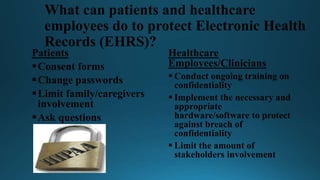
What can patients and healthcare
employees do to protect Electronic Health
Records (EHRS)?
Patients
๏‚งConsent forms
๏‚งChange passwords
๏‚งLimit family/caregivers
involvement
๏‚งAsk questions
Healthcare
Employees/Clinicians
๏‚ง Conduct ongoing training on
confidentiality
๏‚ง Implement the necessary and
appropriate
hardware/software to protect
against breach of
confidentiality
๏‚ง Limit the amount of
stakeholders involvement
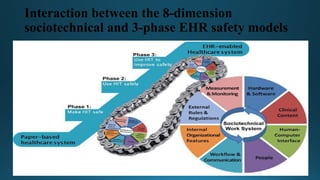
Interaction between the 8-dimension
sociotechnical and 3-phase EHR safety models
Even though there is a need for
healthcare employees to utilize
EHRs and discuss patient care;
it should be done professionally
and without jeopardizing a
patients trust, care, and
confidentiality.
Sittig, D. F., Ash, J. S., & Singh, H. (2014). The SAFER Guides:
Empowering Organizations to Improve the Safety and Effectiveness of
Electronic Health Records. American Journal of Managed Care, 20(5),
418-423. Retrieved from the EBSCOhost database.
Solomon, P., Molinaro, M., Mannion, E., & Cantwell, K. (2012).
Confidentiality Policies and Practices in Regard to Family
Involvement: Does Training Make a Difference?. American Journal of
Psychiatric Rehabilitation, 15(1), 97-115. Retrieved from the
EBSCOhost database.
www.ask.com. Health and confidentiality pictures.

susanfullerMha690 week1discussion2pp

  • 1.
    Confidentiality In theWorkplace Susan M Fuller MHA 690 Dr. Harold Griffin February 5, 2015
  • 2.
    What if confidential informationwas not kept secure among healthcare employees?
  • 4.
    The real threatis the sharing of the personal and/or medical information; which causes confidentiality, work-related, and trust issues.
  • 5.
    There should bezero tolerance for all healthcare employees who reviews a patient personal and/or medical information without permission.
  • 6.
    What can patientsand healthcare employees do to protect Electronic Health Records (EHRS)? Patients ๏‚งConsent forms ๏‚งChange passwords ๏‚งLimit family/caregivers involvement ๏‚งAsk questions Healthcare Employees/Clinicians ๏‚ง Conduct ongoing training on confidentiality ๏‚ง Implement the necessary and appropriate hardware/software to protect against breach of confidentiality ๏‚ง Limit the amount of stakeholders involvement
  • 7.
    Interaction between the8-dimension sociotechnical and 3-phase EHR safety models
  • 8.
    Even though thereis a need for healthcare employees to utilize EHRs and discuss patient care; it should be done professionally and without jeopardizing a patients trust, care, and confidentiality.
  • 9.
    Sittig, D. F.,Ash, J. S., & Singh, H. (2014). The SAFER Guides: Empowering Organizations to Improve the Safety and Effectiveness of Electronic Health Records. American Journal of Managed Care, 20(5), 418-423. Retrieved from the EBSCOhost database. Solomon, P., Molinaro, M., Mannion, E., & Cantwell, K. (2012). Confidentiality Policies and Practices in Regard to Family Involvement: Does Training Make a Difference?. American Journal of Psychiatric Rehabilitation, 15(1), 97-115. Retrieved from the EBSCOhost database. www.ask.com. Health and confidentiality pictures.

Editor's Notes

  • #3ย Allow employee participation. This will allow the employees to interact with one another while the answers are given and written down.
  • #4ย There is a growing problem of healthcare employees looking into a patientโ€™s personal and medical information without consent of the patient; and this is a breach of confidentiality. It is known that โ€œEHRs have potential to improve the quality and safety of healthcareโ€ (Sittig, Ash, & Singh, 2014, p. 419); and this brief training will be a reminder for all employees from administration to healthcare employees.
  • #5ย When an employee is found to have violated the confidentiality policy, trust is broken, and it affects the patient-clinician relationship. With the breach of confidentiality comes safety and security concerns that involves the entire organization. This training is to be interactive where employees will be allowed to voice their opinions, and implement new and innovative ideas on how to keep patients personal/medical information safe and secure while accessing, submitting, and input of Electronic Health Records (EHRs) among each other and other healthcare facilities without compromising confidentiality.
  • #6ย Because of โ€œaddressing EHR-related safety concerns is complex and requires a comprehensive systems-based approach; healthcare organizations must be equipped with a strategy of proactive risk assessmentโ€ฆto identify and address the HER safety concernsโ€ (Sittig, et. al., 2014, p. 419). Therefore, the confidentiality policy states there is zero tolerance for all employees who reviews a patientโ€™s medical/personal or an employees personnel file without permission is subject to harsh reprimands and possible termination.
  • #7ย Interactive exercise. Listed are just a few ideas that patients and employees alike can do to protect EHRs; and dividing into group discussions will be helpful so that everyone can give their opinions and ideas without judgments. Please choose a team reporter to write down and present the ideas.
  • #8ย This screen shows the interaction between the 8-dimension sociotechnical ; which involves โ€œMeasurement/monitoring, hardware/software, clinical content, human-computer interface, people, workflow/communication, internal organizational features, and external rules/regulationsโ€ (Sittig, et. al, 2014, p. 420). The 3-phase HER safety models begins by being paper-based; and making HIT safe (phase 1), using HIT safely (phase 2), and using HIT to improve safety (phase 3): (Sittig, et. al., 2014, p. 421) These two models can be implemented within the healthcare organization along with the current strategies; and training is readily available.
  • #9ย To review, healthcare employees need to be reassured that the ongoing training is to inform them of what other implementations and strategies that can be used when they are utilizing the HIT system to access, input, and share personal/medical information safely and securely. It is not to be used to intimidate, threaten, or gossip about the patient. Patients need to be assured that their information will not be shared among healthcare employees without their consent, and that if it is, there are reprimands and possible termination of staff. Besides that, the organization should not compromise the patientโ€™s trust and care because of an employeeโ€™s curiosity. Confidentiality training should โ€œinvolve clarifying policies and state regulations or laws, training staff about information, and assessing the effects of the trainingโ€ (Solomon, Molinaro, Mannion, & Cantwell, 2012, p. 98). Therefore, there will be evaluations given at the end of this training session, and โ€œresults of this training will be reportedโ€ (Solomon, et. al., 2012, p. 98). Questions????