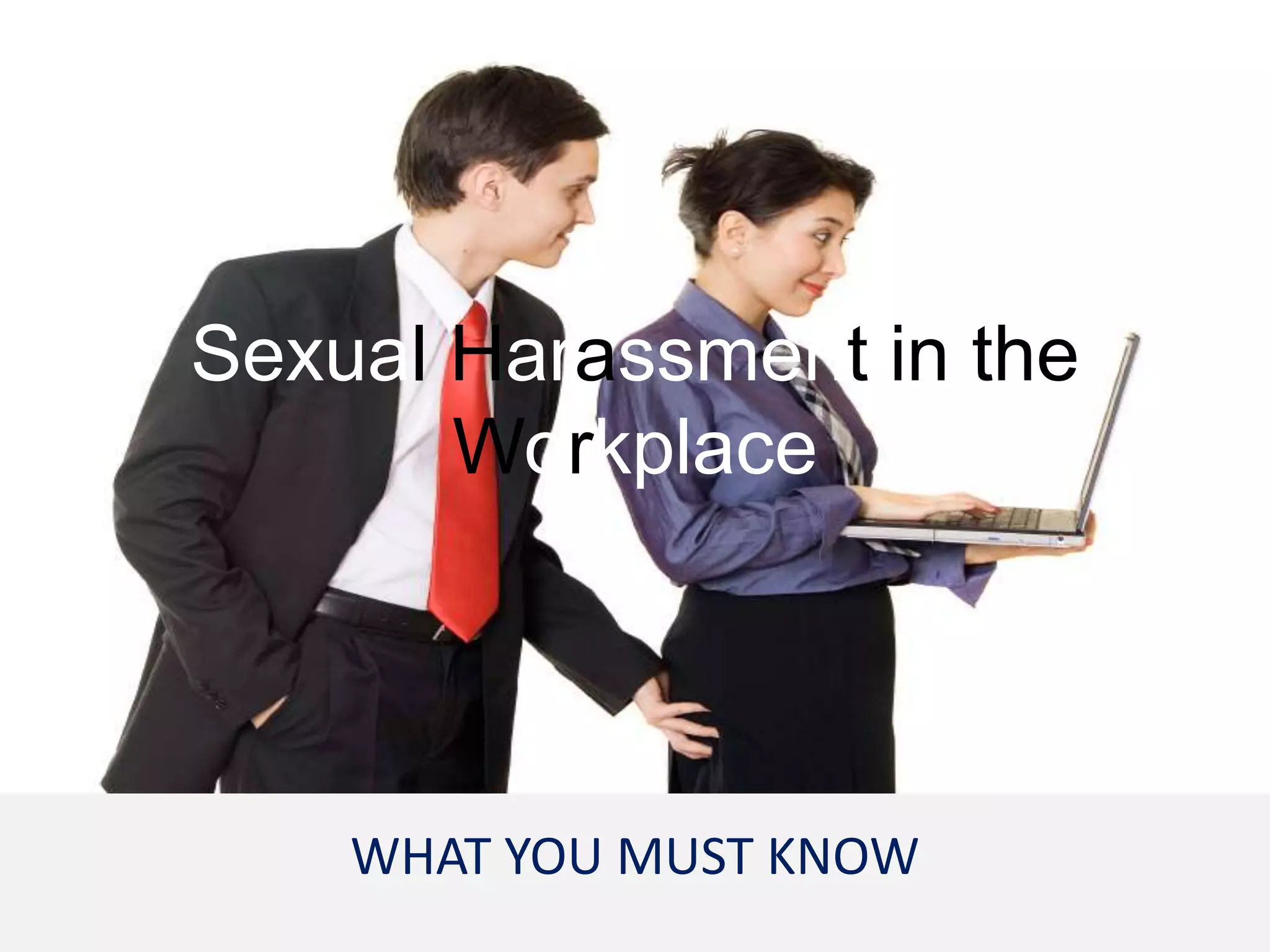
Sexual Harassment in the
       Workplace


    WHAT YOU MUST KNOW
Objectives

By the end of my 1-hour talk, you
should have been able to:
• Understand what Sexual Harassment in
  the Philippine workplace is;
• Keep in mind the provisions of the Anti-
  Sexual Harassment Act of 1995;
• Prepare yourself for any possibility in the
  future and be protected.
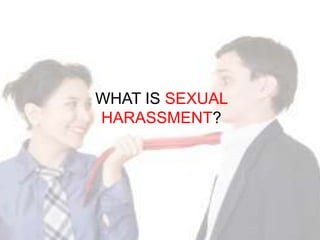
WHAT IS SEXUAL
HARASSMENT?
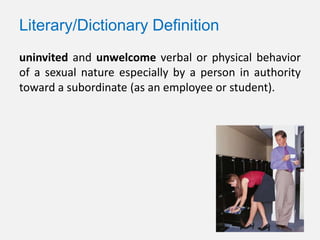
Literary/Dictionary Definition
uninvited and unwelcome verbal or physical behavior
of a sexual nature especially by a person in authority
toward a subordinate (as an employee or student).
As defined by R.A. No. 7877
is committed by an employer, employee, manager,
supervisor, agent of the employer, teacher,
instructor, professor, coach, trainer, or any other
person who, having authority, influence or moral
ascendancy over another in a work or training or
education environment, demands, requests or
otherwise requires any sexual favor from the other,
regardless of whether the demand, request or
requirement for submission is accepted by the
object of said act.
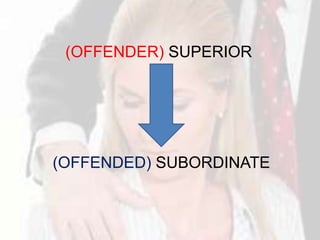
(OFFENDER) SUPERIOR


(OFFENDED) SUBORDINATE
Definition of Terms

ASCENDANCY – governing or controlling
influence

SEXUAL – does not just involve the act itself
but anything that has to do with or related to the
reproductive organs or a behavior which is
sexually motivated or has sexual desires.
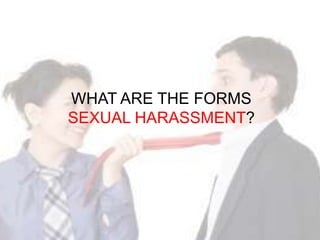
WHAT ARE THE FORMS
SEXUAL HARASSMENT?
Physical:
  - Malicious Touching/Acts of Lasciviousness/Lewdness
  - Overt Sexual Advances
  - Gestures with Lewd Insinuation

Verbal:
  - Requests or Demands for Sexual Favors
  - Lurid Remarks
Use of Objects, Pictures/Graphics,
Letters or Written Notes with Sexual
Underpinnings:
REPUBLIC ACT NO. 7877
 (Anti-Sexual Harassment Act of
              1995)
 AN ACT DECLARING SEXUAL HARASSMENT
UNLAWFUL IN THE EMPLOYMENT, EDUCATION
OR TRAINING ENVIRONMENT, AND FOR OTHER
               PURPOSES
Who are Covered by this Act?

• Workers or Employees

• Applicants or Candidates for Employment

• Students

• Those Undergoing Training, Institution, or
  Education (Trainees)
Who are Punishable by or Held Liable in
this Act?

 • Employer or Head

 • Employee who belongs to a higher level

 • Manager/Supervisor

 • Agent of the Employer
• Anybody else who has authority, influence, or
  moral ascendancy over the offended

• Any person who directs or induces another to
  commit any act of sexual harassment

• Any person who cooperates in the
  commission of the act by another without
  whom it would not have been committed
• Elementary or High School Teacher

• College or University Professor

• College or University Instructor

• Coach/Trainer
Where is this Applicable?

• Workplace

• School

• Any other Place of Training, Institution, or
  Education
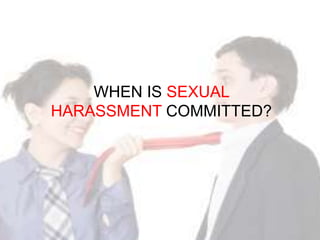
WHEN IS SEXUAL
HARASSMENT COMMITTED?
In a work-related or employment
environment:
1. The sexual favor is made as a condition in the hiring
 or in the employment, re-employment or continued
 employment of said individual, or in granting said
 individual favorable compensation, terms of
 conditions, promotions, or privileges; or the refusal
 to grant the sexual favor results in limiting,
 segregating or classifying the employee which in any
 way     would discriminate, deprive or diminish
 employment opportunities or otherwise adversely
 affect said employee;
In a work-related or employment
environment (continued):
2. The above acts would impair the employee's rights
 or privileges under existing labor laws; or

3. The above acts would result in an intimidating,
 hostile, or offensive environment for the employee.
In   an  education                or     training
environment:
1. Against one who is under the care, custody or
   supervision of the offender;

2. Against   one     whose     education,   training,
   apprenticeship   or tutorship is entrusted to the
   offender;
In   an  education    or                   training
environment (continued):
3. When the sexual favor is made a condition to the
   giving of a passing grade, or the granting of
   honors and scholarships, or the payment of a
   stipend, allowance or other benefits, privileges, or
   consideration; or

4. When the sexual advances result in an intimidating,
   hostile or offensive environment for the student,
   trainee or apprentice.
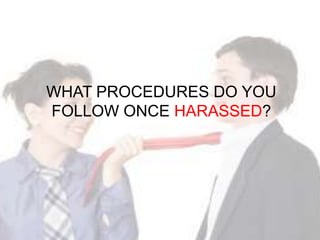
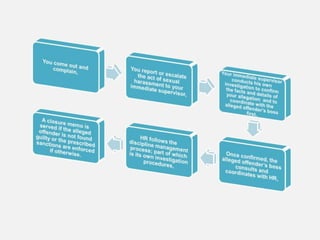
WHAT PROCEDURES DO YOU
FOLLOW ONCE HARASSED?
YOUR EMPLOYER OR HEAD’S
 DUTIES OR INVOLVEMENT
1. PROACTIVE APPROACH - Prevent or deter
   the commission of acts of sexual harassment.

2. REACTIVE APPROACH - Provide the
   procedures for the resolution, settlement or
   prosecution of acts of sexual harassment.
In order to attain such ends, your
employer or head shall:
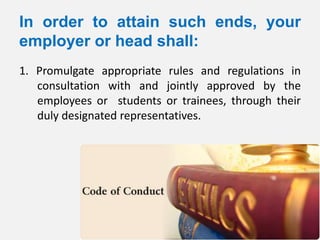
1. Promulgate appropriate rules and regulations in
   consultation with and jointly approved by the
   employees or students or trainees, through their
   duly designated representatives.
These     appropriate rules and
regulations may include but not
limited to:
•   Guidelines on Proper Decorum in the Workplace

•   Employee Code of Conduct

    –   Onboarding or new-hire/employee
        orientations/Induction Programs


•   Other Related Internal or Client-Provided Policies
In order to attain such ends, your
employer or head shall (continued):
2. Prescribe the procedure for the investigation
   of sexual harassment cases and the administrative
   sanctions therefor.

•   Discipline Management Process
•   Grievance Procedures
In order to attain such ends, your
employer or head shall (continued):
3. Create a COMMITTEE ON DECORUM AND
   INVESTIGATION (CODI) of        cases on sexual
   harassment.        The      committee         shall
   conduct meetings, as the case may be, with officers
   and employees, teachers, instructors, professors,
   coaches, trainers, and students or trainees to
   increase understanding and prevent incidents of
   sexual harassment. It shall also conduct
   the investigation of alleged cases constituting
   sexual harassment.
In order to attain such ends, your
employer or head shall (continued):
4. Be solidarily liable for damages arising from the acts
   of sexual harassment committed in the
   employment, education or training environment if
   the employer or head of office, educational or
   training institution is informed of such acts by the
   offended party and no immediate action is taken.
Financial Damages:
  - Monetary Settlement

Emotional/Mental/Psychological
Damages:
  - Counseling

  - Referral to an Agency Offering Professional Help

  - Any other Advice or Option Available
CAN THE VICTIM PURSUE
INDEPENDENT ACTIONS FOR
      THE DAMAGES?
ANSWER: YES.

Nothing in this Act shall preclude (rule out in advance)
the victim of work, education or training-related sexual
harassment from instituting a             separate and
independent action for damages and other affirmative
relief.
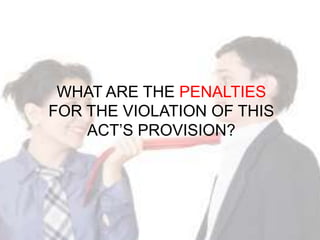
WHAT ARE THE PENALTIES
FOR THE VIOLATION OF THIS
    ACT’S PROVISION?
As per Law:
• Fine of Php10,000 – Php20,000

• Imprisonment of 1-6 months, or

• Both at the discretion of the court based on
 the degree of gravity of the offense
  – Grave offense
  – Less grave offense
  – Light offense
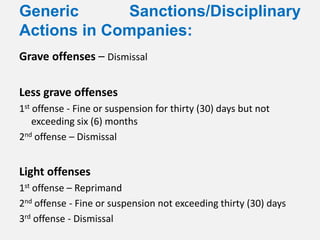
Generic      Sanctions/Disciplinary
Actions in Companies:
Grave offenses – Dismissal

Less grave offenses
1st offense - Fine or suspension for thirty (30) days but not
    exceeding six (6) months
2nd offense – Dismissal


Light offenses
1st offense – Reprimand
2nd offense - Fine or suspension not exceeding thirty (30) days
3rd offense - Dismissal
THE BEST THINGS TO DO
 WHEN DONE AN ACT OF
 SEXUAL HARASSMENT
• Reject the advance being made firmly but politely
  but loud and conspicuous enough for potential
  witnesses to hear and see it.

• Take note of the event by recording the date,
  exact time and specific location in the workplace
  where it happened.

• Tell your closest confidant in the workplace first.
• Report it to your immediate supervisor unless
  he/she is the offender.

• Go to your HR person in your immediate supervisor’s
  absence or if he is the person in question.
“A VICTIM REMAINS AS SUCH
ONLY UNTIL SHE LETS JUSTICE
BE SERVED BUT BECOMES AN
ETERNAL FOOL IF SHE DENIES
       HERSELF OF IT.”
www.youtube.com/MyronStaAna             368-3214
                                        0927-351-9391
www.twitter.com/MyronStaAna


www.myronstaana.wordpress.com


www.linkedin.com/in/MyronStaAna


www.facebook.com/MyronStaAnaTCS


www.myronstaana.wix.com/Myronosophies

Sexual Harassment in the Philippine Workplace

  • 1.
    Sexual Harassment inthe Workplace WHAT YOU MUST KNOW
  • 2.
    Objectives By the endof my 1-hour talk, you should have been able to: • Understand what Sexual Harassment in the Philippine workplace is; • Keep in mind the provisions of the Anti- Sexual Harassment Act of 1995; • Prepare yourself for any possibility in the future and be protected.
  • 3.
  • 4.
    Literary/Dictionary Definition uninvited andunwelcome verbal or physical behavior of a sexual nature especially by a person in authority toward a subordinate (as an employee or student).
  • 5.
    As defined byR.A. No. 7877 is committed by an employer, employee, manager, supervisor, agent of the employer, teacher, instructor, professor, coach, trainer, or any other person who, having authority, influence or moral ascendancy over another in a work or training or education environment, demands, requests or otherwise requires any sexual favor from the other, regardless of whether the demand, request or requirement for submission is accepted by the object of said act.
  • 6.
  • 7.
    Definition of Terms ASCENDANCY– governing or controlling influence SEXUAL – does not just involve the act itself but anything that has to do with or related to the reproductive organs or a behavior which is sexually motivated or has sexual desires.
  • 8.
    WHAT ARE THEFORMS SEXUAL HARASSMENT?
  • 9.
    Physical: -Malicious Touching/Acts of Lasciviousness/Lewdness - Overt Sexual Advances - Gestures with Lewd Insinuation Verbal: - Requests or Demands for Sexual Favors - Lurid Remarks Use of Objects, Pictures/Graphics, Letters or Written Notes with Sexual Underpinnings:
  • 10.
    REPUBLIC ACT NO.7877 (Anti-Sexual Harassment Act of 1995) AN ACT DECLARING SEXUAL HARASSMENT UNLAWFUL IN THE EMPLOYMENT, EDUCATION OR TRAINING ENVIRONMENT, AND FOR OTHER PURPOSES
  • 11.
    Who are Coveredby this Act? • Workers or Employees • Applicants or Candidates for Employment • Students • Those Undergoing Training, Institution, or Education (Trainees)
  • 12.
    Who are Punishableby or Held Liable in this Act? • Employer or Head • Employee who belongs to a higher level • Manager/Supervisor • Agent of the Employer
  • 13.
    • Anybody elsewho has authority, influence, or moral ascendancy over the offended • Any person who directs or induces another to commit any act of sexual harassment • Any person who cooperates in the commission of the act by another without whom it would not have been committed
  • 14.
    • Elementary orHigh School Teacher • College or University Professor • College or University Instructor • Coach/Trainer
  • 15.
    Where is thisApplicable? • Workplace • School • Any other Place of Training, Institution, or Education
  • 16.
  • 17.
    In a work-relatedor employment environment: 1. The sexual favor is made as a condition in the hiring or in the employment, re-employment or continued employment of said individual, or in granting said individual favorable compensation, terms of conditions, promotions, or privileges; or the refusal to grant the sexual favor results in limiting, segregating or classifying the employee which in any way would discriminate, deprive or diminish employment opportunities or otherwise adversely affect said employee;
  • 18.
    In a work-relatedor employment environment (continued): 2. The above acts would impair the employee's rights or privileges under existing labor laws; or 3. The above acts would result in an intimidating, hostile, or offensive environment for the employee.
  • 19.
    In an education or training environment: 1. Against one who is under the care, custody or supervision of the offender; 2. Against one whose education, training, apprenticeship or tutorship is entrusted to the offender;
  • 20.
    In an education or training environment (continued): 3. When the sexual favor is made a condition to the giving of a passing grade, or the granting of honors and scholarships, or the payment of a stipend, allowance or other benefits, privileges, or consideration; or 4. When the sexual advances result in an intimidating, hostile or offensive environment for the student, trainee or apprentice.
  • 21.
    WHAT PROCEDURES DOYOU FOLLOW ONCE HARASSED?
  • 23.
    YOUR EMPLOYER ORHEAD’S DUTIES OR INVOLVEMENT
  • 24.
    1. PROACTIVE APPROACH- Prevent or deter the commission of acts of sexual harassment. 2. REACTIVE APPROACH - Provide the procedures for the resolution, settlement or prosecution of acts of sexual harassment.
  • 25.
    In order toattain such ends, your employer or head shall: 1. Promulgate appropriate rules and regulations in consultation with and jointly approved by the employees or students or trainees, through their duly designated representatives.
  • 26.
    These appropriate rules and regulations may include but not limited to: • Guidelines on Proper Decorum in the Workplace • Employee Code of Conduct – Onboarding or new-hire/employee orientations/Induction Programs • Other Related Internal or Client-Provided Policies
  • 27.
    In order toattain such ends, your employer or head shall (continued): 2. Prescribe the procedure for the investigation of sexual harassment cases and the administrative sanctions therefor. • Discipline Management Process • Grievance Procedures
  • 28.
    In order toattain such ends, your employer or head shall (continued): 3. Create a COMMITTEE ON DECORUM AND INVESTIGATION (CODI) of cases on sexual harassment. The committee shall conduct meetings, as the case may be, with officers and employees, teachers, instructors, professors, coaches, trainers, and students or trainees to increase understanding and prevent incidents of sexual harassment. It shall also conduct the investigation of alleged cases constituting sexual harassment.
  • 29.
    In order toattain such ends, your employer or head shall (continued): 4. Be solidarily liable for damages arising from the acts of sexual harassment committed in the employment, education or training environment if the employer or head of office, educational or training institution is informed of such acts by the offended party and no immediate action is taken.
  • 30.
    Financial Damages: - Monetary Settlement Emotional/Mental/Psychological Damages: - Counseling - Referral to an Agency Offering Professional Help - Any other Advice or Option Available
  • 31.
    CAN THE VICTIMPURSUE INDEPENDENT ACTIONS FOR THE DAMAGES?
  • 32.
    ANSWER: YES. Nothing inthis Act shall preclude (rule out in advance) the victim of work, education or training-related sexual harassment from instituting a separate and independent action for damages and other affirmative relief.
  • 33.
    WHAT ARE THEPENALTIES FOR THE VIOLATION OF THIS ACT’S PROVISION?
  • 34.
    As per Law: •Fine of Php10,000 – Php20,000 • Imprisonment of 1-6 months, or • Both at the discretion of the court based on the degree of gravity of the offense – Grave offense – Less grave offense – Light offense
  • 35.
    Generic Sanctions/Disciplinary Actions in Companies: Grave offenses – Dismissal Less grave offenses 1st offense - Fine or suspension for thirty (30) days but not exceeding six (6) months 2nd offense – Dismissal Light offenses 1st offense – Reprimand 2nd offense - Fine or suspension not exceeding thirty (30) days 3rd offense - Dismissal
  • 36.
    THE BEST THINGSTO DO WHEN DONE AN ACT OF SEXUAL HARASSMENT
  • 38.
    • Reject theadvance being made firmly but politely but loud and conspicuous enough for potential witnesses to hear and see it. • Take note of the event by recording the date, exact time and specific location in the workplace where it happened. • Tell your closest confidant in the workplace first.
  • 39.
    • Report itto your immediate supervisor unless he/she is the offender. • Go to your HR person in your immediate supervisor’s absence or if he is the person in question.
  • 40.
    “A VICTIM REMAINSAS SUCH ONLY UNTIL SHE LETS JUSTICE BE SERVED BUT BECOMES AN ETERNAL FOOL IF SHE DENIES HERSELF OF IT.”
  • 41.
    www.youtube.com/MyronStaAna 368-3214 0927-351-9391 www.twitter.com/MyronStaAna www.myronstaana.wordpress.com www.linkedin.com/in/MyronStaAna www.facebook.com/MyronStaAnaTCS www.myronstaana.wix.com/Myronosophies

Editor's Notes

  • #35 Sexual Harassment is classified as:1. Grave Offensesa. unwanted touching of private parts of the body (genitalia, buttocks, and breast);b. sexual assault;c. malicious touching;d. requesting for sexual favor in exchange for employment, promotion, local or foreign travels, favorable working conditions or assignments, a passing grade, the granting of honors or scholarship, or the grant of benefits or payment of a stipend or allowance; ande. other analogous cases.2. Less Grave Offensesa. unwanted touching or brushing against a victim’s body;b. pinching not falling under grave offenses;c. derogatory or degrading remarks or innuendoes directed toward the members of one sex or one’s sexual orientation or used to describe a person;d. verbal abuse or threats with sexual overtones; ande. other analogous cases.3. Light Offensesa. surreptitiously looking or stealing a look at a person’s private part or worn undergarments;b. telling sexist/smutty jokes or sending these through text, electronic mail or other similar means, causing embarrassment or offense and carried out after the offender has been advised that they are offensive or embarrassing or, even without such advise, when they are by their nature clearly embarrassing, offensive or vulgar;c. malicious leering or ogling;d. the display of sexually offensive pictures, materials or graffiti;e. unwelcome inquiries or comments about a person’s sex life;f. unwelcome sexual flirtation, advances, propositions;g. making offensive hand or body gestures at an employee;h. persistent unwanted attention with sexual overtones;i. unwelcome phone calls with sexual overtones causing discomfort, embarrassment, offense or insult to the receiver; andj. other analogous cases.