Teaching the Flipped Classroom
29 September 2015
CRASH FLIGHT
A group of you are on a flight, heading for a
vacation. Suddenly, something went wrong and the
plane was not stable. The pilot tried to control
the flight but he failed.
Unfortunately, the flight went down and
crashed into the thick forest. Fortunately,
everyone is safe and no one was hurt. However,
now you need help.
There you can see, people sitting around
waiting for directions and the plane is in pieces.
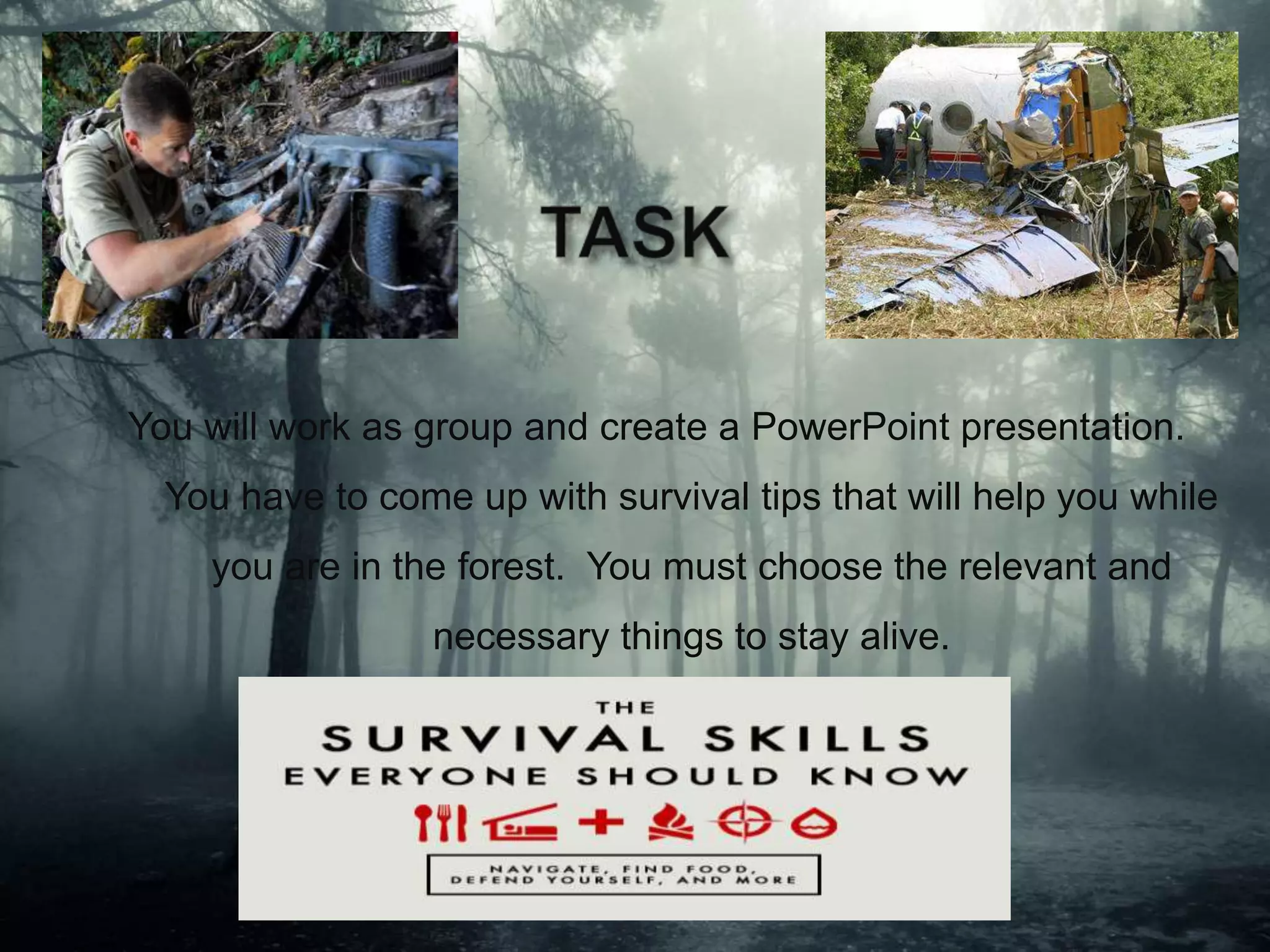
You will work as group and create a PowerPoint presentation.
You have to come up with survival tips that will help you while
you are in the forest. You must choose the relevant and
necessary things to stay alive.
GROUP PRESENTATION
 As a group you will present your
Powerpoint Presentation to the
class. The goal of this assignment is
to share your survival tips and food
with the class.
 The presentation should be 7 - 10
minutes.
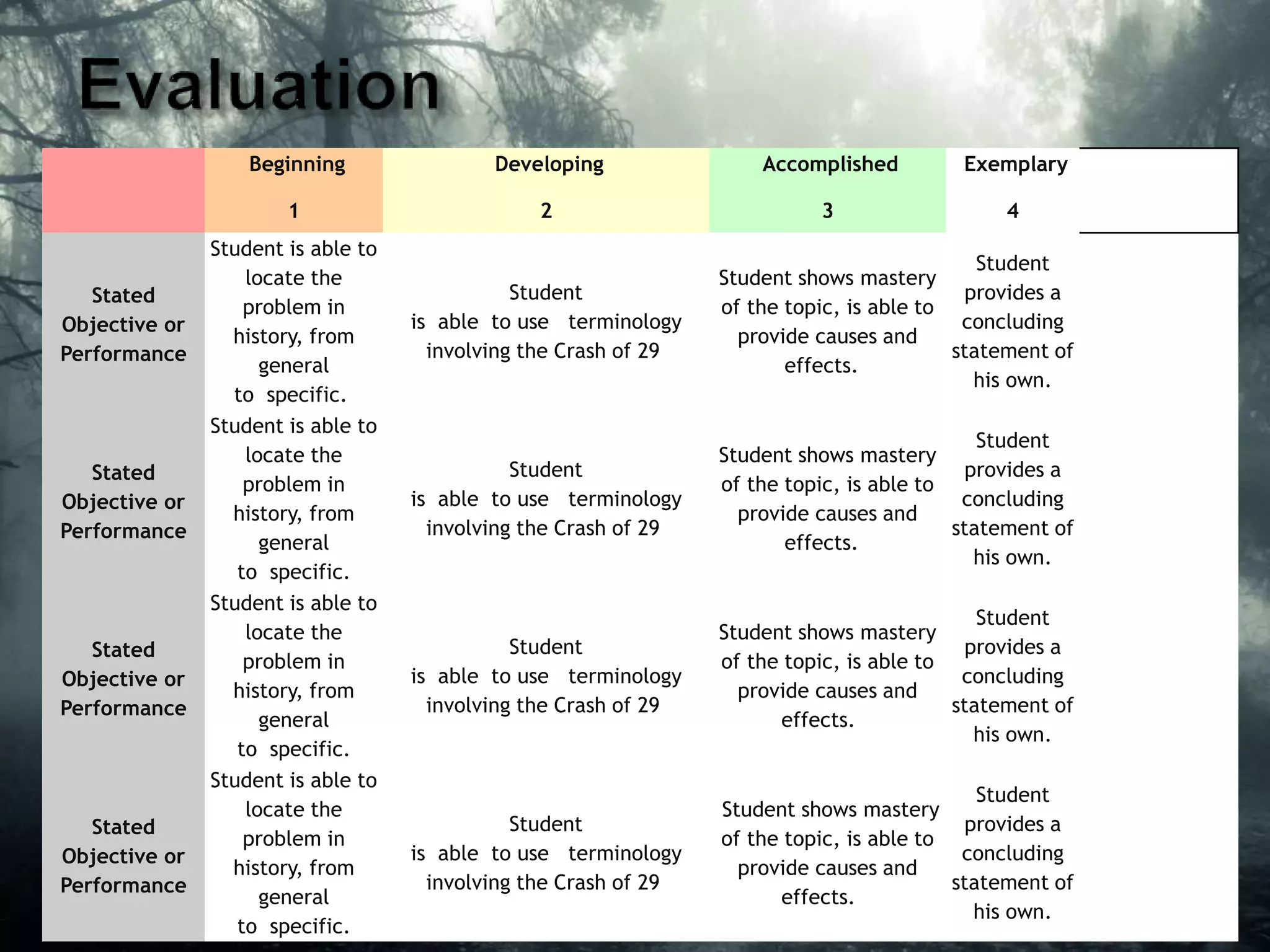
Beginning
1
Developing
2
Accomplished
3
Exemplary
4 Score
Stated
Objective or
Performance
Student is able to
locate the
problem in
history, from
general
to specific.
Student
is able to use terminology
involving the Crash of 29
Student shows mastery
of the topic, is able to
provide causes and
effects.
Student
provides a
concluding
statement of
his own.
Stated
Objective or
Performance
Student is able to
locate the
problem in
history, from
general
to specific.
Student
is able to use terminology
involving the Crash of 29
Student shows mastery
of the topic, is able to
provide causes and
effects.
Student
provides a
concluding
statement of
his own.
Stated
Objective or
Performance
Student is able to
locate the
problem in
history, from
general
to specific.
Student
is able to use terminology
involving the Crash of 29
Student shows mastery
of the topic, is able to
provide causes and
effects.
Student
provides a
concluding
statement of
his own.
Stated
Objective or
Performance
Student is able to
locate the
problem in
history, from
general
to specific.
Student
is able to use terminology
involving the Crash of 29
Student shows mastery
of the topic, is able to
provide causes and
effects.
Student
provides a
concluding
statement of
his own.
Survival Skills
• 1. STOP and Think
• Use the Boy Scouts mnemonic device of "STOP", which
stands for "Stop, Think, Observe, and Plan".
You've just discovered that you are lost in the jungle.
You're unsure about whether or not rescue will be
arriving. Here is a list of what you should be doing:
1. Find a source of drinking water.
2. Find or build a shelter before nightfall.
3. Fashion a weapon you can use for self defense.
4. Wait to see if rescue arrives.
5. Find a source of food.
6. Travel in one direction during daylight hours.
• 2. Finding Water
• In contrast to the dry climate of the desert, the jungle is an abundant source of water. In
many jungles, rainfall is common and can be used as a source of hydration.
Common Sources of Water:
Rainfall:
The leaves in the jungle are large and can be used to collect rain water. Just funnel the large
leaf into any water storage container and you will have sufficient water for later use.
Streams:
Look for streams of running water. You will want to boil any water that you collect from
streams in order to kill any bacteria. If you don't have a pot to boil water, then consider using
a tin/aluminum can.
Bamboo Stalks:
The bamboo collects water during rainfall. Bend the bamboo to allow the water to flow out
into a container
• 3. Finding Food
• Since the jungle is such an abundant resource of plants and
animals, the resources for finding food are everywhere. It's
just a matter of how to get access to it. Here are some tips
for getting food in the jungle.
Hunting/Trapping Animals:
Don't waste your energy and time hunting animals.
Conserve your energy for other survival tasks instead.
Your best bet is to trap animals while you are sleeping.
Using a deadfall trap is an effective way to trap animals and
you can set up many of them to increase your chances of
catching more food.
• 4. Build a Shelter
• In any jungle survival scenario, the shelter
plays an important role in protection against
the elements. It will be one of the top
priorities on your list of survival actions.
We will have to purify
water, collect food, start a
fire and build a shelter
and try to avoid getting
eaten.
Plane crash
By,
Madihah
Azween
Farhana
Aishah
Shalini
The Cause of plane crash
Mechanical error
• Radar reading was not accurate
"The Rule of Threes."
• A human can survive for:
• - 3 minutes without air
- 3 hours without a regulated body temperature
(shelter)
- 3 days without water
- 3 weeks without food
• The "Rule of Threes" provides a guideline of how to
prioritize basic survival skills:
1st shelter
2nd water
3rd food
How they survived?
• Find anything for treating injuries such as clothes, scarves to stop
bleeding.
• Find the river and follow the water current
• Collect flashlight if there’s any
• Sleep on the tree
• Try to give smoke signal
• Use your senses to
1.find roots to be used as rope
2. collect wood and pebbles as a protection tools
3.Catch anything edible from the river and smoke it
4. collect water using leaves and store in a bamboo.
• Move only during daytime
• Stick in your group, cooperate and unite.
• Stay strong and be positive emotionally!
No harm to read books about
wilderness..
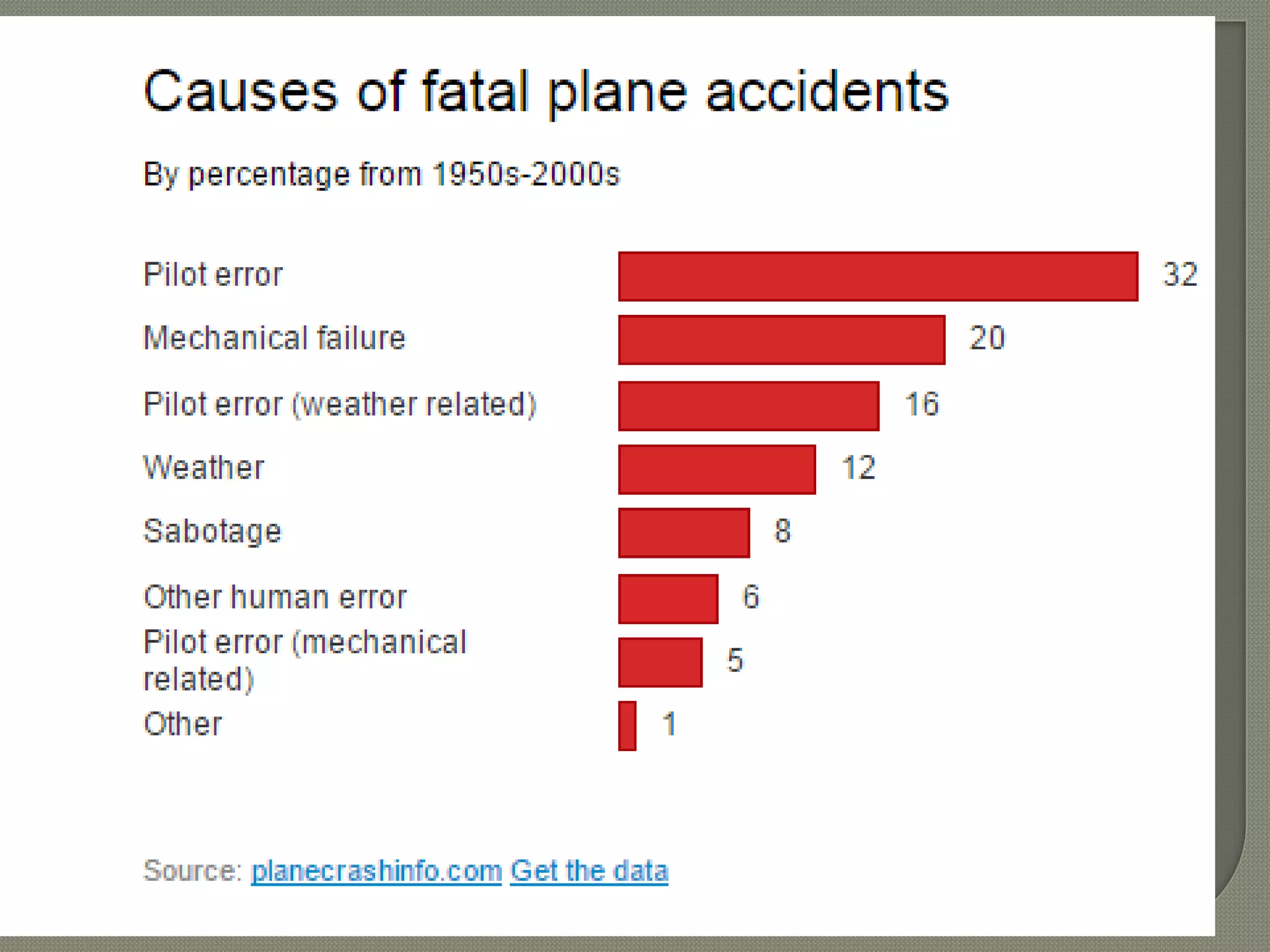
Plane crashes tend to break down into four
main categories:
Mechanical error
Weather
Intentional
Human Error
Analysis of more than 1,000 fatal crashes
from 1950 to 2010 shows the majority were
caused by pilots making mistakes, sometimes
in response to severe weather or mechanical
issues.
More info about the possible causes of the
plane crash, can log on to
http://www.planecrashinfo.com/cause.htm
Dress comfortably
• Wear long pants, a long-sleeve t-shirt, and sturdy,
comfortable, sweater
 Stay warm, dry
Wear shoes
• Proper shoes to keep your feet from sharp and
dangerous objects.
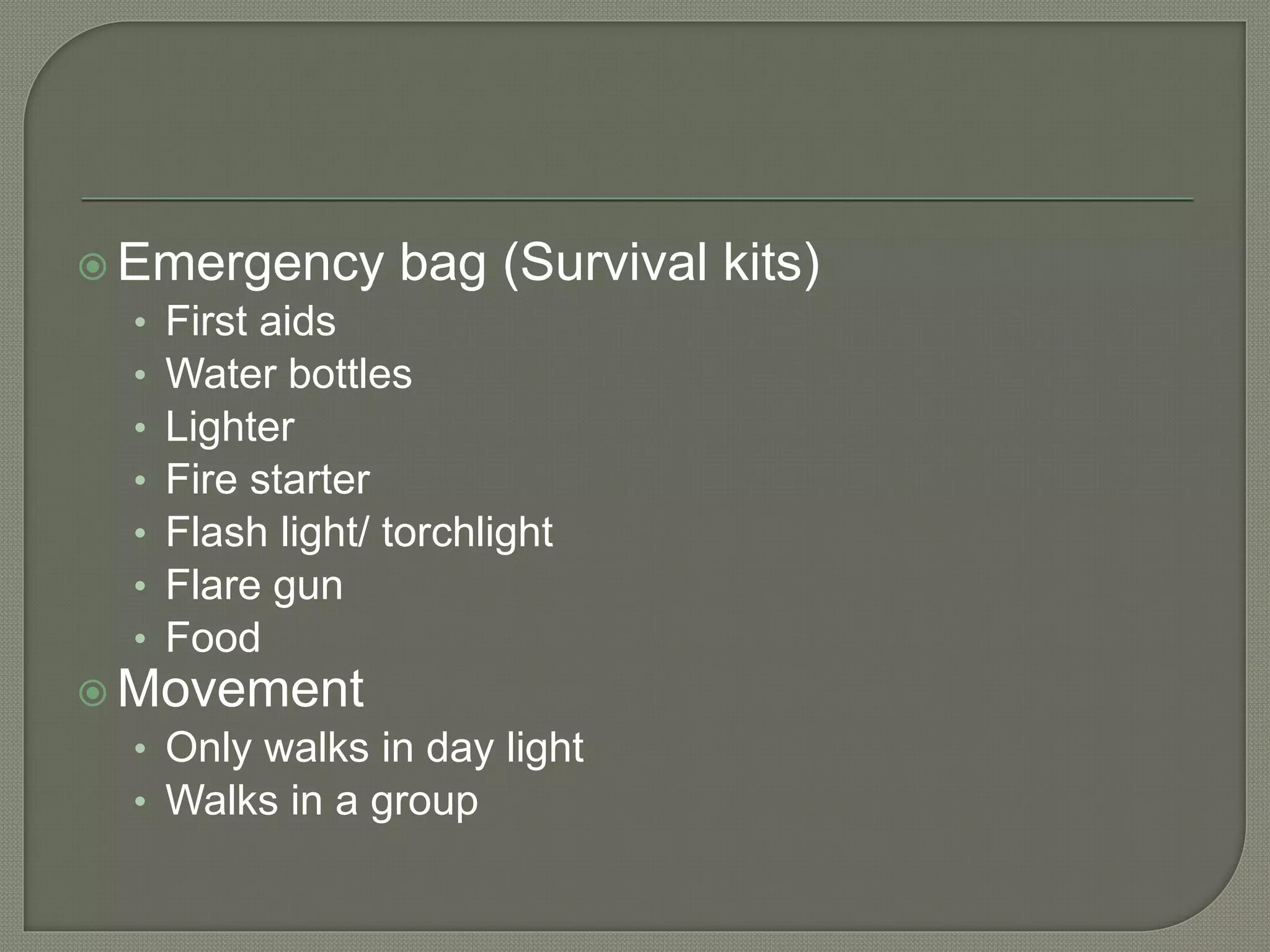
 Emergency bag (Survival kits)
• First aids
• Water bottles
• Lighter
• Fire starter
• Flash light/ torchlight
• Flare gun
• Food
 Movement
• Only walks in day light
• Walks in a group
Self-motivation
• Moral support
• Self confidence
• Survival skills
Find source of water
• River, rain water, tree roots, dew
Make shelter
• Away from predator, safe environment
Find source of food
• Fruits, edible mushroom, animals
Crash Flight

Crash Flight

  • 1.
    Teaching the FlippedClassroom 29 September 2015
  • 2.
  • 4.
    A group ofyou are on a flight, heading for a vacation. Suddenly, something went wrong and the plane was not stable. The pilot tried to control the flight but he failed. Unfortunately, the flight went down and crashed into the thick forest. Fortunately, everyone is safe and no one was hurt. However, now you need help. There you can see, people sitting around waiting for directions and the plane is in pieces.
  • 5.
    You will workas group and create a PowerPoint presentation. You have to come up with survival tips that will help you while you are in the forest. You must choose the relevant and necessary things to stay alive.
  • 6.
    GROUP PRESENTATION  Asa group you will present your Powerpoint Presentation to the class. The goal of this assignment is to share your survival tips and food with the class.  The presentation should be 7 - 10 minutes.
  • 7.
    Beginning 1 Developing 2 Accomplished 3 Exemplary 4 Score Stated Objective or Performance Studentis able to locate the problem in history, from general to specific. Student is able to use terminology involving the Crash of 29 Student shows mastery of the topic, is able to provide causes and effects. Student provides a concluding statement of his own. Stated Objective or Performance Student is able to locate the problem in history, from general to specific. Student is able to use terminology involving the Crash of 29 Student shows mastery of the topic, is able to provide causes and effects. Student provides a concluding statement of his own. Stated Objective or Performance Student is able to locate the problem in history, from general to specific. Student is able to use terminology involving the Crash of 29 Student shows mastery of the topic, is able to provide causes and effects. Student provides a concluding statement of his own. Stated Objective or Performance Student is able to locate the problem in history, from general to specific. Student is able to use terminology involving the Crash of 29 Student shows mastery of the topic, is able to provide causes and effects. Student provides a concluding statement of his own.
  • 8.
    Survival Skills • 1.STOP and Think • Use the Boy Scouts mnemonic device of "STOP", which stands for "Stop, Think, Observe, and Plan". You've just discovered that you are lost in the jungle. You're unsure about whether or not rescue will be arriving. Here is a list of what you should be doing: 1. Find a source of drinking water. 2. Find or build a shelter before nightfall. 3. Fashion a weapon you can use for self defense. 4. Wait to see if rescue arrives. 5. Find a source of food. 6. Travel in one direction during daylight hours.
  • 9.
    • 2. FindingWater • In contrast to the dry climate of the desert, the jungle is an abundant source of water. In many jungles, rainfall is common and can be used as a source of hydration. Common Sources of Water: Rainfall: The leaves in the jungle are large and can be used to collect rain water. Just funnel the large leaf into any water storage container and you will have sufficient water for later use. Streams: Look for streams of running water. You will want to boil any water that you collect from streams in order to kill any bacteria. If you don't have a pot to boil water, then consider using a tin/aluminum can. Bamboo Stalks: The bamboo collects water during rainfall. Bend the bamboo to allow the water to flow out into a container
  • 10.
    • 3. FindingFood • Since the jungle is such an abundant resource of plants and animals, the resources for finding food are everywhere. It's just a matter of how to get access to it. Here are some tips for getting food in the jungle. Hunting/Trapping Animals: Don't waste your energy and time hunting animals. Conserve your energy for other survival tasks instead. Your best bet is to trap animals while you are sleeping. Using a deadfall trap is an effective way to trap animals and you can set up many of them to increase your chances of catching more food.
  • 11.
    • 4. Builda Shelter • In any jungle survival scenario, the shelter plays an important role in protection against the elements. It will be one of the top priorities on your list of survival actions.
  • 12.
    We will haveto purify water, collect food, start a fire and build a shelter and try to avoid getting eaten.
  • 13.
  • 14.
    The Cause ofplane crash Mechanical error • Radar reading was not accurate
  • 16.
    "The Rule ofThrees." • A human can survive for: • - 3 minutes without air - 3 hours without a regulated body temperature (shelter) - 3 days without water - 3 weeks without food • The "Rule of Threes" provides a guideline of how to prioritize basic survival skills: 1st shelter 2nd water 3rd food
  • 17.
    How they survived? •Find anything for treating injuries such as clothes, scarves to stop bleeding. • Find the river and follow the water current • Collect flashlight if there’s any • Sleep on the tree • Try to give smoke signal • Use your senses to 1.find roots to be used as rope 2. collect wood and pebbles as a protection tools 3.Catch anything edible from the river and smoke it 4. collect water using leaves and store in a bamboo. • Move only during daytime • Stick in your group, cooperate and unite. • Stay strong and be positive emotionally!
  • 20.
    No harm toread books about wilderness..
  • 22.
    Plane crashes tendto break down into four main categories: Mechanical error Weather Intentional Human Error Analysis of more than 1,000 fatal crashes from 1950 to 2010 shows the majority were caused by pilots making mistakes, sometimes in response to severe weather or mechanical issues.
  • 24.
    More info aboutthe possible causes of the plane crash, can log on to http://www.planecrashinfo.com/cause.htm
  • 25.
    Dress comfortably • Wearlong pants, a long-sleeve t-shirt, and sturdy, comfortable, sweater  Stay warm, dry Wear shoes • Proper shoes to keep your feet from sharp and dangerous objects.
  • 26.
     Emergency bag(Survival kits) • First aids • Water bottles • Lighter • Fire starter • Flash light/ torchlight • Flare gun • Food  Movement • Only walks in day light • Walks in a group
  • 27.
    Self-motivation • Moral support •Self confidence • Survival skills Find source of water • River, rain water, tree roots, dew Make shelter • Away from predator, safe environment Find source of food • Fruits, edible mushroom, animals