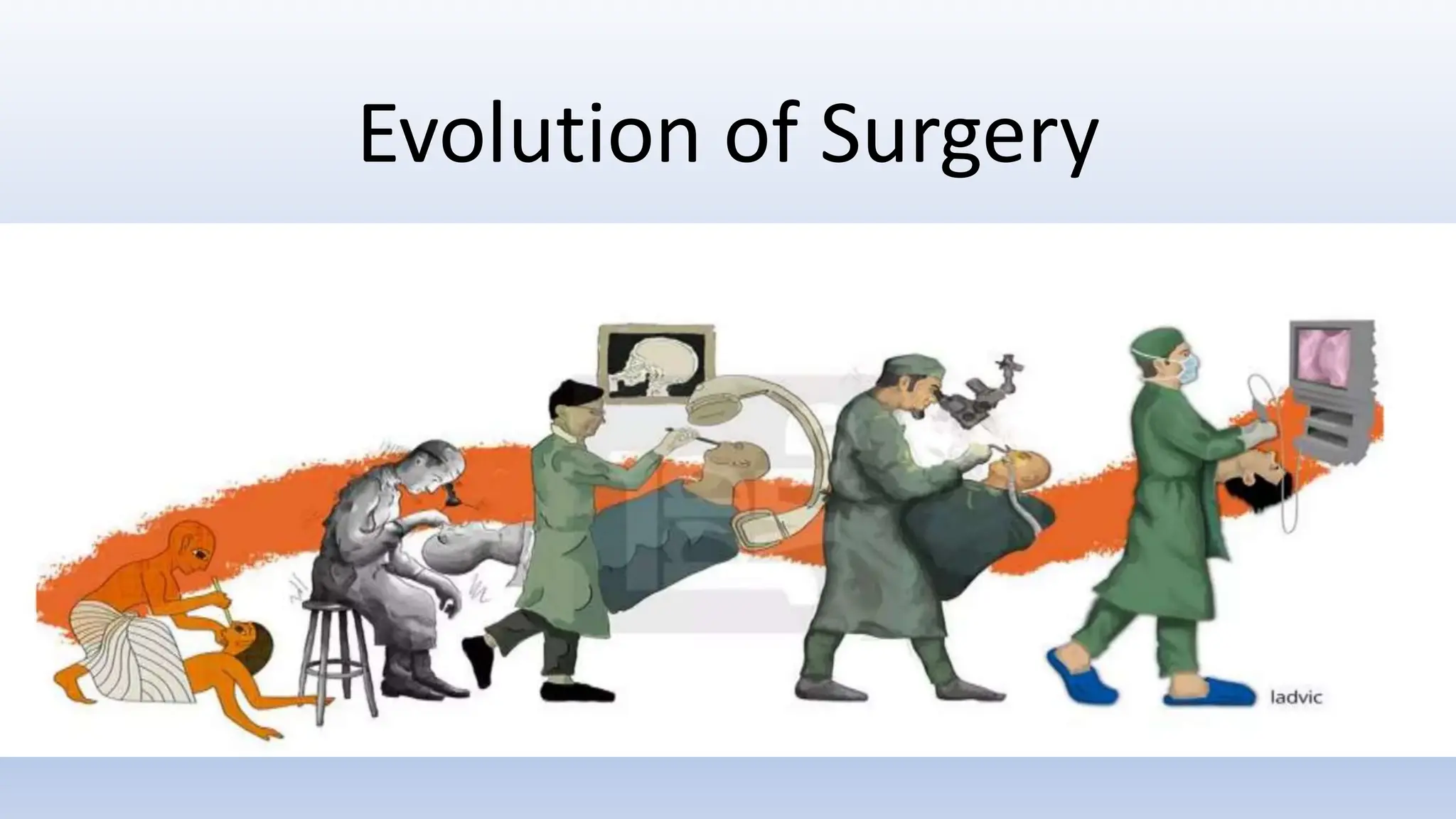
Evolution of Surgery
Prof. Dr. Subinoy Krishna Paul
Head of the Department
Department of Casualty & Emergency
Dhaka Medical College Hospital
•Surgery deals with the physical
manipulation of a bodily structure to
diagnose, prevent, or cure an ailment.
Field of evolution
• Concept of doing surgical procedure
• Mode of Anaesthesia
• Operation theatre
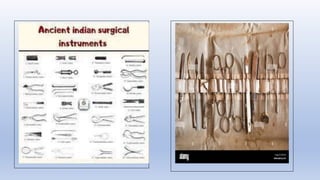
• Instruments
• Aseptic precaution & use of Antibiotics
Landmarks of surgery
•Before the 19th Century
•19th Century
•20th Century
•21st Century
Before the 19th century
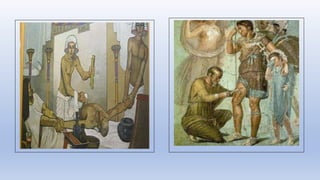
•The concept of surgery was explored well
before recorded history with early surgeons
grasping the basic concepts of the human
anatomy and organ systems.
7300-6220 BC
•Skull trepanning was the first surgical
procedure performed in ancient Egypt
•Inside the pyramid of Egypt skull found with
hole in it
The landmarks before the 19th century
• Stone Age: The oldest known surgery was a leg amputation
performed on a child on the island of Borneo around 31,000
years ago.
• 6500 BCE: Skulls found in France show signs of a
rudimentary surgery called trepanation, which involves
drilling a hole in the skull.
• 1750 BCE: The Code of Hammurabi, one of the earliest
Babylonian codes of laws, details regulation governing
surgeons, medical malpractice, and victim's compensation.
• 1550 BCE: The Ebers Papyrus, an ancient Egyptian medical
treaty, includes information on how to surgically treat
crocodile bites and serious burns.
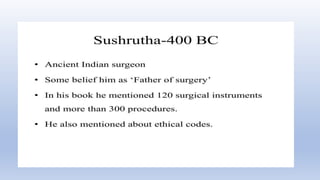
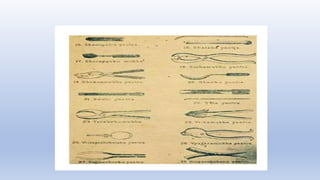
• 600 BCE: Sushruta, regarded as the "founding father of
surgery," was an innovator of plastic surgery,
including rhinoplasty.
• 950: Abulcasis, an Arab physician considered to be among
the greatest medieval surgeons, apparently learned many of
his skills from Greek surgeons.
• 1363: French surgeon Guy de Chauliac writes "Chirurgia
Magna" (Great Surgery), regarded as the standard text for
surgeons until well into the 17th century.
• 1540: English barbers and surgeons unite to form the United
Barber-Surgeons Company. These "barber surgeons"
performed tooth extractions and bloodletting.
• 1630: Wilhelm Fabry, known as "the Father of German
Surgery," is recognized as the first surgeon to
employ amputation as a treatment for gangrene.
•As we know it today, wasn't truly invented until
the late 1800s; even then, infection was common
and outcomes were generally poor.
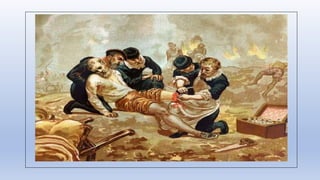
•Early techniques were primitive and even
barbaric, by today's standards. Anesthesia was
not used until the mid to late 1800s.
19th century
• Based on historical records, many regard the 19th
century as the "birth of surgery" as we know it. It was
a century marked by many "firsts," the discoveries of
which enabled many of the surgical procedures still in
use today. Among some of the landmarks of the era:
• 1818: The first transfusion of human blood is performed.
• 1843: The first hysterectomy is performed in England.
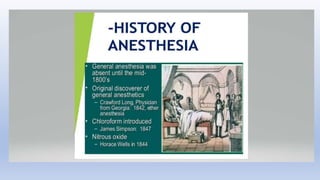
• 1843: Ether is used for the first time as an anesthetic.
• 1846: The first public use of ether as anesthesia is demonstrated in a
surgery performed at the Massachusetts General Hospital in Boston
involving the removal of a neck tumor.
• 1855: Mary Edwards Walker graduates from medical school and
becomes the first female surgeon in America.
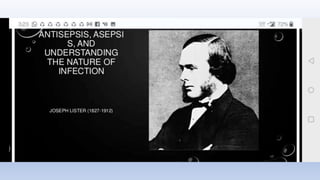
• 1867: British surgeon Joseph Lister publishes Antiseptic Principle in
the Practice of Surgery, extolling the virtues of cleanliness in surgery.
• 1885: The first successful appendectomy is performed in Iowa.
• 1890s: Carbolic acid is one of the first agents used as a microbicide to
disinfect surgical incisions and prevent postoperative infections.
• 1893: The first successful heart surgery is performed at Provident
Hospital in Chicago to repair a defect in the lining of the heart
(pericardium). Some do not regard this as "heart surgery" since the
heart itself was not treated.
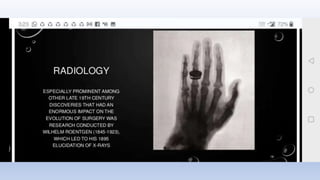
• 1895: The first X-ray is performed in Germany.
• 1896: The first successful open-heart surgery is performed in
Germany to repair a stab wound in the muscle of the right ventricle.
The landmarks of the 20th century
• During the 20th century, major advances in surgery not
only made surgery safer and more effective but enabled
the treatment of a wider range of medical conditions,
including the transplantation of organs.
The landmarks of the 19th century
• 1905: The first successful cornea transplant is performed.
• 1917: The first documented plastic surgery is performed on a
burned English sailor.
• 1928: Antibiotics are discovered, preventing post-surgical
bacterial infections.
• 1930: A German person has the first sex reassignment
operation from male to female.
• 1940: The first metal hip replacement surgery is performed.
• 1950: The first LASIK eye procedure is performed in
Colombia.
• 1950: The first successful organ transplant involving a kidney
is performed, although the recipient dies a few months later
of graft rejection.
• 1952: The first successful heart surgery is performed in
which the heart is stopped and restarted.
• 1953: The first successful use of a heart-lung bypass
machine is performed.
• 1954: The first successful living donor kidney transplant is
performed in which the donor was the recipient's twin.
• 1966: The first successful pancreas transplant is performed.
• 1967: The first successful liver transplant is performed.
• 1967: The first heart transplant surgery is performed by South
African surgeon Christian Barnard.
• 1975: The first organ surgery is performed using minimally-
invasive laparoscopic ("keyhole") surgery.
• 1978: The first "test-tube" baby is born using in vitro
fertilization (IVF).
• 1982: The Jarvik-7 artificial heart was used.
• 1984: A pediatric patient known as Baby Fae survives 21
days after being transplanted with the heart of a baboon.
• 1985: The first documented robotic surgery is performed.
• 1999: The first successful hand transplant is performed.
• 1999: The FDA clears the cyberknife, which uses a
combination of robotics and imaging, for the treatment
of intracranial tumors.
The landmarks of the 21st century
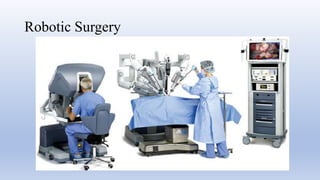
• 2000: The da Vinci robotic surgical system is approved by the
U.S. Food and Drug Administration (FDA) for prostate
surgery, coronary artery bypass, and other surgical procedures.
• 2007: The first natural orifice transluminal endoscopic surgery is
performed in which tools are inserted through the mouth, nose,
and other orifices to perform surgery without external incisions.
• 2008: Connie Culp has the first near-total face
transplant performed at the Cleveland Clinic.
• 2010: The world's first full-face transplant is performed in
Spain.
• 2013: The first successful nerve-transfer surgery is performed
in St. Louis, Missouri, giving a paraplegic individual the
ability to move their hands.
• 2014: The first penis transplant is performed at Tygerberg
Hospital in South Africa.
• 2016: The first uterus transplant is performed, again at the
Cleveland Clinic.
• 2018: The first abdominal wall transplant is performed at
Duke University Hospital.
• 2022: The first transplant of a genetically modified pig's heart
into a human being is performed at the University of
Maryland Medical Center.
• 2023: The first whole eye and partial face transplant is
performed at NYU Langone Health, making it the first-ever
whole eye transplant and the first combined surgery of this
kind.
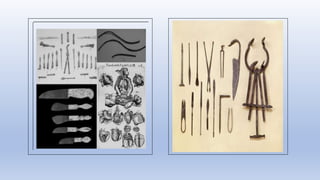
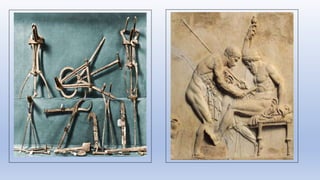
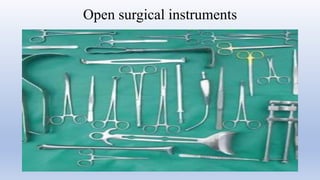
Open surgical instruments
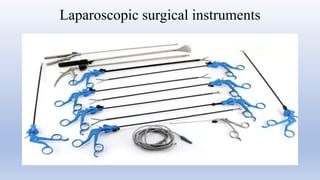
Laparoscopic surgical instruments
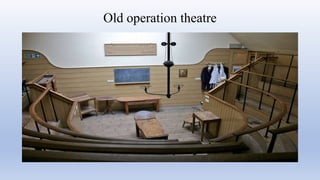
Old operation theatre
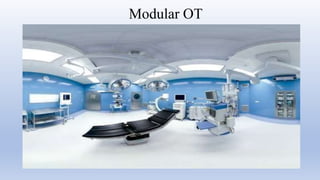
Modular OT
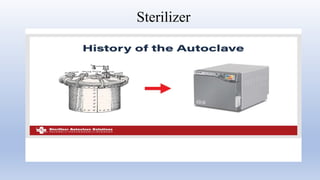
Sterilizer
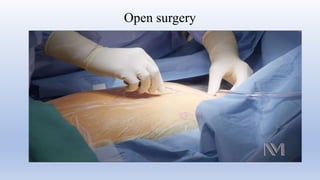
Open surgery
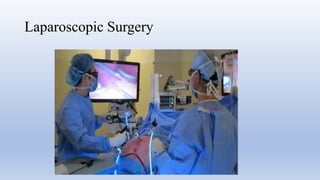
Laparoscopic Surgery
Robotic Surgery
Summary
The first surgeries were performed thousands of years
ago, before anesthesia was invented and before
infection prevention measures were understood. Newer
surgical techniques have resulted in better outcomes,
faster recoveries, less pain, and longer life expectancies
for patients.
Evolution of Surgery from beginning to today

Evolution of Surgery from beginning to today

  • 1.
  • 12.
    Prof. Dr. SubinoyKrishna Paul Head of the Department Department of Casualty & Emergency Dhaka Medical College Hospital
  • 13.
    •Surgery deals withthe physical manipulation of a bodily structure to diagnose, prevent, or cure an ailment.
  • 15.
    Field of evolution •Concept of doing surgical procedure • Mode of Anaesthesia • Operation theatre • Instruments • Aseptic precaution & use of Antibiotics
  • 16.
    Landmarks of surgery •Beforethe 19th Century •19th Century •20th Century •21st Century
  • 17.
    Before the 19thcentury •The concept of surgery was explored well before recorded history with early surgeons grasping the basic concepts of the human anatomy and organ systems.
  • 18.
    7300-6220 BC •Skull trepanningwas the first surgical procedure performed in ancient Egypt •Inside the pyramid of Egypt skull found with hole in it
  • 23.
    The landmarks beforethe 19th century • Stone Age: The oldest known surgery was a leg amputation performed on a child on the island of Borneo around 31,000 years ago. • 6500 BCE: Skulls found in France show signs of a rudimentary surgery called trepanation, which involves drilling a hole in the skull. • 1750 BCE: The Code of Hammurabi, one of the earliest Babylonian codes of laws, details regulation governing surgeons, medical malpractice, and victim's compensation.
  • 24.
    • 1550 BCE:The Ebers Papyrus, an ancient Egyptian medical treaty, includes information on how to surgically treat crocodile bites and serious burns. • 600 BCE: Sushruta, regarded as the "founding father of surgery," was an innovator of plastic surgery, including rhinoplasty. • 950: Abulcasis, an Arab physician considered to be among the greatest medieval surgeons, apparently learned many of his skills from Greek surgeons.
  • 25.
    • 1363: Frenchsurgeon Guy de Chauliac writes "Chirurgia Magna" (Great Surgery), regarded as the standard text for surgeons until well into the 17th century. • 1540: English barbers and surgeons unite to form the United Barber-Surgeons Company. These "barber surgeons" performed tooth extractions and bloodletting. • 1630: Wilhelm Fabry, known as "the Father of German Surgery," is recognized as the first surgeon to employ amputation as a treatment for gangrene.
  • 26.
    •As we knowit today, wasn't truly invented until the late 1800s; even then, infection was common and outcomes were generally poor. •Early techniques were primitive and even barbaric, by today's standards. Anesthesia was not used until the mid to late 1800s.
  • 27.
    19th century • Basedon historical records, many regard the 19th century as the "birth of surgery" as we know it. It was a century marked by many "firsts," the discoveries of which enabled many of the surgical procedures still in use today. Among some of the landmarks of the era:
  • 28.
    • 1818: Thefirst transfusion of human blood is performed. • 1843: The first hysterectomy is performed in England. • 1843: Ether is used for the first time as an anesthetic. • 1846: The first public use of ether as anesthesia is demonstrated in a surgery performed at the Massachusetts General Hospital in Boston involving the removal of a neck tumor. • 1855: Mary Edwards Walker graduates from medical school and becomes the first female surgeon in America.
  • 29.
    • 1867: Britishsurgeon Joseph Lister publishes Antiseptic Principle in the Practice of Surgery, extolling the virtues of cleanliness in surgery. • 1885: The first successful appendectomy is performed in Iowa. • 1890s: Carbolic acid is one of the first agents used as a microbicide to disinfect surgical incisions and prevent postoperative infections. • 1893: The first successful heart surgery is performed at Provident Hospital in Chicago to repair a defect in the lining of the heart (pericardium). Some do not regard this as "heart surgery" since the heart itself was not treated. • 1895: The first X-ray is performed in Germany. • 1896: The first successful open-heart surgery is performed in Germany to repair a stab wound in the muscle of the right ventricle.
  • 30.
    The landmarks ofthe 20th century • During the 20th century, major advances in surgery not only made surgery safer and more effective but enabled the treatment of a wider range of medical conditions, including the transplantation of organs.
  • 31.
    The landmarks ofthe 19th century • 1905: The first successful cornea transplant is performed. • 1917: The first documented plastic surgery is performed on a burned English sailor. • 1928: Antibiotics are discovered, preventing post-surgical bacterial infections. • 1930: A German person has the first sex reassignment operation from male to female.
  • 32.
    • 1940: Thefirst metal hip replacement surgery is performed. • 1950: The first LASIK eye procedure is performed in Colombia. • 1950: The first successful organ transplant involving a kidney is performed, although the recipient dies a few months later of graft rejection. • 1952: The first successful heart surgery is performed in which the heart is stopped and restarted.
  • 33.
    • 1953: Thefirst successful use of a heart-lung bypass machine is performed. • 1954: The first successful living donor kidney transplant is performed in which the donor was the recipient's twin. • 1966: The first successful pancreas transplant is performed. • 1967: The first successful liver transplant is performed. • 1967: The first heart transplant surgery is performed by South African surgeon Christian Barnard. • 1975: The first organ surgery is performed using minimally- invasive laparoscopic ("keyhole") surgery.
  • 34.
    • 1978: Thefirst "test-tube" baby is born using in vitro fertilization (IVF). • 1982: The Jarvik-7 artificial heart was used. • 1984: A pediatric patient known as Baby Fae survives 21 days after being transplanted with the heart of a baboon. • 1985: The first documented robotic surgery is performed. • 1999: The first successful hand transplant is performed. • 1999: The FDA clears the cyberknife, which uses a combination of robotics and imaging, for the treatment of intracranial tumors.
  • 35.
    The landmarks ofthe 21st century • 2000: The da Vinci robotic surgical system is approved by the U.S. Food and Drug Administration (FDA) for prostate surgery, coronary artery bypass, and other surgical procedures. • 2007: The first natural orifice transluminal endoscopic surgery is performed in which tools are inserted through the mouth, nose, and other orifices to perform surgery without external incisions. • 2008: Connie Culp has the first near-total face transplant performed at the Cleveland Clinic.
  • 36.
    • 2010: Theworld's first full-face transplant is performed in Spain. • 2013: The first successful nerve-transfer surgery is performed in St. Louis, Missouri, giving a paraplegic individual the ability to move their hands. • 2014: The first penis transplant is performed at Tygerberg Hospital in South Africa. • 2016: The first uterus transplant is performed, again at the Cleveland Clinic.
  • 37.
    • 2018: Thefirst abdominal wall transplant is performed at Duke University Hospital. • 2022: The first transplant of a genetically modified pig's heart into a human being is performed at the University of Maryland Medical Center. • 2023: The first whole eye and partial face transplant is performed at NYU Langone Health, making it the first-ever whole eye transplant and the first combined surgery of this kind.
  • 48.
  • 49.
  • 50.
  • 51.
  • 52.
  • 53.
  • 54.
  • 55.
  • 56.
    Summary The first surgerieswere performed thousands of years ago, before anesthesia was invented and before infection prevention measures were understood. Newer surgical techniques have resulted in better outcomes, faster recoveries, less pain, and longer life expectancies for patients.