SURGICAL CORMIDITIES
Capt-Htet Ko
PG II ORL-HNS
Introduction:
• Every Surgical procedure involves some risk of significant post operative
complications or death.
• In most cases, the risk is below 1% but it increases 10%-15% in high risk
population.
• This high risk surgical population accounts for over 80% of surgical death.
Factors that predispose patients to a high risk of morbidity and mortality.
Patient Factor
• History of severe cardiac disease (ischaemic heart disease (IHD), myocardial infarction (MI),
cardiac failure)
• Severe respiratory disease (chronic obstructive pulmonary disease (COPD), respiratory failure)
• Aged >70 years with limited physiological reserve in one or more vital organs
• Metabolic disease (renal failure, poorly controlled diabetes)
• Morbid obesity
• Late stage vascular disease
• Poor nutrition
Surgical Factor :
• Prolonged duration of surgery (>1.5 hours)
• Extensive surgery (e.g. oesophagectomy, gastrectomy)
• Type of surgery (thoracic, abdominal, vascular)
• Emergency surgery (e.g. perforated viscus, gangrenous bowel, gastrointestinal
bleeding)
• Acute massive blood loss (>2.5 litres)
• Septicaemia (positive blood cultures or septic focus)
• Severe multiple trauma e.g. >3 organs or >2 systems or >2 body cavities
Common Surgical Comorbidities:
• Diabetes Mellitus
• Hypertension
• IHD
• Thyroid diseases
• COPD
1. Surgery in a patient with DM:
Preoperative assessment:
• Pre-operative assessment must be done in close contact with the physician,
surgeon &anaesthetist.
• Aim should be to have optimal control of diabetes in all diabetics undergoing
surgery( exception- emergency surgery).
• Assess glycaemic control
• Consider delaying surgery and referral to the diabetes team if HbA1c > 75
mmol/mol (9%). Acceptable HbA1c should be b/w 8%-9%.
Assess cardiovascular status
• Optimise blood pressure
• ECG for evidence of (possibly silent) ischaemic heart disease .
Assess Renal function
• Serum creatinine & Blood Urea.
Others:
• Serum electrolytes-( hypokalaemia or hyperkalaemia)
• Urine for- Proteinuria
• UTI
• CXR- to identifying any hidden pneumonia or pulmonary oedema.
Perioperative management(DM)
Day prior to surgery:
• Patient on long acting secretogogues(such as glibenclamide, glimepiride)should be
stopped 36-48 hrs before operation .
• Metformin should be stopped at least 24 hours before operation.
• For major surgery, the patient should keep nil per oral(NPO)overnight prior to
surgery, in patients with gastroparesis duration of NPO should be around 10- 12
hours.
For all type1 & poorly controlled type2 DM:
• Insulin is used to control the diabetes in all types of operation.
• Hospitalize the patient at least 3 days before operation
Day of surgery:
• Anti diabetic medications are omitted(continue long acting analogues-glargine, detemir)
on the morning of the operation.
• Schedule surgery as early as possible.
• In all major surgeries start glucose-insulin infusion. 10units of regular insulin is added to
1L of 5% dextrose in half normal saline& give I/V @ 100-180mL/hour.
• Blood glucose should be monitored 1to 2 hourly. It should be in the range of 6.0-11.0
mmol/L.
• If blood glucose >12 mmol/L, start glucose-insulin potassium(GKI) sliding scale regimen
according to the situations.
Postoperative management(DM)
• The glucose-insulin administration is continued( where required) till the patient
able to take oral food.
• During this time fluid balance & electrolytes level should be monitor carefully.
Insulin- glucose infusion causes hypokalaemia and also hyponatraemia, thus I/V
fluid during prolong infusion should include saline & potassium supplementation.
• At this time , if blood glucose is not under fair control or patient controlled on
tablets previously may require temporary short acting insulin s/c until increased
stress of surgery, wound healing or infection has resolved.
GKI infusion:
A mixture of glucose, K+(potassium) and insulin.
Commonly used peri-operatively as means of providing fluid together with glucose and
insulin to insulin-dependent patients, i.e. type I diabetics and some type II diabetics.
The composition can be remembered by 10-10-10:
10 mmol of potassium chloride
10% glucose (500ml)
10 units (or sometimes more) of rapid-acting insulin (e.g. Actrapid™)
rate 100ml/hour.
Emergency surgery in diabetic patient:
• Insulin infusion started & frequent monitoring of blood glucose is done.
• Electrolytes, acid base status & urinary ketone levels are checked.
• If feasible surgery is delayed till blood glucose comes below 20 mmol/L&
ketonuria disappears.
• If delaying is not possible, operation with intensive management of diabetic state
is to be done.
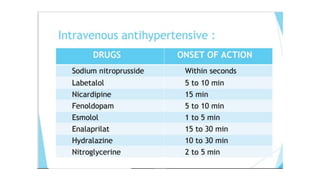
2. Hypertension:
Hypertensive patients must continue on their anti hypertensive drugs periopertively.
ACEI and AT 2 receptor antagonists associated with intra-op hypotension
discontinue atleast 10 hours before surgery.
Preoperative β blockers:
Associated with lesser incidences of perioperative ischemia.
3. Surgery in a patient with IHD:
Risks/complications:
1.Chance of peroperative MI is about 3.5-7.5% in a patient who has history of MI.
2.Chance of re-infarction is more if patient has recent MI within 6 months of period.
Preoperative preparation:
1. Postpone the surgery of patient who has recent MI within 6 months.
2. Patients of angina& MI: Preoperative β-blocker, GTN, statins should be given
which reduce further episodes of ischaemic event.
In peroperative care by anaesthetist is very important.
1. Anaesthetist must avoid:
a. Tachycardia.
b. Hypotension.
c. Hypertension.
d. Any condition that increase myocardial O2 demand.
2. Avoid atropine as preanaesthetic medication as this drug causes tachycardia.
Postoperative:
1. Adequate postoperative analgesia (by adequate dose of opioid), because it reduce
TPR→ Hypotension.
2. Regular monitoring the blood gas analysis; because normal PO2 and PCO2 are
mandatory.
3. Regular serial ECG and cardiac monitoring.
4. Surgery in a patient with thyroid diseases:
• Preoperative preparation of patients with hypothyroidism is essential because
these patients are subjected to acute hypotension,shock & hypothermia during
surgery.
• Delayed recovery from anaesthesia is an important manifestation of a hypothyroid
patient.
Preoperative preparation of a hypothyroid patient:
For routine operation:
• To achieve euthyroid state- Replacement dose of levothyroxine in adults range
from 0.05 to 0.2 mg/day or 1.6-1.7 micro gram/kg/day.
• After 4-6wks dose is adjusted based on the serum TSH level.
• In older patient and patient with cardiac disease start with a low dose of
levothyroxine , that is 0.025-0.05 mg/day or(25micro gram/d) which increased by
25 microgram/day every 2 to 3 months until TSH is normal.
Prepare a hyperthyroid (thyrotoxic) patient for surgery:
Preoperative preparation of a patient with hyperthyroidism in order to make the
patient euthyroid or near euthyroid at operation; before giving or starting antithyroid
drug- thyroid profile should be done with-Free T3, Free T4 and TSH.
Preparation of the patient:
A. Routine elective surgery:
1. Carbimazole (antithyroid drug) is the drug of choice.
a. Carbimazole 30-40 mg once daily or 10mg 8 hourly.
b. When patient becomes euthyroid after 8/-12 weeks the dose may be
reduced to 5 mg every 8hourly- last dose of Carbimazole may be given
2. on the evening before surgery.
Lugol's iodine - 5 drops thrice daily in milk.
Lugol's iodine should be started 10-14 days before surgery or Potassium iodide (KI)
tablet 60 mg TDS.
B. For rapid control (rapid symptomatic relief):
1. Tab. Propranolol 40 mg thrice daily should be continued 7 days postoperatively or
2. Long acting nadolol 80 mg twice daily or 160 mg once daily.
5. Surgery with COPD:
Preparation for surgery is required in a patient with COPD because there is a chance
of postoperative morbidity due to postoperative pulmonary complications.
Preoperative preparation:
1. Timing of elective surgery- Preferable to summer, when period of remission of
symptoms.
2. Smoking should be stopped 6 weeks before operation.
3. Bronchodilator should be continued until time of surgery.
4. Steroid should be continued
5. Preoperative chest physiotherapy and exercise tolerance test.
6. Premedication with diazepam, promethazine (phenergan), atropine, etc.
Postoperative:
1. Immediate postoperative clearance of secretion by oropharyngeal suction.
2. O2 inhalation by O2 mask.
3. Nebulization by bronchodilator/ Intravenous bronchodilator.
4. Steroid should be continued.
5. Antibiotics (appropriate antibiotics).
6. Adequate analgesia.
7. Chest physiotherapy & encourage for deep breathing.
8. Periodic hyperventilation by incentive spirometer.
9. Early ambulation.
10. Regular monitoring
a. O2 saturation.
b. Arterial Blood Gas analysis (ABG).
Conclusion:
By proper management of coexisting diseases in surgical practice we can reduce
mortality & morbidity rate and ensure better outcome of the patient.
SURGICAL CORMIDITIES.pptx

SURGICAL CORMIDITIES.pptx

  • 1.
  • 2.
    Introduction: • Every Surgicalprocedure involves some risk of significant post operative complications or death. • In most cases, the risk is below 1% but it increases 10%-15% in high risk population. • This high risk surgical population accounts for over 80% of surgical death.
  • 3.
    Factors that predisposepatients to a high risk of morbidity and mortality. Patient Factor • History of severe cardiac disease (ischaemic heart disease (IHD), myocardial infarction (MI), cardiac failure) • Severe respiratory disease (chronic obstructive pulmonary disease (COPD), respiratory failure) • Aged >70 years with limited physiological reserve in one or more vital organs • Metabolic disease (renal failure, poorly controlled diabetes) • Morbid obesity • Late stage vascular disease • Poor nutrition
  • 4.
    Surgical Factor : •Prolonged duration of surgery (>1.5 hours) • Extensive surgery (e.g. oesophagectomy, gastrectomy) • Type of surgery (thoracic, abdominal, vascular) • Emergency surgery (e.g. perforated viscus, gangrenous bowel, gastrointestinal bleeding) • Acute massive blood loss (>2.5 litres) • Septicaemia (positive blood cultures or septic focus) • Severe multiple trauma e.g. >3 organs or >2 systems or >2 body cavities
  • 5.
    Common Surgical Comorbidities: •Diabetes Mellitus • Hypertension • IHD • Thyroid diseases • COPD
  • 6.
    1. Surgery ina patient with DM: Preoperative assessment: • Pre-operative assessment must be done in close contact with the physician, surgeon &anaesthetist. • Aim should be to have optimal control of diabetes in all diabetics undergoing surgery( exception- emergency surgery). • Assess glycaemic control • Consider delaying surgery and referral to the diabetes team if HbA1c > 75 mmol/mol (9%). Acceptable HbA1c should be b/w 8%-9%.
  • 7.
    Assess cardiovascular status •Optimise blood pressure • ECG for evidence of (possibly silent) ischaemic heart disease . Assess Renal function • Serum creatinine & Blood Urea. Others: • Serum electrolytes-( hypokalaemia or hyperkalaemia) • Urine for- Proteinuria • UTI • CXR- to identifying any hidden pneumonia or pulmonary oedema.
  • 8.
    Perioperative management(DM) Day priorto surgery: • Patient on long acting secretogogues(such as glibenclamide, glimepiride)should be stopped 36-48 hrs before operation . • Metformin should be stopped at least 24 hours before operation. • For major surgery, the patient should keep nil per oral(NPO)overnight prior to surgery, in patients with gastroparesis duration of NPO should be around 10- 12 hours.
  • 9.
    For all type1& poorly controlled type2 DM: • Insulin is used to control the diabetes in all types of operation. • Hospitalize the patient at least 3 days before operation
  • 10.
    Day of surgery: •Anti diabetic medications are omitted(continue long acting analogues-glargine, detemir) on the morning of the operation. • Schedule surgery as early as possible. • In all major surgeries start glucose-insulin infusion. 10units of regular insulin is added to 1L of 5% dextrose in half normal saline& give I/V @ 100-180mL/hour. • Blood glucose should be monitored 1to 2 hourly. It should be in the range of 6.0-11.0 mmol/L. • If blood glucose >12 mmol/L, start glucose-insulin potassium(GKI) sliding scale regimen according to the situations.
  • 11.
    Postoperative management(DM) • Theglucose-insulin administration is continued( where required) till the patient able to take oral food. • During this time fluid balance & electrolytes level should be monitor carefully. Insulin- glucose infusion causes hypokalaemia and also hyponatraemia, thus I/V fluid during prolong infusion should include saline & potassium supplementation. • At this time , if blood glucose is not under fair control or patient controlled on tablets previously may require temporary short acting insulin s/c until increased stress of surgery, wound healing or infection has resolved.
  • 12.
    GKI infusion: A mixtureof glucose, K+(potassium) and insulin. Commonly used peri-operatively as means of providing fluid together with glucose and insulin to insulin-dependent patients, i.e. type I diabetics and some type II diabetics. The composition can be remembered by 10-10-10: 10 mmol of potassium chloride 10% glucose (500ml) 10 units (or sometimes more) of rapid-acting insulin (e.g. Actrapid™) rate 100ml/hour.
  • 13.
    Emergency surgery indiabetic patient: • Insulin infusion started & frequent monitoring of blood glucose is done. • Electrolytes, acid base status & urinary ketone levels are checked. • If feasible surgery is delayed till blood glucose comes below 20 mmol/L& ketonuria disappears. • If delaying is not possible, operation with intensive management of diabetic state is to be done.
  • 14.
    2. Hypertension: Hypertensive patientsmust continue on their anti hypertensive drugs periopertively. ACEI and AT 2 receptor antagonists associated with intra-op hypotension discontinue atleast 10 hours before surgery. Preoperative β blockers: Associated with lesser incidences of perioperative ischemia.
  • 17.
    3. Surgery ina patient with IHD: Risks/complications: 1.Chance of peroperative MI is about 3.5-7.5% in a patient who has history of MI. 2.Chance of re-infarction is more if patient has recent MI within 6 months of period. Preoperative preparation: 1. Postpone the surgery of patient who has recent MI within 6 months. 2. Patients of angina& MI: Preoperative β-blocker, GTN, statins should be given which reduce further episodes of ischaemic event.
  • 18.
    In peroperative careby anaesthetist is very important. 1. Anaesthetist must avoid: a. Tachycardia. b. Hypotension. c. Hypertension. d. Any condition that increase myocardial O2 demand. 2. Avoid atropine as preanaesthetic medication as this drug causes tachycardia.
  • 19.
    Postoperative: 1. Adequate postoperativeanalgesia (by adequate dose of opioid), because it reduce TPR→ Hypotension. 2. Regular monitoring the blood gas analysis; because normal PO2 and PCO2 are mandatory. 3. Regular serial ECG and cardiac monitoring.
  • 20.
    4. Surgery ina patient with thyroid diseases: • Preoperative preparation of patients with hypothyroidism is essential because these patients are subjected to acute hypotension,shock & hypothermia during surgery. • Delayed recovery from anaesthesia is an important manifestation of a hypothyroid patient.
  • 21.
    Preoperative preparation ofa hypothyroid patient: For routine operation: • To achieve euthyroid state- Replacement dose of levothyroxine in adults range from 0.05 to 0.2 mg/day or 1.6-1.7 micro gram/kg/day. • After 4-6wks dose is adjusted based on the serum TSH level. • In older patient and patient with cardiac disease start with a low dose of levothyroxine , that is 0.025-0.05 mg/day or(25micro gram/d) which increased by 25 microgram/day every 2 to 3 months until TSH is normal.
  • 22.
    Prepare a hyperthyroid(thyrotoxic) patient for surgery: Preoperative preparation of a patient with hyperthyroidism in order to make the patient euthyroid or near euthyroid at operation; before giving or starting antithyroid drug- thyroid profile should be done with-Free T3, Free T4 and TSH. Preparation of the patient: A. Routine elective surgery: 1. Carbimazole (antithyroid drug) is the drug of choice. a. Carbimazole 30-40 mg once daily or 10mg 8 hourly.
  • 23.
    b. When patientbecomes euthyroid after 8/-12 weeks the dose may be reduced to 5 mg every 8hourly- last dose of Carbimazole may be given 2. on the evening before surgery. Lugol's iodine - 5 drops thrice daily in milk. Lugol's iodine should be started 10-14 days before surgery or Potassium iodide (KI) tablet 60 mg TDS.
  • 24.
    B. For rapidcontrol (rapid symptomatic relief): 1. Tab. Propranolol 40 mg thrice daily should be continued 7 days postoperatively or 2. Long acting nadolol 80 mg twice daily or 160 mg once daily.
  • 25.
    5. Surgery withCOPD: Preparation for surgery is required in a patient with COPD because there is a chance of postoperative morbidity due to postoperative pulmonary complications.
  • 26.
    Preoperative preparation: 1. Timingof elective surgery- Preferable to summer, when period of remission of symptoms. 2. Smoking should be stopped 6 weeks before operation. 3. Bronchodilator should be continued until time of surgery. 4. Steroid should be continued 5. Preoperative chest physiotherapy and exercise tolerance test. 6. Premedication with diazepam, promethazine (phenergan), atropine, etc.
  • 27.
    Postoperative: 1. Immediate postoperativeclearance of secretion by oropharyngeal suction. 2. O2 inhalation by O2 mask. 3. Nebulization by bronchodilator/ Intravenous bronchodilator. 4. Steroid should be continued. 5. Antibiotics (appropriate antibiotics).
  • 28.
    6. Adequate analgesia. 7.Chest physiotherapy & encourage for deep breathing. 8. Periodic hyperventilation by incentive spirometer. 9. Early ambulation. 10. Regular monitoring a. O2 saturation. b. Arterial Blood Gas analysis (ABG).
  • 29.
    Conclusion: By proper managementof coexisting diseases in surgical practice we can reduce mortality & morbidity rate and ensure better outcome of the patient.