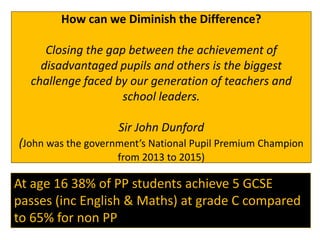
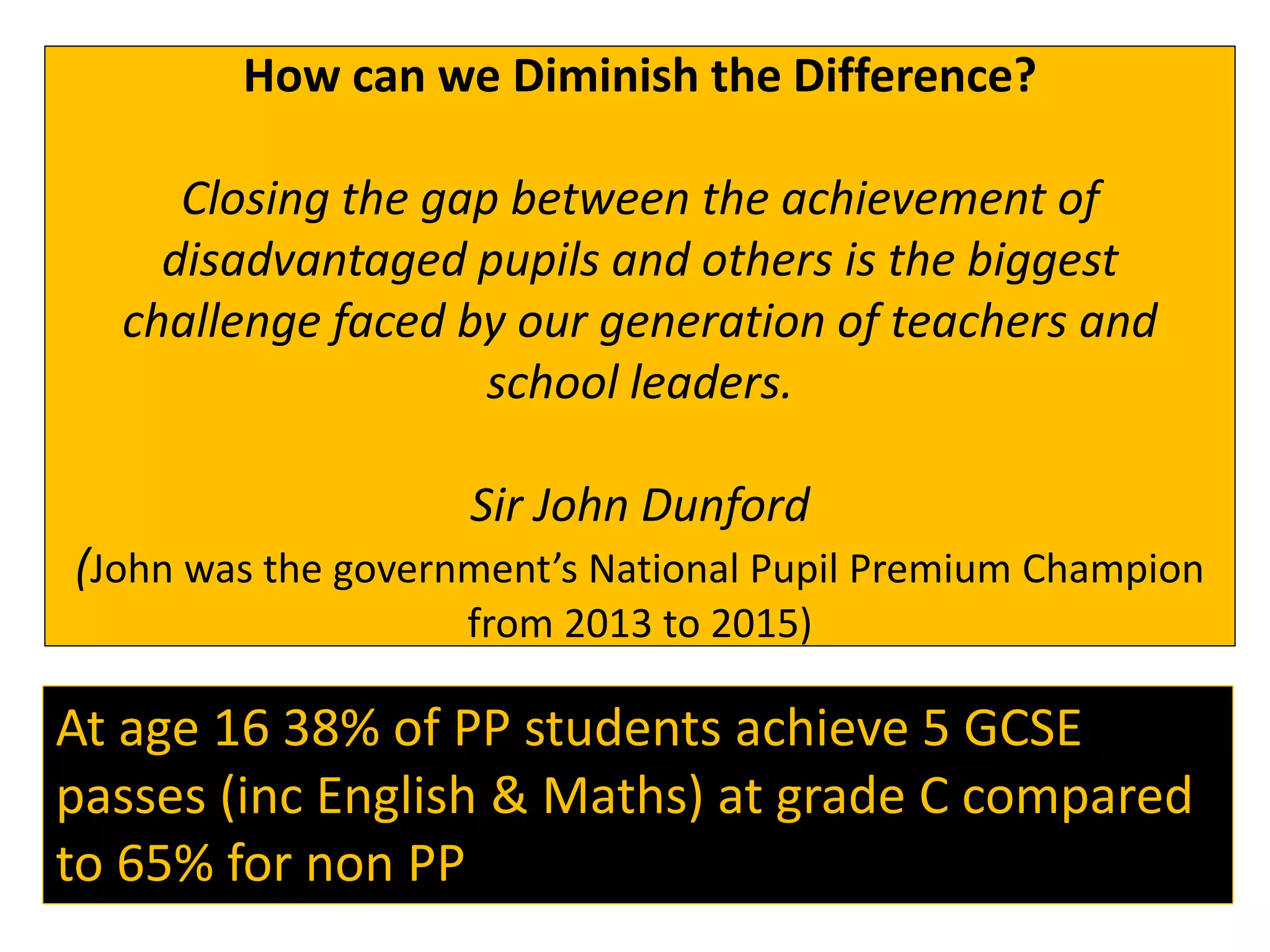
How can we Diminish the Difference?
Closing the gap between the achievement of
disadvantaged pupils and others is the biggest
challenge faced by our generation of teachers and
school leaders.
Sir John Dunford
(John was the government’s National Pupil Premium Champion
from 2013 to 2015)
At age 16 38% of PP students achieve 5 GCSE
passes (inc English & Maths) at grade C compared
to 65% for non PP.
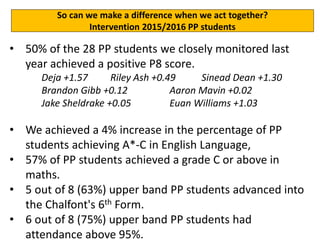
• 50% of the 28 PP students we closely monitored last
year achieved a positive P8 score.
Deja +1.57 Riley Ash +0.49 Sinead Dean +1.30
Brandon Gibb +0.12 Aaron Mavin +0.02
Jake Sheldrake +0.05 Euan Williams +1.03
• We achieved a 4% increase in the percentage of PP
students achieving A*-C in English Language,
• 57% of PP students achieved a grade C or above in
maths.
• 5 out of 8 (63%) upper band PP students advanced into
the Chalfont's 6th Form.
• 6 out of 8 (75%) upper band PP students had
attendance above 95%.
So can we make a difference when we act together?
Intervention 2015/2016 PP students
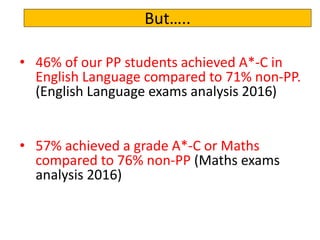
But…..
• 46% of our PP students achieved A*-C in
English Language compared to 71% non-PP.
(English Language exams analysis 2016)
• 57% achieved a grade A*-C or Maths
compared to 76% non-PP (Maths exams
analysis 2016)
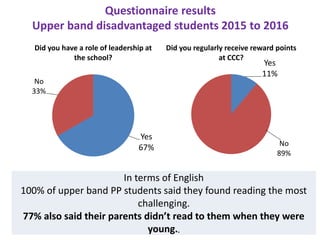
Questionnaire results
Upper band disadvantaged students 2015 to 2016
In terms of English
100% of upper band PP students said they found reading the most
challenging.
77% also said their parents didn’t read to them when they were
young..
Yes
11%
No
89%
Did you regularly receive reward points
at CCC?
Yes
67%
No
33%
Did you have a role of leadership at
the school?
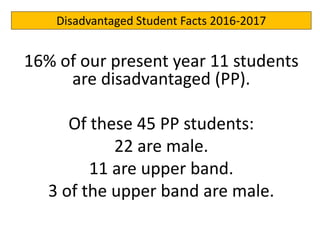
Disadvantaged Student Facts 2016-2017
16% of our present year 11 students
are disadvantaged (PP).
Of these 45 PP students:
22 are male.
11 are upper band.
3 of the upper band are male.
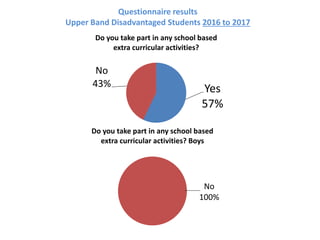
Questionnaire results
Upper Band Disadvantaged Students 2016 to 2017
Yes
57%
No
43%
Do you take part in any school based
extra curricular activities?
No
100%
Do you take part in any school based
extra curricular activities? Boys
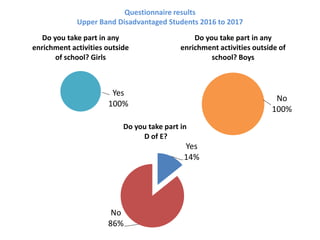
Questionnaire results
Upper Band Disadvantaged Students 2016 to 2017
Yes
14%
No
86%
Do you take part in
D of E?
Yes
100%
Do you take part in any
enrichment activities outside
of school? Girls
No
100%
Do you take part in any
enrichment activities outside of
school? Boys
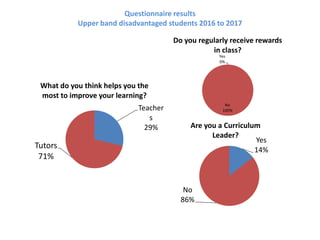
Questionnaire results
Upper band disadvantaged students 2016 to 2017
Teacher
s
29%
Tutors
71%
What do you think helps you the
most to improve your learning?
Yes
14%
No
86%
Are you a Curriculum
Leader?
Yes
0%
No
100%
Do you regularly receive rewards
in class?
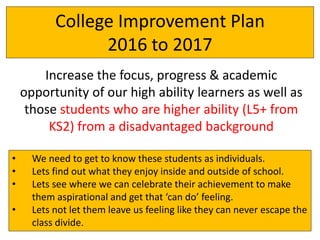
College Improvement Plan
2016 to 2017
Increase the focus, progress & academic
opportunity of our high ability learners as well as
those students who are higher ability (L5+ from
KS2) from a disadvantaged background
• We need to get to know these students as individuals.
• Lets find out what they enjoy inside and outside of school.
• Lets see where we can celebrate their achievement to make
them aspirational and get that ‘can do’ feeling.
• Lets not let them leave us feeling like they can never escape the
class divide.
Action ideas for 2017
Task: Read the case study you have been given.
How has school variance successfully been reduced?
Characteristics of Schools which have managed to reduce within
school variance for their disadvantaged students
Action ideas for 2017
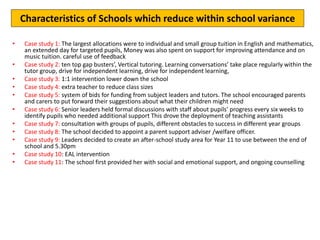
• Case study 1: The largest allocations were to individual and small group tuition in English and mathematics,
an extended day for targeted pupils, Money was also spent on support for improving attendance and on
music tuition. careful use of feedback
• Case study 2: ten top gap busters’, Vertical tutoring. Learning conversations’ take place regularly within the
tutor group, drive for independent learning, drive for independent learning,
• Case study 3: 1:1 intervention lower down the school
• Case study 4: extra teacher to reduce class sizes
• Case study 5: system of bids for funding from subject leaders and tutors. The school encouraged parents
and carers to put forward their suggestions about what their children might need
• Case study 6: Senior leaders held formal discussions with staff about pupils’ progress every six weeks to
identify pupils who needed additional support This drove the deployment of teaching assistants
• Case study 7: consultation with groups of pupils, different obstacles to success in different year groups
• Case study 8: The school decided to appoint a parent support adviser /welfare officer.
• Case study 9: Leaders decided to create an after-school study area for Year 11 to use between the end of
school and 5.30pm
• Case study 10: EAL intervention
• Case study 11: The school first provided her with social and emotional support, and ongoing counselling
Characteristics of Schools which reduce within school variance
Action ideas for 2017
You have each chosen a PP student to work with.
You will be given a certificate to record your
intervention and note any impacts.
We will now give you a wide range of useable
strategies from which to choose.
Your personal record 2016 to 2017
Together at Chalfonts we can face
‘’the biggest challenge in education today!

Supporting PP

  • 1.
    How can weDiminish the Difference? Closing the gap between the achievement of disadvantaged pupils and others is the biggest challenge faced by our generation of teachers and school leaders. Sir John Dunford (John was the government’s National Pupil Premium Champion from 2013 to 2015) At age 16 38% of PP students achieve 5 GCSE passes (inc English & Maths) at grade C compared to 65% for non PP.
  • 2.
    • 50% ofthe 28 PP students we closely monitored last year achieved a positive P8 score. Deja +1.57 Riley Ash +0.49 Sinead Dean +1.30 Brandon Gibb +0.12 Aaron Mavin +0.02 Jake Sheldrake +0.05 Euan Williams +1.03 • We achieved a 4% increase in the percentage of PP students achieving A*-C in English Language, • 57% of PP students achieved a grade C or above in maths. • 5 out of 8 (63%) upper band PP students advanced into the Chalfont's 6th Form. • 6 out of 8 (75%) upper band PP students had attendance above 95%. So can we make a difference when we act together? Intervention 2015/2016 PP students
  • 3.
    But….. • 46% ofour PP students achieved A*-C in English Language compared to 71% non-PP. (English Language exams analysis 2016) • 57% achieved a grade A*-C or Maths compared to 76% non-PP (Maths exams analysis 2016)
  • 4.
    Questionnaire results Upper banddisadvantaged students 2015 to 2016 In terms of English 100% of upper band PP students said they found reading the most challenging. 77% also said their parents didn’t read to them when they were young.. Yes 11% No 89% Did you regularly receive reward points at CCC? Yes 67% No 33% Did you have a role of leadership at the school?
  • 5.
    Disadvantaged Student Facts2016-2017 16% of our present year 11 students are disadvantaged (PP). Of these 45 PP students: 22 are male. 11 are upper band. 3 of the upper band are male.
  • 6.
    Questionnaire results Upper BandDisadvantaged Students 2016 to 2017 Yes 57% No 43% Do you take part in any school based extra curricular activities? No 100% Do you take part in any school based extra curricular activities? Boys
  • 7.
    Questionnaire results Upper BandDisadvantaged Students 2016 to 2017 Yes 14% No 86% Do you take part in D of E? Yes 100% Do you take part in any enrichment activities outside of school? Girls No 100% Do you take part in any enrichment activities outside of school? Boys
  • 8.
    Questionnaire results Upper banddisadvantaged students 2016 to 2017 Teacher s 29% Tutors 71% What do you think helps you the most to improve your learning? Yes 14% No 86% Are you a Curriculum Leader? Yes 0% No 100% Do you regularly receive rewards in class?
  • 9.
    College Improvement Plan 2016to 2017 Increase the focus, progress & academic opportunity of our high ability learners as well as those students who are higher ability (L5+ from KS2) from a disadvantaged background • We need to get to know these students as individuals. • Lets find out what they enjoy inside and outside of school. • Lets see where we can celebrate their achievement to make them aspirational and get that ‘can do’ feeling. • Lets not let them leave us feeling like they can never escape the class divide.
  • 10.
    Action ideas for2017 Task: Read the case study you have been given. How has school variance successfully been reduced? Characteristics of Schools which have managed to reduce within school variance for their disadvantaged students
  • 11.
    Action ideas for2017 • Case study 1: The largest allocations were to individual and small group tuition in English and mathematics, an extended day for targeted pupils, Money was also spent on support for improving attendance and on music tuition. careful use of feedback • Case study 2: ten top gap busters’, Vertical tutoring. Learning conversations’ take place regularly within the tutor group, drive for independent learning, drive for independent learning, • Case study 3: 1:1 intervention lower down the school • Case study 4: extra teacher to reduce class sizes • Case study 5: system of bids for funding from subject leaders and tutors. The school encouraged parents and carers to put forward their suggestions about what their children might need • Case study 6: Senior leaders held formal discussions with staff about pupils’ progress every six weeks to identify pupils who needed additional support This drove the deployment of teaching assistants • Case study 7: consultation with groups of pupils, different obstacles to success in different year groups • Case study 8: The school decided to appoint a parent support adviser /welfare officer. • Case study 9: Leaders decided to create an after-school study area for Year 11 to use between the end of school and 5.30pm • Case study 10: EAL intervention • Case study 11: The school first provided her with social and emotional support, and ongoing counselling Characteristics of Schools which reduce within school variance
  • 12.
    Action ideas for2017 You have each chosen a PP student to work with. You will be given a certificate to record your intervention and note any impacts. We will now give you a wide range of useable strategies from which to choose. Your personal record 2016 to 2017 Together at Chalfonts we can face ‘’the biggest challenge in education today!

Editor's Notes

  • #2 The persistent gap in the UK which is wider than in most other countries has existed for generations. Due to greater inequality in our class system than in many other Scandinavian countries. £2.5 billion per year is now provided by the government to close the gap. Its about making sure students aren’t held back because of their background. They often come from a background of ‘’a lack of education never did me any harm’’
  • #3 So yes we can make a difference!
  • #5 So why does this Gap exist?
  • #11 15 minutes