Support Vector Machine Lecture For Machine Learning
1.
Based on slidesby
Pierre Dönnes and Ron Meir
Modified by Longin Jan Latecki, Temple University
Ch. 5: Support Vector Machines
Stephen Marsland, Machine Learning: An Algorithmic Perspective. CRC
2009
2.
Outline
• What dowe mean with classification, why is
it useful
• Machine learning- basic concept
• Support Vector Machines (SVM)
– Linear SVM – basic terminology and some
formulas
– Non-linear SVM – the Kernel trick
• An example: Predicting protein subcellular
location with SVM
• Performance measurments
3.
Classification
• Everyday, allthe time we classify
things.
• Eg crossing the street:
– Is there a car coming?
– At what speed?
– How far is it to the other side?
– Classification: Safe to walk or not!!!
4.
• Decision treelearning
IF (Outlook = Sunny) ^ (Humidity = High)
THEN PlayTennis =NO
IF (Outlook = Sunny)^ (Humidity = Normal)
THEN PlayTennis = YES
Training examples:
Day Outlook Temp. Humidity Wind PlayTennis
D1 Sunny Hot High Weak No
D2 Overcast Hot High Strong Yes ……
Outlook
Sunny Overcast Rain
Humidity Yes
Wind
High Normal
Yes
No
Strong Weak
Yes
No
5.
Classification tasks
• LearningTask
– Given: Expression profiles of leukemia patients
and healthy persons.
– Compute: A model distinguishing if a person has
leukemia from expression data.
• Classification Task
– Given: Expression profile of a new patient + a
learned model
– Determine: If a patient has leukemia or not.
6.
Problems in classifyingdata
• Often high dimension of data.
• Hard to put up simple rules.
• Amount of data.
• Need automated ways to deal with the
data.
• Use computers – data processing,
statistical analysis, try to learn patterns
from the data (Machine Learning)
7.
Black box viewof
Machine Learning
Magic black box
(learning machine)
Training data
Model
Training data: -Expression patterns of some cancer +
expression data from healty person
Model: - The model can distinguish between healty
and sick persons. Can be used for prediction.
Test-data
Prediction = cancer or not
Model
Linear Support VectorMachines
x1
x2
=+1
=-1
Data: <xi,yi>, i=1,..,l
xi Rd
yi {-1,+1}
11.
=-1
=+1
Data: <xi,yi>, i=1,..,l
xi Rd
yi {-1,+1}
All hyperplanes in Rd
are parameterized by a vector (w) and a constant b.
Can be expressed as w•x+b=0 (remember the equation for a hyperplane
from algebra!)
Our aim is to find such a hyperplane f(x)=sign(w•x+b), that
correctly classify our data.
f(x)
Linear SVM 2
12.
Selection of aGood Hyper-Plane
Objective: Select a `good' hyper-plane using
only the data!
Intuition:
(Vapnik 1965) - assuming linear separability
(i) Separate the data
(ii) Place hyper-plane `far' from data
13.
d+
d-
Definitions
Define the hyperplaneH such that:
xi•w+b +1 when yi =+1
xi•w+b -1 when yi =-1
d+ = the shortest distance to the closest positive point
d- = the shortest distance to the closest negative point
The margin of a separating hyperplane is d+
+ d-
.
H
H1 and H2 are the
planes:
H1: xi•w+b = +1
H2: xi•w+b = -1
The points on the planes
H1 and H2 are the
Support Vectors:
H1
H2
14.
Maximizing the margin
d+
d-
Wewant a classifier with as big margin as possible.
Recall the distance from a point(x0,y0) to a line:
Ax+By+c = 0 is|A x0 +B y0 +c|/sqrt(A2
+B2
)
The distance between H and H1 is:
|w•x+b|/||w||=1/||w||
The distance between H1 and H2 is: 2/||w||
In order to maximize the margin, we need to minimize ||w||. With the
condition that there are no datapoints between H1 and H2:
xi•w+b +1 when yi =+1
xi•w+b -1 when yi =-1 Can be combined into yi(xi•w) 1
H1
H2
H
The Lagrangian trick
Reformulatethe optimization problem:
A ”trick” often used in optimization is to do an Lagrangian
formulation of the problem.The constraints will be replaced
by constraints on the Lagrangian multipliers and the training
data will only occur as dot products.
What we need to see: xiand xj (input vectors) appear only in the form
of dot product – we will soon see why that is important.
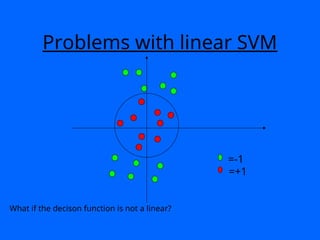
Non-linear SVM 1
TheKernel trick
=-1
=+1
Imagine a function that maps the data into another space:
=Rd
=-1
=+1
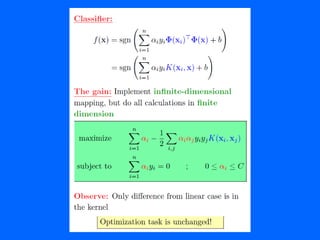
Remember the function we want to optimize: LD = i – ½ijyiyjxi•xj,
xi and xj as a dot product. We will have (xi) • (xj) in the non-linear case.
If there is a ”kernel function” K such as K(xi,xj) = (xi) • (xj), we
do not need to know explicitly. One example:
Rd






![SVM[Support vector Machine] Machine learning](https://cdn.slidesharecdn.com/ss_thumbnails/svm-250403184638-1cd9afdb-thumbnail.jpg?width=640&height=640&fit=bounds)


