Securing Your Cloud:Essential Network
Security Considerations for Cloud Computing
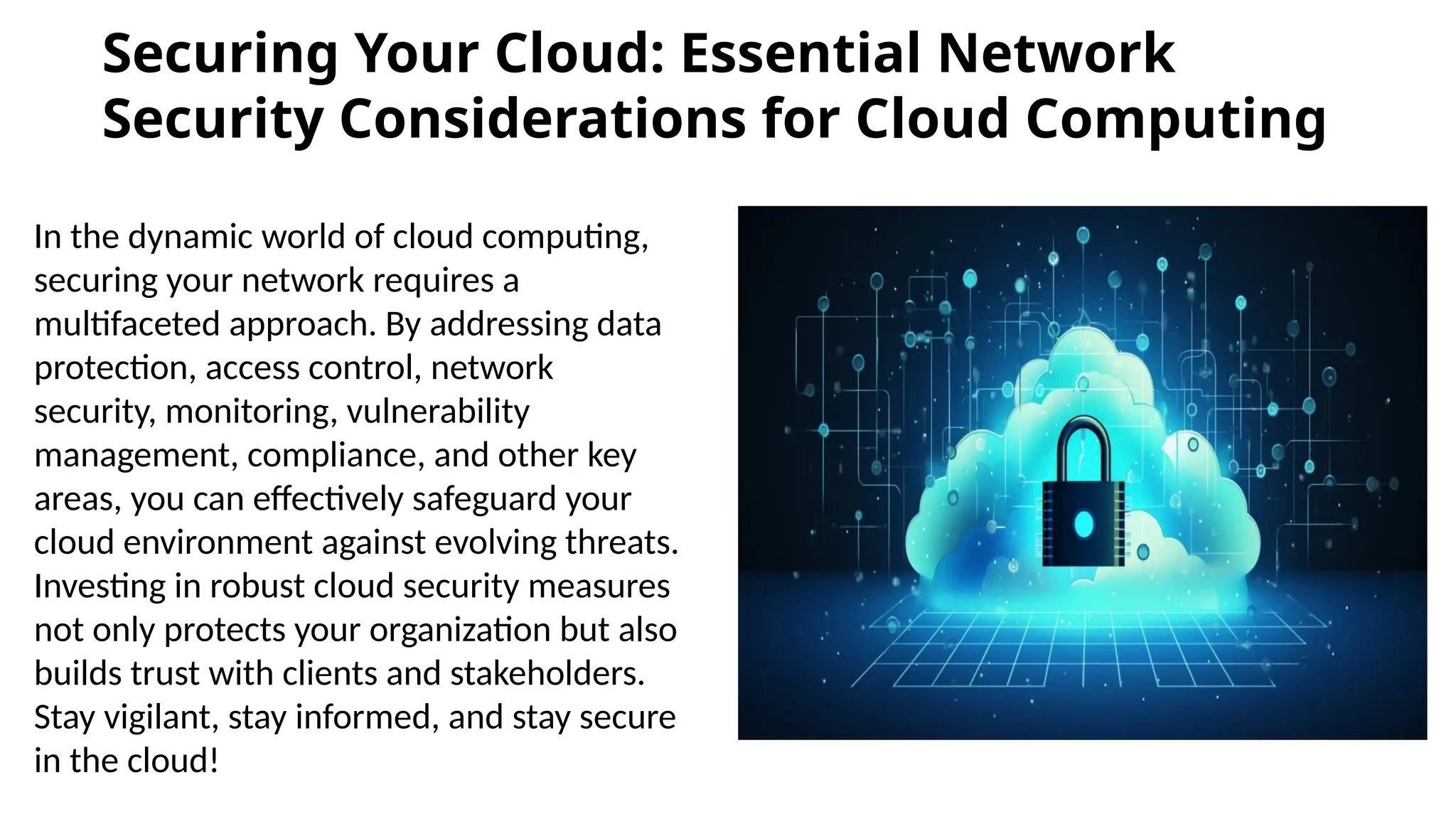
In the dynamic world of cloud computing,
securing your network requires a
multifaceted approach. By addressing data
protection, access control, network
security, monitoring, vulnerability
management, compliance, and other key
areas, you can effectively safeguard your
cloud environment against evolving threats.
Investing in robust cloud security measures
not only protects your organization but also
builds trust with clients and stakeholders.
Stay vigilant, stay informed, and stay secure
in the cloud!
3.
1. Data Protection:The Cornerstone of Cloud
Security
Encryption: Encryption is fundamental to protecting
sensitive data both in transit and at rest. Cloud
providers often offer built-in encryption services, but
it's crucial to manage encryption keys effectively.
Key Management: Proper key management is vital for
maintaining the confidentiality and integrity of your
data. Leverage cloud-native Key Management Services
(KMS) to handle encryption keys, ensuring they are
generated, stored, rotated, and retired securely.
4.
2. Access Control:Guarding the Gates
Identity and Access Management
(IAM): Implement robust IAM policies to control
access to cloud resources. Regularly review and
adjust IAM policies to address changing needs and
potential threats.
Multi-Factor Authentication (MFA): MFA adds an
extra layer of protection beyond passwords,
significantly reducing the risk of unauthorized
access.
5.
3. Network Security:Building a Defensive
Perimeter
Firewalls: Deploy virtual firewalls to regulate inbound and
outbound traffic.
Network Segmentation: Use network segmentation to isolate
different parts of your cloud infrastructure. Create Virtual Private
Networks (VPNs) to secure communications between segments
and between your on-premises environment and the cloud.
Intrusion Detection and Prevention Systems (IDPS): Implement
IDPS to monitor network traffic and detect suspicious activities.
6.
4. Monitoring andLogging: Keeping an Eye on the
Network
Cloud Security Monitoring: Use cloud-native
monitoring tools or third-party solutions to keep
track of security events and anomalies.
Logging: Regular log reviews can provide insights
into potential vulnerabilities and compliance issues.
7.
5. Vulnerability Management:Staying Ahead of
Threats
Patch Management: Timely patching helps protect
against known exploits and security flaws.
Security Scanning: Employ automated security
scanning tools to identify vulnerabilities in your cloud
environment. Regular scans and assessments can help
you address issues before they are exploited by
attackers.
8.
6. Compliance andGovernance: Meeting Regulatory
Standards
Regulatory Compliance: Ensure your cloud setup
adheres to relevant regulations and industry standards
such as GDPR, HIPAA, and PCI-DSS. Cloud providers
often offer compliance certifications, but it's essential to
understand your responsibilities.
Security Policies: Develop and enforce security policies
aligned with best practices and industry standards.
9.
7. Incident Response:Ready for the Unexpected
Incident Response Plan: Regularly test and update the
plan to ensure your team can effectively respond to
security incidents and minimize impact.
Backup and Recovery: Implement robust backup and
recovery procedures to protect against data loss and
ensure business continuity. Regularly test backups to
verify their integrity and effectiveness.
10.
8. Shared ResponsibilityModel: Understanding
Your Role
Cloud Security Responsibilities:While cloud
providers secure the underlying infrastructure, you are
responsible for protecting your data, applications, and
configurations.
11.
9. Configuration Management:Ensuring Secure
Setups
Secure Configurations: Ensure that cloud resources
and services are securely configured according to best
practices. Use tools to automate configuration
management and enforce security standards.
Infrastructure as Code (IAC): Leverage IAC to manage
and deploy cloud resources consistently and securely.
Include security configurations in your IAC scripts to
ensure that security best practices are applied from the
start.
12.
10. Physical Security:Securing the Data Centers
Data Center Security:This includes measures to guard
against unauthorized access, environmental threats, and
other risks.
13.
11. Third-Party Integrations:Evaluating External
Risks
Third-Party Risk Management: Ensure these external
services meet your security standards and do not
introduce additional risks.
14.
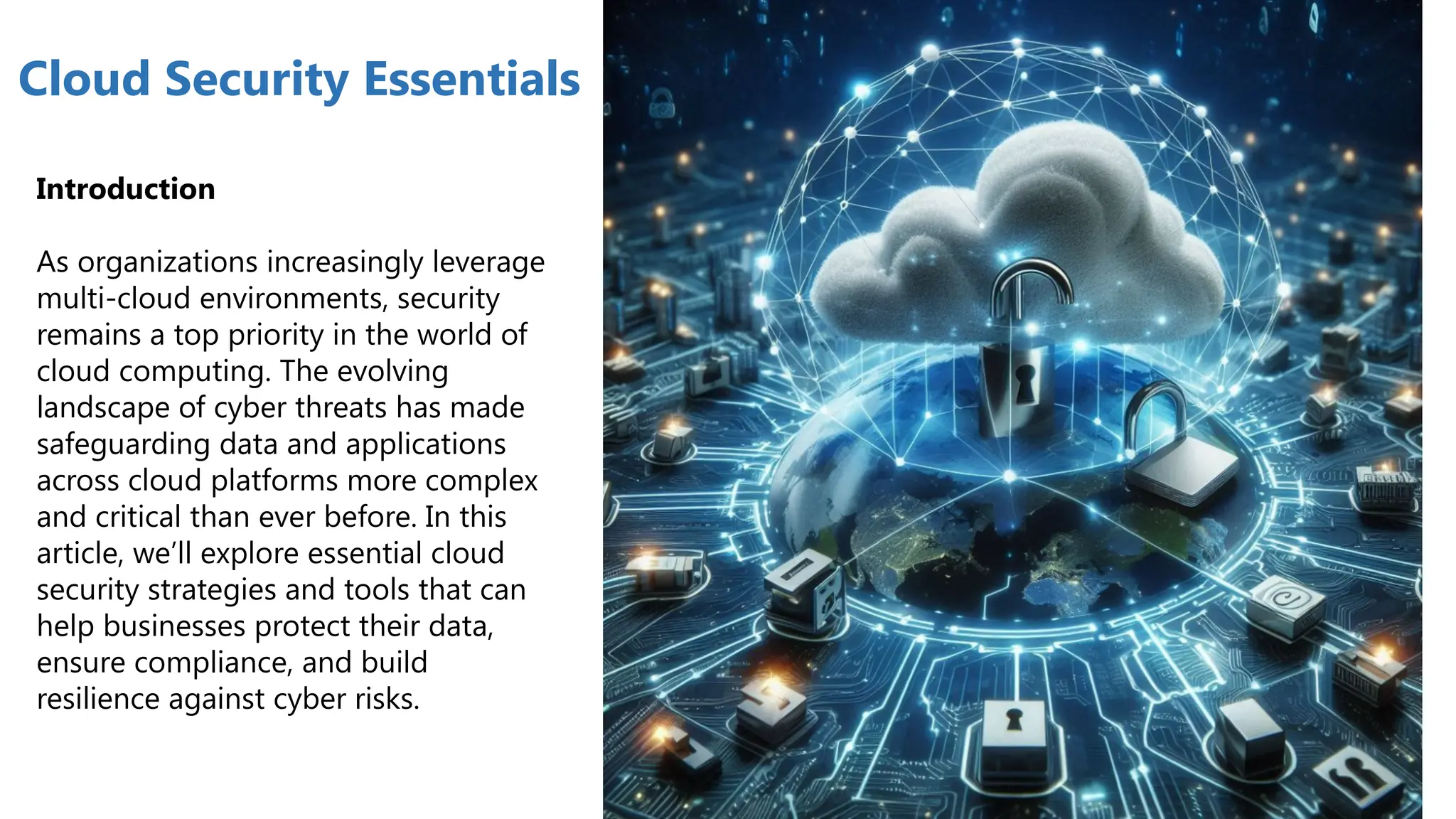
Cloud Security Essentials
Introduction
Asorganizations increasingly leverage
multi-cloud environments, security
remains a top priority in the world of
cloud computing. The evolving
landscape of cyber threats has made
safeguarding data and applications
across cloud platforms more complex
and critical than ever before. In this
article, we’ll explore essential cloud
security strategies and tools that can
help businesses protect their data,
ensure compliance, and build
resilience against cyber risks.
15.
1.The Importance ofMulti-Cloud Security
With multi-cloud strategies gaining popularity,
organizations are using multiple cloud providers to
optimize performance, cost, and flexibility. However, each
cloud environment has unique security configurations and
challenges. This diversity introduces the potential for
security gaps if not managed correctly. To mitigate these
risks, businesses must adopt security practices that ensure
consistent protection across different platforms while
managing the complexities of multiple systems.
16.
2. Cloud SecurityBest Practices in 2024
Zero Trust Architecture (ZTA): Zero Trust has become the gold standard for cloud
security, enforcing the principle of “never trust, always verify.” This approach
ensures that every access request, whether from inside or outside the network,
undergoes strict identity verification and policy enforcement.
End-to-End Encryption: Data encryption at every stage—at rest, in transit, and
during processing—is essential. Most cloud providers offer native encryption tools,
but combining these with additional layers of encryption ensures even higher data
protection.
Multi-Factor Authentication (MFA) and Identity Management: Securing user
access with MFA, combined with strong identity and access management (IAM)
policies, helps prevent unauthorized access. IAM solutions from providers like
Azure AD, AWS IAM, and Google Cloud Identity offer robust tools to manage and
monitor user roles and permissions.
17.
3. Key Toolsfor Cloud Security
Cloud Access Security Brokers (CASBs): CASBs act as intermediaries between
users and cloud services, providing visibility and enforcing security policies. Popular
CASBs like Netskope and Microsoft Cloud App Security offer capabilities such as
threat detection, encryption, and compliance monitoring.
Security Information and Event Management (SIEM) Solutions: SIEM tools like
Splunk and Azure Sentinel analyze security data across cloud environments, helping
teams detect and respond to threats in real time.
Continuous Compliance Monitoring: Solutions such as AWS Config, Azure Policy,
and Google Cloud’s Security Command Center allow businesses to continuously
monitor their cloud resources for compliance with industry standards like GDPR,
HIPAA, and SOC 2.
18.
4. Emerging Threatsand How to Mitigate Them
Ransomware in the Cloud: Ransomware attacks on cloud
systems can lead to significant data loss. A proactive approach
that includes regular backups, robust data protection policies,
and employee training can help mitigate these risks.
Supply Chain Vulnerabilities: Organizations often rely on
third-party vendors for various cloud services, which can
introduce vulnerabilities. Vetting vendors, enforcing third-party
access controls, and monitoring cloud environments are
essential for minimizing supply chain risks.