NEXT GENERATION
SUPPLY CHAIN
SELVAN ATHISHTARAJ V
8/23/2020 Supply Chain for Next Generation - SELVAN ATHISHTARAJ V 1
Content
1. Cloud Computing
2. Block Chain
3. Big Data
4. IoT
5. AI and ML
6. Digital Supply Chain
8/23/2020 Supply Chain for Next Generation - SELVAN ATHISHTARAJ V 2
1.Cloud
Computing
Cloud Computing is an integral of
the following:
BLOCK CHAIN
BIG DATA
IOT
AI
DIGITAL SUPPLY CHAIN
Cloud centralizes data and offers multiple entities
access to that data, decreasing costs and speeding
supply chain velocity while adding data security.
8/23/2020 Supply Chain for Next Generation - SELVAN ATHISHTARAJ V 3
2.Blockchain:
Peer-to-Peer
Network
• Blockchain, is a chain of blocks..
• Blockchain has called distributed digital ledger that
records the transactions occurring between two
parties in a permanent and verifiable manner.
• The primary goal of a blockchain is to allow the
recording and distribution of digital information, but
not editing. Data stored on a blockchain is
immutable.
• Immutability refers to its ability to remain
unchanged.
• A blockchain is a growing list of records, and each
block in a blockchain is linked using cryptography.
• A blockchain functions as a decentralized database.
This database is managed by computers that belong
to a peer-to-peer network.
Blockchain
Uses in
Forex and
Tracking
SupplyChainforNextGeneration-SELVANATHISHTARAJV
This is currently being led by bitcoin. Shortly,
traditional currencies such as the US Dollar or
Euro will also function on blockchain systems,
and this also includes all kinds of securities
such as stocks, funds, and debt instruments.
These will be used by most of the industries
across the globe in the context of financial
activities.
Blockchain will also find its place in various
non-financial use cases such as voting systems,
identity management, the provenance of
goods, tracking goods along the supply chain,
etc. It is a very powerful technology with a
broad range of applications.
8/23/2020
5
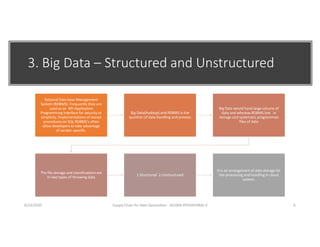
3. Big Data – Structured and Unstructured
Rational Data base Management
System (RDBMS). Frequently they are
used as an API Application
Programming Interface for security or
simplicity. Implementations of stored
procedures on SQL RDBMS's often
allow developers to take advantage
of vendor-specific.
Big Data(Hadoop) and RDBMS is the
question of data handling and process
Big Data would hand large volume of
data and whereas RDBMS low in
storage and systematic programmed
files of data
The file storage and classifications are
in two types of throwing data
1.Structured 2.Unstructured
It is an arrangement of data storage for
the processing and handling in cloud
system,
8/23/2020 Supply Chain for Next Generation - SELVAN ATHISHTARAJ V 6
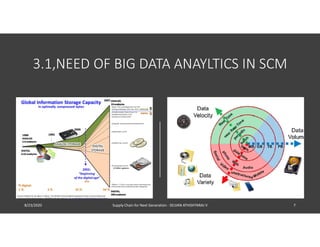
3.1,NEED OF BIG DATA ANAYLTICS IN SCM
8/23/2020 Supply Chain for Next Generation - SELVAN ATHISHTARAJ V 7
3.2,Big Data
Analytics
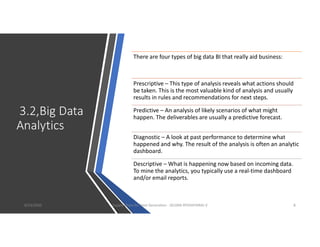
There are four types of big data BI that really aid business:
Prescriptive – This type of analysis reveals what actions should
be taken. This is the most valuable kind of analysis and usually
results in rules and recommendations for next steps.
Predictive – An analysis of likely scenarios of what might
happen. The deliverables are usually a predictive forecast.
Diagnostic – A look at past performance to determine what
happened and why. The result of the analysis is often an analytic
dashboard.
Descriptive – What is happening now based on incoming data.
To mine the analytics, you typically use a real-time dashboard
and/or email reports.
8/23/2020 Supply Chain for Next Generation - SELVAN ATHISHTARAJ V 8
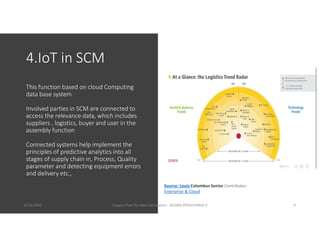
4.IoT in SCM
This function based on cloud Computing
data base system
Involved parties in SCM are connected to
access the relevance data, which includes
suppliers , logistics, buyer and user in the
assembly function
Connected systems help implement the
principles of predictive analytics into all
stages of supply chain in, Process, Quality
parameter and detecting equipment errors
and delivery etc.,
Source: Louis Columbus Senior Contributor
Enterprise & Cloud
8/23/2020 Supply Chain for Next Generation - SELVAN ATHISHTARAJ V 9
5. AI and ML
for Supply
Chain
Management
• Using machine learning and
advanced analytics
manufacturers can discover
quickly who their best and
worst suppliers are, and which
production centers are most
accurate in catching errors.
• Manufacturers are using
dashboards for applying
machine learning to supplier
quality, delivery and
consistency challenges.
• Line Balancing for Plant
assembly based on supplier
production and loading plan
on machines(On Job- line) in
real time monitoring
• Detecting and acting on
inconsistent supplier
quality levels and
deliveries using machine
learning-based
applications is an area
manufacturers .
8/23/2020 Supply Chain for Next Generation - SELVAN ATHISHTARAJ V 10
5.1, Artificial intelligence Types
 Augmentation: AI, which assists humans with their
day-to-day tasks, personally or commercially without
having complete control of the output. Such Artificial
Intelligence is used in Virtual Assistant, Data analysis,
software solutions; where they are mainly used to reduce
errors due to human bias. 1.Forecast2.Scheduling 3.
Delivery 4. Logistics and 5.Costings
• Automation: AI, which works completely autonomously
in any field without the need for any human intervention.
For example, robots performing key process steps in
manufacturing plants 1.Robotic welding 2. X-Ray Testing
3. Handling Furnaces
8/23/2020 Supply Chain for Next Generation - SELVAN ATHISHTARAJ V 11
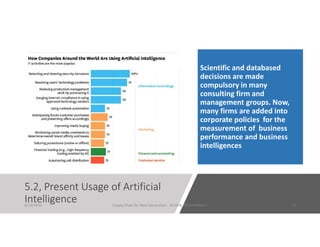
5.2, Present Usage of Artificial
Intelligence
Scientific and databased
decisions are made
compulsory in many
consulting firm and
management groups. Now,
many firms are added into
corporate policies for the
measurement of business
performance and business
intelligences
8/23/2020 Supply Chain for Next Generation - SELVAN ATHISHTARAJ V 12
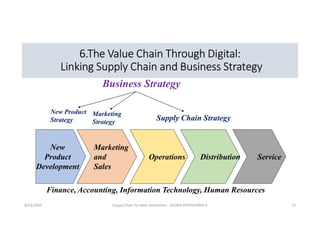
6.The Value Chain Through Digital:
Linking Supply Chain and Business Strategy
New
Product
Development
Marketing
and
Sales
Operations Distribution Service
Finance, Accounting, Information Technology, Human Resources
Business Strategy
New Product
Strategy
Marketing
Strategy
Supply Chain Strategy
8/23/2020 Supply Chain for Next Generation - SELVAN ATHISHTARAJ V 13
6.1,Towards Digital Supply Chain
• leveraging all available POS data/market intelligence, improving the forecast
Price, quality and availability of raw material significantly (up to more than 90
percent in the relevant level, e.g., SKU), and applying methods of demand
shaping in combination with demand sensing to account for systematic
changes/trends, the service level Agreement (SLA)will increase dramatically
and with this lost sales will decrease significantly
• Customization of the supply chain, supply chain setups adopt a greater number
of segments. It needs to master "micro segmentation." The granularization of
the supply chain into hundreds of individual supply chain segments based on
customer requirements and own capabilities designed in a dynamic, big data
approach allows to mass-customize supply chain offerings.
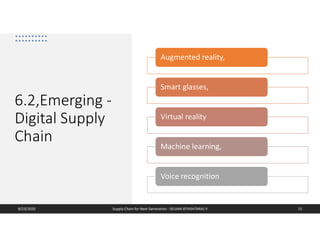
6.2,Emerging -
Digital Supply
Chain
8/23/2020 Supply Chain for Next Generation - SELVAN ATHISHTARAJ V 15
Augmented reality,
Smart glasses,
Virtual reality
Machine learning,
Voice recognition
6.3,Benefits
of Digital
Supply Chain
How Suppliers Benefit
Accurate sourcing: Track and distribute raw materials plant to supplier and supplier to
plant. Mobile apps connect manufacturers to the first step of the supply chain – the raw
materials supplier.
Better inventory control: Inventory management with the tap of a finger. Warehouse
management apps provides real inventory. XR headsets allow suppliers to see what they
have, where it is, and where it needs to go.
Simplified logistics: Order fulfillment that’s simple, intuitive, and on the go. Track the
transit of materials from anywhere in the field. Hands-free devices eliminate the need for
paper lists or handheld devices, making the order picking process faster and less prone to
error.
Enhanced management: Lead the team while being in two places at once. Both AR and VR
can provide accurately visualized digital twins, allowing managers of global operations to
view sites in real-time and ensure smooth operations without the expense of being
physically present.
How Manufacturers Benefit
Faster production times: Decrease the time to manufacture and ship. Supply chain apps
integrate with legacy systems to cut down on the overall production process.
Enhanced, safer training: Increase operational efficiency and safety. Head-mounted AR
displays allow for hands-free, real-time interaction with equipment. VR training offers the
ability to provide a variety of scenarios without the risk associated with on-site or in-the-
moment training.
Recall/damage control: Simplify field assessments and integrate data captured in the field
from mobile apps with back-office applications. The faster a customer complaint is resolved;.
Better final product: Reduce human error. Tighter, technology-led quality control leads to
better oversight and ultimately, a higher-quality product.
8/23/2020 Supply Chain for Next Generation - SELVAN ATHISHTARAJ V 16
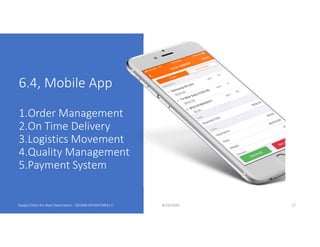
6.4, Mobile App
1.Order Management
2.On Time Delivery
3.Logistics Movement
4.Quality Management
5.Payment System
8/23/2020 17
Supply Chain For Next Generation
Author: SELVAN ATHISHTARAJ V
Mail: selvanathishtaraj@gmail.com
8/23/2020 Supply Chain for Next Generation - SELVAN ATHISHTARAJ V 18

Supply chain for next generation

  • 1.
    NEXT GENERATION SUPPLY CHAIN SELVANATHISHTARAJ V 8/23/2020 Supply Chain for Next Generation - SELVAN ATHISHTARAJ V 1
  • 2.
    Content 1. Cloud Computing 2.Block Chain 3. Big Data 4. IoT 5. AI and ML 6. Digital Supply Chain 8/23/2020 Supply Chain for Next Generation - SELVAN ATHISHTARAJ V 2
  • 3.
    1.Cloud Computing Cloud Computing isan integral of the following: BLOCK CHAIN BIG DATA IOT AI DIGITAL SUPPLY CHAIN Cloud centralizes data and offers multiple entities access to that data, decreasing costs and speeding supply chain velocity while adding data security. 8/23/2020 Supply Chain for Next Generation - SELVAN ATHISHTARAJ V 3
  • 4.
    2.Blockchain: Peer-to-Peer Network • Blockchain, isa chain of blocks.. • Blockchain has called distributed digital ledger that records the transactions occurring between two parties in a permanent and verifiable manner. • The primary goal of a blockchain is to allow the recording and distribution of digital information, but not editing. Data stored on a blockchain is immutable. • Immutability refers to its ability to remain unchanged. • A blockchain is a growing list of records, and each block in a blockchain is linked using cryptography. • A blockchain functions as a decentralized database. This database is managed by computers that belong to a peer-to-peer network.
  • 5.
    Blockchain Uses in Forex and Tracking SupplyChainforNextGeneration-SELVANATHISHTARAJV Thisis currently being led by bitcoin. Shortly, traditional currencies such as the US Dollar or Euro will also function on blockchain systems, and this also includes all kinds of securities such as stocks, funds, and debt instruments. These will be used by most of the industries across the globe in the context of financial activities. Blockchain will also find its place in various non-financial use cases such as voting systems, identity management, the provenance of goods, tracking goods along the supply chain, etc. It is a very powerful technology with a broad range of applications. 8/23/2020 5
  • 6.
    3. Big Data– Structured and Unstructured Rational Data base Management System (RDBMS). Frequently they are used as an API Application Programming Interface for security or simplicity. Implementations of stored procedures on SQL RDBMS's often allow developers to take advantage of vendor-specific. Big Data(Hadoop) and RDBMS is the question of data handling and process Big Data would hand large volume of data and whereas RDBMS low in storage and systematic programmed files of data The file storage and classifications are in two types of throwing data 1.Structured 2.Unstructured It is an arrangement of data storage for the processing and handling in cloud system, 8/23/2020 Supply Chain for Next Generation - SELVAN ATHISHTARAJ V 6
  • 7.
    3.1,NEED OF BIGDATA ANAYLTICS IN SCM 8/23/2020 Supply Chain for Next Generation - SELVAN ATHISHTARAJ V 7
  • 8.
    3.2,Big Data Analytics There arefour types of big data BI that really aid business: Prescriptive – This type of analysis reveals what actions should be taken. This is the most valuable kind of analysis and usually results in rules and recommendations for next steps. Predictive – An analysis of likely scenarios of what might happen. The deliverables are usually a predictive forecast. Diagnostic – A look at past performance to determine what happened and why. The result of the analysis is often an analytic dashboard. Descriptive – What is happening now based on incoming data. To mine the analytics, you typically use a real-time dashboard and/or email reports. 8/23/2020 Supply Chain for Next Generation - SELVAN ATHISHTARAJ V 8
  • 9.
    4.IoT in SCM Thisfunction based on cloud Computing data base system Involved parties in SCM are connected to access the relevance data, which includes suppliers , logistics, buyer and user in the assembly function Connected systems help implement the principles of predictive analytics into all stages of supply chain in, Process, Quality parameter and detecting equipment errors and delivery etc., Source: Louis Columbus Senior Contributor Enterprise & Cloud 8/23/2020 Supply Chain for Next Generation - SELVAN ATHISHTARAJ V 9
  • 10.
    5. AI andML for Supply Chain Management • Using machine learning and advanced analytics manufacturers can discover quickly who their best and worst suppliers are, and which production centers are most accurate in catching errors. • Manufacturers are using dashboards for applying machine learning to supplier quality, delivery and consistency challenges. • Line Balancing for Plant assembly based on supplier production and loading plan on machines(On Job- line) in real time monitoring • Detecting and acting on inconsistent supplier quality levels and deliveries using machine learning-based applications is an area manufacturers . 8/23/2020 Supply Chain for Next Generation - SELVAN ATHISHTARAJ V 10
  • 11.
    5.1, Artificial intelligenceTypes  Augmentation: AI, which assists humans with their day-to-day tasks, personally or commercially without having complete control of the output. Such Artificial Intelligence is used in Virtual Assistant, Data analysis, software solutions; where they are mainly used to reduce errors due to human bias. 1.Forecast2.Scheduling 3. Delivery 4. Logistics and 5.Costings • Automation: AI, which works completely autonomously in any field without the need for any human intervention. For example, robots performing key process steps in manufacturing plants 1.Robotic welding 2. X-Ray Testing 3. Handling Furnaces 8/23/2020 Supply Chain for Next Generation - SELVAN ATHISHTARAJ V 11
  • 12.
    5.2, Present Usageof Artificial Intelligence Scientific and databased decisions are made compulsory in many consulting firm and management groups. Now, many firms are added into corporate policies for the measurement of business performance and business intelligences 8/23/2020 Supply Chain for Next Generation - SELVAN ATHISHTARAJ V 12
  • 13.
    6.The Value ChainThrough Digital: Linking Supply Chain and Business Strategy New Product Development Marketing and Sales Operations Distribution Service Finance, Accounting, Information Technology, Human Resources Business Strategy New Product Strategy Marketing Strategy Supply Chain Strategy 8/23/2020 Supply Chain for Next Generation - SELVAN ATHISHTARAJ V 13
  • 14.
    6.1,Towards Digital SupplyChain • leveraging all available POS data/market intelligence, improving the forecast Price, quality and availability of raw material significantly (up to more than 90 percent in the relevant level, e.g., SKU), and applying methods of demand shaping in combination with demand sensing to account for systematic changes/trends, the service level Agreement (SLA)will increase dramatically and with this lost sales will decrease significantly • Customization of the supply chain, supply chain setups adopt a greater number of segments. It needs to master "micro segmentation." The granularization of the supply chain into hundreds of individual supply chain segments based on customer requirements and own capabilities designed in a dynamic, big data approach allows to mass-customize supply chain offerings.
  • 15.
    6.2,Emerging - Digital Supply Chain 8/23/2020Supply Chain for Next Generation - SELVAN ATHISHTARAJ V 15 Augmented reality, Smart glasses, Virtual reality Machine learning, Voice recognition
  • 16.
    6.3,Benefits of Digital Supply Chain HowSuppliers Benefit Accurate sourcing: Track and distribute raw materials plant to supplier and supplier to plant. Mobile apps connect manufacturers to the first step of the supply chain – the raw materials supplier. Better inventory control: Inventory management with the tap of a finger. Warehouse management apps provides real inventory. XR headsets allow suppliers to see what they have, where it is, and where it needs to go. Simplified logistics: Order fulfillment that’s simple, intuitive, and on the go. Track the transit of materials from anywhere in the field. Hands-free devices eliminate the need for paper lists or handheld devices, making the order picking process faster and less prone to error. Enhanced management: Lead the team while being in two places at once. Both AR and VR can provide accurately visualized digital twins, allowing managers of global operations to view sites in real-time and ensure smooth operations without the expense of being physically present. How Manufacturers Benefit Faster production times: Decrease the time to manufacture and ship. Supply chain apps integrate with legacy systems to cut down on the overall production process. Enhanced, safer training: Increase operational efficiency and safety. Head-mounted AR displays allow for hands-free, real-time interaction with equipment. VR training offers the ability to provide a variety of scenarios without the risk associated with on-site or in-the- moment training. Recall/damage control: Simplify field assessments and integrate data captured in the field from mobile apps with back-office applications. The faster a customer complaint is resolved;. Better final product: Reduce human error. Tighter, technology-led quality control leads to better oversight and ultimately, a higher-quality product. 8/23/2020 Supply Chain for Next Generation - SELVAN ATHISHTARAJ V 16
  • 17.
    6.4, Mobile App 1.OrderManagement 2.On Time Delivery 3.Logistics Movement 4.Quality Management 5.Payment System 8/23/2020 17
  • 18.
    Supply Chain ForNext Generation Author: SELVAN ATHISHTARAJ V Mail: selvanathishtaraj@gmail.com 8/23/2020 Supply Chain for Next Generation - SELVAN ATHISHTARAJ V 18