Visit ebookmass.com todownload the full version and
explore more ebook or textbook
The Digital Supply Chain Bart L. Maccarthy
_____ Click the link below to download _____
https://ebookmass.com/product/the-digital-supply-chain-bart-
l-maccarthy/
Explore and download more ebook or textbook at ebookmass.com
2.
Here are somerecommended products that we believe you will be
interested in. You can click the link to download.
The Digital Transformation of Supply Chain Management
Michela Pellicelli
https://ebookmass.com/product/the-digital-transformation-of-supply-
chain-management-michela-pellicelli/
Supply Chain Logistics Management Bowersox
https://ebookmass.com/product/supply-chain-logistics-management-
bowersox/
Digital Supply Networks: Transform Your Supply Chain and
Gain Competitive Advantage with Disruptive Technology and
Reimagined Processes Amit Sinha
https://ebookmass.com/product/digital-supply-networks-transform-your-
supply-chain-and-gain-competitive-advantage-with-disruptive-
technology-and-reimagined-processes-amit-sinha/
eTextbook 978-0133798258 Managing Quality: Integrating the
Supply Chain
https://ebookmass.com/product/etextbook-978-0133798258-managing-
quality-integrating-the-supply-chain/
3.
Purchasing and SupplyChain Management 6th Edition
https://ebookmass.com/product/purchasing-and-supply-chain-
management-6th-edition/
Supply Network 5.0: How to Improve Human Automation in the
Supply Chain Bernardo Nicoletti
https://ebookmass.com/product/supply-network-5-0-how-to-improve-human-
automation-in-the-supply-chain-bernardo-nicoletti/
Managing Operations Across the Supply Chain, 5th Edition
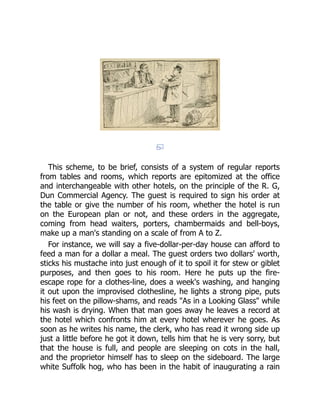
Morgan Swink
https://ebookmass.com/product/managing-operations-across-the-supply-
chain-5th-edition-morgan-swink/
Managing Operations Across the Supply Chain 4th Edition
Morgan Swink
https://ebookmass.com/product/managing-operations-across-the-supply-
chain-4th-edition-morgan-swink/
Supply Chain Management: A Logistics Perspective 10th
Edition
https://ebookmass.com/product/supply-chain-management-a-logistics-
perspective-10th-edition/
The Digital SupplyChain
Edited by
Bart L. MacCarthy
Nottingham University Business School, University of Nottingham, United Kingdom
Dmitry Ivanov
Berlin School of Economics and Law, Supply Chain and Operations Management, Berlin, Germany
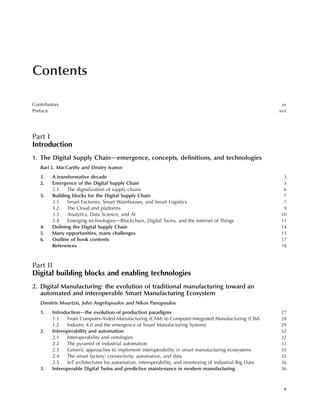
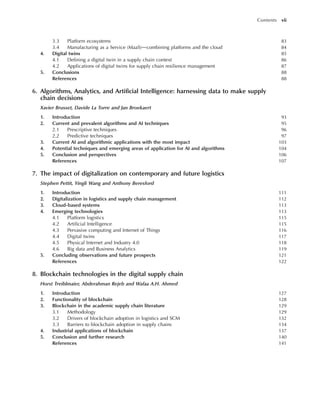
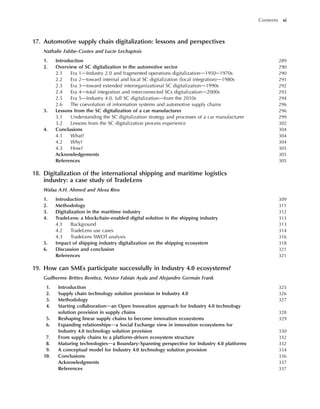
Contents
Contributors xv
Preface xvii
PartI
Introduction
1. The Digital Supply Chaindemergence, concepts, definitions, and technologies
Bart L. MacCarthy and Dmitry Ivanov
1. A transformative decade 3
2. Emergence of the Digital Supply Chain 5
2.1 The digitalization of supply chains 6
3. Building blocks for the Digital Supply Chain 7
3.1 Smart Factories, Smart Warehouses, and Smart Logistics 7
3.2 The Cloud and platforms 9
3.3 Analytics, Data Science, and AI 10
3.4 Emerging technologiesdBlockchain, Digital Twins, and the Internet of Things 11
4. Defining the Digital Supply Chain 14
5. Many opportunities, many challenges 15
6. Outline of book contents 17
References 18
Part II
Digital building blocks and enabling technologies
2. Digital Manufacturing: the evolution of traditional manufacturing toward an
automated and interoperable Smart Manufacturing Ecosystem
Dimitris Mourtzis, John Angelopoulos and Nikos Panopoulos
1. Introductiondthe evolution of production paradigms 27
1.1 From Computer-Aided Manufacturing (CAM) to Computer-Integrated Manufacturing (CIM) 28
1.2 Industry 4.0 and the emergence of Smart Manufacturing Systems 29
2. Interoperability and automation 32
2.1 Interoperability and ontologies 32
2.2 The pyramid of industrial automation 33
2.3 Generic approaches to implement interoperability in smart manufacturing ecosystems 35
2.4 The smart factory: connectivity, automation, and data 35
2.5 IoT architectures for automation, interoperability, and monitoring of Industrial Big Data 36
3. Interoperable Digital Twins and predictive maintenance in modern manufacturing 36
v
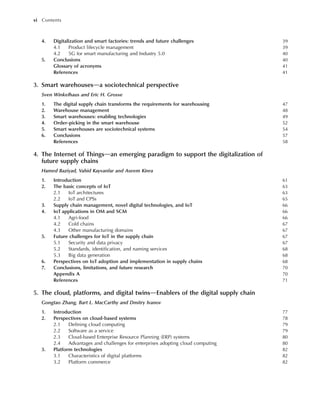
11.
4. Digitalization andsmart factories: trends and future challenges 39
4.1 Product lifecycle management 39
4.2 5G for smart manufacturing and Industry 5.0 40
5. Conclusions 40
Glossary of acronyms 41
References 41
3. Smart warehousesda sociotechnical perspective
Sven Winkelhaus and Eric H. Grosse
1. The digital supply chain transforms the requirements for warehousing 47
2. Warehouse management 48
3. Smart warehouses: enabling technologies 49
4. Order-picking in the smart warehouse 52
5. Smart warehouses are sociotechnical systems 54
6. Conclusions 57
References 58
4. The Internet of Thingsdan emerging paradigm to support the digitalization of
future supply chains
Hamed Baziyad, Vahid Kayvanfar and Aseem Kinra
1. Introduction 61
2. The basic concepts of IoT 63
2.1 IoT architectures 63
2.2 IoT and CPSs 65
3. Supply chain management, novel digital technologies, and IoT 66
4. IoT applications in OM and SCM 66
4.1 Agri-food 66
4.2 Cold chains 67
4.3 Other manufacturing domains 67
5. Future challenges for IoT in the supply chain 67
5.1 Security and data privacy 67
5.2 Standards, identification, and naming services 68
5.3 Big data generation 68
6. Perspectives on IoT adoption and implementation in supply chains 68
7. Conclusions, limitations, and future research 70
Appendix A 70
References 71
5. The cloud, platforms, and digital twinsdEnablers of the digital supply chain
Gongtao Zhang, Bart L. MacCarthy and Dmitry Ivanov
1. Introduction 77
2. Perspectives on cloud-based systems 78
2.1 Defining cloud computing 79
2.2 Software as a service 79
2.3 Cloud-based Enterprise Resource Planning (ERP) systems 80
2.4 Advantages and challenges for enterprises adopting cloud computing 80
3. Platform technologies 82
3.1 Characteristics of digital platforms 82
3.2 Platform commerce 82
vi Contents
12.
3.3 Platform ecosystems83
3.4 Manufacturing as a Service (MaaS)dcombining platforms and the cloud 84
4. Digital twins 85
4.1 Defining a digital twin in a supply chain context 86
4.2 Applications of digital twins for supply chain resilience management 87
5. Conclusions 88
References 88
6. Algorithms, Analytics, and Artificial Intelligence: harnessing data to make supply
chain decisions
Xavier Brusset, Davide La Torre and Jan Broekaert
1. Introduction 93
2. Current and prevalent algorithms and AI techniques 95
2.1 Prescriptive techniques 96
2.2 Predictive techniques 97
3. Current AI and algorithmic applications with the most impact 103
4. Potential techniques and emerging areas of application for AI and algorithms 104
5. Conclusion and perspectives 106
References 107
7. The impact of digitalization on contemporary and future logistics
Stephen Pettit, Yingli Wang and Anthony Beresford
1. Introduction 111
2. Digitalization in logistics and supply chain management 112
3. Cloud-based systems 113
4. Emerging technologies 113
4.1 Platform logistics 115
4.2 Artificial Intelligence 115
4.3 Pervasive computing and Internet of Things 116
4.4 Digital twins 117
4.5 Physical Internet and Industry 4.0 118
4.6 Big data and Business Analytics 119
5. Concluding observations and future prospects 121
References 122
8. Blockchain technologies in the digital supply chain
Horst Treiblmaier, Abderahman Rejeb and Wafaa A.H. Ahmed
1. Introduction 127
2. Functionality of blockchain 128
3. Blockchain in the academic supply chain literature 129
3.1 Methodology 129
3.2 Drivers of blockchain adoption in logistics and SCM 132
3.3 Barriers to blockchain adoption in supply chains 134
4. Industrial applications of blockchain 137
5. Conclusion and further research 140
References 141
Contents vii
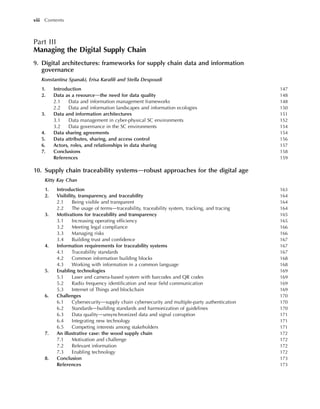
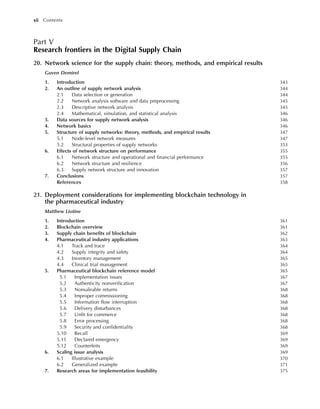
13.
Part III
Managing theDigital Supply Chain
9. Digital architectures: frameworks for supply chain data and information
governance
Konstantina Spanaki, Erisa Karafili and Stella Despoudi
1. Introduction 147
2. Data as a resourcedthe need for data quality 148
2.1 Data and information management frameworks 148
2.2 Data and information landscapes and information ecologies 150
3. Data and information architectures 151
3.1 Data management in cyber-physical SC environments 152
3.2 Data governance in the SC environments 154
4. Data sharing agreements 154
5. Data attributes, sharing, and access control 156
6. Actors, roles, and relationships in data sharing 157
7. Conclusions 158
References 159
10. Supply chain traceability systemsdrobust approaches for the digital age
Kitty Kay Chan
1. Introduction 163
2. Visibility, transparency, and traceability 164
2.1 Being visible and transparent 164
2.2 The usage of termsdtraceability, traceability system, tracking, and tracing 164
3. Motivations for traceability and transparency 165
3.1 Increasing operating efficiency 165
3.2 Meeting legal compliance 166
3.3 Managing risks 166
3.4 Building trust and confidence 167
4. Information requirements for traceability systems 167
4.1 Traceability standards 167
4.2 Common information building blocks 168
4.3 Working with information in a common language 168
5. Enabling technologies 169
5.1 Laser and camera-based system with barcodes and QR codes 169
5.2 Radio frequency identification and near field communication 169
5.3 Internet of Things and blockchain 169
6. Challenges 170
6.1 Cybersecuritydsupply chain cybersecurity and multiple-party authentication 170
6.2 Standardsdbuilding standards and harmonization of guidelines 170
6.3 Data qualitydunsynchronized data and signal corruption 171
6.4 Integrating new technology 171
6.5 Competing interests among stakeholders 171
7. An illustrative case: the wood supply chain 172
7.1 Motivation and challenge 172
7.2 Relevant information 172
7.3 Enabling technology 172
8. Conclusion 173
References 173
viii Contents
14.
11. Digital purchasingand procurement systems: evolution and current state
Karsten Cox
1. Introductiondthe rise of digital procurement systems 181
2. The development of digital procurement systems 182
2.1 Early computer-assisted purchasing with MRP and spreadsheets 183
2.2 The integration of procurement and supply chain management through Electronic Data Inter-
change (EDI) and ERP 183
2.3 Characteristics of contemporary digital procurement systemsdP2P and S2P 184
2.4 State of the art in practice 187
3. Research perspectives on digitalization of procurement 187
3.1 Research on digital procurement systems adoption: technology readiness 187
3.2 The need for wider research on contemporary digital procurement systems 188
4. Hitachi case study 188
4.1 Start of Hitachi’s digital procurement system journey 188
4.2 Hitachi Rail Group: implementing Jaggaer 190
4.3 Pilot study: supporting tenders on high-speed bid projects 191
5. Looking ahead: the future of digital procurement systems 192
5.1 Further automation of digital procurement systems 193
5.2 The future of S2P digital procurement technology 193
5.3 Data integrity and cyber security in future digital procurement 194
6. Conclusions 194
References 194
12. Measuring and managing digital supply chain performance
Ashish Kumar Jha, Nishant Kumar Verma and Indranil Bose
1. Introduction 199
2. A framework for performance management in digital supply chains 200
2.1 Traditional view of performance management in supply chains 200
2.2 Importance of data in digital supply chains 201
2.3 A data-driven framework for performance management 202
3. Case studies 204
3.1 Cisco Systems 204
3.2 Ramco Cements Limited 205
3.3 Tetra Pak 206
4. Impact of emerging technologies on performance measurement and management 210
4.1 Supply chain dashboards 210
4.2 Other emerging technologies 210
5. Conclusions 211
References 212
13. The art of cyber security in the age of the digital supply chain: detecting and
defending against vulnerabilities in your supply chain
Sang Yoon Cha
1. Introduction 215
2. Governments, consultancies, and industry approaches 217
3. Research on supply chain cyber security 221
4. Research frontiers 226
5. Conclusions 227
References 227
Contents ix
15.
Visit https://ebookmass.com todayto explore
a vast collection of ebooks across various
genres, available in popular formats like
PDF, EPUB, and MOBI, fully compatible with
all devices. Enjoy a seamless reading
experience and effortlessly download high-
quality materials in just a few simple steps.
Plus, don’t miss out on exciting offers that
let you access a wealth of knowledge at the
best prices!
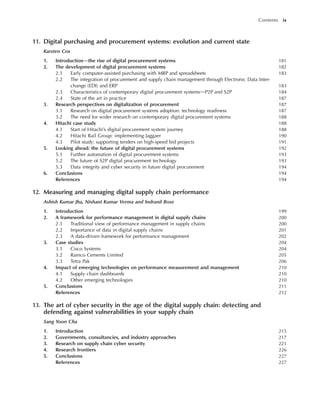
16.
Part IV
Digital SupplyChain e sectoral cases
14. Digital retaildkey trends and developments
Lina Zhang and Mikko Hänninen
1. Introduction 237
2. The reshaping of the retail value chain 238
2.1 Manufacturing in the retail value chain 238
2.2 Retailingdthe emergence of the platform model 239
2.3 Delivery and fulfillment 239
3. Platform-based retail ecosystemsdthe cases of Alibaba and Amazon 240
3.1 Alibaba Group 240
3.2 Amazon.com, Inc. 245
4. Discussion 249
4.1 Transition to a platform business model with ongoing investment in physical assets 249
4.2 Channel-agnostic, convenient, and personalized retail experience 249
4.3 Faster and flexible logistics capabilities 250
4.4 Manufacturing operations 250
5. Conclusions 251
References 251
15. Digitalization in the textiles and clothing sector
Rudrajeet Pal and Amila Jayarathne
1. Introduction 255
2. Digital clothing design and sample development 258
2.1 Product design, sample development, and product lifecycle management 258
2.2 Wearable technology 259
3. Digitalization of clothing supply and manufacturing networks 259
3.1 Sourcing and procurement 259
3.2 Production planning and manufacturing 261
4. Digitalization of clothing distribution and retail formats 262
4.1 Distribution 262
4.2 Retailing 263
5. Digitally enabled clothing circularity 265
6. Conclusions 267
References 268
16. Digitalization in production and warehousing in food supply chains
Fabio Sgarbossa, Anita Romsdal, Olumide Emmanuel Oluyisola and Jan Ola Strandhagen
1. Introduction 273
2. DigiMatdan innovation project between a food supply chain and academia 274
3. Characteristics of food supply chains 275
4. Introduction to cases 277
4.1 Case 1dsmart planning and control in production 278
4.2 Case 2dsmart material handling in production 280
4.3 Case 3dsmart planning and control in warehousing 282
4.4 Case 4dsmart material handling in warehousing 283
5. Conclusions and future research perspective 285
References 286
x Contents
17.
17. Automotive supplychain digitalization: lessons and perspectives
Nathalie Fabbe-Costes and Lucie Lechaptois
1. Introduction 289
2. Overview of SC digitalization in the automotive sector 290
2.1 Era 1dIndustry 2.0 and fragmented operations digitalizationd1950e1970s 290
2.2 Era 2dtoward internal and local SC digitalization (local integration)d1980s 291
2.3 Era 3dtoward extended interorganizational SC digitalizationd1990s 292
2.4 Era 4dtotal integration and interconnected SCs digitalizationd2000s 293
2.5 Era 5dIndustry 4.0, full SC digitalizationdfrom the 2010s 294
2.6 The coevolution of information systems and automotive supply chains 296
3. Lessons from the SC digitalization of a car manufacturer 296
3.1 Understanding the SC digitalization strategy and processes of a car manufacturer 299
3.2 Lessons from the SC digitalization process experience 302
4. Conclusions 304
4.1 What? 304
4.2 Why? 304
4.3 How? 305
Acknowledgements 305
References 305
18. Digitalization of the international shipping and maritime logistics
industry: a case study of TradeLens
Wafaa A.H. Ahmed and Alexa Rios
1. Introduction 309
2. Methodology 311
3. Digitalization in the maritime industry 312
4. TradeLens: a blockchain-enabled digital solution in the shipping industry 313
4.1 Background 313
4.2 TradeLens use cases 314
4.3 TradeLens SWOT analysis 316
5. Impact of shipping industry digitalization on the shipping ecosystem 318
6. Discussion and conclusion 321
References 321
19. How can SMEs participate successfully in Industry 4.0 ecosystems?
Guilherme Brittes Benitez, Néstor Fabián Ayala and Alejandro Germán Frank
1. Introduction 325
2. Supply chain technology solution provision in Industry 4.0 326
3. Methodology 327
4. Starting collaborationdan Open Innovation approach for Industry 4.0 technology
solution provision in supply chains 328
5. Reshaping linear supply chains to become innovation ecosystems 329
6. Expanding relationshipsda Social Exchange view in innovation ecosystems for
Industry 4.0 technology solution provision 330
7. From supply chains to a platform-driven ecosystem structure 332
8. Maturing technologiesda Boundary-Spanning perspective for Industry 4.0 platforms 332
9. A conceptual model for Industry 4.0 technology solution provision 334
10. Conclusions 336
Acknowledgments 337
References 337
Contents xi
18.
Part V
Research frontiersin the Digital Supply Chain
20. Network science for the supply chain: theory, methods, and empirical results
Guven Demirel
1. Introduction 343
2. An outline of supply network analysis 344
2.1 Data selection or generation 344
2.2 Network analysis software and data preprocessing 345
2.3 Descriptive network analysis 345
2.4 Mathematical, simulation, and statistical analysis 346
3. Data sources for supply network analysis 346
4. Network basics 346
5. Structure of supply networks: theory, methods, and empirical results 347
5.1 Node-level network measures 347
5.2 Structural properties of supply networks 353
6. Effects of network structure on performance 355
6.1 Network structure and operational and financial performance 355
6.2 Network structure and resilience 356
6.3 Supply network structure and innovation 357
7. Conclusions 357
References 358
21. Deployment considerations for implementing blockchain technology in
the pharmaceutical industry
Matthew Liotine
1. Introduction 361
2. Blockchain overview 361
3. Supply chain benefits of blockchain 362
4. Pharmaceutical industry applications 363
4.1 Track and trace 364
4.2 Supply integrity and safety 364
4.3 Inventory management 365
4.4 Clinical trial management 365
5. Pharmaceutical blockchain reference model 365
5.1 Implementation issues 367
5.2 Authenticity nonverification 367
5.3 Nonsaleable returns 368
5.4 Improper commissioning 368
5.5 Information flow interruption 368
5.6 Delivery disturbances 368
5.7 Unfit for commerce 368
5.8 Error processing 368
5.9 Security and confidentiality 368
5.10 Recall 369
5.11 Declared emergency 369
5.12 Counterfeits 369
6. Scaling issue analysis 369
6.1 Illustrative example 370
6.2 Generalized example 371
7. Research areas for implementation feasibility 375
xii Contents
19.
7.1 Scalability anddata management 375
7.2 Data obfuscation 375
7.3 Permission and access 375
7.4 Collaboration 375
7.5 Cost models 375
7.6 Comparative studies 376
8. Summary and conclusions 376
References 376
22. Digital supply chain surveillance: concepts, challenges, and frameworks
Alexandra Brintrup, Edward Elson Kosasih, Bart L. MacCarthy and Guven Demirel
1. Introduction 379
2. SDARdsurveillance, detection, action, response 381
3. Supply chain surveillance activities 382
4. The role of AI in DSCS 385
5. Challenges in the application of DSCSdan illustrative example 388
5.1 Problem formulation and solution approaches 388
5.2 Technical challenges 391
5.3 Managerial challenges 391
6. Conclusions 392
References 392
23. Sustainability and the digital supply chain
Ahmad Beltagui, Breno Nunes and Stefan Gold
1. Introduction 397
2. The emergence of a digital supply chain 398
3. Sustainability in the digital supply chain 399
4. Building a sustainable digital supply chain 400
5. Driving down urban emissionsdthe case of the Electric Vehicle (EV) supply chain 401
5.1 Historical perspective 402
5.2 EV supply chain (un)sustainability 402
5.3 Product architecture 403
5.4 Digital technologies in EVs and EV supply chains 404
5.5 Sustainability and the digital EV supply chain 405
6. Global food supply chainsdthe case of the beef supply chain 405
6.1 Historical perspective 405
6.2 Beef supply chain (un)sustainability 408
6.3 Sustainable alternatives to beef production 408
6.4 Sustainability and the digital food supply chain 409
7. Implications for theory, practice, and policy 410
8. Conclusions and research agenda 412
8.1 Harnessing data for sustainability evaluation 412
8.2 Transparent may not always mean sustainable 413
8.3 Tensions and paradoxes 413
8.4 New solutions, same problems 413
References 413
Contents xiii
20.
24. Reconceptualizing supplychain strategy for the digital era: achieving digital
ambidexterity through dynamic capabilities
Eric Lambourdière, Elsa Corbin and Jérôme Verny
1. Introduction 419
2. Literature review 420
2.1 Dynamic capabilities 420
2.2 Organizational ambidexterity 421
2.3 Supply chain theory foundations and evolution 421
2.4 Contemporary supply chain challenges 422
2.5 The supply chain of the future and the shifting theoretical foundations of SCM 422
2.6 New digital technologies (NDTs) to create higher-order capabilities for supply chain
components, processes, networks and flows (SCMCs, SCMPs, SCNSs, and SCFs) 423
3. Conceptual framework and system of relationships 424
4. Building digital supply chain capabilities (DSCCs) 426
4.1 Supply chain visibility capabilities (sensing) 426
4.2 Supply chain agility capabilities (seizing) 426
4.3 Supply chain flexibility capabilities (transforming) 427
4.4 Dynamic supply chain capabilities as a prerequisite of supply chain ambidexterity 427
4.5 Supply chain ambidexterity and DSCCs 427
4.6 The relationship between DSCCs and business performance 428
5. Theoretical implicationsdachieving digital ambidexterity 429
6. Managerial implications 429
7. Conclusions and further research 430
References 430
Index 435
xiv Contents
21.
Contributors
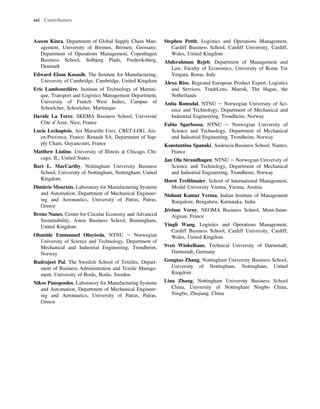
Wafaa A.H. Ahmed,Department of Operations Manage-
ment and Information Systems, Nottingham University
Business School, The University of Nottingham, Not-
tingham, United Kingdom
John Angelopoulos, Laboratory for Manufacturing Sys-
tems and Automation, Department of Mechanical En-
gineering and Aeronautics, University of Patras, Patras,
Greece
Néstor Fabián Ayala, Organizational Engineering Group
(Núcleo de Engenharia OrganizacionaldNEO),
Department of Industrial Engineering, Universidade
Federal do Rio Grande do Sul, Porto Alegre, Rio
Grande do Sul, Brazil
Hamed Baziyad, Department of Information Technology,
Faculty of Industrial and Systems Engineering, Tarbiat
Modares University, Tehran, Iran
Ahmad Beltagui, Advanced Services Group, Aston Busi-
ness School, Birmingham, United Kingdom
Guilherme Brittes Benitez, Organizational Engineering
Group (Núcleo de Engenharia OrganizacionaldNEO),
Department of Industrial Engineering, Universidade
Federal do Rio Grande do Sul, Porto Alegre, Rio
Grande do Sul, Brazil; Industrial and Systems Engi-
neering Graduate Program, Polytechnic School, Pon-
tifical Catholic University of Parana (PUCPR), Brazil
Anthony Beresford, Logistics and Operations Manage-
ment, Cardiff Business School, Cardiff University,
Cardiff, Wales, United Kingdom
Indranil Bose, NEOMA Business School, Reims, France
Alexandra Brintrup, The Institute for Manufacturing,
University of Cambridge, Cambridge, United Kingdom
Jan Broekaert, SKEMA Business School, Université Côte
d’Azur, Nice, France
Xavier Brusset, SKEMA Business School, Université
Côte d’Azur, Nice, France
Sang Yoon Cha, Department of Industrial Engineering,
Seoul National University, Seoul, Republic of Korea
Kitty Kay Chan, Columbia University, New York, New
York, United States
Elsa Corbin, Institute of Technology of Martinique,
Transport and Logistics Management Department,
University of French West Indies, Campus of
Schoelcher, Schoelcher, Martinique
Karsten Cox, Hitachi Information Control Systems Europe
Ltd, Derby, United Kingdom
Guven Demirel, School of Business and Management,
Queen Mary University of London, London, United
Kingdom
Stella Despoudi, School of Economic Sciences, University
of Western Macedonia, Grevena, Greece; Aston Busi-
ness School, Aston University, Birmingham, United
Kingdom
Nathalie Fabbe-Costes, Aix Marseille Univ, CRET-LOG,
Aix-en-Provence, France
Alejandro Germán Frank, Organizational Engineering
Group (Núcleo de Engenharia OrganizacionaldNEO),
Department of Industrial Engineering, Universidade
Federal do Rio Grande do Sul, Porto Alegre, Rio
Grande do Sul, Brazil
Stefan Gold, Faculty of Economics and Management,
University of Kassel, Kassel, Germany
Eric H. Grosse, Digital Transformation in Operations
Management, Saarland University, Saarbrücken,
Germany
Mikko Hänninen, Capgemini Invent, Espoo, Finland
Dmitry Ivanov, Berlin School of Economics and Law,
Supply Chain and Operations Management, Berlin,
Germany
Amila Jayarathne, Department of Marketing Manage-
ment, University of Sri Jayewardenepura, Gangodawila,
Nugegoda, Sri Lanka
Ashish Kumar Jha, Trinity Business School, Trinity
College Dublin, Dublin, Ireland
Erisa Karafili, School of Electronics and Computer Sci-
ence, University of Southampton, Southampton, United
Kingdom
Vahid Kayvanfar, Department of Industrial Engineering,
Sharif University of Technology, Tehran, Iran
xv
22.
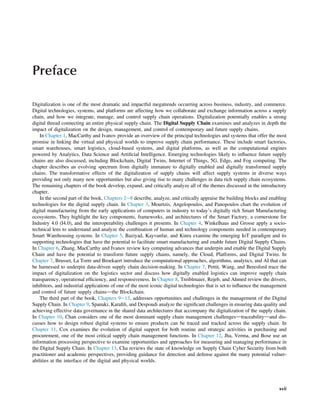
Aseem Kinra, Departmentof Global Supply Chain Man-
agement, University of Bremen, Bremen, Germany;
Department of Operations Management, Copenhagen
Business School, Solbjerg Plads, Frederiksberg,
Denmark
Edward Elson Kosasih, The Institute for Manufacturing,
University of Cambridge, Cambridge, United Kingdom
Eric Lambourdière, Institute of Technology of Martini-
que, Transport and Logistics Management Department,
University of French West Indies, Campus of
Schoelcher, Schoelcher, Martinique
Davide La Torre, SKEMA Business School, Université
Côte d’Azur, Nice, France
Lucie Lechaptois, Aix Marseille Univ, CRET-LOG, Aix-
en-Provence, France; Renault SA, Department of Sup-
ply Chain, Guyancourt, France
Matthew Liotine, University of Illinois at Chicago, Chi-
cago, IL, United States
Bart L. MacCarthy, Nottingham University Business
School, University of Nottingham, Nottingham, United
Kingdom
Dimitris Mourtzis, Laboratory for Manufacturing Systems
and Automation, Department of Mechanical Engineer-
ing and Aeronautics, University of Patras, Patras,
Greece
Breno Nunes, Centre for Circular Economy and Advanced
Sustainability, Aston Business School, Birmingham,
United Kingdom
Olumide Emmanuel Oluyisola, NTNU e Norwegian
University of Science and Technology, Department of
Mechanical and Industrial Engineering, Trondheim,
Norway
Rudrajeet Pal, The Swedish School of Textiles, Depart-
ment of Business Administration and Textile Manage-
ment, University of Borås, Borås, Sweden
Nikos Panopoulos, Laboratory for Manufacturing Systems
and Automation, Department of Mechanical Engineer-
ing and Aeronautics, University of Patras, Patras,
Greece
Stephen Pettit, Logistics and Operations Management,
Cardiff Business School, Cardiff University, Cardiff,
Wales, United Kingdom
Abderahman Rejeb, Department of Management and
Law, Faculty of Economics, University of Rome Tor
Vergata, Rome, Italy
Alexa Rios, Regional European Product Expert, Logistics
and Services, TradeLens, Maersk, The Hague, the
Netherlands
Anita Romsdal, NTNU e Norwegian University of Sci-
ence and Technology, Department of Mechanical and
Industrial Engineering, Trondheim, Norway
Fabio Sgarbossa, NTNU e Norwegian University of
Science and Technology, Department of Mechanical
and Industrial Engineering, Trondheim, Norway
Konstantina Spanaki, Audencia Business School, Nantes,
France
Jan Ola Strandhagen, NTNU e Norwegian University of
Science and Technology, Department of Mechanical
and Industrial Engineering, Trondheim, Norway
Horst Treiblmaier, School of International Management,
Modul University Vienna, Vienna, Austria
Nishant Kumar Verma, Indian Institute of Management
Bangalore, Bengaluru, Karnataka, India
Jérôme Verny, NEOMA Business School, Mont-Saint-
Aignan, France
Yingli Wang, Logistics and Operations Management,
Cardiff Business School, Cardiff University, Cardiff,
Wales, United Kingdom
Sven Winkelhaus, Technical University of Darmstadt,
Darmstadt, Germany
Gongtao Zhang, Nottingham University Business School,
University of Nottingham, Nottingham, United
Kingdom
Lina Zhang, Nottingham University Business School
China, University of Nottingham Ningbo China,
Ningbo, Zhejiang, China
xvi Contributors
23.
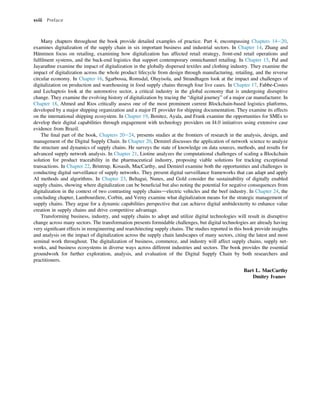
Preface
Digitalization is oneof the most dramatic and impactful megatrends occurring across business, industry, and commerce.
Digital technologies, systems, and platforms are affecting how we collaborate and exchange information across a supply
chain, and how we integrate, manage, and control supply chain operations. Digitalization potentially enables a strong
digital thread connecting an entire physical supply chain. The Digital Supply Chain examines and analyzes in depth the
impact of digitalization on the design, management, and control of contemporary and future supply chains.
In Chapter 1, MacCarthy and Ivanov provide an overview of the principal technologies and systems that offer the most
promise in linking the virtual and physical worlds to improve supply chain performance. These include smart factories,
smart warehouses, smart logistics, cloud-based systems, and digital platforms, as well as the computational engines
powered by Analytics, Data Science and Artificial Intelligence. Emerging technologies likely to influence future supply
chains are also discussed, including Blockchain, Digital Twins, Internet of Things, 5G, Edge, and Fog computing. The
chapter describes an evolving spectrum from digitally immature to digitally enabled and digitally transformed supply
chains. The transformative effects of the digitalization of supply chains will affect supply systems in diverse ways
providing not only many new opportunities but also giving rise to many challenges in data rich supply chain ecosystems.
The remaining chapters of the book develop, expand, and critically analyze all of the themes discussed in the introductory
chapter.
In the second part of the book, Chapters 2e8 describe, analyze, and critically appraise the building blocks and enabling
technologies for the digital supply chain. In Chapter 3, Mourtzis, Angelopoulos, and Panopoulos chart the evolution of
digital manufacturing from the early applications of computers in industry to today’s digitally rich Smart Manufacturing
ecosystems. They highlight the key components, frameworks, and architectures of the Smart Factory, a cornerstone for
Industry 4.0 (I4.0), and the interoperability challenges it presents. In Chapter 4, Winkelhaus and Grosse apply a socio-
technical lens to understand and analyze the combination of human and technology components needed in contemporary
Smart Warehousing systems. In Chapter 5, Baziyad, Kayvanfar, and Kinra examine the emerging IoT paradigm and its
supporting technologies that have the potential to facilitate smart manufacturing and enable future Digital Supply Chains.
In Chapter 6, Zhang, MacCarthy and Ivanov review key computing advances that underpin and enable the Digital Supply
Chain and have the potential to transform future supply chains, namely, the Cloud, Platforms, and Digital Twins. In
Chapter 7, Brusset, La Torre and Broekaert introduce the computational approaches, algorithms, analytics, and AI that can
be harnessed to underpin data-driven supply chain decision-making. In Chapter 7, Pettit, Wang, and Beresford trace the
impact of digitalization on the logistics sector and discuss how digitally enabled logistics can improve supply chain
transparency, operational efficiency, and responsiveness. In Chapter 8, Treiblmaier, Rejeb, and Ahmed review the drivers,
inhibitors, and industrial applications of one of the most iconic digital technologies that is set to influence the management
and control of future supply chainsdthe Blockchain.
The third part of the book, Chapters 9e13, addresses opportunities and challenges in the management of the Digital
Supply Chain. In Chapter 9, Spanaki, Karafili, and Despoudi analyze the significant challenges in ensuring data quality and
achieving effective data governance in the shared data architectures that accompany the digitalization of the supply chain.
In Chapter 10, Chan considers one of the most dominant supply chain management challengesdtraceabilitydand dis-
cusses how to design robust digital systems to ensure products can be traced and tracked across the supply chain. In
Chapter 11, Cox examines the evolution of digital support for both routine and strategic activities in purchasing and
procurement, one of the most critical supply chain management functions. In Chapter 12, Jha, Verma, and Bose use an
information processing perspective to examine opportunities and approaches for measuring and managing performance in
the Digital Supply Chain. In Chapter 13, Cha reviews the state of knowledge on Supply Chain Cyber Security from both
practitioner and academic perspectives, providing guidance for detection and defense against the many potential vulner-
abilities at the interface of the digital and physical worlds.
xvii
24.
Many chapters throughoutthe book provide detailed examples of practice. Part 4, encompassing Chapters 14e20,
examines digitalization of the supply chain in six important business and industrial sectors. In Chapter 14, Zhang and
Hänninen focus on retailing, examining how digitalization has affected retail strategy, front-end retail operations and
fulfilment systems, and the back-end logistics that support contemporary omnichannel retailing. In Chapter 15, Pal and
Jayarathne examine the impact of digitalization in the globally dispersed textiles and clothing industry. They examine the
impact of digitalization across the whole product lifecycle from design through manufacturing, retailing, and the reverse
circular economy. In Chapter 16, Sgarbossa, Romsdal, Oluyisola, and Strandhagen look at the impact and challenges of
digitalization on production and warehousing in food supply chains through four live cases. In Chapter 17, Fabbe-Costes
and Lechaptois look at the automotive sector, a critical industry in the global economy that is undergoing disruptive
change. They examine the evolving history of digitalization by tracing the “digital journey” of a major car manufacturer. In
Chapter 18, Ahmed and Rios critically assess one of the most prominent current Blockchain-based logistics platforms,
developed by a major shipping organization and a major IT provider for shipping documentation. They examine its effects
on the international shipping ecosystem. In Chapter 19, Benitez, Ayala, and Frank examine the opportunities for SMEs to
develop their digital capabilities through engagement with technology providers on I4.0 initiatives using extensive case
evidence from Brazil.
The final part of the book, Chapters 20e24, presents studies at the frontiers of research in the analysis, design, and
management of the Digital Supply Chain. In Chapter 20, Demirel discusses the application of network science to analyze
the structure and dynamics of supply chains. He surveys the state of knowledge on data sources, methods, and results for
advanced supply network analysis. In Chapter 21, Liotine analyzes the computational challenges of scaling a Blockchain
solution for product traceability in the pharmaceutical industry, proposing viable solutions for tracking exceptional
transactions. In Chapter 22, Brintrup, Kosasih, MacCarthy, and Demirel examine both the opportunities and challenges in
conducting digital surveillance of supply networks. They present digital surveillance frameworks that can adapt and apply
AI methods and algorithms. In Chapter 23, Beltagui, Nunes, and Gold consider the sustainability of digitally enabled
supply chains, showing where digitalization can be beneficial but also noting the potential for negative consequences from
digitalization in the context of two contrasting supply chainsdelectric vehicles and the beef industry. In Chapter 24, the
concluding chapter, Lambourdiere, Corbin, and Verny examine what digitalization means for the strategic management of
supply chains. They argue for a dynamic capabilities perspective that can achieve digital ambidexterity to enhance value
creation in supply chains and drive competitive advantage.
Transforming business, industry, and supply chains to adopt and utilize digital technologies will result in disruptive
change across many sectors. The transformation presents formidable challenges, but digital technologies are already having
very significant effects in reengineering and rearchitecting supply chains. The studies reported in this book provide insights
and analysis on the impact of digitalization across the supply chain landscapes of many sectors, citing the latest and most
seminal work throughout. The digitalization of business, commerce, and industry will affect supply chains, supply net-
works, and business ecosystems in diverse ways across different industries and sectors. The book provides the essential
groundwork for further exploration, analysis, and evaluation of the Digital Supply Chain by both researchers and
practitioners.
Bart L. MacCarthy
Dmitry Ivanov
xviii Preface
Visit https://ebookmass.com todayto explore
a vast collection of ebooks across various
genres, available in popular formats like
PDF, EPUB, and MOBI, fully compatible with
all devices. Enjoy a seamless reading
experience and effortlessly download high-
quality materials in just a few simple steps.
Plus, don’t miss out on exciting offers that
let you access a wealth of knowledge at the
best prices!
"I think Iwould but I might not. There was a great deal of passing
along our street, and they may have been taken while I was looking
out of the window, waiting till the crowds rolled by."
And so Mr. Ives continued to shed information upon the inquiring
mind in a courteous and opaque manner that must have endeared
him to all.
Mr. Ives has in no transaction shown himself so thoroughly shrewd
as he did when he swapped a doubtful reputation for a large sum of
money. The only wonder is that there were so many men who
wanted to invest in that kind of goods. He did a shrewd thing, but
he will not be able to profit by it.
Success, however, should only be measured by the content it
brings with it. While Henry S. Ives was lighting his mighty financial
battles and winning for himself the title of the Young Napoleon of
Wall street, dwelling in a little palace lined with ivory and gold, but
cursed by the consuming desire to be rich, and forgetful, like Mr.
Gould, how full of calm and soothing content is the following simple
letter, written by a man who undertook last year to inaugurate a
Shakesperian revival in southern Ohio:
Cincinnati, O., Aug. 3, 1886.
Mr. Henry S. Ives, New York, N. Y.
Dear Sir: I have just arrived in this city after a long and
debilitating but rather enjoyable trip over your line, and I now take
pen in hand to thank you for the use of your roadbed from
Indianapolis to this place. It is a good road, and I was surprised to
find it well ballasted and furnished with cool retreats and shady
culverts every few miles wherein a man could rest.
It is a good route for the poor but pampered tragedian to take,
and water-melons grow close to the fence. I have traveled over
many other roads since the new and pernicious law, but nowhere
have I found watermelons more succulent or less coy and secretive
than on your justly celebrated line. I also notice with pleasure that
green corn is still susceptible, and wild paw paws are growing in the
summer sun.
29.
I thought Isaw you go by in your special car just north of the first
trestle outside of town, but you went by so fast that I could not tell
definitely till too late. Please excuse me for not speaking to you as
you passed by. Success on the stage has not taught me to forget or
ignore my friends whenever I am thrown in contact with them.
People write me that New York State is rapidly settling up, and
that property is advancing rapidly in every direction. Is this so?
Advancing rapidly in every direction is, I suppose, one of the most
difficult feats known to calisthenics. I have tried it myself, years ago,
but now I do not practice it, having quit drinking altogether.
I hope you will let me know any time that I can be of use to you,
either in mowing weeds or gathering nuts that have ripened and
fallen off your track. I enjoy, especially in the autumn when the
hectic of the dying year has flooded the forests with its multiplied
glories, and the cricket sings his sleepy song to the tired heart, and
the locust lifts its lawn-mower voice in the boughs of the poplar, to
go nutting along a prolific railroad track.
I would be glad, also, if you have not secured anyone else, to
assist you in herding your stock on Wall street. Railroad stock
frequently runs down and gets the hollow horn for lack of care
during the winter months.
Always feel free to call on me at any time that I can be of service
to you.
Yours truly,
A——-B———.
The moral to be drawn from the career of Napoleon Bonaparte
Ives is that they who make haste to be rich may not be innocent. As
Gen. McClellan once said, there can be no better incentive to
integrity than the generous approval accorded to honesty by those
who are honest. All other kinds of approval are not worth struggling
for. Money will buy a certain kind of applause, but it is the kind that
turns to scorn when justice begins to get in her fine work.
And life itself is brief. Storied urn and animated bust may succeed
well in society, but they cannot soothe the dull cold ear of death.
30.
Freckled granite andprevaricating marble may perpetuate the fraud
of a lifetime, but they do not always indicate success.
For myself I would rather have more sincere and honest friends
through life, and afterwards content myself with a plainer tomb.
Not many miles from the costly mausoleum of a great millionaire a
sign-board by the roadside reads:
This way to Foley's Grove!
Enjoy life while you live, for
You'll be along time dead.
While I do not fully indorse this sentiment, there is food in it for
earnest thought.
32.
I
THE ANTI-CLINKER BASE-BURNER
BEE.
havenoticed bees very closely indeed, during my life. In fact I
have several times been thrown into immediate juxtaposition
with them, and have had a great many opportunities to observe
their ways, and I am free to say that I have not been so forcibly
struck with the difference in their size as the noticeable difference in
their temperature. I remember at one time sitting by a hive watching
the habits of the bees, and thinking how industrious they were, and
what a wide difference there is between the toilsome life of the little
insect, and the enervating, aimless, idle and luxurious life of the
newspaper man, when an impulsive little bee lit in my hair. He
seemed to be feverish. Wherever he settled down he seemed to
leave a hot place. I learned afterward that it was a new kind of bee
called the anti-clinker base-burner bee.
33.
A
CHESTNUT-BURR X—A FEW
REMARKSON OUR HOSTELRY
SYSTEM AS IT NOW PREVAILS.
Why a man in a Soft Hat is not always Welcome—The Hotel Clerk
and his Frigidity Apparatus—The Hotel Hog and his Habits—how he
may be Headed Off—Drolleries of Shrewd Bonifaces.
merica has made many gigantic strides, aside from those
made at the battle of Bull Run, and her people spend much of
their time pointing with pride to her remarkable progress; but
we are prone to dwell too much upon our advantages as a summer
resort, and our adroit methods of declining the Presidency before we
are asked, while we forget some of our more important
improvements, like the Elevated Railway and the American Hotel.
Let us, for a moment, look at the great changes that have been
wrought in hotels during the past century. How marked has been the
improvement and how wonderful the advancement. Everything has
been changed. Even the towels have been changed.
Electric bells, consisting of a long and alert wire with an overcoat
button at one end and a reticent boy at the other, have taken the
place of the human voice and a low-browed red-elm club. Where
once we were compelled to fall down a dark, narrow staircase, now
we can go down the elevator or wander down the wrong stairway
and ourselves in the laundry.
Where once we were mortified by being compelled to rise at table,
reach nine feet and stab a porous pancake with our fork, meantime
wiping the milk gravy out of a large yellow bowl with our coat-tails,
34.
now we canhire a tall, lithe gentleman in a full-dress suit to pass us
the pancakes.
Even the bar-rooms of American hotels are changed. Once the
bartender waited till his customer ran all his remarks into one long,
hoarse word, with a hiccough on the end, and then he took him by
the collar and threw him out into the cold and chaotic night. Now
the bartender gradually rises on the price of drinks till his customer
is frozen out, and while he is gone to the reading-room to borrow
some more money the chemist moves the bar somewhere else, and
when the guest returns he finds a barber-shop where he thought he
left a bar-room.
One hundred years, on their swift pinions, have borne away the
big and earnest dinner bell, and the sway-backed hair trunk that
surprised a man so when he sat down upon it to consider what
clothes he would put on first.
All these evidences of our crude, embryotic existence are gone,
and in their places we have electric bells, and Saratoga trunks
wherein we may conceal our hotel room and still have space left for
our clothes.
It is very rare now that we see a United States senator snaking a
two-year old Mambrino hair trunk up three flights of stairs to his
room in order to secure the labor vote. Men, as well as hotels and
hotel soap, have changed. Where once a cake of soap would only
last a few weeks, science has come in and perfected a style of pink
soap, flavored with vanilla, that will last for years, and a new
slippery-elm towel that is absolutely impervious to moisture. Hand in
hand, this soap and towel go gaily down the corridors of time,
welcoming the coming and speeding the parting guest, jumping
deftly out of the hands of the aristocracy into the hands of a
receiver, but always calm, smooth and latherless.
Nature did not fit me to be the successful guest at a hotel. I can
see why it is so. I do not know how to impress a hotel. I think all the
way up from the depot, as I change hands with my hot-handled and
heavy bag, how I will stride up to the counter and ask for the room
35.
that is generallygiven to Mr. Blaine; but when I get there I fall up
against a cold wave, step back into a large india-rubber cuspidor,
and my overtaxed valise bursts open. While the porter and I gather
up my collars and gently press them in with our feet, the clerk
decides that he hasn't got such a room as I would want.
I then go to another hotel and succeed in getting a room, which
commands a view of a large red fire-escape, a long sweep of
undulating eaves-trough and a lightning rod—usually No. 7 5/8s,
near the laundry chimney and adjoining the baggage elevator.
After I have remained at the hotel several days and paid my bill
whenever I have been asked to do so, and shown that I did not eat
much and that I was willing to carry up my own coal, the proprietor
relents and puts me in a room that is below timber line, and though
it is a better room, I feel all the time as though I had driven out the
night-watchman, for the bed is still warm, and knowing that he must
be sleeping out in the cold hall all night as he patiently watches the
hotel, I cannot sleep until three or four o'clock in the morning, and
then I have to get up while the chambermaid makes my bed for the
day.
I try hard when I enter a hotel to assume an air of arrogance and
defiance, but I am all the time afraid that there is some one present
who is acquainted with me.
Another thing that works against me is my apparel. In a strange
hotel a man will do better, if he has fifty dollars only, and desires to
remain two weeks, to go and buy a fifty-dollar suit of clothes with
his money, taking his chances with the clerk, than to dress like a
plain American citizen, and expect to be loved, on the grounds that
he will pay his board.
But there is now a prospect for reform in this line, a scheme by
which a man's name and record as a guest will be his credentials.
When this plan becomes thoroughly understood and adopted, a
modest man with money, who prefers to wear a soft hat, will not
have to sleep in the Union depot, solely on the ground that the night
clerk is opposed to a soft hat.
36.
This scheme, tobe brief, consists of a system of regular reports
from tables and rooms, which reports are epitomized at the office
and interchangeable with other hotels, on the principle of the R. G,
Dun Commercial Agency. The guest is required to sign his order at
the table or give the number of his room, whether the hotel is run
on the European plan or not, and these orders in the aggregate,
coming from head waiters, porters, chambermaids and bell-boys,
make up a man's standing on a scale of from A to Z.
For instance, we will say a five-dollar-per-day house can afford to
feed a man for a dollar a meal. The guest orders two dollars' worth,
sticks his mustache into just enough of it to spoil it for stew or giblet
purposes, and then goes to his room. Here he puts up the fire-
escape rope for a clothes-line, does a week's washing, and hanging
it out upon the improvised clothesline, he lights a strong pipe, puts
his feet on the pillow-shams, and reads "As in a Looking Glass" while
his wash is drying. When that man goes away he leaves a record at
the hotel which confronts him at every hotel wherever he goes. As
soon as he writes his name, the clerk, who has read it wrong side up
just a little before he got it down, tells him that he is very sorry, but
that the house is full, and people are sleeping on cots in the hall,
and the proprietor himself has to sleep on the sideboard. The large
white Suffolk hog, who has been in the habit of inaugurating a rain
37.
of terror andgravy in the dining-room and stealing the soap from
the wash-room, just simply because he could out trump the clerk on
diamonds, will thus have to go to the pound, where he belongs, and
quiet, every day people, who rely on their integrity more than they
do on their squeal, will get a chance.
A great many droll characters and bright, shrewd men are met
with among hotel proprietors wherever you go. "The Fat Contributor"
was lecturing once in the State of Kentucky, and had occasion to
take dinner at a six-bit hotel. After the meal Mr. Griswold stepped up
to the counter, took out a bale of bank notes, which he had received
for his lecture the evening before, and asked what might be the
damage.
"Three dollars," said the blue grass gentleman, who had buttoned
his collar with a tenpenny nail, while he looked at "Gris" with a
pained expression.
"Yes, but a man ought to be able to board here a week for three
dollars. The whole house didn't cost more than forty or forty-five
dollars. What's your idea in charging me three dollars for a wad of
hominy and a piece of parched pork?"
"Well, sir," said the urbane landlord, as he put out the fire at a.
distance of twenty feet by emptying his salivary surplus on it, "I
need the money?"
The frankness and open, candid manner of the man won Mr.
Griswold, and he asked him if he thought three dollars would be
enough. The landlord said he could get along with that. Then
Griswold opened his valise and took out a large brunette bottle of
liniment marked "for external use." He passed it over to the landlord,
and told him that he would find this stuff worked as well on the
inside as it did on the outside. In a few moments the liniment of the
"Fat Contributor" and the lineaments of the landlord had merged
into each other, and a friendly feeling sprang up between the two
men which time has never effaced. I have often thought of this, and
wondered why it is that hotel men are not more open and cordial
with their guests. Many a time I have paid a large bill grudgingly
38.
when I wouldhave done it cheerfully if the landlord had told me he
was in need.
I had intended to speak at some length on the new rope law, by
which every man is made his own vigilance committee; but I feel
that I am already encroaching on the advertising space, and so will
have to omit it. In conclusion, I will say that the American hotels are
far preferable to those we have in Paris in many ways, and not only
outstrip those of England and the Continent, even as a corps de
ballet outstrips a toboggan club, but they seem to excel and
everlastingly knock the ancient hotels of Carthage, Rome and Tie
Siding silly.
39.
I
PITY FOR SAD-EYEDHUSBANDS.
f women would spend their evenings at home with their
husbands, they would see a marked change in the brightness of
their homes. Too many sad-eyed men are wearing away their
lives at home alone. Would that I had a pen of fire to write in letters
of living light the ignominy and contumely and—some more things
like that, the names of which have escaped my memory—that are
to-day being visited upon my sex.
40.
M
MARRIAGE.
arriage is, toa man, at once the happiest and saddest event
of his life. He quits all the companions and associations of
his youth, and becomes the chief attraction of a new home.
Every former tie is loosened, the spring of every hope and action is
to be changed, and yet he flees with joy to the untrodden paths
before him. Then woe to the woman who can blight such joyful
anticipations, and wreck the bright hopes of the trusting, faithful,
fragrant, masculine blossom, and bang his head against the sink,
and throw him under the cooking range, and kick him into a three-
cornered mass, and then sit down on him.
41.
T
CHESTNUT-BURR XI—WILLIAM NYE
VISITSROYALTY FROM THE HOME
OF THE HAM SANDWICH.
Queen Kapiolani Receives the Distinguished Littérateur in State—A
Robust, Healthful Queen—Sandwich Business and Court Matters—
The Swallow-tail Coat in the Sandwich Islands.
he sun was just slipping out the back door of the West and
hunting for the timber of New Jersey as Queen Kapiolani, at
her rooms in the Victoria Hotel, received a plain, rectangular
card, printed in two kinds of ink at the owner's steam job office,
containing the following brief but logical statement:
Wilhelm Von Nyj,
Littérateur and Danseuse.
On the back of the card the Von Nyj arms had been emblazoned
with a rubber stamp. Down-stairs, near the dais of the night clerk,
stood a gayly caparisoned yet cultivated cuss, pouring over a late
volume of the city directory. He was the author of these lines.
Scarcely an hour had elapsed when a tinted octavo page who
waits on the Queen, slid down the stair-rail and told me that her
royal Highness would receive me in state as soon as she could
change her dress.
Later on I was ushered into the presence of Queen Kapiolani, who
was at the time accompanied by her suite and another gentleman
whose name I did not learn.
43.
THAI X DIDMOT DU'
She is a distinguished-looking woman of middle age, but in
apparent good health, and with a constitution which I think would
easily endure the fatigue of reigning over a much larger country than
her own.
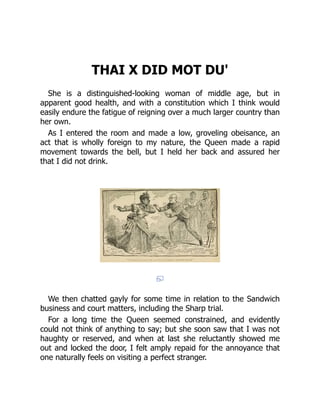
As I entered the room and made a low, groveling obeisance, an
act that is wholly foreign to my nature, the Queen made a rapid
movement towards the bell, but I held her back and assured her
that I did not drink.
We then chatted gayly for some time in relation to the Sandwich
business and court matters, including the Sharp trial.
For a long time the Queen seemed constrained, and evidently
could not think of anything to say; but she soon saw that I was not
haughty or reserved, and when at last she reluctantly showed me
out and locked the door, I felt amply repaid for the annoyance that
one naturally feels on visiting a perfect stranger.
44.
From what shesaid regarding her dynasty I gather that it consists
of a covey of half-grown islands in the Pacific, inhabited by people
who were once benighted and carnivorous, but happy. Now they are
well-informed and bilious, while they revel in suspenders and rum,
with all the blessings of late hours, civilization and suicide.
The better classes of the Sandwich Islands have the same
customs which prevail here, and the swallow-tail coat is quite
prevalent there. The low-neck and short-sleeve costume is even
carried to a greater excess, perhaps, and all opera tickets read:
Admit the Bearer and Barer.
In answer to a question of my own, the Queen said that crops in
the Sandwich Islands were looking well, and that garden truck was
far in advance of what she saw here.
She said that they had pie-plant in her garden big enough to eat
before she came away, and new potatoes were as big as walnuts.
Still, she is enjoying herself here first-rate, and says she sees many
pleasing features about New York which will ever decorate the
tablets of her memory.
I thanked her for this neat little compliment, and told her I should
always regard her in the same manner.
I then wrote a little Impromptu stanza in her autograph album,
wrung Her Majesty's hand, and retired with another suppliant and
crouching bow, which indicated a contrite spirit, but was calculated
to deceive.
I took the liberty of extending to Her Majesty the freedom of the
city, and asked her to visit our pressrooms and see us squat our
burning thoughts into a quarter of a million copies of the paper, and
all for two cents.
I also asked her to come up any time and read our Hawaii
exchanges, for I know how lonely anybody can be in a great city
sometimes, and how one yearns for a glimpse of his country paper.
The Queen is well paid while she reigns; and even while away as
she is now, with her scepter standing idly in the umbrella rack at
45.
home, and alarge pink mosquito net thrown over the throne, her
pay is still going on night and dav.
The above is substantially all that I said during the interview,
though the Queen said something as I came out of the room,
escorted by the janitor, which I did not quite catch.
I did say, however, just before leaving the room, that I regretted
sincerely the unfortunate time of the year at which Her Majesty had
decided to visit us, it being rather between hay and grass, as it
were, for as there was no r in the month it was a little too late for
missionaries and a little too early for watermelons.
It was-only an instant later that I joined the janitor at the foot of
the stairs.
This evening the Queen will visit the Casino and see Mr. Wilson try
for the three hundred and eighty-second time to restrain the flowing
leg of his green plush pantaloons.
46.
F
A WORD OFEXPLANATION.
or the benefit of my readers, many of whom are not what
might be called practical newspaper men and women, I will say
that if your time is very precious, and life is too short for you to
fool away your evenings reading local advertisements, and you are
at times in grave doubt as to what is advertisement and what is
news, just cast your eye to the bottom of the article, and if there is a
foot-note which lays "tylfritu3dp" or something of that stripe, you
may safely say that no matter how much confidence you may have
had in the editor up to that date, the article with a foot-note of that
kind is published from a purely mercenary motive, and the editor
may or may not indorse the sentiments therein enunciated.
47.
I
CHESTNUT-BURR—THE HUMORIST
INTERVIEWS HISGRACE THE DUKE
IN THE IMPROVED STYLE.
Marlborough's Seeming Lack of Appreciation of a Joke—Likewise
his Lack of Loquacity—A Cordial Invitation to the Duke to Visit the
Metropolis—Nye's Naive and Graceful Conservation on Society
Gossip.
Newport, Sept. 8.
have just terminated a pleasant call upon the Duke of Marbro at
his lodgings. I write his name Marbro because that is the way
we pronounce it here at Newport. In the language of my
ostensibly colored friend, Mr. Rankin, the amateur pronouncer would
call it Marl-bor-ough, with three grunts, while in fact Marbro, the
correct pronunciation of the name, is executed with but one grunt.
I found the Duke seated on a low ottoman, clad in a loosely fitting
costume of pajamas. It was so loose and negligé that it was on the
tip of my tongue to ask him if his mother made it for him out of his
father's old pajamas; but I suddenly remembered that I was in
Newport, and not in Tombstone, Arizona, and I restrained myself.
The Duke is suffering from a slight cold, which he contracted for
during the early part of the week. It resulted from his ignorance of
our changeable and freckle-minded climate. On Tuesday he took a
long stroll, and while several miles from his lodgings and wearing his
light summer cane, he was overtaken by a severe and sudden
change in the temperature. The Marbros are not a strong race, and I
am told that one of the Duke's second cousins died of pneumonia
48.
from exposing himselfto the severity of a Christmas-day frolic clad
in an autumn cane.
The Duke rose languidly as I entered, and, taking a reef in his
pajamas clothes, looked at me in an inquiring way which betokened
that, though of lineage high, he was not entirely at his ease in my
presence.
"Duke," said I, standing my umbrella up in the corner to show my
childlike confidence in him, "how's your conduct?"
In five minutes afterwards I would have given worlds if I could
have recalled my rash words. I did not mean anything more than to
utter a piece of pleasantry, for I am passionately fond of pleasantry
even in society; but Marbro seemed to take it to heart and to feel
distressed. He made a low, guttural sound, but his reply seemed to
die away in the mansard roof of his mouth. He stammered out
something which sounded like the wail of a damned soul. At least it
struck me to be like that, although my lot has not been cast among
that class of souls since I got out of politics, and I may have
forgotten their style of wail.
To hide his embarrassment, Marbro "rosined" his eye and put a
large glass paper weight in it. He then regarded me with some
amazement through this piece of brick-a-brac, while I poured out a
grown person's dose of Rectified Ruin which stood on the escritoire
and drank it with a keen relish, which showed that I trusted him
implicitly. Everything I did was done to make Marbro forget himself
and feel at his ease.
I told him I had known the Marbros in Maine ever since I was a
boy; that we didn't feel above them then, and it would be a poor
time to begin now at my time of life to look down on people just
because I now wrote pieces for the paper, many of which were
afterwards printed. We always thought that the Marbros, or
Marlboroughs, of Maine, got their name from burrowing in the marl
along the Piscataquis, I said.
Thus I chatted on with him for an hour or two without seeming to
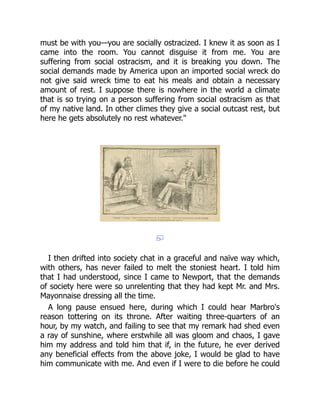
chirk him up at all. "Duke," said I at last, "I know what the matter
49.
must be withyou—you are socially ostracized. I knew it as soon as I
came into the room. You cannot disguise it from me. You are
suffering from social ostracism, and it is breaking you down. The
social demands made by America upon an imported social wreck do
not give said wreck time to eat his meals and obtain a necessary
amount of rest. I suppose there is nowhere in the world a climate
that is so trying on a person suffering from social ostracism as that
of my native land. In other climes they give a social outcast rest, but
here he gets absolutely no rest whatever."
I then drifted into society chat in a graceful and naïve way which,
with others, has never failed to melt the stoniest heart. I told him
that I had understood, since I came to Newport, that the demands
of society here were so unrelenting that they had kept Mr. and Mrs.
Mayonnaise dressing all the time.
A long pause ensued here, during which I could hear Marbro's
reason tottering on its throne. After waiting three-quarters of an
hour, by my watch, and failing to see that my remark had shed even
a ray of sunshine, where erstwhile all was gloom and chaos, I gave
him my address and told him that if, in the future, he ever derived
any beneficial effects from the above joke, I would be glad to have
him communicate with me. And even if I were to die before he could
50.
truly say thathe had been benefited by this joke and grapple with its
keen, incisive nub, my grandchildren would be tickled almost to
death to know that he had taken it to pieces and put it together
again and found out how it was built and laugh at its ingenious
mechanism.
I conversed with the Duke some time about the way his visit to
Newport had depressed the price of real estate, and offered him the
freedom of New York, hoping that he could depress the price of real
estate there so that I could buy some.
"But," said I, assuming an air of perfect repose, as I flung myself
on a low couch in such a way as to give a faint view of my new red
socks, "you will find it different in New York. Social ostracism there
will not materially affect the price of real estate in the neighborhood
of the postoffice. In fact, Marbro," said I, regarding him earnestly for
a moment through the bottom of a cut-glass tumbler, "there is not
enough English social ostracism in New York to supply the demand.
Come to our young and thriving town, a town that is rich in
resources and liabilities; a town that threatens to rival Omaha as a
railroad center; a town where a B. and O. deal has been a common
occurrence every day for over a year; a town where you can ride on
the elevated trains and get yourself pinched in the iron gate by the
guard or go down to Wall street and get pinched by the directors; a
town where a man like Henry S. Ives can buy about seven million
dollars' worth of stuff that he can't pay for, while a poor man who
goes into a general store to buy a pair of ear muffs is followed up by
a private detective for fear he may run his finger into the molasses
barrel and then lick it syruptitiously. Come on, Duke," said I, growing
more talkative as the fumes of his fifty-two dollar liquor rose to my
surprised and delighted brains; "come on to New York and mix up
with us, and get on to our ways."
"See Fulton market by midnight, bite off a piece of atmosphere
from Castle Garden, and come with me to see Guiteau's head in the
museum. Guiteau was the last of a long line of assassins. He
prophesied that everyone connected with his trial would come to a
bad end. Quite a number of those connected with this celebrated
51.
trial are alreadydead, and more especially Mr. Guiteau himself,
whose skeleton is in the Smithsonian Institution, his viscera in the
Potomac, and his head in a jar of alcohol. If you will come to New
York, Marbro, you will have a good time, and the rose geraniums will
come back to your pallid and durable cheek.
"If you will give us a whirl, Duke," said I, selecting an umbrella
from the decorated crock in the hall and coming back to where he
still sat, "you will be pleased and gratified with us; and if you can
spare time to come over and see me personally I would try to be as
cordial and chatty as you have been with me. No man ever
entertained me as you have, or sat and examined me through the
bottom of an old microscope for two hours, to be forgotten again by
me. Marbro, if you will come to New York, we will go and visit
anybody's tomb that you may designate."
I then let myself out of the house with an adjustable pass-key and
hastened away. Shortly after I got back to my own lodgings,
sometimes called a room, a lackey from the Duke, wearing a livery-
colored lively, handed me a note from Marbro, in which he said he
hoped that in case I used this interview for publication I would be
careful to give his exact language.
In my poor, weak way, I think I have done so.
52.
T
THE CHINESE COMPOSITOR.
heChinese compositor cannot sit at his case as our printers
do, but must walk from one case to another constantly, as the
characters needed cover such a large number, that they
cannot be put into anything like the space used in the English
newspaper office. In setting up an ordinary piece of manuscript, the
Chinese printer will waltz up and down the room for a few moments,
and then go down stairs for a line of lower case. Then he takes the
elevator and goes up into the third story after some caps, and then
goes out into the woodshed for a handful of astonishers. The
successful Chinese compositor doesn't need to be so very intelligent,
but he must be a good pedestrian.
53.
T
THE TRUE AMERICAN.
hetrue American would rather work himself into luxury or the
lunatic asylum than to hang like a great wart upon the face of
nature.
54.
T
CHESTNUT-BURR—XII "THE OLD
MANELOQUENT."
Sitting Bull before the Council of the Sioux Nation—An Impressive
Speech—Civilization and the Paleface Doing their Deadly Work—The
Moccasins of a Mighty Nation.
he following speech of Sitting Bull has been specially
translated and reported by our Indian editor, who is also
wholesale and retail dealer in deceased languages, and
general agent for home-made Sioux rhetoric and smoke-tanned
Indian eloquence. New laid Indian laments with bead trimmings.
Compiler of novel and desirable styles of war dances. Indian
eloquence furnished to debating clubs and publishers of school
readers:
"Warriors and war-scarred veterans of the frontier; Once more the
warpath is overgrown with bunch grass, and the tomahawk slumbers
in the wigwam of the red man. Grim-visaged war has given place to
the piping times of peace. The cold and cruel winter is upon lus. It
has been upon us for some time.
"The wail of departed spirits is on the night wind, and the wail of
the man with the chilblain answers back from the warrior's wigwam.
"Children of the forest, we are few. Where once the shrill war-
whoop of the chieftain collected our tribe like the leaves of the
forest, I might now yell till the cows come home without bringing
out a quorum.
"We are fading away before the march of the paleface, and
sinking into oblivion like the snowflake on the bosom of the Stinking
Water.
55.
"Warriors, I amthe last of a mighty race. We were a race of
chieftains. Alas! we will soon begone. The Bull family will soon pass
from the face of the earth. Ole is gone, and John is failing, and I
don't feel very well myself. We are the victims of the paleface, and
our lands are taken away.
"A few more suns, and the civilization, and valley tan, and hand
made sour mash, and horse liniment of the paleface will have done
their deadly work.
"Our squaws and pappooses are scattered to the four winds of
heaven; and we are left desolate.
"Where is The-Daughter-of-the-Tempest? Where is The-Wall-Eyed-
Maiden-With-the-Peeled-Nose?
"Where is Victoria Regina Dei Gracia Sitting Bull? Where is Knock-
Kneed Chemiloon? Where are Sway-Back Sue and Meek-Eyed
Government Socks?
"They have sunk beneath the fire-waters of the goggle-eyed
Caucasian. They have succumbed to the delirum triangles, and when
I call them they come not. They do not hear my voice. Their moans
are heard upon the still night air, and they cry for revenge. Look at
the sad remnant of the family of Sitting Bull, your chief. One sore-
eyed squaw is left alone. Her face is furrowed o'er with the famine of
many winters, and her nose is only the ruin of its former greatness.
Her moccasins are worn out, and the soldier pants she wears are too
long for her. She is drunk also. She is not as drunk as she can get,
but she is hopeful and persevering. She has also learned to lie like
the white man. She is now an easy, extemporaneous liar. When we
gather around the campfire and enact our untutored lies in the
gloaming, Lucretia Borgia Skowhegan Sitting Bull, with the
inspiration of six fingers of agency coffin varnish, proceeds to tell the
prize prevarication, and then the house adjourns, and nothing can
be heard but the muffled tread of the agency corn beef, going out to
get some fresh air. Lucretia Borgia is also becoming slovenly. It is
evening, and yet she has not donned her evening dress. Her back
hair is unkempt, and her front hair is unbung. Pretty soon I will take
56.
a tomahawk andbang it for her. She seems despondent and
hopeless. As she leans against the trunk of a mighty oak and
scratches her back, you can see that her thoughts are far away. Her
other suspender is gone, but she don't care a cold, smooth clam.
She is thinking of her childhood days by the banks of Minnehaha.
"Warriors, we stand in the moccasins of a mighty nation. We
represent the starving remnant of the once powerful Sioux. Our
pirogue stands idly on the shore. I don't know what a pirogue is, but
it stands idly on the shore.
"When the spring flowers bloom again, and the grass is green
upon the plains, we will once more go upon the warpath. We will
avenge the wrongs of our nation. I have not fully glutted my
vengeance. I have seven or eight more gluts on hand, and we will
shout our war-cry once more, and mutilate some more Anglo-
Saxons. We will silence the avenging cries of our people. We will
spatter the green grass and gray greasewood with the gore of the
paleface, and feed the white-livered emigrant to the coyote. We will
spread death and desolation everywhere, and fill the air with gum
overshoes and remains. Let us yield up our lives clearly while we
mash the paleface beyond recognition, and shoot his hired man so
full of holes that he will look like a suspension bridge.
"Warriors, there is our hunting ground. The buffalo, the antelope,
the sage hen and the jackass rabbit are ours. Ours to enjoy, ours to
perpetuate, ours to transmit. The Great Spirit created these animals
for the red man, and not for the bilious tourists, between whose legs
the chestnut sunlight penetrates clear up to his collar bone."
"Then we will ride down on the regular army, when he is thinking
of something else, and we will scare him into convulsions, and our
57.
medicine men willattend to the convulsions while we sample the
supplies.
"Then we will take some cold sliced Indian agent and some bay
rum, and go on a picnic.
"Warriors, farewell. Be virtuous and you will be happy; but you will
be lonesome, sometimes. Think of what I have said to you about the
council fire, and govern yourselves accordingly, We will not murmur
at the celluloid cracker and cast iron codfish ball, but in the spring
we will have veal cutlets for breakfast, and peace commissioner on
toast for dinner. The squaw of Sitting Bull shall have a new plug hat,
and if the weather is severe, she shall have two of them.
"Warriors, farewell. I am done. I have spoken. I have nothing
more to say. Sic semper domino. Plumbago erysipelas, in hock
eureka, sciataca, usufruct, lim-burger, gobraugh."
58.
I
CHESTNUT-BURR XIV—THE
AMENDE HONORABLE.
LingeringTraditions—The Molder of Public Opinion—No Mirth in
making the Amende Honorable—Four Minutes to Decide.
t is rather interesting to watch the manner which old customs
have been slightly changed and handed down from age to age.
Peculiarities of old traditions still linger among us, and are
forked over to posterity like a wappy-jawed teapot or a long-time
mortgage. No one can explain it, but the fact still remains patent
that some of the oddities of our ancestors continue to appear, from
time to time, clothed in the changing costumes of the prevailing
fashion.
Along with these choice antiquities, and carrying the nut-brown
flavor of the dead and relentless years, comes the amende
honorable. From the original amende in which the offender appeared
in public clothed only in a cotton-flannel shirt, and with a rope about
his neck as an evidence of a formal recantation, down to this day
when (sometimes) the pale editor, in a stickful of type, admits that
"his informant was in error," the amende honorable has marched
along with the easy tread of time. The blue-eyed molder of public
opinion, with one suspender hanging down at his side, and writing
on a sheet of news-copy paper, has a more extensive costume,
perhaps, than the old-time offender who bowed in the dust in the
midst of the great populace, and with a halter under his ear
admitted his offense, but he does not feel any more cheerful over it.
I have been called upon several times to make the amende
honorable, and I admit that it is not an occasion of mirth and
merriment. People who come into the editorial office to invest in a
59.
Welcome to ourwebsite – the ideal destination for book lovers and
knowledge seekers. With a mission to inspire endlessly, we offer a
vast collection of books, ranging from classic literary works to
specialized publications, self-development books, and children's
literature. Each book is a new journey of discovery, expanding
knowledge and enriching the soul of the reade
Our website is not just a platform for buying books, but a bridge
connecting readers to the timeless values of culture and wisdom. With
an elegant, user-friendly interface and an intelligent search system,
we are committed to providing a quick and convenient shopping
experience. Additionally, our special promotions and home delivery
services ensure that you save time and fully enjoy the joy of reading.
Let us accompany you on the journey of exploring knowledge and
personal growth!
ebookmass.com