Leadership in Nursing
By
Rahmat Ullah
Nursing Director MTI KTH, Peshawar
Introduction
• Front-line nurse leaders are essential to all
aspects of any health care organization (Donaher,
Russell, Scoble, & Chen, 2007; Gallo, 2007; Kirby & DeCampli, 2008).
• Historically, these nurse leaders are promoted to
their role because of proficiency in technical
nursing skills rather than leadership ability (Garman,
Butler, & Brinkmeyer, 2006).
• It is estimated that as many as 40% of new
supervisors fail in their role due to lack of training
and proper preparation (Traynor, 2008).
Introduction
• Historically nursing has subscribed to a task-oriented
model of leadership that focuses on what mistakes are
made (Cummings et al., 2010), rather than on shared vision and
relationships.
• This model of leadership is perceived as dualistic and
dissonant, resulting in staff dissatisfaction and high
turnover (Cummings et al., 2010).
• The gap between what nurses know about management
and what they need to know can be vast.
• The only way hospitals can bridge this gap is to provide
educational resources to prepare a new leader for
successful performance (McLarty & McCartney, 2009).
Introduction
• Clinical leadership is not a new concept
• There is a need to optimise leadership potential
across the healthcare professions
• To enable this change to take place successfully
and to support nurses we need to further
develop the leadership capability within the
system
• Effective leadership at all levels is essential to
delivering and ensuring high quality, safe and
effective care
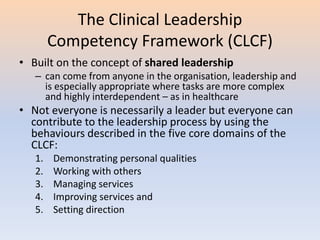
The Clinical Leadership
Competency Framework (CLCF)
• Built on the concept of shared leadership
– can come from anyone in the organisation, leadership and
is especially appropriate where tasks are more complex
and highly interdependent – as in healthcare
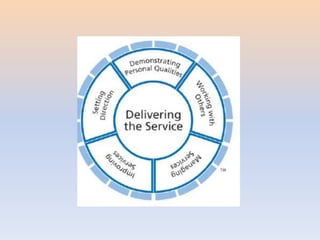
• Not everyone is necessarily a leader but everyone can
contribute to the leadership process by using the
behaviours described in the five core domains of the
CLCF:
1. Demonstrating personal qualities
2. Working with others
3. Managing services
4. Improving services and
5. Setting direction
Demonstrating Personal
Qualities
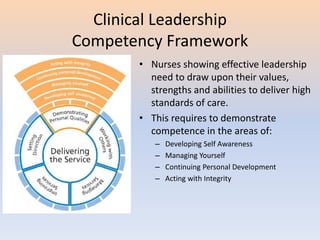
Clinical Leadership
Competency Framework
• Nurses showing effective leadership
need to draw upon their values,
strengths and abilities to deliver high
standards of care.
• This requires to demonstrate
competence in the areas of:
– Developing Self Awareness
– Managing Yourself
– Continuing Personal Development
– Acting with Integrity
Domain 1: Demonstrating Personal
Qualities
– Effective leaders need to draw upon their values, strengths
and abilities to deliver high standards of care.
– This requires leaders to demonstrate competence in the areas
of:
Element 1.1 Developing self awareness
The competency statements for Element 1.1 are:
– Recognise and articulate their own values and principles,
understanding how these may differ from those of other
individuals and groups
– Identify their own strengths and limitations, the impact of their
behaviour on others, and the effect of stress on their own
behaviour
– Identify their own emotions and prejudices and understand how
these can affect their judgment and behaviour
– Obtain, analyse and act on feedback from a variety of sources
Competency- Self Awareness
• Admits personal mistakes, learns from them, and
moves on to correct the situation
• Does an honest self-assessment
• Seeks corrective feedback to improve himself or
herself
• Sorts out his or her strengths & weaknesses fairly
accurately (i.e., knows himself or herself)
Increased Self-awareness
• Self-awareness
– The ability to recognize and understand your
moods, emotions, drives and their effect on
others
– The foundation on which self-development is built
• Increases as you receive feedback from others
Developing self awareness
Learning And Development Opportunities
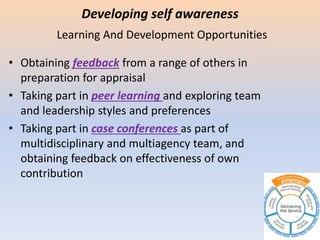
• Obtaining feedback from a range of others in
preparation for appraisal
• Taking part in peer learning and exploring team
and leadership styles and preferences
• Taking part in case conferences as part of
multidisciplinary and multiagency team, and
obtaining feedback on effectiveness of own
contribution
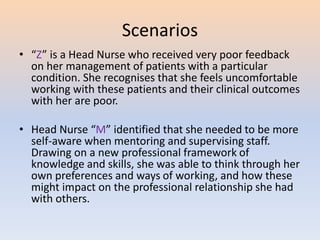
Scenarios
• “Z” is a Head Nurse who received very poor feedback
on her management of patients with a particular
condition. She recognises that she feels uncomfortable
working with these patients and their clinical outcomes
with her are poor.
• Head Nurse “M” identified that she needed to be more
self-aware when mentoring and supervising staff.
Drawing on a new professional framework of
knowledge and skills, she was able to think through her
own preferences and ways of working, and how these
might impact on the professional relationship she had
with others.
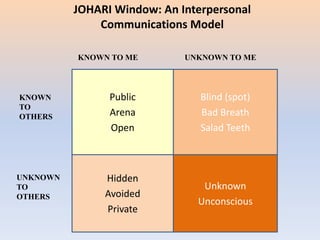
Public
Arena
Open
Blind (spot)
Bad Breath
Salad Teeth
Hidden
Avoided
Private
Unknown
Unconscious
JOHARI Window: An Interpersonal
Communications Model
KNOWN TO ME UNKNOWN TO ME
KNOWN
TO
OTHERS
UNKNOWN
TO
OTHERS
___________
___________
___________
___________
___________
___________
___________
___________
___________
___________
___________
___________
JOHARI Window: A Self-reflection Tool
KNOWN TO ME UNKNOWN TO ME
KNOWN
TO
OTHERS
UNKNOWN
TO
OTHERS
Figure 8.1
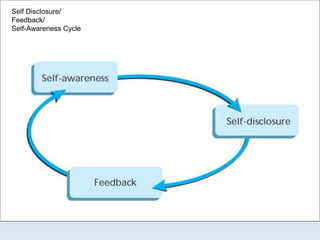
Self Disclosure/
Feedback/
Self-Awareness Cycle
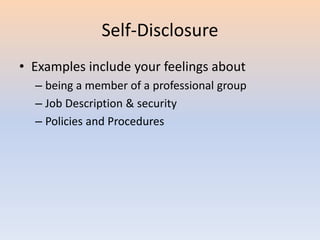
Self-Disclosure
• Examples include your feelings about
– being a member of a professional group
– Job Description & security
– Policies and Procedures
Domain 1: Demonstrating Personal Qualities
1.2 Managing Yourself
• Nurses show leadership through managing
themselves: organising and managing themselves
while taking account of the needs and priorities of
others.
Competent clinicians:
– Manage the impact of their emotions on their behaviour
with consideration of the impact on others
– Are reliable in meeting their responsibilities and
commitments to consistently high standards
– Ensure that their plans and actions are flexible, and take
account of the needs and work patterns of others
– Plan their workload and activities to fulfil work
requirements and commitments, without compromising
their own health
Managing Yourself
Learning And Development Opportunities
• Liaising with colleagues in the planning and
implementation of work rotas and identifying
areas for improvement
• Managing service pressures
• Using feedback and discussion to reflect on how
a personally emotional situation affected
communication with a carer
• Meeting deadlines for completing written
clinical notes on time in conjunction with
meeting other demands
• Critically analysing and evaluating an area of
practice
Scenario
• A newly promoted nurse realises that his role has changed
with added responsibilities.
• He believes he can avoid making the mistakes that some of
his peers, in similar circumstances, have made.
• In conjunction with his line manager he develops a plan
that will be implemented over a six month time frame to
integrate the added responsibilities without impacting on
his colleagues and his own well being.
• At the three month point he reviews his progress with his
line manager and receives positive feedback.
• However, his colleagues identify that he appears more
stressed.
• He reflected on this and began to delegate some of his
responsibilities.
1. Demonstrating Personal Qualities
1.3 Continuing Personal Development
• Clinicians show leadership through continuing
personal development: learning through
participating in continuing professional development
and from experience and feedback.
Competent clinicians:
– Actively seek opportunities and challenges for personal
learning and development
– Acknowledge mistakes and treat them as learning
opportunities
– Participate in continuing professional development
activities
– Change their behaviour in the light of feedback and
reflection
1.3 Continuing Personal Development
Learning And Development Opportunities
• Taking an active part in journal clubs and
multidisciplinary training events and activities
• Seeking feedback on performance from clinical
colleagues and service users
• Seeking opportunities to learn from other
professionals in everyday practice or through formal
opportunities
• Reviewing own practice against peers and best
practice examples
• Taking part in critical incident event audits
• Undertaking to try a new intervention with
supervision/ mentoring
Scenario
• Midwife “B” has had good experience with her
own supervisor of midwives when she needed
advice and felt that it had improved her practice
by helping her to reflect on her actions.
• She decides to train to be a supervisor herself in
order to continue to develop her own mentoring
and learning skills.
• She researches how she can obtain relevant
training, and the associated costs, and presents a
cost/benefit case to her manager in support of
her request for training
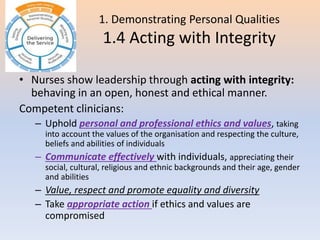
1. Demonstrating Personal Qualities
1.4 Acting with Integrity
• Nurses show leadership through acting with integrity:
behaving in an open, honest and ethical manner.
Competent clinicians:
– Uphold personal and professional ethics and values, taking
into account the values of the organisation and respecting the culture,
beliefs and abilities of individuals
– Communicate effectively with individuals, appreciating their
social, cultural, religious and ethnic backgrounds and their age, gender
and abilities
– Value, respect and promote equality and diversity
– Take appropriate action if ethics and values are
compromised
1.4 Acting with Integrity
Learning And Development Opportunities
• Taking part in ethics discussions and forums
• Taking part in clinical case reviews with
multidisciplinary teams
• Acting as mentor to students and peers faced
with difficult ethical judgments
• Challenging behaviours that are contrary to
promoting equality and diversity
THANK YOU

Session -2 Demonstrating Personal Qualities.pptx

  • 1.
    Leadership in Nursing By RahmatUllah Nursing Director MTI KTH, Peshawar
  • 2.
    Introduction • Front-line nurseleaders are essential to all aspects of any health care organization (Donaher, Russell, Scoble, & Chen, 2007; Gallo, 2007; Kirby & DeCampli, 2008). • Historically, these nurse leaders are promoted to their role because of proficiency in technical nursing skills rather than leadership ability (Garman, Butler, & Brinkmeyer, 2006). • It is estimated that as many as 40% of new supervisors fail in their role due to lack of training and proper preparation (Traynor, 2008).
  • 3.
    Introduction • Historically nursinghas subscribed to a task-oriented model of leadership that focuses on what mistakes are made (Cummings et al., 2010), rather than on shared vision and relationships. • This model of leadership is perceived as dualistic and dissonant, resulting in staff dissatisfaction and high turnover (Cummings et al., 2010). • The gap between what nurses know about management and what they need to know can be vast. • The only way hospitals can bridge this gap is to provide educational resources to prepare a new leader for successful performance (McLarty & McCartney, 2009).
  • 4.
    Introduction • Clinical leadershipis not a new concept • There is a need to optimise leadership potential across the healthcare professions • To enable this change to take place successfully and to support nurses we need to further develop the leadership capability within the system • Effective leadership at all levels is essential to delivering and ensuring high quality, safe and effective care
  • 5.
    The Clinical Leadership CompetencyFramework (CLCF) • Built on the concept of shared leadership – can come from anyone in the organisation, leadership and is especially appropriate where tasks are more complex and highly interdependent – as in healthcare • Not everyone is necessarily a leader but everyone can contribute to the leadership process by using the behaviours described in the five core domains of the CLCF: 1. Demonstrating personal qualities 2. Working with others 3. Managing services 4. Improving services and 5. Setting direction
  • 7.
  • 8.
    Clinical Leadership Competency Framework •Nurses showing effective leadership need to draw upon their values, strengths and abilities to deliver high standards of care. • This requires to demonstrate competence in the areas of: – Developing Self Awareness – Managing Yourself – Continuing Personal Development – Acting with Integrity
  • 9.
    Domain 1: DemonstratingPersonal Qualities – Effective leaders need to draw upon their values, strengths and abilities to deliver high standards of care. – This requires leaders to demonstrate competence in the areas of: Element 1.1 Developing self awareness The competency statements for Element 1.1 are: – Recognise and articulate their own values and principles, understanding how these may differ from those of other individuals and groups – Identify their own strengths and limitations, the impact of their behaviour on others, and the effect of stress on their own behaviour – Identify their own emotions and prejudices and understand how these can affect their judgment and behaviour – Obtain, analyse and act on feedback from a variety of sources
  • 10.
    Competency- Self Awareness •Admits personal mistakes, learns from them, and moves on to correct the situation • Does an honest self-assessment • Seeks corrective feedback to improve himself or herself • Sorts out his or her strengths & weaknesses fairly accurately (i.e., knows himself or herself)
  • 11.
    Increased Self-awareness • Self-awareness –The ability to recognize and understand your moods, emotions, drives and their effect on others – The foundation on which self-development is built • Increases as you receive feedback from others
  • 12.
    Developing self awareness LearningAnd Development Opportunities • Obtaining feedback from a range of others in preparation for appraisal • Taking part in peer learning and exploring team and leadership styles and preferences • Taking part in case conferences as part of multidisciplinary and multiagency team, and obtaining feedback on effectiveness of own contribution
  • 13.
    Scenarios • “Z” isa Head Nurse who received very poor feedback on her management of patients with a particular condition. She recognises that she feels uncomfortable working with these patients and their clinical outcomes with her are poor. • Head Nurse “M” identified that she needed to be more self-aware when mentoring and supervising staff. Drawing on a new professional framework of knowledge and skills, she was able to think through her own preferences and ways of working, and how these might impact on the professional relationship she had with others.
  • 14.
    Public Arena Open Blind (spot) Bad Breath SaladTeeth Hidden Avoided Private Unknown Unconscious JOHARI Window: An Interpersonal Communications Model KNOWN TO ME UNKNOWN TO ME KNOWN TO OTHERS UNKNOWN TO OTHERS
  • 15.
  • 16.
  • 17.
    Self-Disclosure • Examples includeyour feelings about – being a member of a professional group – Job Description & security – Policies and Procedures
  • 18.
    Domain 1: DemonstratingPersonal Qualities 1.2 Managing Yourself • Nurses show leadership through managing themselves: organising and managing themselves while taking account of the needs and priorities of others. Competent clinicians: – Manage the impact of their emotions on their behaviour with consideration of the impact on others – Are reliable in meeting their responsibilities and commitments to consistently high standards – Ensure that their plans and actions are flexible, and take account of the needs and work patterns of others – Plan their workload and activities to fulfil work requirements and commitments, without compromising their own health
  • 19.
    Managing Yourself Learning AndDevelopment Opportunities • Liaising with colleagues in the planning and implementation of work rotas and identifying areas for improvement • Managing service pressures • Using feedback and discussion to reflect on how a personally emotional situation affected communication with a carer • Meeting deadlines for completing written clinical notes on time in conjunction with meeting other demands • Critically analysing and evaluating an area of practice
  • 20.
    Scenario • A newlypromoted nurse realises that his role has changed with added responsibilities. • He believes he can avoid making the mistakes that some of his peers, in similar circumstances, have made. • In conjunction with his line manager he develops a plan that will be implemented over a six month time frame to integrate the added responsibilities without impacting on his colleagues and his own well being. • At the three month point he reviews his progress with his line manager and receives positive feedback. • However, his colleagues identify that he appears more stressed. • He reflected on this and began to delegate some of his responsibilities.
  • 21.
    1. Demonstrating PersonalQualities 1.3 Continuing Personal Development • Clinicians show leadership through continuing personal development: learning through participating in continuing professional development and from experience and feedback. Competent clinicians: – Actively seek opportunities and challenges for personal learning and development – Acknowledge mistakes and treat them as learning opportunities – Participate in continuing professional development activities – Change their behaviour in the light of feedback and reflection
  • 22.
    1.3 Continuing PersonalDevelopment Learning And Development Opportunities • Taking an active part in journal clubs and multidisciplinary training events and activities • Seeking feedback on performance from clinical colleagues and service users • Seeking opportunities to learn from other professionals in everyday practice or through formal opportunities • Reviewing own practice against peers and best practice examples • Taking part in critical incident event audits • Undertaking to try a new intervention with supervision/ mentoring
  • 23.
    Scenario • Midwife “B”has had good experience with her own supervisor of midwives when she needed advice and felt that it had improved her practice by helping her to reflect on her actions. • She decides to train to be a supervisor herself in order to continue to develop her own mentoring and learning skills. • She researches how she can obtain relevant training, and the associated costs, and presents a cost/benefit case to her manager in support of her request for training
  • 24.
    1. Demonstrating PersonalQualities 1.4 Acting with Integrity • Nurses show leadership through acting with integrity: behaving in an open, honest and ethical manner. Competent clinicians: – Uphold personal and professional ethics and values, taking into account the values of the organisation and respecting the culture, beliefs and abilities of individuals – Communicate effectively with individuals, appreciating their social, cultural, religious and ethnic backgrounds and their age, gender and abilities – Value, respect and promote equality and diversity – Take appropriate action if ethics and values are compromised
  • 25.
    1.4 Acting withIntegrity Learning And Development Opportunities • Taking part in ethics discussions and forums • Taking part in clinical case reviews with multidisciplinary teams • Acting as mentor to students and peers faced with difficult ethical judgments • Challenging behaviours that are contrary to promoting equality and diversity
  • 26.

Editor's Notes

  • #16 Invite you to take time to reflect on how you might practice giving and receiving feedback and engaging in self-disclosure. This chart is for yourself