![Institut Mines-Télécom
Clustered graphs layout algorithms -
Summary
Information used
Method Structura
l
Profiles Communitie
s
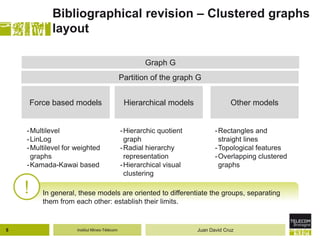
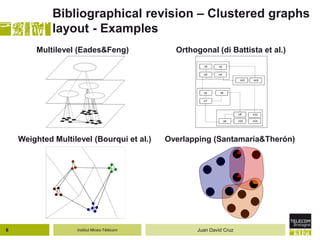
Multilevel /Force directed [Eades&Feng 1999] No No Yes
Rectangles and straight lines [diGiacomo 2007 ] No No Yes
LinLog /Force model [Noack 2003] Yes No No
Hierarchical /Quotient graph [Brockenauer 2001] No No Yes
Multilevel /Force directed w. graphs [Bourqui et al.
2007]
Yes No Yes
Overlapping clustered graphs [Santamaría et al. 2008] No No Yes
Radial representation [Mun& Ha 2005] Yes No No
Hierarchical /visual clustering [Batagelj et al. 2011] Yes No No
Kamada-Kawai based [Shi et al. 2009] No No Yes
Topological features based [Archambault et al. 2007] Yes No Yes
Multivariate layout algorithm (My algorithm) Yes Yes Yes
7 Juan David Cruz](https://image.slidesharecdn.com/sunbeltvisualizationv1-130523034419-phpapp02/85/Sunbelt-2013-Presentation-7-320.jpg)
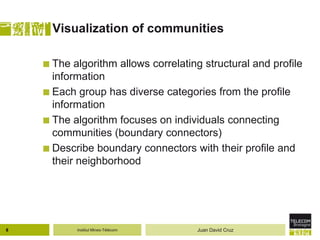
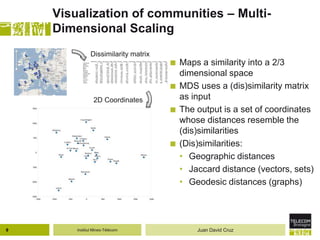
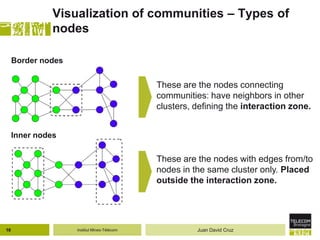
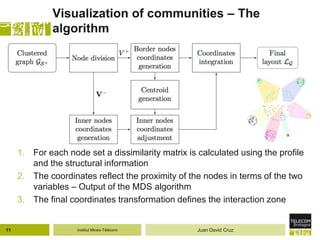
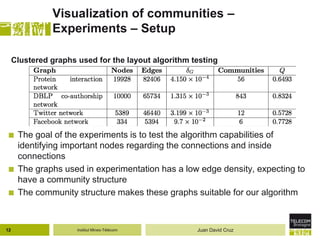
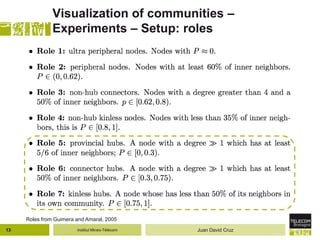
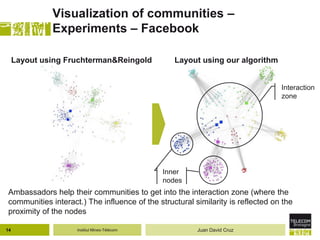
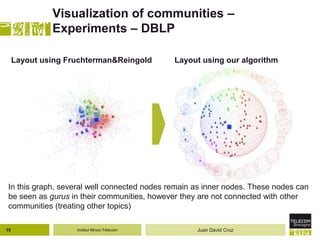
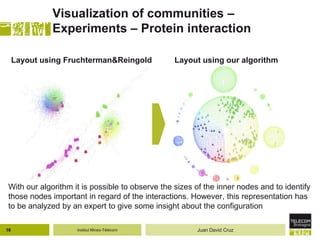
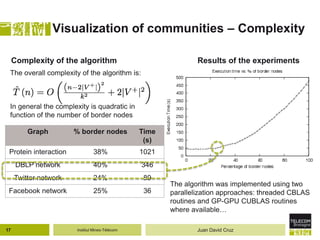
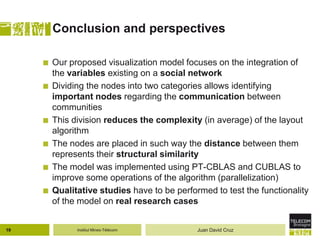
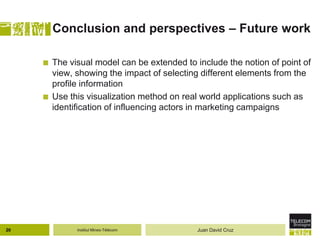

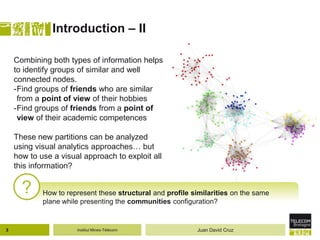
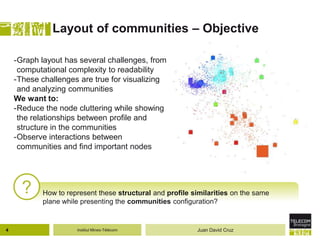
This document presents a new layout algorithm for visualizing communities in clustered social networks that integrates both structural and profile information. The algorithm (1) calculates dissimilarity matrices using profile and structural data, (2) performs multidimensional scaling to reflect node proximity, and (3) defines an interaction zone between communities. Experiments on Facebook, DBLP, and protein networks show it can identify important boundary nodes and observe community interactions. Future work includes extending the model to include viewpoints and applying it to real applications like marketing analysis.


![Community detection in social networks[1]](https://cdn.slidesharecdn.com/ss_thumbnails/communitydetectioninsocialnetworks1-121022180209-phpapp02-thumbnail.jpg?width=640&height=640&fit=bounds)


