
‘Optifood’ – Future Approach to
Improve Nutrition Programme
Planning and Policy Decisions in
SE Asia
Elaine Ferguson
London School of Hygiene & Tropical
Medicine
Improving health worldwide
www.lshtm.ac.uk
Introduction
• Under-nutrition contributes to maternal and child morbidity,
mortality and poor development outcomes.
• In order to reduce negative functional impacts of undernutrition on human potential, effective programmes/policies
are needed
• Tools based on mathematical modelling can generate evidence
to help inform nutrition programme planning and policy
decisions or support advocacy efforts; providing rapid,
objective and flexible methods for theoretically exploring
alternative nutrition interventions or different scenarios
Aims of
Presentation
• Briefly describe a new tool– Optifood - which is based on
linear programming analyses
• To describe its potential for informing nutrition
intervention programme planning and government policy
decisions; using examples of its application in south-east
Asia.
What is linear programming
analyses?
• Mathematical optimisation which selects the best
option from amongst all possible options given
specified criteria
• In Optifood, its diet modeling
What Optifood can do....
Formulate food-based recommendations (FBR) for a
specific target group
Test & compare FBRs → cost & nutrient adequacy
Identify nutrients whose requirements are difficult to
achieve using local foods → “problem nutrients”
Identify the lowest cost nutritionally best diet, and the
most expensive nutrient requirements to meet & the
most expensive food sources of nutrients
Types of issues it can address
• FOOD AVAILABILITY/ ACCESSIBILITY: Can locally available food
provide all nutrients needed by a target population?
• FOOD AFFORDABILITY: How much will the nutritionally best
diet cost ? → Cost transfer programme decisions.
• BEHAVIOUR CHANGE: What food-based recommendations
are best to promote for improving the nutritional status of the
target population?
LINKAGES .....
• NUTRITION PROGRAMME DESIGN & POLICY: What food-based
strategy should be promoted? Are there other foods available that
could fill the nutrient gaps if they were accepted? Is a specific
fortified food required to ensure a target population nutrient needs
are met? What will it cost in relation to alternative strategies?
• PREDICT PROGRAMME IMPACT: Is this food-based
intervention/fortified food likely to improve the nutritional status
of the target population?
• ADVOCACY: Evidence that the food supply will not provide
adequate intakes of nutrients x,y, z to selected target populations
→ the long term impacts on human health and capacity this implies
Data Requirements
• Dietary Surveys
– Quantitative intakes
(recalls, records)
– Food frequency data
• Market surveys
– Food cost per 100 g
edible portion
• Food composition tables
Optifood Analysis Structure
Model Constraints

Module Outputs

Food list

Check parameters

Min & max g/wk

Module#1

Food Patterns
Min & max serves/wk
Main food groups
Staples & snacks
Food sub-groups

Module#2

Energy content
Maximum cost

Module#3

(optional)

Food-based
recommendations (FBRs)

Nutrient content

Module#4

Create food-based
recommendations;
‘Problem nutrients’
Test & compare
alternative FBRs
Type of ‘problem
nutrient’
Cost analysis:
Lowest cost
nutritionally best diet
Food Composition Table
Energy
Protein
Water
Fat
Carbohydrate
Vitamin
Select Fe A
and Zn bioavailability
Vitamin C
B1
B2
B3
Ca
Fe
Zn
B6
B12
Folate
Define “Problem nutrients”
1. Can a nutritionally adequate diet be promoted
given local foods & food patterns?
% RNI/AI & Cost in 2 Best Diets
140
≥ 120
100
80
60
40
20
0

FP
no-FP
Module #2 Question:
• What food-based recommendations are
best to promote for this target group?
Examine Food patterns – observed
median vs best diet
25
20
15

FP Goal

10

No FP Goal

5
0
Best Food Sources of Nutrients
in Best Diet
Ca
%
Anchovy 13
Spinach 10

Fe
Liver
Tofu

%
28
22

Zn %
Liver 20
Rice 18

% of nutrient provided by each food

B-1
%
Anchovy 18
Banana 14
Food-based Recommendations
Tested and compared
Dairy

21 serves / week

Vegetables

21 serves / week

Meat, fish or eggs

5 serves / week

Legumes

7 serves/week
Module 3: test food-based recommendations (constraints)
using “worst-case scenario” level diets
Nutrient Intake Distribution
65% - 75% RNI (EAR )

Worst-case

Worst-case

Best-case

Best-case
Preliminary Results:
• Laos – 15 villages in Salavan district;
women & 6-23 month old children; 7day qualitative 24-hour recall
• Thailand – national nutrition survey;
6-23 month old children; 24-hour
recall and food frequency
questionnaire
• Vietnam – national food
consumption survey; women & 6-23
month old children; 24-hour recall
What are the ‘problem nutrients’?
i.e., RNI cannot be met with local foods
6 – 8 months

# ‘problem nutrients’

3

3

1

Ca, Fe, Zn

Ca

3

3

0

Ca, Fe, Zn
Vietnam

# ‘problem
nutrients’

Ca, Fe, Zn
Thailand

12 – 23 months

# ‘problem
nutrients’

Lao PDR

9 – 11 months

Ca, Fe, Zn

3

1

Ca, Fe, Zn

Fe

0
Number of ‘problem nutrients’
for women ...
Pregnant

# ‘problem
nutrients’

# ‘problem
nutrients’

3

2

0

Ca, Fe, folate

Ca, Fe

4

4

2

Ca, Fe, B2,

Ca, B2, B6,

Ca, Fe

folate

Vietnam

NPNL

# ‘problem
nutrients’

Lao PDR

Lactating

folate

NPNL – non-pregnant & non-lactating
Module #3 Results:
Food-based recommendations
(FBRs)
Number of nutrients for which
the best set of FBRs could
ensure >65% RNI(of 11
micronutrients)
12
10
8
Lao

6

Vietnam
Thailand

4
2
0
6-8 mth

9-11 mth 12-23 mth Pregnant

Lactating

NPNL
Number of countries & nutrients
for which FBRs could not ensure
adequacy for population
6-8 m
9-11 m
12-23 m
Pregnant
Lactating
NPNL

Ca
2
2
2
2
2
2

Fe
3
3
2
2
1
2

Zn
3
3
1

B1
1
1
2
1
1
1

B2

1
1
1

B3
1
1
2
2
2

B6
1
1
1
2

Folate

3
2
2
1
Multiple Micronutrient Powders - Laos
6-8 months
# nuts >65% RNI

9-11 months
# nuts >65% RNI

12-23 months
# nuts >65% RNI

FBR

6

5

5

MNP
1
2
3
4
5

6
8
8
10
10

6
8
8
10
10

1
4
5
7
10

1 + FBR
2 + FBR
3 + FBR
4+ FBR
5 + FBR

8
8
9
10
10

8
8
9
10
10

8
10
11
Food-based recommendations
9-11 month olds

12-23 month olds (not BF)

• Breastfeed on demand
• Feed meat, fish or eggs at
least twice per day
• Feed liver at least three times
per week
• Feed fruit every day

• Feed dairy products twice a day
• Feed meat, fish or eggs at least
twice per day
• Feed liver at least 3 times per
week
• Feed fruit every day
• Feed green leafy vegetables
twice per day

• Introduce vegetables into your
child’s diet as often as you can

• Feed other vegetables as often
as you can
Conclusions
• food-based approaches can improve the micronutrient content
of diets but they may not ensure dietary adequacy for all
nutrients especially
– Ca, Fe, and Zn for children;
and perhaps also thiamin, niacin & B6
– Ca, Fe, folate, B2 and B6 for women;
and perhaps also thiamin & niacin
• Diet modelling so the results are dependent on model
parameters especially
– RNIs used
– Food composition tables values
– Dietary data accuracy → database of foods servings and
food patterns
Acknowledgements
Lao – Ministry of Health
– Dr Sengchanh Kownnavong
– Dr Manithong Vonglokham

Thailand – Mahidol University
– Dr Nipa Rojroongwasiukul
– Dr Uraiporn Chittchang
– Dr Pattanee Winnichagoon

Vietnam – National Institute
of Nutrition
– Dr Tran Thaan Do
– Dr Tran Lua-NIN
– Dr Le Bach Mai
• Funding: European Union
Thank-you!
Compare intervention foods
example from Cambodia (6-8 months)
Foods
Winfood
Winfood-lite
CSB+
CSB++

J Kloppenborg-Heick, unpublished
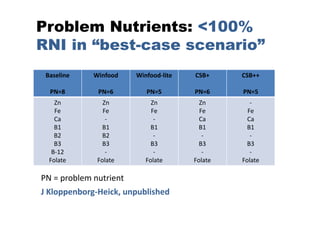
Problem Nutrients: <100%
RNI in “best-case scenario”
Baseline

Winfood

Winfood-lite

CSB+

CSB++

PN=8

PN=6

PN=5

PN=6

PN=5

Zn
Fe
Ca
B1
B2
B3
B-12
Folate

Zn
Fe
B1
B2
B3
Folate

Zn
Fe
B1
B3
Folate

Zn
Fe
Ca
B1
B3
Folate

Fe
Ca
B1
B3
Folate

PN = problem nutrient
J Kloppenborg-Heick, unpublished

OptiFood Improving Nutrition Programmes for the Future

  • 1.
    ‘Optifood’ – FutureApproach to Improve Nutrition Programme Planning and Policy Decisions in SE Asia Elaine Ferguson London School of Hygiene & Tropical Medicine Improving health worldwide www.lshtm.ac.uk
  • 2.
    Introduction • Under-nutrition contributesto maternal and child morbidity, mortality and poor development outcomes. • In order to reduce negative functional impacts of undernutrition on human potential, effective programmes/policies are needed • Tools based on mathematical modelling can generate evidence to help inform nutrition programme planning and policy decisions or support advocacy efforts; providing rapid, objective and flexible methods for theoretically exploring alternative nutrition interventions or different scenarios
  • 3.
    Aims of Presentation • Brieflydescribe a new tool– Optifood - which is based on linear programming analyses • To describe its potential for informing nutrition intervention programme planning and government policy decisions; using examples of its application in south-east Asia.
  • 4.
    What is linearprogramming analyses? • Mathematical optimisation which selects the best option from amongst all possible options given specified criteria • In Optifood, its diet modeling
  • 5.
    What Optifood cando.... Formulate food-based recommendations (FBR) for a specific target group Test & compare FBRs → cost & nutrient adequacy Identify nutrients whose requirements are difficult to achieve using local foods → “problem nutrients” Identify the lowest cost nutritionally best diet, and the most expensive nutrient requirements to meet & the most expensive food sources of nutrients
  • 6.
    Types of issuesit can address • FOOD AVAILABILITY/ ACCESSIBILITY: Can locally available food provide all nutrients needed by a target population? • FOOD AFFORDABILITY: How much will the nutritionally best diet cost ? → Cost transfer programme decisions. • BEHAVIOUR CHANGE: What food-based recommendations are best to promote for improving the nutritional status of the target population?
  • 7.
    LINKAGES ..... • NUTRITIONPROGRAMME DESIGN & POLICY: What food-based strategy should be promoted? Are there other foods available that could fill the nutrient gaps if they were accepted? Is a specific fortified food required to ensure a target population nutrient needs are met? What will it cost in relation to alternative strategies? • PREDICT PROGRAMME IMPACT: Is this food-based intervention/fortified food likely to improve the nutritional status of the target population? • ADVOCACY: Evidence that the food supply will not provide adequate intakes of nutrients x,y, z to selected target populations → the long term impacts on human health and capacity this implies
  • 8.
    Data Requirements • DietarySurveys – Quantitative intakes (recalls, records) – Food frequency data • Market surveys – Food cost per 100 g edible portion • Food composition tables
  • 9.
    Optifood Analysis Structure ModelConstraints Module Outputs Food list Check parameters Min & max g/wk Module#1 Food Patterns Min & max serves/wk Main food groups Staples & snacks Food sub-groups Module#2 Energy content Maximum cost Module#3 (optional) Food-based recommendations (FBRs) Nutrient content Module#4 Create food-based recommendations; ‘Problem nutrients’ Test & compare alternative FBRs Type of ‘problem nutrient’ Cost analysis: Lowest cost nutritionally best diet
  • 10.
    Food Composition Table Energy Protein Water Fat Carbohydrate Vitamin SelectFe A and Zn bioavailability Vitamin C B1 B2 B3 Ca Fe Zn B6 B12 Folate
  • 11.
    Define “Problem nutrients” 1.Can a nutritionally adequate diet be promoted given local foods & food patterns?
  • 12.
    % RNI/AI &Cost in 2 Best Diets 140 ≥ 120 100 80 60 40 20 0 FP no-FP
  • 13.
    Module #2 Question: •What food-based recommendations are best to promote for this target group?
  • 14.
    Examine Food patterns– observed median vs best diet 25 20 15 FP Goal 10 No FP Goal 5 0
  • 15.
    Best Food Sourcesof Nutrients in Best Diet Ca % Anchovy 13 Spinach 10 Fe Liver Tofu % 28 22 Zn % Liver 20 Rice 18 % of nutrient provided by each food B-1 % Anchovy 18 Banana 14
  • 16.
    Food-based Recommendations Tested andcompared Dairy 21 serves / week Vegetables 21 serves / week Meat, fish or eggs 5 serves / week Legumes 7 serves/week
  • 17.
    Module 3: testfood-based recommendations (constraints) using “worst-case scenario” level diets
  • 18.
    Nutrient Intake Distribution 65%- 75% RNI (EAR ) Worst-case Worst-case Best-case Best-case
  • 20.
    Preliminary Results: • Laos– 15 villages in Salavan district; women & 6-23 month old children; 7day qualitative 24-hour recall • Thailand – national nutrition survey; 6-23 month old children; 24-hour recall and food frequency questionnaire • Vietnam – national food consumption survey; women & 6-23 month old children; 24-hour recall
  • 21.
    What are the‘problem nutrients’? i.e., RNI cannot be met with local foods 6 – 8 months # ‘problem nutrients’ 3 3 1 Ca, Fe, Zn Ca 3 3 0 Ca, Fe, Zn Vietnam # ‘problem nutrients’ Ca, Fe, Zn Thailand 12 – 23 months # ‘problem nutrients’ Lao PDR 9 – 11 months Ca, Fe, Zn 3 1 Ca, Fe, Zn Fe 0
  • 22.
    Number of ‘problemnutrients’ for women ... Pregnant # ‘problem nutrients’ # ‘problem nutrients’ 3 2 0 Ca, Fe, folate Ca, Fe 4 4 2 Ca, Fe, B2, Ca, B2, B6, Ca, Fe folate Vietnam NPNL # ‘problem nutrients’ Lao PDR Lactating folate NPNL – non-pregnant & non-lactating
  • 23.
    Module #3 Results: Food-basedrecommendations (FBRs)
  • 24.
    Number of nutrientsfor which the best set of FBRs could ensure >65% RNI(of 11 micronutrients) 12 10 8 Lao 6 Vietnam Thailand 4 2 0 6-8 mth 9-11 mth 12-23 mth Pregnant Lactating NPNL
  • 25.
    Number of countries& nutrients for which FBRs could not ensure adequacy for population 6-8 m 9-11 m 12-23 m Pregnant Lactating NPNL Ca 2 2 2 2 2 2 Fe 3 3 2 2 1 2 Zn 3 3 1 B1 1 1 2 1 1 1 B2 1 1 1 B3 1 1 2 2 2 B6 1 1 1 2 Folate 3 2 2 1
  • 26.
    Multiple Micronutrient Powders- Laos 6-8 months # nuts >65% RNI 9-11 months # nuts >65% RNI 12-23 months # nuts >65% RNI FBR 6 5 5 MNP 1 2 3 4 5 6 8 8 10 10 6 8 8 10 10 1 4 5 7 10 1 + FBR 2 + FBR 3 + FBR 4+ FBR 5 + FBR 8 8 9 10 10 8 8 9 10 10 8 10 11
  • 27.
    Food-based recommendations 9-11 montholds 12-23 month olds (not BF) • Breastfeed on demand • Feed meat, fish or eggs at least twice per day • Feed liver at least three times per week • Feed fruit every day • Feed dairy products twice a day • Feed meat, fish or eggs at least twice per day • Feed liver at least 3 times per week • Feed fruit every day • Feed green leafy vegetables twice per day • Introduce vegetables into your child’s diet as often as you can • Feed other vegetables as often as you can
  • 28.
    Conclusions • food-based approachescan improve the micronutrient content of diets but they may not ensure dietary adequacy for all nutrients especially – Ca, Fe, and Zn for children; and perhaps also thiamin, niacin & B6 – Ca, Fe, folate, B2 and B6 for women; and perhaps also thiamin & niacin • Diet modelling so the results are dependent on model parameters especially – RNIs used – Food composition tables values – Dietary data accuracy → database of foods servings and food patterns
  • 29.
    Acknowledgements Lao – Ministryof Health – Dr Sengchanh Kownnavong – Dr Manithong Vonglokham Thailand – Mahidol University – Dr Nipa Rojroongwasiukul – Dr Uraiporn Chittchang – Dr Pattanee Winnichagoon Vietnam – National Institute of Nutrition – Dr Tran Thaan Do – Dr Tran Lua-NIN – Dr Le Bach Mai • Funding: European Union
  • 30.
  • 31.
    Compare intervention foods examplefrom Cambodia (6-8 months) Foods Winfood Winfood-lite CSB+ CSB++ J Kloppenborg-Heick, unpublished
  • 32.
    Problem Nutrients: <100% RNIin “best-case scenario” Baseline Winfood Winfood-lite CSB+ CSB++ PN=8 PN=6 PN=5 PN=6 PN=5 Zn Fe Ca B1 B2 B3 B-12 Folate Zn Fe B1 B2 B3 Folate Zn Fe B1 B3 Folate Zn Fe Ca B1 B3 Folate Fe Ca B1 B3 Folate PN = problem nutrient J Kloppenborg-Heick, unpublished