Summarizing WebinarsShaping our way to teach
BYTHE END OF THIS SEMINAR, YOU WILL BE ABLE TO:i.Define and distinguish between ice breakers and warm upsii.List the reasons for using ice breakers and warm upsiii.Identify best practices, including when and how to use activities with teensiv.Create a list of some examples PBL
According to brain-based learning theory, we learn better when we are relaxed The human brain functions more effectively and at a higher level when stress is reduced
Theory 1: Activity is learningTheory 2: Learning involves the whole body/mindTheory 3: Learning is shared
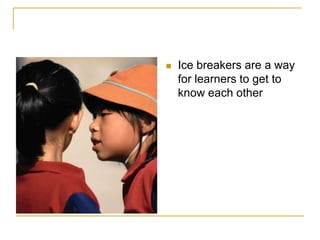
Ice breakers are a way for learners to get to know each other
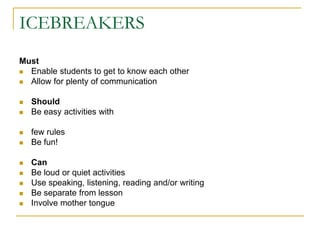
ICEBREAKERSMust Enable students to get to know each other Allow for plenty of communicationShould Be easy activities with few rulesBe fun!Can Be loud or quiet activitiesUse speaking, listening, reading and/or writingBe separate from lessonInvolve mother tongue
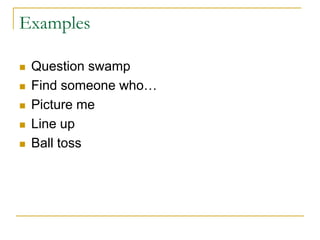
Examples Question swampFind someone who…Picture meLine upBall toss
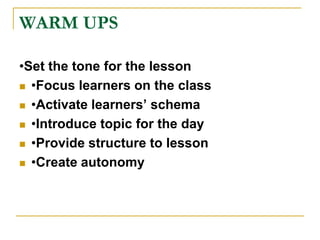
WARM UPS•Set the tone for the lesson •Focus learners on the class •Activate learners’ schema •Introduce topic for the day •Provide structure to lesson •Create autonomy
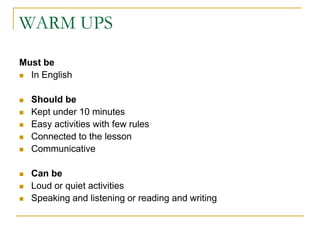
WARM UPSMust be In EnglishShould be Kept under 10 minutesEasy activities with few rulesConnected to the lesson CommunicativeCan beLoud or quiet activitiesSpeaking and listening or reading and writing
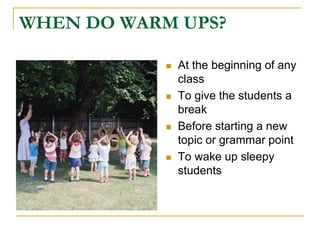
WHEN DO WARM UPS?At the beginning of any classTo give the students a breakBefore starting a new topic or grammar pointTo wake up sleepy students
Examples Circulating storyListening for a songReading for a storySentence completionWho am I?Simon saysWhat do these objects have in common?
12-14 years•Natural egoism•Emotional and melodramatic•Extreme physical changes•Sensitive to appearance•Want to belong to the “pack”•Influenced by peers and fads•Wavering between independence and need for security•Think they have “figured things out”•Strive to create a “system” to analyze what they see•Test hypotheses and think critically about abstract ideas and concepts•Strong opinions•See things in black and white
14-17 years•Physically mature•Able to work independently•Good planners and can manage group work without much supervision•Less reliant on the group for support•More focus on individual relationships•Stronger sense of place in society•Aware of the opposite sex and begin to mix groups (girls and boys)•Understand there is not only one answer to every question and not everything is black and white
APPROACH TO TEACHING TEENSEngage teens by creating language awareness activities which foster an understanding of, and an interest in, how language function.Encourage students to become precise critical thinkers and to link their language study to other areas of their education.Promote group work and collaborative learning through class projects.(LEWIS, 2007)
12 things to keep in mindBring (pop) music into the classroom2.Find cool, up-to-date topics3.Use group work4.Use role-play activities5.Encourage learner autonomy6.Find ways to bring in students’ outside interests7.Liven up your class with variety and humor8.Give students a chance to move around9.Use effective classroom management10.Use of mother tongue strategically11.Use games and competition12.Use project work
PUTTING THE LEARNER AT THE CENTER (LEWIS, 2007)Take an interest in your students’ lives:“Teenagers, especially younger ones, are the center of their own attention. Ask questions about the student. How do they feel? What do they think?”Encourage students to be honest and candid:“Afford opportunities for students to express their opinions.”Make students responsible for their actions:“Teenagers strive to be independent. They want more responsibility. Grant this and all the rights and obligations it implies, but hold students accountable for both their work and their behavior.”Get students involved in setting class goals:“Negotiate the syllabus with your students. Allow students to make suggestions about how to conduct activities… Give students choices.”
Examples of activitiesThe director’s cutSample DialogueReal life communicationPersonal storiesNon-verbal storytellingDigital storiesTeacher for a dayProject based instruction
BENEFITS OF PBLEnabling students to make and see connections between disciplinesProviding opportunities to contribute to their school or communityIncreasing self-esteem. (Jobs for the Future, n.d.)Allowing children to use their individual learning strengths and diverse approaches to learning(Thomas, 1998)Providing a practical, real-world way to learn to use technology (Kadel, 1999; Moursund, Bielefeldt, & Underwood, 1997).
Develops 21st-Century SkillsCollaborationProblem solvingNegotiatingCritical thinkingDigital literacyGlobal awarenessAdaptability/self-direction
Sources of Feedback1.Teacher: teacher gives summative and formative feedback.2.Peer: students give each other feedback about content and form.3. Self: students reflect on what they did, what went well and what they might change
Thank you for your attention

Summarizing web-inar

  • 1.
  • 2.
    BYTHE END OFTHIS SEMINAR, YOU WILL BE ABLE TO:i.Define and distinguish between ice breakers and warm upsii.List the reasons for using ice breakers and warm upsiii.Identify best practices, including when and how to use activities with teensiv.Create a list of some examples PBL
  • 3.
    According to brain-basedlearning theory, we learn better when we are relaxed The human brain functions more effectively and at a higher level when stress is reduced
  • 4.
    Theory 1: Activityis learningTheory 2: Learning involves the whole body/mindTheory 3: Learning is shared
  • 5.
    Ice breakers area way for learners to get to know each other
  • 6.
    ICEBREAKERSMust Enable studentsto get to know each other Allow for plenty of communicationShould Be easy activities with few rulesBe fun!Can Be loud or quiet activitiesUse speaking, listening, reading and/or writingBe separate from lessonInvolve mother tongue
  • 7.
    Examples Question swampFindsomeone who…Picture meLine upBall toss
  • 8.
    WARM UPS•Set thetone for the lesson •Focus learners on the class •Activate learners’ schema •Introduce topic for the day •Provide structure to lesson •Create autonomy
  • 9.
    WARM UPSMust beIn EnglishShould be Kept under 10 minutesEasy activities with few rulesConnected to the lesson CommunicativeCan beLoud or quiet activitiesSpeaking and listening or reading and writing
  • 10.
    WHEN DO WARMUPS?At the beginning of any classTo give the students a breakBefore starting a new topic or grammar pointTo wake up sleepy students
  • 11.
    Examples Circulating storyListeningfor a songReading for a storySentence completionWho am I?Simon saysWhat do these objects have in common?
  • 13.
    12-14 years•Natural egoism•Emotionaland melodramatic•Extreme physical changes•Sensitive to appearance•Want to belong to the “pack”•Influenced by peers and fads•Wavering between independence and need for security•Think they have “figured things out”•Strive to create a “system” to analyze what they see•Test hypotheses and think critically about abstract ideas and concepts•Strong opinions•See things in black and white
  • 14.
    14-17 years•Physically mature•Ableto work independently•Good planners and can manage group work without much supervision•Less reliant on the group for support•More focus on individual relationships•Stronger sense of place in society•Aware of the opposite sex and begin to mix groups (girls and boys)•Understand there is not only one answer to every question and not everything is black and white
  • 15.
    APPROACH TO TEACHINGTEENSEngage teens by creating language awareness activities which foster an understanding of, and an interest in, how language function.Encourage students to become precise critical thinkers and to link their language study to other areas of their education.Promote group work and collaborative learning through class projects.(LEWIS, 2007)
  • 16.
    12 things tokeep in mindBring (pop) music into the classroom2.Find cool, up-to-date topics3.Use group work4.Use role-play activities5.Encourage learner autonomy6.Find ways to bring in students’ outside interests7.Liven up your class with variety and humor8.Give students a chance to move around9.Use effective classroom management10.Use of mother tongue strategically11.Use games and competition12.Use project work
  • 17.
    PUTTING THE LEARNERAT THE CENTER (LEWIS, 2007)Take an interest in your students’ lives:“Teenagers, especially younger ones, are the center of their own attention. Ask questions about the student. How do they feel? What do they think?”Encourage students to be honest and candid:“Afford opportunities for students to express their opinions.”Make students responsible for their actions:“Teenagers strive to be independent. They want more responsibility. Grant this and all the rights and obligations it implies, but hold students accountable for both their work and their behavior.”Get students involved in setting class goals:“Negotiate the syllabus with your students. Allow students to make suggestions about how to conduct activities… Give students choices.”
  • 18.
    Examples of activitiesThedirector’s cutSample DialogueReal life communicationPersonal storiesNon-verbal storytellingDigital storiesTeacher for a dayProject based instruction
  • 19.
    BENEFITS OF PBLEnablingstudents to make and see connections between disciplinesProviding opportunities to contribute to their school or communityIncreasing self-esteem. (Jobs for the Future, n.d.)Allowing children to use their individual learning strengths and diverse approaches to learning(Thomas, 1998)Providing a practical, real-world way to learn to use technology (Kadel, 1999; Moursund, Bielefeldt, & Underwood, 1997).
  • 20.
    BENEFITS OF PBLEnablingstudents to make and see connections between disciplinesProviding opportunities to contribute to their school or communityIncreasing self-esteem. (Jobs for the Future, n.d.)Allowing children to use their individual learning strengths and diverse approaches to learning(Thomas, 1998)Providing a practical, real-world way to learn to use technology (Kadel, 1999; Moursund, Bielefeldt, & Underwood, 1997).
  • 21.
    Develops 21st-Century SkillsCollaborationProblemsolvingNegotiatingCritical thinkingDigital literacyGlobal awarenessAdaptability/self-direction
  • 22.
    Sources of Feedback1.Teacher:teacher gives summative and formative feedback.2.Peer: students give each other feedback about content and form.3. Self: students reflect on what they did, what went well and what they might change
  • 23.
    Thank you foryour attention