Dr.Shaila Banu
PG
SULFONAMIDES &
COTRIMOXAZOLE
Learning Outcome
At the end of the session student
should be able to:
•Classify the Sulfonamides.
•Explain the mechanism of action,
therapeutic uses, adverse effects* of
clinically useful Sulfonamides
•Explain the rationale of combination of
sulfamethoxazole and Trimethoprim in
Cotrimoxazole
Sulfonamides/ SSRMC/2020
2
 First antimicrobial agent effective
against pyogenic bacterial
infection
 Scientist-DOMAGK
 PRONTOSIL RED
DYE 3
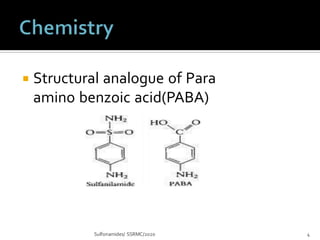
 Structural analogue of Para
amino benzoic acid(PABA)
Sulfonamides/ SSRMC/2020 4
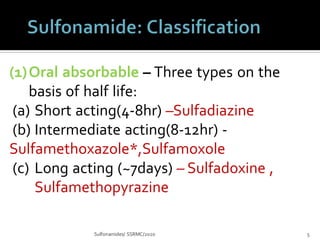
(1)Oral absorbable – Three types on the
basis of half life:
(a) Short acting(4-8hr) –Sulfadiazine
(b) Intermediate acting(8-12hr) -
Sulfamethoxazole*,Sulfamoxole
(c) Long acting (~7days) – Sulfadoxine ,
Sulfamethopyrazine
Sulfonamides/ SSRMC/2020 5
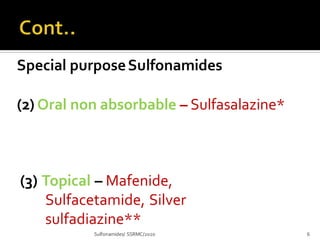
Special purposeSulfonamides
(2) Oral non absorbable – Sulfasalazine*
Sulfonamides/ SSRMC/2020 6
(3) Topical – Mafenide,
Sulfacetamide, Silver
sulfadiazine**
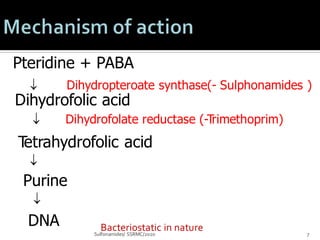
Pteridine + PABA
Sulfonamides/ SSRMC/2020 7
Dihydropteroate synthase(- Sulphonamides )
Dihydrofolic acid
Dihydrofolate reductase (-Trimethoprim)
Tetrahydrofolic acid

Purine

DNA


Bacteriostatic in nature
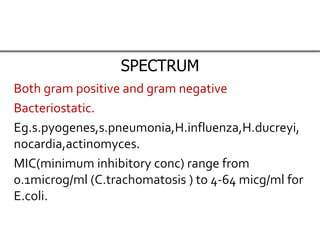
SPECTRUM
Both gram positive and gram negative
Bacteriostatic.
Eg.s.pyogenes,s.pneumonia,H.influenza,H.ducreyi,
nocardia,actinomyces.
MIC(minimum inhibitory conc) range from
0.1microg/ml (C.trachomatosis ) to 4-64 micg/ml for
E.coli.
PHARMACOKINETICS
Abs:70-100% orally absorbed
sulfonamides can be found in urine within 30 mins
peak plasma levels 2-6hrs
major site:SI>Stomach
bound to albumin
Dis:throughout all the tissues and body fluids
crosses placenta and cause both antibacterial
and troxic effects.
Cont..
Metabolism:Liver
Acetylation
metabolic derivative(N4 acetylated sulfonamide)
Excretion:excreted in urine
t1/2 (depends on renal function)
In acid urine,the older sulfonamides are insoluble
and may ppt ,forming crystalline deposits tat can
cause urinary obs.
Small amounts-feces,bile,milk and other secretion.
 Toxoplasmosis – Combination of
sulfadiazine
& Pyrimethamine is DOC .
 Urinary tract infection – Due to appearance
of resistant organism , no longer therapy of
first choice.
- Co-trimoxazole ,Fluoroquinolones are
preferred drugs.
 Nocardiasis- Sulfadiazine may be given 6-8
gm daily.
 P. falciparum malaria- 3 tab stat of
Sulfadoxine (500mg ) + Pyrimethamine
(25mg) Sulfonamides/ SSRMC/2020 1
 To prevent burn infection – Silver
sulfadiazine 1% cream
 In Ulcerative colitis – Sulfasalazine in dose
of 3-4 gm /day induces remission for few
weeks. Maintance therapy 1.5-2 gm is
required.
 Trachoma- Sulfacetamide Sod. as eye drops
& eye ointment. Systemic therapy with
tetracycline is preferred.
 Preventing of Streptococcal infection &
recurrence of Rheumatic fever- Used in
who are sensitive to Penicillin.Sulfonamides/ SSRMC/2020 1
 1.Nausea , vomiting , epigastric pain
 2.Crystalluria is dose related
 Advice- Alkalization of urine increases
pHsolubility of sulfonamide
increased.
 Plenty of fluid – daily urine volume in
adult at least 1200 ml.
 3. Hypersensitivity reactions
 Rashes , urticaria,& drug fever
Sulfonamides/ SSRMC/2020 10
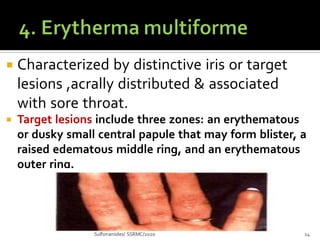
 Characterized by distinctive iris or target
lesions ,acrally distributed & associated
with sore throat.
 Target lesions include three zones: an erythematous
or dusky small central papule that may form blister, a
raised edematous middle ring, and an erythematous
outer ring.
Sulfonamides/ SSRMC/2020 14
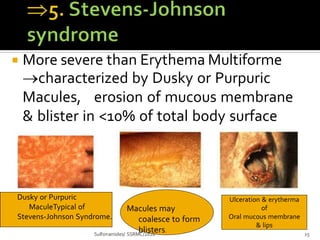
 More severe than Erythema Multiforme
characterized by Dusky or Purpuric
Macules, erosion of mucous membrane
& blister in <10% of total body surface
area
Dusky or Purpuric
MaculeTypical of
Stevens-Johnson Syndrome.
Macules may
coalesce to form
blisters.
Sulfonamides/ SSRMC/2020 15
Ulceration & erytherma
of
Oral mucous membrane
& lips
Or Lyells syndrome > 30 % of body
surface area.
7. Hemolysis in dose dependent
in G- 6-PD deficiency patients.
8.Kernicterus may precipitate in
premature neonate , by displacement
of bilirubin from plasma protein
binding site.
9. Hepatitis
Sulfonamides/ SSRMC/2020 16
DRUG INTERACTION:
Oral anticoagulants,
sulfonylureas,hypoglycaemic agents and
hydantoin anticonvulsants
In each case sulfonamides can potentiate the
effects of each other drug.
 The resistant mutants either:
-Produced increase amount of PABA.
-Dihydropteroate synthase enzyme
has low affinity for sulfonamide.
Sulfonamides/ SSRMC/2020 18
 Combination of sulfamethoxazole(400mg) with
Trimethoprim (80 mg) – 5:1 Ratio
Combination preferred due to
 MOA- Individual compounds are
bacteriostatic
- combination become bactericidal due to
sequential blockade of folate metabolism.
- STUDENTS +TEACHER
15
 To achieve optimum synergism
-absorption &Excretion characteristics are
similar
-Half life sulfamethaoxazole – 10 hrs
Trimethoprim – 11 hrs
-Trimethoprim more widely distributed in
tissue than sulfamethaoxazole
 To reduce bacterial resistance.
Sulfonamides/ SSRMC/2020 20
 Trimethoprim 80 mg
Sulfonamides/ SSRMC/2020 21
+ 0ral or Inj/5ml
 Sulfamethoxazole 400 mg
= Co-trimoxazole
 Dose – 2 tab or double strength (DS) of
single tab given twice daily for 10 –14
days for management of most
infection
 Megaloblastic anemia occur in
patient with marginal folate level
 Hemolytic anemia may develop
individual with G6PD deficiency
 Stevens –Johnson syndrome & Lyell’s
syndrome can occur.
Sulfonamides/ SSRMC/2020 22
 Nausea, vomiting, stomatitis,
headache, rashes
 Patient with renal disease may develop
uremia
 Fever, bone marrow hypoplasia in AIDS
patients with Pneumocystis jiroveci
 Diuretics along with cotrimoxazole-
thrombocytopenia
Sulfonamides/ SSRMC/2020 23
 Urinary tract infection (UTI)
single dose of 4 tab of Co – trimoxazole
Sulfonamides/ SSRMC/2020 20
T/t for acute cystitis or Uncomplicated UTI
 Prostatitis has good value - 4-6
weeks T/t
 Bacterial respiratory tract infection
 Effective in acute otitis media in children
& acute maxillary sinusitis caused by H.
influenza
 Streptococcal pharyngitis– does not
eradicatestreptococcus
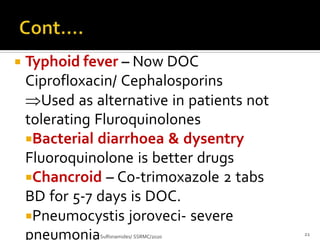
 Typhoid fever – Now DOC
Ciprofloxacin/ Cephalosporins
Used as alternative in patients not
tolerating Fluroquinolones
Bacterial diarrhoea & dysentry
Fluoroquinolone is better drugs
Chancroid – Co-trimoxazole 2 tabs
BD for 5-7 days is DOC.
Pneumocystis joroveci- severe
pneumoniaSulfonamides/ SSRMC/2020 21
Sulfonamides/ SSRMC/2020
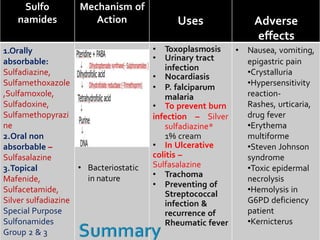
Sulfo
namides
Mechanism of
Action Uses Adverse
effects
1.Orally
absorbable:
Sulfadiazine,
Sulfamethoxazole
,Sulfamoxole,
Sulfadoxine,
Sulfamethopyrazi
ne
2.Oral non
absorbable –
Sulfasalazine
3.Topical
Mafenide,
Sulfacetamide,
Silver sulfadiazine
Special Purpose
Sulfonamides
Group 2 & 3
• Bacteriostatic
in nature
• Toxoplasmosis
• Urinary tract
infection
• Nocardiasis
• P. falciparum
malaria
• To prevent burn
infection – Silver
sulfadiazine*
1% cream
• In Ulcerative
colitis –
Sulfasalazine
• Trachoma
• Preventing of
Streptococcal
infection &
recurrence of
Rheumatic fever
• Nausea, vomiting,
epigastric pain
•Crystalluria
•Hypersensitivity
reaction-
Rashes, urticaria,
drug fever
•Erythema
multiforme
•Steven Johnson
syndrome
•Toxic epidermal
necrolysis
•Hemolysis in
G6PD deficiency
patient
•Kernicterus
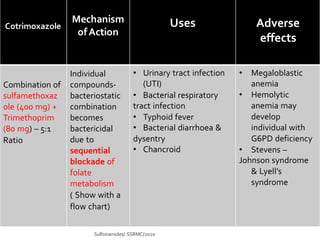
Cotrimoxazole
Sulfonamides/ SSRMC/2020
Mechanism
ofAction
Uses Adverse
effects
Combination of
sulfamethoxaz
ole (400 mg) +
Trimethoprim
(80 mg) – 5:1
Ratio
Individual
compounds-
bacteriostatic
combination
becomes
bactericidal
due to
sequential
blockade of
folate
metabolism
( Show with a
flow chart)
• Urinary tract infection
(UTI)
• Bacterial respiratory
tract infection
• Typhoid fever
• Bacterial diarrhoea &
dysentry
• Chancroid
• Megaloblastic
anemia
• Hemolytic
anemia may
develop
individual with
G6PD deficiency
• Stevens –
Johnson syndrome
& Lyell’s
syndrome
Sulfonamides/ SSRMC/2020

Sulfonamidesssr2020 200528142847

  • 1.
  • 2.
    Learning Outcome At theend of the session student should be able to: •Classify the Sulfonamides. •Explain the mechanism of action, therapeutic uses, adverse effects* of clinically useful Sulfonamides •Explain the rationale of combination of sulfamethoxazole and Trimethoprim in Cotrimoxazole Sulfonamides/ SSRMC/2020 2
  • 3.
     First antimicrobialagent effective against pyogenic bacterial infection  Scientist-DOMAGK  PRONTOSIL RED DYE 3
  • 4.
     Structural analogueof Para amino benzoic acid(PABA) Sulfonamides/ SSRMC/2020 4
  • 5.
    (1)Oral absorbable –Three types on the basis of half life: (a) Short acting(4-8hr) –Sulfadiazine (b) Intermediate acting(8-12hr) - Sulfamethoxazole*,Sulfamoxole (c) Long acting (~7days) – Sulfadoxine , Sulfamethopyrazine Sulfonamides/ SSRMC/2020 5
  • 6.
    Special purposeSulfonamides (2) Oralnon absorbable – Sulfasalazine* Sulfonamides/ SSRMC/2020 6 (3) Topical – Mafenide, Sulfacetamide, Silver sulfadiazine**
  • 7.
    Pteridine + PABA Sulfonamides/SSRMC/2020 7 Dihydropteroate synthase(- Sulphonamides ) Dihydrofolic acid Dihydrofolate reductase (-Trimethoprim) Tetrahydrofolic acid  Purine  DNA   Bacteriostatic in nature
  • 8.
    SPECTRUM Both gram positiveand gram negative Bacteriostatic. Eg.s.pyogenes,s.pneumonia,H.influenza,H.ducreyi, nocardia,actinomyces. MIC(minimum inhibitory conc) range from 0.1microg/ml (C.trachomatosis ) to 4-64 micg/ml for E.coli.
  • 9.
    PHARMACOKINETICS Abs:70-100% orally absorbed sulfonamidescan be found in urine within 30 mins peak plasma levels 2-6hrs major site:SI>Stomach bound to albumin Dis:throughout all the tissues and body fluids crosses placenta and cause both antibacterial and troxic effects.
  • 10.
    Cont.. Metabolism:Liver Acetylation metabolic derivative(N4 acetylatedsulfonamide) Excretion:excreted in urine t1/2 (depends on renal function) In acid urine,the older sulfonamides are insoluble and may ppt ,forming crystalline deposits tat can cause urinary obs. Small amounts-feces,bile,milk and other secretion.
  • 11.
     Toxoplasmosis –Combination of sulfadiazine & Pyrimethamine is DOC .  Urinary tract infection – Due to appearance of resistant organism , no longer therapy of first choice. - Co-trimoxazole ,Fluoroquinolones are preferred drugs.  Nocardiasis- Sulfadiazine may be given 6-8 gm daily.  P. falciparum malaria- 3 tab stat of Sulfadoxine (500mg ) + Pyrimethamine (25mg) Sulfonamides/ SSRMC/2020 1
  • 12.
     To preventburn infection – Silver sulfadiazine 1% cream  In Ulcerative colitis – Sulfasalazine in dose of 3-4 gm /day induces remission for few weeks. Maintance therapy 1.5-2 gm is required.  Trachoma- Sulfacetamide Sod. as eye drops & eye ointment. Systemic therapy with tetracycline is preferred.  Preventing of Streptococcal infection & recurrence of Rheumatic fever- Used in who are sensitive to Penicillin.Sulfonamides/ SSRMC/2020 1
  • 13.
     1.Nausea ,vomiting , epigastric pain  2.Crystalluria is dose related  Advice- Alkalization of urine increases pHsolubility of sulfonamide increased.  Plenty of fluid – daily urine volume in adult at least 1200 ml.  3. Hypersensitivity reactions  Rashes , urticaria,& drug fever Sulfonamides/ SSRMC/2020 10
  • 14.
     Characterized bydistinctive iris or target lesions ,acrally distributed & associated with sore throat.  Target lesions include three zones: an erythematous or dusky small central papule that may form blister, a raised edematous middle ring, and an erythematous outer ring. Sulfonamides/ SSRMC/2020 14
  • 15.
     More severethan Erythema Multiforme characterized by Dusky or Purpuric Macules, erosion of mucous membrane & blister in <10% of total body surface area Dusky or Purpuric MaculeTypical of Stevens-Johnson Syndrome. Macules may coalesce to form blisters. Sulfonamides/ SSRMC/2020 15 Ulceration & erytherma of Oral mucous membrane & lips
  • 16.
    Or Lyells syndrome> 30 % of body surface area. 7. Hemolysis in dose dependent in G- 6-PD deficiency patients. 8.Kernicterus may precipitate in premature neonate , by displacement of bilirubin from plasma protein binding site. 9. Hepatitis Sulfonamides/ SSRMC/2020 16
  • 17.
    DRUG INTERACTION: Oral anticoagulants, sulfonylureas,hypoglycaemicagents and hydantoin anticonvulsants In each case sulfonamides can potentiate the effects of each other drug.
  • 18.
     The resistantmutants either: -Produced increase amount of PABA. -Dihydropteroate synthase enzyme has low affinity for sulfonamide. Sulfonamides/ SSRMC/2020 18
  • 19.
     Combination ofsulfamethoxazole(400mg) with Trimethoprim (80 mg) – 5:1 Ratio Combination preferred due to  MOA- Individual compounds are bacteriostatic - combination become bactericidal due to sequential blockade of folate metabolism. - STUDENTS +TEACHER 15
  • 20.
     To achieveoptimum synergism -absorption &Excretion characteristics are similar -Half life sulfamethaoxazole – 10 hrs Trimethoprim – 11 hrs -Trimethoprim more widely distributed in tissue than sulfamethaoxazole  To reduce bacterial resistance. Sulfonamides/ SSRMC/2020 20
  • 21.
     Trimethoprim 80mg Sulfonamides/ SSRMC/2020 21 + 0ral or Inj/5ml  Sulfamethoxazole 400 mg = Co-trimoxazole  Dose – 2 tab or double strength (DS) of single tab given twice daily for 10 –14 days for management of most infection
  • 22.
     Megaloblastic anemiaoccur in patient with marginal folate level  Hemolytic anemia may develop individual with G6PD deficiency  Stevens –Johnson syndrome & Lyell’s syndrome can occur. Sulfonamides/ SSRMC/2020 22
  • 23.
     Nausea, vomiting,stomatitis, headache, rashes  Patient with renal disease may develop uremia  Fever, bone marrow hypoplasia in AIDS patients with Pneumocystis jiroveci  Diuretics along with cotrimoxazole- thrombocytopenia Sulfonamides/ SSRMC/2020 23
  • 24.
     Urinary tractinfection (UTI) single dose of 4 tab of Co – trimoxazole Sulfonamides/ SSRMC/2020 20 T/t for acute cystitis or Uncomplicated UTI  Prostatitis has good value - 4-6 weeks T/t  Bacterial respiratory tract infection  Effective in acute otitis media in children & acute maxillary sinusitis caused by H. influenza  Streptococcal pharyngitis– does not eradicatestreptococcus
  • 25.
     Typhoid fever– Now DOC Ciprofloxacin/ Cephalosporins Used as alternative in patients not tolerating Fluroquinolones Bacterial diarrhoea & dysentry Fluoroquinolone is better drugs Chancroid – Co-trimoxazole 2 tabs BD for 5-7 days is DOC. Pneumocystis joroveci- severe pneumoniaSulfonamides/ SSRMC/2020 21
  • 26.
    Sulfonamides/ SSRMC/2020 Sulfo namides Mechanism of ActionUses Adverse effects 1.Orally absorbable: Sulfadiazine, Sulfamethoxazole ,Sulfamoxole, Sulfadoxine, Sulfamethopyrazi ne 2.Oral non absorbable – Sulfasalazine 3.Topical Mafenide, Sulfacetamide, Silver sulfadiazine Special Purpose Sulfonamides Group 2 & 3 • Bacteriostatic in nature • Toxoplasmosis • Urinary tract infection • Nocardiasis • P. falciparum malaria • To prevent burn infection – Silver sulfadiazine* 1% cream • In Ulcerative colitis – Sulfasalazine • Trachoma • Preventing of Streptococcal infection & recurrence of Rheumatic fever • Nausea, vomiting, epigastric pain •Crystalluria •Hypersensitivity reaction- Rashes, urticaria, drug fever •Erythema multiforme •Steven Johnson syndrome •Toxic epidermal necrolysis •Hemolysis in G6PD deficiency patient •Kernicterus
  • 27.
    Cotrimoxazole Sulfonamides/ SSRMC/2020 Mechanism ofAction Uses Adverse effects Combinationof sulfamethoxaz ole (400 mg) + Trimethoprim (80 mg) – 5:1 Ratio Individual compounds- bacteriostatic combination becomes bactericidal due to sequential blockade of folate metabolism ( Show with a flow chart) • Urinary tract infection (UTI) • Bacterial respiratory tract infection • Typhoid fever • Bacterial diarrhoea & dysentry • Chancroid • Megaloblastic anemia • Hemolytic anemia may develop individual with G6PD deficiency • Stevens – Johnson syndrome & Lyell’s syndrome
  • 28.