Islamic Money Market
ECON 6862: Islamic Capital Markets
Dr. Zaharuddin Abd Rahman
7th March 2017
Group Members
• Ahmad Tarmizi Bin Abdul Aznan G1620511
• Saliou Boiro G1515999
• Conde Mamoudou G1612561
• Mohd Asraf Abd Wahab G1514689
• Mohamed Moharam Fahmy Abouzeid G1414099
2
1) Overview
2) Functions of Islamic Money Market
3) Comparison between Islamic and Conventional Money Market
4) Islamic Interbank Market
5) Islamic Money Market Instruments
6) Islamic Money Market Calculations
Presentation Outline – Islamic Money Market
3
4
Overview
FLOW OF FUNDS
DIRECT INDIRECT
The investor has full control
over his funds. He is the one
who invest the funds, monitor
its performance, and take
corrective actions in his
investments.
The investor appointed an
agent to invest his funds and
monitor its performance (on his
behalf). In return, the agent will
be compensated with certain
fees for his services.
Eg: Investment in the capital
market (stock exchange), money
market and banks.
Eg: Investment through
intermediaries such as mutual
funds, pension funds and
investment banks.
5
INVESTMENT IN FINANCIAL
MARKET (“Direct” flow of funds)
Medium & Long-term
(Capital market instrument)
Short-term
(Money market instrument)
Between 1 to 10 years
(Medium)
More than 10 years (Long-term)
Less than 1 year (Short-
term)
Instruments: Stocks and bonds
Instruments: Treasury Bills,
Commercial Papers,
Certificate of Deposits
6
So, what is the function of Islamic money market??
7
• The first and foremost important underlying philosophy of Islamic Capital and
Money market is to strengthen the institutional structure of Islamic banking
operations.
• The main function is to facilitate transfer of investable funds from those having
surplus units to those requiring funds to meet short and long term liquidity needs.
• IMM mainly concern with Interbank players, but there are also IMM products such
as Islamic Accepted Bills for importers and exporters to provide short term
working capital financing.
• Beside the main function of channelling surplus units to deficit units, Islamic
Money Market plays also the role of:
 Liquidity Management
 Facilitate secondary trading of Islamic MM instruments
 Channel for Central Bank to conduct their monetary policy
Functions of Islamic Money Market (1)
8
• Liquidity Management:
 Enables IFIs to fulfil daily funding and to invest in short term and highly liquid
instruments.
 Enables IFIs to maintain optimal liquidity condition by not being overly liquid or
less in order to meet investors’ and customers’ demands at any time.
 Helps to reduce liquidity pressures from different timings of cash inflows and
outflows (Facilitates IFIs to effectively manage their asset liability mismatch).
• Serve as a market for trading short term Islamic Instruments that are liquid while
offering acceptable return on the investments.
• IMM also provides Pricing Mechanism or platform of trading IMM instruments by
providing information to all participants.
Functions of Islamic Money Market (2)
9
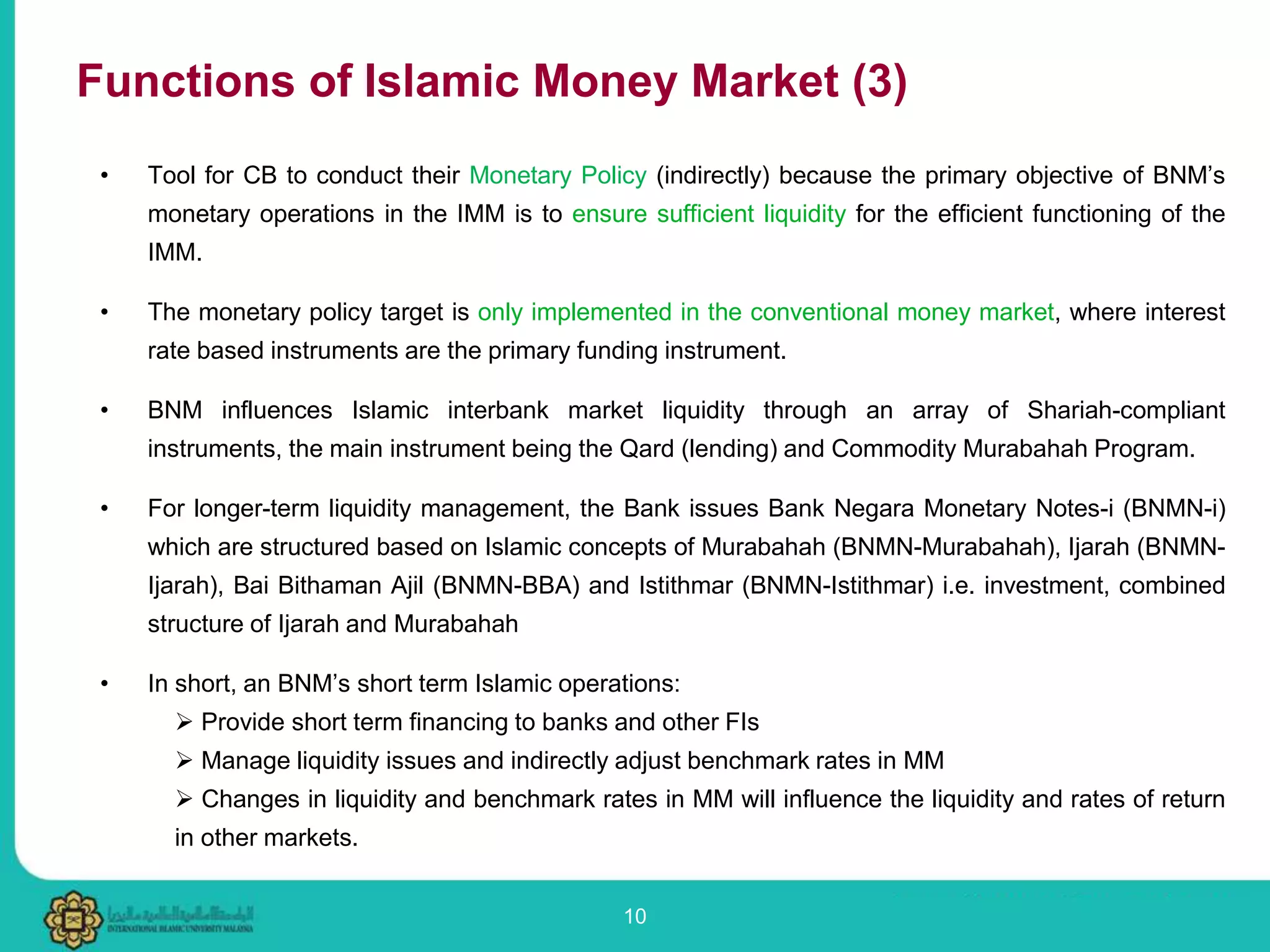
• Tool for CB to conduct their Monetary Policy (indirectly) because the primary objective of BNM’s
monetary operations in the IMM is to ensure sufficient liquidity for the efficient functioning of the
IMM.
• The monetary policy target is only implemented in the conventional money market, where interest
rate based instruments are the primary funding instrument.
• BNM influences Islamic interbank market liquidity through an array of Shariah-compliant
instruments, the main instrument being the Qard (lending) and Commodity Murabahah Program.
• For longer-term liquidity management, the Bank issues Bank Negara Monetary Notes-i (BNMN-i)
which are structured based on Islamic concepts of Murabahah (BNMN-Murabahah), Ijarah (BNMN-
Ijarah), Bai Bithaman Ajil (BNMN-BBA) and Istithmar (BNMN-Istithmar) i.e. investment, combined
structure of Ijarah and Murabahah
• In short, an BNM’s short term Islamic operations:
 Provide short term financing to banks and other FIs
 Manage liquidity issues and indirectly adjust benchmark rates in MM
 Changes in liquidity and benchmark rates in MM will influence the liquidity and rates of return
in other markets.
Functions of Islamic Money Market (3)
10
Difference between Islamic and conventional
money markets
11
Islamic Conventional
Interbank market Utilises shariah compliant contracts
such as murabahah, mudarabah,
and wakalah.
Debt contract is used for
placement of funds
Issuance process Must be shariah compliant and
approved by both SAC of BNM and
SCM
Approved by regulatory authority
only.
Types of structure Structured based on asset,
equity and debt
Structured based on debt only
Investors Both Islamic and conventional Conventional only
Money market
instuments
Deposits type:
Mudharabah Interbank Investment,
Wadiah Acceptance, Qard,
Commodity Murabahah, Wakalah
Deposit, Investment Account
Platform (IAP)
Deposits type:
Interbank placement (deposit),
12
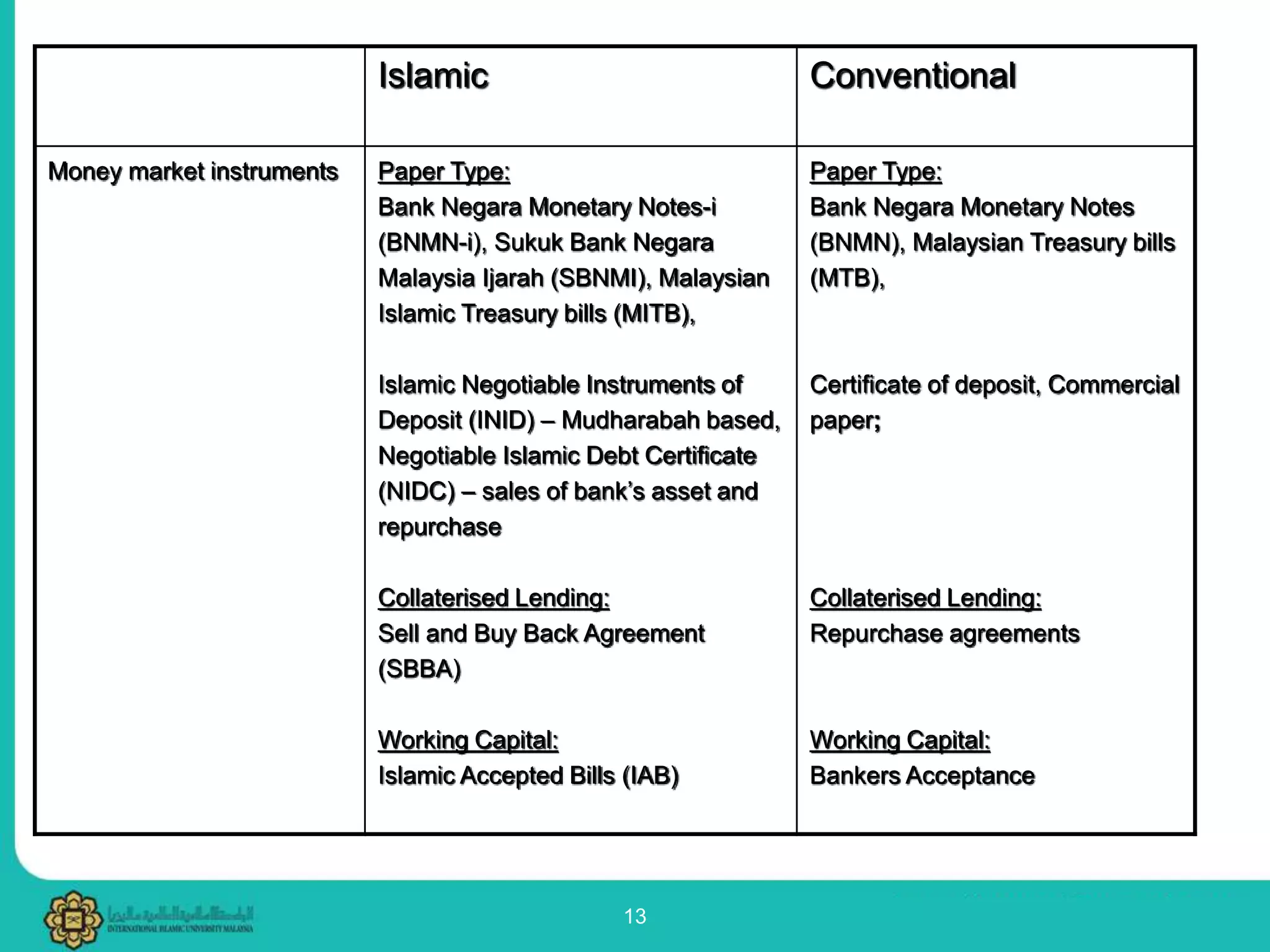
Islamic Conventional
Money market instruments Paper Type:
Bank Negara Monetary Notes-i
(BNMN-i), Sukuk Bank Negara
Malaysia Ijarah (SBNMI), Malaysian
Islamic Treasury bills (MITB),
Islamic Negotiable Instruments of
Deposit (INID) – Mudharabah based,
Negotiable Islamic Debt Certificate
(NIDC) – sales of bank’s asset and
repurchase
Collaterised Lending:
Sell and Buy Back Agreement
(SBBA)
Working Capital:
Islamic Accepted Bills (IAB)
Paper Type:
Bank Negara Monetary Notes
(BNMN), Malaysian Treasury bills
(MTB),
Certificate of deposit, Commercial
paper;
Collaterised Lending:
Repurchase agreements
Working Capital:
Bankers Acceptance
13
Islamic Interbank Market
14
Islamic Banking Represents 23% of Total Banking Asset
presently
92,337.8
320,518.5
572,860.6
1,094,371.0
1,423,879.3
1,870,744.0
0.0
200,000.0
400,000.0
600,000.0
800,000.0
1,000,000.0
1,200,000.0
1,400,000.0
1,600,000.0
1,800,000.0
2,000,000.0
Dec-2007 Dec-2011 Dec-2016
RM mio Banking System Total Asset
Islamic Banks Conventional Banks
8%
92%
Banking System Total Asset, Dec-2007
Islamic Banks Conventional Banks
23%
77%
Banking System Total Asset, Dec-2016
Islamic Banks Conventional Banks
Source: BNM Monthly Statistical Bulletin15
Islamic Interbank Market – The Players
16
• Previously, many are
windows to conventional
banks, but now all are
recognized as proper Islamic
Banks
• 10 locally owned Islamic
banks and 6 foreign owned
• International Islamic Bank –
only operate in non-Ringgit
Malaysia business
Source: BNM website
Islamic Interbank Market Turnover in Malaysia
Source: BNM Monthly Statistical Bulletin17
36,847.2
41,209.3
37,827.0
10,170.0
0.0 0.0
0.0
5,000.0
10,000.0
15,000.0
20,000.0
25,000.0
30,000.0
35,000.0
40,000.0
45,000.0
Mudharabah
Deposits
Wadiah/Qard
Deposits
Commodity
Murabahah
Deposits
Islamic
Negotiable
Instrument
of Deposit
Wakalah
Deposits
Islamic
Bankers
Acceptance
RM mio
Turnover of Interbank Islamic Money Market in Dec-2016
93,486.7
10,130.6 7,015.8 7,674.2
2,320.0 923.1
-
10,000.0
20,000.0
30,000.0
40,000.0
50,000.0
60,000.0
70,000.0
80,000.0
90,000.0
100,000.0
Mudharabah
Deposits
Wadiah/Qard
Deposits
Commodity
Murabahah
Deposits
Islamic
Negotiable
Instrument
of Deposit
Wakalah
Deposits
Islamic
Bankers
Acceptance
RM mio
Turnover of Interbank Islamic Money Market in Dec-2012
29%
33%
30%
8%
Turnover of Interbank Islamic Money Market in Dec-2016
Mudharabah Deposits
Wadiah/Qard Deposits
Commodity Murabahah Deposits
Islamic Negotiable Instrument of Deposit
77%
8%
6%
6%
2%1%
Turnover of Interbank Islamic Money Market in Dec-2012
Mudharabah Deposits
Wadiah/Qard Deposits
Commodity Murabahah Deposits
Islamic Negotiable Instrument of Deposit
Wakalah Deposits
Islamic Bankers Acceptance
Islamic Money Market League Table
Source: BNM’s Bond Info Hub website18
League Table by Instruments
Source: BNM’s Bond Info Hub website19
League Table by Instruments (con’t)
Source: BNM’s Bond Info Hub website20
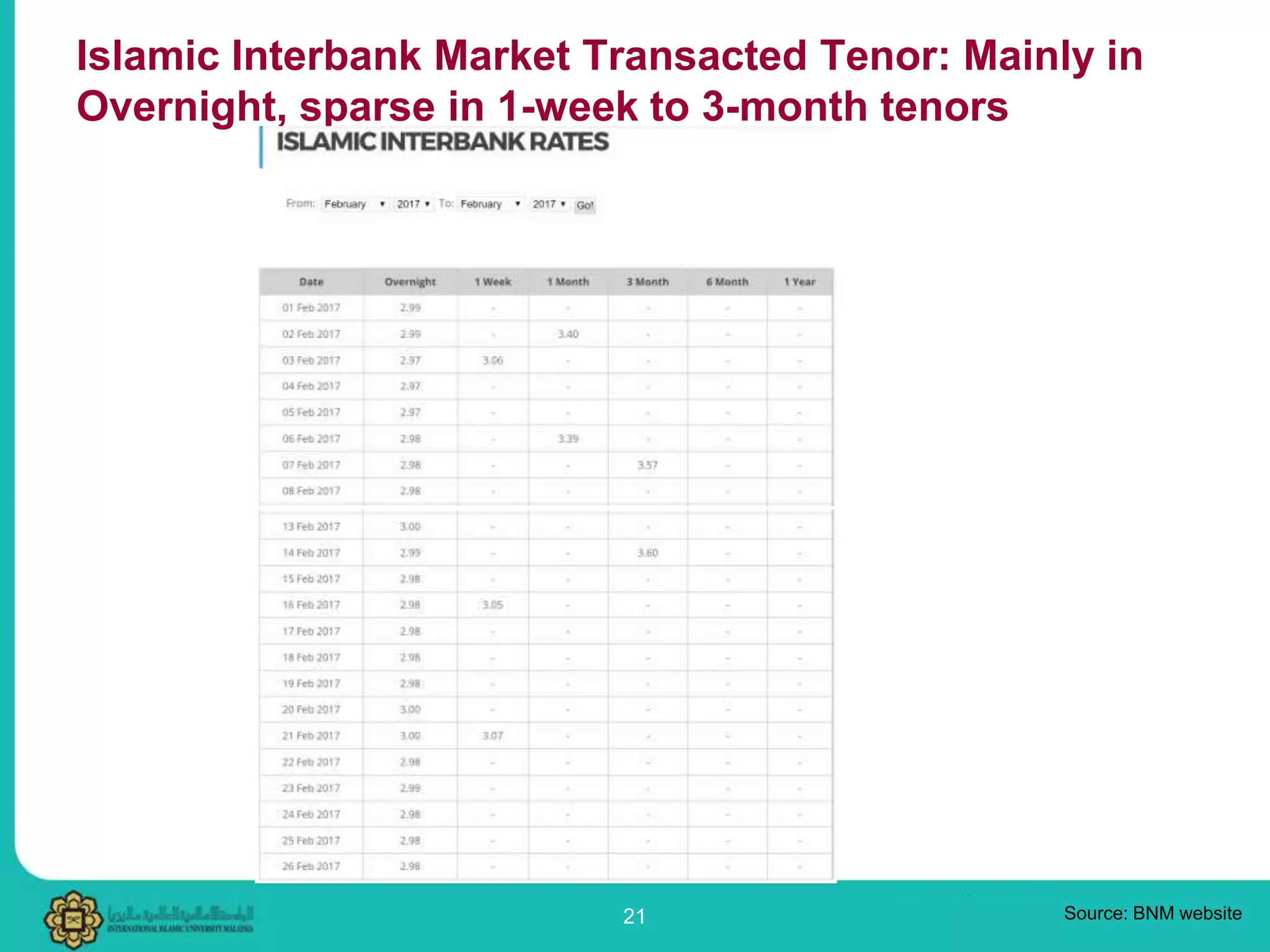
Islamic Interbank Market Transacted Tenor: Mainly in
Overnight, sparse in 1-week to 3-month tenors
Source: BNM website21
Outright Sales &
Purchases of Securities
Statutory Reserve
Requirement
Qard
(Borrowing)
Sukuk BNM
Ijarah
Commodity
Murabahah
Programme
(CMP)
Conventional Islamic
Bank Negara
Monetary
Notes Islamic
(BNMN-i)
Up to 1-month
Up to 3-months
Up to 6-months
Up to 1-year
Common Instruments
to both Conventional
and Islamic System
Money market
borrowings
Bank Negara
Monetary
Notes
(BNMNs)
Foreign
Currency
Swaps
 Shorter term money market transactions of up to 3-month tenor focus on Qard (borrowing) and
Commodity Murabahah
Repo and
Reverse
Repo
Islamic Interbank Money Market Transactions with the
Central Bank (BNM)
22 Source: BNM
Interbank Market with BNM: BNM announces money market
transactions to be conducted every morning @9.30 am
• Table showed how much
Islamic balances that will be
placed with BNM (RM12.03
billion):
• RM3.3 billion = Qard of 7 to
28 days
• RM0.5 billion = Commodity
Murabahah of 28 days
• Balance of RM8.2 billion =
Overnight Qard (1-day)
23 Source: Fully Automated System for Issuing/Tendering (FAST)
Islamic Money Market Instruments
24
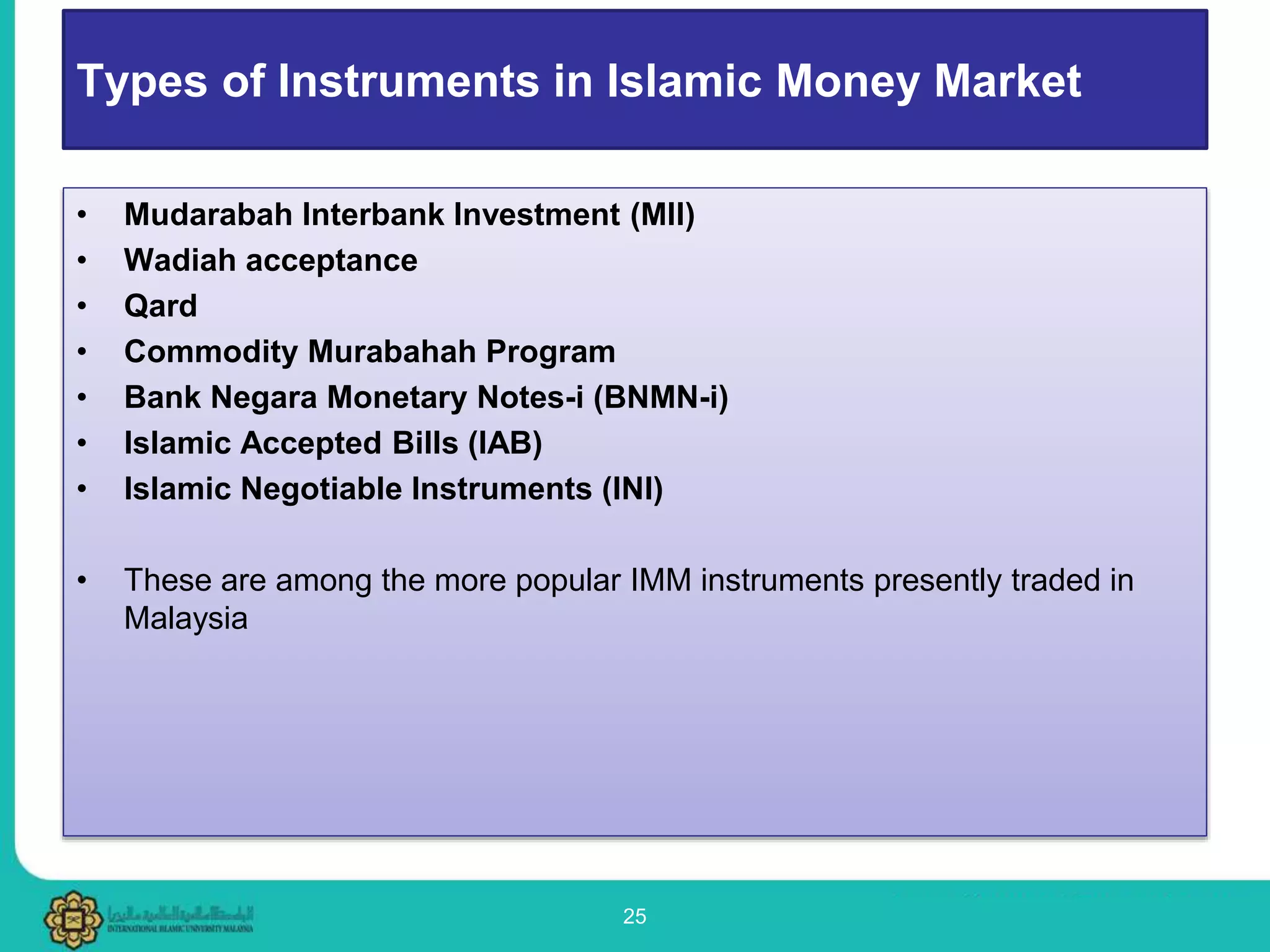
Types of Instruments in Islamic Money Market
• Mudarabah Interbank Investment (MII)
• Wadiah acceptance
• Qard
• Commodity Murabahah Program
• Bank Negara Monetary Notes-i (BNMN-i)
• Islamic Accepted Bills (IAB)
• Islamic Negotiable Instruments (INI)
• These are among the more popular IMM instruments presently traded in
Malaysia
25
Mudharabah Interbank Investment (MII)
• MII refers to a mechanism whereby a deficit Islamic banking institution (investee
bank) can obtain investment from a surplus Islamic banking institution (investor bank)
based on Mudharabah (profit sharing).
• The period of investment is from overnight to 12 months, while the rate of return is
based on the rate of gross profit before distribution for investment of 1-year of the
investee bank.
• The profit sharing ratio is negotiable among both parties. The investor bank at the
time of negotiation would not know what the return would be, as the actual return will
be crystallised towards the end of the investment period.
• The principal invested shall be repaid at the end of the period, together with a share
of the profit arising from the used of the fund by the investee bank
26
Wadiah Acceptance
• Wadiah Acceptance, is a transaction between BNM and the Islamic banking
institutions.
• It refers to a mechanism whereby the Islamic banking institutions placed their surplus
fund with BNM based on the concept of Al- Wadiah.
• Under this concept, the acceptor of funds is viewed as the custodian for the funds
and there is no obligation on the part of the custodian to pay any return on the
account.
• However, if there is any dividend paid by the custodian, is perceived as 'hibah' (gift).
• The Wadiah Acceptance facilitates BNM's liquidity management operation as it gives
flexibility for BNM to declare dividend without having to invest the funds received.
27
Qard
28
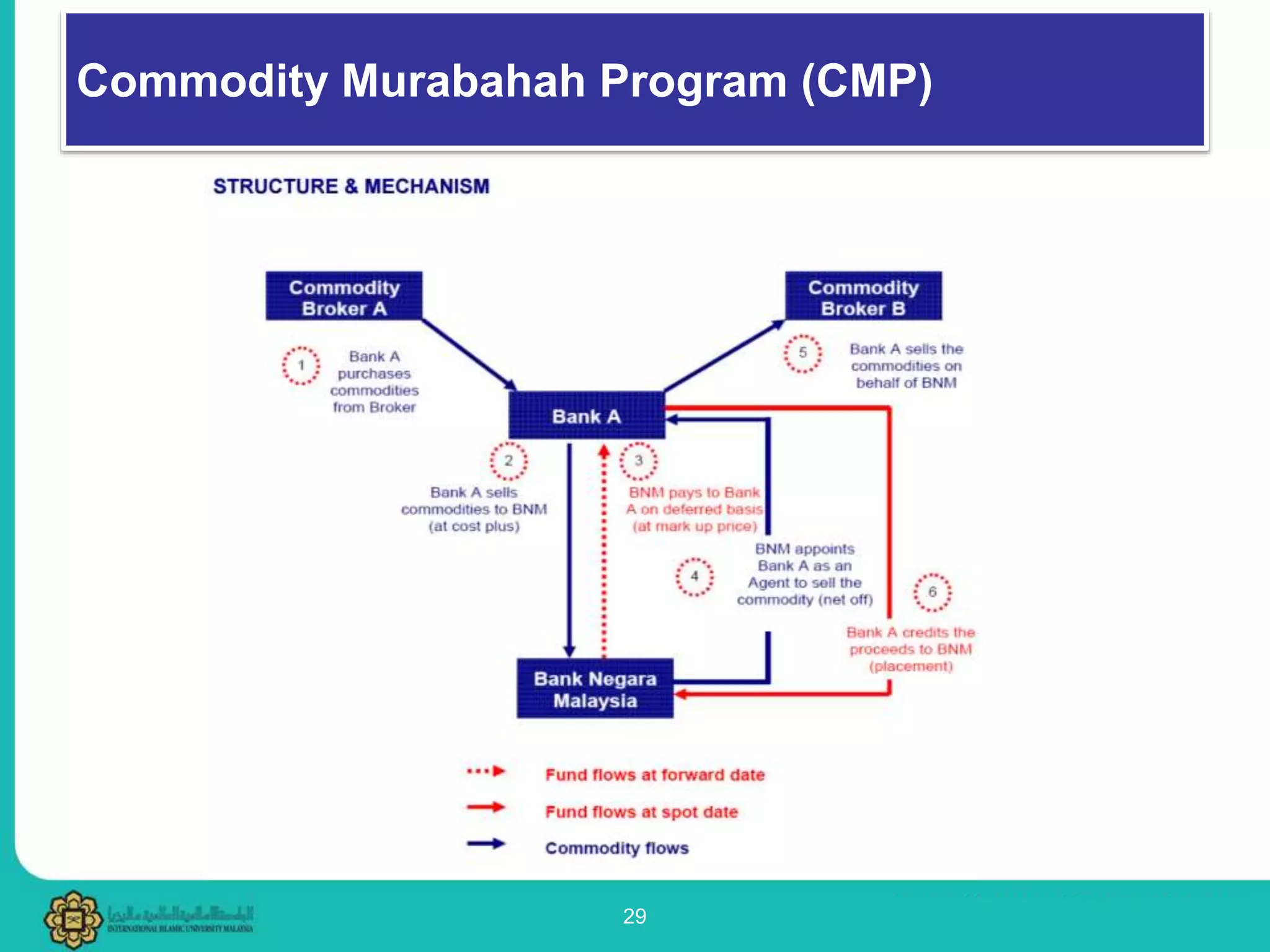
Commodity Murabahah Program (CMP)
29
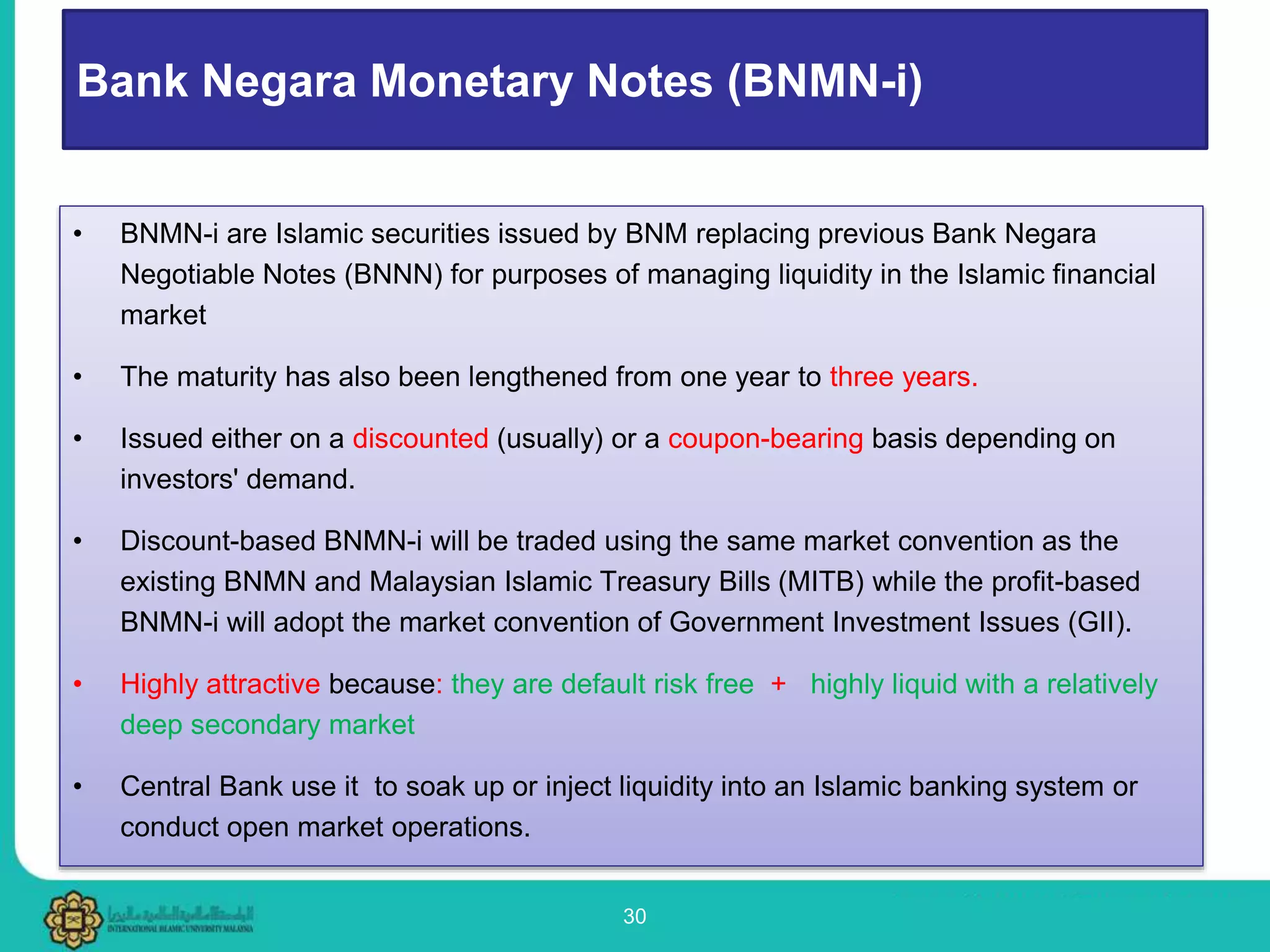
Bank Negara Monetary Notes (BNMN-i)
• BNMN-i are Islamic securities issued by BNM replacing previous Bank Negara
Negotiable Notes (BNNN) for purposes of managing liquidity in the Islamic financial
market
• The maturity has also been lengthened from one year to three years.
• Issued either on a discounted (usually) or a coupon-bearing basis depending on
investors' demand.
• Discount-based BNMN-i will be traded using the same market convention as the
existing BNMN and Malaysian Islamic Treasury Bills (MITB) while the profit-based
BNMN-i will adopt the market convention of Government Investment Issues (GII).
• Highly attractive because: they are default risk free + highly liquid with a relatively
deep secondary market
• Central Bank use it to soak up or inject liquidity into an Islamic banking system or
conduct open market operations.
30
Islamic Accepted Bills (IAB)
• Objective: to encourage and promote both domestic and foreign trade, by providing
Malaysian traders with an attractive Islamic financing product.
• The IAB is formulated on the Islamic principles of Al-Murabahah (deferred lump-sum
sale or cost-plus) and Bai ad-Dayn (debt-trading).
• Al-Murabahah refers to the selling of merchandise at a price based on cost-plus profit
margin agreed to by both parties (importer/exporter with banks)
• Bai Al-Dayn refers to the sale of a debt arising from a trade transaction in the form of
a deferred payment sale.
31
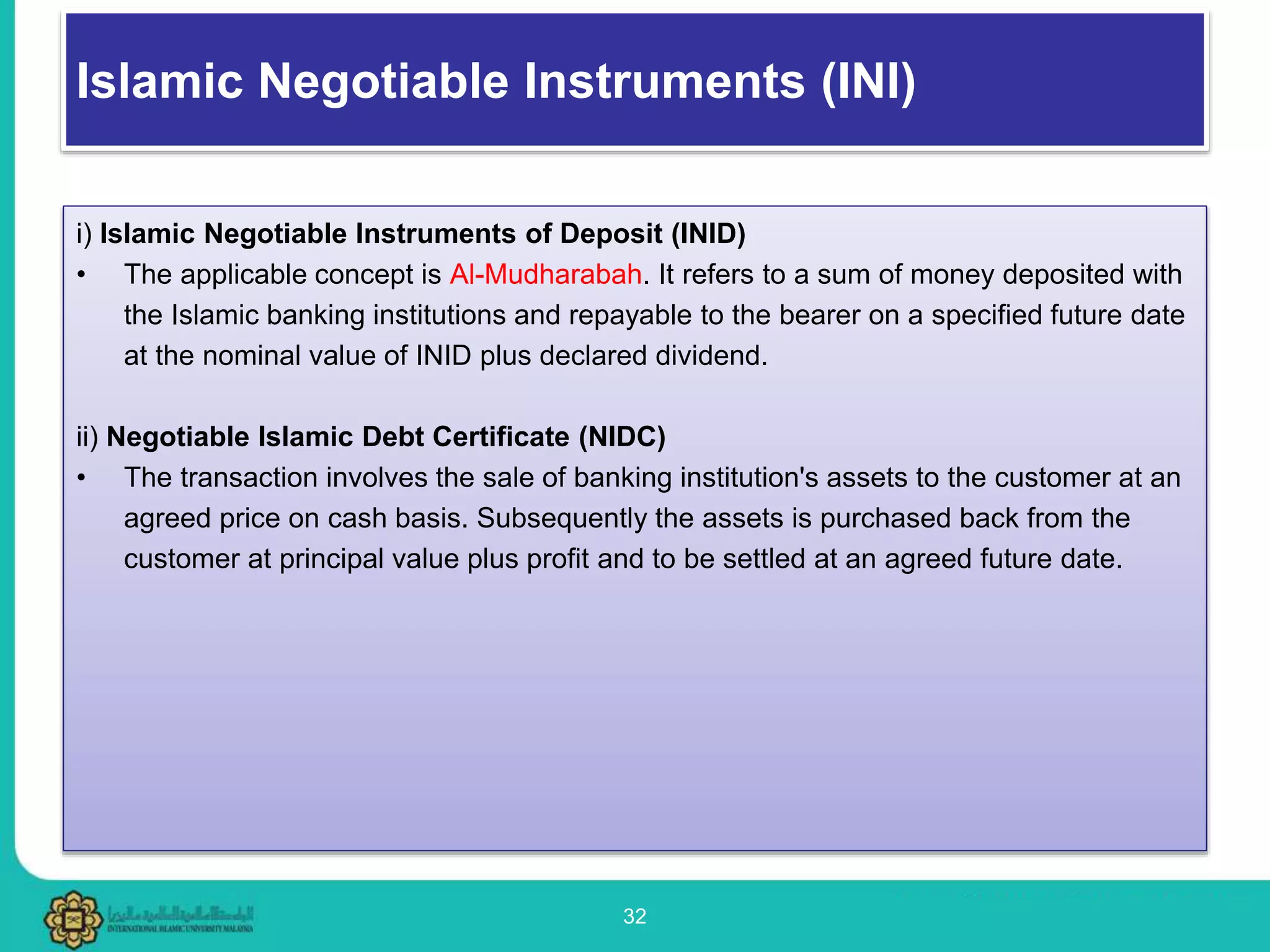
Islamic Negotiable Instruments (INI)
i) Islamic Negotiable Instruments of Deposit (INID)
• The applicable concept is Al-Mudharabah. It refers to a sum of money deposited with
the Islamic banking institutions and repayable to the bearer on a specified future date
at the nominal value of INID plus declared dividend.
ii) Negotiable Islamic Debt Certificate (NIDC)
• The transaction involves the sale of banking institution's assets to the customer at an
agreed price on cash basis. Subsequently the assets is purchased back from the
customer at principal value plus profit and to be settled at an agreed future date.
32
Islamic Money Market Calculations
33
Mudarabah Interbank Investment
34
Wadiah and Qard
35
• Hibah computation is based on the followings:-
• Principal (P) X Time (T) X Rate quoted *
Example:
Tier Range Rate (% p.a)
Tier 1 Up to RM 1,000 1.05 %
Tier 2 RM 1,001 to RM 5,000 1.85 %
Tier 3 RM 5,001 and above 2.54 %
Hence compute WSA with balance of RM 7,000 for whole of January 03 based on the
above hibah rates.
31/365 X 1.05% X 1,000 = RM 0.89
31/365 X 1.85% X 4,000 = RM 6.28
31/365 x 2.54% x 2,000 = RM 4.31
Total hibah = RM 11.48
Commodity Murabahah Program
36
Profit = Principal (P) X Rate (R)
Discounted Notes = BNMN-I and MITB
37
Discount = (Par Value – Purchase Price) X 365 x 100
Par Value T
3.22 = (100 – 96.893) X 365 x 100 Yield
96.893 364
3.116 = (100 – 96.893) X 365 x 100  Discount
100 364
Islamic Accepted Bills (IAB) - Import
38
Islamic Accepted Bills (IAB) - Export
39
Islamic Negotiable Instruments (INI)
40
Profit = Principal (P) X Time
(T) X Rate quoted net Profit
Sharing Ratio
Thank you and Q&A
41

Islamic Money Market ppt

  • 1.
    Islamic Money Market ECON6862: Islamic Capital Markets Dr. Zaharuddin Abd Rahman 7th March 2017
  • 2.
    Group Members • AhmadTarmizi Bin Abdul Aznan G1620511 • Saliou Boiro G1515999 • Conde Mamoudou G1612561 • Mohd Asraf Abd Wahab G1514689 • Mohamed Moharam Fahmy Abouzeid G1414099 2
  • 3.
    1) Overview 2) Functionsof Islamic Money Market 3) Comparison between Islamic and Conventional Money Market 4) Islamic Interbank Market 5) Islamic Money Market Instruments 6) Islamic Money Market Calculations Presentation Outline – Islamic Money Market 3
  • 4.
  • 5.
    FLOW OF FUNDS DIRECTINDIRECT The investor has full control over his funds. He is the one who invest the funds, monitor its performance, and take corrective actions in his investments. The investor appointed an agent to invest his funds and monitor its performance (on his behalf). In return, the agent will be compensated with certain fees for his services. Eg: Investment in the capital market (stock exchange), money market and banks. Eg: Investment through intermediaries such as mutual funds, pension funds and investment banks. 5
  • 6.
    INVESTMENT IN FINANCIAL MARKET(“Direct” flow of funds) Medium & Long-term (Capital market instrument) Short-term (Money market instrument) Between 1 to 10 years (Medium) More than 10 years (Long-term) Less than 1 year (Short- term) Instruments: Stocks and bonds Instruments: Treasury Bills, Commercial Papers, Certificate of Deposits 6
  • 7.
    So, what isthe function of Islamic money market?? 7
  • 8.
    • The firstand foremost important underlying philosophy of Islamic Capital and Money market is to strengthen the institutional structure of Islamic banking operations. • The main function is to facilitate transfer of investable funds from those having surplus units to those requiring funds to meet short and long term liquidity needs. • IMM mainly concern with Interbank players, but there are also IMM products such as Islamic Accepted Bills for importers and exporters to provide short term working capital financing. • Beside the main function of channelling surplus units to deficit units, Islamic Money Market plays also the role of:  Liquidity Management  Facilitate secondary trading of Islamic MM instruments  Channel for Central Bank to conduct their monetary policy Functions of Islamic Money Market (1) 8
  • 9.
    • Liquidity Management: Enables IFIs to fulfil daily funding and to invest in short term and highly liquid instruments.  Enables IFIs to maintain optimal liquidity condition by not being overly liquid or less in order to meet investors’ and customers’ demands at any time.  Helps to reduce liquidity pressures from different timings of cash inflows and outflows (Facilitates IFIs to effectively manage their asset liability mismatch). • Serve as a market for trading short term Islamic Instruments that are liquid while offering acceptable return on the investments. • IMM also provides Pricing Mechanism or platform of trading IMM instruments by providing information to all participants. Functions of Islamic Money Market (2) 9
  • 10.
    • Tool forCB to conduct their Monetary Policy (indirectly) because the primary objective of BNM’s monetary operations in the IMM is to ensure sufficient liquidity for the efficient functioning of the IMM. • The monetary policy target is only implemented in the conventional money market, where interest rate based instruments are the primary funding instrument. • BNM influences Islamic interbank market liquidity through an array of Shariah-compliant instruments, the main instrument being the Qard (lending) and Commodity Murabahah Program. • For longer-term liquidity management, the Bank issues Bank Negara Monetary Notes-i (BNMN-i) which are structured based on Islamic concepts of Murabahah (BNMN-Murabahah), Ijarah (BNMN- Ijarah), Bai Bithaman Ajil (BNMN-BBA) and Istithmar (BNMN-Istithmar) i.e. investment, combined structure of Ijarah and Murabahah • In short, an BNM’s short term Islamic operations:  Provide short term financing to banks and other FIs  Manage liquidity issues and indirectly adjust benchmark rates in MM  Changes in liquidity and benchmark rates in MM will influence the liquidity and rates of return in other markets. Functions of Islamic Money Market (3) 10
  • 11.
    Difference between Islamicand conventional money markets 11
  • 12.
    Islamic Conventional Interbank marketUtilises shariah compliant contracts such as murabahah, mudarabah, and wakalah. Debt contract is used for placement of funds Issuance process Must be shariah compliant and approved by both SAC of BNM and SCM Approved by regulatory authority only. Types of structure Structured based on asset, equity and debt Structured based on debt only Investors Both Islamic and conventional Conventional only Money market instuments Deposits type: Mudharabah Interbank Investment, Wadiah Acceptance, Qard, Commodity Murabahah, Wakalah Deposit, Investment Account Platform (IAP) Deposits type: Interbank placement (deposit), 12
  • 13.
    Islamic Conventional Money marketinstruments Paper Type: Bank Negara Monetary Notes-i (BNMN-i), Sukuk Bank Negara Malaysia Ijarah (SBNMI), Malaysian Islamic Treasury bills (MITB), Islamic Negotiable Instruments of Deposit (INID) – Mudharabah based, Negotiable Islamic Debt Certificate (NIDC) – sales of bank’s asset and repurchase Collaterised Lending: Sell and Buy Back Agreement (SBBA) Working Capital: Islamic Accepted Bills (IAB) Paper Type: Bank Negara Monetary Notes (BNMN), Malaysian Treasury bills (MTB), Certificate of deposit, Commercial paper; Collaterised Lending: Repurchase agreements Working Capital: Bankers Acceptance 13
  • 14.
  • 15.
    Islamic Banking Represents23% of Total Banking Asset presently 92,337.8 320,518.5 572,860.6 1,094,371.0 1,423,879.3 1,870,744.0 0.0 200,000.0 400,000.0 600,000.0 800,000.0 1,000,000.0 1,200,000.0 1,400,000.0 1,600,000.0 1,800,000.0 2,000,000.0 Dec-2007 Dec-2011 Dec-2016 RM mio Banking System Total Asset Islamic Banks Conventional Banks 8% 92% Banking System Total Asset, Dec-2007 Islamic Banks Conventional Banks 23% 77% Banking System Total Asset, Dec-2016 Islamic Banks Conventional Banks Source: BNM Monthly Statistical Bulletin15
  • 16.
    Islamic Interbank Market– The Players 16 • Previously, many are windows to conventional banks, but now all are recognized as proper Islamic Banks • 10 locally owned Islamic banks and 6 foreign owned • International Islamic Bank – only operate in non-Ringgit Malaysia business Source: BNM website
  • 17.
    Islamic Interbank MarketTurnover in Malaysia Source: BNM Monthly Statistical Bulletin17 36,847.2 41,209.3 37,827.0 10,170.0 0.0 0.0 0.0 5,000.0 10,000.0 15,000.0 20,000.0 25,000.0 30,000.0 35,000.0 40,000.0 45,000.0 Mudharabah Deposits Wadiah/Qard Deposits Commodity Murabahah Deposits Islamic Negotiable Instrument of Deposit Wakalah Deposits Islamic Bankers Acceptance RM mio Turnover of Interbank Islamic Money Market in Dec-2016 93,486.7 10,130.6 7,015.8 7,674.2 2,320.0 923.1 - 10,000.0 20,000.0 30,000.0 40,000.0 50,000.0 60,000.0 70,000.0 80,000.0 90,000.0 100,000.0 Mudharabah Deposits Wadiah/Qard Deposits Commodity Murabahah Deposits Islamic Negotiable Instrument of Deposit Wakalah Deposits Islamic Bankers Acceptance RM mio Turnover of Interbank Islamic Money Market in Dec-2012 29% 33% 30% 8% Turnover of Interbank Islamic Money Market in Dec-2016 Mudharabah Deposits Wadiah/Qard Deposits Commodity Murabahah Deposits Islamic Negotiable Instrument of Deposit 77% 8% 6% 6% 2%1% Turnover of Interbank Islamic Money Market in Dec-2012 Mudharabah Deposits Wadiah/Qard Deposits Commodity Murabahah Deposits Islamic Negotiable Instrument of Deposit Wakalah Deposits Islamic Bankers Acceptance
  • 18.
    Islamic Money MarketLeague Table Source: BNM’s Bond Info Hub website18
  • 19.
    League Table byInstruments Source: BNM’s Bond Info Hub website19
  • 20.
    League Table byInstruments (con’t) Source: BNM’s Bond Info Hub website20
  • 21.
    Islamic Interbank MarketTransacted Tenor: Mainly in Overnight, sparse in 1-week to 3-month tenors Source: BNM website21
  • 22.
    Outright Sales & Purchasesof Securities Statutory Reserve Requirement Qard (Borrowing) Sukuk BNM Ijarah Commodity Murabahah Programme (CMP) Conventional Islamic Bank Negara Monetary Notes Islamic (BNMN-i) Up to 1-month Up to 3-months Up to 6-months Up to 1-year Common Instruments to both Conventional and Islamic System Money market borrowings Bank Negara Monetary Notes (BNMNs) Foreign Currency Swaps  Shorter term money market transactions of up to 3-month tenor focus on Qard (borrowing) and Commodity Murabahah Repo and Reverse Repo Islamic Interbank Money Market Transactions with the Central Bank (BNM) 22 Source: BNM
  • 23.
    Interbank Market withBNM: BNM announces money market transactions to be conducted every morning @9.30 am • Table showed how much Islamic balances that will be placed with BNM (RM12.03 billion): • RM3.3 billion = Qard of 7 to 28 days • RM0.5 billion = Commodity Murabahah of 28 days • Balance of RM8.2 billion = Overnight Qard (1-day) 23 Source: Fully Automated System for Issuing/Tendering (FAST)
  • 24.
    Islamic Money MarketInstruments 24
  • 25.
    Types of Instrumentsin Islamic Money Market • Mudarabah Interbank Investment (MII) • Wadiah acceptance • Qard • Commodity Murabahah Program • Bank Negara Monetary Notes-i (BNMN-i) • Islamic Accepted Bills (IAB) • Islamic Negotiable Instruments (INI) • These are among the more popular IMM instruments presently traded in Malaysia 25
  • 26.
    Mudharabah Interbank Investment(MII) • MII refers to a mechanism whereby a deficit Islamic banking institution (investee bank) can obtain investment from a surplus Islamic banking institution (investor bank) based on Mudharabah (profit sharing). • The period of investment is from overnight to 12 months, while the rate of return is based on the rate of gross profit before distribution for investment of 1-year of the investee bank. • The profit sharing ratio is negotiable among both parties. The investor bank at the time of negotiation would not know what the return would be, as the actual return will be crystallised towards the end of the investment period. • The principal invested shall be repaid at the end of the period, together with a share of the profit arising from the used of the fund by the investee bank 26
  • 27.
    Wadiah Acceptance • WadiahAcceptance, is a transaction between BNM and the Islamic banking institutions. • It refers to a mechanism whereby the Islamic banking institutions placed their surplus fund with BNM based on the concept of Al- Wadiah. • Under this concept, the acceptor of funds is viewed as the custodian for the funds and there is no obligation on the part of the custodian to pay any return on the account. • However, if there is any dividend paid by the custodian, is perceived as 'hibah' (gift). • The Wadiah Acceptance facilitates BNM's liquidity management operation as it gives flexibility for BNM to declare dividend without having to invest the funds received. 27
  • 28.
  • 29.
  • 30.
    Bank Negara MonetaryNotes (BNMN-i) • BNMN-i are Islamic securities issued by BNM replacing previous Bank Negara Negotiable Notes (BNNN) for purposes of managing liquidity in the Islamic financial market • The maturity has also been lengthened from one year to three years. • Issued either on a discounted (usually) or a coupon-bearing basis depending on investors' demand. • Discount-based BNMN-i will be traded using the same market convention as the existing BNMN and Malaysian Islamic Treasury Bills (MITB) while the profit-based BNMN-i will adopt the market convention of Government Investment Issues (GII). • Highly attractive because: they are default risk free + highly liquid with a relatively deep secondary market • Central Bank use it to soak up or inject liquidity into an Islamic banking system or conduct open market operations. 30
  • 31.
    Islamic Accepted Bills(IAB) • Objective: to encourage and promote both domestic and foreign trade, by providing Malaysian traders with an attractive Islamic financing product. • The IAB is formulated on the Islamic principles of Al-Murabahah (deferred lump-sum sale or cost-plus) and Bai ad-Dayn (debt-trading). • Al-Murabahah refers to the selling of merchandise at a price based on cost-plus profit margin agreed to by both parties (importer/exporter with banks) • Bai Al-Dayn refers to the sale of a debt arising from a trade transaction in the form of a deferred payment sale. 31
  • 32.
    Islamic Negotiable Instruments(INI) i) Islamic Negotiable Instruments of Deposit (INID) • The applicable concept is Al-Mudharabah. It refers to a sum of money deposited with the Islamic banking institutions and repayable to the bearer on a specified future date at the nominal value of INID plus declared dividend. ii) Negotiable Islamic Debt Certificate (NIDC) • The transaction involves the sale of banking institution's assets to the customer at an agreed price on cash basis. Subsequently the assets is purchased back from the customer at principal value plus profit and to be settled at an agreed future date. 32
  • 33.
    Islamic Money MarketCalculations 33
  • 34.
  • 35.
    Wadiah and Qard 35 •Hibah computation is based on the followings:- • Principal (P) X Time (T) X Rate quoted * Example: Tier Range Rate (% p.a) Tier 1 Up to RM 1,000 1.05 % Tier 2 RM 1,001 to RM 5,000 1.85 % Tier 3 RM 5,001 and above 2.54 % Hence compute WSA with balance of RM 7,000 for whole of January 03 based on the above hibah rates. 31/365 X 1.05% X 1,000 = RM 0.89 31/365 X 1.85% X 4,000 = RM 6.28 31/365 x 2.54% x 2,000 = RM 4.31 Total hibah = RM 11.48
  • 36.
    Commodity Murabahah Program 36 Profit= Principal (P) X Rate (R)
  • 37.
    Discounted Notes =BNMN-I and MITB 37 Discount = (Par Value – Purchase Price) X 365 x 100 Par Value T 3.22 = (100 – 96.893) X 365 x 100 Yield 96.893 364 3.116 = (100 – 96.893) X 365 x 100  Discount 100 364
  • 38.
    Islamic Accepted Bills(IAB) - Import 38
  • 39.
    Islamic Accepted Bills(IAB) - Export 39
  • 40.
    Islamic Negotiable Instruments(INI) 40 Profit = Principal (P) X Time (T) X Rate quoted net Profit Sharing Ratio
  • 41.

Editor's Notes

  • #16 2011 = 18%
  • #23 For longer-term liquidity management, the Bank issues Bank Negara Monetary Notes-i (BNMN-i) which are structured based on Islamic concepts of Murabahah (BNMN-Murabahah), Ijarah (BNMN-Ijarah), Bai Bithaman Ajil (BNMN-BBA) and Istithmar (BNMN-Istithmar). The key objectives of issuing BNMN-i are to increase efficiency and flexibility in liquidity management in the Islamic money market by diversifying Islamic financial instrument and expanding the Shariah concept used in BNM’s Islamic monetary operation.