Islamic Banking Concept, Application
and
brief Operational Procedure
Presented by
Md. Fariduddin Ahmed
Advisor
Export Import Bank of Bangladesh Limited
Former
Managing Director & Chief Executive Officer
Islami Bank Bangladesh Limited
Export Import Bank of Bangladesh Limited
General Secretariat of the Organization of Islamic Conference
(OIC) defined Islamic Banking as “An Islamic Bank is a
financial Institution whose statutes, rules and
procedures expressly state its commitment to the
principles of Islamic Shariah and to the banking of the
receipt and payment of interest on any of its
operations”.
Prepared by Forkan Uddin Mahmood
2
Meaning and definition of Islamic Banking:
Bangladesh Bank Guidelines for Islamic Banking states
“Islamic Bank” means such a company or an Islamic Bank
Branch(es) of a banking company licensed by Bangladesh Bank,
which follows the Islamic Shariah in all its principles and
modes of operations and avoids receiving and paying of
interest at all levels.
“Islamic Banking Business”, the BB guidelines states, means
such banking business the goals, objectives and activities of
which is to conduct banking business/activities according to
the principles of Islamic Shariah and no part of the business
either in form and substance has any elements not approved
by Islamic Shariah.”
Prepared by Forkan Uddin Mahmood
3
Meaning and definition of Islamic Banking:
Definition of Riba :
The word ‘Riba’ means excess, increase or addition, which
correctly interpreted according to shariah terminology,
implies any excess compensation without due consideration
Types of Riba (Interest) : There are two types of Riba.
‘Riba Nasiyah’ is defined as excess which results from
predetermined interest which a lender receives over and
above the principal (Ras-ul-Maal).
Prepared by Forkan Uddin Mahmood
4
Definition & Types of Riba (Interest) :
‘Riba-Al-Fdl’ is defined as excess compensation without any
consideration resulting from sale of goods. Riba-Al-Fadl
actually mean that excess which is taken in exchange of
specific homogenous commodities and encountered in their
hand to hand purchase and sale. Gold, Silver, Dates, Wheat,
Salt & Barley are the six commodities can only be bought and
sold in equal quantities and on spot.
Prepared by Forkan Uddin Mahmood
5
Definition & Types of Riba (Interest) :
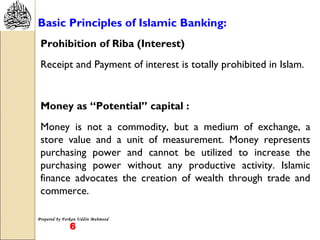
Prohibition of Riba (Interest)
Receipt and Payment of interest is totally prohibited in Islam.
Money as “Potential” capital :
Money is not a commodity, but a medium of exchange, a
store value and a unit of measurement. Money represents
purchasing power and cannot be utilized to increase the
purchasing power without any productive activity. Islamic
finance advocates the creation of wealth through trade and
commerce.
Prepared by Forkan Uddin Mahmood
6
Basic Principles of Islamic Banking:
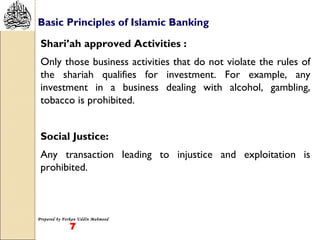
Shari’ah approved Activities :
Only those business activities that do not violate the rules of
the shariah qualifies for investment. For example, any
investment in a business dealing with alcohol, gambling,
tobacco is prohibited.
Social Justice:
Any transaction leading to injustice and exploitation is
prohibited.
Prepared by Forkan Uddin Mahmood
7
Basic Principles of Islamic Banking
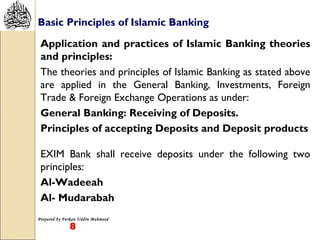
Application and practices of Islamic Banking theories
and principles:
The theories and principles of Islamic Banking as stated above
are applied in the General Banking, Investments, Foreign
Trade & Foreign Exchange Operations as under:
General Banking: Receiving of Deposits.
Principles of accepting Deposits and Deposit products
EXIM Bank shall receive deposits under the following two
principles:
Al-Wadeeah
Al- Mudarabah
Prepared by Forkan Uddin Mahmood
8
Basic Principles of Islamic Banking
Bangladesh Bank in their Guidelines for Islamic Banking
has given the following definitions of the above two
Modes.
Al-Wadeeah:
Fund which is deposited with Banks by the depositors with clear
permission to utilize/invest the same is called Al-Wadeeah.
Islamic banks receive deposits in Current Accounts on the basis
of this Al-Wadeeah principle. Islamic banks obtain permission
from the Al-Wadeeah depositors to utilize the funds at its own
responsibility and the depositors would not share any profit or
loss earned/incurred out of using of this funds by the bank. The
banks have to pay back the deposits received on the principle of
Al-Wadeeah on demand of the holders. The depositors have to
pay govt. taxes and other charges, if any.
Prepared by Forkan Uddin Mahmood
9
Basic Principles of Islamic Banking
Mudaraba:
Mudaraba is a partnership of labor and capital, where one partner
provides full capital and the other one manages the business. The
capital provider is called Sahib-Al-Maal and the user of the capital is
called Mudarib. As per shariah principles, the Mudarib will conduct
the business independently following shariah principles. The Sahib-
Al-Maal may provide advices, if he deems fit but he can not impose
any decision over the Mudarib. Profit, if any, is divisible between the
Sahib-Al-Maal and the Mudarib at a predetermined ratio, while loss,
if any, is borne by the Sahib-Al-Maal. Mudarib can not avail of any
salary or remuneration against his labor as a manager or conductor
of the enterprise/business. The deposits, received by Islamic banks
under this principle are called Mudaraba Deposits. Here, the
depositors are called Sahib-Al-Maal and the bank is called Mudarib.
Prepared by Forkan Uddin Mahmood
10
Basic Principles of Islamic Banking
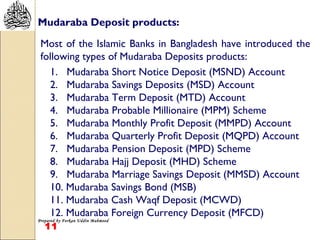
Most of the Islamic Banks in Bangladesh have introduced the
following types of Mudaraba Deposits products:
1. Mudaraba Short Notice Deposit (MSND) Account
2. Mudaraba Savings Deposits (MSD) Account
3. Mudaraba Term Deposit (MTD) Account
4. Mudaraba Probable Millionaire (MPM) Scheme
5. Mudaraba Monthly Profit Deposit (MMPD) Account
6. Mudaraba Quarterly Profit Deposit (MQPD) Account
7. Mudaraba Pension Deposit (MPD) Scheme
8. Mudaraba Hajj Deposit (MHD) Scheme
9. Mudaraba Marriage Savings Deposit (MMSD) Account
10. Mudaraba Savings Bond (MSB)
11. Mudaraba Cash Waqf Deposit (MCWD)
12. Mudaraba Foreign Currency Deposit (MFCD)
Prepared by Forkan Uddin Mahmood
11
Mudaraba Deposit products:
Opening of an Account in a Bank is a contractual relationship.
Therefore, before opening any Account, be it an Al-Wadeeah
Current Account or any type of Mudaraba Deposit Account,
the rules and procedures of the concerned account to be
read out and clearly explained to the prospective account
holder & his signature to be obtained at the appropriate place
of the Account opening Forms. Special care to be taken to
communicate the rules for distribution of profit to the
Mudaraba depositors.
Prepared by Forkan Uddin Mahmood
12
Compliance of Shariah Rules in Deposit Account :
Bangladesh Bank in their Guidelines for Islamic Banking, has
prescribed the following Modes of Investments :
1) Mudaraba;
2) Musharaka;
3) Bai-Murabaha (Murabaha to the purchase orderers);
4) Bai-Muajjal;
5) Bai - Salam and parallel Salam;
6) Bai - Istisna and parallel Istisna;
7) Ijara;
8) Ijarah Muntahia Bittamleek (Hire Purchase);
9) Hire Purchase Musharaka Mutanaqisa (HPMM);
10) Direct Investment;
11) Investment Auctioning etc.
12) Quard
13) Quard Hassan etc.Prepared by Forkan Uddin Mahmood
13
Investment (Uses and deployment of Funds) :
Meaning and Operational issues of the above
Investment Modes as given by Bangladesh Bank in their
Guidelines for Islamic Banking are quoted below:
Mudaraba:
Mudaraba is a shared venture between labor and capital. Here
Bank provides the entire capital and the investment client
conducts the business. The Bank, provider of capital, is called
Sahib-Al-Maal and the client is called Mudarib. The profit is to
be distributed between the Bank and the investment client at
a predetermined ratio while the bank has to bear the entire
loss, if any.
Prepared by Forkan Uddin Mahmood
14
Investment (Uses and deployment of Funds):
Musharaka:
Musharaka means partnership business. Every partner has to
provide more or less equity funds in this partnership business.
Both the Bank and the investment client reserve the right to
share in the management of the business. But the Bank may
operate to permit the investment client to operate the whole
business. In practice, the investment client normally conducts
the business. The profit is divided between the bank and the
investment client at a predetermined ratio. Loss, if any, is to
be borne by the bank and the investment client according to
capital ratio.
Prepared by Forkan Uddin Mahmood
15
Investment (Uses and deployment of Funds):
Bai-Murabaha (Murabaha to the Purchase Orderers):
Contractual buying and selling at a mark-up profit is called
Murabaha. In this case, the client requests the Bank to
purchase certain goods for him. The Bank purchases the
goods as per specification and requirement of the client. The
client receives the goods on payment of the price which
includes mark-up profit as per contract. Under this mode of
investment the purchase/cost price and profit are to be
disclosed separately.
Prepared by Forkan Uddin Mahmood
16
Investment (Uses and deployment of Funds):
Bai-Muajjal:
"Bai-Muajjal" means sale for which payment is made at a future
fixed date or within a fixed period. In short, it is a sale on
Credit. It is a contract between a buyer and a seller under which
the seller sells certain specific goods (permissible under shariah
and law of the country), to the buyer at an agreed fixed price
payable at a certain fixed future date in lump sum or within a
fixed period by fixed installments. The seller may also sell the
goods purchased by him as per order and specification of the
buyer. In Bank's perspective, Bai-Muajjal is treated as a contract
between the Bank and the Client under which the bank sells to
the Client certain specified goods, purchased as per order and
specification of the Client at an agreed price payable within a
fixed future date in lump sum or by fixed installments.
Prepared by Forkan Uddin Mahmood
17
Investment (Uses and deployment of Funds):
Bai-Salam and Parallel Salam:
Salam means advance purchase. It is a mode of business under
which the buyer pays the price of the goods in advance on the
condition that the goods would be supplied / delivered at a
particular future time. The seller supplies the goods within
the fixed time.
Parallel Salam:
Parallel Salam is a Salam contract whereby the seller depends,
for executing his obligation, on receiving what is due to him
-in his capacity as purchaser from a sale in a previous Salam
contract, without making the execution of the second Salam
contract dependent on the execution of the first one.
Prepared by Forkan Uddin Mahmood
18
Investment (Uses and deployment of Funds):
Bai-Istisna and parallel Istisna:
A contract executed between a buyer and a seller under
which the seller pledges to manufacture and supply certain
goods according to specification of the buyer is called Istisna.
An Istisna agreement is executed when a manufacturer or a
factory owner accepts a proposal placed to him by a person
or an Institution to produce/manufacture certain goods for
the latter at a certain negotiated price. Here, the person
giving the order is called Mustasni, the receiver of the order is
called Sani and the goods manufactured as per order is called
Masnu. An order placed for manufacturing or producing those
goods which under prevailing customs and practice are
produced or manufactured will be treated as Istisna contract.
Prepared by Forkan Uddin Mahmood
19
Investment (Uses and deployment of Funds):
Parallel Istisna:
If it is not stipulated in the contract that the seller himself would
produce/provide the goods or services, then the seller can enter
into another contract with third party for getting the goods or
services produced/ provided by the third party. Such a contract is
called Parallel Istisna. This may be treated as a sub-contract. The
main features of this contract are:­
i) The original Istisna contract remains valid even if the Parallel
Istisna contract fails and the seller will be legally liable to
produce/ provide the goods or services mentioned in the
Istisna contract.
ii) Istisna and Parallel Istisna contracts are treated as two separate
contracts.
iii) The seller under the Istisna contract will remain liable for
failure of the sub-contract.Prepared by Forkan Uddin Mahmood
20
Investment (Uses and deployment of Funds):
Ijara:
The mode under which any asset owned by the bank, by
creation, acquirement/or building-up is rented out is called
Ijara or leasing. In this mode, the leasee pays the Bank rents at
a determined rate for using the assets/properties and returns
the same to the Bank at the expiry of the agreement. The
Bank retains absolute ownership of the assets/properties in
such a case. However, at the end of the leased period, the
asset may be sold to the client at an agreed price.
Investment (Uses and deployment of Funds):
Prepared by Forkan Uddin Mahmood
21
Ijarah Muntahia Bittamleak (Hire-Purchase):
Under this mode, the bank purchases vehicles, machineries
and instruments, building, apartment etc. and allow clients to
use those on payment of fixed rents in installments with the
ultimate objective to sell the asset to the client at the end of
the rental period. The client acquires the ownership/ title of
the assets/ properties subject to full payment/ adjustment of
all the installments.
Investment (Uses and deployment of Funds):
Prepared by Forkan Uddin Mahmood
22
Hire-purchase Musharaka Mutanaqasa (HPMM):
Hire-purchase Musharaka Mutanaqasa means purchasing and
acquiring ownership by one party by sharing in equity and
paying rents for the rest of the equity held by the Bank/or
other party. Under this mode, the Bank and the client on
contract basis jointly purchase vehicles, machineries, building,
apartment etc. The client uses the portion of the assets
owned by the bank on rental basis and acquires the
ownership of the same assets by way of paying banks portion
of the equity on the assets in installments together with its
rents as agreed upon.
Investment (Uses and deployment of Funds):
Prepared by Forkan Uddin Mahmood
23
Direct Investment:
Under this mode, the bank can under its full proprietorship
conduct business by directly investing in the industries,
trading, transports etc. In these cases, the profit/loss fully
goes to the bank.
Investment Auctioning:
Selling by auction of those assets/goods acquired by the bank
through direct investment is called Investment auctioning.
Generally, the bank establishes industrial units by direct
investment, makes the same operationally profitable and then
sells out on auction. This mode of investment is very helpful
for industrialization of the country.
Investment (Uses and deployment of Funds):
Prepared by Forkan Uddin Mahmood
24
Quard:
It is a mode to provide financial assistance/ loan with the stipulation to
return the principal amount in the future without any increase
thereon.
Quard Hassan:
This is a benevolent loan that obliges a borrower to repay the lender
the principal amount borrowed on maturity. The borrower, however,
has the discretion to reward the lender for his loan by paying any
amount over and above the amount of the principal provided there
will be no reference (explicit or implicit) in this regard. If a bank
provides its client any loan, it can receive actual expenditure relating
to the loan as service charge only once. It can not charge annually at a
percentage rate. If a loan is provided against the money deposited by a
client in the bank, it has the right not to pay any profit against the
amount of money given as loan. But profit should be paid on the rest
of the amount deposited as per previous agreement.
Investment (Uses and deployment of Funds):
Prepared by Forkan Uddin Mahmood
25
Foreign Exchange & Foreign Trade under Islamic
Framework :
Foreign Exchange and Foreign Trade business are conducted
as per “Guidelines for Foreign Exchange Transactions” of
Bangladesh Bank and the Circulars issued by them from time
to time in this regard.
General Framework of Foreign exchange & Foreign
Trade Transaction :
Bangladesh Bank, in their “Guidelines for Islamic Banking” has
provided detailed principles and rules for foreign trade
business. Before quoting those principles & rules, Islamic
perspectives’ and principles of foreign exchanges & foreign
trade are given below:
Investment (Uses and deployment of Funds):
Prepared by Forkan Uddin Mahmood
26
Islamic & Conventional Trade Finance : A Comparison
Prepared by Forkan Uddin Mahmood
27
Islamic Conventional
Based on sale contract
between the parties
Legal relation is based on
assignment and Mandate
Title in the name of the Bank Title of goods in the name of
the client
Deals in goods Deals in documents
Accepts Risk Does not take Risk
Subordinate to the Contract Abstract responsibility in case
of fraud or defective goods
No interest elements Charges interest
Foreign Trade under Islamic Perspective:
Import & Export Services and Financing Products:
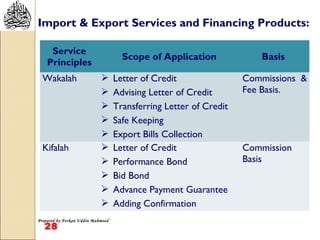
Service
Principles
Scope of Application Basis
Wakalah  Letter of Credit
 Advising Letter of Credit
 Transferring Letter of Credit
 Safe Keeping
 Export Bills Collection
Commissions &
Fee Basis.
Kifalah  Letter of Credit
 Performance Bond
 Bid Bond
 Advance Payment Guarantee
 Adding Confirmation
Commission
Basis
Prepared by Forkan Uddin Mahmood
28
Import & Export Services and Financing Products:
Financing
Principles
Scope of Application Basis
Bai  Bai-Murabaha (Import)
 Bai-Murabaha (Import Bills)
 Bai-Murabaha (Post Import)
 Bai-Muajjal (Pre shipment)
 Bai-Salam (Pre shipment)
 Bai-as-Sarf (Post Shipment)
Mark up Basis
Mark up Basis
Mark up Basis
Mark up Basis
Profit Basis
Profit Basis
Shirkat  Mudaraba (Import)
 Musharaka (Pre shipment)
 Musharaka Documentary Bills
P/L sharing Basis
P/L sharing Basis
P/L sharing Basis
Ijara  Hire Purchase under Shirkatul
Meek
Rental Basis
Prepared by Forkan Uddin Mahmood
29
Difference between Islamic Banking and
Conventional Banking
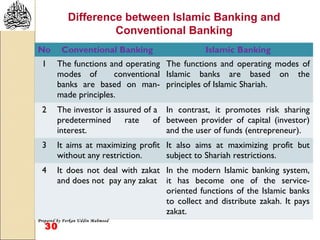
No Conventional Banking Islamic Banking
1 The functions and operating
modes of conventional
banks are based on man-
made principles.
The functions and operating modes of
Islamic banks are based on the
principles of Islamic Shariah.
2 The investor is assured of a
predetermined rate of
interest.
In contrast, it promotes risk sharing
between provider of capital (investor)
and the user of funds (entrepreneur).
3 It aims at maximizing profit
without any restriction.
It also aims at maximizing profit but
subject to Shariah restrictions.
4 It does not deal with zakat
and does not pay any zakat
In the modern Islamic banking system,
it has become one of the service-
oriented functions of the Islamic banks
to collect and distribute zakah. It pays
zakat.
Prepared by Forkan Uddin Mahmood
30
Difference between Islamic Banking and
Conventional Banking (Contd…)
No Conventional Banking Islamic Banking
5 Lending money and getting it back
with interest is the fundamental
function of the conventional banks.
Participation in partnership
business is the fundamental
function of the Islamic banks
6 Its scope of activities is narrower
when compared with an Islamic
bank
Its scope of activities is wider
when compared with a
conventional bank. It is, in
effect, a multipurpose
institution.
7 It can charge additional money
(compound rate of interest) in
case of defaulters..
The Islamic banks have no
provision to charge any extra
money from the defaulters.
8 In it very often, bank’s own
interest becomes prominent. It
makes no effort to ensure growth
with equity.
It gives due importance to the
public interest. Its ultimate aim
is to ensure growth with equity.
Prepared by Forkan Uddin Mahmood
31
Difference between Islamic Banking and
Conventional Banking (Contd…)
No Conventional Banking Islamic Banking
9 For interest - based commercial
banks, borrowing from the money
market is relatively easier.
For Islamic banks, it is comparatively
difficult to borrow money from the
money market.
10 Since income from the advances is
fixed, it gives little importance to
developing expertise in project
appraisal and evaluations.
Since it shares profit and loss,
Islamic banks pay greater attention
to developing project appraisal
project appraisal and evaluations.
11 Conventional banks give greater
emphasis on credit-worthiness of
the clients.
Islamic banks, on the other hand,
give greater emphasis on the
viability of the projects.
12 The status of a conventional bank,
in relation to its clients, is that of
creditor and debtors.
The status of Islamic bank in
relation to its clients is that of
partners, investors and trader
13 A conventional bank has to
guarantee al its deposits.
Strictly speaking, an Islamic bank
cannot guarantee all its deposits.
Prepared by Forkan Uddin Mahmood
32
Thanks for your
Co-operaTion
Allah Hafez

Islamic-banking-concept-application-and-brief-operational-procedure

  • 1.
    Islamic Banking Concept,Application and brief Operational Procedure Presented by Md. Fariduddin Ahmed Advisor Export Import Bank of Bangladesh Limited Former Managing Director & Chief Executive Officer Islami Bank Bangladesh Limited Export Import Bank of Bangladesh Limited
  • 2.
    General Secretariat ofthe Organization of Islamic Conference (OIC) defined Islamic Banking as “An Islamic Bank is a financial Institution whose statutes, rules and procedures expressly state its commitment to the principles of Islamic Shariah and to the banking of the receipt and payment of interest on any of its operations”. Prepared by Forkan Uddin Mahmood 2 Meaning and definition of Islamic Banking:
  • 3.
    Bangladesh Bank Guidelinesfor Islamic Banking states “Islamic Bank” means such a company or an Islamic Bank Branch(es) of a banking company licensed by Bangladesh Bank, which follows the Islamic Shariah in all its principles and modes of operations and avoids receiving and paying of interest at all levels. “Islamic Banking Business”, the BB guidelines states, means such banking business the goals, objectives and activities of which is to conduct banking business/activities according to the principles of Islamic Shariah and no part of the business either in form and substance has any elements not approved by Islamic Shariah.” Prepared by Forkan Uddin Mahmood 3 Meaning and definition of Islamic Banking:
  • 4.
    Definition of Riba: The word ‘Riba’ means excess, increase or addition, which correctly interpreted according to shariah terminology, implies any excess compensation without due consideration Types of Riba (Interest) : There are two types of Riba. ‘Riba Nasiyah’ is defined as excess which results from predetermined interest which a lender receives over and above the principal (Ras-ul-Maal). Prepared by Forkan Uddin Mahmood 4 Definition & Types of Riba (Interest) :
  • 5.
    ‘Riba-Al-Fdl’ is definedas excess compensation without any consideration resulting from sale of goods. Riba-Al-Fadl actually mean that excess which is taken in exchange of specific homogenous commodities and encountered in their hand to hand purchase and sale. Gold, Silver, Dates, Wheat, Salt & Barley are the six commodities can only be bought and sold in equal quantities and on spot. Prepared by Forkan Uddin Mahmood 5 Definition & Types of Riba (Interest) :
  • 6.
    Prohibition of Riba(Interest) Receipt and Payment of interest is totally prohibited in Islam. Money as “Potential” capital : Money is not a commodity, but a medium of exchange, a store value and a unit of measurement. Money represents purchasing power and cannot be utilized to increase the purchasing power without any productive activity. Islamic finance advocates the creation of wealth through trade and commerce. Prepared by Forkan Uddin Mahmood 6 Basic Principles of Islamic Banking:
  • 7.
    Shari’ah approved Activities: Only those business activities that do not violate the rules of the shariah qualifies for investment. For example, any investment in a business dealing with alcohol, gambling, tobacco is prohibited. Social Justice: Any transaction leading to injustice and exploitation is prohibited. Prepared by Forkan Uddin Mahmood 7 Basic Principles of Islamic Banking
  • 8.
    Application and practicesof Islamic Banking theories and principles: The theories and principles of Islamic Banking as stated above are applied in the General Banking, Investments, Foreign Trade & Foreign Exchange Operations as under: General Banking: Receiving of Deposits. Principles of accepting Deposits and Deposit products EXIM Bank shall receive deposits under the following two principles: Al-Wadeeah Al- Mudarabah Prepared by Forkan Uddin Mahmood 8 Basic Principles of Islamic Banking
  • 9.
    Bangladesh Bank intheir Guidelines for Islamic Banking has given the following definitions of the above two Modes. Al-Wadeeah: Fund which is deposited with Banks by the depositors with clear permission to utilize/invest the same is called Al-Wadeeah. Islamic banks receive deposits in Current Accounts on the basis of this Al-Wadeeah principle. Islamic banks obtain permission from the Al-Wadeeah depositors to utilize the funds at its own responsibility and the depositors would not share any profit or loss earned/incurred out of using of this funds by the bank. The banks have to pay back the deposits received on the principle of Al-Wadeeah on demand of the holders. The depositors have to pay govt. taxes and other charges, if any. Prepared by Forkan Uddin Mahmood 9 Basic Principles of Islamic Banking
  • 10.
    Mudaraba: Mudaraba is apartnership of labor and capital, where one partner provides full capital and the other one manages the business. The capital provider is called Sahib-Al-Maal and the user of the capital is called Mudarib. As per shariah principles, the Mudarib will conduct the business independently following shariah principles. The Sahib- Al-Maal may provide advices, if he deems fit but he can not impose any decision over the Mudarib. Profit, if any, is divisible between the Sahib-Al-Maal and the Mudarib at a predetermined ratio, while loss, if any, is borne by the Sahib-Al-Maal. Mudarib can not avail of any salary or remuneration against his labor as a manager or conductor of the enterprise/business. The deposits, received by Islamic banks under this principle are called Mudaraba Deposits. Here, the depositors are called Sahib-Al-Maal and the bank is called Mudarib. Prepared by Forkan Uddin Mahmood 10 Basic Principles of Islamic Banking
  • 11.
    Most of theIslamic Banks in Bangladesh have introduced the following types of Mudaraba Deposits products: 1. Mudaraba Short Notice Deposit (MSND) Account 2. Mudaraba Savings Deposits (MSD) Account 3. Mudaraba Term Deposit (MTD) Account 4. Mudaraba Probable Millionaire (MPM) Scheme 5. Mudaraba Monthly Profit Deposit (MMPD) Account 6. Mudaraba Quarterly Profit Deposit (MQPD) Account 7. Mudaraba Pension Deposit (MPD) Scheme 8. Mudaraba Hajj Deposit (MHD) Scheme 9. Mudaraba Marriage Savings Deposit (MMSD) Account 10. Mudaraba Savings Bond (MSB) 11. Mudaraba Cash Waqf Deposit (MCWD) 12. Mudaraba Foreign Currency Deposit (MFCD) Prepared by Forkan Uddin Mahmood 11 Mudaraba Deposit products:
  • 12.
    Opening of anAccount in a Bank is a contractual relationship. Therefore, before opening any Account, be it an Al-Wadeeah Current Account or any type of Mudaraba Deposit Account, the rules and procedures of the concerned account to be read out and clearly explained to the prospective account holder & his signature to be obtained at the appropriate place of the Account opening Forms. Special care to be taken to communicate the rules for distribution of profit to the Mudaraba depositors. Prepared by Forkan Uddin Mahmood 12 Compliance of Shariah Rules in Deposit Account :
  • 13.
    Bangladesh Bank intheir Guidelines for Islamic Banking, has prescribed the following Modes of Investments : 1) Mudaraba; 2) Musharaka; 3) Bai-Murabaha (Murabaha to the purchase orderers); 4) Bai-Muajjal; 5) Bai - Salam and parallel Salam; 6) Bai - Istisna and parallel Istisna; 7) Ijara; 8) Ijarah Muntahia Bittamleek (Hire Purchase); 9) Hire Purchase Musharaka Mutanaqisa (HPMM); 10) Direct Investment; 11) Investment Auctioning etc. 12) Quard 13) Quard Hassan etc.Prepared by Forkan Uddin Mahmood 13 Investment (Uses and deployment of Funds) :
  • 14.
    Meaning and Operationalissues of the above Investment Modes as given by Bangladesh Bank in their Guidelines for Islamic Banking are quoted below: Mudaraba: Mudaraba is a shared venture between labor and capital. Here Bank provides the entire capital and the investment client conducts the business. The Bank, provider of capital, is called Sahib-Al-Maal and the client is called Mudarib. The profit is to be distributed between the Bank and the investment client at a predetermined ratio while the bank has to bear the entire loss, if any. Prepared by Forkan Uddin Mahmood 14 Investment (Uses and deployment of Funds):
  • 15.
    Musharaka: Musharaka means partnershipbusiness. Every partner has to provide more or less equity funds in this partnership business. Both the Bank and the investment client reserve the right to share in the management of the business. But the Bank may operate to permit the investment client to operate the whole business. In practice, the investment client normally conducts the business. The profit is divided between the bank and the investment client at a predetermined ratio. Loss, if any, is to be borne by the bank and the investment client according to capital ratio. Prepared by Forkan Uddin Mahmood 15 Investment (Uses and deployment of Funds):
  • 16.
    Bai-Murabaha (Murabaha tothe Purchase Orderers): Contractual buying and selling at a mark-up profit is called Murabaha. In this case, the client requests the Bank to purchase certain goods for him. The Bank purchases the goods as per specification and requirement of the client. The client receives the goods on payment of the price which includes mark-up profit as per contract. Under this mode of investment the purchase/cost price and profit are to be disclosed separately. Prepared by Forkan Uddin Mahmood 16 Investment (Uses and deployment of Funds):
  • 17.
    Bai-Muajjal: "Bai-Muajjal" means salefor which payment is made at a future fixed date or within a fixed period. In short, it is a sale on Credit. It is a contract between a buyer and a seller under which the seller sells certain specific goods (permissible under shariah and law of the country), to the buyer at an agreed fixed price payable at a certain fixed future date in lump sum or within a fixed period by fixed installments. The seller may also sell the goods purchased by him as per order and specification of the buyer. In Bank's perspective, Bai-Muajjal is treated as a contract between the Bank and the Client under which the bank sells to the Client certain specified goods, purchased as per order and specification of the Client at an agreed price payable within a fixed future date in lump sum or by fixed installments. Prepared by Forkan Uddin Mahmood 17 Investment (Uses and deployment of Funds):
  • 18.
    Bai-Salam and ParallelSalam: Salam means advance purchase. It is a mode of business under which the buyer pays the price of the goods in advance on the condition that the goods would be supplied / delivered at a particular future time. The seller supplies the goods within the fixed time. Parallel Salam: Parallel Salam is a Salam contract whereby the seller depends, for executing his obligation, on receiving what is due to him -in his capacity as purchaser from a sale in a previous Salam contract, without making the execution of the second Salam contract dependent on the execution of the first one. Prepared by Forkan Uddin Mahmood 18 Investment (Uses and deployment of Funds):
  • 19.
    Bai-Istisna and parallelIstisna: A contract executed between a buyer and a seller under which the seller pledges to manufacture and supply certain goods according to specification of the buyer is called Istisna. An Istisna agreement is executed when a manufacturer or a factory owner accepts a proposal placed to him by a person or an Institution to produce/manufacture certain goods for the latter at a certain negotiated price. Here, the person giving the order is called Mustasni, the receiver of the order is called Sani and the goods manufactured as per order is called Masnu. An order placed for manufacturing or producing those goods which under prevailing customs and practice are produced or manufactured will be treated as Istisna contract. Prepared by Forkan Uddin Mahmood 19 Investment (Uses and deployment of Funds):
  • 20.
    Parallel Istisna: If itis not stipulated in the contract that the seller himself would produce/provide the goods or services, then the seller can enter into another contract with third party for getting the goods or services produced/ provided by the third party. Such a contract is called Parallel Istisna. This may be treated as a sub-contract. The main features of this contract are:­ i) The original Istisna contract remains valid even if the Parallel Istisna contract fails and the seller will be legally liable to produce/ provide the goods or services mentioned in the Istisna contract. ii) Istisna and Parallel Istisna contracts are treated as two separate contracts. iii) The seller under the Istisna contract will remain liable for failure of the sub-contract.Prepared by Forkan Uddin Mahmood 20 Investment (Uses and deployment of Funds):
  • 21.
    Ijara: The mode underwhich any asset owned by the bank, by creation, acquirement/or building-up is rented out is called Ijara or leasing. In this mode, the leasee pays the Bank rents at a determined rate for using the assets/properties and returns the same to the Bank at the expiry of the agreement. The Bank retains absolute ownership of the assets/properties in such a case. However, at the end of the leased period, the asset may be sold to the client at an agreed price. Investment (Uses and deployment of Funds): Prepared by Forkan Uddin Mahmood 21
  • 22.
    Ijarah Muntahia Bittamleak(Hire-Purchase): Under this mode, the bank purchases vehicles, machineries and instruments, building, apartment etc. and allow clients to use those on payment of fixed rents in installments with the ultimate objective to sell the asset to the client at the end of the rental period. The client acquires the ownership/ title of the assets/ properties subject to full payment/ adjustment of all the installments. Investment (Uses and deployment of Funds): Prepared by Forkan Uddin Mahmood 22
  • 23.
    Hire-purchase Musharaka Mutanaqasa(HPMM): Hire-purchase Musharaka Mutanaqasa means purchasing and acquiring ownership by one party by sharing in equity and paying rents for the rest of the equity held by the Bank/or other party. Under this mode, the Bank and the client on contract basis jointly purchase vehicles, machineries, building, apartment etc. The client uses the portion of the assets owned by the bank on rental basis and acquires the ownership of the same assets by way of paying banks portion of the equity on the assets in installments together with its rents as agreed upon. Investment (Uses and deployment of Funds): Prepared by Forkan Uddin Mahmood 23
  • 24.
    Direct Investment: Under thismode, the bank can under its full proprietorship conduct business by directly investing in the industries, trading, transports etc. In these cases, the profit/loss fully goes to the bank. Investment Auctioning: Selling by auction of those assets/goods acquired by the bank through direct investment is called Investment auctioning. Generally, the bank establishes industrial units by direct investment, makes the same operationally profitable and then sells out on auction. This mode of investment is very helpful for industrialization of the country. Investment (Uses and deployment of Funds): Prepared by Forkan Uddin Mahmood 24
  • 25.
    Quard: It is amode to provide financial assistance/ loan with the stipulation to return the principal amount in the future without any increase thereon. Quard Hassan: This is a benevolent loan that obliges a borrower to repay the lender the principal amount borrowed on maturity. The borrower, however, has the discretion to reward the lender for his loan by paying any amount over and above the amount of the principal provided there will be no reference (explicit or implicit) in this regard. If a bank provides its client any loan, it can receive actual expenditure relating to the loan as service charge only once. It can not charge annually at a percentage rate. If a loan is provided against the money deposited by a client in the bank, it has the right not to pay any profit against the amount of money given as loan. But profit should be paid on the rest of the amount deposited as per previous agreement. Investment (Uses and deployment of Funds): Prepared by Forkan Uddin Mahmood 25
  • 26.
    Foreign Exchange &Foreign Trade under Islamic Framework : Foreign Exchange and Foreign Trade business are conducted as per “Guidelines for Foreign Exchange Transactions” of Bangladesh Bank and the Circulars issued by them from time to time in this regard. General Framework of Foreign exchange & Foreign Trade Transaction : Bangladesh Bank, in their “Guidelines for Islamic Banking” has provided detailed principles and rules for foreign trade business. Before quoting those principles & rules, Islamic perspectives’ and principles of foreign exchanges & foreign trade are given below: Investment (Uses and deployment of Funds): Prepared by Forkan Uddin Mahmood 26
  • 27.
    Islamic & ConventionalTrade Finance : A Comparison Prepared by Forkan Uddin Mahmood 27 Islamic Conventional Based on sale contract between the parties Legal relation is based on assignment and Mandate Title in the name of the Bank Title of goods in the name of the client Deals in goods Deals in documents Accepts Risk Does not take Risk Subordinate to the Contract Abstract responsibility in case of fraud or defective goods No interest elements Charges interest Foreign Trade under Islamic Perspective:
  • 28.
    Import & ExportServices and Financing Products: Service Principles Scope of Application Basis Wakalah  Letter of Credit  Advising Letter of Credit  Transferring Letter of Credit  Safe Keeping  Export Bills Collection Commissions & Fee Basis. Kifalah  Letter of Credit  Performance Bond  Bid Bond  Advance Payment Guarantee  Adding Confirmation Commission Basis Prepared by Forkan Uddin Mahmood 28
  • 29.
    Import & ExportServices and Financing Products: Financing Principles Scope of Application Basis Bai  Bai-Murabaha (Import)  Bai-Murabaha (Import Bills)  Bai-Murabaha (Post Import)  Bai-Muajjal (Pre shipment)  Bai-Salam (Pre shipment)  Bai-as-Sarf (Post Shipment) Mark up Basis Mark up Basis Mark up Basis Mark up Basis Profit Basis Profit Basis Shirkat  Mudaraba (Import)  Musharaka (Pre shipment)  Musharaka Documentary Bills P/L sharing Basis P/L sharing Basis P/L sharing Basis Ijara  Hire Purchase under Shirkatul Meek Rental Basis Prepared by Forkan Uddin Mahmood 29
  • 30.
    Difference between IslamicBanking and Conventional Banking No Conventional Banking Islamic Banking 1 The functions and operating modes of conventional banks are based on man- made principles. The functions and operating modes of Islamic banks are based on the principles of Islamic Shariah. 2 The investor is assured of a predetermined rate of interest. In contrast, it promotes risk sharing between provider of capital (investor) and the user of funds (entrepreneur). 3 It aims at maximizing profit without any restriction. It also aims at maximizing profit but subject to Shariah restrictions. 4 It does not deal with zakat and does not pay any zakat In the modern Islamic banking system, it has become one of the service- oriented functions of the Islamic banks to collect and distribute zakah. It pays zakat. Prepared by Forkan Uddin Mahmood 30
  • 31.
    Difference between IslamicBanking and Conventional Banking (Contd…) No Conventional Banking Islamic Banking 5 Lending money and getting it back with interest is the fundamental function of the conventional banks. Participation in partnership business is the fundamental function of the Islamic banks 6 Its scope of activities is narrower when compared with an Islamic bank Its scope of activities is wider when compared with a conventional bank. It is, in effect, a multipurpose institution. 7 It can charge additional money (compound rate of interest) in case of defaulters.. The Islamic banks have no provision to charge any extra money from the defaulters. 8 In it very often, bank’s own interest becomes prominent. It makes no effort to ensure growth with equity. It gives due importance to the public interest. Its ultimate aim is to ensure growth with equity. Prepared by Forkan Uddin Mahmood 31
  • 32.
    Difference between IslamicBanking and Conventional Banking (Contd…) No Conventional Banking Islamic Banking 9 For interest - based commercial banks, borrowing from the money market is relatively easier. For Islamic banks, it is comparatively difficult to borrow money from the money market. 10 Since income from the advances is fixed, it gives little importance to developing expertise in project appraisal and evaluations. Since it shares profit and loss, Islamic banks pay greater attention to developing project appraisal project appraisal and evaluations. 11 Conventional banks give greater emphasis on credit-worthiness of the clients. Islamic banks, on the other hand, give greater emphasis on the viability of the projects. 12 The status of a conventional bank, in relation to its clients, is that of creditor and debtors. The status of Islamic bank in relation to its clients is that of partners, investors and trader 13 A conventional bank has to guarantee al its deposits. Strictly speaking, an Islamic bank cannot guarantee all its deposits. Prepared by Forkan Uddin Mahmood 32
  • 33.