Oracle® Succession Planning
Implementation and User Guide
Release 12.1
Part No. E16346-02
July 2010
Oracle Succession Planning Implementation and User Guide, Release 12.1
Part No. E16346-02
Copyright © 2010, Oracle and/or its affiliates. All rights reserved.
Primary Author:     Gowri Arur
Contributing Author:     Rajshekar Ayyadevara, Vinod Vishwanathan, HCM Core Architecture Development
Team, Prem Armugam, Bina Kulkarni, Justine Fitzsimmons, Kathryn Tucker, Krishna Mohan Gowripeddi
Oracle is a registered trademark of Oracle Corporation and/or its affiliates. Other names may be trademarks
of their respective owners.
This software and related documentation are provided under a license agreement containing restrictions on
use and disclosure and are protected by intellectual property laws. Except as expressly permitted in your
license agreement or allowed by law, you may not use, copy, reproduce, translate, broadcast, modify, license,
transmit, distribute, exhibit, perform, publish or display any part, in any form, or by any means. Reverse
engineering, disassembly, or decompilation of this software, unless required by law for interoperability, is
prohibited.
The information contained herein is subject to change without notice and is not warranted to be error-free. If
you find any errors, please report them to us in writing.
If this software or related documentation is delivered to the U.S. Government or anyone licensing it on behalf
of the U.S. Government, the following notice is applicable:
U.S. GOVERNMENT RIGHTS
Programs, software, databases, and related documentation and technical data delivered to U.S. Government
customers are "commercial computer software" or "commercial technical data" pursuant to the applicable
Federal Acquisition Regulation and agency-specific supplemental regulations. As such, the use, duplication,
disclosure, modification, and adaptation shall be subject to the restrictions and license terms set forth in the
applicable Government contract, and, to the extent applicable by the terms of the Government contract, the
additional rights set forth in FAR 52.227-19, Commercial Computer Software License (December 2007). Oracle
USA, Inc., 500 Oracle Parkway, Redwood City, CA 94065.
This software is developed for general use in a variety of information management applications. It is not
developed or intended for use in any inherently dangerous applications, including applications which may
create a risk of personal injury. If you use this software in dangerous applications, then you shall be
responsible to take all appropriate fail-safe, backup, redundancy and other measures to ensure the safe use of
this software. Oracle Corporation and its affiliates disclaim any liability for any damages caused by use of this
software in dangerous applications.
This software and documentation may provide access to or information on content, products and services
from third parties. Oracle Corporation and its affiliates are not responsible for and expressly disclaim all
warranties of any kind with respect to third party content, products and services. Oracle Corporation and its
affiliates will not be responsible for any loss, costs, or damages incurred due to your access to or use of third
party content, products or services.
    iii
 
Contents
Send Us Your Comments
Preface
1 Oracle Succession Planning
Introduction to Oracle Succession Planning............................................................................ 1-1
2 Implementing Oracle Succession Planning
Implementing Oracle Succession Planning..............................................................................2-2
Oracle Succession Planning Licenses................................................................................... 2-2
Oracle Succession Planning Predefined Components..........................................................2-4
Implementing Oracle Succession Planning.......................................................................... 2-5
Setup Steps to Implement a Custom Version of Talent Profile Feature..................................2-8
Setup Steps to Implement a Custom Version of the Talent Profile Feature......................... 2-8
Setting up the Talent Profile Form Function........................................................................ 2-9
Setting up the Talent Profile Regions................................................................................. 2-10
Configuring the More Links in the Talent Profile Regions................................................ 2-17
Configuring Talent Profile Functions, Suitability Analyzer, and Compare Profile Templates
........................................................................................................................................... 2-24
Self-Service Actions on the Talent Profile Page..................................................................... 2-29
Setting up Self-Service Actions on the Talent Profile Page................................................ 2-29
Configuration Steps for Oracle Succession Planning............................................................ 2-30
Completing the Configuration Steps for Oracle Succession Planning............................... 2-30
Configuring the Quick Search and Hierarchy Regions...................................................... 2-34
Configuring the Region Icons............................................................................................ 2-35
Personalizing Talent Profile .............................................................................................. 2-35
Setting up Information for Succession Plans......................................................................... 2-38
iv
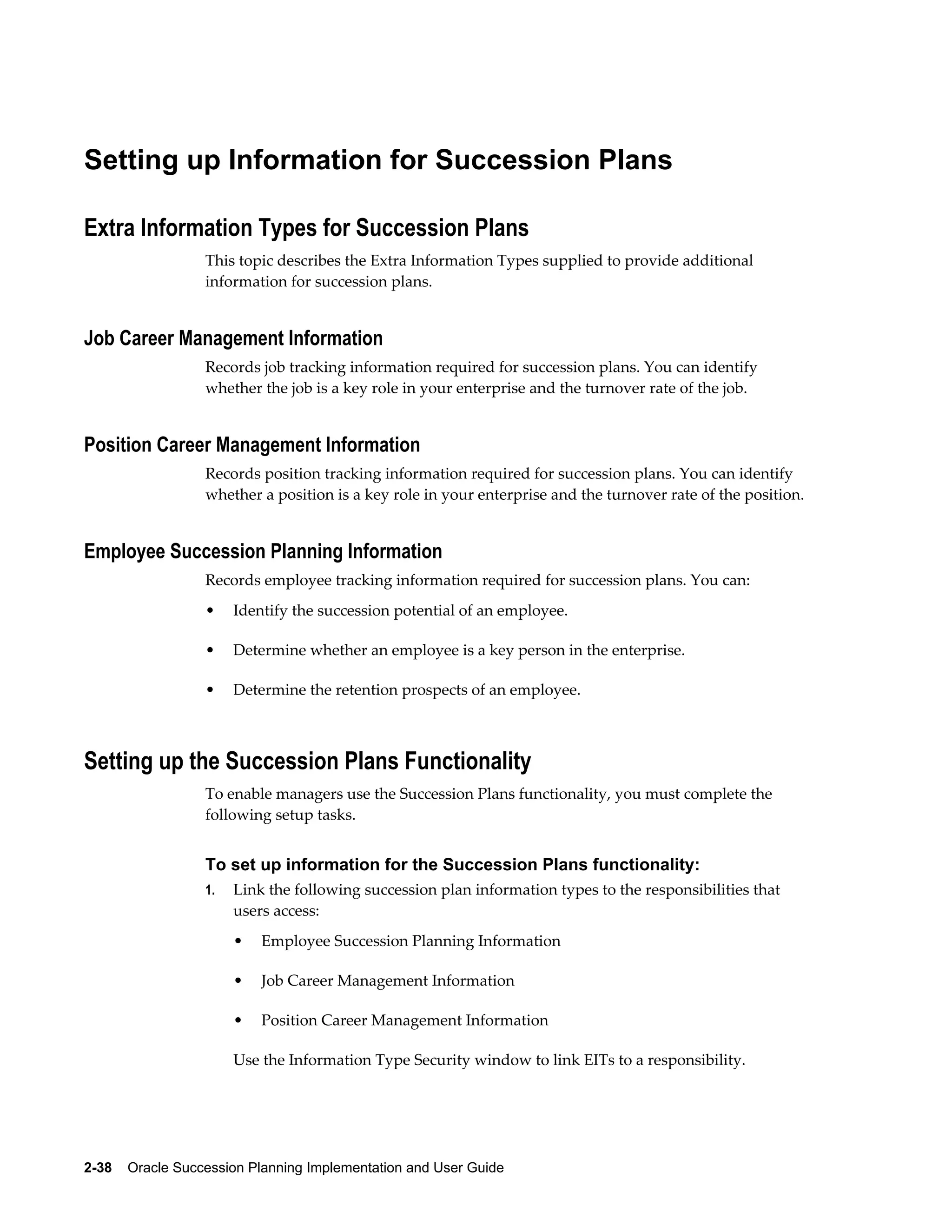
Extra Information Types for Succession Plans................................................................... 2-38
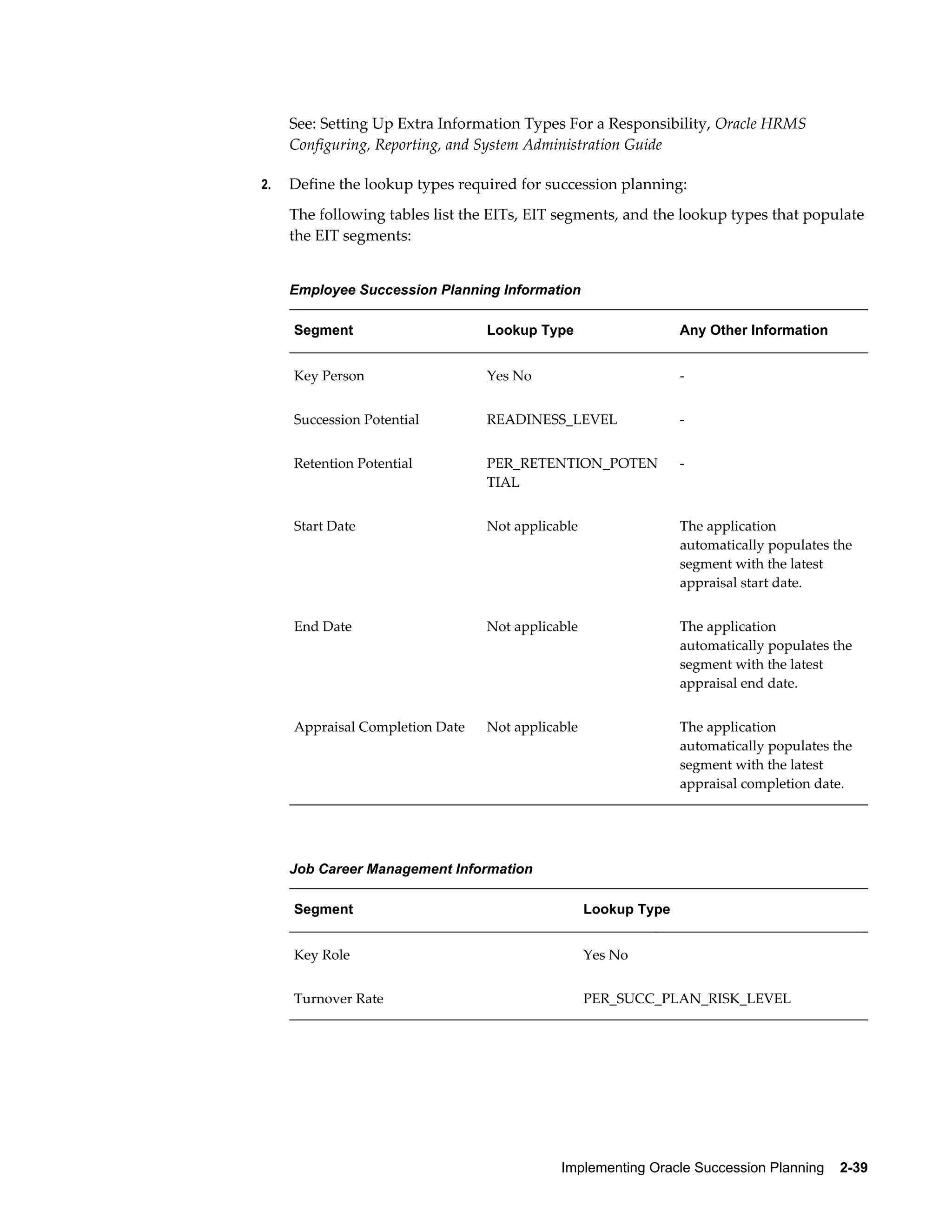
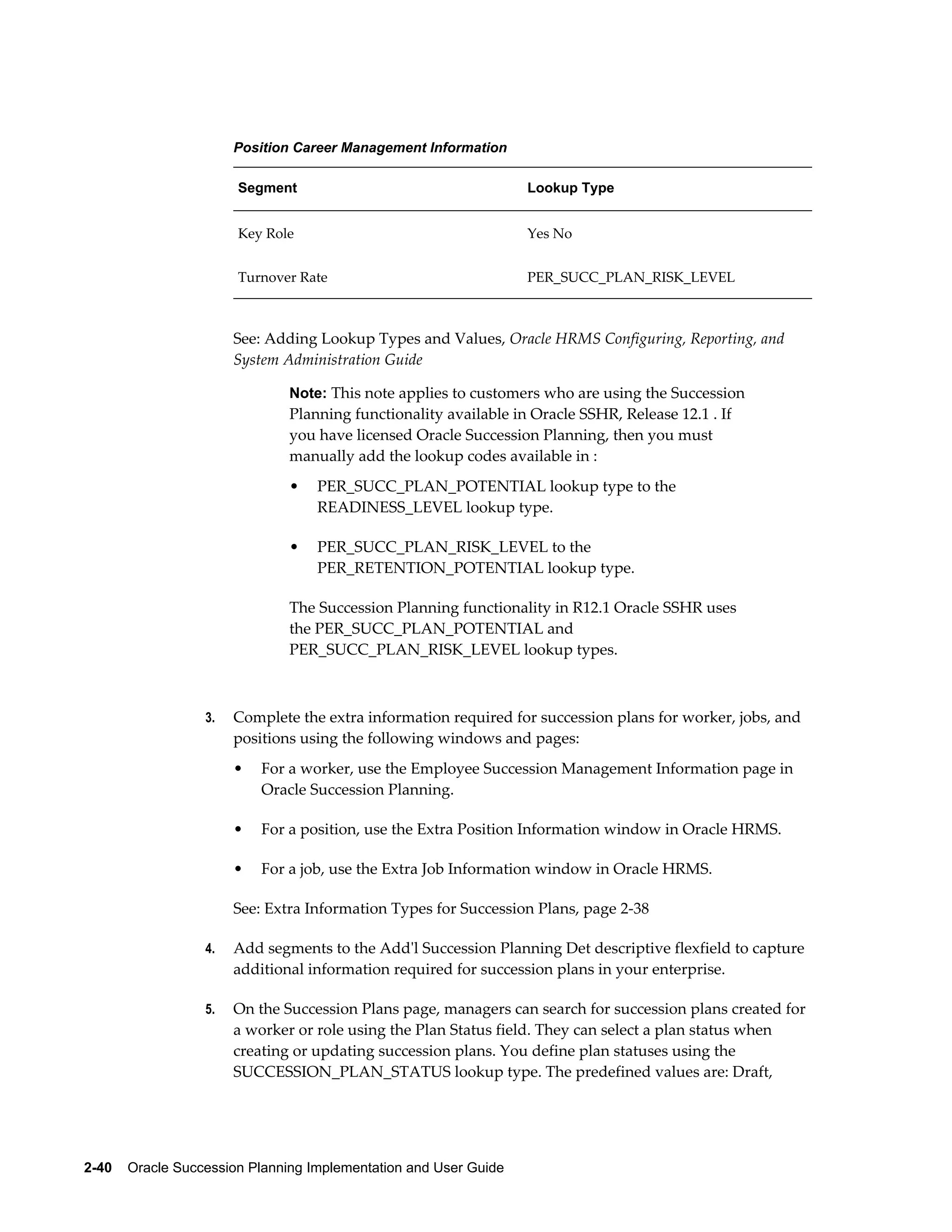
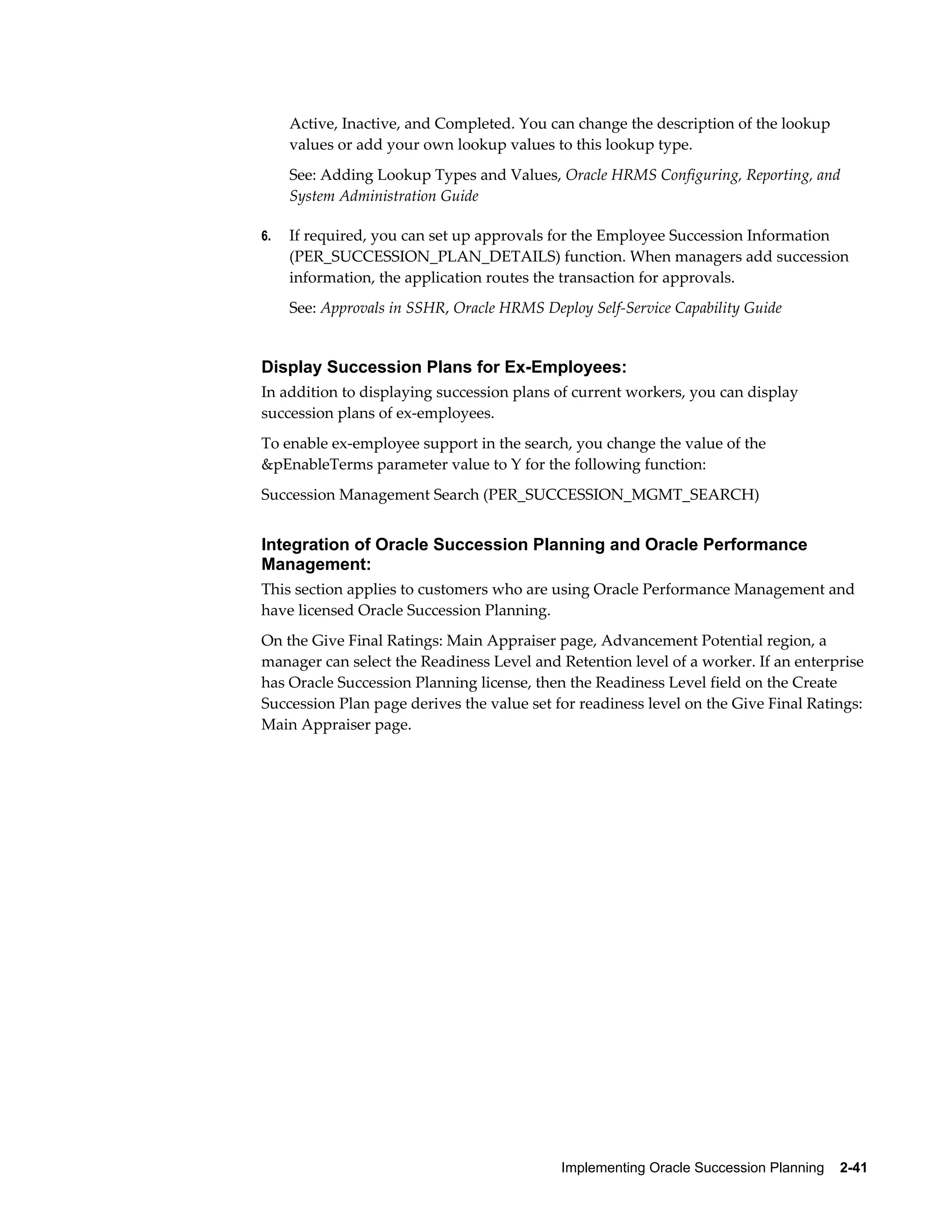
Setting up the Succession Plans Functionality................................................................... 2-38
Configuring Suitability Matching.......................................................................................... 2-42
Configuring Suitability Matching...................................................................................... 2-42
3 Using Oracle Succession Planning
Succession Planning.................................................................................................................. 3-2
The Succession Plans Feature...............................................................................................3-2
Identifying Workforce Talent Using Talent Profile.................................................................3-5
An Overview of Talent Profile............................................................................................. 3-5
Using Talent Profile as Managers........................................................................................ 3-8
Using Talent Profile as Workers........................................................................................ 3-24
Generating Printable Profiles............................................................................................. 3-36
Assessing Workforce Talent................................................................................................... 3-39
Using Performance Matrix (Potential) and Performance Matrix (Retention).....................3-39
Using Performance Matrix (Potential)......................................................................... 3-39
Using Performance Matrix (Retention)........................................................................3-43
Comparing Talent Profiles................................................................................................. 3-47
Using Suitability Matching in Oracle Succession Planning................................................3-50
Using the Suitability Analyzer........................................................................................... 3-51
Managing Succession Plans.................................................................................................... 3-55
Succession Planning Using Talent Profile.......................................................................... 3-55
Using the Succession Plans Page........................................................................................3-58
Creating and Maintaining Succession Plans Using Oracle Succession Planning............... 3-59
Index
    v
 
Send Us Your Comments
Oracle Succession Planning Implementation and User Guide, Release 12.1
Part No. E16346-02
Oracle welcomes customers' comments and suggestions on the quality and usefulness of this document.
Your feedback is important, and helps us to best meet your needs as a user of our products. For example:
• Are the implementation steps correct and complete?
• Did you understand the context of the procedures?
• Did you find any errors in the information?
• Does the structure of the information help you with your tasks?
• Do you need different information or graphics? If so, where, and in what format?
• Are the examples correct? Do you need more examples?
If you find any errors or have any other suggestions for improvement, then please tell us your name, the
name of the company who has licensed our products, the title and part number of the documentation and
the chapter, section, and page number (if available).
Note: Before sending us your comments, you might like to check that you have the latest version of the
document and if any concerns are already addressed. To do this, access the new Oracle E-Business Suite
Release Online Documentation CD available on My Oracle Support and www.oracle.com. It contains the
most current Documentation Library plus all documents revised or released recently.
Send your comments to us using the electronic mail address: appsdoc_us@oracle.com
Please give your name, address, electronic mail address, and telephone number (optional).
If you need assistance with Oracle software, then please contact your support representative or Oracle
Support Services.
If you require training or instruction in using Oracle software, then please contact your Oracle local office
and inquire about our Oracle University offerings. A list of Oracle offices is available on our Web site at
www.oracle.com.
    vii
 
Preface
Intended Audience
Welcome to Release 12.1 of the Oracle Succession Planning Implementation and User Guide.
This guide assumes you have a working knowledge of the following:
• The principles and customary practices of your business area.
• Oracle HRMS.
If you have never used Oracle HRMS, Oracle suggests you attend one or more of
the Oracle HRMS training classes available through Oracle University
• Oracle Self-Service Web Applications.
• The Oracle Applications graphical user interface.
To learn more about the Oracle Applications graphical user interface, read the
Oracle E-Business Suite User's Guide.
See Related Information Sources on page viii for more Oracle E-Business Suite product
information.
Deaf/Hard of Hearing Access to Oracle Support Services
To reach Oracle Support Services, use a telecommunications relay service (TRS) to call
Oracle Support at 1.800.223.1711. An Oracle Support Services engineer will handle
technical issues and provide customer support according to the Oracle service request
process. Information about TRS is available at
http://www.fcc.gov/cgb/consumerfacts/trs.html, and a list of phone numbers is
available at http://www.fcc.gov/cgb/dro/trsphonebk.html.
viii
Documentation Accessibility
Our goal is to make Oracle products, services, and supporting documentation accessible
to all users, including users that are disabled. To that end, our documentation includes
features that make information available to users of assistive technology. This
documentation is available in HTML format, and contains markup to facilitate access by
the disabled community. Accessibility standards will continue to evolve over time, and
Oracle is actively engaged with other market-leading technology vendors to address
technical obstacles so that our documentation can be accessible to all of our customers.
For more information, visit the Oracle Accessibility Program Web site at
http://www.oracle.com/accessibility/.
Accessibility of Code Examples in Documentation
Screen readers may not always correctly read the code examples in this document. The
conventions for writing code require that closing braces should appear on an otherwise
empty line; however, some screen readers may not always read a line of text that
consists solely of a bracket or brace.
Accessibility of Links to External Web Sites in Documentation
This documentation may contain links to Web sites of other companies or organizations
that Oracle does not own or control. Oracle neither evaluates nor makes any
representations regarding the accessibility of these Web sites.
Structure
1  Oracle Succession Planning
2  Implementing Oracle Succession Planning
3  Using Oracle Succession Planning
Related Information Sources
Oracle HRMS shares business and setup information with other Oracle Applications
products. Therefore, you may want to refer to other user guides when you set up and
use Oracle HRMS.
You can read the guides online by choosing Library from the expandable menu on your
HTML help window, by reading from the Oracle Applications Document Library CD
included in your media pack, or by using a Web browser with a URL that your system
administrator provides.
If you require printed guides, you can purchase them from the Oracle store at
http://oraclestore.oracle.com.
Guides Related to All Products
    ix
Oracle E-Business Suite User's Guide
This guide explains how to navigate, enter data, query, and run reports using the user
interface (UI) of Oracle E-Business Suite. This guide also includes information on setting
user profiles, as well as running and reviewing concurrent requests.
Guides Related to This Product
Oracle Daily Business Intelligence for HRMS User Guide
This guide describes the dashboards and reports available for HR Line Managers, Chief
HR Officer, Budget Managers, and Benefits Managers using Daily Business Intelligence
for HRMS. It includes information on using parameters, how DBI for HRMS derives
values, and how to troubleshoot dashboards and reports.
Oracle Daily Business Intelligence for HRMS Implementation Guide
This guide provides basic setup procedures for implementing and maintaining
HRMS-related dashboards.
Oracle Daily Business Intelligence Implementation Guide
This guide describes the common concepts for Daily Business Intelligence. It describes
the product architecture and provides information on the common dimensions, security
considerations, and data summarization flow. It includes a consolidated setup checklist
by page and provides detailed information on how to set up, maintain, and
troubleshoot Daily Business Intelligence pages and reports for the following functional
areas: Financials, Interaction Center, iStore, Marketing, Product Lifecycle Management,
Projects, Procurement, Sales, Service, Service Contracts, and Supply Chain.
Oracle Daily Business Intelligence User Guide
This guide describes the common concepts for Daily Business Intelligence. It describes
the product architecture and provides information on the common dimensions, security
considerations, and data summarization flow. It includes a consolidated setup checklist
by page and provides detailed information on how to set up, maintain, and
troubleshoot Daily Business Intelligence pages and reports for the following functional
areas: Financials, Interaction Center, iStore, Marketing, Product Lifecycle Management,
Projects, Procurement, Sales, Service, Service Contracts, and Supply Chain.
Oracle Application Framework Personalization Guide
Learn about the capabilities of the OA Framework technologies.
Oracle Human Resources Management Systems Enterprise and Workforce
Management Guide
Learn how to use Oracle HRMS to represent your enterprise. This includes setting up
your organization hierarchy, recording details about jobs and positions within your
enterprise, defining person types to represent your workforce, and also how to manage
your budgets and costs.
Oracle Human Resources Management Systems Workforce Sourcing, Deployment, and
Talent Management Guide
x
Learn how to use Oracle HRMS to represent your workforce. This includes recruiting
new workers, developing their careers, managing contingent workers, and reporting on
your workforce.
Oracle Human Resources Management Systems Payroll Processing Management Guide
Learn about wage attachments, taxes and social insurance, the payroll run, and other
processes.
Oracle Human Resources Management Systems Compensation and Benefits
Management Guide
Learn how to use Oracle HRMS to manage your total compensation package. For
example, read how to administer salaries and benefits, set up automated grade/step
progression, and allocate salary budgets. You can also learn about setting up earnings
and deductions for payroll processing, managing leave and absences, and reporting on
compensation across your enterprise.
Oracle Human Resources Management Systems Configuring, Reporting, and System
Administration Guide
Learn about extending and configuring Oracle HRMS, managing security, auditing,
information access, and letter generation.
Oracle Human Resources Management Systems Implementation Guide
Learn about the setup procedures you need to carry out in order to implement Oracle
HRMS successfully in your enterprise.
Oracle Human Resources Management Systems FastFormula User Guide
Learn about the different uses of Oracle FastFormula, and understand the rules and
techniques you should employ when defining and amending formulas for use with
Oracle applications.
Oracle Self-Service Human Resources Deploy Self-Service Capability Guide
Set up and use self-service human resources (SSHR) functions for managers, HR
Professionals, and employees.
Oracle Performance Management Implementation and User Guide
Learn how to set up and use performance management functions. This includes setting
objectives, defining performance management plans, managing appraisals, and
administering questionnaires.
Oracle Succession Planning Implementation and User Guide
Learn how to set up and use Succession Planning functions. This includes identifying
succession-planning requirements, using talent profile, suitability analyzer, and
performance matrices.
Oracle Human Resources Management Systems Deploy Strategic Reporting (HRMSi)
Implement and administer Oracle Human Resources Management Systems Intelligence
(HRMSi) in your environment.
    xi
Oracle Human Resources Management Systems Strategic Reporting (HRMSi) User
Guide
Learn about the workforce intelligence reports included in the HRMSi product,
including Daily Business Intelligence reports, Discoverer workbooks, and Performance
Management Framework reports.
Oracle Human Resources Management Systems Approvals Management
Implementation Guide
Use Oracle Approvals Management (AME) to define the approval rules that determine
the approval processes for Oracle applications.
Oracle Human Resources Management Systems Window Navigation and Reports
Guide
This guide lists the default navigation paths for all windows and the default reports and
processes as they are supplied in Oracle HRMS.
Oracle iRecruitment Implementation and User Guide
Set up and use Oracle iRecruitment to manage all of your enterprise's recruitment
needs.
Oracle Learning Management User Guide
Use Oracle Learning Management to accomplish your online and offline learning goals.
Oracle Learning Management Implementation Guide
Implement Oracle Learning Management to accommodate your specific business
practices.
Oracle Time and Labor Implementation and User Guide
Learn how to capture work patterns, such as shift hours, so that this information can be
used by other applications, such as General Ledger.
Oracle Labor Distribution User Guide
Learn how to maintain employee labor distribution schedules, distribute pay amounts,
encumber (commit) labor expenses, distribute labor costs, adjust posted labor
distribution, route distribution adjustment for approval, and manage error recovery
processes. You also learn how to set up effort reporting for Office of Management and
Budget (OMB) compliance.
Other Implementation Documentation
Oracle Workflow Administrator's Guide
This guide explains how to complete the setup steps necessary for any product that
includes workflow-enabled processes. It also describes how to manage workflow
processes and business events using Oracle Applications Manager, how to monitor the
progress of runtime workflow processes, and how to administer notifications sent to
workflow users.
Oracle Workflow Developer's Guide
xii
This guide explains how to define new workflow business processes and customize
existing Oracle E-Business Suite-embedded workflow processes. It also describes how
to define and customize business events and event subscriptions.
Oracle Workflow User's Guide
This guide describes how users can view and respond to workflow notifications and
monitor the progress of their workflow processes.
Oracle Workflow API Reference
This guide describes the APIs provided for developers and administrators to access
Oracle Workflow.
Oracle E-Business Suite Flexfields Guide
This guide provides flexfields planning, setup, and reference information for the Oracle
E-Business Suite implementation team, as well as for users responsible for the ongoing
maintenance of Oracle E-Business Suite product data. This guide also provides
information on creating custom reports on flexfields data.
Oracle eTechnical Reference Manuals
Each eTechnical Reference Manual (eTRM) contains database diagrams and a detailed
description of database tables, forms, reports, and programs for a specific Oracle
Applications product. This information helps you convert data from your existing
applications, integrate Oracle Applications data with non-Oracle applications, and write
custom reports for Oracle Applications products. Oracle eTRM is available on My
Oracle Support.
Integration Repository
The Oracle Integration Repository is a compilation of information about the service
endpoints exposed by the Oracle E-Business Suite of applications. It provides a
complete catalog of Oracle E-Business Suite's business service interfaces. The tool lets
users easily discover and deploy the appropriate business service interface for
integration with any system, application, or business partner.
The Oracle Integration Repository is shipped as part of the E-Business Suite. As your
instance is patched, the repository is automatically updated with content appropriate
for the precise revisions of interfaces in your environment.
Do Not Use Database Tools to Modify Oracle E-Business Suite Data
Oracle STRONGLY RECOMMENDS that you never use SQL*Plus, Oracle Data
Browser, database triggers, or any other tool to modify Oracle E-Business Suite data
unless otherwise instructed.
Oracle provides powerful tools you can use to create, store, change, retrieve, and
maintain information in an Oracle database. But if you use Oracle tools such as
SQL*Plus to modify Oracle E-Business Suite data, you risk destroying the integrity of
    xiii
your data and you lose the ability to audit changes to your data.
Because Oracle E-Business Suite tables are interrelated, any change you make using an
Oracle E-Business Suite form can update many tables at once. But when you modify
Oracle E-Business Suite data using anything other than Oracle E-Business Suite, you
may change a row in one table without making corresponding changes in related tables.
If your tables get out of synchronization with each other, you risk retrieving erroneous
information and you risk unpredictable results throughout Oracle E-Business Suite.
When you use Oracle E-Business Suite to modify your data, Oracle E-Business Suite
automatically checks that your changes are valid. Oracle E-Business Suite also keeps
track of who changes information. If you enter information into database tables using
database tools, you may store invalid information. You also lose the ability to track who
has changed your information because SQL*Plus and other database tools do not keep a
record of changes.
Oracle Succession Planning    1-1
1
Oracle Succession Planning
Introduction to Oracle Succession Planning
Succession planning and management is critical to the growth of an enterprise.
Enterprises have key questions such as:
• What are the critical roles in the enterprise?
• How can we identify high performers with high potential to fill key leadership
roles?
• Who are the workers who are the best fit for critical roles?
• Which workers have specialized skills and experience; process and product
knowledge that would be difficult or impossible to replace?
• How do we proactively train and prepare high performers with high potential for
key roles?
• How do we increase employee engagement and retain our key talent?
Oracle Succession Planning is a comprehensive and integrated product that helps
enterprises to:
• Identify succession-planning requirements.
• Identify available and qualified talent pool.
• Assess types of talent required to meet business goals.
• Search talent pool for potential successors using various tools such as 9-Box
analysis, Suitability Matching, and Suitability Analyzer and compare workers'
talent profiles.
1-2    Oracle Succession Planning Implementation and User Guide
• Create and maintain succession plans to ensure that critical roles are covered at all
times.
• Identify training and other development activities to close the gap between a
worker's competencies and those required by the enterprise.
Using the relevant data that Oracle Succession Planning presents, managers can take
informed decisions to staff key roles with competent workers to maintain and grow
business. A professionally executed succession planning process helps enterprises to
focus on the future, including the identification of the most qualified candidates for
growth and the development of emerging talent.
Identify Succession Planning Requirements
The first step in the succession planning process is to understand the succession
planning requirements. An effective succession plan identifies vital executive and
management positions, forecasts future vacancies in those positions, and identifies
potential managers who would fill these vacancies. Using Oracle Succession Planning,
enterprises can identify:
• People in the enterprise who are critical to business.
• Roles (jobs and positions) that must always be staffed with competent and
well-trained workers to sustain business.
• Competent workers who may leave the enterprise due to reasons, such as
retirement, turnover, competitor offers, or other causes.
Identify Talent
Managers must identify the talent pool that is available in their enterprise to carry out
their business strategy. They require information about their workers such as education,
experience, current assignment, learning, and mobility to ensure continuity of coverage
in important positions. Oracle Succession Planning provides the Talent Profile feature
that helps enterprises to obtain a complete picture of the talent profile of their
workforce. Talent Profile captures and displays complete worker talent details on a
single-interface. Talent Profile obtains relevant data from talent management products
and presents the information in the following regions:
• Competencies
• Qualifications
• Other Professional Qualifications
• Previous Employment
Oracle Succession Planning    1-3
• Learning Certifications
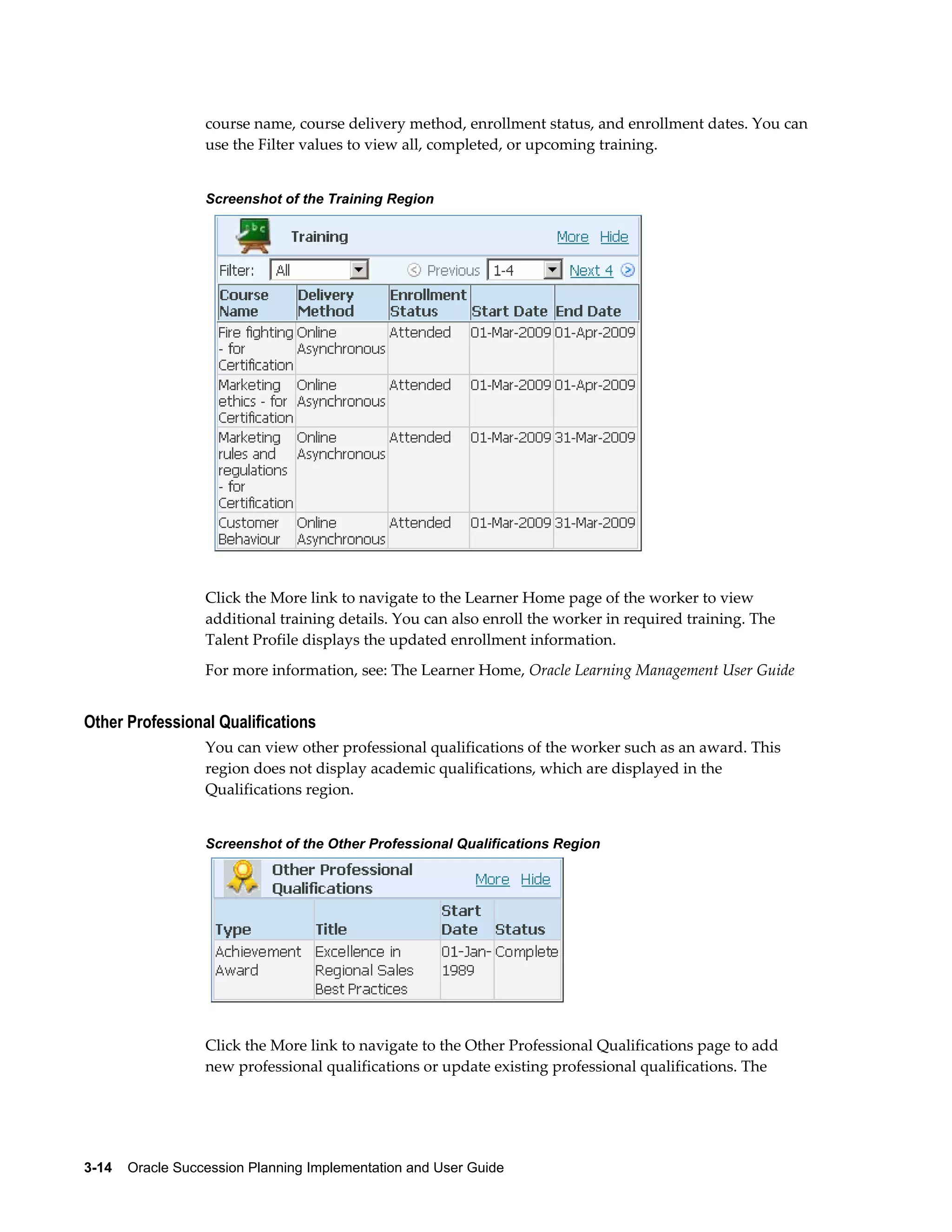
• Training
• Appraisals
• Performance Objectives
• Succession Plans
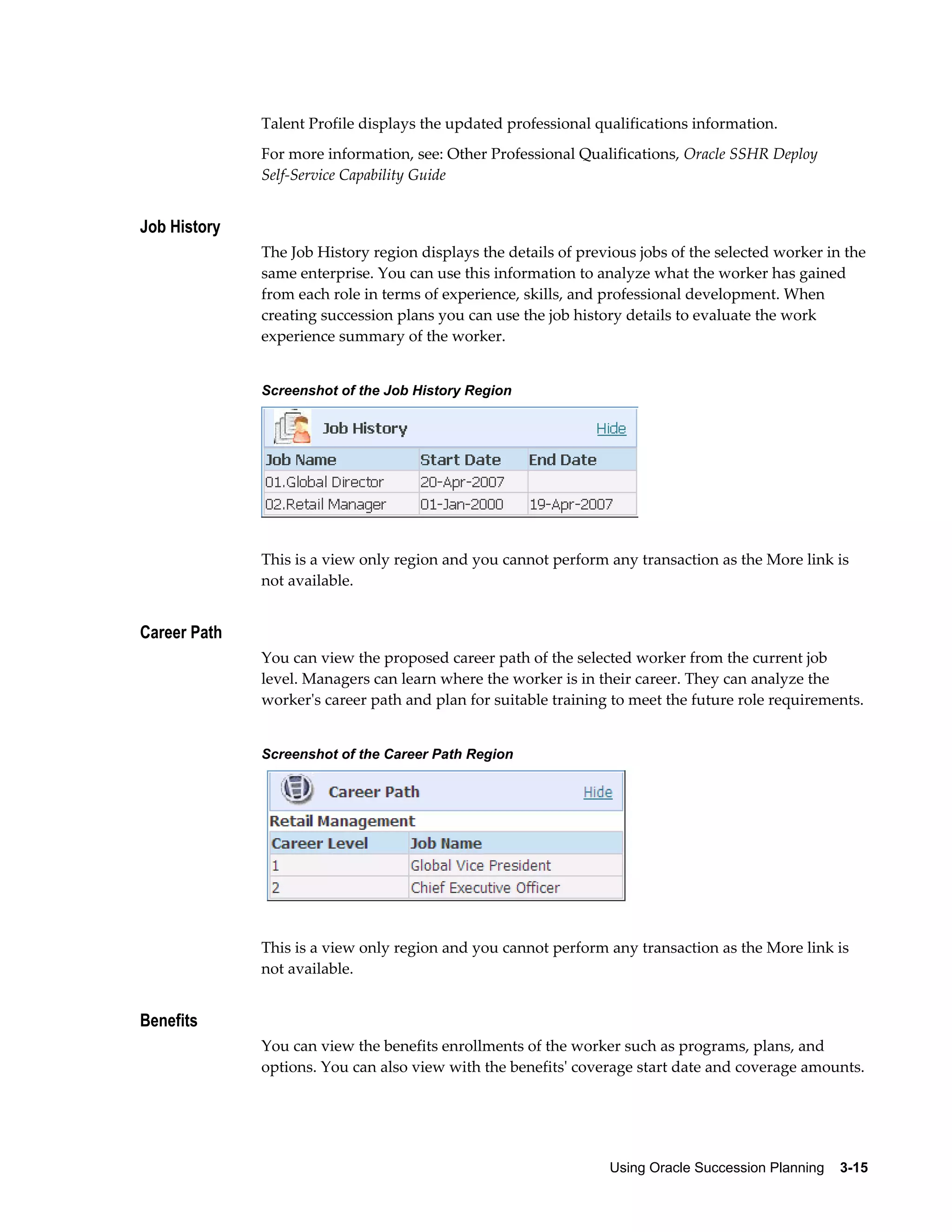
• Job History
• Career Path
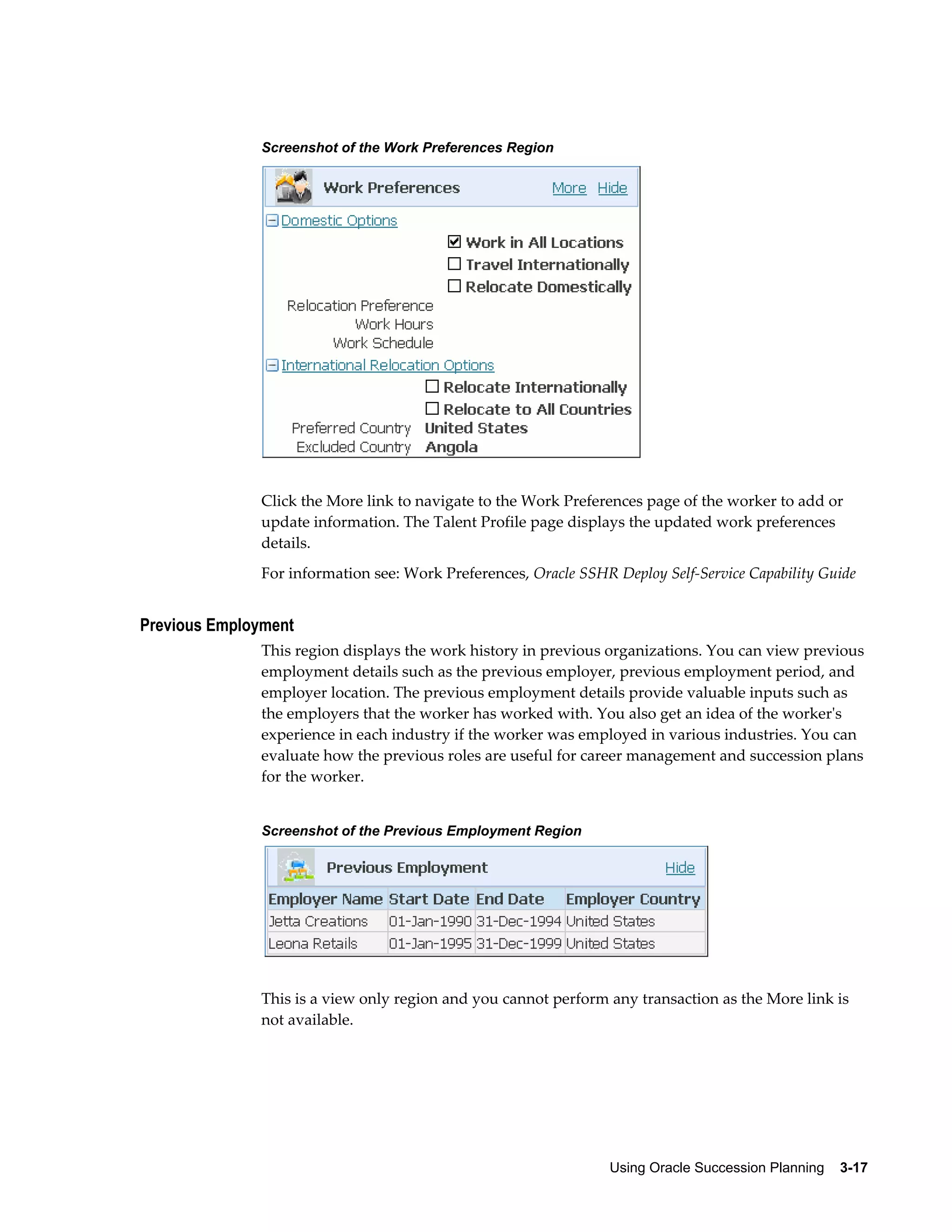
• Work Preferences
• Salary
• Benefits
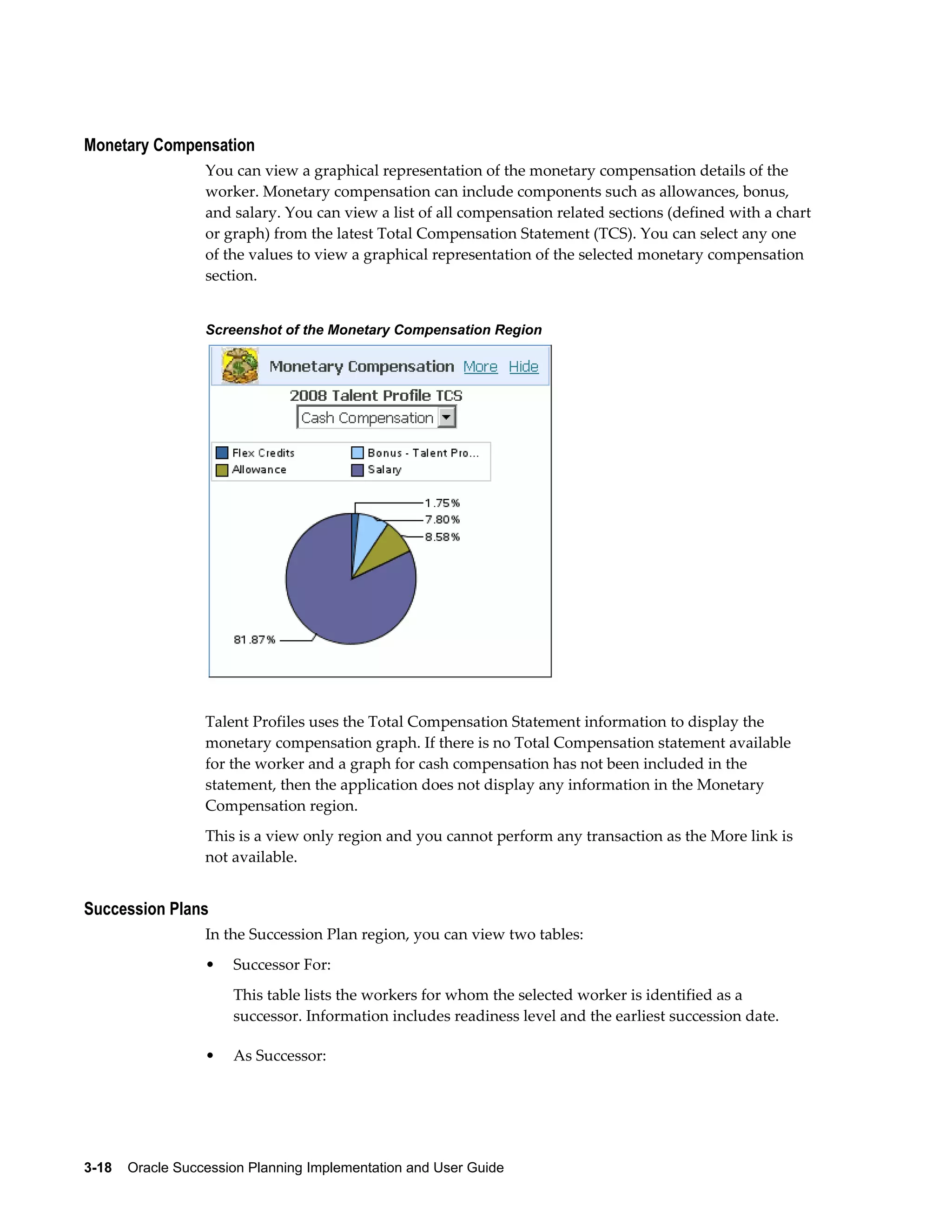
• Monetary Compensation
• Compensation Statement
• Other Information
• Performance Ratings
Assess Workforce Talent
Oracle Succession Planning provides various tools such as Compare Profile report,
9-Box analysis, Suitability Matching, and Suitability Analyzer to assess workforce
talent.
Compare Talent Profiles
Enterprises can compare talent profiles of their workforce and use this information in
succession planning. The application displays the comparison report in a printable
format. When managers compare the talent profiles of workers, if they find a suitable
successor, then they can select the worker as a successor and create a succession plan
from the Talent Profile page. While creating a succession plan, managers can use the
Show Suitable Successors feature that uses the competency-based search to display a list
of workers who meet the competency requirements.
View Performance Matrices (9-Box)
Oracle Succession Planning's performance matrices: Performance Matrix (Potential) and
Performance Matrix (Retention), provide insight into the depth and breadth of the talent
1-4    Oracle Succession Planning Implementation and User Guide
pool. Managers can use these matrices to assess the workforce:
• Performance
• Potential for growth
• Readiness level for promotion
• Retention prospects
The Performance Matrix (Potential) enables managers to evaluate workers' skill fit and
potential. Using this matrix, enterprises can identify both their highest potential
performers and the strength of their talent pool.
The Performance Matrix (Retention) enables managers to evaluate workers on skill fit
and retention prospects. It helps managers to recognize high performers who will
continue with the organization and assign them critical roles. They can also identify
high performers with low retention prospects and analyze the reasons for low retention
prospects. Enterprises can use the matrix information to develop retention strategies for
sustained growth.
Managers can view performance matrices of individual workers and also of workers in
their supervisor hierarchy.
Suitability Matching
Managers can use the Suitability Matching function to find a person for a work
opportunity or a work opportunity for a person. This process uses factors such as a
person's current role, a person's competency levels (as defined in their competency
profile), and succession plans to identify workers and opportunities.
Suitability Analyzer
Suitability Analyzer displays competency ratings of workers in a graphical format.
Managers can use the Suitability Analyzer to compare competencies of workers for
succession planning. After comparing the competencies of the workers, they can
identify suitable workers as successors.
Create and Maintain Succession Plans
Using the Succession Plans feature, managers can:
• Identify key jobs and positions in their organization to ensure that succession plans
are in place.
• Identify workers who are likely to vacate their current positions because of
promotion, retirement, or voluntary termination.
• Define additional information for succession plans to meet business needs.
Oracle Succession Planning    1-5
• Create and update succession plans for jobs, positions, and workers.
Identify Developmental Activities
Availability of succession planning data enables enterprises to develop
organization-wide training programs to address competency gaps. After assessing
competencies and evaluating talent profiles, managers can enroll workers in
appropriate training. Oracle Succession Planning's integration with Oracle Learning
Management enables managers to identify training courses and enroll workers in
relevant courses.
Reporting in Oracle Succession Planning
Oracle Succession Planning provides the following reports in Adobe Acrobat PDF
format:
• Compare Profile
Using this report, managers can compare the talent profiles of their workers.
• Printable Profile
Using this feature, managers can print worker talent profiles.
Integration with Other E-Business Products
Oracle Succession Planning is an integrated talent management solution that enables
managers to plan and implement integrated succession management processes. Oracle
Succession Planning and Oracle HRMS talent management products such as Oracle
Learning Management, Oracle Performance Management, and the Oracle
Compensation suite of products (Compensation Workbench, Total Compensation
Statement, and Salary Administration) use a single data repository to enable you to
share and view common information for succession planning purposes. Oracle
Succession Planning retrieves relevant data from Oracle HRMS, Oracle SSHR, Learning
Management, Performance Management, and the Compensation suite of products.
Key Concepts
For information on Oracle Succession Planning, see:
• Succession Plans
• The Succession Plans Feature, page 3-2
• Creating and Maintaining Succession Plans Using Oracle Succession Planning,
page 3-59
1-6    Oracle Succession Planning Implementation and User Guide
• Talent Profile
• Overview of Talent Profile, page 3-5
• Using Talent Profile as Managers, page 3-8
• Using Talent Profile as Workers, page 3-24
• Succession Planning Using Talent Profile, page 3-55
• Using Performance Matrix (Potential) and Performance Matrix (Retention),
page 3-39
• Comparing Talent Profiles, page 3-47
• Generating Printable Profiles, page 3-36
• Suitability Matching
Using Suitability Matching in Oracle Succession Planning, page 3-50
Implementing Oracle Succession Planning    2-1
2
Implementing Oracle Succession Planning
2-2    Oracle Succession Planning Implementation and User Guide
Implementing Oracle Succession Planning
Oracle Succession Planning Licenses
Before implementing Oracle Succession Planning, you must install Oracle Self-Service
HR, which is a prerequisite.
You must purchase Oracle Succession Planning license to use the following features:
• Succession Plans
Use this feature for effective succession planning in your enterprise. Enterprises can
identify succession planning requirements to create and manage succession plans
for their workforce.
• Talent Profile
Use the Talent Profile feature of Oracle Succession Planning to obtain a complete
picture of the talent profile of your workforce to manage the talent processes.
Note
Oracle Self-Service HR provides you with a minimal Talent Profile function to only
view the talent profiles of your workforce. You require Oracle Succession Planning
license to:
• Compare Talent Profiles
• Use performance matrices (9-box): Performance Matrix (Potential), Performance
Matrix (Retention)
• Use Suitability Analyzer
• Suitability Matching
Managers can use the Suitability Matching function to find a person for a work
opportunity or a work opportunity for a person. Suitability Matching uses factors
such as a person's current role, a person's competency levels (as defined in their
competency profile), and succession plans in identifying candidates and
opportunities
Oracle Self-Service HR provides you with the Suitability Matching feature.
However, you require Oracle Succession Planning license to use the Suitability
Analyzer to perform competency-based search for succession planning. Users can
launch Suitability Analyzer only from the Suitability Matching function.
• Employee Succession Information
Use the Employee Succession Information page to record tracking information
Implementing Oracle Succession Planning    2-3
required for succession plans. You can:
• Identify the succession potential of a worker
• Determine whether a worker is a key person in the enterprise
• Determine the retention prospects of a worker
Integration with Other E-Business Products
Oracle Succession Planning is an integrated talent management solution that enables
managers to plan and implement integrated succession management processes. Oracle
Succession Planning and Oracle HRMS talent management products such as Oracle
Learning Management, Oracle Performance Management, and the Oracle
Compensation suite of products (Compensation Workbench, Total Compensation
Statement, and Salary Administration) use a single data repository to enable you to
share and view common information for succession planning purposes. Oracle
Succession Planning retrieves relevant data from Oracle HRMS, Oracle SSHR, Oracle
Learning Management, Oracle Performance Management, and the Compensation suite
of products.
To enable your managers to view talent profile information of workers such as
monetary compensation, training, learning certification, benefits, compensation
statement, performance objectives, and appraisal details, you must install the following
products. For information on licenses, contact your Oracle sales representative.
Oracle Performance Management
Oracle Performance Management is a self-service product that enables enterprises to
implement an effective performance management system. It enables managers and
workers to manage performance management functions including objectives setting
and appraisals process. Enterprises can create and administer questionnaires for the
various potential participants in the appraisal process.
Oracle Performance Management is a separately licensed product.
See: Oracle Performance Management Overview, Oracle Performance Management
Implementation and User Guide
Oracle Learning Management
Oracle Learning Management is an enterprise learning management system (LMS) that
enables you to train your workforce effectively and at lower cost. Oracle Learning
Management enables you to manage, deliver, and monitor your online and
classroom-based training: you can efficiently assemble and deliver learning content;
you can provide the most appropriate combination of classroom and online training;
and you can measure the effectiveness of your training initiatives.
Oracle Learning Management is a separately licensed product.
2-4    Oracle Succession Planning Implementation and User Guide
See: Introduction to Oracle Learning Management, Oracle Learning Management User
Guide
Oracle Advanced Benefits (OAB)
Oracle Advanced Benefits (OAB) is a benefits application that enables you to define and
manage benefits programs in support of your enterprise's missions and objectives,
while addressing the diverse and complex requirements of evolving benefits practices
and governmental regulations.
Oracle Advanced Benefits is a separately licensed product. Your Oracle Human
Resources license includes Standard Benefits, a more limited set of benefits
administration features.
See: Standard and Advanced Benefits Administration, Oracle HRMS Compensation and
Benefits Management Guide
Oracle Succession Planning Predefined Components
This topic lists the predefined responsibility, menus, and functions supplied with
Oracle Succession Planning.
Predefined Responsibility
Oracle Succession Planning supplies the predefined Succession Planning responsibility
with the corresponding Succession Planning (HR_SUCCESSION_MGMT) menu.
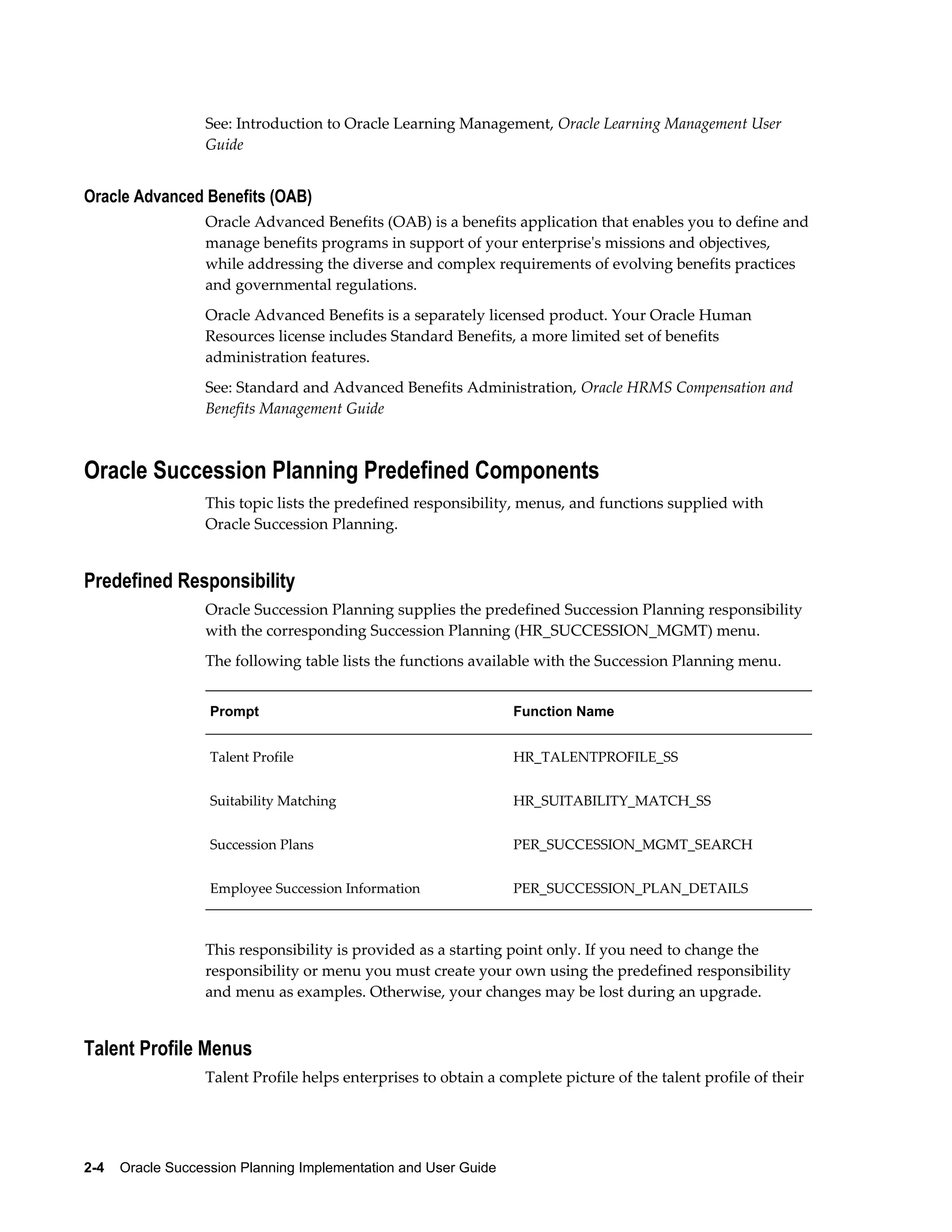
The following table lists the functions available with the Succession Planning menu.
Prompt Function Name
Talent Profile HR_TALENTPROFILE_SS
Suitability Matching HR_SUITABILITY_MATCH_SS
Succession Plans PER_SUCCESSION_MGMT_SEARCH
Employee Succession Information PER_SUCCESSION_PLAN_DETAILS
This responsibility is provided as a starting point only. If you need to change the
responsibility or menu you must create your own using the predefined responsibility
and menu as examples. Otherwise, your changes may be lost during an upgrade.
Talent Profile Menus
Talent Profile helps enterprises to obtain a complete picture of the talent profile of their
Implementing Oracle Succession Planning    2-5
workforce on a single-interface.
Talent Profile Based on Role Requirements
As managers and workers have different business requirements, Talent Profile delivers
views based on their roles. For example, only managers can view the Succession Plans
region, compare talent profiles, and use performance matrices.
To meet the different talent requirements, Oracle Succession Planning delivers the
following Talent Profile Menus:
Menu Description
Talent Profile Manager Access Menu
(HR_TP_MGR_MENU)
Enables managers to access Talent Profile
functions that include Compare Profiles and
view Performance Matrix (Potential) and
Performance Matrix (Retention). Managers
can view talent profiles of workers in their
supervisor hierarchy.
Talent Profile Employee Access Menu
(HR_TP_EMP_MENU)
Enables workers to view their talent profiles.
Suitability Matching Spider Menu
(HR_SUIT_MATCH_SPIDER_MENU)
Launches the Suitability Analyzer tool and
enables competency-based search.
Menu For All Seeded Report Template
Functions (HR_TP_TEMPLATES_MENU)
Enables managers to generate the compare
profile reports of a single worker, two
workers, or three workers. Managers can also
print the talent profile of a worker.
The reports are generated in the Adobe
Acrobat PDF format.
Talent Profile Launch Menu
(HR_TP_LAUNCH_MENU)
Launches the Talent Profile page.
Implementing Oracle Succession Planning
This topic discusses the steps that you must complete to use Oracle Succession
Planning.
Prerequisites
Before implementing Oracle Succession Planning, you must install Oracle Self-Service
HR, which is a prerequisite.
2-6    Oracle Succession Planning Implementation and User Guide
See: Implementation Steps for Self-Service HR (SSHR), Oracle HRMS Deploy Self-Service
Capability Guide
Required Implementation Steps
1. Set the HR: Succession Planning Licensed Profile Option
Controls whether Oracle Succession Planning is available. If your enterprise obtains
a license, then you must set this profile option to Yes at the site level to work with
Oracle Succession Planning.
2. Create and Assign the Responsibility to use Oracle Succession Planning
Based on your business requirements, create and assign the required Succession
Planning responsibility to managers and HR professionals. To create your own
responsibilities, use the supplied Succession Planning responsibility as a sample.
See: Responsibilities, Oracle HRMS Configuring, Reporting, and System Administration
Guide
3. Define the HR: Enable Talent Profile Option
If you have licensed Oracle Succession Planning, then set the HR: Enable Talent
profile option value to Yes. This profile option determines whether managers can
access the Suitability Analyzer tool from the Suitability Matching function. If you
set the profile option value to No, then managers cannot use the Suitability
Analyzer tool.
4. Set up Action Menu for Self-Service Actions
The Talent Profile page has an Action drop down list. This list includes Self-Service
or SSHR actions. Depending on your business needs, you must add the SSHR
Personal Actions Menu and Manager Actions Menu to the supplied Succession
Planning (HR_SUCCESSION_MGMT) menu or your own configured menu. This
enables users to perform self-service functions from the Talent Profile page.
See: Setting up Self-Service Actions on the Talent Profile Page, page 2-29
5. Set up the Succession Plans Functionality
The Succession Plans functionality enables managers to plan for future vacant
positions by identifying possible successors for workers, jobs, and positions.
For information on setting up Succession Planning, see: Setting up the Succession
Plans Functionality, page 2-38
6. Configure Suitability Matching
Managers can use the Suitability Matching function to find a person for a work
opportunity or a work opportunity for a person. The process uses factors such as a
person's current role, a person's competency levels (as defined in their competency
Implementing Oracle Succession Planning    2-7
profile), and succession plans in identifying candidates and opportunities.
You can configure the Suitability Matching according to your business needs. For
more information, see: Configuring Suitability Matching, page 2-42
Steps to Setup a Custom Version of the Talent Profile Feature
If you do not want to use the supplied Talent Profile feature, then you can customize
the supplied menus and functions to implement the Talent Profile feature based on
your business needs. Custom implementation process involves set up steps such as
setting up the Talent Profile form function and regions.
See: Setup Steps to Implement a Custom Version of Talent Profile Feature, page 2-8
Additional Implementation Steps
After you complete the required steps, you can customize the following features on the
Talent Profile page:
• Talent Profile regions
See: Personalizing Talent Profile, page 2-35
• Region icons
See: Configuring the Region Icons, page 2-35
• Hierarchy list and quick search
See: Configuring the Quick Search and Hierarchy Regions, page 2-34
Configuration Steps
After completing the required and additional implementation steps, you carry out the
configuration steps, such as configuring the XML template for the Compare Profile
report, defining lookups and EITs required for succession planning, and defining user
ratings for Performance Matrix (Potential) and Performance Matrix (Retention).
See: Completing the Configuration Steps for Oracle Succession Planning, page 2-30
2-8    Oracle Succession Planning Implementation and User Guide
Setup Steps to Implement a Custom Version of Talent
Profile Feature
Setup Steps to Implement a Custom Version of the Talent Profile Feature
This topic describes the implementation steps to set up a custom version of the Talent
Profile feature:
1. Create Copies of the Supplied Talent Profile Menus
Using the Functional Administrator responsibility, create copies of the following
supplied menus for Talent Profile.
• Talent Profile Manager Access Menu (HR_TP_MGR_MENU)
• Talent Profile Employee Access Menu (HR_TP_EMP_MENU)
• Suitability Matching Spider Menu (HR_SUIT_MATCH_SPIDER_MENU)
• Menu For All Seeded Report Template Functions
(HR_TP_TEMPLATES_MENU)
For more information on supplied menus, see: Oracle Succession Planning
Predefined Components, page 2-4
The predefined Succession Planning responsibility is linked to a menu that contains
a number of functions. You can create menus based on the predefined menus and, if
necessary, add or remove functions so that the menus accurately reflect your
enterprise's business processes.
You can base your configuration on the sample menus provided although you
should not change the predefined menus directly. You must create your own
menus using the predefined menus as examples. Otherwise, your changes may be
lost during an upgrade.
2. Create a form function to set up the custom Talent Profile functionality.
See: Setting up the Talent Profile Form Function, page 2-9
3. Set up the required Talent Profile regions for workers and managers. You can
exclude the functions that you do not your workforce to use from the copied
menus.
See: Setting up the Talent Profile Regions, page 2-10
4. If required, configure the More links on the Talent Profile regions that enable
managers and workers to navigate to the relevant Oracle HRMS talent product
Implementing Oracle Succession Planning    2-9
pages, such as Oracle SSHR, Oracle Performance Management, and Oracle Learning
Management.
Configuring the More Links in the Talent Profile Regions, page 2-17
5. Configure the Talent Profile custom actions.
See: Setting up the Action Menus for Talent Profile, page 2-29
6. Configure the SSHR actions on the Talent Profile page.
See: Setting up Self-Service Actions on the Talent Profile Page, page 2-29
7. Configure the Suitability Analyzer and Performance Matrix (Potential) and
Performance Matrix (Retention) functions.
You can also determine the print and compare profile actions that you want
managers to use.
See: Configuring Talent Profile Functions, Suitability Analyzer, and Compare
Profile Templates, page 2-24
8. Grant Menus or Add Menus to the Responsibility
To enable managers and workers to use the Talent Profile features, in addition to
assigning the Oracle Succession Planning responsibility, you must grant the custom
Talent Profile menus to the Succession Planning responsibility assigned to the
users. You can grant the custom menus using the Functional Administrator
responsibility. Grants enable managers and workers to access the Talent Profile
functions.
For information on creating grants and using permission sets, see: Grants and
Permissions Sets in Oracle E-Business Suite System Administrator's Guide - Security
You can also add the custom menus to the Succession Planning responsibility
assigned to the users using the System Administrator responsibility
Setting up the Talent Profile Form Function
To set up a custom version of the supplied Talent Profile feature, you must first create
your Talent Profile form function using the Form Functions window of the System
Administrator responsibility.
Provide the following values:
Description Tab Region
Function Name: <User Defined function name>, for example: HR_TALENTPROFILE_SS
User Function Name: <User Defined user function name, for example: Talent Profile
Properties Tab Region
2-10    Oracle Succession Planning Implementation and User Guide
Type: SSWA jsp function
Form Tab Region
Parameters: MoreLinkMapMgr=<user defined sub-function
name>&MoreLinkMapEmp=<user defined sub-function name>, for example:
MoreLinkMapMgr=HR_TP_MGR_MORE_LINK&MoreLinkMapEmp=HR_TP_EMP_M
ORE_LINK
Note: The parameters provided while creating the functions are used to
configure the More links on the individual regions of the Talent Profile
page. See: Configuring the More Links in the Talent Profile Regions,
page 2-17
Web HTML Tab Region
HTML Call: OA.jsp?page=/oracle/apps/per/talentprofile/webui/TMEmployeePG
Setting up the Talent Profile Regions
Talent Profile displays talent information in individual regions. As managers and
workers have different business requirements, Talent Profile delivers views based on
their roles. For example, only managers can view the Succession Plans region and
Performance Matrix (Potential) and Performance Matrix (Retention) details. For more
information: see:
• Using Talent Profile as Managers, page 3-8
• Using Talent Profile as Workers, page 3-24
By default, Talent Profile displays a set of regions for workers and managers, called
Employee View and Manager View. Each of the regions is assigned a region code and a
sub-function with the same name as the region code.
The sub-functions for each of the regions control the security of the region. These
sub-functions determine whether the application can display that region in the
particular profile view or not.
The following section describes how information is secured for employee view and
manager view:
When a user logs in to Talent Profile, the application determines whether the user is a
worker or manager. Then, the application checks whether the corresponding worker or
manager sub-function for the view is granted. If the function is granted, then the
application will display the region for the worker or manager.
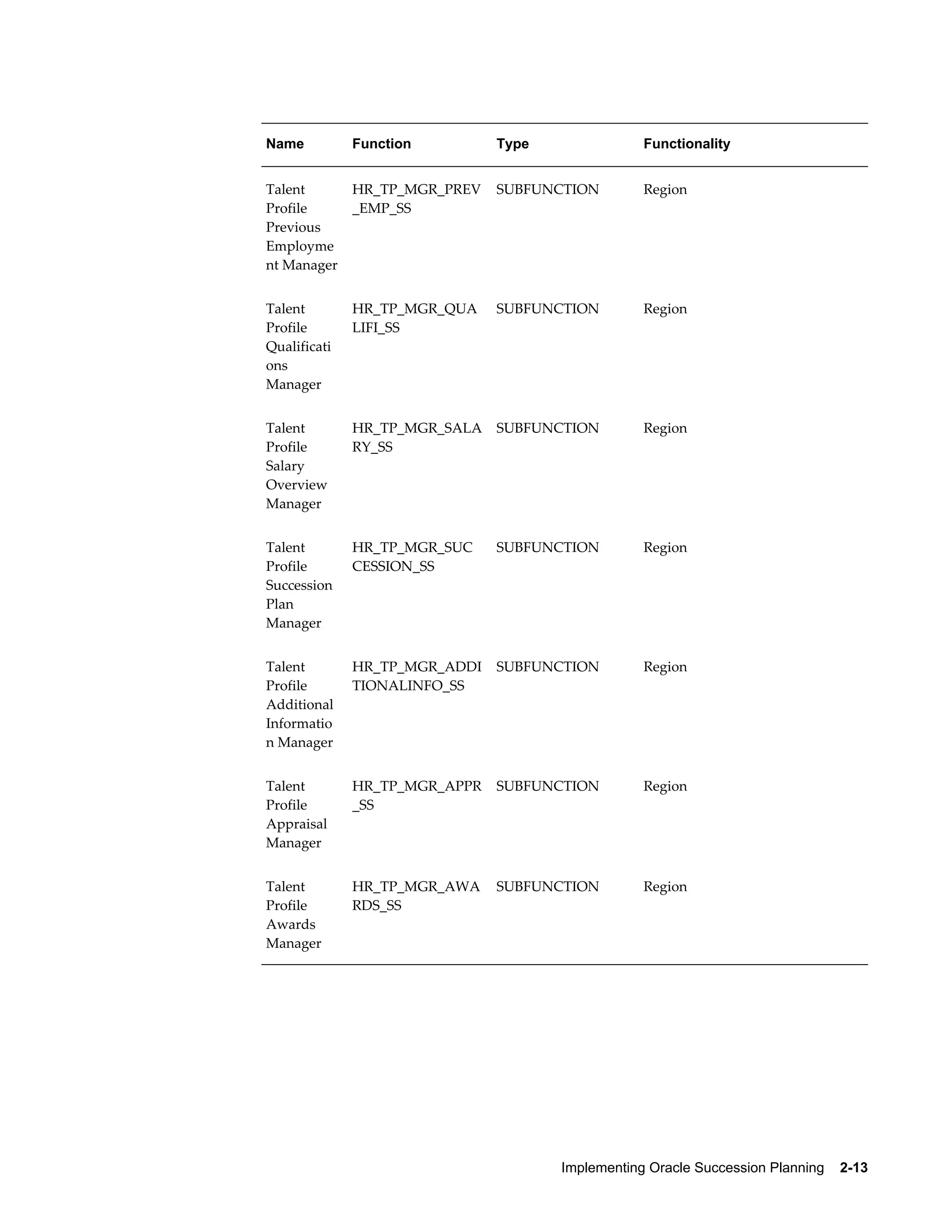
The following tables list the functions granted with the supplied menus: Talent Profile
Manager Access Menu - HR_TP_MGR_MENU and Talent Profile Employee Access
Menu - HR_TP_EMP_MENU. You can exclude the functions that you do not want
managers or workers to use from the copied menus using the Functional Administrator
Implementing Oracle Succession Planning    2-11
responsibility.
Supplied Talent Profile Manager Access Menu - HR_TP_MGR_MENU
Name Function Type Functionality
Talent
Profile
Career
Path
Manager
HR_TP_MGR_CAR
EER_PATH_SS
SUBFUNCTION Region
Talent
Profile
Cash
Compensat
ion
Manager
HR_TP_MGR_CAS
H_COMP_SS
SUBFUNCTION Region
Talent
Profile
Certificatio
ns
Manager
HR_TP_MGR_CERT
IFI_SS
SUBFUNCTION Region
Compare
Profile
HR_TP_MGR_COM
PARE_WITH_ACT
N
SUBFUNCTION Action
Talent
Profile
Competenc
y Manager
HR_TP_MGR_COM
PETENCY_SS
SUBFUNCTION Region
Talent
Profile
Compensat
ion
Statement
Manager
HR_TP_MGR_COM
P_STAT_SS
SUBFUNCTION Region
Talent
Profile
Lookup
Data AM
HR_TP_LKUP_DAT
A_AM
REST Rest Service
2-12    Oracle Succession Planning Implementation and User Guide
Name Function Type Functionality
Talent
Profile
Lookup
init AM
HR_TP_LKUP_INIT
_AM
REST Rest Service
Printable
Profile
HR_TP_MGR_EXPO
RT_CUSTOM_ACT
N
SUBFUNCTION Action
Compare
Profile
HR_TP_EMP_COM
PARE_WITH_ACT
N
SUBFUNCTION Action
Talent
Profile Perf
Matrix
Directs
HR_TP_PERFMATR
IX_DIRECTS_SS
JSP Action
Talent
Profile Job
History
Manager
HR_TP_MGR_JOB_
HIST_SS
SUBFUNCTION Region
Performanc
e Matrix (
Potential )
HR_TP_MGR_PERF
_MATRIX_ACTN
SUBFUNCTION Action
Talent
Profile
Performanc
e Matrix
Manager
HR_TP_MGR_PERF
_MATRIX_SS
SUBFUNCTION Region
Talent
Profile
Performanc
e
Objectives
Manager
HR_TP_MGR_PERF
_OBJ_SS
SUBFUNCTION Region
Implementing Oracle Succession Planning    2-13
Name Function Type Functionality
Talent
Profile
Previous
Employme
nt Manager
HR_TP_MGR_PREV
_EMP_SS
SUBFUNCTION Region
Talent
Profile
Qualificati
ons
Manager
HR_TP_MGR_QUA
LIFI_SS
SUBFUNCTION Region
Talent
Profile
Salary
Overview
Manager
HR_TP_MGR_SALA
RY_SS
SUBFUNCTION Region
Talent
Profile
Succession
Plan
Manager
HR_TP_MGR_SUC
CESSION_SS
SUBFUNCTION Region
Talent
Profile
Additional
Informatio
n Manager
HR_TP_MGR_ADDI
TIONALINFO_SS
SUBFUNCTION Region
Talent
Profile
Appraisal
Manager
HR_TP_MGR_APPR
_SS
SUBFUNCTION Region
Talent
Profile
Awards
Manager
HR_TP_MGR_AWA
RDS_SS
SUBFUNCTION Region
2-14    Oracle Succession Planning Implementation and User Guide
Name Function Type Functionality
Talent
Profile
Work
Preferences
Manager
HR_TP_MGR_WOR
K_PREF_SS
SUBFUNCTION Region
Talent
Profile
Training
Manager
HR_TP_MGR_TRAI
NING_SS
SUBFUNCTION Region
Talent
Profile
Global
Search
Enabled
HR_TP_VIEW_GBL
_SEARCH_SS
SUBFUNCTION Region
Talent
Profile
Show
Person
Hierarchy
Enabled
HR_TP_VIEW_PER_
HIERARCHY_SS
SUBFUNCTION Region
Download
Compare
XML
Button
Security
Renderer
HR_TP_OWNLOAD
_COMPARE_XML
SUBFUNCTION Reporting Action
Download
Export
XML
Button
Security
Renderer
HR_TP_DOWNLOA
D_EXPORT_XML
SUBFUNCTION Reporting Action
Talent
Profile
More Link
Manager
HR_TP_MGR_MOR
E_LINK
SUBFUNCTION More link configuration option for
Manager
Implementing Oracle Succession Planning    2-15
Name Function Type Functionality
Printable
Profile (
Full )
HR_TP_MGR_EXPO
RT_FULL_ACTN
SUBFUNCTION Action
Talent
Profile
Performanc
e Matrix
Flash
HR_TP_PERF_MAT
RIX_SWF
WIDGET Action
Talent
Profile
Performanc
e Matrix
Succession
Plan GRD
HR_TP_PERFMTRX
_SUCCPLAN_GRD_
AM
REST Rest Function
Talent
Profile Perf
Matrix
Directs AM
HR_TP_PERFMTRX
_GRD_AM
REST Rest Service
Talent
Profile
Benefits
Manager
HR_TP_MGR_BENF
TS_SS
SUBFUNCTION Region
Talent
Profile
Performanc
e Ratings
Managers
HR_TP_MGR_PERF
RATING_SS
SUBFUNCTION Region
Performanc
e Matrix (
Retention )
HR_TP_MGR_RET_
PERF_MTRX_ACTN
SUBFUNCTION Action
2-16    Oracle Succession Planning Implementation and User Guide
Supplied Talent Profile Employee Access Menu - HR_TP_EMP_MENU
Name Function Type Functionality
Talent Profile
Additional
Information
Employee
HR_TP_EMP_ADDIT
IONALINFO_SS
SUBFUNCTION Region
Talent Profile
Appraisal Employee
HR_TP_EMP_APPR_
SS
SUBFUNCTION Region
Talent Profile Awards
Employee
HR_TP_EMP_AWAR
DS_SS
SUBFUNCTION Region
Talent Profile Career
Path Employee
HR_TP_EMP_CAREE
R_PATH_SS
SUBFUNCTION Region
Talent Profile
Certifications
Employee
HR_TP_EMP_CERTI
FI_SS
SUBFUNCTION Region
Talent Profile
Competency
Employee
HR_TP_EMP_COMP
ETENCY_SS
SUBFUNCTION Region
Talent Profile Job
History Employee
HR_TP_EMP_JOB_HI
ST_SS
SUBFUNCTION Region
Talent Profile
Performance
Objectives Employee
HR_TP_EMP_PERF_
OBJ_SS
SUBFUNCTION Region
Talent Profile
Previous
Employment
Employee
HR_TP_EMP_PREV_
EMP_SS
SUBFUNCTION Region
Talent Profile
Qualifications
Employee
HR_TP_EMP_QUALI
FI_SS
SUBFUNCTION Region
Talent Profile
Training Employee
HR_TP_EMP_TRAIN
ING_SS
SUBFUNCTION Region
Implementing Oracle Succession Planning    2-17
Name Function Type Functionality
Talent Profile Work
Preferences Employee
HR_TP_EMP_WORK
_PREF_SS
SUBFUNCTION Region
Talent Profile More
Link Employee
HR_TP_EMP_MORE
_LINK
SUBFUNCTION Region
Talent Profile Cash
Compensation
Employee
HR_TP_EMP_CASH_
COMP_SS
SUBFUNCTION Region
Talent Profile Salary
Overview Employee
HR_TP_EMP_SALAR
Y_SS
SUBFUNCTION Region
Talent Profile
Compensation
Statement Employee
R_TP_EMP_COMP_S
TAT_SS
SUBFUNCTION Region
Printable Profile HR_TP_MGR_EXPO
RT_CUSTOM_ACTN
SUBFUNCTION Action
Compare Profile HR_TP_EMP_COMP
ARE_WITH_ACTN
SUBFUNCTION Action
Printable Profile ( Full
)
HR_TP_MGR_EXPO
RT_FULL_ACTN
SUBFUNCTION Action
Talent Profile Benefits
Employee
HR_TP_EMP_BENFT
S_SS
SUBFUNCTION Region
Talent Profile
Performance Ratings
Employee
HR_TP_EMP_PERFR
ATING_SS
SUBFUNCTION Region
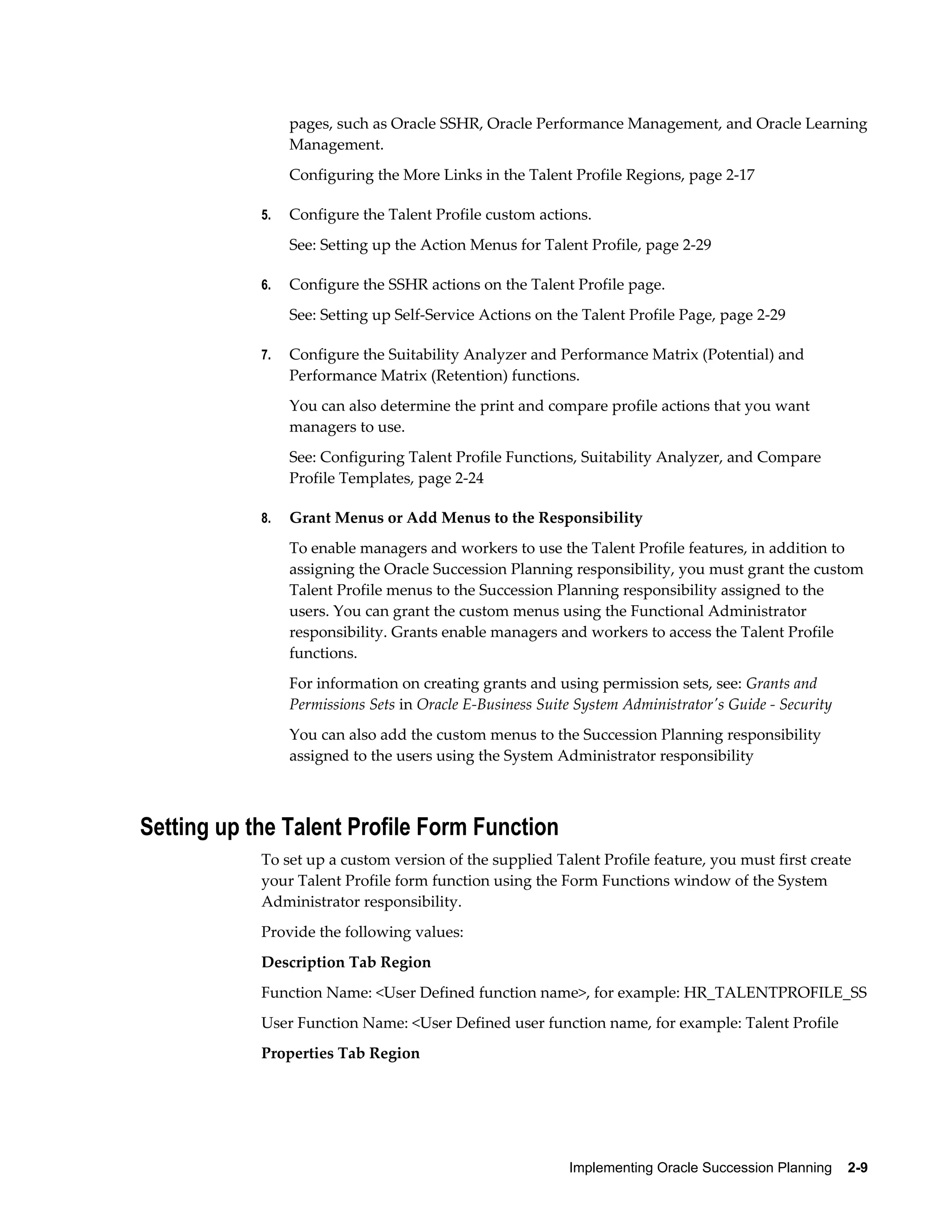
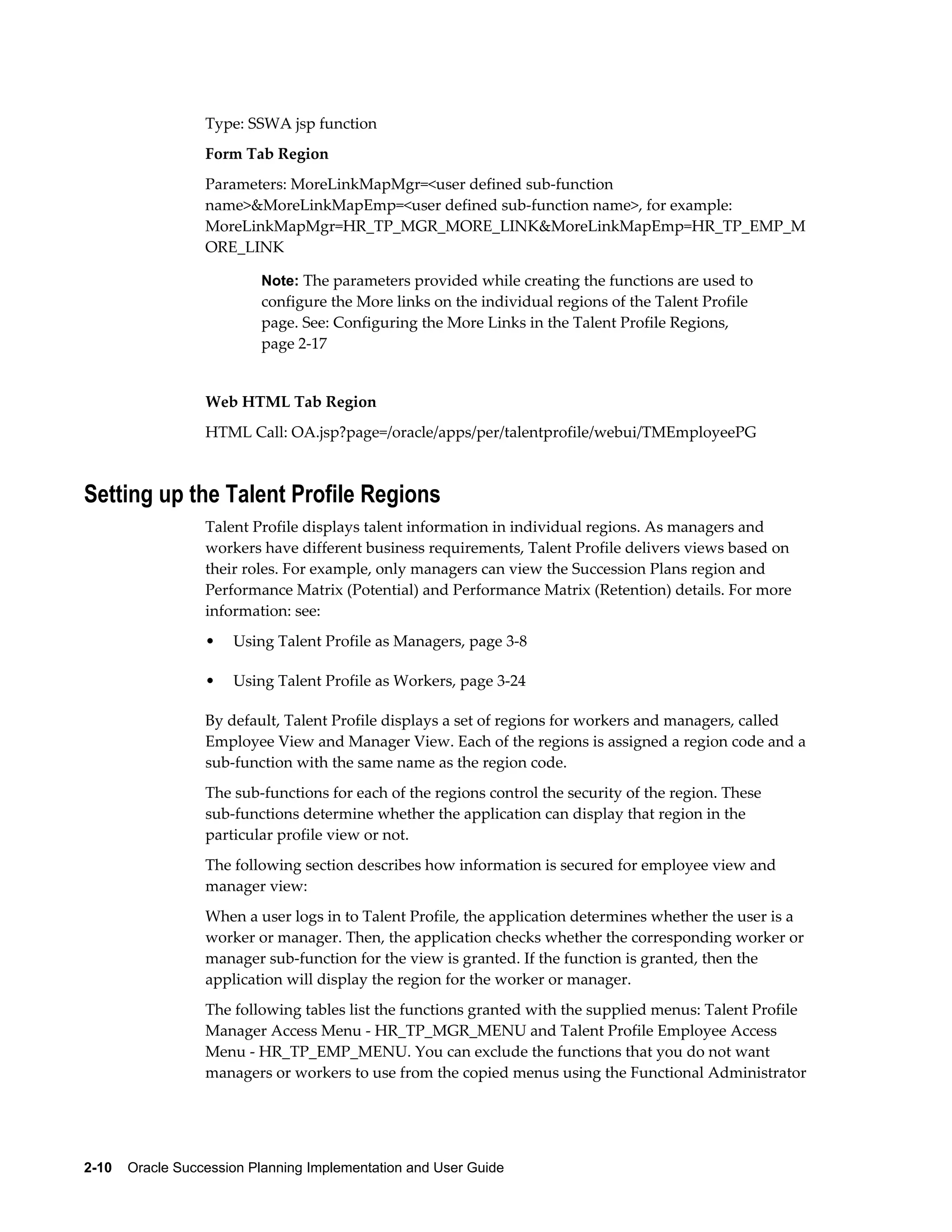
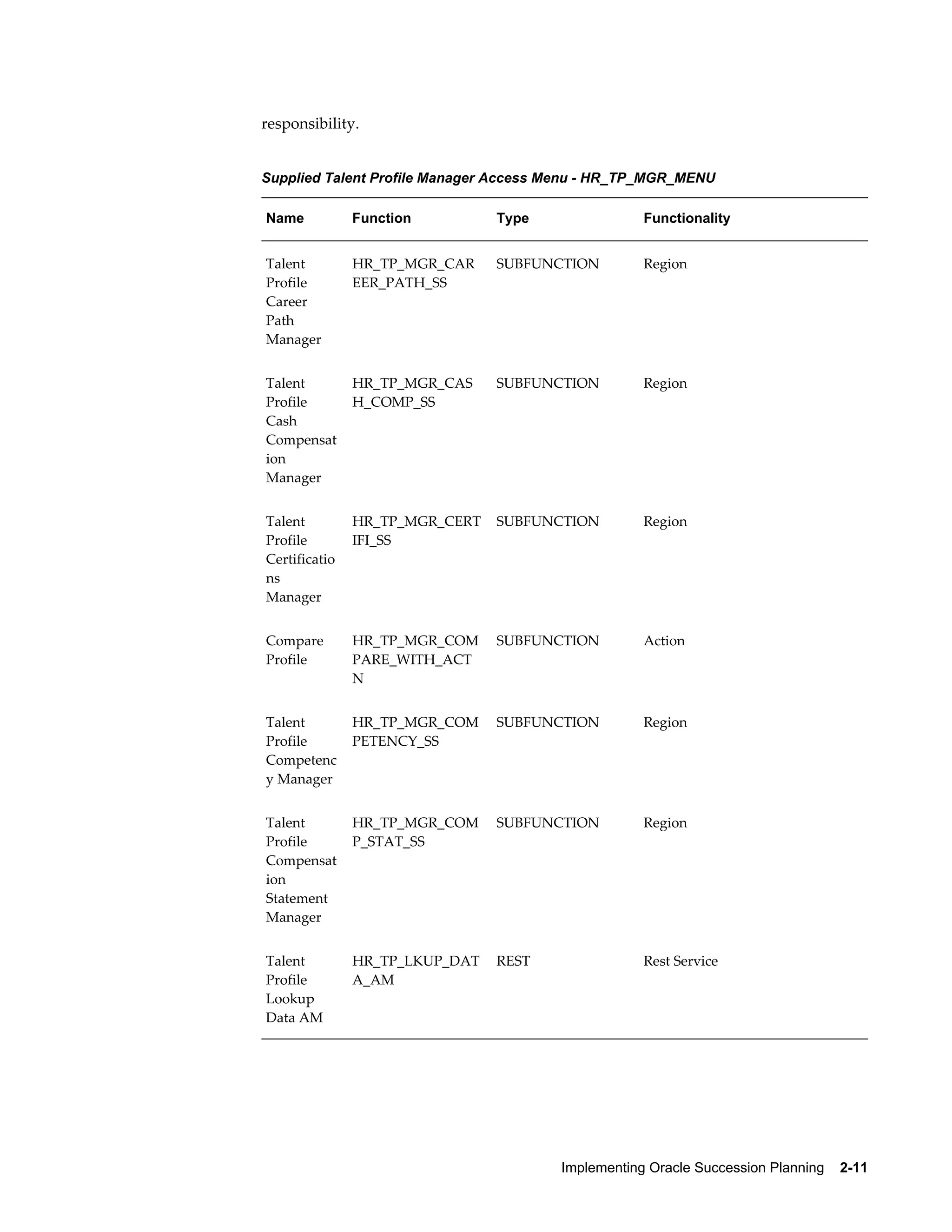
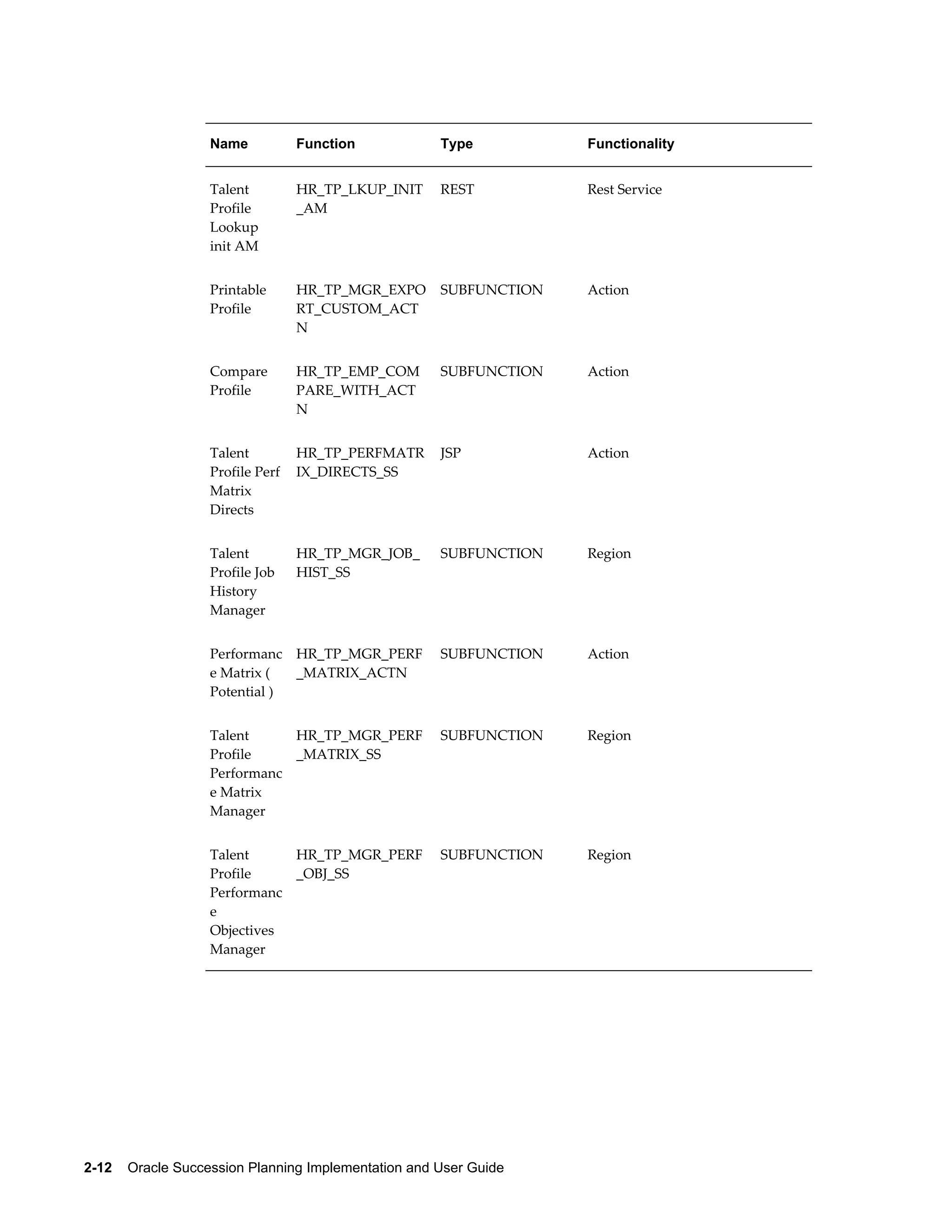
Configuring the More Links in the Talent Profile Regions
The Talent Profile page regions provide a More link that managers can use to navigate
to the relevant self-service pages of workers. For example, when a manager clicks the
More in the Qualifications region, the application displays the worker's Qualifications
page. Similarly, when workers view their own Talent Profile page, they can navigate to
2-18    Oracle Succession Planning Implementation and User Guide
the self-service pages using the More link.
Talent Profile delivers predefined More links for manager and employee views using
the following sub-functions:
• Manager View
Function Name: Talent Profile More Link Manager (HR_TP_MGR_MORE_LINK).
This sub-function is included in the Talent Profile Manager Access Menu
(HR_TP_MGR_MENU)
• Employee View
Function Name: Talent Profile More Link Employee (HR_TP_EMP_MORE_LINK).
This sub-function is included in the Talent Profile Employee Access Menu
(HR_TP_EMP_MENU).
You can configure the More links to display different application pages instead of the
default configured pages.
Each region has a predefined unique code defined for More links. This code is different
from the region codes. The region codes are used for security of the regions. The More
link code is used to specify the destination page when the More link is clicked.
Important: If you do not want users to navigate to any application page
from the More link, then you must leave the parameter value blank.
To map the More link code to the destination function, navigate to the Form Functions
window. Query the Talent Profile form function that you have set up. Click the Form
Tab region and configure the Parameter as follows:
MoreLinkMapMgr=<user defined sub-function name>&MoreLinkMapEmp=<user
defined sub-function name>, for example:
MoreLinkMapMgr=HR_TP_MGR_MORE_LINK&MoreLinkMapEmp=HR_TP_EMP_M
ORE_LINK
The two parameters: MoreLinkMapMgr and MoreLinkMapEmp derive the destination
for the More links. The value for both these parameters is a user defined sub-function.
These sub-functions contain the mapping of region More link code to the destination
function.
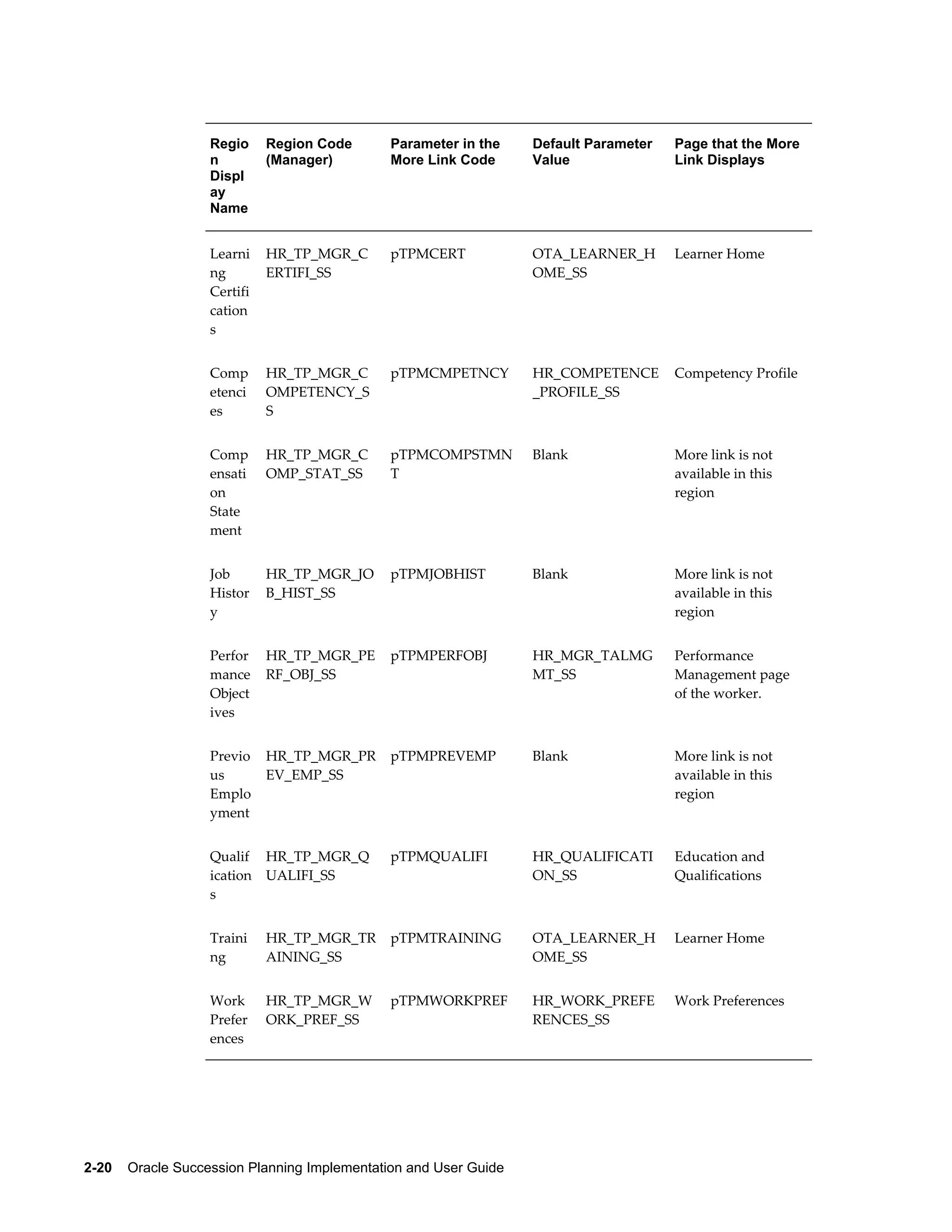
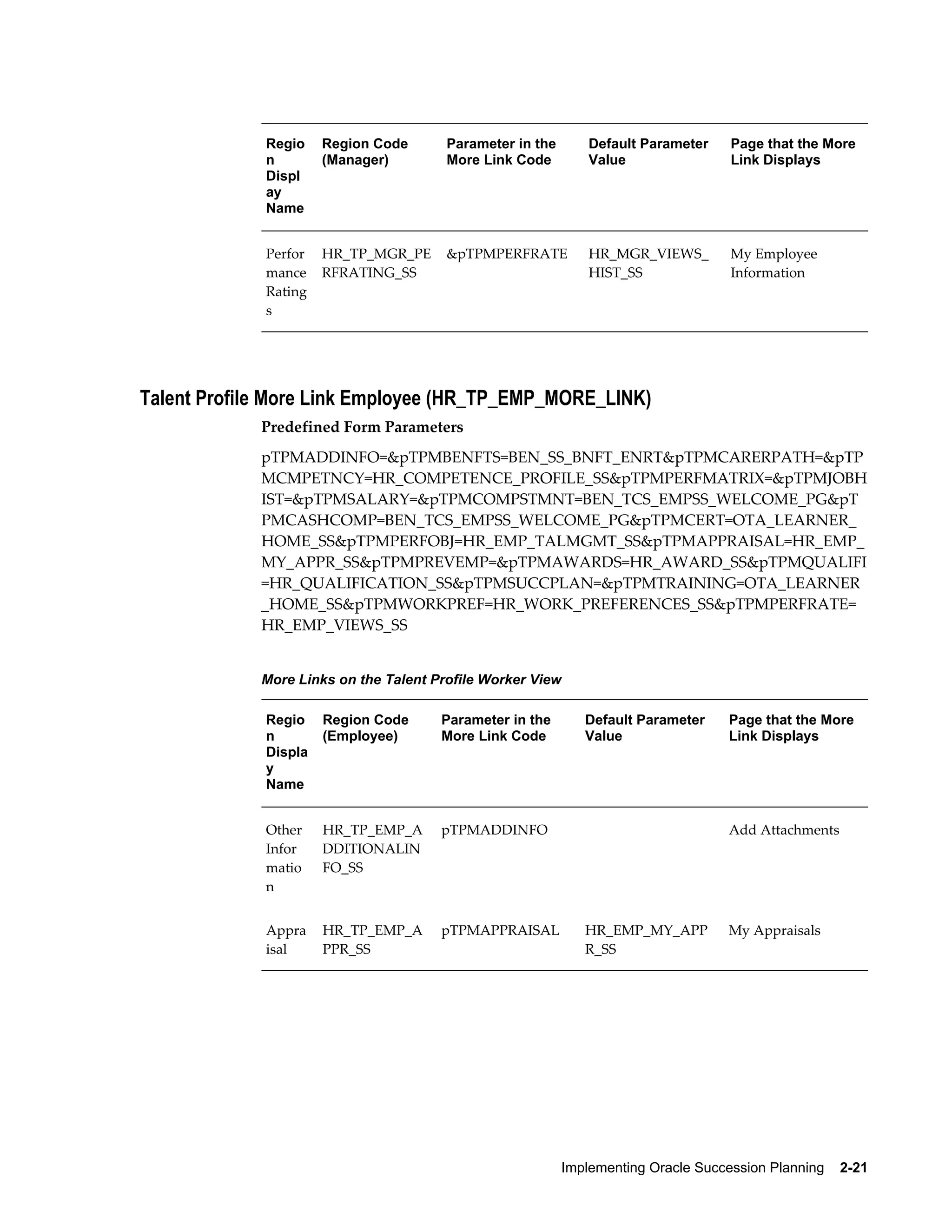
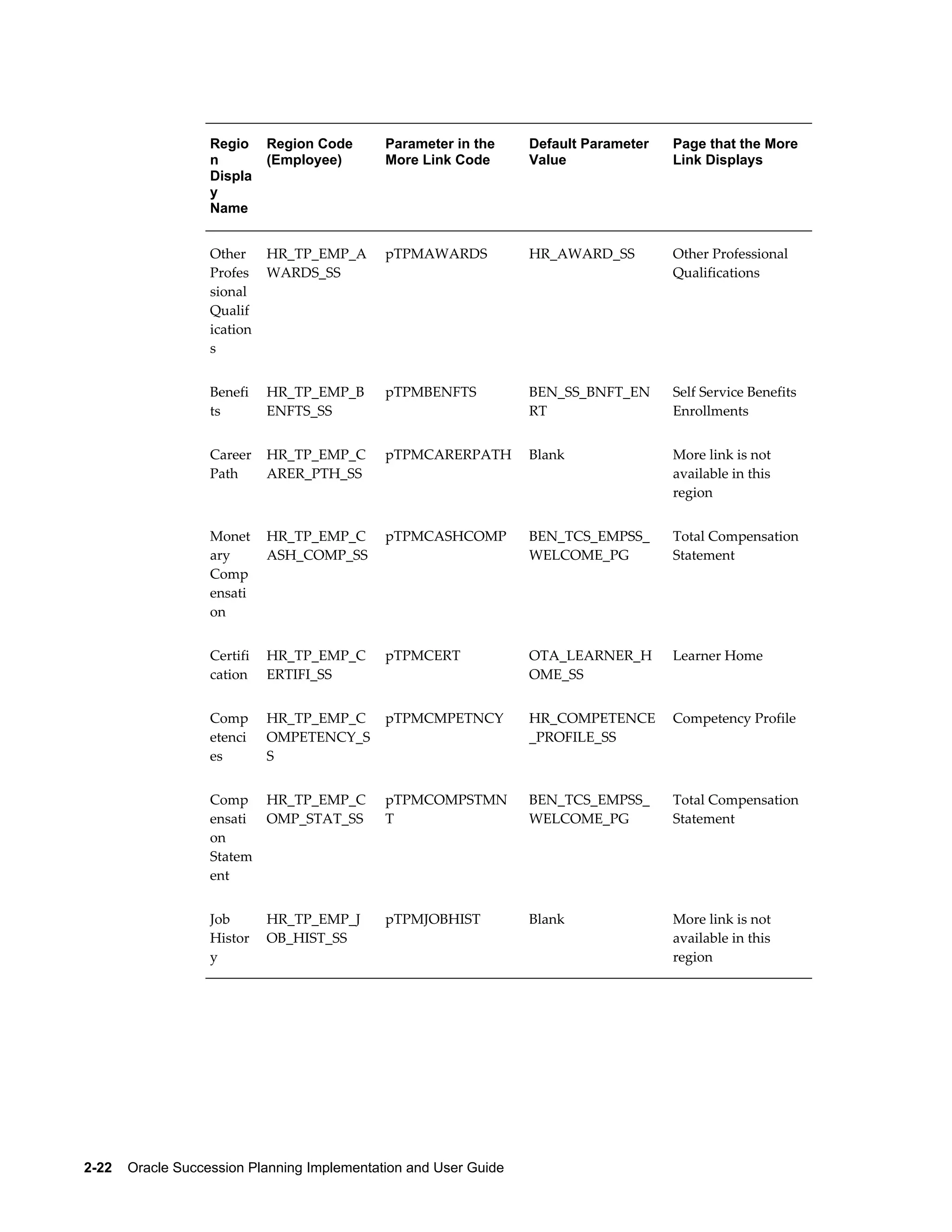
The following sections provide information about the predefined parameters supplied
with the HR_TP_EMP_MORE_LINK and HR_TP_MGR_MORE_LINK sub-functions.
Talent Profile More Link Manager (HR_TP_MGR_MORE_LINK)
Predefined Form Parameters
pTPMADDINFO=&pTPMBENFTS=BEN_SS_MGR_ENRT&pTPMCARERPATH=&pTP
MCMPETNCY=HR_COMPETENCE_PROFILE_SS&pTPMPERFMATRIX=&pTPMJOBH
IST=&pTPMSALARY=&pTPMCOMPSTMNT=&pTPMCASHCOMP=&pTPMCERT=OT
Implementing Oracle Succession Planning    2-19
A_LEARNER_HOME_SS&pTPMPERFOBJ=HR_MGR_TALMGMT_SS&pTPMAPPRAI
SAL=HR_VIEW_APPRAISALS_PAGE_SS&pTPMPREVEMP=&pTPMAWARDS=HR_A
WARD_SS&pTPMQUALIFI=HR_QUALIFICATION_SS&pTPMSUCCPLAN=&pTPMT
RAINING=OTA_LEARNER_HOME_SS&pTPMWORKPREF=HR_WORK_PREFERENC
ES_SS&pTPMPERFRATE=HR_MGR_VIEWS_HIST_SS
More Links on the Talent Profile Manager View
Regio
n
Displ
ay
Name
Region Code
(Manager)
Parameter in the
More Link Code
Default Parameter
Value
Page that the More
Link Displays
Other
Infor
matio
n
HR_TP_MGR_A
DDITIONALINF
O_SS
pTPMADDINFO Blank Add Attachment
page.
Appra
isal
HR_TP_MGR_A
PPR_SS
pTPMAPPRAISAL HR_VIEW_APPRAI
SALS_PAGE_SS
View Appraisals
page
Other
Profes
sional
Qualif
ication
s
HR_TP_MGR_A
WARDS_SS
pTPMAWARDS HR_AWARD_SS Other Professional
Qualifications
Benefi
ts
HR_TP_MGR_BE
NFTS_SS
pTPMBENFTS BEN_SS_MGR_ENR
T
Self-Service Benefits
Enrollment
Career
Path
HR_TP_MGR_C
ARER_PTH_SS
pTPMCARERPATH Blank More link is not
available in this
region
Monet
ary
Comp
ensati
on
HR_TP_MGR_C
ASH_COMP_SS
pTPMCASHCOMP Blank More link is not
available in this
region
2-20    Oracle Succession Planning Implementation and User Guide
Regio
n
Displ
ay
Name
Region Code
(Manager)
Parameter in the
More Link Code
Default Parameter
Value
Page that the More
Link Displays
Learni
ng
Certifi
cation
s
HR_TP_MGR_C
ERTIFI_SS
pTPMCERT OTA_LEARNER_H
OME_SS
Learner Home
Comp
etenci
es
HR_TP_MGR_C
OMPETENCY_S
S
pTPMCMPETNCY HR_COMPETENCE
_PROFILE_SS
Competency Profile
Comp
ensati
on
State
ment
HR_TP_MGR_C
OMP_STAT_SS
pTPMCOMPSTMN
T
Blank More link is not
available in this
region
Job
Histor
y
HR_TP_MGR_JO
B_HIST_SS
pTPMJOBHIST Blank More link is not
available in this
region
Perfor
mance
Object
ives
HR_TP_MGR_PE
RF_OBJ_SS
pTPMPERFOBJ HR_MGR_TALMG
MT_SS
Performance
Management page
of the worker.
Previo
us
Emplo
yment
HR_TP_MGR_PR
EV_EMP_SS
pTPMPREVEMP Blank More link is not
available in this
region
Qualif
ication
s
HR_TP_MGR_Q
UALIFI_SS
pTPMQUALIFI HR_QUALIFICATI
ON_SS
Education and
Qualifications
Traini
ng
HR_TP_MGR_TR
AINING_SS
pTPMTRAINING OTA_LEARNER_H
OME_SS
Learner Home
Work
Prefer
ences
HR_TP_MGR_W
ORK_PREF_SS
pTPMWORKPREF HR_WORK_PREFE
RENCES_SS
Work Preferences
Implementing Oracle Succession Planning    2-21
Regio
n
Displ
ay
Name
Region Code
(Manager)
Parameter in the
More Link Code
Default Parameter
Value
Page that the More
Link Displays
Perfor
mance
Rating
s
HR_TP_MGR_PE
RFRATING_SS
&pTPMPERFRATE HR_MGR_VIEWS_
HIST_SS
My Employee
Information
Talent Profile More Link Employee (HR_TP_EMP_MORE_LINK)
Predefined Form Parameters
pTPMADDINFO=&pTPMBENFTS=BEN_SS_BNFT_ENRT&pTPMCARERPATH=&pTP
MCMPETNCY=HR_COMPETENCE_PROFILE_SS&pTPMPERFMATRIX=&pTPMJOBH
IST=&pTPMSALARY=&pTPMCOMPSTMNT=BEN_TCS_EMPSS_WELCOME_PG&pT
PMCASHCOMP=BEN_TCS_EMPSS_WELCOME_PG&pTPMCERT=OTA_LEARNER_
HOME_SS&pTPMPERFOBJ=HR_EMP_TALMGMT_SS&pTPMAPPRAISAL=HR_EMP_
MY_APPR_SS&pTPMPREVEMP=&pTPMAWARDS=HR_AWARD_SS&pTPMQUALIFI
=HR_QUALIFICATION_SS&pTPMSUCCPLAN=&pTPMTRAINING=OTA_LEARNER
_HOME_SS&pTPMWORKPREF=HR_WORK_PREFERENCES_SS&pTPMPERFRATE=
HR_EMP_VIEWS_SS
More Links on the Talent Profile Worker View
Regio
n
Displa
y
Name
Region Code
(Employee)
Parameter in the
More Link Code
Default Parameter
Value
Page that the More
Link Displays
Other
Infor
matio
n
HR_TP_EMP_A
DDITIONALIN
FO_SS
pTPMADDINFO Add Attachments
Appra
isal
HR_TP_EMP_A
PPR_SS
pTPMAPPRAISAL HR_EMP_MY_APP
R_SS
My Appraisals
2-22    Oracle Succession Planning Implementation and User Guide
Regio
n
Displa
y
Name
Region Code
(Employee)
Parameter in the
More Link Code
Default Parameter
Value
Page that the More
Link Displays
Other
Profes
sional
Qualif
ication
s
HR_TP_EMP_A
WARDS_SS
pTPMAWARDS HR_AWARD_SS Other Professional
Qualifications
Benefi
ts
HR_TP_EMP_B
ENFTS_SS
pTPMBENFTS BEN_SS_BNFT_EN
RT
Self Service Benefits
Enrollments
Career
Path
HR_TP_EMP_C
ARER_PTH_SS
pTPMCARERPATH Blank More link is not
available in this
region
Monet
ary
Comp
ensati
on
HR_TP_EMP_C
ASH_COMP_SS
pTPMCASHCOMP BEN_TCS_EMPSS_
WELCOME_PG
Total Compensation
Statement
Certifi
cation
HR_TP_EMP_C
ERTIFI_SS
pTPMCERT OTA_LEARNER_H
OME_SS
Learner Home
Comp
etenci
es
HR_TP_EMP_C
OMPETENCY_S
S
pTPMCMPETNCY HR_COMPETENCE
_PROFILE_SS
Competency Profile
Comp
ensati
on
Statem
ent
HR_TP_EMP_C
OMP_STAT_SS
pTPMCOMPSTMN
T
BEN_TCS_EMPSS_
WELCOME_PG
Total Compensation
Statement
Job
Histor
y
HR_TP_EMP_J
OB_HIST_SS
pTPMJOBHIST Blank More link is not
available in this
region
Implementing Oracle Succession Planning    2-23
Regio
n
Displa
y
Name
Region Code
(Employee)
Parameter in the
More Link Code
Default Parameter
Value
Page that the More
Link Displays
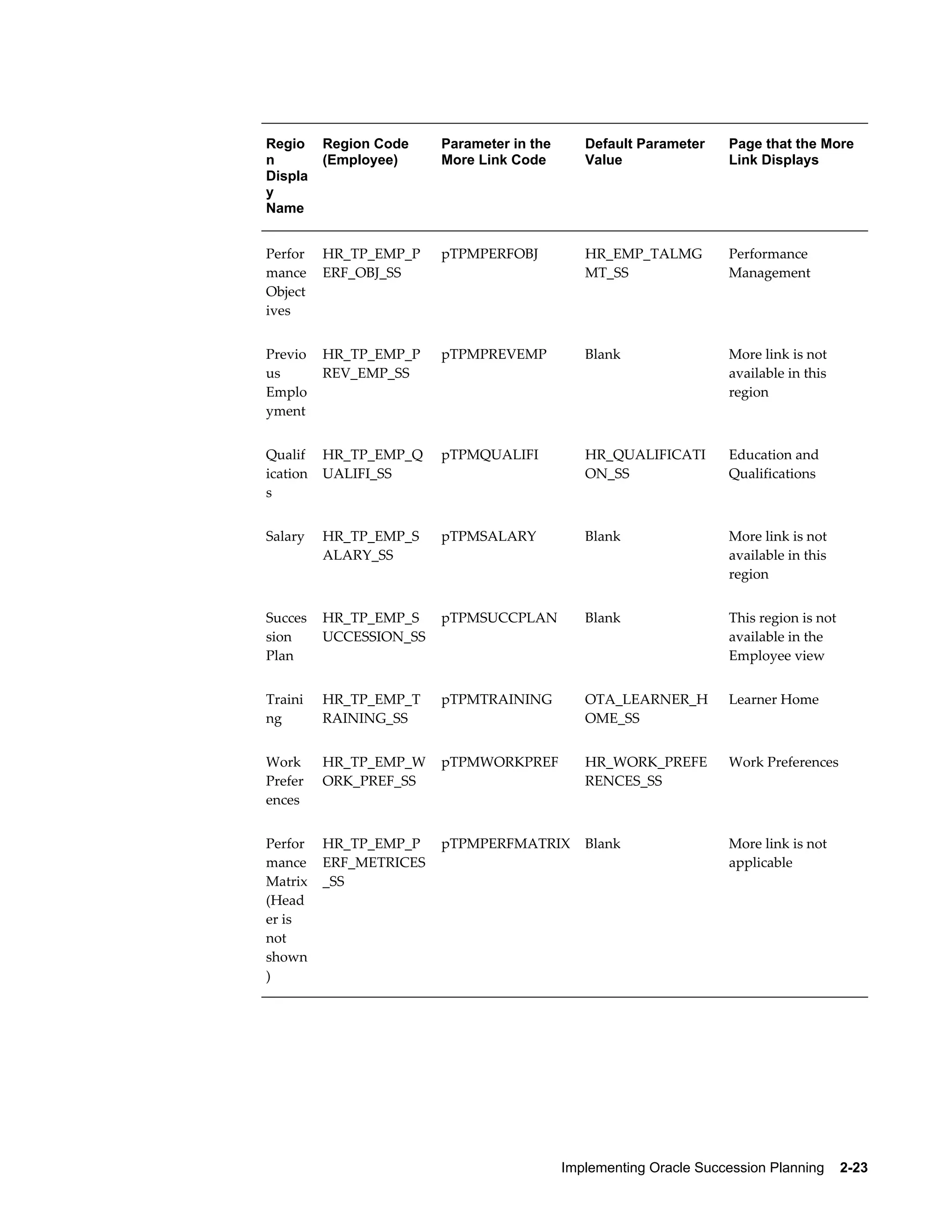
Perfor
mance
Object
ives
HR_TP_EMP_P
ERF_OBJ_SS
pTPMPERFOBJ HR_EMP_TALMG
MT_SS
Performance
Management
Previo
us
Emplo
yment
HR_TP_EMP_P
REV_EMP_SS
pTPMPREVEMP Blank More link is not
available in this
region
Qualif
ication
s
HR_TP_EMP_Q
UALIFI_SS
pTPMQUALIFI HR_QUALIFICATI
ON_SS
Education and
Qualifications
Salary HR_TP_EMP_S
ALARY_SS
pTPMSALARY Blank More link is not
available in this
region
Succes
sion
Plan
HR_TP_EMP_S
UCCESSION_SS
pTPMSUCCPLAN Blank This region is not
available in the
Employee view
Traini
ng
HR_TP_EMP_T
RAINING_SS
pTPMTRAINING OTA_LEARNER_H
OME_SS
Learner Home
Work
Prefer
ences
HR_TP_EMP_W
ORK_PREF_SS
pTPMWORKPREF HR_WORK_PREFE
RENCES_SS
Work Preferences
Perfor
mance
Matrix
(Head
er is
not
shown
)
HR_TP_EMP_P
ERF_METRICES
_SS
pTPMPERFMATRIX Blank More link is not
applicable
2-24    Oracle Succession Planning Implementation and User Guide
Regio
n
Displa
y
Name
Region Code
(Employee)
Parameter in the
More Link Code
Default Parameter
Value
Page that the More
Link Displays
Perfor
mance
Rating
s
HR_TP_EMP_P
ERFRATING_SS
&pTPMPERFRATE HR_EMP_VIEWS_S
S
My Information
Configuring Talent Profile Functions, Suitability Analyzer, and Compare
Profile Templates
The Talent Profile page has an Action drop down that lists the actions that a logged in
user (worker or manager) can perform when viewing the talent profile. This topic
explains how to configure the talent profile actions that managers can perform.
Configuring the Talent Profile Actions
Talent Profile actions are specific to the Talent Profile functionality. The following is a
list of talent profile actions:
• Performance Matrix (Potential)
• Performance Matrix (Retention)
• Compare Profile
• Printable Profile
• Printable Profile (Full)
Each talent profile action is defined as a sub-function. The sub function name is
predefined for the delivered functionality. If you create a custom responsibility, then
you must include the sub-function in the responsibility so that the user can access the
talent profile actions. Administrators can restrict the access of some of the actions,
depending upon the requirement. Some actions have two functions created for them so
that the access of the action can be restricted at both the employee and manager view.
The following tables provide details about all the talent action sub-functions.
Implementing Oracle Succession Planning    2-25
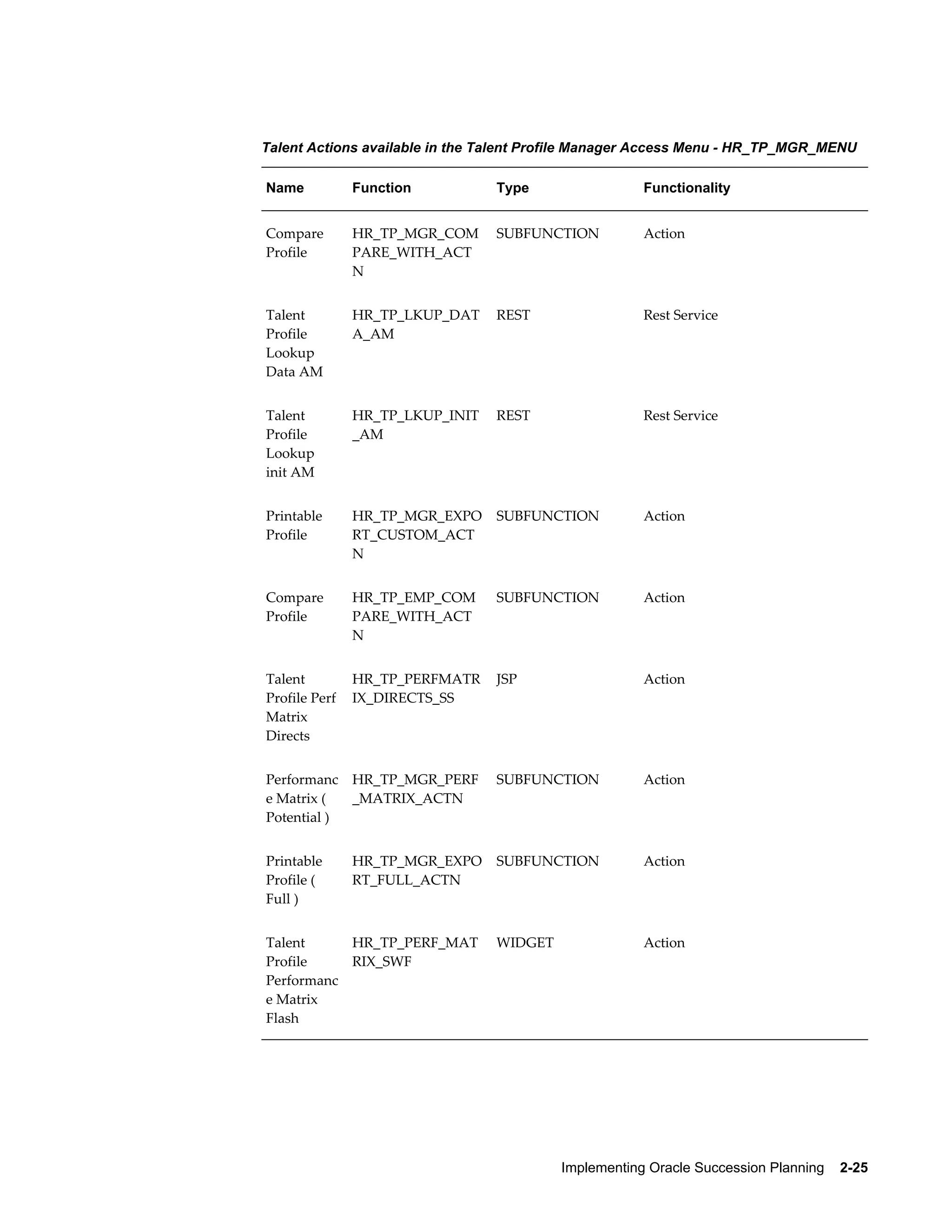
Talent Actions available in the Talent Profile Manager Access Menu - HR_TP_MGR_MENU
Name Function Type Functionality
Compare
Profile
HR_TP_MGR_COM
PARE_WITH_ACT
N
SUBFUNCTION Action
Talent
Profile
Lookup
Data AM
HR_TP_LKUP_DAT
A_AM
REST Rest Service
Talent
Profile
Lookup
init AM
HR_TP_LKUP_INIT
_AM
REST Rest Service
Printable
Profile
HR_TP_MGR_EXPO
RT_CUSTOM_ACT
N
SUBFUNCTION Action
Compare
Profile
HR_TP_EMP_COM
PARE_WITH_ACT
N
SUBFUNCTION Action
Talent
Profile Perf
Matrix
Directs
HR_TP_PERFMATR
IX_DIRECTS_SS
JSP Action
Performanc
e Matrix (
Potential )
HR_TP_MGR_PERF
_MATRIX_ACTN
SUBFUNCTION Action
Printable
Profile (
Full )
HR_TP_MGR_EXPO
RT_FULL_ACTN
SUBFUNCTION Action
Talent
Profile
Performanc
e Matrix
Flash
HR_TP_PERF_MAT
RIX_SWF
WIDGET Action
2-26    Oracle Succession Planning Implementation and User Guide
Name Function Type Functionality
Talent
Profile
Performanc
e Matrix
Succession
Plan GRD
HR_TP_PERFMTRX
_SUCCPLAN_GRD_
AM
REST Rest Function
Talent
Profile Perf
Matrix
Directs AM
HR_TP_PERFMTRX
_GRD_AM
REST Rest Service
Performanc
e Matrix (
Retention )
HR_TP_MGR_RET_
PERF_MTRX_ACTN
SUBFUNCTION Action
Talent Actions available in the Talent Profile Employee Access Menu - HR_TP_EMP_MENU
Name Function
TypeFunctionality
Type Functionality
Printable Profile HR_TP_MGR_EXPO
RT_CUSTOM_ACTN
SUBFUNCTION Action
Compare Profile HR_TP_EMP_COMP
ARE_WITH_ACTN
SUBFUNCTION Action
Printable Profile ( Full
)
HR_TP_MGR_EXPO
RT_FULL_ACTN
SUBFUNCTION Action
Enable Managers to Use the Suitability Analyzer
Managers can use the Suitability Analyzer tool to compare competencies of workers.
The tool displays competencies in a graphical format. Managers can access this tool
from the Suitability Matching function page.
To enable managers to use the Suitability Analyzer, you can either add the supplied
Suitability Matching Spider Menu - (HR_SUIT_MATCH_SPIDER_MENU) or a copy of
the supplied menu to the responsibility that managers use to render the Suitability
Analyzer.
Implementing Oracle Succession Planning    2-27
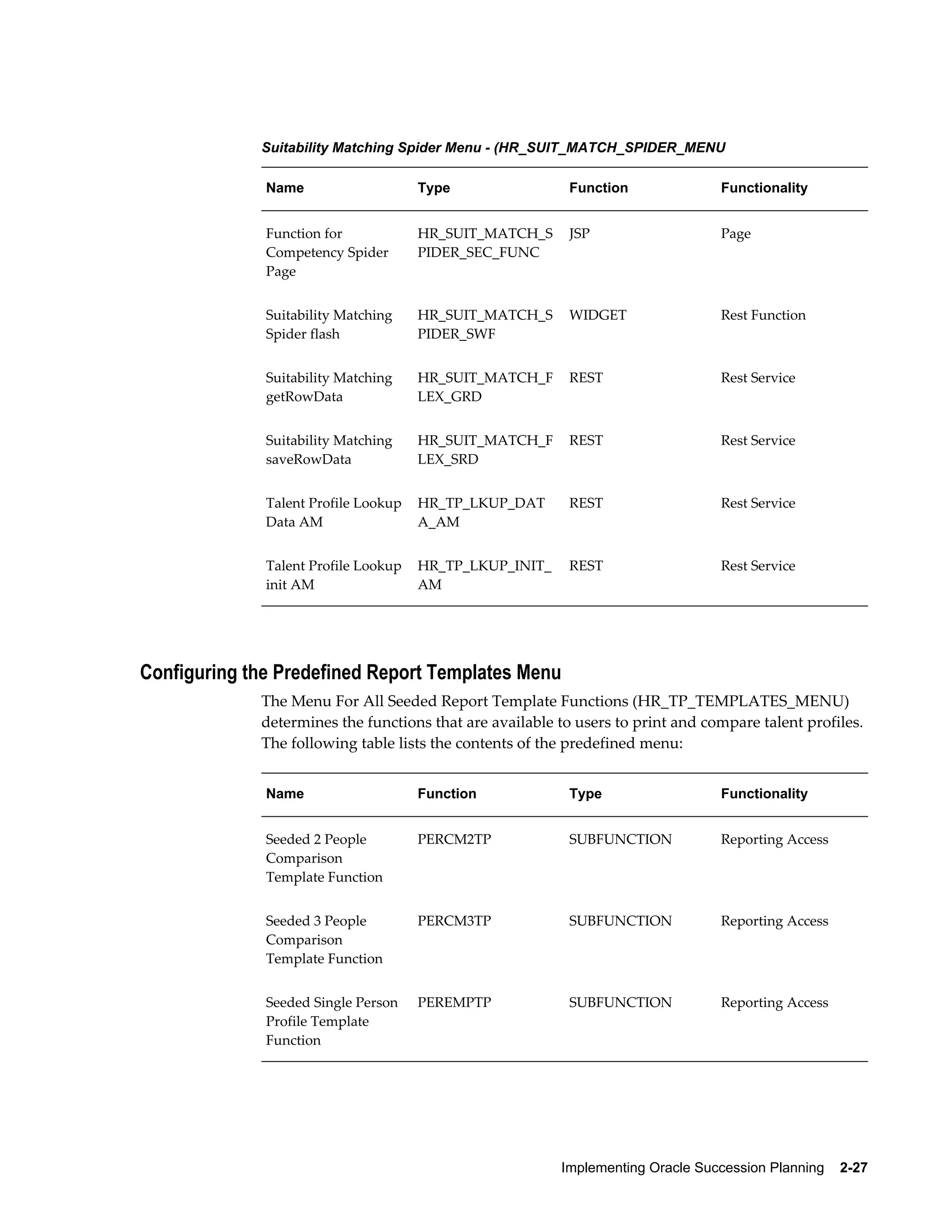
Suitability Matching Spider Menu - (HR_SUIT_MATCH_SPIDER_MENU
Name Type Function Functionality
Function for
Competency Spider
Page
HR_SUIT_MATCH_S
PIDER_SEC_FUNC
JSP Page
Suitability Matching
Spider flash
HR_SUIT_MATCH_S
PIDER_SWF
WIDGET Rest Function
Suitability Matching
getRowData
HR_SUIT_MATCH_F
LEX_GRD
REST Rest Service
Suitability Matching
saveRowData
HR_SUIT_MATCH_F
LEX_SRD
REST Rest Service
Talent Profile Lookup
Data AM
HR_TP_LKUP_DAT
A_AM
REST Rest Service
Talent Profile Lookup
init AM
HR_TP_LKUP_INIT_
AM
REST Rest Service
Configuring the Predefined Report Templates Menu
The Menu For All Seeded Report Template Functions (HR_TP_TEMPLATES_MENU)
determines the functions that are available to users to print and compare talent profiles.
The following table lists the contents of the predefined menu:
Name Function Type Functionality
Seeded 2 People
Comparison
Template Function
PERCM2TP SUBFUNCTION Reporting Access
Seeded 3 People
Comparison
Template Function
PERCM3TP SUBFUNCTION Reporting Access
Seeded Single Person
Profile Template
Function
PEREMPTP SUBFUNCTION Reporting Access
2-28    Oracle Succession Planning Implementation and User Guide
You can exclude the functions that you do want managers to use from the copied
menus.
Implementing Oracle Succession Planning    2-29
Self-Service Actions on the Talent Profile Page
Setting up Self-Service Actions on the Talent Profile Page
The Talent Profile page has an Action drop down that lists the actions that a logged in
user (worker or manager) can perform when viewing the talent profile.
The Action list includes:
• Self-Service or SSHR Actions
• Talent Profile Actions
Add Self-Service or SSHR Actions
SSHR defines the list of self-service actions that a manager or worker can perform.
To enable managers or workers perform self-service actions, you must add the
following menus to the Succession Planning (HR_SUCCESSION_MGMT) menu:
• Personal Actions (or your configured copy of this menu). This menu displays a list
of available functions for the worker.
• Manager Actions Menu (or your configured copy of this menu). This menu defines
the self-service actions that managers can perform.
For information on SSHR functions and menus, see: Predefined Self-Service
Responsibilities and User Menus, Oracle SSHR Deploy Self-Service Capability Guide
2-30    Oracle Succession Planning Implementation and User Guide
Configuration Steps for Oracle Succession Planning
Completing the Configuration Steps for Oracle Succession Planning
After you instal Oracle Succession Planning, you carry out the following configuration
steps:
Configure the Print Profile and Compare Profile Default XML Templates, if Required
Managers can print talent profiles of their workers. They can also generate a
comparison report of the talent profiles of their workers.
Oracle Succession Planning delivers the Single Person Profile Template (PEREMPTP) to
print the talent profile of a worker.
By default, managers can compare either two or three workers using the following
predefined templates:
• Name: Talent Profile Comparison Report of 2 Employees
Default File: PERCM2TP.rtf
Code: PERCM2TP
• Name: Talent Profile Comparison Report of 3 Employees
Default File: PERCM3TP.rtf
Code: PERCM3TP
Oracle Succession Planning supplies the PERTPDDF data definition source file that
contains all the data tags that compare profile templates use. To enable your managers
to compare the profiles of more than two or three workers, you must create templates
using the predefined data definition source. You must also create a new function with
the same name as the template name and grant the function. You can create custom
templates using Oracle XML Publisher. This enables managers to select the custom
template when they compare profiles.
Define the and Extra Information Types (EITs) Required for Succession Plans
You must set up the Lookups and EITs required for succession plans.
See: Setting up the Succession Plans Functionality, page 2-38
Define the Lookups to Assess Performance, Potential, and Retention
Define the following lookup types to assess performance, potential, and retention:
Implementing Oracle Succession Planning    2-31
• PERFORMANCE_RATING: Indicates the performance rating.
• READINESS_LEVEL: Indicates the succession potential.
• PER_RETENTION_POTENTIAL: Indicates the retention potential
If these lookups have already been defined, then you must verify that the information
meets your business requirements.
Configure the Rating Scale Values for Performance Matrices (9-Box)
Managers can view the performance profiles of workers in their hierarchy using the
following performance matrices:
• Performance Matrix (Potential): Provides information on performance and
leadership potential of workers on a scale of 1 to 3.
• Performance Matrix (Retention): Provides information on workers performance and
retention prospects on a scale of 1 to 3.
To display the performance matrix rating values, you must complete the following
steps:
Define the Lookup Types for Performance Matrix (Potential) and Performance Matrix (Retention)
You must add lookup values to the following lookup types that the performance
matrices use:
• PER_9_BOX_LEVEL
Indicates the performance level such as low, medium, and high. When adding the
lookup values, you must specify the code, so that the application can display the
relevant rating values for workers on the performance 9-box. If you do not enter the
code, then the 9-box does not display the rating value. Define a maximum of three
codes on a scale of 1 to 3.
The following example displays lookup values for PER_9_BOX_LEVEL:
Code Meaning Description
1 Needs Performance is significantly
below the required level.
2 Meets Performance is good and
in-line with job
requirements.
2-32    Oracle Succession Planning Implementation and User Guide
Code Meaning Description
3 Exceeds Worker has exceeded the
required level of
performance.
You use the PER_9_BOX_LEVEL lookup type to extend the
PERFORMANCE_RATING lookup type.
• PER_POTENTIAL_9_BOX_LEVEL
Indicates the potential level of workers such as limited, growth, and high. You must
specify codes for the lookup and define a maximum of three codes on a scale of 1 to
3.
The following example displays lookup values for
PER_POTENTIAL_9_BOX_LEVEL:
Code Meaning Description
1 Limited Worker shows little or no
potential to move to the next
work level.
2 Meets Worker shows potential to
advance to the next or
higher work level.
3 Exceeds Worker has requisite skills
and expertise and exhibits
leadership qualities.
You use the PER_POTENTIAL_9_BOX_LEVEL lookup type to extend the
READINESS_LEVEL lookup type.
• PER_RETENTION_9_BOX_LEVEL
Indicates the retention prospects of workers such as low, medium, and high. You
must specify codes for the lookups and define a maximum of three codes on a scale
of 1 to 3.
The following example displays lookup values for
PER_RETENTION_9_BOX_LEVEL:
Implementing Oracle Succession Planning    2-33
Code Meaning Description
1 Low Risk of losing the worker is
high.
2 Medium Risk of losing the worker is
moderate.
3 High Risk of losing the worker is
minimal.
You use the PER_RETENTION_9_BOX_LEVEL lookup type to extend the
PER_RETENTION_POTENTIAL lookup type.
After you define the lookup types for performance matrices, you must create user types
and statuses for the following lookups:
• PERFORMANCE_RATING
• READINESS_LEVEL
• PER_RETENTION_POTENTIAL
Create User Statuses for PERFORMANCE_RATING, READINESS_LEVEL, and
PER_RETENTION_POTENTIAL Lookup Types
The Performance Matrix (9 -Box) does not directly use the lookup codes that you define
for the PERFORMANCE_RATING, READINESS_LEVEL, and
PER_RETENTION_POTENTIAL lookup types. Performance Matrix (Potential) and
Performance Matrix (Retention) display ratings using three levels only. Therefore, you
must identify the 9-box level for the PERFORMANCE_RATING, READINESS_LEVEL,
and PER_RETENTION_POTENTIAL lookup codes.
You use the User Types and Statuses window to create user types and statuses for the
lookups:
1. Navigate to the User Types and Statuses window.
2. Select a lookup type, for example, PERFORMANCE_RATING.
3. In the System Type field, select the lookup value that you want to extend. For
example, select the Above Average system type.
4. Enter a description of the new user type or status. For example, enter Exceeds as a
description.
2-34    Oracle Succession Planning Implementation and User Guide
5. Enter a code for the new user type or status.
6. Click the Further Info field. The Share Type Information window appears.
7. Select the 9 Box level that the user status applies to.
8. Save your work.
Configuring the Quick Search and Hierarchy Regions
By default, the Talent Profile page displays two regions: Quick Search and Hierarchy
that managers can use to navigate between talent profiles of workers. These regions are
configurable and can be removed from the Talent Profile page.
The following sections explain the regions and how you can configure them.
Configuring the Quick Search Region
The Quick Search region displays two search options:
• Search Profile
Displays profiles that logged in user can access. Users can select one of the profiles
and click the Show Profile button to view the talent profile details.
• Recently Visited Profile
This option displays recently viewed profiles. Currently, the visited profiles
information is stored only during a transaction and this information is lost once the
transaction ends.
To display the region, you must grant the HR_TP_VIEW_GBL_SEARCH_SS function to
the user.
Details of the Function
• User Function Name: Talent Profile Global Search Enabled
• Type: SUBFUNCTION
Configuring the Hierarchy Bean
The hierarchy bean appears at the top of the profile below the Quick Search region. The
hierarchy bean lists the workers in the supervisor hierarchy of the logged in user.
To display the hierarchy bean, you must the grant the
HR_TP_VIEW_PER_HIERARCHY_SS function to the user.
Details of the Function
Implementing Oracle Succession Planning    2-35
• User Function Name: Talent Profile Show Person Hierarchy Enabled
• Type: SUBFUNCTION
Configuring the Region Icons
This topic explains how you can configure the region icons in the Talent Profile regions.
Configuring the Region Icon in the Talent Profile Regions
All the Talent Profile regions display icons that indicate the regions content in a
graphical representation. You can add the required icons using the Personalization
function. Each region is shared region and a separate XML document. Place the icons
that are going to be used in the Talent Profile Regions in the OA_Media folder.
Locate the region icon item and navigate to the PhotoCellRN page element. The Photo
item of PhotoCellRN is an image type item. This item has an Image URI property,
which is set to a blank image, by default. To display another image, personalize this
property to point to the required image to be used on the region by starting with
/OA_Media/ followed by the icon file name of the icon being used for this region.
Personalizing Talent Profile
This topic provides information on personalizing Talent Profile regions and region
columns.
See: Oracle Application Framework Personalization Guide for more information on
personalizing OA Framework pages.
Talent Profile Regions
Use the information in the following table to create or rearrange regions on the Talent
Profile page (/oracle/apps/per/talentprofile/webui/TMProfileRN):
Note: TMProfileRN represents the entire page. Therefore, you cannot
add this region, for example, in the Appraisals region of the Talent
Profile page.
Region Display Name Region Path
Other Information /oracle/apps/per/talentprofile/additionalinfo/webui/Additio
nalInformationRN
2-36    Oracle Succession Planning Implementation and User Guide
Region Display Name Region Path
Appraisal /oracle/apps/per/talentprofile/performance/webui/Appraisal
ChartRN
Other Professional
Qualifications
/oracle/apps/per/talentprofile/qualifications/webui/Awards
OverviewRN
Benefits /oracle/apps/per/talentprofile/benefit/webui/BenefitsOvervie
wRN
Career Path /oracle/apps/per/talentprofile/careerpath/webui/CareerPath
RN
Cash Compensation /oracle/apps/per/talentprofile/empsalary/webui/SalaryCash
CompGraphRN
Certification /oracle/apps/per/talentprofile/learning/webui/CertificationsS
ummaryRN
Competencies /oracle/apps/per/talentprofile/competency/webui/Competen
cyOverviewRN
Compensation Statement /oracle/apps/per/talentprofile/empsalary/webui/SalaryComp
onentsRN
Job History /oracle/apps/per/talentprofile/employment/webui/CareerHis
toryRN
Performance Objectives /oracle/apps/per/talentprofile/perfmanagement/webui/Perfo
rmanceManagementRN
Previous Employment /oracle/apps/per/talentprofile/prevemp/webui/PrevEmploy
mentOverviewRN
Qualifications /oracle/apps/per/talentprofile/qualifications/webui/Qualifica
tionsOverviewRN
Salary /oracle/apps/per/talentprofile/empsalary/webui/SalaryOverv
iewRN
Succession Plan /oracle/apps/per/talentprofile/successionplan/webui/Success
ionPlanOverviewRN
Implementing Oracle Succession Planning    2-37
Region Display Name Region Path
Training /oracle/apps/per/talentprofile/training/webui/TrainingOverv
iewRN
Work Preferences /oracle/apps/per/talentprofile/workpreference/webui/WorkP
referenceOverviewRN
Performance Matrix (Header is
not shown)
/oracle/apps/per/talentprofile/performancematrix/webui/Ni
neBoxSwitcherRN
Performance Ratings /oracle/apps/per/talentprofile/performance/webui/Performa
nceRatingRN
Talent Profile Region Columns
You can personalize the supplied Talent Profile region columns to suit your business
requirements. For example, by default, the Competencies region displays the following
columns:
• Competency Name
• Current Proficiency Level
• Status
• Start Date
• End Date
If required, you can add columns to display different information. Using
personalization, you can change labels, hints, tips, and messages.
See: Oracle Application Framework Personalization Guide, Extensibility chapter.
2-38    Oracle Succession Planning Implementation and User Guide
Setting up Information for Succession Plans
Extra Information Types for Succession Plans
This topic describes the Extra Information Types supplied to provide additional
information for succession plans.
Job Career Management Information
Records job tracking information required for succession plans. You can identify
whether the job is a key role in your enterprise and the turnover rate of the job.
Position Career Management Information
Records position tracking information required for succession plans. You can identify
whether a position is a key role in your enterprise and the turnover rate of the position.
Employee Succession Planning Information
Records employee tracking information required for succession plans. You can:
• Identify the succession potential of an employee.
• Determine whether an employee is a key person in the enterprise.
• Determine the retention prospects of an employee.
Setting up the Succession Plans Functionality
To enable managers use the Succession Plans functionality, you must complete the
following setup tasks.
To set up information for the Succession Plans functionality:
1. Link the following succession plan information types to the responsibilities that
users access:
• Employee Succession Planning Information
• Job Career Management Information
• Position Career Management Information
Use the Information Type Security window to link EITs to a responsibility.
Implementing Oracle Succession Planning    2-39
See: Setting Up Extra Information Types For a Responsibility, Oracle HRMS
Configuring, Reporting, and System Administration Guide
2. Define the lookup types required for succession planning:
The following tables list the EITs, EIT segments, and the lookup types that populate
the EIT segments:
Employee Succession Planning Information
Segment Lookup Type Any Other Information
Key Person Yes No -
Succession Potential READINESS_LEVEL -
Retention Potential PER_RETENTION_POTEN
TIAL
-
Start Date Not applicable The application
automatically populates the
segment with the latest
appraisal start date.
End Date Not applicable The application
automatically populates the
segment with the latest
appraisal end date.
Appraisal Completion Date Not applicable The application
automatically populates the
segment with the latest
appraisal completion date.
Job Career Management Information
Segment Lookup Type
Key Role Yes No
Turnover Rate PER_SUCC_PLAN_RISK_LEVEL
2-40    Oracle Succession Planning Implementation and User Guide
Position Career Management Information
Segment Lookup Type
Key Role Yes No
Turnover Rate PER_SUCC_PLAN_RISK_LEVEL
See: Adding Lookup Types and Values, Oracle HRMS Configuring, Reporting, and
System Administration Guide
Note: This note applies to customers who are using the Succession
Planning functionality available in Oracle SSHR, Release 12.1 . If
you have licensed Oracle Succession Planning, then you must
manually add the lookup codes available in :
• PER_SUCC_PLAN_POTENTIAL lookup type to the
READINESS_LEVEL lookup type.
• PER_SUCC_PLAN_RISK_LEVEL to the
PER_RETENTION_POTENTIAL lookup type.
The Succession Planning functionality in R12.1 Oracle SSHR uses
the PER_SUCC_PLAN_POTENTIAL and
PER_SUCC_PLAN_RISK_LEVEL lookup types.
3. Complete the extra information required for succession plans for worker, jobs, and
positions using the following windows and pages:
• For a worker, use the Employee Succession Management Information page in
Oracle Succession Planning.
• For a position, use the Extra Position Information window in Oracle HRMS.
• For a job, use the Extra Job Information window in Oracle HRMS.
See: Extra Information Types for Succession Plans, page 2-38
4. Add segments to the Add'l Succession Planning Det descriptive flexfield to capture
additional information required for succession plans in your enterprise.
5. On the Succession Plans page, managers can search for succession plans created for
a worker or role using the Plan Status field. They can select a plan status when
creating or updating succession plans. You define plan statuses using the
SUCCESSION_PLAN_STATUS lookup type. The predefined values are: Draft,
Implementing Oracle Succession Planning    2-41
Active, Inactive, and Completed. You can change the description of the lookup
values or add your own lookup values to this lookup type.
See: Adding Lookup Types and Values, Oracle HRMS Configuring, Reporting, and
System Administration Guide
6. If required, you can set up approvals for the Employee Succession Information
(PER_SUCCESSION_PLAN_DETAILS) function. When managers add succession
information, the application routes the transaction for approvals.
See: Approvals in SSHR, Oracle HRMS Deploy Self-Service Capability Guide
Display Succession Plans for Ex-Employees:
In addition to displaying succession plans of current workers, you can display
succession plans of ex-employees.
To enable ex-employee support in the search, you change the value of the
&pEnableTerms parameter value to Y for the following function:
Succession Management Search (PER_SUCCESSION_MGMT_SEARCH)
Integration of Oracle Succession Planning and Oracle Performance
Management:
This section applies to customers who are using Oracle Performance Management and
have licensed Oracle Succession Planning.
On the Give Final Ratings: Main Appraiser page, Advancement Potential region, a
manager can select the Readiness Level and Retention level of a worker. If an enterprise
has Oracle Succession Planning license, then the Readiness Level field on the Create
Succession Plan page derives the value set for readiness level on the Give Final Ratings:
Main Appraiser page.
2-42    Oracle Succession Planning Implementation and User Guide
Configuring Suitability Matching
This topic provides details about the Suitability Matching module.
Suitability Matching Options
Category Option Access by
Responsibility
Find a Person for a
Work Opportunity
Find Suitable People by Role Manager, HR
Professional
Find a Person for a
Work Opportunity
Find Suitable People by Competency Manager, HR
Professional
Find a Person for a
Work Opportunity
Compare People by Current Role Manager, HR
Professional
Find a Person for a
Work Opportunity
Compare Named Successors for a Position HR Professional
Find a Person for a
Work Opportunity
Compare Applicants for a Vacancy Manager, HR
Professional
Find a Work
Opportunity for a
Person
Find Work Opportunities by Role Manager, Employee,
HR Professional
Find a Work
Opportunity for a
Person
Find Work Opportunities by Competency Manager, Employee,
HR Professional
Find a Work
Opportunity for a
Person
Compare Pending Applications Manager, Employee,
HR Professional
Find a Work
Opportunity for a
Person
Compare Succession Options HR Professional
Implementing Oracle Succession Planning    2-43
Category Option Access by
Responsibility
Find a Work
Opportunity for a
Person
Compare Current Assignments Manager, Employee,
HR Professional
Menu and Function Names
Suitability Matching is accessible through three menus and corresponding functions as
described in the following table.
Menu and Function Names
User Menu Name Function Name
Manager Self-Service
(LINE_MANAGER_ACCESS_V4.0)
Suitability Matching Mgr
(HR_SUITABILITY_MATCH_MGR_SS)
Employee Self-Service
(EMPLOYEE_DIRECT_ACCESS_V4.0)
Suitability Matching
(HR_SUITABILITY_MATCH_SS)
Contingent Worker Self-Service
(HR_CWK_DIRECT_ACCESS)
Suitability Matching
(HR_SUITABILITY_MATCH_SS)
HR Professional
(HR_PROF_SELF_SERVICE_V4.0)
Suitability Matching Hr
(HR_SUITABILITY_MATCH_HR_SS)
Workflow
Suitability Matching uses no configurable workflow processes.
Tips and Instructions
You can configure all the following tips and instructions directly from the Suitability
Matching pages, using the "Personalize..." links.
The following table describes the tips and instructions.
2-44    Oracle Succession Planning Implementation and User Guide
Tips and Instructions
Region Attribute Name Message Name
AddCompetenciesPG SelectCompInst HR_INST_ADD_COMP_TO_
LIST
CompGapsPG SMCompGapsInst HR_INST_COMP_GAPS_SS
ComparePeopleListPG PersonListInst HR_INST_PERSON_LIST
CompareSuccessorsListPG PersonListInst HR_INST_PERSON_LIST
CurrentAssignmentsPG CurrentAssnInst HR_INST_ASSIGNMENT_LI
ST
GraphByCompetencePG GraphCompInst HR_INST_GRAPH_COMP
GraphByPersonPG GraphPersonInst HR_INST_GRAPH_PERSON
GraphByWorkOppPG GraphWorkOppInst HR_INST_GRAPH_WORKO
PP
PersonCompetenciesPG PersonCompInst HR_INST_PERSON_SELECT
_COMP
PersonListPG PersonListInst HR_INST_PERSON_LIST
RefineSearchPG RefineSearchInst HR_INST_REFINE_SEARCH
SMManagerOptionsPG ManagerOppInst HR_INST_SUITMATCH_LM
DA_OPTIONS
SMManagerOptionsPG WorkOppInst HR_INST_WORK_OPP_OPTI
ONS
SMManagerOptionsPG PersonOppInst HR_INST_PERSON_OPP_OP
TIONS
SMOptionsPG HROptionsInst HR_INST_SUITMATCH_LM
DA_OPTIONS
Implementing Oracle Succession Planning    2-45
Region Attribute Name Message Name
SMOptionsPG WorkOppInst HR_INST_WORK_OPP_OPTI
ONS
SMOptionsPG PersonOppInst HR_INST_PERSON_OPP_OP
TIONS
SMPersonOptionsPG PersonPageOppInst HR_INST_SUITMATCH_ED
A_OPTIONS
SMTrainingActivitiesPG SMTrainActInst HR_INST_TRAIN_ACT_SS
SelectCompetenciesPG SelectCompInst HR_INST_SELECT_COMP
SelectMultiRolePG SelectRoleInst HR_INST_MULTI_SELECT_R
OLE
SelectRolePG SelectRoleInst HR_INST_SELECT_ROLE
SelectRolePG CompareByRoleInst HR_INST_COMPARE_PEOP
LE_ROLE
SelectRolePG SelectPositionInst HR_INST_SELECT_POSITIO
N
SelectRolePG SelectVacancyInst HR_INST_SELECT_VACAN
CY
SuccessionOptionsPG SuccOptionsInst HR_INST_SUCCESSION_OP
TIONS
SuitableWorkOppListPG WorkOppListInst HR_INST_SUITABLE_WORK
OPP_LIST
VacancyListPG VacancyListInst HR_INST_VACANCIES_LIST
WorkOppListPG WorkOppListInst HR_INST_WORKOPP_LIST
MultiJobLovPG SearchInst FND_LOV_GO
MultiOrganizationLovPG SearchInst FND_LOV_GO
2-46    Oracle Succession Planning Implementation and User Guide
Region Attribute Name Message Name
MultiPositionLovPG SearchInst FND_LOV_GO
MultiVacancyLovPG SearchInst FND_LOV_GO
Configurable Flexfields
Suitability Matching uses no configurable flexfields.
Profile Options
The three profile options control the matching options available to each category of
user: employee, manager, and HR professional. Each of the values is a menu name. If
you want to change the options available to a given user (if you want to hide the
succession options from everyone, for example), you can clone a menu and replace the
profile value with the name of your new menu. Note that these menus differ in kind
and structure from the user menus listed above.
The following table describes the profile options.
Profile Options
Profile Configurable Level Values (default value in
boldface)
Value
Required?
HR: SM Manager
Find Work Opp
Menu
(HR_SM_PERSONAL
_ACTIONS_MENU)
Responsibility HR_SM_PERSONAL_FUN
CTIONS (at
Responsibility:HR
Professional)
HR_SM_PERSONAL_FUN
CTIONS (at
Responsibility:Manager
Self-Service)
Yes
HR: SM Manager
Find Person Menu
(HR_SM_MANAGER
_ACTIONS_MENU)
Responsibility HR_SM_MANAGER_FUN
CTIONS (at
responsibility:HR
Professional)
HR_SM_MANAGER_FUN
CTIONS (at responsibility:
Manager Self-Service)
Yes
Implementing Oracle Succession Planning    2-47
Profile Configurable Level Values (default value in
boldface)
Value
Required?
HR: SM Employee
Find Work Opp
Menu
(HR_SM_EMP_PERS
ONAL_ACTIONS_M
ENU)
Responsibility HR_SM_EMP_PERSONAL
_FUNCTIONS (at
responsibility: Employee
Self-Service)
Yes
Using Oracle Succession Planning    3-1
3
Using Oracle Succession Planning
3-2    Oracle Succession Planning Implementation and User Guide
Succession Planning
The Succession Plans Feature
Using the Succession Plans functionality that Oracle Succession Planning provides, you
can:
• Identify key roles (jobs and positions) in your enterprise to ensure that succession
plans are in place.
• Identify workers who are likely to vacate their current positions because of
promotion, retirement, or voluntary termination.
• Define additional information for succession plans to meet business needs.
• Create and update succession plans for jobs, positions, and workers.
The following sections describe how your enterprise can plan and manage succession
processes using Oracle Succession Planning:
Identify Key Roles in the Enterprise
Enterprises must first identify the key roles (jobs and positions) in their enterprise.
Enterprises can then identify the available talent pool that suits the requirements to fill
these key roles. If there is a deficit of talented workforce within the enterprise to fill
these roles, managers can find other suitable talent in their enterprise and create
succession plans. Based on the succession planning, managers can implement
development plans to prepare the suitable talent for key roles in the enterprise.
Enterprises can use the Job Career Management Information and Position Career
Management Extra Information Types to:
• Identify whether a job is a key role in the enterprise and the turnover rate of the job.
• Identify whether a position is a key role in the enterprise and the turnover rate of
the position.
Identify Key Workers in the Enterprise
Enterprises must identify workers who posses specialized skills and experience and are
difficult to replace to ensure continuity of the business growth. Managers require data
about the availability of qualified workforce.
Managers can view talent profiles of workers, compare talent profiles, analyze
performance based on appraisals, use the 9-box potential and retention information to
identify key workers. Enterprises can use the Employee Succession Planning Extra
Using Oracle Succession Planning    3-3
Information Type to:
• Determine whether a worker is a key person in the enterprise.
• Identify the succession potential of workers.
• Assess the retention prospects of workers.
Find Suitable Talent in the Enterprise
Managers require information about workers such as employment details,
competencies, qualifications, work experience, work preferences, learning certifications,
training details, compensation, proposed career path to identify suitable talent to fill
key roles.
Talent Profile feature of Oracle Succession Planning provides managers with
comprehensive talent information that assists managers in finding suitable talent.
Managers can compare and print workers profiles. Oracle Succession Planning provides
9-box analytical tool to evaluate the performance, potential, and retention prospects of
workers in the enterprise. Managers can assess the performance potential and retention
prospects of workers in their hierarchy to find suitable talent in the enterprise. In
addition to the performance matrices, managers can use the Suitability Analyzer tool
provided within the Suitability Matching function to compare workers based on their
competencies. They can identify suitable successors using the Suitability Analyzer tool.
Create and Manage Succession Plans
Managers can use the Succession Plans page to:
• Search for plans for a job, position, or worker.
• Create, update, and delete succession plans.
Using the Create Succession Plan page, managers can create a succession plan for a job,
position, or worker, and add successors.
Key Concepts
The following topics explain the succession planning tasks:
• Extra Information Types for Succession Plans, page 2-38
• Creating and Maintaining Succession Plans Using Oracle Succession Planning, page
3-59
• Using Talent Profile as Managers, page 3-8
• Using Talent Profile as Workers, page 3-24
3-4    Oracle Succession Planning Implementation and User Guide
• Succession Planning Using Talent Profile, page 3-55
• Using Performance Matrix (Potential) and Performance Matrix (Retention), page 3-
39
• Comparing Talent Profiles, page 3-47
• Generating Printable Profiles, page 3-36
Using Oracle Succession Planning    3-5
Identifying Workforce Talent Using Talent Profile
An Overview of Talent Profile
Enterprises work with multiple applications and systems to gather talent related
information about their workforce to make informed decisions and formalize action
plans for succession planning and management. The Talent Profile feature of Oracle
Succession Planning helps enterprises to obtain a complete picture of the talent profile
of their workforce to manage and execute their talent processes. Talent Profile captures
and displays complete worker talent details on a single-interface enabling enterprises to
attract, develop, and retain the best talent.
Talent Profile Features
Enterprises can use the following Talent Profile features to develop and manage
succession plans for their workforce:
View Complete Talent Information
Talent Profile displays worker information such as personal information, photograph,
contact information, and employment details. Talent Profile obtains relevant data from
talent management products and presents the information in the following regions:
• Competencies
• Qualifications
• Other Professional Qualifications
• Previous Employment
• Learning Certifications
• Training
• Appraisals
• Performance Objectives
• Succession Plans
• Job History
• Career Path
3-6    Oracle Succession Planning Implementation and User Guide
• Work Preferences
• Salary
• Benefits
• Monetary Compensation
• Compensation Statement
• Other Information
• Performance Ratings
View 9-Box Matrix for Potential and Retention
Managers can view the performance profile of a worker in the Performance Matrix (9 -
Box) that indicates performance and growth potential. This information is crucial to
take key talent development, retention, and succession decisions.
Performance Matrix displays information using the following matrices:
• Performance vs. Potential: This matrix provides information on performance and
leadership potential.
• Performance vs. Retention: This matrix provides information on performance and
risk of loss.
The performance, potential, and retention rating scales on the matrices are configurable
and depend on the ratings scales defined by the enterprise.
Compare Talent Profiles
Enterprises can compare talent profiles of their workforce. Talent Profile displays the
comparison report in a printable format. When managers compare the talent profiles of
workers, if they find a suitable successor, then they can select the worker as a successor
and create a succession plan from the Talent Profile page. While creating a succession
plan, managers can use the Show Suitable Successors feature that uses the
competency-based search to display list of workers who meet the competency
requirements.
Print Talent Profiles
Managers can print a worker's talent profile. The application provides a default print
option with all the configured regions. Managers have the flexibility to select required
talent profile regions and print a custom view of the talent profile.
Using Oracle Succession Planning    3-7
Maintain Notes
Workers and managers can create and update notes to record important information
about their talent profile such as notes about appraisals or learning plans.
Create and Use Tags
Workers and managers can create tags that are similar to keywords. Tags help
categorize and group talent. Workers can create tags that match their individual
profiles. Managers can create tags that match with the talent profiles of their workers.
Perform Self-Service Actions
Managers and workers can perform self-service actions. For example, when a manager
views the talent profile of a worker, the manager can change the pay of the worker by
selecting the Change Pay self-service action directly from the Talent Profile page.
Use Talent Profile Based on Role Requirements
As managers and workers have different business requirements, Talent Profile delivers
views based on their roles. For example, only managers can view the Succession Plan
and Performance Matrix (9-box).
Use Flexible Search Options to Search for Talent Profiles
Managers can directly search for the worker whose talent profile they want to view
with out having to navigate through the entire hierarchy. The search displays the talent
profile of the selected worker. Horizontal links display the complete hierarchical
relationship of the worker and the manager. A saved view of recently viewed profiles
helps managers to return to recent records without having to perform the search again.
The application saves the recently viewed profiles only for that specific session.
Key Concepts
The following topics provide conceptual and procedural information about using Talent
Profile:
• Using Talent Profile as Managers, page 3-8
• Using Talent Profile as Workers, page 3-24
• Succession Planning Using Talent Profile, page 3-55
• Viewing Performance Matrix (Potential), page 3-39
• Viewing Performance Matrix (Retention), page 3-43
• Comparing Talent Profiles, page 3-47
3-8    Oracle Succession Planning Implementation and User Guide
• Generating Printable Profiles, page 3-36
Using Talent Profile as Managers
When managers navigate to the Talent Profile page, the page displays their own talent
information. The Talent Profile page of a worker provides managers with information
required for succession planning. To view talent profiles of workers in their hierarchy,
managers can select a worker either from the hierarchy list or quick search region.
Note: Currently, Talent Profile supports only supervisor hierarchy.
As a manager, when you navigate to the Talent Profile page of a worker, you can:
• View worker details
• View talent information presented in different regions
• View Performance Matrix (9-Box)
• Perform talent actions
• View Performance Matrix (Potential)
• View Performance Matrix (Retention)
• Compare talent profiles
• Print talent profiles
• Perform self-service actions
View Worker Details
You can view employment details such as the organization, job, position, supervisor,
and the hire date. The contact details include address, phone numbers, and e-mail
address. You can also view a photograph of the worker, if available. You can also view
tags.
View Talent Information Presented in Different Regions
This section lists the talent regions that managers can view for their workers.
Note: Your enterprise may display all the regions or hide some of the
regions according to the business needs and processes.
Using Oracle Succession Planning    3-9
• Competencies
• Appraisals
• Performance Objectives
• Qualifications
• Learning Certifications
• Training
• Other Professional Qualifications
• Job History
• Career Path
• Benefits
• Work Preferences
• Previous Employment
• Monetary Compensation
• Succession Plans
• Other Information
• Salary
• Compensation Statement
• Performance Ratings
Competencies
The Competencies region displays the current competencies of the selected worker. You
can view the level and status of the competencies.
3-10    Oracle Succession Planning Implementation and User Guide
Screenshot of the Competencies Region
Click the More link to navigate to the Competency Profile page of the worker to view or
update the existing competency profile. When you update or add competencies for a
worker, the updated information is visible on the Talent Profile page.
For information on competencies, see: Competency Profile, Oracle SSHR Deploy
Self-Service Capability Guide
Appraisals
The Appraisals region displays the appraisal information using a bar graph. The bar
graph is a column chart where the x-axis shows the appraisal period end date and the
y-axis shows the appraisal rating of the worker and the total rating value. You can
easily distinguish the rating of the worker and the total rating value as the bar graph
uses different color codes. Talent Profile displays information only from appraisals that
are given an overall rating, regardless of whether the appraisals are created using the
Appraisals function or appraisals are created as part of performance management
plans. The bar graph displays information for five appraisals.
Note: Talent Profile does not display information from self appraisals.
Using Oracle Succession Planning    3-11
Screenshot of the Appraisals Region
Click the More link to navigate to the View Appraisals page for more information on
the worker's appraisals. On the View Appraisals page, you can view completed and in
progress appraisals.
For more information on appraisals, see: The Appraisal Process, Oracle Performance
Management Implementation and User Guide
Performance Objectives
You can view worker objectives for a specific performance management plan. By
default, the Plan Name field displays the latest published performance management
plan. The Performance Objectives region displays the plan name, plan period,
objectives, and objective start and end date. The Complete % field helps you to track the
progress of the worker's objectives.
3-12    Oracle Succession Planning Implementation and User Guide
Screenshot of the Performance Objectives Region
Click the More link to navigate to the Performance Management page of the worker.
For each performance management plan, you can view a list of tasks. The application
enables these tasks at appropriate times during the performance-management period.
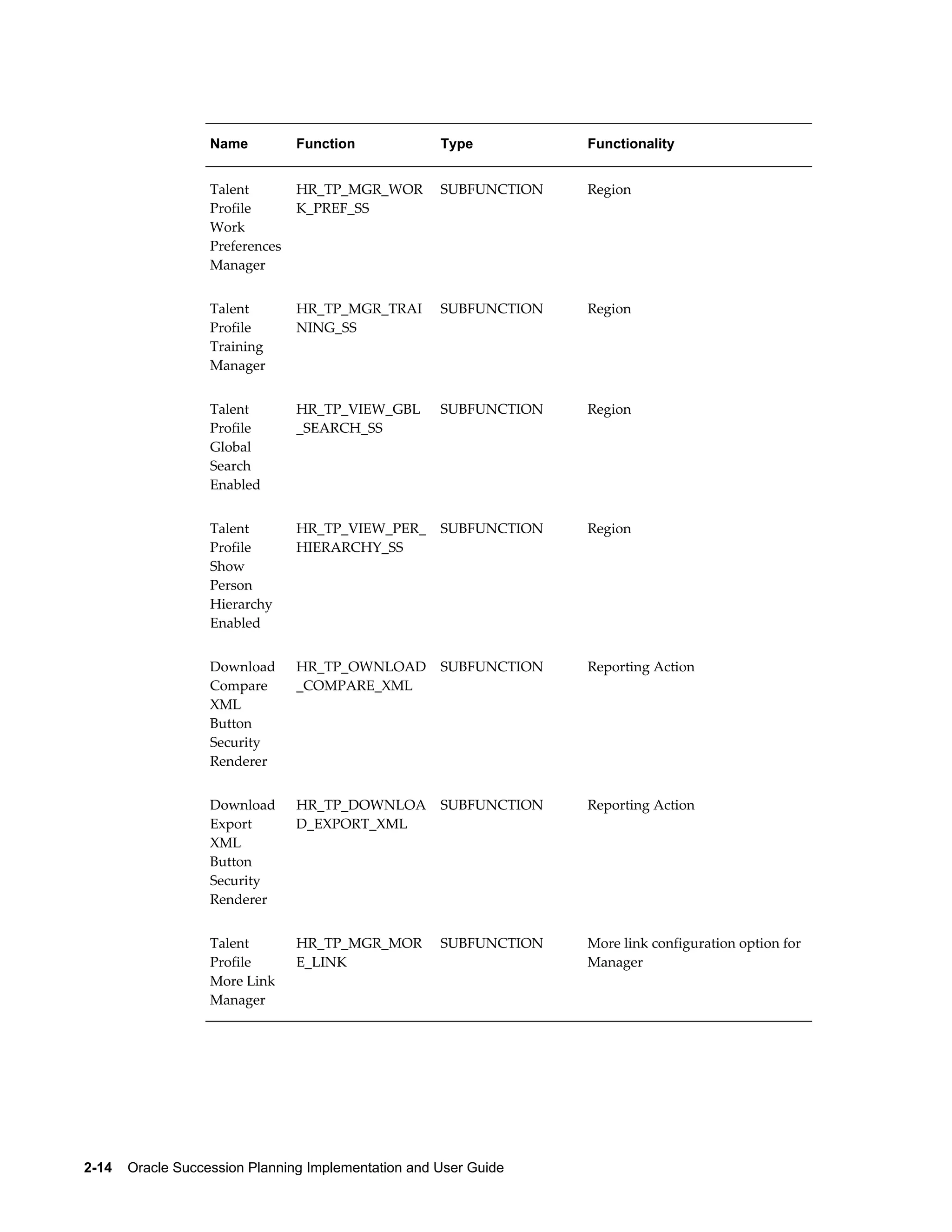
View Performance Objectives of an Indirect Report
When you view the Talent Profile page of an indirect report (a worker reporting to your
direct report), and click the More link, the application enables you to view and carry out
the performance management tasks as the indirect report's manager. For example, Dan
Bird is Sales Manager, Vision Corporation and Alice Taylor, the manager of Store A
reports to Dan. When Dan views the Talent Profile of Alex Smith who reports to Alice,
Dan can perform Alice's performance-management tasks.
For more information on manager performance management tasks, see: Manager
Performance-Management Tasks, Oracle Performance Management Implementation and
User Guide
Qualifications
The Qualifications region displays the education qualifications information such as
qualification type, title, and status.
Using Oracle Succession Planning    3-13
Screenshot of the Qualifications Region
Click the More link to navigate to the Education and Qualifications page of the worker
to create or update qualifications. The Talent Profile page displays the updated
qualifications information.
For more information, see: Education and Qualifications, Oracle SSHR Deploy Self-Service
Capability Guide
Learning Certifications
You can view the learning certification details such as the certification name, status,
progress, and renew date.
Screenshot of the Learning Certifications Region
Click the More link to navigate to the Learner Home page of the worker. On the Learner
Home page of the worker, you can view details such as additional certification details,
classes that the worker has currently enrolled in, and learning paths that the worker has
subscribed to.
For more information, see: The Learner Home, Oracle Learning Management User Guide
Training
This region displays the training information of the selected worker. Details include the
3-14    Oracle Succession Planning Implementation and User Guide
course name, course delivery method, enrollment status, and enrollment dates. You can
use the Filter values to view all, completed, or upcoming training.
Screenshot of the Training Region
Click the More link to navigate to the Learner Home page of the worker to view
additional training details. You can also enroll the worker in required training. The
Talent Profile displays the updated enrollment information.
For more information, see: The Learner Home, Oracle Learning Management User Guide
Other Professional Qualifications
You can view other professional qualifications of the worker such as an award. This
region does not display academic qualifications, which are displayed in the
Qualifications region.
Screenshot of the Other Professional Qualifications Region
Click the More link to navigate to the Other Professional Qualifications page to add
new professional qualifications or update existing professional qualifications. The
Using Oracle Succession Planning    3-15
Talent Profile displays the updated professional qualifications information.
For more information, see: Other Professional Qualifications, Oracle SSHR Deploy
Self-Service Capability Guide
Job History
The Job History region displays the details of previous jobs of the selected worker in the
same enterprise. You can use this information to analyze what the worker has gained
from each role in terms of experience, skills, and professional development. When
creating succession plans you can use the job history details to evaluate the work
experience summary of the worker.
Screenshot of the Job History Region
This is a view only region and you cannot perform any transaction as the More link is
not available.
Career Path
You can view the proposed career path of the selected worker from the current job
level. Managers can learn where the worker is in their career. They can analyze the
worker's career path and plan for suitable training to meet the future role requirements.
Screenshot of the Career Path Region
This is a view only region and you cannot perform any transaction as the More link is
not available.
Benefits
You can view the benefits enrollments of the worker such as programs, plans, and
options. You can also view with the benefits' coverage start date and coverage amounts.
3-16    Oracle Succession Planning Implementation and User Guide
Screenshot of the Benefits Region
Click the More link to launch the Self-Service Benefits Enrollments function. The
subsequent Benefits Enrollments pages that you view depend on the configuration
choices that your enterprise makes.
For more information, see:Self-Service Benefits Enrollments, Oracle HRMS Compensation
and Benefits Management Guide
Work Preferences
You can view the work preferences specified by the worker in two regions: Domestic
Options and International Relocation Options. You can gather information such as
whether the worker is willing to accept international travel or relocate domestically.
You can also view preferred work hours and work schedule.
Using Oracle Succession Planning    3-17
Screenshot of the Work Preferences Region
Click the More link to navigate to the Work Preferences page of the worker to add or
update information. The Talent Profile page displays the updated work preferences
details.
For information see: Work Preferences, Oracle SSHR Deploy Self-Service Capability Guide
Previous Employment
This region displays the work history in previous organizations. You can view previous
employment details such as the previous employer, previous employment period, and
employer location. The previous employment details provide valuable inputs such as
the employers that the worker has worked with. You also get an idea of the worker's
experience in each industry if the worker was employed in various industries. You can
evaluate how the previous roles are useful for career management and succession plans
for the worker.
Screenshot of the Previous Employment Region
This is a view only region and you cannot perform any transaction as the More link is
not available.
3-18    Oracle Succession Planning Implementation and User Guide
Monetary Compensation
You can view a graphical representation of the monetary compensation details of the
worker. Monetary compensation can include components such as allowances, bonus,
and salary. You can view a list of all compensation related sections (defined with a chart
or graph) from the latest Total Compensation Statement (TCS). You can select any one
of the values to view a graphical representation of the selected monetary compensation
section.
Screenshot of the Monetary Compensation Region
Talent Profiles uses the Total Compensation Statement information to display the
monetary compensation graph. If there is no Total Compensation statement available
for the worker and a graph for cash compensation has not been included in the
statement, then the application does not display any information in the Monetary
Compensation region.
This is a view only region and you cannot perform any transaction as the More link is
not available.
Succession Plans
In the Succession Plan region, you can view two tables:
• Successor For:
This table lists the workers for whom the selected worker is identified as a
successor. Information includes readiness level and the earliest succession date.
• As Successor:
Using Oracle Succession Planning    3-19
This table lists the workers identified as the successors of the selected worker.
Information includes readiness level and the earliest succession date.
Screenshot of the Succession Plan Region
This is a view only region and you cannot perform any transactions as the More
link is not available.
Other Information
For your workers, you can make notes about their achievements and contributions.
Click the More link to navigate to the Attachments page where you can add
attachments. You can create attachments in different ways. You can attach a file,
provide the location of the directory in which you saved the document, or provide a
text description.
Screenshot of the Other Information Region
You can add tags for your workers. The tags that you add for a worker appear on that
worker's Talent Profile page. Tags help group and categorize talent.
3-20    Oracle Succession Planning Implementation and User Guide
Salary
You can view details of the current salary. Details include salary rate and annualized
salary.
Screenshot of the Salary Region
This is a view only region and you cannot perform any transactions as the More link is
not available.
Compensation Statement
This region displays the worker's total compensation information including
compensation awards and benefits. Compensation information can include monetary
awards such as salary and bonus awards as well as non-monetary awards such as stock
options. Benefits information can include medical and dental benefits (optionally
showing the cost to your organization).
Screenshot of the Compensation Statement Region
This is a view only region and you cannot perform any transactions as the More link is
not available.
Using Oracle Succession Planning    3-21
Performance Ratings
The application hides this region by default. Your enterprise can display this region, if
you use Oracle HRMS to rate performance. HR Managers can enter performance of
their workers using the Performance window in Oracle HRMS. The Performance
Ratings region displays the information that HR managers enter in Oracle HRMS. You
can view details such as the main appraiser and rating.
Screenshot of the Performance Ratings Region
Note: If your enterprise uses Oracle Performance Management to
evaluate workforce performance, then your enterprise can hide the
Performance Ratings region . In this case, use Appraisals region to view
performance ratings.
Click the More link to navigate to the My Employee Information page. This page
enables managers to view employment, salary, performance, absence, and other related
details of people within their security access.
Perform Talent Actions
You can:
View Performance Matrix (9 - Box)
On the Talent Profile page of the selected worker, you can view the performance profile
using Performance Matrix (9 - Box).
Performance Matrix displays performance profile of the worker using the following
matrices:
• Performance vs. Potential: Provides information on the performance and leadership
potential of a worker. You can view the Performance rating on the horizontal x-axis
on a scale of 1 to 3 and the Potential rating on the vertical y-axis on a scale of 1 to 3.
• Performance vs. Retention: Provides information on a worker's performance and
risk of loss. You can view the Performance rating on the horizontal x-axis on a scale
of 1 to 3 and the Retention rating on the vertical y-axis on a scale of 1 to 3.
3-22    Oracle Succession Planning Implementation and User Guide
Important: The values that you view on the Performance Matrix are the
values that your enterprise defines for performance, potential, and
retention rating scales.
For example, your enterprise can define the following rating scales for
performance, potential, and retention:
Performance
• 1: Needs
Indicates that the performance is significantly below the required
level.
• 2: Meets
Indicates that the performance is good and in-line with job
requirements.
• 3: Exceeds
Indicates that the worker has exceeded the required level of
performance.
Potential
• 1: Limited
Indicates that the worker shows little or no potential to move to the
next work level.
• 2: Growth
Indicates that the worker shows potential to advance to the next or
higher work level.
• 3: High
Indicates that the worker has requisite skills and expertise and
exhibits leadership qualities.
Retention
• 1: Low
Indicates that the risk of losing the worker is high.
• 2: Medium
Indicates that the risk of losing the worker is moderate.
• 3: High
Using Oracle Succession Planning    3-23
Indicates that the risk of losing the worker is minimal.
You can use performance matrices information for succession planning.
To view the performance profile of workers in your hierarchy, select Performance
Matrix (Potential) and Performance Matrix (Retention) in the Select an Action list and
click Go.
See: Using Performance Matrix (Potential) and Performance Matrix (Retention), page 3-
39
Note: Enterprises require Oracle Succession Planning license to view
the performance profile of workers in a manager's hierarchy.
Compare Profile
Enterprises require Oracle Succession Planning license to compare talent profiles of
workers.
Use this feature to compare talent profiles of workers. Select Compare Profile in the
Select an Action list and click Go. The selected worker's name appears in the Profile
Comparison tabbed region. To select another worker to compare profiles, you can either
navigate to the hierarchy list on your Talent Profile page or select a worker using the
quick search feature. Click the Add to Compare button to add required workers to the
compare profile list. Select the workers and then choose the appropriate compare
profile template to generate the Compare Profile report.
You can view a profile comparison of the selected workers for multiple criteria such as
qualifications, competency profile, appraisal ratings, work preferences, and
compensation. The Compare Profile report displays the workers performance and
potential and performance and retention matrices using the 9-Box representation.
See: Comparing Talent Profiles, page 3-47
Print Talent Profile
Managers can print a worker's talent profile. Select Printable Profile in the Select an
Action list and click Go. Then, click Generate Report to generate the talent report. The
printable profile is a PDF document. You can view the profile of the selected worker for
multiple criteria such as competency profile, appraisal ratings, and compensation. The
profile report displays the workers's performance and potential matrix that helps
evaluate talent. The performance and retention matrix helps to understand correlation
between performance and possibility of the worker's separation from the enterprise.
Managers have the flexibility to print required talent profile regions.
See: Generating Talent Profiles, page 3-36
3-24    Oracle Succession Planning Implementation and User Guide
Perform Self-Service Actions
The Select an Action list displays the list of actions that you can perform as a manager
for the selected worker. For example, you can perform self-service actions such as
transfers, change manager, change worker status, and manage absences.
Note: Your enterprise configures the self-service actions that a manager
can perform.
Using Talent Profile as Workers
As a worker, when you navigate to the Talent Profile page, the page displays your
talent information. On this page, you can:
• View employment details
• View talent information presented in different regions
• Perform self-service actions
• Print your talent profile
View Employment Details
You can view employment details such as the organization, job, position, supervisor,
and the hire date. The contact details include address, phone numbers, and e-mail
address. You can also view your photograph, if available. You can view tags added to
your profile and you can also add tags.
View Talent Information Presented in Different Regions
This section lists the talent regions that you can view on your Talent Profile page:
Note: Your enterprise may display all the regions or hide some of the
regions according to the business needs and processes.
• Competencies
• Appraisals
• Performance Objectives
• Qualifications
Using Oracle Succession Planning    3-25
• Learning Certifications
• Training
• Other Professional Qualifications
• Job History
• Career Path
• Benefits
• Work Preferences
• Previous Employment
• Monetary Compensation
• Other Information
• Salary
• Compensation Statement
• Performance Ratings
Competencies
The Competencies region displays your current competencies. You can view the level
and status of the competencies.
3-26    Oracle Succession Planning Implementation and User Guide
Screenshot of the Competencies Region
Click the More link to navigate to the Competency Profile page to view or update the
existing competency profile. When you update or add competencies, the updated
information is visible on the Talent Profile page.
For more information, see: Competency Profile, Oracle SSHR Deploy Self-Service
Capability Guide
Appraisals
The Appraisals region displays the appraisal information using a bar graph. The bar
graph is a column chart where the x-axis shows the appraisal period end date and the
y-axis shows your appraisal rating and the total rating value. You can easily distinguish
your appraisal and the total rating value as the bar graph uses different color codes.
Talent Profile displays information only from appraisals that are given an overall rating,
regardless of whether the appraisals are created using the Appraisals function or
appraisals are created as part of performance management plans. The bar graph
displays information for five appraisals.
Note: Talent Profile does not display information from self appraisals.
Using Oracle Succession Planning    3-27
Screenshot of the Appraisals Region
Click the More link to navigate to the My Appraisals page to view or update your
appraisals. The Appraisal Process, Oracle Performance Management Implementation and
User Guide
Performance Objectives
You can view objectives for a specific performance management plan. By default, the
Plan Name field displays the latest published performance management plan. The
Performance Objectives region displays the plan name, plan period, objectives, and
objective start and end date. The Complete % field helps you to track the progress of
your performance objectives.
Screenshot of the Performance Objectives Region
3-28    Oracle Succession Planning Implementation and User Guide
Click the More link to navigate to the Performance Management page to view your
Performance Management Task List. The tasks are those appropriate to the performance
management plan (PMP) and can vary from one PMP to another. The application
enables these tasks at appropriate times during the performance-management period.
For example, you can perform the appraisal-management task during the appraisal-task
period only.
For more information, see: Worker Performance-Management Tasks, Oracle Performance
Management Implementation and User Guide
Qualifications
The Qualifications region displays your education qualification information such as
qualification type, title and status.
Screenshot of the Qualifications Region
Click the More link to navigate to the Education and Qualifications page to create or
update qualifications. The Talent Profile page displays the updated qualifications
information.
For more information, see: Education and Qualifications, Oracle SSHR Deploy Self-Service
Capability Guide
Learning Certifications
You can view the learning certification details such as the certification name, status,
progress, and renew date.
Using Oracle Succession Planning    3-29
Screenshot of the Learning Certifications Region
Click the More link to navigate to the Learner Home page to view additional
certification details. On the Learner Home page, you can view classes that you are
currently enrolled in, view learning certifications and learning paths that you have
subscribed to, track the status of pending enrollments, and communicate with
instructors and other learners using forums and chats.
For more information, see: The Learner Home, Oracle Learning Management User Guide
Training
This region displays your training information. Details include course name, course
delivery method, enrollment status and enrollment status, and enrollment dates. You
can use the Filter values to see all, completed, or upcoming training.
Screenshot of the Training Region
3-30    Oracle Succession Planning Implementation and User Guide
Click the More link to navigate to the Learner Home page to view additional training
details. Use the Catalog page to browse categories, search for and enroll in courses, or
request enrollment from an approver.
After you enroll in training, the Talent Profile page displays the updated information.
For more information, see: The Learner Home, Oracle Learning Management User Guide
Other Professional Qualifications
You can view other professional qualifications such as an award. This region does not
display academic qualifications, which are displayed in the Qualifications region.
Screenshot of the Other Professional Qualifications Region
Click the More link to navigate to the Other Professional Qualifications page to add
new professional qualifications or update existing professional qualifications. The
Talent Profile page displays the updated information.
For more information, see: Other Professional Qualifications, Oracle SSHR Deploy
Self-Service Capability Guide
Job History
The Job History region displays the details of your previous jobs in the same enterprise.
You can use this information to review each role in terms of experience, skills, and
professional development.
Screenshot of the Job History Region
This is a view only region and you cannot perform any transactions as the More link is
not available.
Using Oracle Succession Planning    3-31
Career Path
You can view your proposed career path from the current job level. You can use this
information to assess your skills and experience and create an action plan on updating
your skills to meet your career goals.
Screenshot of the Career Path Region
This is a view only region and you cannot perform any transaction as the More link is
not available.
Benefits
You can view the benefits programs, plans, and options in which you are enrolled in
along with the coverage start date and coverage amounts.
Screenshot of the Benefits Region
Click the More link to launch the Self-Service Benefits Enrollments function. The
subsequent Benefits Enrollments pages that you view depend on the configuration
choices that your enterprise makes.
For more information, see: Self-Service Benefits Enrollments, Oracle HRMS Compensation
and Benefits Management Guide
3-32    Oracle Succession Planning Implementation and User Guide
Work Preferences
You can view your work preferences in two regions: Domestic Options and
International Relocation Options.
Screenshot of the Work Preferences Region
Click the More link to navigate to the Work Preferences page of to add or update your
work preferences information. The Talent Profile page displays the updated work
preferences details.
For more information, see: Work Preferences, Oracle SSHR Deploy Self-Service Capability
Guide
Previous Employment
This region displays previous employment details such as the previous employer,
previous employment period, and employer location.
Screenshot of the Previous Employment Region
This is a view only region and you cannot perform any transaction as the More link is
not available.
Using Oracle Succession Planning    3-33
Monetary Compensation
You can view a graphical representation of your monetary compensation details.
Monetary compensation can include components such as allowances, bonus, and salary.
You can view a list of all compensation related sections (defined with a chart or graph)
from the latest Total Compensation Statement (TCS). You can select any one of the
values to view a graphical representation of the selected monetary compensation
section.
Screenshot of the Monetary Compensation Region
Talent Profiles uses the Total Compensation Statement information to display the
monetary compensation graph. If there is no Total Compensation statement available or
a graph for cash compensation has not been included in the statement, then the
application does not display any information in the Monetary Compensation region.
Click the More link to navigate to the Total Compensation Statement page and view
details.
Other Information
Use the Notes feature to add any information about your talent profile, for example,
your achievements and contributions. Click the More link to navigate to the
Attachments page where you can add attachments. You can attach a file, provide the
location of the directory in which you saved the document, or provide a text
description.
3-34    Oracle Succession Planning Implementation and User Guide
Screenshot of the Other Information Region
Salary
You can view details of your current salary. Details include salary rate and annualized
salary.
Screenshot of the Salary Region
Compensation Statement
This region displays your total compensation information including compensation
awards and benefits. Compensation information can include monetary awards such as
salary and bonus awards as well as non-monetary awards such as stock options.
Benefits information can include medical and dental benefits (optionally showing the
cost to your organization).
Using Oracle Succession Planning    3-35
Screenshot of the Compensation Statement Region
Click the More link to navigate to the Total Compensation Statement page and view
details.
Performance Ratings
By default, this region is hidden on the Talent Profile page. If your enterprise uses
Oracle HRMS to record performance ratings, then your enterprise can display this
region.
Using the Performance window in Oracle HRMS, HR managers can enter the
performance ratings of their workers. The Talent Profile's Performance Ratings region
displays the information that HR managers enter in Oracle HRMS. You can view details
such as the main appraiser and rating.
Screenshot of the Performance Ratings Region
Note: If your enterprise uses Oracle Performance Management to
evaluate workforce performance, then your enterprise can hide the
Performance Ratings region. In this case, use Appraisals region to view
performance ratings.
3-36    Oracle Succession Planning Implementation and User Guide
Click the More link to navigate to the My Information page that displays details such as
salary, performance, and absence.
Perform Self-Service Actions
The Select an Action list displays the list of actions that you can perform. For example,
perform self-service actions such as manage payroll payments, create absence, or
update your resume.
Note: Your enterprise configures the self-service actions that you can
perform.
Print Talent Profile
You can print your talent profile, if the Printable Profile option is available in the Select
an Action list. Select the option and click Go. On the Talent Profile page, the Include in
Report check box is selected by default in all the talent regions. You can choose to print
selected talent regions. When you click Generate Report, the application displays a
printable profile in the Adobe Acrobat PDF format.
Generating Printable Profiles
Managers can print the talent profile of workers when they view the profile of workers
in their hierarchy. Individual workers can also print their own talent profiles. When you
select the Printable Profile option as a worker or manager, and click Go, the printable
version page appears. On this page, the Include in Report check box is automatically
selected for all the talent information regions. You can select only the required regions
and click Generate Report. The application generates a printable profile in the Adobe
Acrobat PDF format.
Contents of the Printable Profile
The talent profile information that managers and workers view differs. Only managers
can view the following information for their workers:
• Succession Plan
• Performance Matrix (Potential)
• Performance Matrix (Retention)
The talent profile PDF displays information for multiple criteria such as competency
profile, work preferences, and compensation. You can view a graphical representation
of the appraisal ratings and the cash compensation. The report includes certification
details, job history and salary information of your employees. You can also view the
Using Oracle Succession Planning    3-37
compensation statement and training details.
Note: The Printable Profile report displays only those regions that have
data. For example, if no data is available for Appraisals, then this
region does not appear in the report.
Viewing Performance Matrix (Potential) and Performance Matrix (Retention)
Managers can view the performance profile of workers using the following matrices:
Enterprises require Oracle Succession Planning license to view the performance profile
of workers in a manager's hierarchy.
• Performance Matrix (Potential): Provides information on performance and
leadership potential of a worker on a rating scale of 1 to 3.
• Performance Matrix (Retention): Provides information on a worker's performance
and risk of loss on a rating scale of 1 to 3.
Important: The values that you view on the Performance Matrix are the
values that your enterprise defines for performance, potential, and
retention rating scales.
For example, your enterprise can define the following rating scales for
performance, potential, and retention:
Performance
• 1: Needs
Indicates that the performance is significantly below the required
level.
• 2: Meets
Indicates that the performance is good and in-line with job
requirements.
• 3: Exceeds
Indicates that the worker has exceeded the required level of
performance.
Potential
• 1: Limited
Indicates that the worker shows little or no potential to move to the
next work level.
3-38    Oracle Succession Planning Implementation and User Guide
• 2: Growth
Indicates that the worker shows potential to advance to the next or
higher work level.
• 3: High
Indicates that the worker has requisite skills and expertise and
exhibits leadership qualities.
Retention
• 1: Low
Indicates that the risk of losing the worker is high.
• 2: Medium
Indicates that the risk of losing the worker is moderate.
• 3: High
Indicates that the risk of losing the worker is minimal.
The performance matrices enable you to quickly identify both the highest potential
performers and the skills sets of the talent pool. You can use this information for career
and succession planning.
Using Oracle Succession Planning    3-39
Assessing Workforce Talent
Using Performance Matrix (Potential) and Performance Matrix (Retention)
Oracle Succession Planning's performance matrices: Performance Matrix (Potential) and
Performance Matrix (Retention), provide insight into the depth and breadth of the talent
pool in the enterprise.
• See: Using Performance Matrix (Potential), page 3-39
• See: Using Performance Matrix (Retention), page 3-43
Using Performance Matrix (Potential)
The Performance Matrix (Potential) enables enterprises to assess their workforce talent
and evaluate the talent pool. As a manager, you can use this matrix to assess
performance and leadership potential for effective succession planning.
The Performance Matrix (Potential) page displays information for all the direct reports
of a manager in the supervisor hierarchy. You have the flexibility to view the
performance matrix for required workers. You can zoom in and zoom out as required.
3-40    Oracle Succession Planning Implementation and User Guide
What the Performance Matrix (Potential) Represents
Screenshot of Performance Matrix (Potential)
Performance Matrix (Potential) is divided into nine boxes. Each box represents the level
or scale of performance and potential.
Note: The performance and potential rating scales that you view on the
matrix are configurable and depend on the ratings scales defined by the
enterprise.
Assess Performance
Use the horizontal x-axis to assess the performance of workers. The matrix plots
performance on a scale of 1 to 3.
Assess Potential
Use the vertical y-axis to assess the potential of workers. The matrix plots potential on a
scale of 1 to 3.
A combination of x and y axes makes up the box within the grid that workers are placed
on.
Typically, workers in the top right box will be the high performers with the greatest
potential, and those in the bottom left box will be the lowest performers with the least
potential. The other boxes will display workers who are performing and displaying
potential to varying degrees.
Using Oracle Succession Planning    3-41
Assessing Performance and Potential
Performance Matrix (Potential) uses information from the following products to assess
performance and potential:
• Performance
If your enterprise uses Oracle Performance Management, then the application
derives the Performance value from the Overrall Rating field on the Give Final
Ratings: Main Appraiser page of the Appraisals function. Otherwise, the
Performance value is derived from the Performance window in Oracle HRMS.
• Potential
If your enterprise uses Oracle Performance Management, then the application
derives the Potential value from the Readiness Level field in the Advancement
Potential region on the Give Final Ratings: Main Appraiser page of the Appraisals
function. Otherwise, the Potential value is derived from the Succession Potential
field of the Succession Plans feature.
Understanding Performance Matrix (Potential)
This diagram shows the Performance Matrix (Potential) for workers who report to
Steven Bird, starting with Blair Smith who is placed on the Exceeds Performance/High
Potential grid
3-42    Oracle Succession Planning Implementation and User Guide
This examples uses the following rating scales:
Performance
• 1: Needs
Indicates that the performance is significantly below the required level.
• 2: Meets
Indicates that the performance is good and in-line with job requirements.
• 3: Exceeds
Indicates that the worker has exceeded the required level of performance.
Potential
• 1: Limited
Indicates that the worker shows little or no potential to move to the next work level.
• 2: Growth
Indicates that the worker shows potential to advance to the next or higher work
level.
• 3: High
Indicates that the worker has requisite skills and expertise and exhibits leadership
Using Oracle Succession Planning    3-43
qualities.
The following section describes where some of the workers are placed in the
Performance Matrix (Potential):
• Blair Smith
Indicates that Blair exceeds the required performance level and has high potential.
• Terry Burns
Indicates that Terry exceeds the required performance level and has moderate
growth potential.
• Kate Ritz
Indicates that Kate exceeds the required performance level and has limited
potential.
Based on the analysis of the performance and potential of workers, Steven Bird can plan
relevant career and succession planning actions. For example, Steve can allocate critical
assignments to Blair Smith who is a high performer and has high potential.
Performance improvement action plans can be implemented for average performers.
Benefits of Performance Matrix (Potential)
The Performance Matrix (Potential):
• Provides performance and potential details of the workforce in a clear and intuitive
manner.
• Helps managers to determine the potential and job fit of workers.
• Helps enterprises identify potential internal top performers for future positions.
• Facilitates managers to make informed decision about career and succession
planning for their workers.
Using Performance Matrix (Retention)
Employee retention, especially of the best and top performing workers is a key
challenge that enterprises face. Turnover costs can significantly affect the financial
performance of enterprises. Direct costs include recruitment, selection, and training of
new people. High turnover can increase workload and overtime expenses for
coworkers. For an enterprise to develop a retention strategy for their talented workforce
and use it for succession planning, they must assess the retention prospects of their
workforce along with their performance.
Managers require tools to:
3-44    Oracle Succession Planning Implementation and User Guide
• Examine the number of workers who will continue to remain in the enterprise or
likely to move out of the enterprise.
• Analyze the connection between performance and retention prospects.
Performance Matrix (Retention) enables enterprises to assess their workforce
performance and prospects of retention of workers. This matrix provides managers a
visual representation of who their top talent is and who is likely to leave the enterprise.
This information is vital for effective succession planning.
Assessing Performance and Retention
Screenshot of Performance Matrix (Retention)
Performance Matrix (Retention) uses information from the following products to assess
performance and potential:
• Performance
If your enterprise uses Oracle Performance Management, then the application
derives the Performance value from the Overrall Rating field on the Give Final
Ratings: Main Appraiser page of the Appraisals function. Otherwise, the
Performance value is derived from the Performance window in Oracle HRMS.
• Retention
If your enterprise uses Oracle Performance Management, then the application
derives the Retention value from the Retention Level field in the Advancement
Potential region on the Give Final Ratings: Main Appraiser page of the Appraisals
function. Otherwise, the Retention value is derived from the Retention Potential
Using Oracle Succession Planning    3-45
field of the Succession Plans feature.
What Performance Matrix (Retention) Represents?
Performance Matrix (Retention) is divided into nine boxes. Each box represents the
level or scale of performance and retention.
Note: The performance and retention rating scales that you view on the
matrix are configurable and depend on the ratings scales defined by the
enterprise.
Assess Performance
Use the horizontal x-axis to assess the performance of workers. The matrix plots
performance on a scale of 1 to 3.
Assess Retention
Use the vertical y-axis to understand the retention prospect of workers. The matrix plots
retention on a scale of 1 to 3.
A combination of x and y axes makes up the box within the grid that workers are placed
on.
Typically, workers in the top right box will be the high performers with a high prospect
of retention, and those in the bottom left box will be the lowest performers with low
retention prospects. The other boxes will display workers who are performing and have
retention prospects to varying degrees.
Understanding Performance Matrix (Retention)
This diagram shows the Performance Matrix (Retention) for workers who report to
Mike Connors starting with Nick Reeve who is placed on the Exceeds
Performance/High Retention grid
3-46    Oracle Succession Planning Implementation and User Guide
This examples uses the following rating scales:
Performance
• 1: Needs
Indicates that the performance is significantly below the required level.
• 2: Meets
Indicates that the performance is good and in-line with job requirements.
• 3: Exceeds
Indicates that the worker has exceeded the required level of performance.
Retention
• 1: Low
Indicates that the risk of losing the worker is high.
• 2: Medium
Indicates that the risk of losing the worker is moderate.
• 3: High
Indicates that the risk of losing the worker is minimal.
Using Oracle Succession Planning    3-47
The following section describes where some of the workers are placed in the
Performance Matrix (Retention):
• Nick Reeve
Indicates that Nick is a high performer and has high retention prospects.
• Geoff Murray
Indicates that Terry is a high performer and has moderate retention prospects.
• Ray Bradley
Indicates that Kate is a high performer and has low retention prospects.
Based on the analysis of the performance and retention prospects of workers in his
hierarchy, Mike Connors can plan relevant career and succession planning actions. For
example, Mike can allocate critical assignments to Nick Reeve who is a high performer
and has high retention potential. Enterprises can implement workforce retention
strategies such as plan succession options, create better reward systems, and increase
employee engagement to retain good performers with low retention prospects.
Benefits of Performance Matrix (Retention)
The Performance Matrix (Retention):
• Provides details of performance and retention prospects of the workforce in a clear
and intuitive manner.
• Helps enterprises to identify potential internal top performers who have high
retention prospect for future positions.
• Facilitates analysis of retention and turnover strategies of the enterprise. For
example, managers can use the matrix information and develop retention strategies
and reward systems that increase employee involvement, and promote
development, recognition, and advancement of the workforce.
Comparing Talent Profiles
Talent Profile enables comparison of talent profiles of your workers. By default, you can
compare the talent profiles of two or three workers.
Note: Your system administrator can make available templates to
compare talent profiles of required number of workers according to
your business requirements.
3-48    Oracle Succession Planning Implementation and User Guide
Generating the Compare Profile Report
As a manager, when you select Compare Profile in the Select Actions list and click Go,
the selected worker's name automatically appears in the Profile Comparison tabbed
region. To select another worker, you can either search using the Name field and click
Show Profile or select a worker in the hierarchy list on the manager's Talent Profile
page. Click the Add to Compare button to add the worker to the compare profile list.
You must repeat this process to select the required number of workers to add to the
compare list. For each of the regions, the Include in Report is automatically selected.
You can choose to compare all the talent profile regions or select only the required
regions. Then, select the workers whose profile you want to compare, and click
Compare. The Comparison PDF window opens. You can either save the PDF report to
your local machine or view the report directly. You can use the compare profile report
to analyze and plan succession options for your workers.
Contents of the Compare Profile Report
Note: The Compare Profile report displays only those regions that have
data.
You can view the profile comparison data of the selected workers for multiple criteria
such as competency profile, appraisal ratings, and compensation. You can view a
graphical representation of the appraisal ratings and the cash compensation. The report
includes certification details, job history, and salary information of your workers. You
can also view the compensation statement and training details.
Viewing Performance Matrix (Potential) and Performance Matrix (Retention)
Managers can view the performance profile of workers using the following matrices:
• Performance Matrix (Potential): Provides information on performance and
leadership potential of a worker on a rating scale of 1 to 3.
• Performance Matrix (Retention): Provides information on a worker's performance
and risk of loss on a rating scale of 1 to 3.
Important: The values that you view on the Performance Matrix are the
values that your enterprise defines for performance, potential, and
retention rating scales.
For example, your enterprise can define the following rating scales for
performance, potential, and retention:
Performance
Using Oracle Succession Planning    3-49
• 1: Needs
Indicates that the performance is significantly below the required
level.
• 2: Meets
Indicates that the performance is good and in-line with job
requirements.
• 3: Exceeds
Indicates that the worker has exceeded the required level of
performance.
Potential
• 1: Limited
Indicates that the worker shows little or no potential to move to the
next work level.
• 2: Growth
Indicates that the worker shows potential to advance to the next or
higher work level.
• 3: High
Indicates that the worker has requisite skills and expertise and
exhibits leadership qualities.
Retention
• 1: Low
Indicates that the risk of losing the worker is high.
• 2: Medium
Indicates that the risk of losing the worker is moderate.
• 3: High
Indicates that the risk of losing the worker is minimal.
The performance matrices enable you to quickly identify both the highest potential
performers and risk of loss of your talent pool. You can use this information for career
and succession planning.
See: Using Performance Matrix (Potential) and Performance Matrix (Retention), page 3-
39
3-50    Oracle Succession Planning Implementation and User Guide
Using Suitability Matching in Oracle Succession Planning
The Suitability Matching function provides a range of competency-based methods for
finding the right person for a work opportunity or finding the right work opportunity
for a person. Managers and HR professionals can compare employees, applicants, and
contingent workers by role, job, and position, and employees can find work
opportunities that fit their competencies.
Suitability Matching Options Available to Managers
The Suitability Matching page for managers displays two regions:
• Find a Person for a Work Opportunity
Using the options available in this region, managers can:
• Find employees, contingent workers, and applicants who fit the competency
profile for a job, position, department, vacancy, or some combination of these
criteria.
• Find employees, contingent workers, and applicants who match a list of
competencies that the managers specify.
• Compare the competencies of employees and contingent workers who
currently occupy a specified job or position in a department or any department
within the business group.
• Compare anyone who has applied for a vacant job or position in a department
or any department within the business group.
In addition to these options, HR Professionals can use the Compare Named
Successors for a Position option.
• Find a Work Opportunity for a Person
Using the options available in this region, managers can:
• Find work opportunities for an individual who fits the competency profile for
one or more jobs, positions, departments, vacancies, or some combination of
these criteria.
• Find work opportunities for an individual employee or contingent worker who
matches a list of competencies that the managers specify.
On the Find suitable successors for Worker : Suitable People page, a pop-up
window displays details of workers such as contact and employment, when
managers place the mouse over a worker name in the following tables:
Using Oracle Succession Planning    3-51
• Matches All Essential and Desirable Competencies
• Matches All Essential Competencies
• Matches All Desirable Competencies
• Matches Some or No Essential or Desirable Competencies
• Compare an applicant's competency profile with the competency profiles of
existing vacancies.
• Compare, by competency, an employee's or contingent worker's current
assignments.
In addition to these options, HR Professionals can use the Compare Succession option.
Using the Suitability Analyzer
When managers perform competency-based search while creating succession plans,
they can use Suitability Analyzer to compare competencies of workers.
The Suitability Analyzer tool appears when you click the Suitability Analyzer button on
the Find suitable successors for Worker: Select Competencies page to compare worker
competencies. The competencies that you view on this page are the competencies of the
worker for whom you are creating a succession plan.
See: Using the Suitability Analyzer, page 3-51
Using the Suitability Analyzer
The Suitability Analyzer displays competency ratings of workers in a graphical format.
As a manager, you can use the Suitability Analyzer to compare competencies of
workers for succession planning.
The Suitability Analyzer tool appears when you click the Suitability Analyzer button on
the Find suitable successors for Worker: Select Competencies page to compare worker
competencies. The competencies that you view on this page are the competencies of the
worker for whom you want to create a succession plan.
3-52    Oracle Succession Planning Implementation and User Guide
Suitability Analyzer Regions
Screenshot of Suitability Analyzer
The Suitability Analyzer presents the following regions:
Competencies: Essential and Desired
The list of workers that you view in this region are the workers displayed on the
Suitability Matching, Find suitable successors for Worker: Suitable People page. This
region identifies workers who:
• Meet all essential and desirable competency requirements
• Meet all essential competency requirements
• Meet all desirable competency requirements
• Meet some or no essential or desirable competency requirements
You can select the required workers to view their competency information.
Graphical Format
Suitability Analyzer displays competencies in a graphical format. The graphical format
is dynamic and the shape depends on the number of competencies that you select to
view data. Suitability Analyzer uses the number of competencies that you select to
display a geometric shape such as a triangle, pentagon, hexagon, or heptagon. For
example, if you select 5 competencies, then Suitability Analyzer displays the pentagon
Using Oracle Succession Planning    3-53
geometric shape. Similarly, if you select 3 competencies, the application displays the
triangle geometric shape.
Graphical Representation of Competency Ratings
Suitability Analyzer uses the minimum and maximum competency levels defined
across all the selected competencies to display the competency levels as lines in the
graph. For example, if the minimum rating level is 1 and the maximum rating level is 5,
then you can view 5 lines representing the rating levels. Suitability Analyzer uses
different colors to display the competency ratings of multiple workers and you can
easily distinguish the different competency ratings of workers.
Criteria and Competencies
Criteria Region
Use the Criteria region to search for suitable successors for workers. Suitability
Analyzer searches for workers who meet the competency requirements in:
• Business Groups
• Departments
• Jobs
• Positions
• Vacancies
Competencies Region
The Competencies region on the Suitability Analyzer displays the competencies that
you select in the Suitability Matching, Find Suitable Successors for Worker: Select
Competencies page. Use the Suitability Analyzer to refine your search criteria and select
the competencies for which you want to view data.
You can combine the criteria and competencies search to identify successors who match
the specific competency requirements.
How to Use the Suitability Analyzer
The Suitability Analyzer enables you to view competency ratings for selected workers
and competencies. You can select specific workers and compare the competency ratings.
The Suitability Analyzer displays the competency ratings of workers using lines of
different colors. To clearly view the competency ratings of workers, you can use the Fill
feature.
When you hover the mouse on a point on the Suitability Analyzer, you can view the
workers who are placed on that rating scale. You can also use the tool's zoom in and
zoom out functionality to view the competency ratings at a particular magnification
level.
3-54    Oracle Succession Planning Implementation and User Guide
Use the reload icon to view updated information when you change the search criteria.
You can reset the graph to initial view using the reset icon.
Identifying Successors
After you compare the competencies of workers, you can use the Identify as Successor
icon to designate suitable workers as successors.
Selecting Successors
To select workers as successors, you must use the Select as Successor button on the Find
suitable successors for Worker: Suitable People page
Using Oracle Succession Planning    3-55
Managing Succession Plans
Succession Planning Using Talent Profile
Succession planning is critical to the growth of an enterprise. Typically, succession
planning involves:
• Identifying key positions in your organization to ensure that succession plans are in
place.
• Identifying workers who are likely to vacate their current positions because of
promotion, retirement, or voluntary termination.
• Creating and maintaining succession plans for jobs, positions, and workers.
To implement a succession planning and development process, enterprises must
identify their talent pool based on the enterprise's business goals and strategies.
Managers have to evaluate the performance profiles, competencies, potential, and
retention prospects of their workers for succession planning.
Succession Planning Using Talent Profile
To identify suitable successors for workers, managers can use the following processes:
• Compare talent profiles
• Use competency-based search to identify successors
The following diagram displays the two processes:
3-56    Oracle Succession Planning Implementation and User Guide
The following sections explain how you can use these processes.
Comparing Talent Profiles for Succession Planning
As a manager, you can follow these steps to create succession plans for your workers:
1. On the Talent Profile page of a worker, select the Performance Matrix (Potential)
and Performance Matrix (Retention) options to view the performance profile
matrix. These matrices provide critical information on performance and potential
profile and performance and retention.
See: Using Performance Matrix (Potential) and Performance Matrix (Retention),
page 3-39
Using Oracle Succession Planning    3-57
2. After you analyze the performance matrices, select the workers whose talent
profiles you want to compare and generate a Compare Profile report.
See: Comparing Talent Profiles, page 3-47
3. Analyze the talent profile information that Performance Matrix and Compare
Profile reports provide.
After evaluating performance profiles, you can create succession plans.
See: Creating and Maintaining Succession Plans Using Oracle Succession Planning,
page 3-59
Using the Competency-Based Search for Succession Planning
As a manager, you can follow these steps to create succession plans for your workers
using the Competency-Based search:
1. On the Talent Profile page of a worker, select the Compare Profile option. The
Talent Profile page appears for the worker where you can view two tabbed regions:
Profile Comparison and Succession Planning.
2. In the Succession Planning tabbed region, search and select the worker for whom
you would like to create a succession plan. Then, select a successor and click the
Create a Succession Plan button.
3. On the Create Succession Plan page, you can search for suitable successors by
clicking the Show Suitable Successors button. You use the Competency based
search, to search for suitable successors. You can also view the Performance Matrix
(9-Box) of workers.
See: Creating and Maintaining Succession Plans Using Oracle Succession Planning,
page 3-59
4. The Find Suitable Successors for Worker: Select Competencies page displays the
competencies of the worker for whom you are creating a succession plan. On this
page, you can add competencies to find suitable successors based on competencies.
You can specify which competencies are essential and which are desirable. You can
also define the required proficiency levels.
5. On the Find suitable successors for Worker: Select Competencies page, you can use
search for suitable successors among workers, applicants, or contingent workers.
However, the application does not search applicants in iRecruitment.
6. The Suitability Matching function identifies workers who possess essential
competencies separately from those who possess desirable (nonessential)
competencies. When you perform the search for workers who match your
competency requirements, the application identifies workers who:
3-58    Oracle Succession Planning Implementation and User Guide
• Meet all essential and desirable competency requirements
• Meet all essential competency requirements
• Meet all desirable competency requirements
• Meet some or no essential or desirable competency requirements
If workers who match the competency requirements are found, then the Find
suitable successors for Worker: Suitable People page lists workers.
Click the Suitability Analyzer button to compare competencies of workers.
7. Use the Suitability Analyzer to Find Successors
You use Suitability Analyzer to identify successors for workers for whom you want
to create succession plans. You can perform the competency-based search using the
business group, department, job, position, and vacancy filter criteria. You can select
the competencies for which you want to view information. You can point to the
ratings on the chart to view the competency ratings of workers.
You can identify suitable workers who match the search criteria as successors. To
select workers as successors, you must use the Select as Successor button on the
Find suitable successors for Worker: Select Competencies page.
For more information on suitability matching, see: Suitability Matching, page 3-50
Using the Succession Plans Page
This topic describes how to use the Succession Plans page.
For a general introduction to succession planning see: The Succession Plans Feature,
page 3-2
On the Succession Plans page, you can:
• Search for plans for a job, position, or an employee.
• Create, update, and delete succession plans.
Searching for Succession Plans
You can search succession plans for applicants, employees, contingent workers, and
ex-employees. You can use search criteria such as job, position, and worker to search for
plans. For example, you can search for plans for the Manager job or search for plans for
worker John Smith. The application provides additional search criteria, such as key role
and turnover rate to search for job and position plans. You can use search criteria such
as worker name, number, or key person, to search for a worker's succession plans.
Use the Plan Status criteria to search for succession plans for a worker or role at a
Using Oracle Succession Planning    3-59
specific status. For example, you can search for succession plans at the Draft or Active
status. If you do not select a status, then the search results display plans at all statuses.
Some workers may have multiple succession plans. To search for multiple succession
plans use the Successor search criteria. The successor for a job, position, or person is
always a worker.
The search results include successions plans of ex-employees who are identified as
successors. You can easily identify ex-employees as the application displays an icon for
terminated employees.
Viewing Plan Details
You can view the following information for a succession plan:
• Name of the job, position, or worker.
• Whether the job or position is a key role and the worker is a key person.
• The time frame after which a worker is eligible to move to the new position.
• The turnover rate for the role and the retention potential of a worker.
• Readiness level or the date by which a worker can move to a new position.
• Additional successions plan details and comments.
When you move the mouse over the successor name, you can view the details of a
successor such as contact and employment in a pop-up window.
From the search results table, you can update or delete an existing succession plan.
See: Creating and Maintaining Succession Plans Using Oracle Succession Planning,
page 3-59
Creating and Maintaining Succession Plans Using Oracle Succession
Planning
As an HR Professional or manager, you can create and maintain succession plans for
workers (employees and contingent workers).
For a general introduction to succession planning, see: The Succession Plans Feature,
page 3-2
The following sections describe how to create and update succession plans.
Creating a Succession Plan
Using the Create Succession Plan page, you can create a succession plan for a job,
position, or worker, and you can add successors. You can add multiple successors to a
3-60    Oracle Succession Planning Implementation and User Guide
plan.
When creating a succession plan, you can use the following features to find suitable
successors:
Show Suitable Successors Feature
You can search for successors by clicking the Show Suitable Successors button. This
feature uses the Competency based search to search for suitable successors.
Note: When you select multiple successors on the Find suitable
successors for Worker: Suitable People page and click the Select as
Successors button, the Rank field on the Create Succession Plan page
displays a value for each of the successors. This ranking is random and
is not based on workers' competencies. You can rank the successors as
required. See the Creating a Succession Plan section
See:
• Suitability Matching, page 3-50
• Succession Planning Using Talent Profile, page 3-55
Performance Matrix
The Performance Matrix enables you to assess workforce talent and evaluate talent
pool. The Performance Matrix displays information for all the direct reports of a
manager in the supervisor hierarchy.
Performance Matrix is divided into nine boxes. Each box represents the level or scale of
performance and potential. The performance and potential rating scales that you view
on the matrix are configurable and depends on the ratings scales that your enterprise
defines.
• Assess Performance:
Use the horizontal x-axis to assess the performance of workers. Performance is
plotted on three scales.
• Assess Potential:
Use the vertical y-axis to assess the future potential. Potential is plotted on three
scales.
A combination of X and Y axes makes up the box within the grid that workers are
placed.
Typically, workers in the top right box will be the high performers with the greatest
potential, and those in the bottom left box will be the lowest performers with the least
potential. The other boxes will display workers who are performing and displaying
Using Oracle Succession Planning    3-61
potential to varying degrees.
Talent Profile
When creating a succession plan for a worker, you can view that worker's talent profile.
You can view the worker's talent information such as competencies, qualifications,
learning certifications, appraisal ratings, and performance objectives. The Talent Profile
feature captures and displays complete worker talent details on a single-interface.
For more information on using Talent Profile, see: Using Talent Profile as Managers,
page 3-8
Creating a Succession Plan
Complete these steps to create a succession plan:
• Select the type of succession plan that you want to create. You can create a
succession plan for a job, position, or worker.
• View the talent profile of the worker for whom you want to create a succession
plan.
• Select the worker's successor. The worker's number automatically appears.
You can select an applicant as a successor.
• Select a plan status to specify at what stage the plan is at, for example, Draft or
Active.
• Enter a numeric value, for example 80, as the readiness percentage to indicate how
ready the potential successor is to move to the identified role.
• Specify the time period after which the worker is eligible to move to a new position,
for example, immediately or in one month.
• Enter the succession dates, such as the earliest date on which a worker can move to
a new position.
• Select whether the worker is eligible for a promotion.
• Provide additional plan details, if required.
• Add your comments on the succession plan. An Add Attachment window appears
when you move the mouse over the plus icon in the Comments column. You can
add text, provide a URL to a relevant document, or attach a supporting document.
You can also upload attachments using the Add Attachment page that appears
when you click the plus icon in the Comments column.
• Rank the successors, if you identify more than one successor for a worker or role.
3-62    Oracle Succession Planning Implementation and User Guide
If your enterprise has set up information for job, position, and worker, then the
following information appears automatically on the page:
• Key role and turnover rate for a role (job or position)
• Key person, succession, and retention potential of a person
Updating a Succession Plan
You update a succession plan to modify details such as succession dates or the
readiness level. You can record your comments on the update.
Enroll Workers in Training
Because a major goal of the succession planning process is the identification of a pool of
high potential workers, a focus on leadership development and training is essential.
After creating succession plans, managers can enroll workers in appropriate training to
meet the succession planning requirements. Oracle Succession Planning's integration
with Oracle Learning Management enables managers to identify training courses and
enroll workers in the courses. To enroll a worker in training, you can navigate to that
worker's Talent Profile page and use the Training region. Click the More link in the
Training region to display the Learner Home page and create enrollments.
Index-1
 
Index
E
EIT
Employee Succession Planning Information, 2-
38
Job Career Management Information, 2-38
Position Career Management Information, 2-
38
EITs
Succession Plans, 2-38
Extra Information Types (EITs) for Succession
Plans
defining, 2-30
O
Oracle Succession Planning
additional implementation steps, 2-7
completing configuration steps, 2-30
configuration steps, 2-7
implementing, 2-5
introduction, 1-1
Performance Matrix (Potential), 3-39
Performance Matrix (Retention), 3-43
predefined responsibility, 2-4
required implementation steps, 2-6
Succession Planning, 3-2
Suitability Analyzer, 3-51
Suitability Matching, 3-50
Supplied components, 2-4
Talent Profile, 3-5
Talent Profile menus, 2-4
Oracle Succession Planning
features, 2-2
Integration with Other E-Business Products, 2-
3
licenses, 2-2
P
Performance Matrix (Potential)
viewing, 3-39
Performance Matrix (Potential) and Performance
Matrix (Retention), 3-39
Performance Matrix (Retention)
viewing, 3-43
Print Profile and Compare Profile Default XML
Templates
configuring, 2-30
R
Rating Scale Values for Performance Matrices
(9-Box)
configuring, 2-31
S
Succession plan
creating, 3-59
updating, 3-62
view details, 3-59
Succession Planning
comparing talent profiles, 3-56
using competency-based search, 3-57
Succession plans
search for, 3-58
Succession Plans
Index-2
creating and maintaining, 3-59
Succession Plans
Extra Information Types, 2-38
Succession Plans functionality
setting up, 2-38
Succession Plans page
using, 3-58
Suitability Analyzer
enabling, 2-26
T
Talent Profile
9-Box Matrix for Potential and Retention, 3-6
Appraisals region, 3-10
Benefits region, 3-15
Career Path region, 3-15
Compare profile, 3-23
Compensation Statement region, 3-20
Competencies region, 3-9
configuring actions, 2-24
configuring report templates menu, 2-27
features, 3-5
Job History region, 3-15
Learning Certifications region, 3-13
managers, 3-8
Monetary Compensation region, 3-18
Other Information region, 3-19
Other Professional Qualifications region, 3-14
Performance Objectives region, 3-11
Performance Ratings region, 3-21
personalizing, 2-35
Previous Employment region, 3-17
print, 3-6, 3-6, 3-23, 3-36
Qualifications region, 3-12
Salary region, 3-20
setting up self-service actions, 2-29
Succession Plans region, 3-18
Training region, 3-13
view, 3-5
view Performance Matrix, 3-21
view worker details, 3-8
workers, 3-24
Work Preferences region, 3-16
Talent Profile in Oracle Succession Planning
configuring the More Links in the Talent
Profile Regions, 2-17
setting up a custom version, 2-8
setting up the Talent Profile Form Function, 2-
9
setting up the Talent Profile Regions, 2-10
Talent Profile Quick Search and Hierarchy
Regions
configuring, 2-34
Talent Profile Region icons
configuring, 2-35
Talent Profiles
comparing, 3-47
U
user statuses, 2-33

Oracle Succession Planning Setup

  • 1.
    Oracle® Succession Planning Implementationand User Guide Release 12.1 Part No. E16346-02 July 2010
  • 2.
    Oracle Succession PlanningImplementation and User Guide, Release 12.1 Part No. E16346-02 Copyright © 2010, Oracle and/or its affiliates. All rights reserved. Primary Author:     Gowri Arur Contributing Author:     Rajshekar Ayyadevara, Vinod Vishwanathan, HCM Core Architecture Development Team, Prem Armugam, Bina Kulkarni, Justine Fitzsimmons, Kathryn Tucker, Krishna Mohan Gowripeddi Oracle is a registered trademark of Oracle Corporation and/or its affiliates. Other names may be trademarks of their respective owners. This software and related documentation are provided under a license agreement containing restrictions on use and disclosure and are protected by intellectual property laws. Except as expressly permitted in your license agreement or allowed by law, you may not use, copy, reproduce, translate, broadcast, modify, license, transmit, distribute, exhibit, perform, publish or display any part, in any form, or by any means. Reverse engineering, disassembly, or decompilation of this software, unless required by law for interoperability, is prohibited. The information contained herein is subject to change without notice and is not warranted to be error-free. If you find any errors, please report them to us in writing. If this software or related documentation is delivered to the U.S. Government or anyone licensing it on behalf of the U.S. Government, the following notice is applicable: U.S. GOVERNMENT RIGHTS Programs, software, databases, and related documentation and technical data delivered to U.S. Government customers are "commercial computer software" or "commercial technical data" pursuant to the applicable Federal Acquisition Regulation and agency-specific supplemental regulations. As such, the use, duplication, disclosure, modification, and adaptation shall be subject to the restrictions and license terms set forth in the applicable Government contract, and, to the extent applicable by the terms of the Government contract, the additional rights set forth in FAR 52.227-19, Commercial Computer Software License (December 2007). Oracle USA, Inc., 500 Oracle Parkway, Redwood City, CA 94065. This software is developed for general use in a variety of information management applications. It is not developed or intended for use in any inherently dangerous applications, including applications which may create a risk of personal injury. If you use this software in dangerous applications, then you shall be responsible to take all appropriate fail-safe, backup, redundancy and other measures to ensure the safe use of this software. Oracle Corporation and its affiliates disclaim any liability for any damages caused by use of this software in dangerous applications. This software and documentation may provide access to or information on content, products and services from third parties. Oracle Corporation and its affiliates are not responsible for and expressly disclaim all warranties of any kind with respect to third party content, products and services. Oracle Corporation and its affiliates will not be responsible for any loss, costs, or damages incurred due to your access to or use of third party content, products or services.
  • 3.
        iii   Contents Send UsYour Comments Preface 1 Oracle Succession Planning Introduction to Oracle Succession Planning............................................................................ 1-1 2 Implementing Oracle Succession Planning Implementing Oracle Succession Planning..............................................................................2-2 Oracle Succession Planning Licenses................................................................................... 2-2 Oracle Succession Planning Predefined Components..........................................................2-4 Implementing Oracle Succession Planning.......................................................................... 2-5 Setup Steps to Implement a Custom Version of Talent Profile Feature..................................2-8 Setup Steps to Implement a Custom Version of the Talent Profile Feature......................... 2-8 Setting up the Talent Profile Form Function........................................................................ 2-9 Setting up the Talent Profile Regions................................................................................. 2-10 Configuring the More Links in the Talent Profile Regions................................................ 2-17 Configuring Talent Profile Functions, Suitability Analyzer, and Compare Profile Templates ........................................................................................................................................... 2-24 Self-Service Actions on the Talent Profile Page..................................................................... 2-29 Setting up Self-Service Actions on the Talent Profile Page................................................ 2-29 Configuration Steps for Oracle Succession Planning............................................................ 2-30 Completing the Configuration Steps for Oracle Succession Planning............................... 2-30 Configuring the Quick Search and Hierarchy Regions...................................................... 2-34 Configuring the Region Icons............................................................................................ 2-35 Personalizing Talent Profile .............................................................................................. 2-35 Setting up Information for Succession Plans......................................................................... 2-38
  • 4.
    iv Extra Information Typesfor Succession Plans................................................................... 2-38 Setting up the Succession Plans Functionality................................................................... 2-38 Configuring Suitability Matching.......................................................................................... 2-42 Configuring Suitability Matching...................................................................................... 2-42 3 Using Oracle Succession Planning Succession Planning.................................................................................................................. 3-2 The Succession Plans Feature...............................................................................................3-2 Identifying Workforce Talent Using Talent Profile.................................................................3-5 An Overview of Talent Profile............................................................................................. 3-5 Using Talent Profile as Managers........................................................................................ 3-8 Using Talent Profile as Workers........................................................................................ 3-24 Generating Printable Profiles............................................................................................. 3-36 Assessing Workforce Talent................................................................................................... 3-39 Using Performance Matrix (Potential) and Performance Matrix (Retention).....................3-39 Using Performance Matrix (Potential)......................................................................... 3-39 Using Performance Matrix (Retention)........................................................................3-43 Comparing Talent Profiles................................................................................................. 3-47 Using Suitability Matching in Oracle Succession Planning................................................3-50 Using the Suitability Analyzer........................................................................................... 3-51 Managing Succession Plans.................................................................................................... 3-55 Succession Planning Using Talent Profile.......................................................................... 3-55 Using the Succession Plans Page........................................................................................3-58 Creating and Maintaining Succession Plans Using Oracle Succession Planning............... 3-59 Index
  • 5.
        v   Send UsYour Comments Oracle Succession Planning Implementation and User Guide, Release 12.1 Part No. E16346-02 Oracle welcomes customers' comments and suggestions on the quality and usefulness of this document. Your feedback is important, and helps us to best meet your needs as a user of our products. For example: • Are the implementation steps correct and complete? • Did you understand the context of the procedures? • Did you find any errors in the information? • Does the structure of the information help you with your tasks? • Do you need different information or graphics? If so, where, and in what format? • Are the examples correct? Do you need more examples? If you find any errors or have any other suggestions for improvement, then please tell us your name, the name of the company who has licensed our products, the title and part number of the documentation and the chapter, section, and page number (if available). Note: Before sending us your comments, you might like to check that you have the latest version of the document and if any concerns are already addressed. To do this, access the new Oracle E-Business Suite Release Online Documentation CD available on My Oracle Support and www.oracle.com. It contains the most current Documentation Library plus all documents revised or released recently. Send your comments to us using the electronic mail address: appsdoc_us@oracle.com Please give your name, address, electronic mail address, and telephone number (optional). If you need assistance with Oracle software, then please contact your support representative or Oracle Support Services. If you require training or instruction in using Oracle software, then please contact your Oracle local office and inquire about our Oracle University offerings. A list of Oracle offices is available on our Web site at www.oracle.com.
  • 7.
        vii   Preface Intended Audience Welcometo Release 12.1 of the Oracle Succession Planning Implementation and User Guide. This guide assumes you have a working knowledge of the following: • The principles and customary practices of your business area. • Oracle HRMS. If you have never used Oracle HRMS, Oracle suggests you attend one or more of the Oracle HRMS training classes available through Oracle University • Oracle Self-Service Web Applications. • The Oracle Applications graphical user interface. To learn more about the Oracle Applications graphical user interface, read the Oracle E-Business Suite User's Guide. See Related Information Sources on page viii for more Oracle E-Business Suite product information. Deaf/Hard of Hearing Access to Oracle Support Services To reach Oracle Support Services, use a telecommunications relay service (TRS) to call Oracle Support at 1.800.223.1711. An Oracle Support Services engineer will handle technical issues and provide customer support according to the Oracle service request process. Information about TRS is available at http://www.fcc.gov/cgb/consumerfacts/trs.html, and a list of phone numbers is available at http://www.fcc.gov/cgb/dro/trsphonebk.html.
  • 8.
    viii Documentation Accessibility Our goalis to make Oracle products, services, and supporting documentation accessible to all users, including users that are disabled. To that end, our documentation includes features that make information available to users of assistive technology. This documentation is available in HTML format, and contains markup to facilitate access by the disabled community. Accessibility standards will continue to evolve over time, and Oracle is actively engaged with other market-leading technology vendors to address technical obstacles so that our documentation can be accessible to all of our customers. For more information, visit the Oracle Accessibility Program Web site at http://www.oracle.com/accessibility/. Accessibility of Code Examples in Documentation Screen readers may not always correctly read the code examples in this document. The conventions for writing code require that closing braces should appear on an otherwise empty line; however, some screen readers may not always read a line of text that consists solely of a bracket or brace. Accessibility of Links to External Web Sites in Documentation This documentation may contain links to Web sites of other companies or organizations that Oracle does not own or control. Oracle neither evaluates nor makes any representations regarding the accessibility of these Web sites. Structure 1  Oracle Succession Planning 2  Implementing Oracle Succession Planning 3  Using Oracle Succession Planning Related Information Sources Oracle HRMS shares business and setup information with other Oracle Applications products. Therefore, you may want to refer to other user guides when you set up and use Oracle HRMS. You can read the guides online by choosing Library from the expandable menu on your HTML help window, by reading from the Oracle Applications Document Library CD included in your media pack, or by using a Web browser with a URL that your system administrator provides. If you require printed guides, you can purchase them from the Oracle store at http://oraclestore.oracle.com. Guides Related to All Products
  • 9.
        ix Oracle E-BusinessSuite User's Guide This guide explains how to navigate, enter data, query, and run reports using the user interface (UI) of Oracle E-Business Suite. This guide also includes information on setting user profiles, as well as running and reviewing concurrent requests. Guides Related to This Product Oracle Daily Business Intelligence for HRMS User Guide This guide describes the dashboards and reports available for HR Line Managers, Chief HR Officer, Budget Managers, and Benefits Managers using Daily Business Intelligence for HRMS. It includes information on using parameters, how DBI for HRMS derives values, and how to troubleshoot dashboards and reports. Oracle Daily Business Intelligence for HRMS Implementation Guide This guide provides basic setup procedures for implementing and maintaining HRMS-related dashboards. Oracle Daily Business Intelligence Implementation Guide This guide describes the common concepts for Daily Business Intelligence. It describes the product architecture and provides information on the common dimensions, security considerations, and data summarization flow. It includes a consolidated setup checklist by page and provides detailed information on how to set up, maintain, and troubleshoot Daily Business Intelligence pages and reports for the following functional areas: Financials, Interaction Center, iStore, Marketing, Product Lifecycle Management, Projects, Procurement, Sales, Service, Service Contracts, and Supply Chain. Oracle Daily Business Intelligence User Guide This guide describes the common concepts for Daily Business Intelligence. It describes the product architecture and provides information on the common dimensions, security considerations, and data summarization flow. It includes a consolidated setup checklist by page and provides detailed information on how to set up, maintain, and troubleshoot Daily Business Intelligence pages and reports for the following functional areas: Financials, Interaction Center, iStore, Marketing, Product Lifecycle Management, Projects, Procurement, Sales, Service, Service Contracts, and Supply Chain. Oracle Application Framework Personalization Guide Learn about the capabilities of the OA Framework technologies. Oracle Human Resources Management Systems Enterprise and Workforce Management Guide Learn how to use Oracle HRMS to represent your enterprise. This includes setting up your organization hierarchy, recording details about jobs and positions within your enterprise, defining person types to represent your workforce, and also how to manage your budgets and costs. Oracle Human Resources Management Systems Workforce Sourcing, Deployment, and Talent Management Guide
  • 10.
    x Learn how touse Oracle HRMS to represent your workforce. This includes recruiting new workers, developing their careers, managing contingent workers, and reporting on your workforce. Oracle Human Resources Management Systems Payroll Processing Management Guide Learn about wage attachments, taxes and social insurance, the payroll run, and other processes. Oracle Human Resources Management Systems Compensation and Benefits Management Guide Learn how to use Oracle HRMS to manage your total compensation package. For example, read how to administer salaries and benefits, set up automated grade/step progression, and allocate salary budgets. You can also learn about setting up earnings and deductions for payroll processing, managing leave and absences, and reporting on compensation across your enterprise. Oracle Human Resources Management Systems Configuring, Reporting, and System Administration Guide Learn about extending and configuring Oracle HRMS, managing security, auditing, information access, and letter generation. Oracle Human Resources Management Systems Implementation Guide Learn about the setup procedures you need to carry out in order to implement Oracle HRMS successfully in your enterprise. Oracle Human Resources Management Systems FastFormula User Guide Learn about the different uses of Oracle FastFormula, and understand the rules and techniques you should employ when defining and amending formulas for use with Oracle applications. Oracle Self-Service Human Resources Deploy Self-Service Capability Guide Set up and use self-service human resources (SSHR) functions for managers, HR Professionals, and employees. Oracle Performance Management Implementation and User Guide Learn how to set up and use performance management functions. This includes setting objectives, defining performance management plans, managing appraisals, and administering questionnaires. Oracle Succession Planning Implementation and User Guide Learn how to set up and use Succession Planning functions. This includes identifying succession-planning requirements, using talent profile, suitability analyzer, and performance matrices. Oracle Human Resources Management Systems Deploy Strategic Reporting (HRMSi) Implement and administer Oracle Human Resources Management Systems Intelligence (HRMSi) in your environment.
  • 11.
        xi Oracle HumanResources Management Systems Strategic Reporting (HRMSi) User Guide Learn about the workforce intelligence reports included in the HRMSi product, including Daily Business Intelligence reports, Discoverer workbooks, and Performance Management Framework reports. Oracle Human Resources Management Systems Approvals Management Implementation Guide Use Oracle Approvals Management (AME) to define the approval rules that determine the approval processes for Oracle applications. Oracle Human Resources Management Systems Window Navigation and Reports Guide This guide lists the default navigation paths for all windows and the default reports and processes as they are supplied in Oracle HRMS. Oracle iRecruitment Implementation and User Guide Set up and use Oracle iRecruitment to manage all of your enterprise's recruitment needs. Oracle Learning Management User Guide Use Oracle Learning Management to accomplish your online and offline learning goals. Oracle Learning Management Implementation Guide Implement Oracle Learning Management to accommodate your specific business practices. Oracle Time and Labor Implementation and User Guide Learn how to capture work patterns, such as shift hours, so that this information can be used by other applications, such as General Ledger. Oracle Labor Distribution User Guide Learn how to maintain employee labor distribution schedules, distribute pay amounts, encumber (commit) labor expenses, distribute labor costs, adjust posted labor distribution, route distribution adjustment for approval, and manage error recovery processes. You also learn how to set up effort reporting for Office of Management and Budget (OMB) compliance. Other Implementation Documentation Oracle Workflow Administrator's Guide This guide explains how to complete the setup steps necessary for any product that includes workflow-enabled processes. It also describes how to manage workflow processes and business events using Oracle Applications Manager, how to monitor the progress of runtime workflow processes, and how to administer notifications sent to workflow users. Oracle Workflow Developer's Guide
  • 12.
    xii This guide explainshow to define new workflow business processes and customize existing Oracle E-Business Suite-embedded workflow processes. It also describes how to define and customize business events and event subscriptions. Oracle Workflow User's Guide This guide describes how users can view and respond to workflow notifications and monitor the progress of their workflow processes. Oracle Workflow API Reference This guide describes the APIs provided for developers and administrators to access Oracle Workflow. Oracle E-Business Suite Flexfields Guide This guide provides flexfields planning, setup, and reference information for the Oracle E-Business Suite implementation team, as well as for users responsible for the ongoing maintenance of Oracle E-Business Suite product data. This guide also provides information on creating custom reports on flexfields data. Oracle eTechnical Reference Manuals Each eTechnical Reference Manual (eTRM) contains database diagrams and a detailed description of database tables, forms, reports, and programs for a specific Oracle Applications product. This information helps you convert data from your existing applications, integrate Oracle Applications data with non-Oracle applications, and write custom reports for Oracle Applications products. Oracle eTRM is available on My Oracle Support. Integration Repository The Oracle Integration Repository is a compilation of information about the service endpoints exposed by the Oracle E-Business Suite of applications. It provides a complete catalog of Oracle E-Business Suite's business service interfaces. The tool lets users easily discover and deploy the appropriate business service interface for integration with any system, application, or business partner. The Oracle Integration Repository is shipped as part of the E-Business Suite. As your instance is patched, the repository is automatically updated with content appropriate for the precise revisions of interfaces in your environment. Do Not Use Database Tools to Modify Oracle E-Business Suite Data Oracle STRONGLY RECOMMENDS that you never use SQL*Plus, Oracle Data Browser, database triggers, or any other tool to modify Oracle E-Business Suite data unless otherwise instructed. Oracle provides powerful tools you can use to create, store, change, retrieve, and maintain information in an Oracle database. But if you use Oracle tools such as SQL*Plus to modify Oracle E-Business Suite data, you risk destroying the integrity of
  • 13.
        xiii your dataand you lose the ability to audit changes to your data. Because Oracle E-Business Suite tables are interrelated, any change you make using an Oracle E-Business Suite form can update many tables at once. But when you modify Oracle E-Business Suite data using anything other than Oracle E-Business Suite, you may change a row in one table without making corresponding changes in related tables. If your tables get out of synchronization with each other, you risk retrieving erroneous information and you risk unpredictable results throughout Oracle E-Business Suite. When you use Oracle E-Business Suite to modify your data, Oracle E-Business Suite automatically checks that your changes are valid. Oracle E-Business Suite also keeps track of who changes information. If you enter information into database tables using database tools, you may store invalid information. You also lose the ability to track who has changed your information because SQL*Plus and other database tools do not keep a record of changes.
  • 15.
    Oracle Succession Planning   1-1 1 Oracle Succession Planning Introduction to Oracle Succession Planning Succession planning and management is critical to the growth of an enterprise. Enterprises have key questions such as: • What are the critical roles in the enterprise? • How can we identify high performers with high potential to fill key leadership roles? • Who are the workers who are the best fit for critical roles? • Which workers have specialized skills and experience; process and product knowledge that would be difficult or impossible to replace? • How do we proactively train and prepare high performers with high potential for key roles? • How do we increase employee engagement and retain our key talent? Oracle Succession Planning is a comprehensive and integrated product that helps enterprises to: • Identify succession-planning requirements. • Identify available and qualified talent pool. • Assess types of talent required to meet business goals. • Search talent pool for potential successors using various tools such as 9-Box analysis, Suitability Matching, and Suitability Analyzer and compare workers' talent profiles.
  • 16.
    1-2    Oracle SuccessionPlanning Implementation and User Guide • Create and maintain succession plans to ensure that critical roles are covered at all times. • Identify training and other development activities to close the gap between a worker's competencies and those required by the enterprise. Using the relevant data that Oracle Succession Planning presents, managers can take informed decisions to staff key roles with competent workers to maintain and grow business. A professionally executed succession planning process helps enterprises to focus on the future, including the identification of the most qualified candidates for growth and the development of emerging talent. Identify Succession Planning Requirements The first step in the succession planning process is to understand the succession planning requirements. An effective succession plan identifies vital executive and management positions, forecasts future vacancies in those positions, and identifies potential managers who would fill these vacancies. Using Oracle Succession Planning, enterprises can identify: • People in the enterprise who are critical to business. • Roles (jobs and positions) that must always be staffed with competent and well-trained workers to sustain business. • Competent workers who may leave the enterprise due to reasons, such as retirement, turnover, competitor offers, or other causes. Identify Talent Managers must identify the talent pool that is available in their enterprise to carry out their business strategy. They require information about their workers such as education, experience, current assignment, learning, and mobility to ensure continuity of coverage in important positions. Oracle Succession Planning provides the Talent Profile feature that helps enterprises to obtain a complete picture of the talent profile of their workforce. Talent Profile captures and displays complete worker talent details on a single-interface. Talent Profile obtains relevant data from talent management products and presents the information in the following regions: • Competencies • Qualifications • Other Professional Qualifications • Previous Employment
  • 17.
    Oracle Succession Planning   1-3 • Learning Certifications • Training • Appraisals • Performance Objectives • Succession Plans • Job History • Career Path • Work Preferences • Salary • Benefits • Monetary Compensation • Compensation Statement • Other Information • Performance Ratings Assess Workforce Talent Oracle Succession Planning provides various tools such as Compare Profile report, 9-Box analysis, Suitability Matching, and Suitability Analyzer to assess workforce talent. Compare Talent Profiles Enterprises can compare talent profiles of their workforce and use this information in succession planning. The application displays the comparison report in a printable format. When managers compare the talent profiles of workers, if they find a suitable successor, then they can select the worker as a successor and create a succession plan from the Talent Profile page. While creating a succession plan, managers can use the Show Suitable Successors feature that uses the competency-based search to display a list of workers who meet the competency requirements. View Performance Matrices (9-Box) Oracle Succession Planning's performance matrices: Performance Matrix (Potential) and Performance Matrix (Retention), provide insight into the depth and breadth of the talent
  • 18.
    1-4    Oracle SuccessionPlanning Implementation and User Guide pool. Managers can use these matrices to assess the workforce: • Performance • Potential for growth • Readiness level for promotion • Retention prospects The Performance Matrix (Potential) enables managers to evaluate workers' skill fit and potential. Using this matrix, enterprises can identify both their highest potential performers and the strength of their talent pool. The Performance Matrix (Retention) enables managers to evaluate workers on skill fit and retention prospects. It helps managers to recognize high performers who will continue with the organization and assign them critical roles. They can also identify high performers with low retention prospects and analyze the reasons for low retention prospects. Enterprises can use the matrix information to develop retention strategies for sustained growth. Managers can view performance matrices of individual workers and also of workers in their supervisor hierarchy. Suitability Matching Managers can use the Suitability Matching function to find a person for a work opportunity or a work opportunity for a person. This process uses factors such as a person's current role, a person's competency levels (as defined in their competency profile), and succession plans to identify workers and opportunities. Suitability Analyzer Suitability Analyzer displays competency ratings of workers in a graphical format. Managers can use the Suitability Analyzer to compare competencies of workers for succession planning. After comparing the competencies of the workers, they can identify suitable workers as successors. Create and Maintain Succession Plans Using the Succession Plans feature, managers can: • Identify key jobs and positions in their organization to ensure that succession plans are in place. • Identify workers who are likely to vacate their current positions because of promotion, retirement, or voluntary termination. • Define additional information for succession plans to meet business needs.
  • 19.
    Oracle Succession Planning   1-5 • Create and update succession plans for jobs, positions, and workers. Identify Developmental Activities Availability of succession planning data enables enterprises to develop organization-wide training programs to address competency gaps. After assessing competencies and evaluating talent profiles, managers can enroll workers in appropriate training. Oracle Succession Planning's integration with Oracle Learning Management enables managers to identify training courses and enroll workers in relevant courses. Reporting in Oracle Succession Planning Oracle Succession Planning provides the following reports in Adobe Acrobat PDF format: • Compare Profile Using this report, managers can compare the talent profiles of their workers. • Printable Profile Using this feature, managers can print worker talent profiles. Integration with Other E-Business Products Oracle Succession Planning is an integrated talent management solution that enables managers to plan and implement integrated succession management processes. Oracle Succession Planning and Oracle HRMS talent management products such as Oracle Learning Management, Oracle Performance Management, and the Oracle Compensation suite of products (Compensation Workbench, Total Compensation Statement, and Salary Administration) use a single data repository to enable you to share and view common information for succession planning purposes. Oracle Succession Planning retrieves relevant data from Oracle HRMS, Oracle SSHR, Learning Management, Performance Management, and the Compensation suite of products. Key Concepts For information on Oracle Succession Planning, see: • Succession Plans • The Succession Plans Feature, page 3-2 • Creating and Maintaining Succession Plans Using Oracle Succession Planning, page 3-59
  • 20.
    1-6    Oracle SuccessionPlanning Implementation and User Guide • Talent Profile • Overview of Talent Profile, page 3-5 • Using Talent Profile as Managers, page 3-8 • Using Talent Profile as Workers, page 3-24 • Succession Planning Using Talent Profile, page 3-55 • Using Performance Matrix (Potential) and Performance Matrix (Retention), page 3-39 • Comparing Talent Profiles, page 3-47 • Generating Printable Profiles, page 3-36 • Suitability Matching Using Suitability Matching in Oracle Succession Planning, page 3-50
  • 21.
    Implementing Oracle SuccessionPlanning    2-1 2 Implementing Oracle Succession Planning
  • 22.
    2-2    Oracle SuccessionPlanning Implementation and User Guide Implementing Oracle Succession Planning Oracle Succession Planning Licenses Before implementing Oracle Succession Planning, you must install Oracle Self-Service HR, which is a prerequisite. You must purchase Oracle Succession Planning license to use the following features: • Succession Plans Use this feature for effective succession planning in your enterprise. Enterprises can identify succession planning requirements to create and manage succession plans for their workforce. • Talent Profile Use the Talent Profile feature of Oracle Succession Planning to obtain a complete picture of the talent profile of your workforce to manage the talent processes. Note Oracle Self-Service HR provides you with a minimal Talent Profile function to only view the talent profiles of your workforce. You require Oracle Succession Planning license to: • Compare Talent Profiles • Use performance matrices (9-box): Performance Matrix (Potential), Performance Matrix (Retention) • Use Suitability Analyzer • Suitability Matching Managers can use the Suitability Matching function to find a person for a work opportunity or a work opportunity for a person. Suitability Matching uses factors such as a person's current role, a person's competency levels (as defined in their competency profile), and succession plans in identifying candidates and opportunities Oracle Self-Service HR provides you with the Suitability Matching feature. However, you require Oracle Succession Planning license to use the Suitability Analyzer to perform competency-based search for succession planning. Users can launch Suitability Analyzer only from the Suitability Matching function. • Employee Succession Information Use the Employee Succession Information page to record tracking information
  • 23.
    Implementing Oracle SuccessionPlanning    2-3 required for succession plans. You can: • Identify the succession potential of a worker • Determine whether a worker is a key person in the enterprise • Determine the retention prospects of a worker Integration with Other E-Business Products Oracle Succession Planning is an integrated talent management solution that enables managers to plan and implement integrated succession management processes. Oracle Succession Planning and Oracle HRMS talent management products such as Oracle Learning Management, Oracle Performance Management, and the Oracle Compensation suite of products (Compensation Workbench, Total Compensation Statement, and Salary Administration) use a single data repository to enable you to share and view common information for succession planning purposes. Oracle Succession Planning retrieves relevant data from Oracle HRMS, Oracle SSHR, Oracle Learning Management, Oracle Performance Management, and the Compensation suite of products. To enable your managers to view talent profile information of workers such as monetary compensation, training, learning certification, benefits, compensation statement, performance objectives, and appraisal details, you must install the following products. For information on licenses, contact your Oracle sales representative. Oracle Performance Management Oracle Performance Management is a self-service product that enables enterprises to implement an effective performance management system. It enables managers and workers to manage performance management functions including objectives setting and appraisals process. Enterprises can create and administer questionnaires for the various potential participants in the appraisal process. Oracle Performance Management is a separately licensed product. See: Oracle Performance Management Overview, Oracle Performance Management Implementation and User Guide Oracle Learning Management Oracle Learning Management is an enterprise learning management system (LMS) that enables you to train your workforce effectively and at lower cost. Oracle Learning Management enables you to manage, deliver, and monitor your online and classroom-based training: you can efficiently assemble and deliver learning content; you can provide the most appropriate combination of classroom and online training; and you can measure the effectiveness of your training initiatives. Oracle Learning Management is a separately licensed product.
  • 24.
    2-4    Oracle SuccessionPlanning Implementation and User Guide See: Introduction to Oracle Learning Management, Oracle Learning Management User Guide Oracle Advanced Benefits (OAB) Oracle Advanced Benefits (OAB) is a benefits application that enables you to define and manage benefits programs in support of your enterprise's missions and objectives, while addressing the diverse and complex requirements of evolving benefits practices and governmental regulations. Oracle Advanced Benefits is a separately licensed product. Your Oracle Human Resources license includes Standard Benefits, a more limited set of benefits administration features. See: Standard and Advanced Benefits Administration, Oracle HRMS Compensation and Benefits Management Guide Oracle Succession Planning Predefined Components This topic lists the predefined responsibility, menus, and functions supplied with Oracle Succession Planning. Predefined Responsibility Oracle Succession Planning supplies the predefined Succession Planning responsibility with the corresponding Succession Planning (HR_SUCCESSION_MGMT) menu. The following table lists the functions available with the Succession Planning menu. Prompt Function Name Talent Profile HR_TALENTPROFILE_SS Suitability Matching HR_SUITABILITY_MATCH_SS Succession Plans PER_SUCCESSION_MGMT_SEARCH Employee Succession Information PER_SUCCESSION_PLAN_DETAILS This responsibility is provided as a starting point only. If you need to change the responsibility or menu you must create your own using the predefined responsibility and menu as examples. Otherwise, your changes may be lost during an upgrade. Talent Profile Menus Talent Profile helps enterprises to obtain a complete picture of the talent profile of their
  • 25.
    Implementing Oracle SuccessionPlanning    2-5 workforce on a single-interface. Talent Profile Based on Role Requirements As managers and workers have different business requirements, Talent Profile delivers views based on their roles. For example, only managers can view the Succession Plans region, compare talent profiles, and use performance matrices. To meet the different talent requirements, Oracle Succession Planning delivers the following Talent Profile Menus: Menu Description Talent Profile Manager Access Menu (HR_TP_MGR_MENU) Enables managers to access Talent Profile functions that include Compare Profiles and view Performance Matrix (Potential) and Performance Matrix (Retention). Managers can view talent profiles of workers in their supervisor hierarchy. Talent Profile Employee Access Menu (HR_TP_EMP_MENU) Enables workers to view their talent profiles. Suitability Matching Spider Menu (HR_SUIT_MATCH_SPIDER_MENU) Launches the Suitability Analyzer tool and enables competency-based search. Menu For All Seeded Report Template Functions (HR_TP_TEMPLATES_MENU) Enables managers to generate the compare profile reports of a single worker, two workers, or three workers. Managers can also print the talent profile of a worker. The reports are generated in the Adobe Acrobat PDF format. Talent Profile Launch Menu (HR_TP_LAUNCH_MENU) Launches the Talent Profile page. Implementing Oracle Succession Planning This topic discusses the steps that you must complete to use Oracle Succession Planning. Prerequisites Before implementing Oracle Succession Planning, you must install Oracle Self-Service HR, which is a prerequisite.
  • 26.
    2-6    Oracle SuccessionPlanning Implementation and User Guide See: Implementation Steps for Self-Service HR (SSHR), Oracle HRMS Deploy Self-Service Capability Guide Required Implementation Steps 1. Set the HR: Succession Planning Licensed Profile Option Controls whether Oracle Succession Planning is available. If your enterprise obtains a license, then you must set this profile option to Yes at the site level to work with Oracle Succession Planning. 2. Create and Assign the Responsibility to use Oracle Succession Planning Based on your business requirements, create and assign the required Succession Planning responsibility to managers and HR professionals. To create your own responsibilities, use the supplied Succession Planning responsibility as a sample. See: Responsibilities, Oracle HRMS Configuring, Reporting, and System Administration Guide 3. Define the HR: Enable Talent Profile Option If you have licensed Oracle Succession Planning, then set the HR: Enable Talent profile option value to Yes. This profile option determines whether managers can access the Suitability Analyzer tool from the Suitability Matching function. If you set the profile option value to No, then managers cannot use the Suitability Analyzer tool. 4. Set up Action Menu for Self-Service Actions The Talent Profile page has an Action drop down list. This list includes Self-Service or SSHR actions. Depending on your business needs, you must add the SSHR Personal Actions Menu and Manager Actions Menu to the supplied Succession Planning (HR_SUCCESSION_MGMT) menu or your own configured menu. This enables users to perform self-service functions from the Talent Profile page. See: Setting up Self-Service Actions on the Talent Profile Page, page 2-29 5. Set up the Succession Plans Functionality The Succession Plans functionality enables managers to plan for future vacant positions by identifying possible successors for workers, jobs, and positions. For information on setting up Succession Planning, see: Setting up the Succession Plans Functionality, page 2-38 6. Configure Suitability Matching Managers can use the Suitability Matching function to find a person for a work opportunity or a work opportunity for a person. The process uses factors such as a person's current role, a person's competency levels (as defined in their competency
  • 27.
    Implementing Oracle SuccessionPlanning    2-7 profile), and succession plans in identifying candidates and opportunities. You can configure the Suitability Matching according to your business needs. For more information, see: Configuring Suitability Matching, page 2-42 Steps to Setup a Custom Version of the Talent Profile Feature If you do not want to use the supplied Talent Profile feature, then you can customize the supplied menus and functions to implement the Talent Profile feature based on your business needs. Custom implementation process involves set up steps such as setting up the Talent Profile form function and regions. See: Setup Steps to Implement a Custom Version of Talent Profile Feature, page 2-8 Additional Implementation Steps After you complete the required steps, you can customize the following features on the Talent Profile page: • Talent Profile regions See: Personalizing Talent Profile, page 2-35 • Region icons See: Configuring the Region Icons, page 2-35 • Hierarchy list and quick search See: Configuring the Quick Search and Hierarchy Regions, page 2-34 Configuration Steps After completing the required and additional implementation steps, you carry out the configuration steps, such as configuring the XML template for the Compare Profile report, defining lookups and EITs required for succession planning, and defining user ratings for Performance Matrix (Potential) and Performance Matrix (Retention). See: Completing the Configuration Steps for Oracle Succession Planning, page 2-30
  • 28.
    2-8    Oracle SuccessionPlanning Implementation and User Guide Setup Steps to Implement a Custom Version of Talent Profile Feature Setup Steps to Implement a Custom Version of the Talent Profile Feature This topic describes the implementation steps to set up a custom version of the Talent Profile feature: 1. Create Copies of the Supplied Talent Profile Menus Using the Functional Administrator responsibility, create copies of the following supplied menus for Talent Profile. • Talent Profile Manager Access Menu (HR_TP_MGR_MENU) • Talent Profile Employee Access Menu (HR_TP_EMP_MENU) • Suitability Matching Spider Menu (HR_SUIT_MATCH_SPIDER_MENU) • Menu For All Seeded Report Template Functions (HR_TP_TEMPLATES_MENU) For more information on supplied menus, see: Oracle Succession Planning Predefined Components, page 2-4 The predefined Succession Planning responsibility is linked to a menu that contains a number of functions. You can create menus based on the predefined menus and, if necessary, add or remove functions so that the menus accurately reflect your enterprise's business processes. You can base your configuration on the sample menus provided although you should not change the predefined menus directly. You must create your own menus using the predefined menus as examples. Otherwise, your changes may be lost during an upgrade. 2. Create a form function to set up the custom Talent Profile functionality. See: Setting up the Talent Profile Form Function, page 2-9 3. Set up the required Talent Profile regions for workers and managers. You can exclude the functions that you do not your workforce to use from the copied menus. See: Setting up the Talent Profile Regions, page 2-10 4. If required, configure the More links on the Talent Profile regions that enable managers and workers to navigate to the relevant Oracle HRMS talent product
  • 29.
    Implementing Oracle SuccessionPlanning    2-9 pages, such as Oracle SSHR, Oracle Performance Management, and Oracle Learning Management. Configuring the More Links in the Talent Profile Regions, page 2-17 5. Configure the Talent Profile custom actions. See: Setting up the Action Menus for Talent Profile, page 2-29 6. Configure the SSHR actions on the Talent Profile page. See: Setting up Self-Service Actions on the Talent Profile Page, page 2-29 7. Configure the Suitability Analyzer and Performance Matrix (Potential) and Performance Matrix (Retention) functions. You can also determine the print and compare profile actions that you want managers to use. See: Configuring Talent Profile Functions, Suitability Analyzer, and Compare Profile Templates, page 2-24 8. Grant Menus or Add Menus to the Responsibility To enable managers and workers to use the Talent Profile features, in addition to assigning the Oracle Succession Planning responsibility, you must grant the custom Talent Profile menus to the Succession Planning responsibility assigned to the users. You can grant the custom menus using the Functional Administrator responsibility. Grants enable managers and workers to access the Talent Profile functions. For information on creating grants and using permission sets, see: Grants and Permissions Sets in Oracle E-Business Suite System Administrator's Guide - Security You can also add the custom menus to the Succession Planning responsibility assigned to the users using the System Administrator responsibility Setting up the Talent Profile Form Function To set up a custom version of the supplied Talent Profile feature, you must first create your Talent Profile form function using the Form Functions window of the System Administrator responsibility. Provide the following values: Description Tab Region Function Name: <User Defined function name>, for example: HR_TALENTPROFILE_SS User Function Name: <User Defined user function name, for example: Talent Profile Properties Tab Region
  • 30.
    2-10    Oracle SuccessionPlanning Implementation and User Guide Type: SSWA jsp function Form Tab Region Parameters: MoreLinkMapMgr=<user defined sub-function name>&MoreLinkMapEmp=<user defined sub-function name>, for example: MoreLinkMapMgr=HR_TP_MGR_MORE_LINK&MoreLinkMapEmp=HR_TP_EMP_M ORE_LINK Note: The parameters provided while creating the functions are used to configure the More links on the individual regions of the Talent Profile page. See: Configuring the More Links in the Talent Profile Regions, page 2-17 Web HTML Tab Region HTML Call: OA.jsp?page=/oracle/apps/per/talentprofile/webui/TMEmployeePG Setting up the Talent Profile Regions Talent Profile displays talent information in individual regions. As managers and workers have different business requirements, Talent Profile delivers views based on their roles. For example, only managers can view the Succession Plans region and Performance Matrix (Potential) and Performance Matrix (Retention) details. For more information: see: • Using Talent Profile as Managers, page 3-8 • Using Talent Profile as Workers, page 3-24 By default, Talent Profile displays a set of regions for workers and managers, called Employee View and Manager View. Each of the regions is assigned a region code and a sub-function with the same name as the region code. The sub-functions for each of the regions control the security of the region. These sub-functions determine whether the application can display that region in the particular profile view or not. The following section describes how information is secured for employee view and manager view: When a user logs in to Talent Profile, the application determines whether the user is a worker or manager. Then, the application checks whether the corresponding worker or manager sub-function for the view is granted. If the function is granted, then the application will display the region for the worker or manager. The following tables list the functions granted with the supplied menus: Talent Profile Manager Access Menu - HR_TP_MGR_MENU and Talent Profile Employee Access Menu - HR_TP_EMP_MENU. You can exclude the functions that you do not want managers or workers to use from the copied menus using the Functional Administrator
  • 31.
    Implementing Oracle SuccessionPlanning    2-11 responsibility. Supplied Talent Profile Manager Access Menu - HR_TP_MGR_MENU Name Function Type Functionality Talent Profile Career Path Manager HR_TP_MGR_CAR EER_PATH_SS SUBFUNCTION Region Talent Profile Cash Compensat ion Manager HR_TP_MGR_CAS H_COMP_SS SUBFUNCTION Region Talent Profile Certificatio ns Manager HR_TP_MGR_CERT IFI_SS SUBFUNCTION Region Compare Profile HR_TP_MGR_COM PARE_WITH_ACT N SUBFUNCTION Action Talent Profile Competenc y Manager HR_TP_MGR_COM PETENCY_SS SUBFUNCTION Region Talent Profile Compensat ion Statement Manager HR_TP_MGR_COM P_STAT_SS SUBFUNCTION Region Talent Profile Lookup Data AM HR_TP_LKUP_DAT A_AM REST Rest Service
  • 32.
    2-12    Oracle SuccessionPlanning Implementation and User Guide Name Function Type Functionality Talent Profile Lookup init AM HR_TP_LKUP_INIT _AM REST Rest Service Printable Profile HR_TP_MGR_EXPO RT_CUSTOM_ACT N SUBFUNCTION Action Compare Profile HR_TP_EMP_COM PARE_WITH_ACT N SUBFUNCTION Action Talent Profile Perf Matrix Directs HR_TP_PERFMATR IX_DIRECTS_SS JSP Action Talent Profile Job History Manager HR_TP_MGR_JOB_ HIST_SS SUBFUNCTION Region Performanc e Matrix ( Potential ) HR_TP_MGR_PERF _MATRIX_ACTN SUBFUNCTION Action Talent Profile Performanc e Matrix Manager HR_TP_MGR_PERF _MATRIX_SS SUBFUNCTION Region Talent Profile Performanc e Objectives Manager HR_TP_MGR_PERF _OBJ_SS SUBFUNCTION Region
  • 33.
    Implementing Oracle SuccessionPlanning    2-13 Name Function Type Functionality Talent Profile Previous Employme nt Manager HR_TP_MGR_PREV _EMP_SS SUBFUNCTION Region Talent Profile Qualificati ons Manager HR_TP_MGR_QUA LIFI_SS SUBFUNCTION Region Talent Profile Salary Overview Manager HR_TP_MGR_SALA RY_SS SUBFUNCTION Region Talent Profile Succession Plan Manager HR_TP_MGR_SUC CESSION_SS SUBFUNCTION Region Talent Profile Additional Informatio n Manager HR_TP_MGR_ADDI TIONALINFO_SS SUBFUNCTION Region Talent Profile Appraisal Manager HR_TP_MGR_APPR _SS SUBFUNCTION Region Talent Profile Awards Manager HR_TP_MGR_AWA RDS_SS SUBFUNCTION Region
  • 34.
    2-14    Oracle SuccessionPlanning Implementation and User Guide Name Function Type Functionality Talent Profile Work Preferences Manager HR_TP_MGR_WOR K_PREF_SS SUBFUNCTION Region Talent Profile Training Manager HR_TP_MGR_TRAI NING_SS SUBFUNCTION Region Talent Profile Global Search Enabled HR_TP_VIEW_GBL _SEARCH_SS SUBFUNCTION Region Talent Profile Show Person Hierarchy Enabled HR_TP_VIEW_PER_ HIERARCHY_SS SUBFUNCTION Region Download Compare XML Button Security Renderer HR_TP_OWNLOAD _COMPARE_XML SUBFUNCTION Reporting Action Download Export XML Button Security Renderer HR_TP_DOWNLOA D_EXPORT_XML SUBFUNCTION Reporting Action Talent Profile More Link Manager HR_TP_MGR_MOR E_LINK SUBFUNCTION More link configuration option for Manager
  • 35.
    Implementing Oracle SuccessionPlanning    2-15 Name Function Type Functionality Printable Profile ( Full ) HR_TP_MGR_EXPO RT_FULL_ACTN SUBFUNCTION Action Talent Profile Performanc e Matrix Flash HR_TP_PERF_MAT RIX_SWF WIDGET Action Talent Profile Performanc e Matrix Succession Plan GRD HR_TP_PERFMTRX _SUCCPLAN_GRD_ AM REST Rest Function Talent Profile Perf Matrix Directs AM HR_TP_PERFMTRX _GRD_AM REST Rest Service Talent Profile Benefits Manager HR_TP_MGR_BENF TS_SS SUBFUNCTION Region Talent Profile Performanc e Ratings Managers HR_TP_MGR_PERF RATING_SS SUBFUNCTION Region Performanc e Matrix ( Retention ) HR_TP_MGR_RET_ PERF_MTRX_ACTN SUBFUNCTION Action
  • 36.
    2-16    Oracle SuccessionPlanning Implementation and User Guide Supplied Talent Profile Employee Access Menu - HR_TP_EMP_MENU Name Function Type Functionality Talent Profile Additional Information Employee HR_TP_EMP_ADDIT IONALINFO_SS SUBFUNCTION Region Talent Profile Appraisal Employee HR_TP_EMP_APPR_ SS SUBFUNCTION Region Talent Profile Awards Employee HR_TP_EMP_AWAR DS_SS SUBFUNCTION Region Talent Profile Career Path Employee HR_TP_EMP_CAREE R_PATH_SS SUBFUNCTION Region Talent Profile Certifications Employee HR_TP_EMP_CERTI FI_SS SUBFUNCTION Region Talent Profile Competency Employee HR_TP_EMP_COMP ETENCY_SS SUBFUNCTION Region Talent Profile Job History Employee HR_TP_EMP_JOB_HI ST_SS SUBFUNCTION Region Talent Profile Performance Objectives Employee HR_TP_EMP_PERF_ OBJ_SS SUBFUNCTION Region Talent Profile Previous Employment Employee HR_TP_EMP_PREV_ EMP_SS SUBFUNCTION Region Talent Profile Qualifications Employee HR_TP_EMP_QUALI FI_SS SUBFUNCTION Region Talent Profile Training Employee HR_TP_EMP_TRAIN ING_SS SUBFUNCTION Region
  • 37.
    Implementing Oracle SuccessionPlanning    2-17 Name Function Type Functionality Talent Profile Work Preferences Employee HR_TP_EMP_WORK _PREF_SS SUBFUNCTION Region Talent Profile More Link Employee HR_TP_EMP_MORE _LINK SUBFUNCTION Region Talent Profile Cash Compensation Employee HR_TP_EMP_CASH_ COMP_SS SUBFUNCTION Region Talent Profile Salary Overview Employee HR_TP_EMP_SALAR Y_SS SUBFUNCTION Region Talent Profile Compensation Statement Employee R_TP_EMP_COMP_S TAT_SS SUBFUNCTION Region Printable Profile HR_TP_MGR_EXPO RT_CUSTOM_ACTN SUBFUNCTION Action Compare Profile HR_TP_EMP_COMP ARE_WITH_ACTN SUBFUNCTION Action Printable Profile ( Full ) HR_TP_MGR_EXPO RT_FULL_ACTN SUBFUNCTION Action Talent Profile Benefits Employee HR_TP_EMP_BENFT S_SS SUBFUNCTION Region Talent Profile Performance Ratings Employee HR_TP_EMP_PERFR ATING_SS SUBFUNCTION Region Configuring the More Links in the Talent Profile Regions Configuring the More Links in the Talent Profile Regions The Talent Profile page regions provide a More link that managers can use to navigate to the relevant self-service pages of workers. For example, when a manager clicks the More in the Qualifications region, the application displays the worker's Qualifications page. Similarly, when workers view their own Talent Profile page, they can navigate to
  • 38.
    2-18    Oracle SuccessionPlanning Implementation and User Guide the self-service pages using the More link. Talent Profile delivers predefined More links for manager and employee views using the following sub-functions: • Manager View Function Name: Talent Profile More Link Manager (HR_TP_MGR_MORE_LINK). This sub-function is included in the Talent Profile Manager Access Menu (HR_TP_MGR_MENU) • Employee View Function Name: Talent Profile More Link Employee (HR_TP_EMP_MORE_LINK). This sub-function is included in the Talent Profile Employee Access Menu (HR_TP_EMP_MENU). You can configure the More links to display different application pages instead of the default configured pages. Each region has a predefined unique code defined for More links. This code is different from the region codes. The region codes are used for security of the regions. The More link code is used to specify the destination page when the More link is clicked. Important: If you do not want users to navigate to any application page from the More link, then you must leave the parameter value blank. To map the More link code to the destination function, navigate to the Form Functions window. Query the Talent Profile form function that you have set up. Click the Form Tab region and configure the Parameter as follows: MoreLinkMapMgr=<user defined sub-function name>&MoreLinkMapEmp=<user defined sub-function name>, for example: MoreLinkMapMgr=HR_TP_MGR_MORE_LINK&MoreLinkMapEmp=HR_TP_EMP_M ORE_LINK The two parameters: MoreLinkMapMgr and MoreLinkMapEmp derive the destination for the More links. The value for both these parameters is a user defined sub-function. These sub-functions contain the mapping of region More link code to the destination function. The following sections provide information about the predefined parameters supplied with the HR_TP_EMP_MORE_LINK and HR_TP_MGR_MORE_LINK sub-functions. Talent Profile More Link Manager (HR_TP_MGR_MORE_LINK) Predefined Form Parameters pTPMADDINFO=&pTPMBENFTS=BEN_SS_MGR_ENRT&pTPMCARERPATH=&pTP MCMPETNCY=HR_COMPETENCE_PROFILE_SS&pTPMPERFMATRIX=&pTPMJOBH IST=&pTPMSALARY=&pTPMCOMPSTMNT=&pTPMCASHCOMP=&pTPMCERT=OT
  • 39.
    Implementing Oracle SuccessionPlanning    2-19 A_LEARNER_HOME_SS&pTPMPERFOBJ=HR_MGR_TALMGMT_SS&pTPMAPPRAI SAL=HR_VIEW_APPRAISALS_PAGE_SS&pTPMPREVEMP=&pTPMAWARDS=HR_A WARD_SS&pTPMQUALIFI=HR_QUALIFICATION_SS&pTPMSUCCPLAN=&pTPMT RAINING=OTA_LEARNER_HOME_SS&pTPMWORKPREF=HR_WORK_PREFERENC ES_SS&pTPMPERFRATE=HR_MGR_VIEWS_HIST_SS More Links on the Talent Profile Manager View Regio n Displ ay Name Region Code (Manager) Parameter in the More Link Code Default Parameter Value Page that the More Link Displays Other Infor matio n HR_TP_MGR_A DDITIONALINF O_SS pTPMADDINFO Blank Add Attachment page. Appra isal HR_TP_MGR_A PPR_SS pTPMAPPRAISAL HR_VIEW_APPRAI SALS_PAGE_SS View Appraisals page Other Profes sional Qualif ication s HR_TP_MGR_A WARDS_SS pTPMAWARDS HR_AWARD_SS Other Professional Qualifications Benefi ts HR_TP_MGR_BE NFTS_SS pTPMBENFTS BEN_SS_MGR_ENR T Self-Service Benefits Enrollment Career Path HR_TP_MGR_C ARER_PTH_SS pTPMCARERPATH Blank More link is not available in this region Monet ary Comp ensati on HR_TP_MGR_C ASH_COMP_SS pTPMCASHCOMP Blank More link is not available in this region
  • 40.
    2-20    Oracle SuccessionPlanning Implementation and User Guide Regio n Displ ay Name Region Code (Manager) Parameter in the More Link Code Default Parameter Value Page that the More Link Displays Learni ng Certifi cation s HR_TP_MGR_C ERTIFI_SS pTPMCERT OTA_LEARNER_H OME_SS Learner Home Comp etenci es HR_TP_MGR_C OMPETENCY_S S pTPMCMPETNCY HR_COMPETENCE _PROFILE_SS Competency Profile Comp ensati on State ment HR_TP_MGR_C OMP_STAT_SS pTPMCOMPSTMN T Blank More link is not available in this region Job Histor y HR_TP_MGR_JO B_HIST_SS pTPMJOBHIST Blank More link is not available in this region Perfor mance Object ives HR_TP_MGR_PE RF_OBJ_SS pTPMPERFOBJ HR_MGR_TALMG MT_SS Performance Management page of the worker. Previo us Emplo yment HR_TP_MGR_PR EV_EMP_SS pTPMPREVEMP Blank More link is not available in this region Qualif ication s HR_TP_MGR_Q UALIFI_SS pTPMQUALIFI HR_QUALIFICATI ON_SS Education and Qualifications Traini ng HR_TP_MGR_TR AINING_SS pTPMTRAINING OTA_LEARNER_H OME_SS Learner Home Work Prefer ences HR_TP_MGR_W ORK_PREF_SS pTPMWORKPREF HR_WORK_PREFE RENCES_SS Work Preferences
  • 41.
    Implementing Oracle SuccessionPlanning    2-21 Regio n Displ ay Name Region Code (Manager) Parameter in the More Link Code Default Parameter Value Page that the More Link Displays Perfor mance Rating s HR_TP_MGR_PE RFRATING_SS &pTPMPERFRATE HR_MGR_VIEWS_ HIST_SS My Employee Information Talent Profile More Link Employee (HR_TP_EMP_MORE_LINK) Predefined Form Parameters pTPMADDINFO=&pTPMBENFTS=BEN_SS_BNFT_ENRT&pTPMCARERPATH=&pTP MCMPETNCY=HR_COMPETENCE_PROFILE_SS&pTPMPERFMATRIX=&pTPMJOBH IST=&pTPMSALARY=&pTPMCOMPSTMNT=BEN_TCS_EMPSS_WELCOME_PG&pT PMCASHCOMP=BEN_TCS_EMPSS_WELCOME_PG&pTPMCERT=OTA_LEARNER_ HOME_SS&pTPMPERFOBJ=HR_EMP_TALMGMT_SS&pTPMAPPRAISAL=HR_EMP_ MY_APPR_SS&pTPMPREVEMP=&pTPMAWARDS=HR_AWARD_SS&pTPMQUALIFI =HR_QUALIFICATION_SS&pTPMSUCCPLAN=&pTPMTRAINING=OTA_LEARNER _HOME_SS&pTPMWORKPREF=HR_WORK_PREFERENCES_SS&pTPMPERFRATE= HR_EMP_VIEWS_SS More Links on the Talent Profile Worker View Regio n Displa y Name Region Code (Employee) Parameter in the More Link Code Default Parameter Value Page that the More Link Displays Other Infor matio n HR_TP_EMP_A DDITIONALIN FO_SS pTPMADDINFO Add Attachments Appra isal HR_TP_EMP_A PPR_SS pTPMAPPRAISAL HR_EMP_MY_APP R_SS My Appraisals
  • 42.
    2-22    Oracle SuccessionPlanning Implementation and User Guide Regio n Displa y Name Region Code (Employee) Parameter in the More Link Code Default Parameter Value Page that the More Link Displays Other Profes sional Qualif ication s HR_TP_EMP_A WARDS_SS pTPMAWARDS HR_AWARD_SS Other Professional Qualifications Benefi ts HR_TP_EMP_B ENFTS_SS pTPMBENFTS BEN_SS_BNFT_EN RT Self Service Benefits Enrollments Career Path HR_TP_EMP_C ARER_PTH_SS pTPMCARERPATH Blank More link is not available in this region Monet ary Comp ensati on HR_TP_EMP_C ASH_COMP_SS pTPMCASHCOMP BEN_TCS_EMPSS_ WELCOME_PG Total Compensation Statement Certifi cation HR_TP_EMP_C ERTIFI_SS pTPMCERT OTA_LEARNER_H OME_SS Learner Home Comp etenci es HR_TP_EMP_C OMPETENCY_S S pTPMCMPETNCY HR_COMPETENCE _PROFILE_SS Competency Profile Comp ensati on Statem ent HR_TP_EMP_C OMP_STAT_SS pTPMCOMPSTMN T BEN_TCS_EMPSS_ WELCOME_PG Total Compensation Statement Job Histor y HR_TP_EMP_J OB_HIST_SS pTPMJOBHIST Blank More link is not available in this region
  • 43.
    Implementing Oracle SuccessionPlanning    2-23 Regio n Displa y Name Region Code (Employee) Parameter in the More Link Code Default Parameter Value Page that the More Link Displays Perfor mance Object ives HR_TP_EMP_P ERF_OBJ_SS pTPMPERFOBJ HR_EMP_TALMG MT_SS Performance Management Previo us Emplo yment HR_TP_EMP_P REV_EMP_SS pTPMPREVEMP Blank More link is not available in this region Qualif ication s HR_TP_EMP_Q UALIFI_SS pTPMQUALIFI HR_QUALIFICATI ON_SS Education and Qualifications Salary HR_TP_EMP_S ALARY_SS pTPMSALARY Blank More link is not available in this region Succes sion Plan HR_TP_EMP_S UCCESSION_SS pTPMSUCCPLAN Blank This region is not available in the Employee view Traini ng HR_TP_EMP_T RAINING_SS pTPMTRAINING OTA_LEARNER_H OME_SS Learner Home Work Prefer ences HR_TP_EMP_W ORK_PREF_SS pTPMWORKPREF HR_WORK_PREFE RENCES_SS Work Preferences Perfor mance Matrix (Head er is not shown ) HR_TP_EMP_P ERF_METRICES _SS pTPMPERFMATRIX Blank More link is not applicable
  • 44.
    2-24    Oracle SuccessionPlanning Implementation and User Guide Regio n Displa y Name Region Code (Employee) Parameter in the More Link Code Default Parameter Value Page that the More Link Displays Perfor mance Rating s HR_TP_EMP_P ERFRATING_SS &pTPMPERFRATE HR_EMP_VIEWS_S S My Information Configuring Talent Profile Functions, Suitability Analyzer, and Compare Profile Templates The Talent Profile page has an Action drop down that lists the actions that a logged in user (worker or manager) can perform when viewing the talent profile. This topic explains how to configure the talent profile actions that managers can perform. Configuring the Talent Profile Actions Talent Profile actions are specific to the Talent Profile functionality. The following is a list of talent profile actions: • Performance Matrix (Potential) • Performance Matrix (Retention) • Compare Profile • Printable Profile • Printable Profile (Full) Each talent profile action is defined as a sub-function. The sub function name is predefined for the delivered functionality. If you create a custom responsibility, then you must include the sub-function in the responsibility so that the user can access the talent profile actions. Administrators can restrict the access of some of the actions, depending upon the requirement. Some actions have two functions created for them so that the access of the action can be restricted at both the employee and manager view. The following tables provide details about all the talent action sub-functions.
  • 45.
    Implementing Oracle SuccessionPlanning    2-25 Talent Actions available in the Talent Profile Manager Access Menu - HR_TP_MGR_MENU Name Function Type Functionality Compare Profile HR_TP_MGR_COM PARE_WITH_ACT N SUBFUNCTION Action Talent Profile Lookup Data AM HR_TP_LKUP_DAT A_AM REST Rest Service Talent Profile Lookup init AM HR_TP_LKUP_INIT _AM REST Rest Service Printable Profile HR_TP_MGR_EXPO RT_CUSTOM_ACT N SUBFUNCTION Action Compare Profile HR_TP_EMP_COM PARE_WITH_ACT N SUBFUNCTION Action Talent Profile Perf Matrix Directs HR_TP_PERFMATR IX_DIRECTS_SS JSP Action Performanc e Matrix ( Potential ) HR_TP_MGR_PERF _MATRIX_ACTN SUBFUNCTION Action Printable Profile ( Full ) HR_TP_MGR_EXPO RT_FULL_ACTN SUBFUNCTION Action Talent Profile Performanc e Matrix Flash HR_TP_PERF_MAT RIX_SWF WIDGET Action
  • 46.
    2-26    Oracle SuccessionPlanning Implementation and User Guide Name Function Type Functionality Talent Profile Performanc e Matrix Succession Plan GRD HR_TP_PERFMTRX _SUCCPLAN_GRD_ AM REST Rest Function Talent Profile Perf Matrix Directs AM HR_TP_PERFMTRX _GRD_AM REST Rest Service Performanc e Matrix ( Retention ) HR_TP_MGR_RET_ PERF_MTRX_ACTN SUBFUNCTION Action Talent Actions available in the Talent Profile Employee Access Menu - HR_TP_EMP_MENU Name Function TypeFunctionality Type Functionality Printable Profile HR_TP_MGR_EXPO RT_CUSTOM_ACTN SUBFUNCTION Action Compare Profile HR_TP_EMP_COMP ARE_WITH_ACTN SUBFUNCTION Action Printable Profile ( Full ) HR_TP_MGR_EXPO RT_FULL_ACTN SUBFUNCTION Action Enable Managers to Use the Suitability Analyzer Managers can use the Suitability Analyzer tool to compare competencies of workers. The tool displays competencies in a graphical format. Managers can access this tool from the Suitability Matching function page. To enable managers to use the Suitability Analyzer, you can either add the supplied Suitability Matching Spider Menu - (HR_SUIT_MATCH_SPIDER_MENU) or a copy of the supplied menu to the responsibility that managers use to render the Suitability Analyzer.
  • 47.
    Implementing Oracle SuccessionPlanning    2-27 Suitability Matching Spider Menu - (HR_SUIT_MATCH_SPIDER_MENU Name Type Function Functionality Function for Competency Spider Page HR_SUIT_MATCH_S PIDER_SEC_FUNC JSP Page Suitability Matching Spider flash HR_SUIT_MATCH_S PIDER_SWF WIDGET Rest Function Suitability Matching getRowData HR_SUIT_MATCH_F LEX_GRD REST Rest Service Suitability Matching saveRowData HR_SUIT_MATCH_F LEX_SRD REST Rest Service Talent Profile Lookup Data AM HR_TP_LKUP_DAT A_AM REST Rest Service Talent Profile Lookup init AM HR_TP_LKUP_INIT_ AM REST Rest Service Configuring the Predefined Report Templates Menu The Menu For All Seeded Report Template Functions (HR_TP_TEMPLATES_MENU) determines the functions that are available to users to print and compare talent profiles. The following table lists the contents of the predefined menu: Name Function Type Functionality Seeded 2 People Comparison Template Function PERCM2TP SUBFUNCTION Reporting Access Seeded 3 People Comparison Template Function PERCM3TP SUBFUNCTION Reporting Access Seeded Single Person Profile Template Function PEREMPTP SUBFUNCTION Reporting Access
  • 48.
    2-28    Oracle SuccessionPlanning Implementation and User Guide You can exclude the functions that you do want managers to use from the copied menus.
  • 49.
    Implementing Oracle SuccessionPlanning    2-29 Self-Service Actions on the Talent Profile Page Setting up Self-Service Actions on the Talent Profile Page The Talent Profile page has an Action drop down that lists the actions that a logged in user (worker or manager) can perform when viewing the talent profile. The Action list includes: • Self-Service or SSHR Actions • Talent Profile Actions Add Self-Service or SSHR Actions SSHR defines the list of self-service actions that a manager or worker can perform. To enable managers or workers perform self-service actions, you must add the following menus to the Succession Planning (HR_SUCCESSION_MGMT) menu: • Personal Actions (or your configured copy of this menu). This menu displays a list of available functions for the worker. • Manager Actions Menu (or your configured copy of this menu). This menu defines the self-service actions that managers can perform. For information on SSHR functions and menus, see: Predefined Self-Service Responsibilities and User Menus, Oracle SSHR Deploy Self-Service Capability Guide
  • 50.
    2-30    Oracle SuccessionPlanning Implementation and User Guide Configuration Steps for Oracle Succession Planning Completing the Configuration Steps for Oracle Succession Planning After you instal Oracle Succession Planning, you carry out the following configuration steps: Configure the Print Profile and Compare Profile Default XML Templates, if Required Managers can print talent profiles of their workers. They can also generate a comparison report of the talent profiles of their workers. Oracle Succession Planning delivers the Single Person Profile Template (PEREMPTP) to print the talent profile of a worker. By default, managers can compare either two or three workers using the following predefined templates: • Name: Talent Profile Comparison Report of 2 Employees Default File: PERCM2TP.rtf Code: PERCM2TP • Name: Talent Profile Comparison Report of 3 Employees Default File: PERCM3TP.rtf Code: PERCM3TP Oracle Succession Planning supplies the PERTPDDF data definition source file that contains all the data tags that compare profile templates use. To enable your managers to compare the profiles of more than two or three workers, you must create templates using the predefined data definition source. You must also create a new function with the same name as the template name and grant the function. You can create custom templates using Oracle XML Publisher. This enables managers to select the custom template when they compare profiles. Define the and Extra Information Types (EITs) Required for Succession Plans You must set up the Lookups and EITs required for succession plans. See: Setting up the Succession Plans Functionality, page 2-38 Define the Lookups to Assess Performance, Potential, and Retention Define the following lookup types to assess performance, potential, and retention:
  • 51.
    Implementing Oracle SuccessionPlanning    2-31 • PERFORMANCE_RATING: Indicates the performance rating. • READINESS_LEVEL: Indicates the succession potential. • PER_RETENTION_POTENTIAL: Indicates the retention potential If these lookups have already been defined, then you must verify that the information meets your business requirements. Configure the Rating Scale Values for Performance Matrices (9-Box) Managers can view the performance profiles of workers in their hierarchy using the following performance matrices: • Performance Matrix (Potential): Provides information on performance and leadership potential of workers on a scale of 1 to 3. • Performance Matrix (Retention): Provides information on workers performance and retention prospects on a scale of 1 to 3. To display the performance matrix rating values, you must complete the following steps: Define the Lookup Types for Performance Matrix (Potential) and Performance Matrix (Retention) You must add lookup values to the following lookup types that the performance matrices use: • PER_9_BOX_LEVEL Indicates the performance level such as low, medium, and high. When adding the lookup values, you must specify the code, so that the application can display the relevant rating values for workers on the performance 9-box. If you do not enter the code, then the 9-box does not display the rating value. Define a maximum of three codes on a scale of 1 to 3. The following example displays lookup values for PER_9_BOX_LEVEL: Code Meaning Description 1 Needs Performance is significantly below the required level. 2 Meets Performance is good and in-line with job requirements.
  • 52.
    2-32    Oracle SuccessionPlanning Implementation and User Guide Code Meaning Description 3 Exceeds Worker has exceeded the required level of performance. You use the PER_9_BOX_LEVEL lookup type to extend the PERFORMANCE_RATING lookup type. • PER_POTENTIAL_9_BOX_LEVEL Indicates the potential level of workers such as limited, growth, and high. You must specify codes for the lookup and define a maximum of three codes on a scale of 1 to 3. The following example displays lookup values for PER_POTENTIAL_9_BOX_LEVEL: Code Meaning Description 1 Limited Worker shows little or no potential to move to the next work level. 2 Meets Worker shows potential to advance to the next or higher work level. 3 Exceeds Worker has requisite skills and expertise and exhibits leadership qualities. You use the PER_POTENTIAL_9_BOX_LEVEL lookup type to extend the READINESS_LEVEL lookup type. • PER_RETENTION_9_BOX_LEVEL Indicates the retention prospects of workers such as low, medium, and high. You must specify codes for the lookups and define a maximum of three codes on a scale of 1 to 3. The following example displays lookup values for PER_RETENTION_9_BOX_LEVEL:
  • 53.
    Implementing Oracle SuccessionPlanning    2-33 Code Meaning Description 1 Low Risk of losing the worker is high. 2 Medium Risk of losing the worker is moderate. 3 High Risk of losing the worker is minimal. You use the PER_RETENTION_9_BOX_LEVEL lookup type to extend the PER_RETENTION_POTENTIAL lookup type. After you define the lookup types for performance matrices, you must create user types and statuses for the following lookups: • PERFORMANCE_RATING • READINESS_LEVEL • PER_RETENTION_POTENTIAL Create User Statuses for PERFORMANCE_RATING, READINESS_LEVEL, and PER_RETENTION_POTENTIAL Lookup Types The Performance Matrix (9 -Box) does not directly use the lookup codes that you define for the PERFORMANCE_RATING, READINESS_LEVEL, and PER_RETENTION_POTENTIAL lookup types. Performance Matrix (Potential) and Performance Matrix (Retention) display ratings using three levels only. Therefore, you must identify the 9-box level for the PERFORMANCE_RATING, READINESS_LEVEL, and PER_RETENTION_POTENTIAL lookup codes. You use the User Types and Statuses window to create user types and statuses for the lookups: 1. Navigate to the User Types and Statuses window. 2. Select a lookup type, for example, PERFORMANCE_RATING. 3. In the System Type field, select the lookup value that you want to extend. For example, select the Above Average system type. 4. Enter a description of the new user type or status. For example, enter Exceeds as a description.
  • 54.
    2-34    Oracle SuccessionPlanning Implementation and User Guide 5. Enter a code for the new user type or status. 6. Click the Further Info field. The Share Type Information window appears. 7. Select the 9 Box level that the user status applies to. 8. Save your work. Configuring the Quick Search and Hierarchy Regions By default, the Talent Profile page displays two regions: Quick Search and Hierarchy that managers can use to navigate between talent profiles of workers. These regions are configurable and can be removed from the Talent Profile page. The following sections explain the regions and how you can configure them. Configuring the Quick Search Region The Quick Search region displays two search options: • Search Profile Displays profiles that logged in user can access. Users can select one of the profiles and click the Show Profile button to view the talent profile details. • Recently Visited Profile This option displays recently viewed profiles. Currently, the visited profiles information is stored only during a transaction and this information is lost once the transaction ends. To display the region, you must grant the HR_TP_VIEW_GBL_SEARCH_SS function to the user. Details of the Function • User Function Name: Talent Profile Global Search Enabled • Type: SUBFUNCTION Configuring the Hierarchy Bean The hierarchy bean appears at the top of the profile below the Quick Search region. The hierarchy bean lists the workers in the supervisor hierarchy of the logged in user. To display the hierarchy bean, you must the grant the HR_TP_VIEW_PER_HIERARCHY_SS function to the user. Details of the Function
  • 55.
    Implementing Oracle SuccessionPlanning    2-35 • User Function Name: Talent Profile Show Person Hierarchy Enabled • Type: SUBFUNCTION Configuring the Region Icons This topic explains how you can configure the region icons in the Talent Profile regions. Configuring the Region Icon in the Talent Profile Regions All the Talent Profile regions display icons that indicate the regions content in a graphical representation. You can add the required icons using the Personalization function. Each region is shared region and a separate XML document. Place the icons that are going to be used in the Talent Profile Regions in the OA_Media folder. Locate the region icon item and navigate to the PhotoCellRN page element. The Photo item of PhotoCellRN is an image type item. This item has an Image URI property, which is set to a blank image, by default. To display another image, personalize this property to point to the required image to be used on the region by starting with /OA_Media/ followed by the icon file name of the icon being used for this region. Personalizing Talent Profile This topic provides information on personalizing Talent Profile regions and region columns. See: Oracle Application Framework Personalization Guide for more information on personalizing OA Framework pages. Talent Profile Regions Use the information in the following table to create or rearrange regions on the Talent Profile page (/oracle/apps/per/talentprofile/webui/TMProfileRN): Note: TMProfileRN represents the entire page. Therefore, you cannot add this region, for example, in the Appraisals region of the Talent Profile page. Region Display Name Region Path Other Information /oracle/apps/per/talentprofile/additionalinfo/webui/Additio nalInformationRN
  • 56.
    2-36    Oracle SuccessionPlanning Implementation and User Guide Region Display Name Region Path Appraisal /oracle/apps/per/talentprofile/performance/webui/Appraisal ChartRN Other Professional Qualifications /oracle/apps/per/talentprofile/qualifications/webui/Awards OverviewRN Benefits /oracle/apps/per/talentprofile/benefit/webui/BenefitsOvervie wRN Career Path /oracle/apps/per/talentprofile/careerpath/webui/CareerPath RN Cash Compensation /oracle/apps/per/talentprofile/empsalary/webui/SalaryCash CompGraphRN Certification /oracle/apps/per/talentprofile/learning/webui/CertificationsS ummaryRN Competencies /oracle/apps/per/talentprofile/competency/webui/Competen cyOverviewRN Compensation Statement /oracle/apps/per/talentprofile/empsalary/webui/SalaryComp onentsRN Job History /oracle/apps/per/talentprofile/employment/webui/CareerHis toryRN Performance Objectives /oracle/apps/per/talentprofile/perfmanagement/webui/Perfo rmanceManagementRN Previous Employment /oracle/apps/per/talentprofile/prevemp/webui/PrevEmploy mentOverviewRN Qualifications /oracle/apps/per/talentprofile/qualifications/webui/Qualifica tionsOverviewRN Salary /oracle/apps/per/talentprofile/empsalary/webui/SalaryOverv iewRN Succession Plan /oracle/apps/per/talentprofile/successionplan/webui/Success ionPlanOverviewRN
  • 57.
    Implementing Oracle SuccessionPlanning    2-37 Region Display Name Region Path Training /oracle/apps/per/talentprofile/training/webui/TrainingOverv iewRN Work Preferences /oracle/apps/per/talentprofile/workpreference/webui/WorkP referenceOverviewRN Performance Matrix (Header is not shown) /oracle/apps/per/talentprofile/performancematrix/webui/Ni neBoxSwitcherRN Performance Ratings /oracle/apps/per/talentprofile/performance/webui/Performa nceRatingRN Talent Profile Region Columns You can personalize the supplied Talent Profile region columns to suit your business requirements. For example, by default, the Competencies region displays the following columns: • Competency Name • Current Proficiency Level • Status • Start Date • End Date If required, you can add columns to display different information. Using personalization, you can change labels, hints, tips, and messages. See: Oracle Application Framework Personalization Guide, Extensibility chapter.
  • 58.
    2-38    Oracle SuccessionPlanning Implementation and User Guide Setting up Information for Succession Plans Extra Information Types for Succession Plans This topic describes the Extra Information Types supplied to provide additional information for succession plans. Job Career Management Information Records job tracking information required for succession plans. You can identify whether the job is a key role in your enterprise and the turnover rate of the job. Position Career Management Information Records position tracking information required for succession plans. You can identify whether a position is a key role in your enterprise and the turnover rate of the position. Employee Succession Planning Information Records employee tracking information required for succession plans. You can: • Identify the succession potential of an employee. • Determine whether an employee is a key person in the enterprise. • Determine the retention prospects of an employee. Setting up the Succession Plans Functionality To enable managers use the Succession Plans functionality, you must complete the following setup tasks. To set up information for the Succession Plans functionality: 1. Link the following succession plan information types to the responsibilities that users access: • Employee Succession Planning Information • Job Career Management Information • Position Career Management Information Use the Information Type Security window to link EITs to a responsibility.
  • 59.
    Implementing Oracle SuccessionPlanning    2-39 See: Setting Up Extra Information Types For a Responsibility, Oracle HRMS Configuring, Reporting, and System Administration Guide 2. Define the lookup types required for succession planning: The following tables list the EITs, EIT segments, and the lookup types that populate the EIT segments: Employee Succession Planning Information Segment Lookup Type Any Other Information Key Person Yes No - Succession Potential READINESS_LEVEL - Retention Potential PER_RETENTION_POTEN TIAL - Start Date Not applicable The application automatically populates the segment with the latest appraisal start date. End Date Not applicable The application automatically populates the segment with the latest appraisal end date. Appraisal Completion Date Not applicable The application automatically populates the segment with the latest appraisal completion date. Job Career Management Information Segment Lookup Type Key Role Yes No Turnover Rate PER_SUCC_PLAN_RISK_LEVEL
  • 60.
    2-40    Oracle SuccessionPlanning Implementation and User Guide Position Career Management Information Segment Lookup Type Key Role Yes No Turnover Rate PER_SUCC_PLAN_RISK_LEVEL See: Adding Lookup Types and Values, Oracle HRMS Configuring, Reporting, and System Administration Guide Note: This note applies to customers who are using the Succession Planning functionality available in Oracle SSHR, Release 12.1 . If you have licensed Oracle Succession Planning, then you must manually add the lookup codes available in : • PER_SUCC_PLAN_POTENTIAL lookup type to the READINESS_LEVEL lookup type. • PER_SUCC_PLAN_RISK_LEVEL to the PER_RETENTION_POTENTIAL lookup type. The Succession Planning functionality in R12.1 Oracle SSHR uses the PER_SUCC_PLAN_POTENTIAL and PER_SUCC_PLAN_RISK_LEVEL lookup types. 3. Complete the extra information required for succession plans for worker, jobs, and positions using the following windows and pages: • For a worker, use the Employee Succession Management Information page in Oracle Succession Planning. • For a position, use the Extra Position Information window in Oracle HRMS. • For a job, use the Extra Job Information window in Oracle HRMS. See: Extra Information Types for Succession Plans, page 2-38 4. Add segments to the Add'l Succession Planning Det descriptive flexfield to capture additional information required for succession plans in your enterprise. 5. On the Succession Plans page, managers can search for succession plans created for a worker or role using the Plan Status field. They can select a plan status when creating or updating succession plans. You define plan statuses using the SUCCESSION_PLAN_STATUS lookup type. The predefined values are: Draft,
  • 61.
    Implementing Oracle SuccessionPlanning    2-41 Active, Inactive, and Completed. You can change the description of the lookup values or add your own lookup values to this lookup type. See: Adding Lookup Types and Values, Oracle HRMS Configuring, Reporting, and System Administration Guide 6. If required, you can set up approvals for the Employee Succession Information (PER_SUCCESSION_PLAN_DETAILS) function. When managers add succession information, the application routes the transaction for approvals. See: Approvals in SSHR, Oracle HRMS Deploy Self-Service Capability Guide Display Succession Plans for Ex-Employees: In addition to displaying succession plans of current workers, you can display succession plans of ex-employees. To enable ex-employee support in the search, you change the value of the &pEnableTerms parameter value to Y for the following function: Succession Management Search (PER_SUCCESSION_MGMT_SEARCH) Integration of Oracle Succession Planning and Oracle Performance Management: This section applies to customers who are using Oracle Performance Management and have licensed Oracle Succession Planning. On the Give Final Ratings: Main Appraiser page, Advancement Potential region, a manager can select the Readiness Level and Retention level of a worker. If an enterprise has Oracle Succession Planning license, then the Readiness Level field on the Create Succession Plan page derives the value set for readiness level on the Give Final Ratings: Main Appraiser page.
  • 62.
    2-42    Oracle SuccessionPlanning Implementation and User Guide Configuring Suitability Matching Configuring Suitability Matching This topic provides details about the Suitability Matching module. Suitability Matching Options Category Option Access by Responsibility Find a Person for a Work Opportunity Find Suitable People by Role Manager, HR Professional Find a Person for a Work Opportunity Find Suitable People by Competency Manager, HR Professional Find a Person for a Work Opportunity Compare People by Current Role Manager, HR Professional Find a Person for a Work Opportunity Compare Named Successors for a Position HR Professional Find a Person for a Work Opportunity Compare Applicants for a Vacancy Manager, HR Professional Find a Work Opportunity for a Person Find Work Opportunities by Role Manager, Employee, HR Professional Find a Work Opportunity for a Person Find Work Opportunities by Competency Manager, Employee, HR Professional Find a Work Opportunity for a Person Compare Pending Applications Manager, Employee, HR Professional Find a Work Opportunity for a Person Compare Succession Options HR Professional
  • 63.
    Implementing Oracle SuccessionPlanning    2-43 Category Option Access by Responsibility Find a Work Opportunity for a Person Compare Current Assignments Manager, Employee, HR Professional Menu and Function Names Suitability Matching is accessible through three menus and corresponding functions as described in the following table. Menu and Function Names User Menu Name Function Name Manager Self-Service (LINE_MANAGER_ACCESS_V4.0) Suitability Matching Mgr (HR_SUITABILITY_MATCH_MGR_SS) Employee Self-Service (EMPLOYEE_DIRECT_ACCESS_V4.0) Suitability Matching (HR_SUITABILITY_MATCH_SS) Contingent Worker Self-Service (HR_CWK_DIRECT_ACCESS) Suitability Matching (HR_SUITABILITY_MATCH_SS) HR Professional (HR_PROF_SELF_SERVICE_V4.0) Suitability Matching Hr (HR_SUITABILITY_MATCH_HR_SS) Workflow Suitability Matching uses no configurable workflow processes. Tips and Instructions You can configure all the following tips and instructions directly from the Suitability Matching pages, using the "Personalize..." links. The following table describes the tips and instructions.
  • 64.
    2-44    Oracle SuccessionPlanning Implementation and User Guide Tips and Instructions Region Attribute Name Message Name AddCompetenciesPG SelectCompInst HR_INST_ADD_COMP_TO_ LIST CompGapsPG SMCompGapsInst HR_INST_COMP_GAPS_SS ComparePeopleListPG PersonListInst HR_INST_PERSON_LIST CompareSuccessorsListPG PersonListInst HR_INST_PERSON_LIST CurrentAssignmentsPG CurrentAssnInst HR_INST_ASSIGNMENT_LI ST GraphByCompetencePG GraphCompInst HR_INST_GRAPH_COMP GraphByPersonPG GraphPersonInst HR_INST_GRAPH_PERSON GraphByWorkOppPG GraphWorkOppInst HR_INST_GRAPH_WORKO PP PersonCompetenciesPG PersonCompInst HR_INST_PERSON_SELECT _COMP PersonListPG PersonListInst HR_INST_PERSON_LIST RefineSearchPG RefineSearchInst HR_INST_REFINE_SEARCH SMManagerOptionsPG ManagerOppInst HR_INST_SUITMATCH_LM DA_OPTIONS SMManagerOptionsPG WorkOppInst HR_INST_WORK_OPP_OPTI ONS SMManagerOptionsPG PersonOppInst HR_INST_PERSON_OPP_OP TIONS SMOptionsPG HROptionsInst HR_INST_SUITMATCH_LM DA_OPTIONS
  • 65.
    Implementing Oracle SuccessionPlanning    2-45 Region Attribute Name Message Name SMOptionsPG WorkOppInst HR_INST_WORK_OPP_OPTI ONS SMOptionsPG PersonOppInst HR_INST_PERSON_OPP_OP TIONS SMPersonOptionsPG PersonPageOppInst HR_INST_SUITMATCH_ED A_OPTIONS SMTrainingActivitiesPG SMTrainActInst HR_INST_TRAIN_ACT_SS SelectCompetenciesPG SelectCompInst HR_INST_SELECT_COMP SelectMultiRolePG SelectRoleInst HR_INST_MULTI_SELECT_R OLE SelectRolePG SelectRoleInst HR_INST_SELECT_ROLE SelectRolePG CompareByRoleInst HR_INST_COMPARE_PEOP LE_ROLE SelectRolePG SelectPositionInst HR_INST_SELECT_POSITIO N SelectRolePG SelectVacancyInst HR_INST_SELECT_VACAN CY SuccessionOptionsPG SuccOptionsInst HR_INST_SUCCESSION_OP TIONS SuitableWorkOppListPG WorkOppListInst HR_INST_SUITABLE_WORK OPP_LIST VacancyListPG VacancyListInst HR_INST_VACANCIES_LIST WorkOppListPG WorkOppListInst HR_INST_WORKOPP_LIST MultiJobLovPG SearchInst FND_LOV_GO MultiOrganizationLovPG SearchInst FND_LOV_GO
  • 66.
    2-46    Oracle SuccessionPlanning Implementation and User Guide Region Attribute Name Message Name MultiPositionLovPG SearchInst FND_LOV_GO MultiVacancyLovPG SearchInst FND_LOV_GO Configurable Flexfields Suitability Matching uses no configurable flexfields. Profile Options The three profile options control the matching options available to each category of user: employee, manager, and HR professional. Each of the values is a menu name. If you want to change the options available to a given user (if you want to hide the succession options from everyone, for example), you can clone a menu and replace the profile value with the name of your new menu. Note that these menus differ in kind and structure from the user menus listed above. The following table describes the profile options. Profile Options Profile Configurable Level Values (default value in boldface) Value Required? HR: SM Manager Find Work Opp Menu (HR_SM_PERSONAL _ACTIONS_MENU) Responsibility HR_SM_PERSONAL_FUN CTIONS (at Responsibility:HR Professional) HR_SM_PERSONAL_FUN CTIONS (at Responsibility:Manager Self-Service) Yes HR: SM Manager Find Person Menu (HR_SM_MANAGER _ACTIONS_MENU) Responsibility HR_SM_MANAGER_FUN CTIONS (at responsibility:HR Professional) HR_SM_MANAGER_FUN CTIONS (at responsibility: Manager Self-Service) Yes
  • 67.
    Implementing Oracle SuccessionPlanning    2-47 Profile Configurable Level Values (default value in boldface) Value Required? HR: SM Employee Find Work Opp Menu (HR_SM_EMP_PERS ONAL_ACTIONS_M ENU) Responsibility HR_SM_EMP_PERSONAL _FUNCTIONS (at responsibility: Employee Self-Service) Yes
  • 69.
    Using Oracle SuccessionPlanning    3-1 3 Using Oracle Succession Planning
  • 70.
    3-2    Oracle SuccessionPlanning Implementation and User Guide Succession Planning The Succession Plans Feature Using the Succession Plans functionality that Oracle Succession Planning provides, you can: • Identify key roles (jobs and positions) in your enterprise to ensure that succession plans are in place. • Identify workers who are likely to vacate their current positions because of promotion, retirement, or voluntary termination. • Define additional information for succession plans to meet business needs. • Create and update succession plans for jobs, positions, and workers. The following sections describe how your enterprise can plan and manage succession processes using Oracle Succession Planning: Identify Key Roles in the Enterprise Enterprises must first identify the key roles (jobs and positions) in their enterprise. Enterprises can then identify the available talent pool that suits the requirements to fill these key roles. If there is a deficit of talented workforce within the enterprise to fill these roles, managers can find other suitable talent in their enterprise and create succession plans. Based on the succession planning, managers can implement development plans to prepare the suitable talent for key roles in the enterprise. Enterprises can use the Job Career Management Information and Position Career Management Extra Information Types to: • Identify whether a job is a key role in the enterprise and the turnover rate of the job. • Identify whether a position is a key role in the enterprise and the turnover rate of the position. Identify Key Workers in the Enterprise Enterprises must identify workers who posses specialized skills and experience and are difficult to replace to ensure continuity of the business growth. Managers require data about the availability of qualified workforce. Managers can view talent profiles of workers, compare talent profiles, analyze performance based on appraisals, use the 9-box potential and retention information to identify key workers. Enterprises can use the Employee Succession Planning Extra
  • 71.
    Using Oracle SuccessionPlanning    3-3 Information Type to: • Determine whether a worker is a key person in the enterprise. • Identify the succession potential of workers. • Assess the retention prospects of workers. Find Suitable Talent in the Enterprise Managers require information about workers such as employment details, competencies, qualifications, work experience, work preferences, learning certifications, training details, compensation, proposed career path to identify suitable talent to fill key roles. Talent Profile feature of Oracle Succession Planning provides managers with comprehensive talent information that assists managers in finding suitable talent. Managers can compare and print workers profiles. Oracle Succession Planning provides 9-box analytical tool to evaluate the performance, potential, and retention prospects of workers in the enterprise. Managers can assess the performance potential and retention prospects of workers in their hierarchy to find suitable talent in the enterprise. In addition to the performance matrices, managers can use the Suitability Analyzer tool provided within the Suitability Matching function to compare workers based on their competencies. They can identify suitable successors using the Suitability Analyzer tool. Create and Manage Succession Plans Managers can use the Succession Plans page to: • Search for plans for a job, position, or worker. • Create, update, and delete succession plans. Using the Create Succession Plan page, managers can create a succession plan for a job, position, or worker, and add successors. Key Concepts The following topics explain the succession planning tasks: • Extra Information Types for Succession Plans, page 2-38 • Creating and Maintaining Succession Plans Using Oracle Succession Planning, page 3-59 • Using Talent Profile as Managers, page 3-8 • Using Talent Profile as Workers, page 3-24
  • 72.
    3-4    Oracle SuccessionPlanning Implementation and User Guide • Succession Planning Using Talent Profile, page 3-55 • Using Performance Matrix (Potential) and Performance Matrix (Retention), page 3- 39 • Comparing Talent Profiles, page 3-47 • Generating Printable Profiles, page 3-36
  • 73.
    Using Oracle SuccessionPlanning    3-5 Identifying Workforce Talent Using Talent Profile An Overview of Talent Profile Enterprises work with multiple applications and systems to gather talent related information about their workforce to make informed decisions and formalize action plans for succession planning and management. The Talent Profile feature of Oracle Succession Planning helps enterprises to obtain a complete picture of the talent profile of their workforce to manage and execute their talent processes. Talent Profile captures and displays complete worker talent details on a single-interface enabling enterprises to attract, develop, and retain the best talent. Talent Profile Features Enterprises can use the following Talent Profile features to develop and manage succession plans for their workforce: View Complete Talent Information Talent Profile displays worker information such as personal information, photograph, contact information, and employment details. Talent Profile obtains relevant data from talent management products and presents the information in the following regions: • Competencies • Qualifications • Other Professional Qualifications • Previous Employment • Learning Certifications • Training • Appraisals • Performance Objectives • Succession Plans • Job History • Career Path
  • 74.
    3-6    Oracle SuccessionPlanning Implementation and User Guide • Work Preferences • Salary • Benefits • Monetary Compensation • Compensation Statement • Other Information • Performance Ratings View 9-Box Matrix for Potential and Retention Managers can view the performance profile of a worker in the Performance Matrix (9 - Box) that indicates performance and growth potential. This information is crucial to take key talent development, retention, and succession decisions. Performance Matrix displays information using the following matrices: • Performance vs. Potential: This matrix provides information on performance and leadership potential. • Performance vs. Retention: This matrix provides information on performance and risk of loss. The performance, potential, and retention rating scales on the matrices are configurable and depend on the ratings scales defined by the enterprise. Compare Talent Profiles Enterprises can compare talent profiles of their workforce. Talent Profile displays the comparison report in a printable format. When managers compare the talent profiles of workers, if they find a suitable successor, then they can select the worker as a successor and create a succession plan from the Talent Profile page. While creating a succession plan, managers can use the Show Suitable Successors feature that uses the competency-based search to display list of workers who meet the competency requirements. Print Talent Profiles Managers can print a worker's talent profile. The application provides a default print option with all the configured regions. Managers have the flexibility to select required talent profile regions and print a custom view of the talent profile.
  • 75.
    Using Oracle SuccessionPlanning    3-7 Maintain Notes Workers and managers can create and update notes to record important information about their talent profile such as notes about appraisals or learning plans. Create and Use Tags Workers and managers can create tags that are similar to keywords. Tags help categorize and group talent. Workers can create tags that match their individual profiles. Managers can create tags that match with the talent profiles of their workers. Perform Self-Service Actions Managers and workers can perform self-service actions. For example, when a manager views the talent profile of a worker, the manager can change the pay of the worker by selecting the Change Pay self-service action directly from the Talent Profile page. Use Talent Profile Based on Role Requirements As managers and workers have different business requirements, Talent Profile delivers views based on their roles. For example, only managers can view the Succession Plan and Performance Matrix (9-box). Use Flexible Search Options to Search for Talent Profiles Managers can directly search for the worker whose talent profile they want to view with out having to navigate through the entire hierarchy. The search displays the talent profile of the selected worker. Horizontal links display the complete hierarchical relationship of the worker and the manager. A saved view of recently viewed profiles helps managers to return to recent records without having to perform the search again. The application saves the recently viewed profiles only for that specific session. Key Concepts The following topics provide conceptual and procedural information about using Talent Profile: • Using Talent Profile as Managers, page 3-8 • Using Talent Profile as Workers, page 3-24 • Succession Planning Using Talent Profile, page 3-55 • Viewing Performance Matrix (Potential), page 3-39 • Viewing Performance Matrix (Retention), page 3-43 • Comparing Talent Profiles, page 3-47
  • 76.
    3-8    Oracle SuccessionPlanning Implementation and User Guide • Generating Printable Profiles, page 3-36 Using Talent Profile as Managers When managers navigate to the Talent Profile page, the page displays their own talent information. The Talent Profile page of a worker provides managers with information required for succession planning. To view talent profiles of workers in their hierarchy, managers can select a worker either from the hierarchy list or quick search region. Note: Currently, Talent Profile supports only supervisor hierarchy. As a manager, when you navigate to the Talent Profile page of a worker, you can: • View worker details • View talent information presented in different regions • View Performance Matrix (9-Box) • Perform talent actions • View Performance Matrix (Potential) • View Performance Matrix (Retention) • Compare talent profiles • Print talent profiles • Perform self-service actions View Worker Details You can view employment details such as the organization, job, position, supervisor, and the hire date. The contact details include address, phone numbers, and e-mail address. You can also view a photograph of the worker, if available. You can also view tags. View Talent Information Presented in Different Regions This section lists the talent regions that managers can view for their workers. Note: Your enterprise may display all the regions or hide some of the regions according to the business needs and processes.
  • 77.
    Using Oracle SuccessionPlanning    3-9 • Competencies • Appraisals • Performance Objectives • Qualifications • Learning Certifications • Training • Other Professional Qualifications • Job History • Career Path • Benefits • Work Preferences • Previous Employment • Monetary Compensation • Succession Plans • Other Information • Salary • Compensation Statement • Performance Ratings Competencies The Competencies region displays the current competencies of the selected worker. You can view the level and status of the competencies.
  • 78.
    3-10    Oracle SuccessionPlanning Implementation and User Guide Screenshot of the Competencies Region Click the More link to navigate to the Competency Profile page of the worker to view or update the existing competency profile. When you update or add competencies for a worker, the updated information is visible on the Talent Profile page. For information on competencies, see: Competency Profile, Oracle SSHR Deploy Self-Service Capability Guide Appraisals The Appraisals region displays the appraisal information using a bar graph. The bar graph is a column chart where the x-axis shows the appraisal period end date and the y-axis shows the appraisal rating of the worker and the total rating value. You can easily distinguish the rating of the worker and the total rating value as the bar graph uses different color codes. Talent Profile displays information only from appraisals that are given an overall rating, regardless of whether the appraisals are created using the Appraisals function or appraisals are created as part of performance management plans. The bar graph displays information for five appraisals. Note: Talent Profile does not display information from self appraisals.
  • 79.
    Using Oracle SuccessionPlanning    3-11 Screenshot of the Appraisals Region Click the More link to navigate to the View Appraisals page for more information on the worker's appraisals. On the View Appraisals page, you can view completed and in progress appraisals. For more information on appraisals, see: The Appraisal Process, Oracle Performance Management Implementation and User Guide Performance Objectives You can view worker objectives for a specific performance management plan. By default, the Plan Name field displays the latest published performance management plan. The Performance Objectives region displays the plan name, plan period, objectives, and objective start and end date. The Complete % field helps you to track the progress of the worker's objectives.
  • 80.
    3-12    Oracle SuccessionPlanning Implementation and User Guide Screenshot of the Performance Objectives Region Click the More link to navigate to the Performance Management page of the worker. For each performance management plan, you can view a list of tasks. The application enables these tasks at appropriate times during the performance-management period. View Performance Objectives of an Indirect Report When you view the Talent Profile page of an indirect report (a worker reporting to your direct report), and click the More link, the application enables you to view and carry out the performance management tasks as the indirect report's manager. For example, Dan Bird is Sales Manager, Vision Corporation and Alice Taylor, the manager of Store A reports to Dan. When Dan views the Talent Profile of Alex Smith who reports to Alice, Dan can perform Alice's performance-management tasks. For more information on manager performance management tasks, see: Manager Performance-Management Tasks, Oracle Performance Management Implementation and User Guide Qualifications The Qualifications region displays the education qualifications information such as qualification type, title, and status.
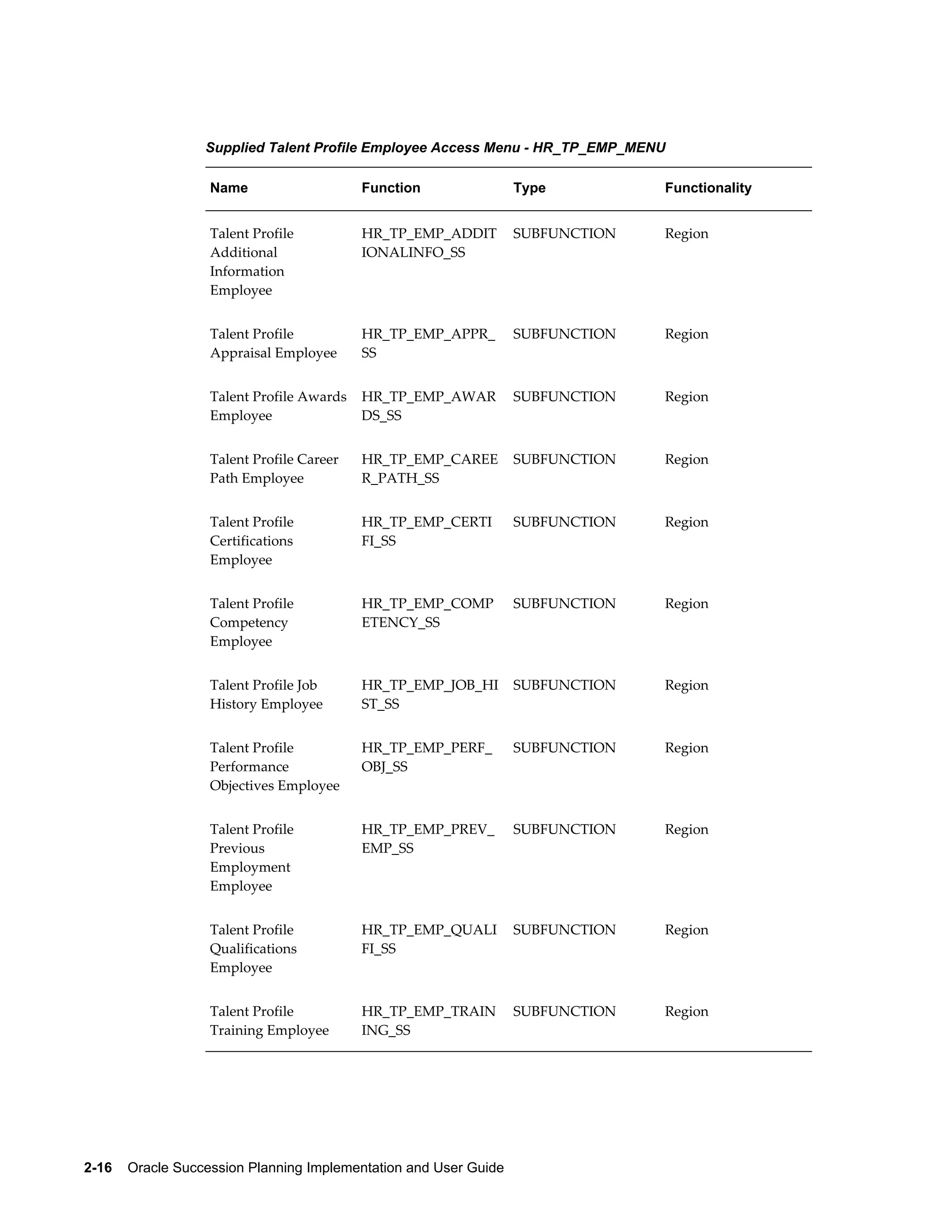
  • 81.
    Using Oracle SuccessionPlanning    3-13 Screenshot of the Qualifications Region Click the More link to navigate to the Education and Qualifications page of the worker to create or update qualifications. The Talent Profile page displays the updated qualifications information. For more information, see: Education and Qualifications, Oracle SSHR Deploy Self-Service Capability Guide Learning Certifications You can view the learning certification details such as the certification name, status, progress, and renew date. Screenshot of the Learning Certifications Region Click the More link to navigate to the Learner Home page of the worker. On the Learner Home page of the worker, you can view details such as additional certification details, classes that the worker has currently enrolled in, and learning paths that the worker has subscribed to. For more information, see: The Learner Home, Oracle Learning Management User Guide Training This region displays the training information of the selected worker. Details include the
  • 82.
    3-14    Oracle SuccessionPlanning Implementation and User Guide course name, course delivery method, enrollment status, and enrollment dates. You can use the Filter values to view all, completed, or upcoming training. Screenshot of the Training Region Click the More link to navigate to the Learner Home page of the worker to view additional training details. You can also enroll the worker in required training. The Talent Profile displays the updated enrollment information. For more information, see: The Learner Home, Oracle Learning Management User Guide Other Professional Qualifications You can view other professional qualifications of the worker such as an award. This region does not display academic qualifications, which are displayed in the Qualifications region. Screenshot of the Other Professional Qualifications Region Click the More link to navigate to the Other Professional Qualifications page to add new professional qualifications or update existing professional qualifications. The
  • 83.
    Using Oracle SuccessionPlanning    3-15 Talent Profile displays the updated professional qualifications information. For more information, see: Other Professional Qualifications, Oracle SSHR Deploy Self-Service Capability Guide Job History The Job History region displays the details of previous jobs of the selected worker in the same enterprise. You can use this information to analyze what the worker has gained from each role in terms of experience, skills, and professional development. When creating succession plans you can use the job history details to evaluate the work experience summary of the worker. Screenshot of the Job History Region This is a view only region and you cannot perform any transaction as the More link is not available. Career Path You can view the proposed career path of the selected worker from the current job level. Managers can learn where the worker is in their career. They can analyze the worker's career path and plan for suitable training to meet the future role requirements. Screenshot of the Career Path Region This is a view only region and you cannot perform any transaction as the More link is not available. Benefits You can view the benefits enrollments of the worker such as programs, plans, and options. You can also view with the benefits' coverage start date and coverage amounts.
  • 84.
    3-16    Oracle SuccessionPlanning Implementation and User Guide Screenshot of the Benefits Region Click the More link to launch the Self-Service Benefits Enrollments function. The subsequent Benefits Enrollments pages that you view depend on the configuration choices that your enterprise makes. For more information, see:Self-Service Benefits Enrollments, Oracle HRMS Compensation and Benefits Management Guide Work Preferences You can view the work preferences specified by the worker in two regions: Domestic Options and International Relocation Options. You can gather information such as whether the worker is willing to accept international travel or relocate domestically. You can also view preferred work hours and work schedule.
  • 85.
    Using Oracle SuccessionPlanning    3-17 Screenshot of the Work Preferences Region Click the More link to navigate to the Work Preferences page of the worker to add or update information. The Talent Profile page displays the updated work preferences details. For information see: Work Preferences, Oracle SSHR Deploy Self-Service Capability Guide Previous Employment This region displays the work history in previous organizations. You can view previous employment details such as the previous employer, previous employment period, and employer location. The previous employment details provide valuable inputs such as the employers that the worker has worked with. You also get an idea of the worker's experience in each industry if the worker was employed in various industries. You can evaluate how the previous roles are useful for career management and succession plans for the worker. Screenshot of the Previous Employment Region This is a view only region and you cannot perform any transaction as the More link is not available.
  • 86.
    3-18    Oracle SuccessionPlanning Implementation and User Guide Monetary Compensation You can view a graphical representation of the monetary compensation details of the worker. Monetary compensation can include components such as allowances, bonus, and salary. You can view a list of all compensation related sections (defined with a chart or graph) from the latest Total Compensation Statement (TCS). You can select any one of the values to view a graphical representation of the selected monetary compensation section. Screenshot of the Monetary Compensation Region Talent Profiles uses the Total Compensation Statement information to display the monetary compensation graph. If there is no Total Compensation statement available for the worker and a graph for cash compensation has not been included in the statement, then the application does not display any information in the Monetary Compensation region. This is a view only region and you cannot perform any transaction as the More link is not available. Succession Plans In the Succession Plan region, you can view two tables: • Successor For: This table lists the workers for whom the selected worker is identified as a successor. Information includes readiness level and the earliest succession date. • As Successor:
  • 87.
    Using Oracle SuccessionPlanning    3-19 This table lists the workers identified as the successors of the selected worker. Information includes readiness level and the earliest succession date. Screenshot of the Succession Plan Region This is a view only region and you cannot perform any transactions as the More link is not available. Other Information For your workers, you can make notes about their achievements and contributions. Click the More link to navigate to the Attachments page where you can add attachments. You can create attachments in different ways. You can attach a file, provide the location of the directory in which you saved the document, or provide a text description. Screenshot of the Other Information Region You can add tags for your workers. The tags that you add for a worker appear on that worker's Talent Profile page. Tags help group and categorize talent.
  • 88.
    3-20    Oracle SuccessionPlanning Implementation and User Guide Salary You can view details of the current salary. Details include salary rate and annualized salary. Screenshot of the Salary Region This is a view only region and you cannot perform any transactions as the More link is not available. Compensation Statement This region displays the worker's total compensation information including compensation awards and benefits. Compensation information can include monetary awards such as salary and bonus awards as well as non-monetary awards such as stock options. Benefits information can include medical and dental benefits (optionally showing the cost to your organization). Screenshot of the Compensation Statement Region This is a view only region and you cannot perform any transactions as the More link is not available.
  • 89.
    Using Oracle SuccessionPlanning    3-21 Performance Ratings The application hides this region by default. Your enterprise can display this region, if you use Oracle HRMS to rate performance. HR Managers can enter performance of their workers using the Performance window in Oracle HRMS. The Performance Ratings region displays the information that HR managers enter in Oracle HRMS. You can view details such as the main appraiser and rating. Screenshot of the Performance Ratings Region Note: If your enterprise uses Oracle Performance Management to evaluate workforce performance, then your enterprise can hide the Performance Ratings region . In this case, use Appraisals region to view performance ratings. Click the More link to navigate to the My Employee Information page. This page enables managers to view employment, salary, performance, absence, and other related details of people within their security access. Perform Talent Actions You can: View Performance Matrix (9 - Box) On the Talent Profile page of the selected worker, you can view the performance profile using Performance Matrix (9 - Box). Performance Matrix displays performance profile of the worker using the following matrices: • Performance vs. Potential: Provides information on the performance and leadership potential of a worker. You can view the Performance rating on the horizontal x-axis on a scale of 1 to 3 and the Potential rating on the vertical y-axis on a scale of 1 to 3. • Performance vs. Retention: Provides information on a worker's performance and risk of loss. You can view the Performance rating on the horizontal x-axis on a scale of 1 to 3 and the Retention rating on the vertical y-axis on a scale of 1 to 3.
  • 90.
    3-22    Oracle SuccessionPlanning Implementation and User Guide Important: The values that you view on the Performance Matrix are the values that your enterprise defines for performance, potential, and retention rating scales. For example, your enterprise can define the following rating scales for performance, potential, and retention: Performance • 1: Needs Indicates that the performance is significantly below the required level. • 2: Meets Indicates that the performance is good and in-line with job requirements. • 3: Exceeds Indicates that the worker has exceeded the required level of performance. Potential • 1: Limited Indicates that the worker shows little or no potential to move to the next work level. • 2: Growth Indicates that the worker shows potential to advance to the next or higher work level. • 3: High Indicates that the worker has requisite skills and expertise and exhibits leadership qualities. Retention • 1: Low Indicates that the risk of losing the worker is high. • 2: Medium Indicates that the risk of losing the worker is moderate. • 3: High
  • 91.
    Using Oracle SuccessionPlanning    3-23 Indicates that the risk of losing the worker is minimal. You can use performance matrices information for succession planning. To view the performance profile of workers in your hierarchy, select Performance Matrix (Potential) and Performance Matrix (Retention) in the Select an Action list and click Go. See: Using Performance Matrix (Potential) and Performance Matrix (Retention), page 3- 39 Note: Enterprises require Oracle Succession Planning license to view the performance profile of workers in a manager's hierarchy. Compare Profile Enterprises require Oracle Succession Planning license to compare talent profiles of workers. Use this feature to compare talent profiles of workers. Select Compare Profile in the Select an Action list and click Go. The selected worker's name appears in the Profile Comparison tabbed region. To select another worker to compare profiles, you can either navigate to the hierarchy list on your Talent Profile page or select a worker using the quick search feature. Click the Add to Compare button to add required workers to the compare profile list. Select the workers and then choose the appropriate compare profile template to generate the Compare Profile report. You can view a profile comparison of the selected workers for multiple criteria such as qualifications, competency profile, appraisal ratings, work preferences, and compensation. The Compare Profile report displays the workers performance and potential and performance and retention matrices using the 9-Box representation. See: Comparing Talent Profiles, page 3-47 Print Talent Profile Managers can print a worker's talent profile. Select Printable Profile in the Select an Action list and click Go. Then, click Generate Report to generate the talent report. The printable profile is a PDF document. You can view the profile of the selected worker for multiple criteria such as competency profile, appraisal ratings, and compensation. The profile report displays the workers's performance and potential matrix that helps evaluate talent. The performance and retention matrix helps to understand correlation between performance and possibility of the worker's separation from the enterprise. Managers have the flexibility to print required talent profile regions. See: Generating Talent Profiles, page 3-36
  • 92.
    3-24    Oracle SuccessionPlanning Implementation and User Guide Perform Self-Service Actions The Select an Action list displays the list of actions that you can perform as a manager for the selected worker. For example, you can perform self-service actions such as transfers, change manager, change worker status, and manage absences. Note: Your enterprise configures the self-service actions that a manager can perform. Using Talent Profile as Workers As a worker, when you navigate to the Talent Profile page, the page displays your talent information. On this page, you can: • View employment details • View talent information presented in different regions • Perform self-service actions • Print your talent profile View Employment Details You can view employment details such as the organization, job, position, supervisor, and the hire date. The contact details include address, phone numbers, and e-mail address. You can also view your photograph, if available. You can view tags added to your profile and you can also add tags. View Talent Information Presented in Different Regions This section lists the talent regions that you can view on your Talent Profile page: Note: Your enterprise may display all the regions or hide some of the regions according to the business needs and processes. • Competencies • Appraisals • Performance Objectives • Qualifications
  • 93.
    Using Oracle SuccessionPlanning    3-25 • Learning Certifications • Training • Other Professional Qualifications • Job History • Career Path • Benefits • Work Preferences • Previous Employment • Monetary Compensation • Other Information • Salary • Compensation Statement • Performance Ratings Competencies The Competencies region displays your current competencies. You can view the level and status of the competencies.
  • 94.
    3-26    Oracle SuccessionPlanning Implementation and User Guide Screenshot of the Competencies Region Click the More link to navigate to the Competency Profile page to view or update the existing competency profile. When you update or add competencies, the updated information is visible on the Talent Profile page. For more information, see: Competency Profile, Oracle SSHR Deploy Self-Service Capability Guide Appraisals The Appraisals region displays the appraisal information using a bar graph. The bar graph is a column chart where the x-axis shows the appraisal period end date and the y-axis shows your appraisal rating and the total rating value. You can easily distinguish your appraisal and the total rating value as the bar graph uses different color codes. Talent Profile displays information only from appraisals that are given an overall rating, regardless of whether the appraisals are created using the Appraisals function or appraisals are created as part of performance management plans. The bar graph displays information for five appraisals. Note: Talent Profile does not display information from self appraisals.
  • 95.
    Using Oracle SuccessionPlanning    3-27 Screenshot of the Appraisals Region Click the More link to navigate to the My Appraisals page to view or update your appraisals. The Appraisal Process, Oracle Performance Management Implementation and User Guide Performance Objectives You can view objectives for a specific performance management plan. By default, the Plan Name field displays the latest published performance management plan. The Performance Objectives region displays the plan name, plan period, objectives, and objective start and end date. The Complete % field helps you to track the progress of your performance objectives. Screenshot of the Performance Objectives Region
  • 96.
    3-28    Oracle SuccessionPlanning Implementation and User Guide Click the More link to navigate to the Performance Management page to view your Performance Management Task List. The tasks are those appropriate to the performance management plan (PMP) and can vary from one PMP to another. The application enables these tasks at appropriate times during the performance-management period. For example, you can perform the appraisal-management task during the appraisal-task period only. For more information, see: Worker Performance-Management Tasks, Oracle Performance Management Implementation and User Guide Qualifications The Qualifications region displays your education qualification information such as qualification type, title and status. Screenshot of the Qualifications Region Click the More link to navigate to the Education and Qualifications page to create or update qualifications. The Talent Profile page displays the updated qualifications information. For more information, see: Education and Qualifications, Oracle SSHR Deploy Self-Service Capability Guide Learning Certifications You can view the learning certification details such as the certification name, status, progress, and renew date.
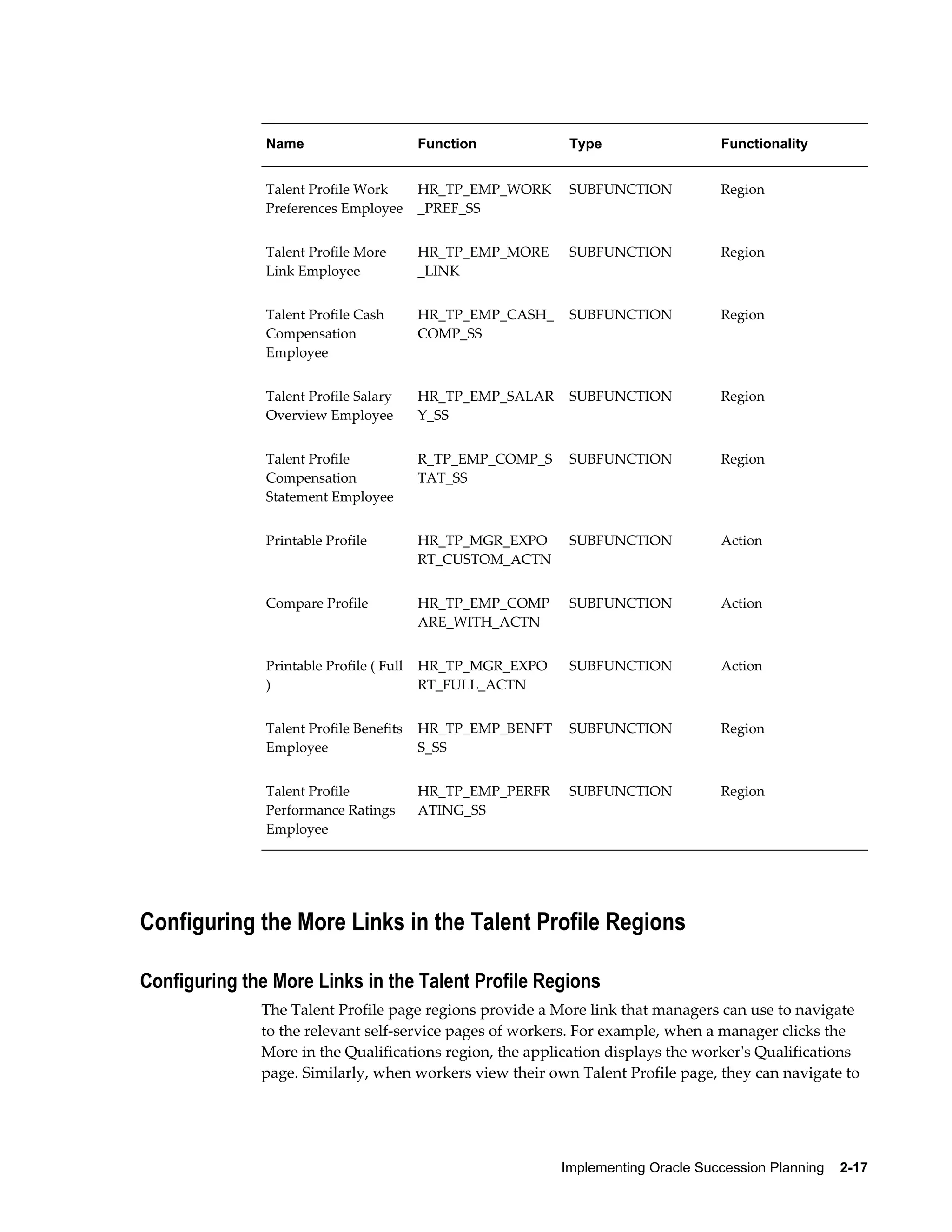
  • 97.
    Using Oracle SuccessionPlanning    3-29 Screenshot of the Learning Certifications Region Click the More link to navigate to the Learner Home page to view additional certification details. On the Learner Home page, you can view classes that you are currently enrolled in, view learning certifications and learning paths that you have subscribed to, track the status of pending enrollments, and communicate with instructors and other learners using forums and chats. For more information, see: The Learner Home, Oracle Learning Management User Guide Training This region displays your training information. Details include course name, course delivery method, enrollment status and enrollment status, and enrollment dates. You can use the Filter values to see all, completed, or upcoming training. Screenshot of the Training Region
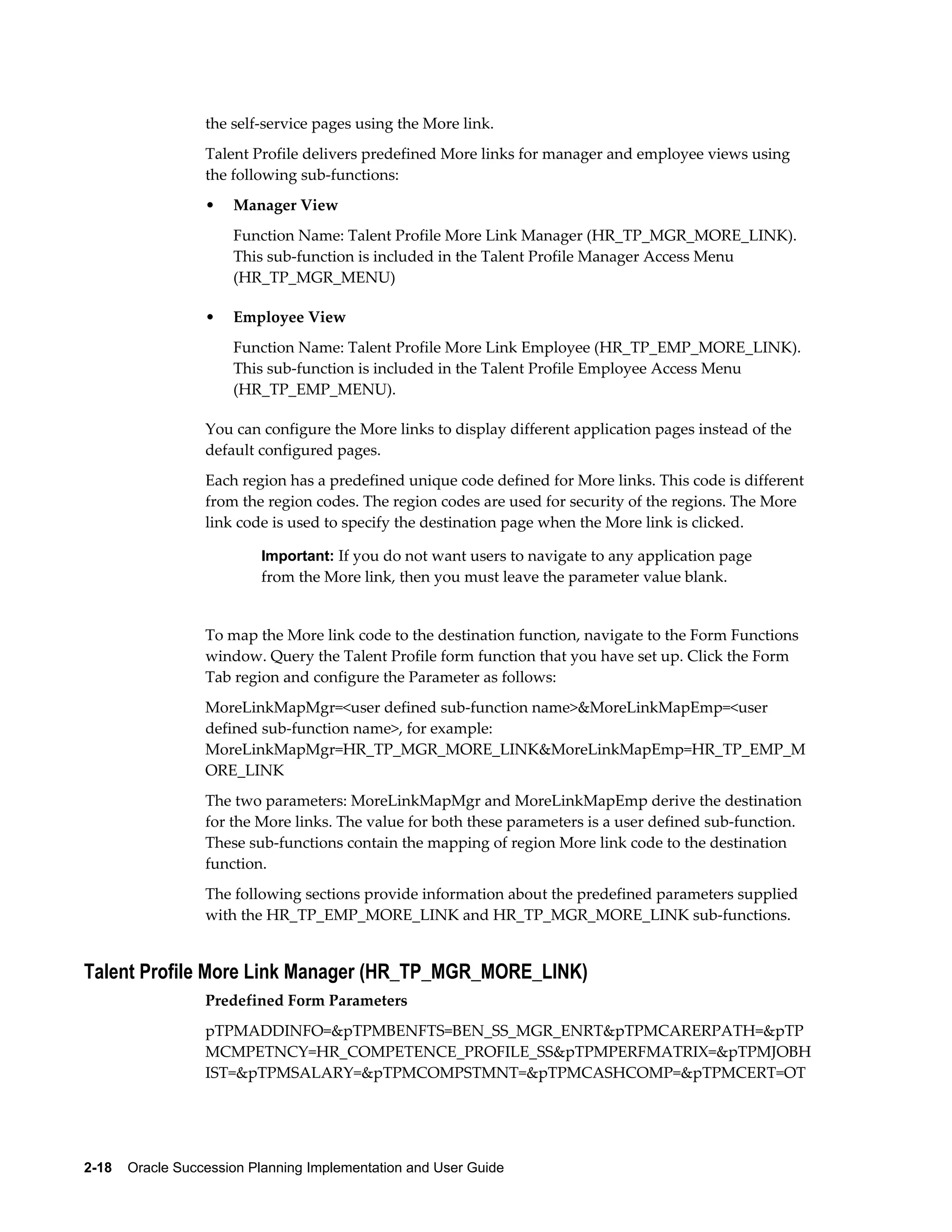
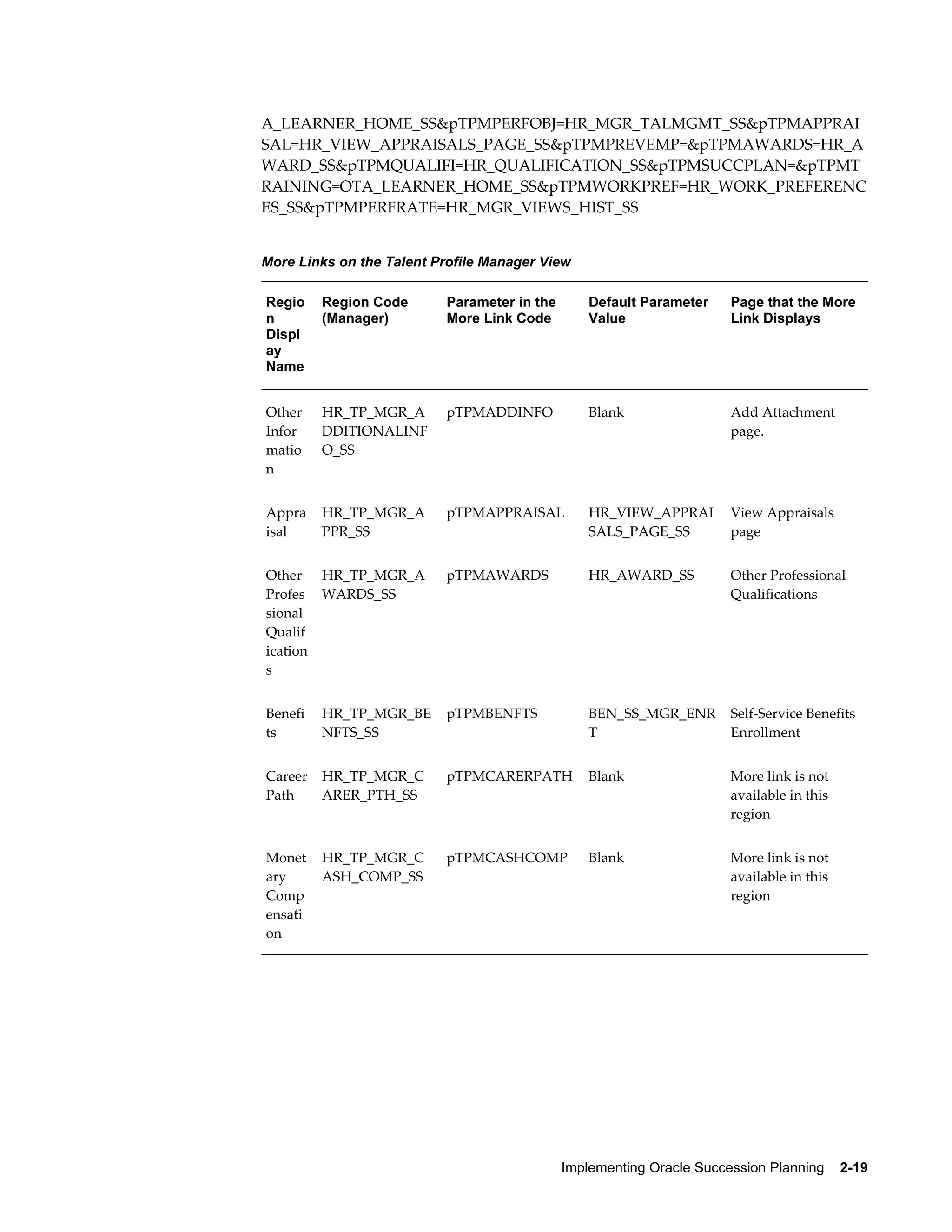
  • 98.
    3-30    Oracle SuccessionPlanning Implementation and User Guide Click the More link to navigate to the Learner Home page to view additional training details. Use the Catalog page to browse categories, search for and enroll in courses, or request enrollment from an approver. After you enroll in training, the Talent Profile page displays the updated information. For more information, see: The Learner Home, Oracle Learning Management User Guide Other Professional Qualifications You can view other professional qualifications such as an award. This region does not display academic qualifications, which are displayed in the Qualifications region. Screenshot of the Other Professional Qualifications Region Click the More link to navigate to the Other Professional Qualifications page to add new professional qualifications or update existing professional qualifications. The Talent Profile page displays the updated information. For more information, see: Other Professional Qualifications, Oracle SSHR Deploy Self-Service Capability Guide Job History The Job History region displays the details of your previous jobs in the same enterprise. You can use this information to review each role in terms of experience, skills, and professional development. Screenshot of the Job History Region This is a view only region and you cannot perform any transactions as the More link is not available.
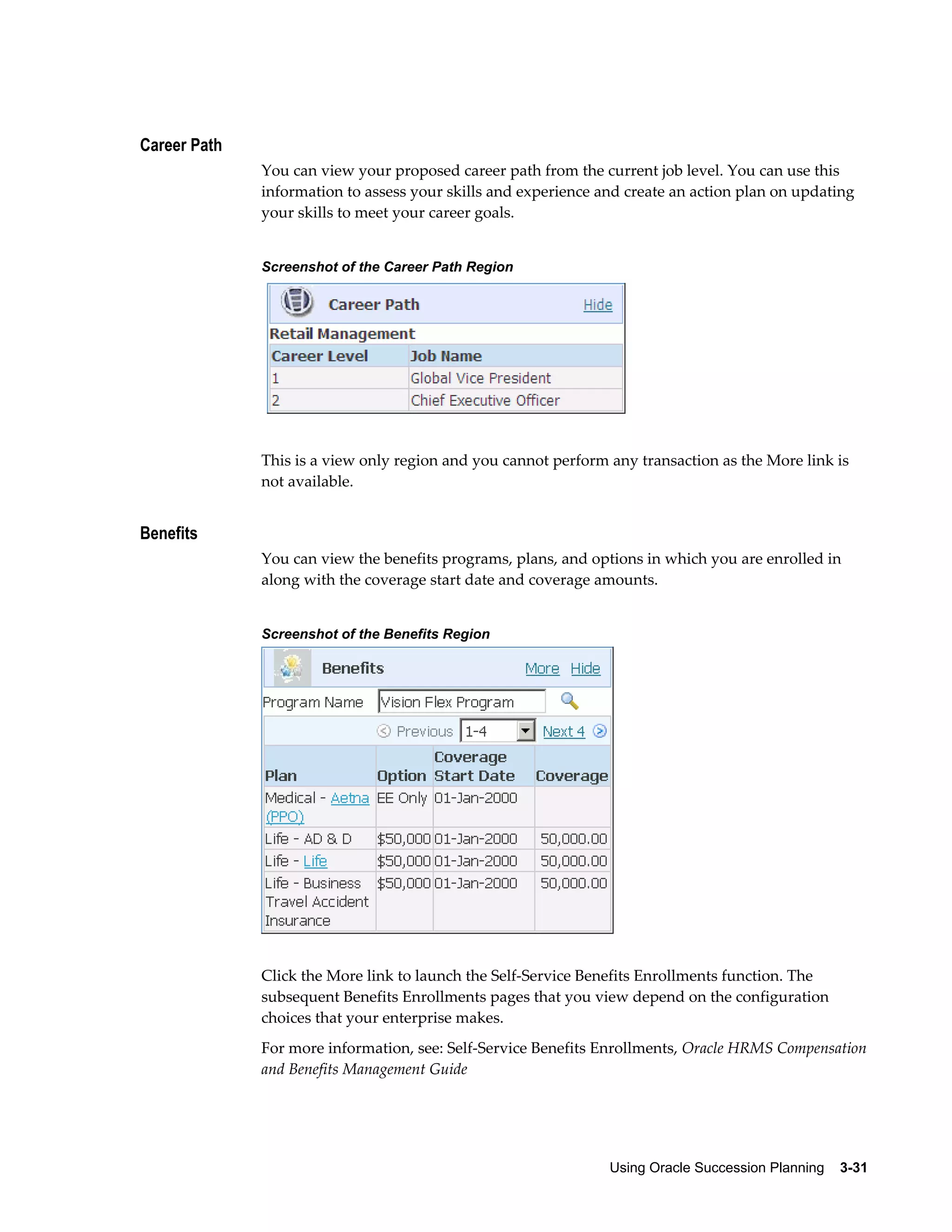
  • 99.
    Using Oracle SuccessionPlanning    3-31 Career Path You can view your proposed career path from the current job level. You can use this information to assess your skills and experience and create an action plan on updating your skills to meet your career goals. Screenshot of the Career Path Region This is a view only region and you cannot perform any transaction as the More link is not available. Benefits You can view the benefits programs, plans, and options in which you are enrolled in along with the coverage start date and coverage amounts. Screenshot of the Benefits Region Click the More link to launch the Self-Service Benefits Enrollments function. The subsequent Benefits Enrollments pages that you view depend on the configuration choices that your enterprise makes. For more information, see: Self-Service Benefits Enrollments, Oracle HRMS Compensation and Benefits Management Guide
  • 100.
    3-32    Oracle SuccessionPlanning Implementation and User Guide Work Preferences You can view your work preferences in two regions: Domestic Options and International Relocation Options. Screenshot of the Work Preferences Region Click the More link to navigate to the Work Preferences page of to add or update your work preferences information. The Talent Profile page displays the updated work preferences details. For more information, see: Work Preferences, Oracle SSHR Deploy Self-Service Capability Guide Previous Employment This region displays previous employment details such as the previous employer, previous employment period, and employer location. Screenshot of the Previous Employment Region This is a view only region and you cannot perform any transaction as the More link is not available.
  • 101.
    Using Oracle SuccessionPlanning    3-33 Monetary Compensation You can view a graphical representation of your monetary compensation details. Monetary compensation can include components such as allowances, bonus, and salary. You can view a list of all compensation related sections (defined with a chart or graph) from the latest Total Compensation Statement (TCS). You can select any one of the values to view a graphical representation of the selected monetary compensation section. Screenshot of the Monetary Compensation Region Talent Profiles uses the Total Compensation Statement information to display the monetary compensation graph. If there is no Total Compensation statement available or a graph for cash compensation has not been included in the statement, then the application does not display any information in the Monetary Compensation region. Click the More link to navigate to the Total Compensation Statement page and view details. Other Information Use the Notes feature to add any information about your talent profile, for example, your achievements and contributions. Click the More link to navigate to the Attachments page where you can add attachments. You can attach a file, provide the location of the directory in which you saved the document, or provide a text description.
  • 102.
    3-34    Oracle SuccessionPlanning Implementation and User Guide Screenshot of the Other Information Region Salary You can view details of your current salary. Details include salary rate and annualized salary. Screenshot of the Salary Region Compensation Statement This region displays your total compensation information including compensation awards and benefits. Compensation information can include monetary awards such as salary and bonus awards as well as non-monetary awards such as stock options. Benefits information can include medical and dental benefits (optionally showing the cost to your organization).
  • 103.
    Using Oracle SuccessionPlanning    3-35 Screenshot of the Compensation Statement Region Click the More link to navigate to the Total Compensation Statement page and view details. Performance Ratings By default, this region is hidden on the Talent Profile page. If your enterprise uses Oracle HRMS to record performance ratings, then your enterprise can display this region. Using the Performance window in Oracle HRMS, HR managers can enter the performance ratings of their workers. The Talent Profile's Performance Ratings region displays the information that HR managers enter in Oracle HRMS. You can view details such as the main appraiser and rating. Screenshot of the Performance Ratings Region Note: If your enterprise uses Oracle Performance Management to evaluate workforce performance, then your enterprise can hide the Performance Ratings region. In this case, use Appraisals region to view performance ratings.
  • 104.
    3-36    Oracle SuccessionPlanning Implementation and User Guide Click the More link to navigate to the My Information page that displays details such as salary, performance, and absence. Perform Self-Service Actions The Select an Action list displays the list of actions that you can perform. For example, perform self-service actions such as manage payroll payments, create absence, or update your resume. Note: Your enterprise configures the self-service actions that you can perform. Print Talent Profile You can print your talent profile, if the Printable Profile option is available in the Select an Action list. Select the option and click Go. On the Talent Profile page, the Include in Report check box is selected by default in all the talent regions. You can choose to print selected talent regions. When you click Generate Report, the application displays a printable profile in the Adobe Acrobat PDF format. Generating Printable Profiles Managers can print the talent profile of workers when they view the profile of workers in their hierarchy. Individual workers can also print their own talent profiles. When you select the Printable Profile option as a worker or manager, and click Go, the printable version page appears. On this page, the Include in Report check box is automatically selected for all the talent information regions. You can select only the required regions and click Generate Report. The application generates a printable profile in the Adobe Acrobat PDF format. Contents of the Printable Profile The talent profile information that managers and workers view differs. Only managers can view the following information for their workers: • Succession Plan • Performance Matrix (Potential) • Performance Matrix (Retention) The talent profile PDF displays information for multiple criteria such as competency profile, work preferences, and compensation. You can view a graphical representation of the appraisal ratings and the cash compensation. The report includes certification details, job history and salary information of your employees. You can also view the
  • 105.
    Using Oracle SuccessionPlanning    3-37 compensation statement and training details. Note: The Printable Profile report displays only those regions that have data. For example, if no data is available for Appraisals, then this region does not appear in the report. Viewing Performance Matrix (Potential) and Performance Matrix (Retention) Managers can view the performance profile of workers using the following matrices: Enterprises require Oracle Succession Planning license to view the performance profile of workers in a manager's hierarchy. • Performance Matrix (Potential): Provides information on performance and leadership potential of a worker on a rating scale of 1 to 3. • Performance Matrix (Retention): Provides information on a worker's performance and risk of loss on a rating scale of 1 to 3. Important: The values that you view on the Performance Matrix are the values that your enterprise defines for performance, potential, and retention rating scales. For example, your enterprise can define the following rating scales for performance, potential, and retention: Performance • 1: Needs Indicates that the performance is significantly below the required level. • 2: Meets Indicates that the performance is good and in-line with job requirements. • 3: Exceeds Indicates that the worker has exceeded the required level of performance. Potential • 1: Limited Indicates that the worker shows little or no potential to move to the next work level.
  • 106.
    3-38    Oracle SuccessionPlanning Implementation and User Guide • 2: Growth Indicates that the worker shows potential to advance to the next or higher work level. • 3: High Indicates that the worker has requisite skills and expertise and exhibits leadership qualities. Retention • 1: Low Indicates that the risk of losing the worker is high. • 2: Medium Indicates that the risk of losing the worker is moderate. • 3: High Indicates that the risk of losing the worker is minimal. The performance matrices enable you to quickly identify both the highest potential performers and the skills sets of the talent pool. You can use this information for career and succession planning.
  • 107.
    Using Oracle SuccessionPlanning    3-39 Assessing Workforce Talent Using Performance Matrix (Potential) and Performance Matrix (Retention) Oracle Succession Planning's performance matrices: Performance Matrix (Potential) and Performance Matrix (Retention), provide insight into the depth and breadth of the talent pool in the enterprise. • See: Using Performance Matrix (Potential), page 3-39 • See: Using Performance Matrix (Retention), page 3-43 Using Performance Matrix (Potential) The Performance Matrix (Potential) enables enterprises to assess their workforce talent and evaluate the talent pool. As a manager, you can use this matrix to assess performance and leadership potential for effective succession planning. The Performance Matrix (Potential) page displays information for all the direct reports of a manager in the supervisor hierarchy. You have the flexibility to view the performance matrix for required workers. You can zoom in and zoom out as required.
  • 108.
    3-40    Oracle SuccessionPlanning Implementation and User Guide What the Performance Matrix (Potential) Represents Screenshot of Performance Matrix (Potential) Performance Matrix (Potential) is divided into nine boxes. Each box represents the level or scale of performance and potential. Note: The performance and potential rating scales that you view on the matrix are configurable and depend on the ratings scales defined by the enterprise. Assess Performance Use the horizontal x-axis to assess the performance of workers. The matrix plots performance on a scale of 1 to 3. Assess Potential Use the vertical y-axis to assess the potential of workers. The matrix plots potential on a scale of 1 to 3. A combination of x and y axes makes up the box within the grid that workers are placed on. Typically, workers in the top right box will be the high performers with the greatest potential, and those in the bottom left box will be the lowest performers with the least potential. The other boxes will display workers who are performing and displaying potential to varying degrees.
  • 109.
    Using Oracle SuccessionPlanning    3-41 Assessing Performance and Potential Performance Matrix (Potential) uses information from the following products to assess performance and potential: • Performance If your enterprise uses Oracle Performance Management, then the application derives the Performance value from the Overrall Rating field on the Give Final Ratings: Main Appraiser page of the Appraisals function. Otherwise, the Performance value is derived from the Performance window in Oracle HRMS. • Potential If your enterprise uses Oracle Performance Management, then the application derives the Potential value from the Readiness Level field in the Advancement Potential region on the Give Final Ratings: Main Appraiser page of the Appraisals function. Otherwise, the Potential value is derived from the Succession Potential field of the Succession Plans feature. Understanding Performance Matrix (Potential) This diagram shows the Performance Matrix (Potential) for workers who report to Steven Bird, starting with Blair Smith who is placed on the Exceeds Performance/High Potential grid
  • 110.
    3-42    Oracle SuccessionPlanning Implementation and User Guide This examples uses the following rating scales: Performance • 1: Needs Indicates that the performance is significantly below the required level. • 2: Meets Indicates that the performance is good and in-line with job requirements. • 3: Exceeds Indicates that the worker has exceeded the required level of performance. Potential • 1: Limited Indicates that the worker shows little or no potential to move to the next work level. • 2: Growth Indicates that the worker shows potential to advance to the next or higher work level. • 3: High Indicates that the worker has requisite skills and expertise and exhibits leadership
  • 111.
    Using Oracle SuccessionPlanning    3-43 qualities. The following section describes where some of the workers are placed in the Performance Matrix (Potential): • Blair Smith Indicates that Blair exceeds the required performance level and has high potential. • Terry Burns Indicates that Terry exceeds the required performance level and has moderate growth potential. • Kate Ritz Indicates that Kate exceeds the required performance level and has limited potential. Based on the analysis of the performance and potential of workers, Steven Bird can plan relevant career and succession planning actions. For example, Steve can allocate critical assignments to Blair Smith who is a high performer and has high potential. Performance improvement action plans can be implemented for average performers. Benefits of Performance Matrix (Potential) The Performance Matrix (Potential): • Provides performance and potential details of the workforce in a clear and intuitive manner. • Helps managers to determine the potential and job fit of workers. • Helps enterprises identify potential internal top performers for future positions. • Facilitates managers to make informed decision about career and succession planning for their workers. Using Performance Matrix (Retention) Employee retention, especially of the best and top performing workers is a key challenge that enterprises face. Turnover costs can significantly affect the financial performance of enterprises. Direct costs include recruitment, selection, and training of new people. High turnover can increase workload and overtime expenses for coworkers. For an enterprise to develop a retention strategy for their talented workforce and use it for succession planning, they must assess the retention prospects of their workforce along with their performance. Managers require tools to:
  • 112.
    3-44    Oracle SuccessionPlanning Implementation and User Guide • Examine the number of workers who will continue to remain in the enterprise or likely to move out of the enterprise. • Analyze the connection between performance and retention prospects. Performance Matrix (Retention) enables enterprises to assess their workforce performance and prospects of retention of workers. This matrix provides managers a visual representation of who their top talent is and who is likely to leave the enterprise. This information is vital for effective succession planning. Assessing Performance and Retention Screenshot of Performance Matrix (Retention) Performance Matrix (Retention) uses information from the following products to assess performance and potential: • Performance If your enterprise uses Oracle Performance Management, then the application derives the Performance value from the Overrall Rating field on the Give Final Ratings: Main Appraiser page of the Appraisals function. Otherwise, the Performance value is derived from the Performance window in Oracle HRMS. • Retention If your enterprise uses Oracle Performance Management, then the application derives the Retention value from the Retention Level field in the Advancement Potential region on the Give Final Ratings: Main Appraiser page of the Appraisals function. Otherwise, the Retention value is derived from the Retention Potential
  • 113.
    Using Oracle SuccessionPlanning    3-45 field of the Succession Plans feature. What Performance Matrix (Retention) Represents? Performance Matrix (Retention) is divided into nine boxes. Each box represents the level or scale of performance and retention. Note: The performance and retention rating scales that you view on the matrix are configurable and depend on the ratings scales defined by the enterprise. Assess Performance Use the horizontal x-axis to assess the performance of workers. The matrix plots performance on a scale of 1 to 3. Assess Retention Use the vertical y-axis to understand the retention prospect of workers. The matrix plots retention on a scale of 1 to 3. A combination of x and y axes makes up the box within the grid that workers are placed on. Typically, workers in the top right box will be the high performers with a high prospect of retention, and those in the bottom left box will be the lowest performers with low retention prospects. The other boxes will display workers who are performing and have retention prospects to varying degrees. Understanding Performance Matrix (Retention) This diagram shows the Performance Matrix (Retention) for workers who report to Mike Connors starting with Nick Reeve who is placed on the Exceeds Performance/High Retention grid
  • 114.
    3-46    Oracle SuccessionPlanning Implementation and User Guide This examples uses the following rating scales: Performance • 1: Needs Indicates that the performance is significantly below the required level. • 2: Meets Indicates that the performance is good and in-line with job requirements. • 3: Exceeds Indicates that the worker has exceeded the required level of performance. Retention • 1: Low Indicates that the risk of losing the worker is high. • 2: Medium Indicates that the risk of losing the worker is moderate. • 3: High Indicates that the risk of losing the worker is minimal.
  • 115.
    Using Oracle SuccessionPlanning    3-47 The following section describes where some of the workers are placed in the Performance Matrix (Retention): • Nick Reeve Indicates that Nick is a high performer and has high retention prospects. • Geoff Murray Indicates that Terry is a high performer and has moderate retention prospects. • Ray Bradley Indicates that Kate is a high performer and has low retention prospects. Based on the analysis of the performance and retention prospects of workers in his hierarchy, Mike Connors can plan relevant career and succession planning actions. For example, Mike can allocate critical assignments to Nick Reeve who is a high performer and has high retention potential. Enterprises can implement workforce retention strategies such as plan succession options, create better reward systems, and increase employee engagement to retain good performers with low retention prospects. Benefits of Performance Matrix (Retention) The Performance Matrix (Retention): • Provides details of performance and retention prospects of the workforce in a clear and intuitive manner. • Helps enterprises to identify potential internal top performers who have high retention prospect for future positions. • Facilitates analysis of retention and turnover strategies of the enterprise. For example, managers can use the matrix information and develop retention strategies and reward systems that increase employee involvement, and promote development, recognition, and advancement of the workforce. Comparing Talent Profiles Talent Profile enables comparison of talent profiles of your workers. By default, you can compare the talent profiles of two or three workers. Note: Your system administrator can make available templates to compare talent profiles of required number of workers according to your business requirements.
  • 116.
    3-48    Oracle SuccessionPlanning Implementation and User Guide Generating the Compare Profile Report As a manager, when you select Compare Profile in the Select Actions list and click Go, the selected worker's name automatically appears in the Profile Comparison tabbed region. To select another worker, you can either search using the Name field and click Show Profile or select a worker in the hierarchy list on the manager's Talent Profile page. Click the Add to Compare button to add the worker to the compare profile list. You must repeat this process to select the required number of workers to add to the compare list. For each of the regions, the Include in Report is automatically selected. You can choose to compare all the talent profile regions or select only the required regions. Then, select the workers whose profile you want to compare, and click Compare. The Comparison PDF window opens. You can either save the PDF report to your local machine or view the report directly. You can use the compare profile report to analyze and plan succession options for your workers. Contents of the Compare Profile Report Note: The Compare Profile report displays only those regions that have data. You can view the profile comparison data of the selected workers for multiple criteria such as competency profile, appraisal ratings, and compensation. You can view a graphical representation of the appraisal ratings and the cash compensation. The report includes certification details, job history, and salary information of your workers. You can also view the compensation statement and training details. Viewing Performance Matrix (Potential) and Performance Matrix (Retention) Managers can view the performance profile of workers using the following matrices: • Performance Matrix (Potential): Provides information on performance and leadership potential of a worker on a rating scale of 1 to 3. • Performance Matrix (Retention): Provides information on a worker's performance and risk of loss on a rating scale of 1 to 3. Important: The values that you view on the Performance Matrix are the values that your enterprise defines for performance, potential, and retention rating scales. For example, your enterprise can define the following rating scales for performance, potential, and retention: Performance
  • 117.
    Using Oracle SuccessionPlanning    3-49 • 1: Needs Indicates that the performance is significantly below the required level. • 2: Meets Indicates that the performance is good and in-line with job requirements. • 3: Exceeds Indicates that the worker has exceeded the required level of performance. Potential • 1: Limited Indicates that the worker shows little or no potential to move to the next work level. • 2: Growth Indicates that the worker shows potential to advance to the next or higher work level. • 3: High Indicates that the worker has requisite skills and expertise and exhibits leadership qualities. Retention • 1: Low Indicates that the risk of losing the worker is high. • 2: Medium Indicates that the risk of losing the worker is moderate. • 3: High Indicates that the risk of losing the worker is minimal. The performance matrices enable you to quickly identify both the highest potential performers and risk of loss of your talent pool. You can use this information for career and succession planning. See: Using Performance Matrix (Potential) and Performance Matrix (Retention), page 3- 39
  • 118.
    3-50    Oracle SuccessionPlanning Implementation and User Guide Using Suitability Matching in Oracle Succession Planning The Suitability Matching function provides a range of competency-based methods for finding the right person for a work opportunity or finding the right work opportunity for a person. Managers and HR professionals can compare employees, applicants, and contingent workers by role, job, and position, and employees can find work opportunities that fit their competencies. Suitability Matching Options Available to Managers The Suitability Matching page for managers displays two regions: • Find a Person for a Work Opportunity Using the options available in this region, managers can: • Find employees, contingent workers, and applicants who fit the competency profile for a job, position, department, vacancy, or some combination of these criteria. • Find employees, contingent workers, and applicants who match a list of competencies that the managers specify. • Compare the competencies of employees and contingent workers who currently occupy a specified job or position in a department or any department within the business group. • Compare anyone who has applied for a vacant job or position in a department or any department within the business group. In addition to these options, HR Professionals can use the Compare Named Successors for a Position option. • Find a Work Opportunity for a Person Using the options available in this region, managers can: • Find work opportunities for an individual who fits the competency profile for one or more jobs, positions, departments, vacancies, or some combination of these criteria. • Find work opportunities for an individual employee or contingent worker who matches a list of competencies that the managers specify. On the Find suitable successors for Worker : Suitable People page, a pop-up window displays details of workers such as contact and employment, when managers place the mouse over a worker name in the following tables:
  • 119.
    Using Oracle SuccessionPlanning    3-51 • Matches All Essential and Desirable Competencies • Matches All Essential Competencies • Matches All Desirable Competencies • Matches Some or No Essential or Desirable Competencies • Compare an applicant's competency profile with the competency profiles of existing vacancies. • Compare, by competency, an employee's or contingent worker's current assignments. In addition to these options, HR Professionals can use the Compare Succession option. Using the Suitability Analyzer When managers perform competency-based search while creating succession plans, they can use Suitability Analyzer to compare competencies of workers. The Suitability Analyzer tool appears when you click the Suitability Analyzer button on the Find suitable successors for Worker: Select Competencies page to compare worker competencies. The competencies that you view on this page are the competencies of the worker for whom you are creating a succession plan. See: Using the Suitability Analyzer, page 3-51 Using the Suitability Analyzer The Suitability Analyzer displays competency ratings of workers in a graphical format. As a manager, you can use the Suitability Analyzer to compare competencies of workers for succession planning. The Suitability Analyzer tool appears when you click the Suitability Analyzer button on the Find suitable successors for Worker: Select Competencies page to compare worker competencies. The competencies that you view on this page are the competencies of the worker for whom you want to create a succession plan.
  • 120.
    3-52    Oracle SuccessionPlanning Implementation and User Guide Suitability Analyzer Regions Screenshot of Suitability Analyzer The Suitability Analyzer presents the following regions: Competencies: Essential and Desired The list of workers that you view in this region are the workers displayed on the Suitability Matching, Find suitable successors for Worker: Suitable People page. This region identifies workers who: • Meet all essential and desirable competency requirements • Meet all essential competency requirements • Meet all desirable competency requirements • Meet some or no essential or desirable competency requirements You can select the required workers to view their competency information. Graphical Format Suitability Analyzer displays competencies in a graphical format. The graphical format is dynamic and the shape depends on the number of competencies that you select to view data. Suitability Analyzer uses the number of competencies that you select to display a geometric shape such as a triangle, pentagon, hexagon, or heptagon. For example, if you select 5 competencies, then Suitability Analyzer displays the pentagon
  • 121.
    Using Oracle SuccessionPlanning    3-53 geometric shape. Similarly, if you select 3 competencies, the application displays the triangle geometric shape. Graphical Representation of Competency Ratings Suitability Analyzer uses the minimum and maximum competency levels defined across all the selected competencies to display the competency levels as lines in the graph. For example, if the minimum rating level is 1 and the maximum rating level is 5, then you can view 5 lines representing the rating levels. Suitability Analyzer uses different colors to display the competency ratings of multiple workers and you can easily distinguish the different competency ratings of workers. Criteria and Competencies Criteria Region Use the Criteria region to search for suitable successors for workers. Suitability Analyzer searches for workers who meet the competency requirements in: • Business Groups • Departments • Jobs • Positions • Vacancies Competencies Region The Competencies region on the Suitability Analyzer displays the competencies that you select in the Suitability Matching, Find Suitable Successors for Worker: Select Competencies page. Use the Suitability Analyzer to refine your search criteria and select the competencies for which you want to view data. You can combine the criteria and competencies search to identify successors who match the specific competency requirements. How to Use the Suitability Analyzer The Suitability Analyzer enables you to view competency ratings for selected workers and competencies. You can select specific workers and compare the competency ratings. The Suitability Analyzer displays the competency ratings of workers using lines of different colors. To clearly view the competency ratings of workers, you can use the Fill feature. When you hover the mouse on a point on the Suitability Analyzer, you can view the workers who are placed on that rating scale. You can also use the tool's zoom in and zoom out functionality to view the competency ratings at a particular magnification level.
  • 122.
    3-54    Oracle SuccessionPlanning Implementation and User Guide Use the reload icon to view updated information when you change the search criteria. You can reset the graph to initial view using the reset icon. Identifying Successors After you compare the competencies of workers, you can use the Identify as Successor icon to designate suitable workers as successors. Selecting Successors To select workers as successors, you must use the Select as Successor button on the Find suitable successors for Worker: Suitable People page
  • 123.
    Using Oracle SuccessionPlanning    3-55 Managing Succession Plans Succession Planning Using Talent Profile Succession planning is critical to the growth of an enterprise. Typically, succession planning involves: • Identifying key positions in your organization to ensure that succession plans are in place. • Identifying workers who are likely to vacate their current positions because of promotion, retirement, or voluntary termination. • Creating and maintaining succession plans for jobs, positions, and workers. To implement a succession planning and development process, enterprises must identify their talent pool based on the enterprise's business goals and strategies. Managers have to evaluate the performance profiles, competencies, potential, and retention prospects of their workers for succession planning. Succession Planning Using Talent Profile To identify suitable successors for workers, managers can use the following processes: • Compare talent profiles • Use competency-based search to identify successors The following diagram displays the two processes:
  • 124.
    3-56    Oracle SuccessionPlanning Implementation and User Guide The following sections explain how you can use these processes. Comparing Talent Profiles for Succession Planning As a manager, you can follow these steps to create succession plans for your workers: 1. On the Talent Profile page of a worker, select the Performance Matrix (Potential) and Performance Matrix (Retention) options to view the performance profile matrix. These matrices provide critical information on performance and potential profile and performance and retention. See: Using Performance Matrix (Potential) and Performance Matrix (Retention), page 3-39
  • 125.
    Using Oracle SuccessionPlanning    3-57 2. After you analyze the performance matrices, select the workers whose talent profiles you want to compare and generate a Compare Profile report. See: Comparing Talent Profiles, page 3-47 3. Analyze the talent profile information that Performance Matrix and Compare Profile reports provide. After evaluating performance profiles, you can create succession plans. See: Creating and Maintaining Succession Plans Using Oracle Succession Planning, page 3-59 Using the Competency-Based Search for Succession Planning As a manager, you can follow these steps to create succession plans for your workers using the Competency-Based search: 1. On the Talent Profile page of a worker, select the Compare Profile option. The Talent Profile page appears for the worker where you can view two tabbed regions: Profile Comparison and Succession Planning. 2. In the Succession Planning tabbed region, search and select the worker for whom you would like to create a succession plan. Then, select a successor and click the Create a Succession Plan button. 3. On the Create Succession Plan page, you can search for suitable successors by clicking the Show Suitable Successors button. You use the Competency based search, to search for suitable successors. You can also view the Performance Matrix (9-Box) of workers. See: Creating and Maintaining Succession Plans Using Oracle Succession Planning, page 3-59 4. The Find Suitable Successors for Worker: Select Competencies page displays the competencies of the worker for whom you are creating a succession plan. On this page, you can add competencies to find suitable successors based on competencies. You can specify which competencies are essential and which are desirable. You can also define the required proficiency levels. 5. On the Find suitable successors for Worker: Select Competencies page, you can use search for suitable successors among workers, applicants, or contingent workers. However, the application does not search applicants in iRecruitment. 6. The Suitability Matching function identifies workers who possess essential competencies separately from those who possess desirable (nonessential) competencies. When you perform the search for workers who match your competency requirements, the application identifies workers who:
  • 126.
    3-58    Oracle SuccessionPlanning Implementation and User Guide • Meet all essential and desirable competency requirements • Meet all essential competency requirements • Meet all desirable competency requirements • Meet some or no essential or desirable competency requirements If workers who match the competency requirements are found, then the Find suitable successors for Worker: Suitable People page lists workers. Click the Suitability Analyzer button to compare competencies of workers. 7. Use the Suitability Analyzer to Find Successors You use Suitability Analyzer to identify successors for workers for whom you want to create succession plans. You can perform the competency-based search using the business group, department, job, position, and vacancy filter criteria. You can select the competencies for which you want to view information. You can point to the ratings on the chart to view the competency ratings of workers. You can identify suitable workers who match the search criteria as successors. To select workers as successors, you must use the Select as Successor button on the Find suitable successors for Worker: Select Competencies page. For more information on suitability matching, see: Suitability Matching, page 3-50 Using the Succession Plans Page This topic describes how to use the Succession Plans page. For a general introduction to succession planning see: The Succession Plans Feature, page 3-2 On the Succession Plans page, you can: • Search for plans for a job, position, or an employee. • Create, update, and delete succession plans. Searching for Succession Plans You can search succession plans for applicants, employees, contingent workers, and ex-employees. You can use search criteria such as job, position, and worker to search for plans. For example, you can search for plans for the Manager job or search for plans for worker John Smith. The application provides additional search criteria, such as key role and turnover rate to search for job and position plans. You can use search criteria such as worker name, number, or key person, to search for a worker's succession plans. Use the Plan Status criteria to search for succession plans for a worker or role at a
  • 127.
    Using Oracle SuccessionPlanning    3-59 specific status. For example, you can search for succession plans at the Draft or Active status. If you do not select a status, then the search results display plans at all statuses. Some workers may have multiple succession plans. To search for multiple succession plans use the Successor search criteria. The successor for a job, position, or person is always a worker. The search results include successions plans of ex-employees who are identified as successors. You can easily identify ex-employees as the application displays an icon for terminated employees. Viewing Plan Details You can view the following information for a succession plan: • Name of the job, position, or worker. • Whether the job or position is a key role and the worker is a key person. • The time frame after which a worker is eligible to move to the new position. • The turnover rate for the role and the retention potential of a worker. • Readiness level or the date by which a worker can move to a new position. • Additional successions plan details and comments. When you move the mouse over the successor name, you can view the details of a successor such as contact and employment in a pop-up window. From the search results table, you can update or delete an existing succession plan. See: Creating and Maintaining Succession Plans Using Oracle Succession Planning, page 3-59 Creating and Maintaining Succession Plans Using Oracle Succession Planning As an HR Professional or manager, you can create and maintain succession plans for workers (employees and contingent workers). For a general introduction to succession planning, see: The Succession Plans Feature, page 3-2 The following sections describe how to create and update succession plans. Creating a Succession Plan Using the Create Succession Plan page, you can create a succession plan for a job, position, or worker, and you can add successors. You can add multiple successors to a
  • 128.
    3-60    Oracle SuccessionPlanning Implementation and User Guide plan. When creating a succession plan, you can use the following features to find suitable successors: Show Suitable Successors Feature You can search for successors by clicking the Show Suitable Successors button. This feature uses the Competency based search to search for suitable successors. Note: When you select multiple successors on the Find suitable successors for Worker: Suitable People page and click the Select as Successors button, the Rank field on the Create Succession Plan page displays a value for each of the successors. This ranking is random and is not based on workers' competencies. You can rank the successors as required. See the Creating a Succession Plan section See: • Suitability Matching, page 3-50 • Succession Planning Using Talent Profile, page 3-55 Performance Matrix The Performance Matrix enables you to assess workforce talent and evaluate talent pool. The Performance Matrix displays information for all the direct reports of a manager in the supervisor hierarchy. Performance Matrix is divided into nine boxes. Each box represents the level or scale of performance and potential. The performance and potential rating scales that you view on the matrix are configurable and depends on the ratings scales that your enterprise defines. • Assess Performance: Use the horizontal x-axis to assess the performance of workers. Performance is plotted on three scales. • Assess Potential: Use the vertical y-axis to assess the future potential. Potential is plotted on three scales. A combination of X and Y axes makes up the box within the grid that workers are placed. Typically, workers in the top right box will be the high performers with the greatest potential, and those in the bottom left box will be the lowest performers with the least potential. The other boxes will display workers who are performing and displaying
  • 129.
    Using Oracle SuccessionPlanning    3-61 potential to varying degrees. Talent Profile When creating a succession plan for a worker, you can view that worker's talent profile. You can view the worker's talent information such as competencies, qualifications, learning certifications, appraisal ratings, and performance objectives. The Talent Profile feature captures and displays complete worker talent details on a single-interface. For more information on using Talent Profile, see: Using Talent Profile as Managers, page 3-8 Creating a Succession Plan Complete these steps to create a succession plan: • Select the type of succession plan that you want to create. You can create a succession plan for a job, position, or worker. • View the talent profile of the worker for whom you want to create a succession plan. • Select the worker's successor. The worker's number automatically appears. You can select an applicant as a successor. • Select a plan status to specify at what stage the plan is at, for example, Draft or Active. • Enter a numeric value, for example 80, as the readiness percentage to indicate how ready the potential successor is to move to the identified role. • Specify the time period after which the worker is eligible to move to a new position, for example, immediately or in one month. • Enter the succession dates, such as the earliest date on which a worker can move to a new position. • Select whether the worker is eligible for a promotion. • Provide additional plan details, if required. • Add your comments on the succession plan. An Add Attachment window appears when you move the mouse over the plus icon in the Comments column. You can add text, provide a URL to a relevant document, or attach a supporting document. You can also upload attachments using the Add Attachment page that appears when you click the plus icon in the Comments column. • Rank the successors, if you identify more than one successor for a worker or role.
  • 130.
    3-62    Oracle SuccessionPlanning Implementation and User Guide If your enterprise has set up information for job, position, and worker, then the following information appears automatically on the page: • Key role and turnover rate for a role (job or position) • Key person, succession, and retention potential of a person Updating a Succession Plan You update a succession plan to modify details such as succession dates or the readiness level. You can record your comments on the update. Enroll Workers in Training Because a major goal of the succession planning process is the identification of a pool of high potential workers, a focus on leadership development and training is essential. After creating succession plans, managers can enroll workers in appropriate training to meet the succession planning requirements. Oracle Succession Planning's integration with Oracle Learning Management enables managers to identify training courses and enroll workers in the courses. To enroll a worker in training, you can navigate to that worker's Talent Profile page and use the Training region. Click the More link in the Training region to display the Learner Home page and create enrollments.
  • 131.
    Index-1   Index E EIT Employee Succession PlanningInformation, 2- 38 Job Career Management Information, 2-38 Position Career Management Information, 2- 38 EITs Succession Plans, 2-38 Extra Information Types (EITs) for Succession Plans defining, 2-30 O Oracle Succession Planning additional implementation steps, 2-7 completing configuration steps, 2-30 configuration steps, 2-7 implementing, 2-5 introduction, 1-1 Performance Matrix (Potential), 3-39 Performance Matrix (Retention), 3-43 predefined responsibility, 2-4 required implementation steps, 2-6 Succession Planning, 3-2 Suitability Analyzer, 3-51 Suitability Matching, 3-50 Supplied components, 2-4 Talent Profile, 3-5 Talent Profile menus, 2-4 Oracle Succession Planning features, 2-2 Integration with Other E-Business Products, 2- 3 licenses, 2-2 P Performance Matrix (Potential) viewing, 3-39 Performance Matrix (Potential) and Performance Matrix (Retention), 3-39 Performance Matrix (Retention) viewing, 3-43 Print Profile and Compare Profile Default XML Templates configuring, 2-30 R Rating Scale Values for Performance Matrices (9-Box) configuring, 2-31 S Succession plan creating, 3-59 updating, 3-62 view details, 3-59 Succession Planning comparing talent profiles, 3-56 using competency-based search, 3-57 Succession plans search for, 3-58 Succession Plans
  • 132.
    Index-2 creating and maintaining,3-59 Succession Plans Extra Information Types, 2-38 Succession Plans functionality setting up, 2-38 Succession Plans page using, 3-58 Suitability Analyzer enabling, 2-26 T Talent Profile 9-Box Matrix for Potential and Retention, 3-6 Appraisals region, 3-10 Benefits region, 3-15 Career Path region, 3-15 Compare profile, 3-23 Compensation Statement region, 3-20 Competencies region, 3-9 configuring actions, 2-24 configuring report templates menu, 2-27 features, 3-5 Job History region, 3-15 Learning Certifications region, 3-13 managers, 3-8 Monetary Compensation region, 3-18 Other Information region, 3-19 Other Professional Qualifications region, 3-14 Performance Objectives region, 3-11 Performance Ratings region, 3-21 personalizing, 2-35 Previous Employment region, 3-17 print, 3-6, 3-6, 3-23, 3-36 Qualifications region, 3-12 Salary region, 3-20 setting up self-service actions, 2-29 Succession Plans region, 3-18 Training region, 3-13 view, 3-5 view Performance Matrix, 3-21 view worker details, 3-8 workers, 3-24 Work Preferences region, 3-16 Talent Profile in Oracle Succession Planning configuring the More Links in the Talent Profile Regions, 2-17 setting up a custom version, 2-8 setting up the Talent Profile Form Function, 2- 9 setting up the Talent Profile Regions, 2-10 Talent Profile Quick Search and Hierarchy Regions configuring, 2-34 Talent Profile Region icons configuring, 2-35 Talent Profiles comparing, 3-47 U user statuses, 2-33