A PROJECT ON HR PRACTICES
OF
FMCG SECTOR IN INDIA

AT

SUBMITED BY:

SUBMITED TO:

Desai Madhav Ashutosh(45)

Dr. Bhavna Jaiswal

Vishesh Mehta(13)

Faculty Human Resource

Varun Banga(47)

IBS, Hyderabad.

Nitesh Raj(27)
Rishav Milind(29)
Saurav Rai(60)
INTRODUCTION OF FMCG SECTOR INDIA

The Indian FMCG sector is the fourth largest in the Indian economy and has a market size of
$13.1 billion. This industry primarily includes the production, distribution and marketing of
consumer packaged goods, that is those categories of products which are consumed at regular
intervals. The sector is growing at rapid pace with well-established distribution networks and
intense competition between the organized and unorganized segments. It has a strong and
competitive MNC presence across the entire value chain. The FMCG’s promising market
includes middle class and the rural segments of the Indian population, and give brand makers
the opportunity to convert them to branded products. It includes food and beverage, personal
care, pharmaceuticals, plastic goods, paper and stationery and household products etc.

India, Asia’s third largest economy, saw urban consumers spend less in calendar year 2012 due
to high inflation, muted salary hikes, and slowing economic growth that affected both real
wages and sentiment. During 2012, the overall slowdown in the economy has begun to affect
the FMCG sector with companies posting deceleration in volume growth in the recent quarterly
results. Discretionary spending has been hit severely due to the ongoing slowdown. The
prevailing high inflation level is also a cause of concern for the sector. The trends seen in 2012
are likely to accelerate in 2013. Growth will come from rural dwellers that are expected to see a
rise in disposable incomes due to the direct cash transfer scheme, while urban consumers will
continue to be affected by the macroeconomic environment.
HR CHALLENGES IN FMCG SECTOR INDIA
Over the past three to four years, the global economy has gone through a tumultuous change
and the looming threat of a “double dip” and “triple dip” recession. The environment that
organizations are operating in today is one characterized by volatility, uncertainty, complexity
and ambiguity. The Indian economy has also not remained insulated from the economic turmoil
that the world is going through – many industries have seen slowdown and organizational
decision-making is today marked by cautiousness. In this context, the HR profession in the
Indian context has several daunting challenges to face in the year 2013.
FMCG registered gains of just 33% on the BSE FMCG Index last year. At the macro level, Indian
economy is poised to remained buoyant and grow at more than 7%. The economic growth
would impact large proportions of the population thus leading to more money in the hands of
the consumer. Changes in demographic composition of the population and thus the market
would also continue to impact the FMCG industry.
Major HR challenges in FMCG sector India are as follow:
1. Managing Knowledge Workers
Essentially, here we are looking at different kind of people who does not obey the
principles of management for the traditional group. This boils down to higher
educational qualifications, taking up responsibilities at a lesser age and experience, high
bargaining power due to the knowledge and skills in hand, high demand for the
knowledge workers, and techno suaveness. The clear shift is seen in terms of
organization career commitment to individualized career management. Managing this
set of people is essential for the growth of any industry but especially the IT, BPOs and
other knowledge based sectors.
2. Managing Technological Challenges
In every arena organizations are getting more and more technologically oriented.
Though it is not in the main run after the initial debates, preparing the work force to
accept technological changes is a major challenge. We have seen sectors like banking
undergoing revolutionary changes enabled by technology. It is a huge challenge to bring
in IT and other technology acceptance all levels in organizations.
3. Competence of HR Managers
As it is more and more accepted that lot of success of organizations depend on the
human capital, this boils to recruiting the best, managing the best and retaining the
best. Clearly HR managers have a role in this process. Often it is discussed about lack of
competence of HR managers in understanding the business imperative. There is now a
need to develop competent HR professionals who are sound in HR management
practices with strong business knowledge.
4. Developing Leadership
It is quite interesting to note that there is less importance given to developing
leadership at the organizational level. Though leadership is discussed on basis of traits
and certain qualities, at an organizational level it is more based on knowledge. The
challenge is to develop individuals who have performance potential on basis of past
record and knowledge based expertise in to business leaders by imparting them with
the necessary "soft skills".
5. Managing Change
Business environment in India is volatile. There is boom in terms of opportunities
brought forward by globalization. However this is also leading to many interventions in
terms of restructuring, turnaround, mergers, downsizing, etc. Research has clearly
shown that the success of these interventions is heavily dependent on managing the
people issues in the process. HR has a pivotal role to play here.
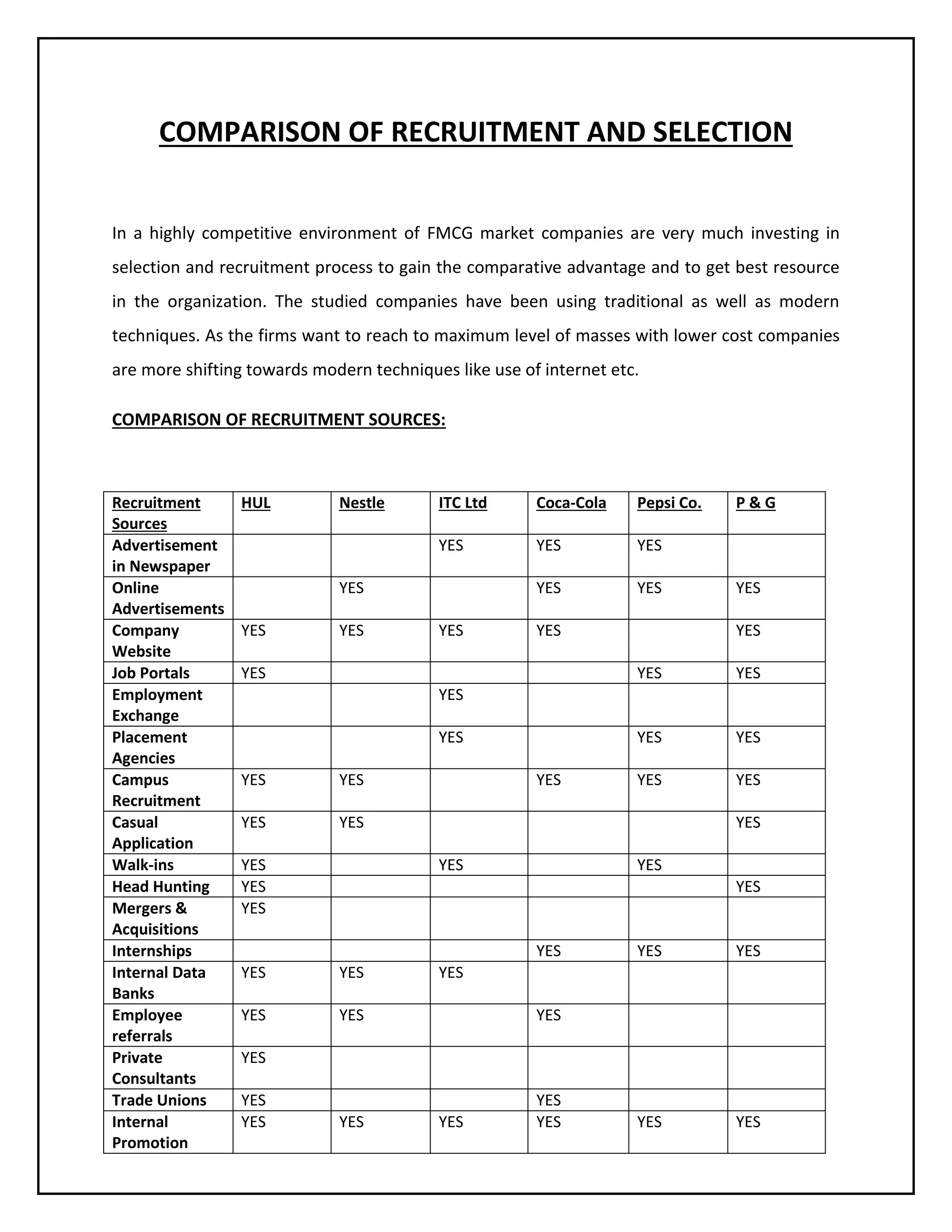
COMPARISON OF RECRUITMENT AND SELECTION
In a highly competitive environment of FMCG market companies are very much investing in
selection and recruitment process to gain the comparative advantage and to get best resource
in the organization. The studied companies have been using traditional as well as modern
techniques. As the firms want to reach to maximum level of masses with lower cost companies
are more shifting towards modern techniques like use of internet etc.
COMPARISON OF RECRUITMENT SOURCES:

Recruitment
Sources
Advertisement
in Newspaper
Online
Advertisements
Company
Website
Job Portals
Employment
Exchange
Placement
Agencies
Campus
Recruitment
Casual
Application
Walk-ins
Head Hunting
Mergers &
Acquisitions
Internships
Internal Data
Banks
Employee
referrals
Private
Consultants
Trade Unions
Internal
Promotion

HUL

Nestle

ITC Ltd

Coca-Cola

Pepsi Co.

YES

YES

YES

YES

YES

YES
YES

YES

YES

YES

YES

P&G

YES
YES

YES

YES

YES

YES

YES

YES

YES
YES
YES

YES

YES

YES

YES
YES
YES

YES

YES
YES

YES
YES

YES
YES

YES

YES

YES

YES

YES

YES

YES

YES

YES
YES

YES

YES

YES
YES
YES

YES
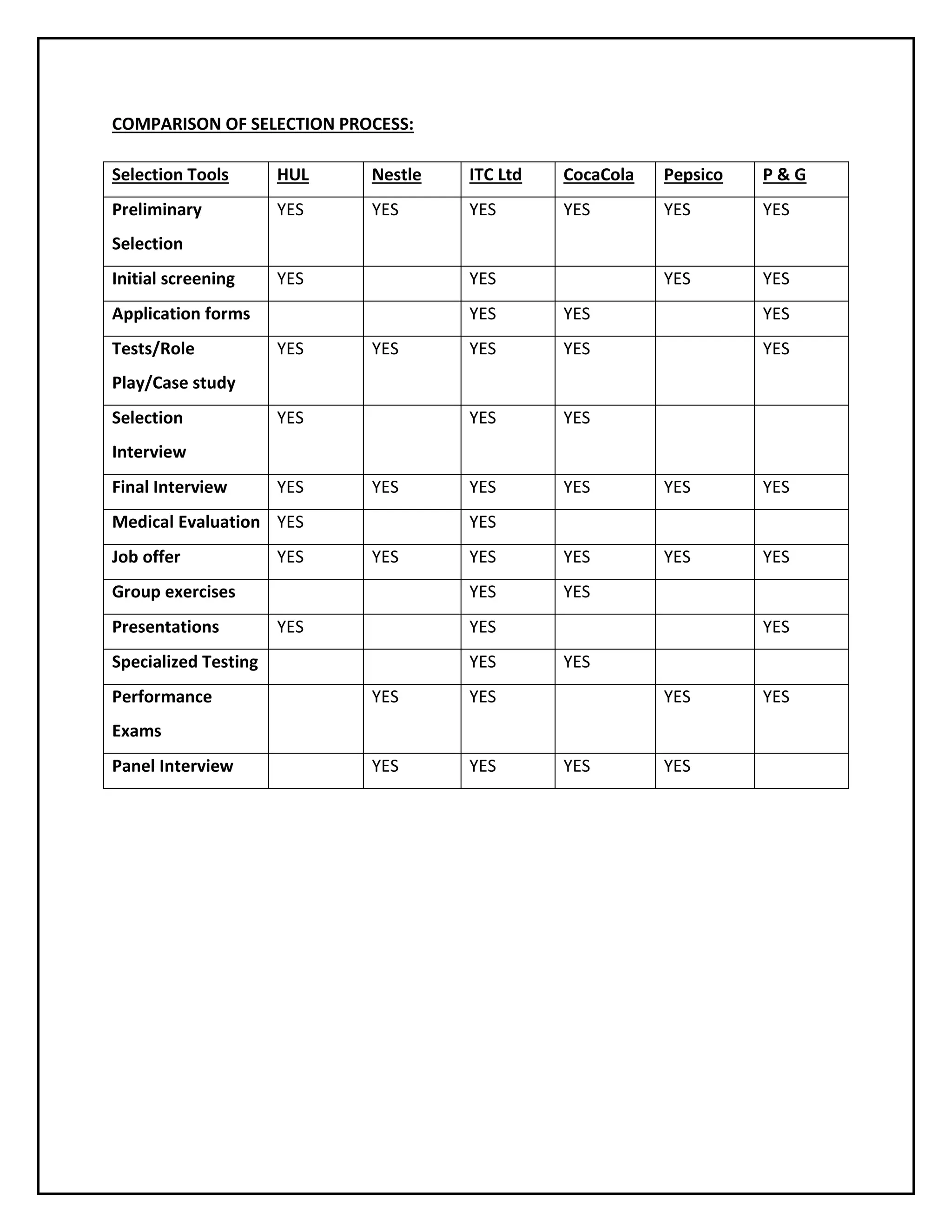
COMPARISON OF SELECTION PROCESS:
Selection Tools

HUL

Nestle

ITC Ltd

CocaCola

Pepsico

P&G

Preliminary

YES

YES

YES

YES

YES

YES

YES

YES

Selection
Initial screening

YES

YES

Application forms
Tests/Role

YES
YES

YES

YES

YES

YES

YES

YES

YES

YES

YES

YES

YES

YES

YES

YES

YES

YES

YES

YES

Play/Case study
Selection

YES

Interview
Final Interview

YES

YES

Medical Evaluation YES
Job offer

YES

YES
YES

Group exercises
Presentations

YES

YES

Specialized Testing
Performance

YES
YES

YES

YES

YES

YES

YES

YES

Exams
Panel Interview

YES

YES

YES
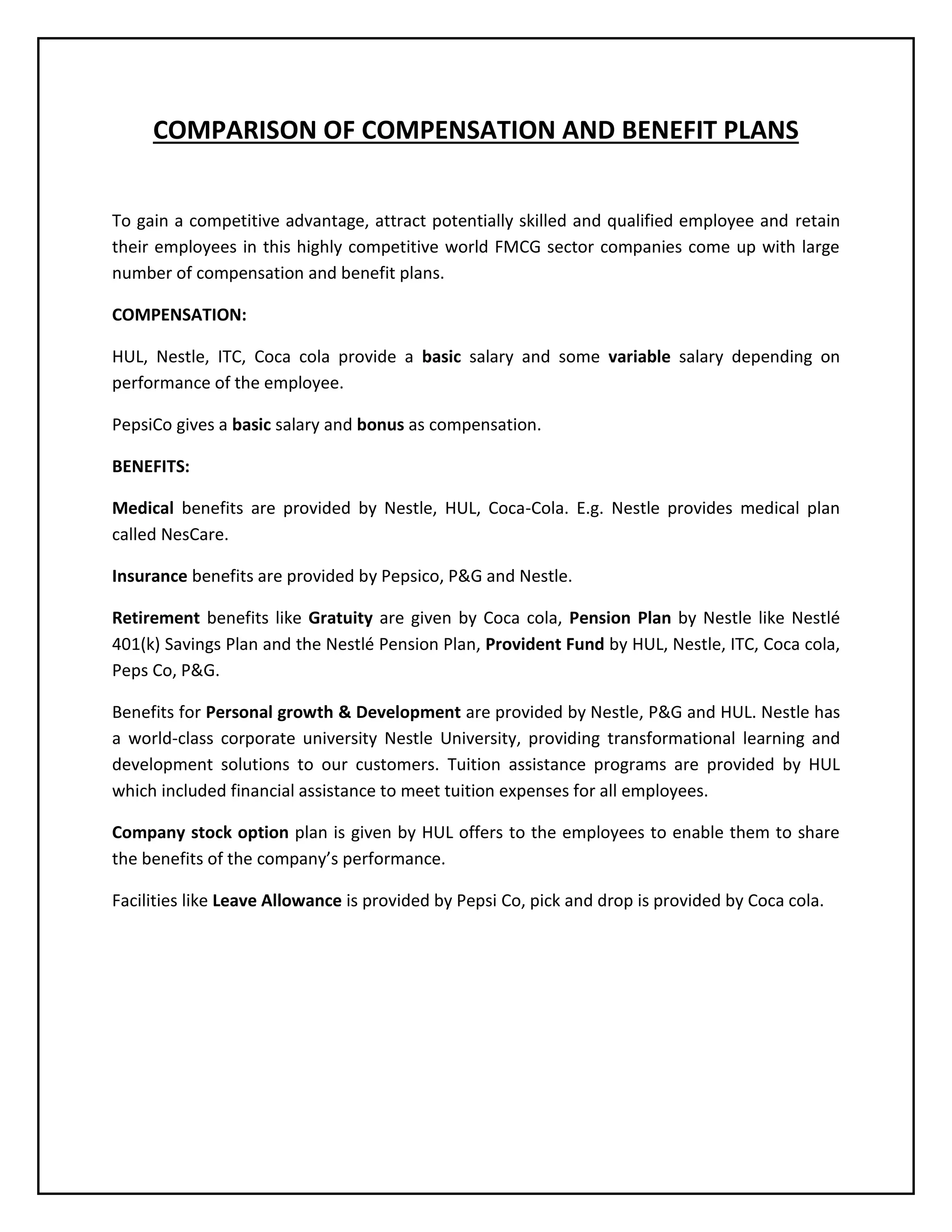
COMPARISON OF COMPENSATION AND BENEFIT PLANS
To gain a competitive advantage, attract potentially skilled and qualified employee and retain
their employees in this highly competitive world FMCG sector companies come up with large
number of compensation and benefit plans.
COMPENSATION:
HUL, Nestle, ITC, Coca cola provide a basic salary and some variable salary depending on
performance of the employee.
PepsiCo gives a basic salary and bonus as compensation.
BENEFITS:
Medical benefits are provided by Nestle, HUL, Coca-Cola. E.g. Nestle provides medical plan
called NesCare.
Insurance benefits are provided by Pepsico, P&G and Nestle.
Retirement benefits like Gratuity are given by Coca cola, Pension Plan by Nestle like Nestlé
401(k) Savings Plan and the Nestlé Pension Plan, Provident Fund by HUL, Nestle, ITC, Coca cola,
Peps Co, P&G.
Benefits for Personal growth & Development are provided by Nestle, P&G and HUL. Nestle has
a world-class corporate university Nestle University, providing transformational learning and
development solutions to our customers. Tuition assistance programs are provided by HUL
which included financial assistance to meet tuition expenses for all employees.
Company stock option plan is given by HUL offers to the employees to enable them to share
the benefits of the company’s performance.
Facilities like Leave Allowance is provided by Pepsi Co, pick and drop is provided by Coca cola.
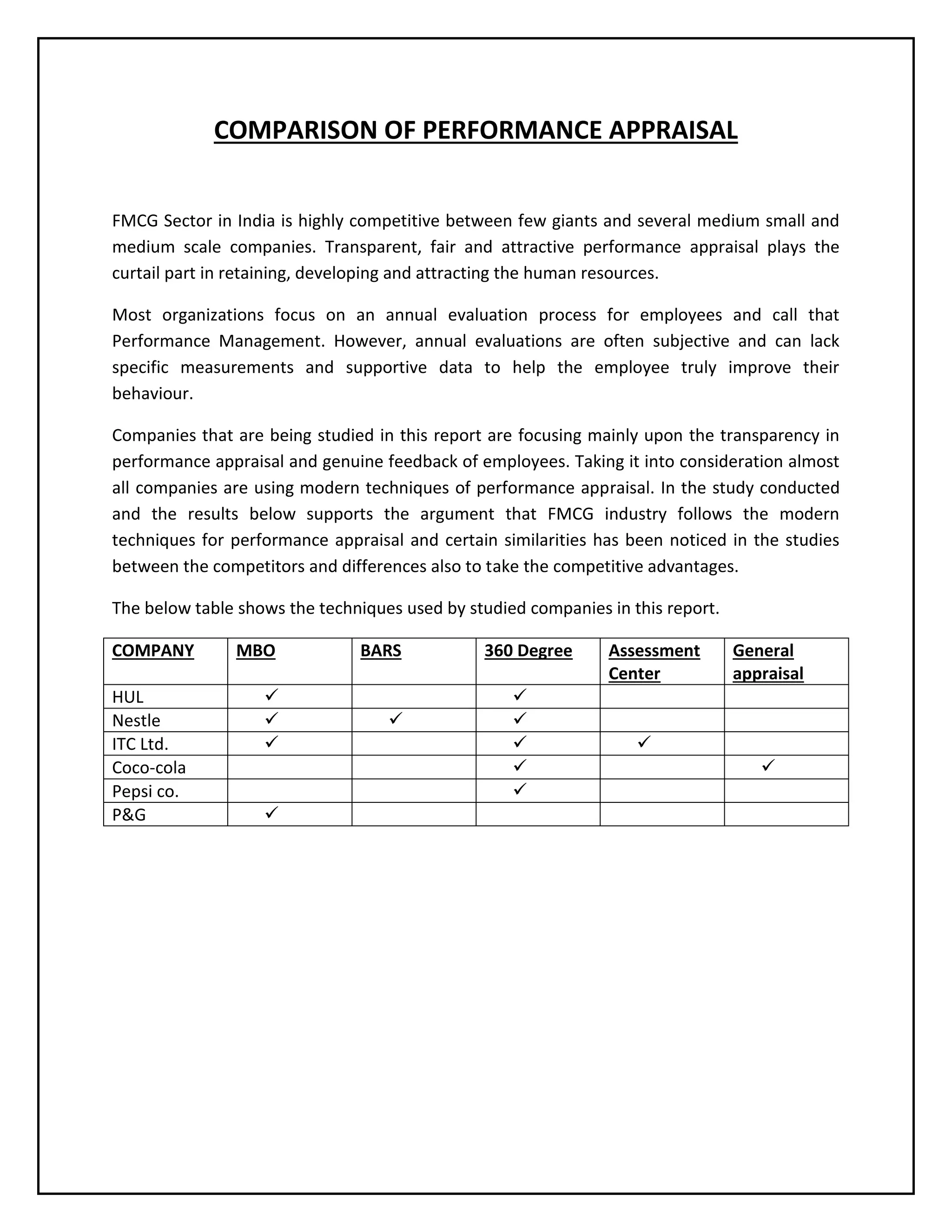
COMPARISON OF PERFORMANCE APPRAISAL
FMCG Sector in India is highly competitive between few giants and several medium small and
medium scale companies. Transparent, fair and attractive performance appraisal plays the
curtail part in retaining, developing and attracting the human resources.
Most organizations focus on an annual evaluation process for employees and call that
Performance Management. However, annual evaluations are often subjective and can lack
specific measurements and supportive data to help the employee truly improve their
behaviour.
Companies that are being studied in this report are focusing mainly upon the transparency in
performance appraisal and genuine feedback of employees. Taking it into consideration almost
all companies are using modern techniques of performance appraisal. In the study conducted
and the results below supports the argument that FMCG industry follows the modern
techniques for performance appraisal and certain similarities has been noticed in the studies
between the competitors and differences also to take the competitive advantages.
The below table shows the techniques used by studied companies in this report.
COMPANY
HUL
Nestle
ITC Ltd.
Coco-cola
Pepsi co.
P&G

MBO






BARS



360 Degree






Assessment
Center

General
appraisal



COMPAIRISON OF TRAINING AND DEVELOPMENT

The needs of individual are objectively identified & necessary interventions are planned for
identified groups, which get rolled out in a phased manner through training calendar.
The training and development program is charted out to cover the number of trainees, existing
staff. The programs also cover the identification of resource personnel for conducting
development program, frequency of training and development programs and budget allocation.
Training and development programs can also be designed depending upon job requirement and
analysis. Selection of trainees is also facilitated by job analysis.
The company has a strong focus on manpower training according to their requirements. The
internal training department aims at improving the skill sets relevant to the work profile of
employees. This includes improving communication, Different skills, E-mail programming,
Operation systems.
The design of the training program can be undertaken only when a clear training objective has
been produced. The training objective clears what goal has to be achieved by the end of
training program i.e. what the trainees are expected to be able to do at the end of their
training. Training objectives assist trainers to design the training program.

HUL, ITC Ltd, Nestle, CocaCola, PepsiCo and P&G being all multinational firms has operations in
many different countries of the world but they all are well interconnected with their all the
offices and ground workforce. For instance if a plant at Cairo does something new or applies a
new strategy which is successful, people are sent from here so as to learn them and apply it
into their operations. So on job training takes place continuously.
They also comprise of technology based training programs. Like they have a mentor program on
their website where employees can interact with each other, discuss issues and find ways to
help each other in times of need (Experiential exercises). Here people in similar departments or
on similar projects interact, share information, guide and find solutions.
Annual functions are held regularly where employees of all levels interact and discuss advance
strategies and do planning for future. Team building exercises are also conducted along with
motivational workshops so that specific issues concerning employees could be addressed and
rectified. Management trainees in this company are also trained through job rotation.
Similar practices are carried on by all the companies.
Conclusion
The entire are Learning Organizations to some extent as it focuses on enhancing its systems
(including people) to continually increase the organization's capacity for performance. They all
have built a strong foundation for consistent sustainable growth, with clear strategies and room
to grow in each strategic focus area, core strengths in the competencies that matter most in the
industry, and a unique organizational structure that leverages strengths.
Their HR department has evolved since the organization’s inception and it now empowers
employees to choose their mentor on their own from any part of the organization worldwide
through their intranet. This helps to even resolve any issue regarding similar problems faced by
employees in different parts of the world.
An organization’s ability to meet the recruitment & selection challenges provides an
opportunity to make significant contribution to the company. With better quality people
executing the company’s operations the HR department can create a competitive advantage for
the company.
In light of the research conducted by our team members we have concluded that these
organizations are extremely formal, organized, dedicated and quality conscious organization. It
has very formalized structure for the recruitment and selection of employees.
All these organization have a unique human resource management system where it focuses on
bringing out the best of its employees through continuous hard work and devotion.

HR practice at FMCG in sector India.

  • 1.
    A PROJECT ONHR PRACTICES OF FMCG SECTOR IN INDIA AT SUBMITED BY: SUBMITED TO: Desai Madhav Ashutosh(45) Dr. Bhavna Jaiswal Vishesh Mehta(13) Faculty Human Resource Varun Banga(47) IBS, Hyderabad. Nitesh Raj(27) Rishav Milind(29) Saurav Rai(60)
  • 2.
    INTRODUCTION OF FMCGSECTOR INDIA The Indian FMCG sector is the fourth largest in the Indian economy and has a market size of $13.1 billion. This industry primarily includes the production, distribution and marketing of consumer packaged goods, that is those categories of products which are consumed at regular intervals. The sector is growing at rapid pace with well-established distribution networks and intense competition between the organized and unorganized segments. It has a strong and competitive MNC presence across the entire value chain. The FMCG’s promising market includes middle class and the rural segments of the Indian population, and give brand makers the opportunity to convert them to branded products. It includes food and beverage, personal care, pharmaceuticals, plastic goods, paper and stationery and household products etc. India, Asia’s third largest economy, saw urban consumers spend less in calendar year 2012 due to high inflation, muted salary hikes, and slowing economic growth that affected both real wages and sentiment. During 2012, the overall slowdown in the economy has begun to affect the FMCG sector with companies posting deceleration in volume growth in the recent quarterly results. Discretionary spending has been hit severely due to the ongoing slowdown. The prevailing high inflation level is also a cause of concern for the sector. The trends seen in 2012 are likely to accelerate in 2013. Growth will come from rural dwellers that are expected to see a rise in disposable incomes due to the direct cash transfer scheme, while urban consumers will continue to be affected by the macroeconomic environment.
  • 3.
    HR CHALLENGES INFMCG SECTOR INDIA Over the past three to four years, the global economy has gone through a tumultuous change and the looming threat of a “double dip” and “triple dip” recession. The environment that organizations are operating in today is one characterized by volatility, uncertainty, complexity and ambiguity. The Indian economy has also not remained insulated from the economic turmoil that the world is going through – many industries have seen slowdown and organizational decision-making is today marked by cautiousness. In this context, the HR profession in the Indian context has several daunting challenges to face in the year 2013. FMCG registered gains of just 33% on the BSE FMCG Index last year. At the macro level, Indian economy is poised to remained buoyant and grow at more than 7%. The economic growth would impact large proportions of the population thus leading to more money in the hands of the consumer. Changes in demographic composition of the population and thus the market would also continue to impact the FMCG industry. Major HR challenges in FMCG sector India are as follow: 1. Managing Knowledge Workers Essentially, here we are looking at different kind of people who does not obey the principles of management for the traditional group. This boils down to higher educational qualifications, taking up responsibilities at a lesser age and experience, high bargaining power due to the knowledge and skills in hand, high demand for the knowledge workers, and techno suaveness. The clear shift is seen in terms of organization career commitment to individualized career management. Managing this set of people is essential for the growth of any industry but especially the IT, BPOs and other knowledge based sectors. 2. Managing Technological Challenges In every arena organizations are getting more and more technologically oriented. Though it is not in the main run after the initial debates, preparing the work force to accept technological changes is a major challenge. We have seen sectors like banking undergoing revolutionary changes enabled by technology. It is a huge challenge to bring in IT and other technology acceptance all levels in organizations. 3. Competence of HR Managers As it is more and more accepted that lot of success of organizations depend on the human capital, this boils to recruiting the best, managing the best and retaining the
  • 4.
    best. Clearly HRmanagers have a role in this process. Often it is discussed about lack of competence of HR managers in understanding the business imperative. There is now a need to develop competent HR professionals who are sound in HR management practices with strong business knowledge. 4. Developing Leadership It is quite interesting to note that there is less importance given to developing leadership at the organizational level. Though leadership is discussed on basis of traits and certain qualities, at an organizational level it is more based on knowledge. The challenge is to develop individuals who have performance potential on basis of past record and knowledge based expertise in to business leaders by imparting them with the necessary "soft skills". 5. Managing Change Business environment in India is volatile. There is boom in terms of opportunities brought forward by globalization. However this is also leading to many interventions in terms of restructuring, turnaround, mergers, downsizing, etc. Research has clearly shown that the success of these interventions is heavily dependent on managing the people issues in the process. HR has a pivotal role to play here.
  • 5.
    COMPARISON OF RECRUITMENTAND SELECTION In a highly competitive environment of FMCG market companies are very much investing in selection and recruitment process to gain the comparative advantage and to get best resource in the organization. The studied companies have been using traditional as well as modern techniques. As the firms want to reach to maximum level of masses with lower cost companies are more shifting towards modern techniques like use of internet etc. COMPARISON OF RECRUITMENT SOURCES: Recruitment Sources Advertisement in Newspaper Online Advertisements Company Website Job Portals Employment Exchange Placement Agencies Campus Recruitment Casual Application Walk-ins Head Hunting Mergers & Acquisitions Internships Internal Data Banks Employee referrals Private Consultants Trade Unions Internal Promotion HUL Nestle ITC Ltd Coca-Cola Pepsi Co. YES YES YES YES YES YES YES YES YES YES YES P&G YES YES YES YES YES YES YES YES YES YES YES YES YES YES YES YES YES YES YES YES YES YES YES YES YES YES YES YES YES YES YES YES YES YES YES YES YES YES YES YES
  • 6.
    COMPARISON OF SELECTIONPROCESS: Selection Tools HUL Nestle ITC Ltd CocaCola Pepsico P&G Preliminary YES YES YES YES YES YES YES YES Selection Initial screening YES YES Application forms Tests/Role YES YES YES YES YES YES YES YES YES YES YES YES YES YES YES YES YES YES YES YES Play/Case study Selection YES Interview Final Interview YES YES Medical Evaluation YES Job offer YES YES YES Group exercises Presentations YES YES Specialized Testing Performance YES YES YES YES YES YES YES YES Exams Panel Interview YES YES YES
  • 7.
    COMPARISON OF COMPENSATIONAND BENEFIT PLANS To gain a competitive advantage, attract potentially skilled and qualified employee and retain their employees in this highly competitive world FMCG sector companies come up with large number of compensation and benefit plans. COMPENSATION: HUL, Nestle, ITC, Coca cola provide a basic salary and some variable salary depending on performance of the employee. PepsiCo gives a basic salary and bonus as compensation. BENEFITS: Medical benefits are provided by Nestle, HUL, Coca-Cola. E.g. Nestle provides medical plan called NesCare. Insurance benefits are provided by Pepsico, P&G and Nestle. Retirement benefits like Gratuity are given by Coca cola, Pension Plan by Nestle like Nestlé 401(k) Savings Plan and the Nestlé Pension Plan, Provident Fund by HUL, Nestle, ITC, Coca cola, Peps Co, P&G. Benefits for Personal growth & Development are provided by Nestle, P&G and HUL. Nestle has a world-class corporate university Nestle University, providing transformational learning and development solutions to our customers. Tuition assistance programs are provided by HUL which included financial assistance to meet tuition expenses for all employees. Company stock option plan is given by HUL offers to the employees to enable them to share the benefits of the company’s performance. Facilities like Leave Allowance is provided by Pepsi Co, pick and drop is provided by Coca cola.
  • 8.
    COMPARISON OF PERFORMANCEAPPRAISAL FMCG Sector in India is highly competitive between few giants and several medium small and medium scale companies. Transparent, fair and attractive performance appraisal plays the curtail part in retaining, developing and attracting the human resources. Most organizations focus on an annual evaluation process for employees and call that Performance Management. However, annual evaluations are often subjective and can lack specific measurements and supportive data to help the employee truly improve their behaviour. Companies that are being studied in this report are focusing mainly upon the transparency in performance appraisal and genuine feedback of employees. Taking it into consideration almost all companies are using modern techniques of performance appraisal. In the study conducted and the results below supports the argument that FMCG industry follows the modern techniques for performance appraisal and certain similarities has been noticed in the studies between the competitors and differences also to take the competitive advantages. The below table shows the techniques used by studied companies in this report. COMPANY HUL Nestle ITC Ltd. Coco-cola Pepsi co. P&G MBO     BARS  360 Degree      Assessment Center General appraisal  
  • 9.
    COMPAIRISON OF TRAININGAND DEVELOPMENT The needs of individual are objectively identified & necessary interventions are planned for identified groups, which get rolled out in a phased manner through training calendar. The training and development program is charted out to cover the number of trainees, existing staff. The programs also cover the identification of resource personnel for conducting development program, frequency of training and development programs and budget allocation. Training and development programs can also be designed depending upon job requirement and analysis. Selection of trainees is also facilitated by job analysis. The company has a strong focus on manpower training according to their requirements. The internal training department aims at improving the skill sets relevant to the work profile of employees. This includes improving communication, Different skills, E-mail programming, Operation systems. The design of the training program can be undertaken only when a clear training objective has been produced. The training objective clears what goal has to be achieved by the end of training program i.e. what the trainees are expected to be able to do at the end of their training. Training objectives assist trainers to design the training program. HUL, ITC Ltd, Nestle, CocaCola, PepsiCo and P&G being all multinational firms has operations in many different countries of the world but they all are well interconnected with their all the offices and ground workforce. For instance if a plant at Cairo does something new or applies a new strategy which is successful, people are sent from here so as to learn them and apply it into their operations. So on job training takes place continuously. They also comprise of technology based training programs. Like they have a mentor program on their website where employees can interact with each other, discuss issues and find ways to help each other in times of need (Experiential exercises). Here people in similar departments or on similar projects interact, share information, guide and find solutions. Annual functions are held regularly where employees of all levels interact and discuss advance strategies and do planning for future. Team building exercises are also conducted along with motivational workshops so that specific issues concerning employees could be addressed and rectified. Management trainees in this company are also trained through job rotation. Similar practices are carried on by all the companies.
  • 10.
    Conclusion The entire areLearning Organizations to some extent as it focuses on enhancing its systems (including people) to continually increase the organization's capacity for performance. They all have built a strong foundation for consistent sustainable growth, with clear strategies and room to grow in each strategic focus area, core strengths in the competencies that matter most in the industry, and a unique organizational structure that leverages strengths. Their HR department has evolved since the organization’s inception and it now empowers employees to choose their mentor on their own from any part of the organization worldwide through their intranet. This helps to even resolve any issue regarding similar problems faced by employees in different parts of the world. An organization’s ability to meet the recruitment & selection challenges provides an opportunity to make significant contribution to the company. With better quality people executing the company’s operations the HR department can create a competitive advantage for the company. In light of the research conducted by our team members we have concluded that these organizations are extremely formal, organized, dedicated and quality conscious organization. It has very formalized structure for the recruitment and selection of employees. All these organization have a unique human resource management system where it focuses on bringing out the best of its employees through continuous hard work and devotion.